Solomon Wept; or
The Calamitous Return of Cap’m Beadle
(a recap by Will Kaiser)
Title: The Aftermath
Airdate: November 7, 1977
Written by Don Balluck
Directed by William F. Claxton
SUMMARY IN A NUTSHELL: Two murderers on the run come to town and hire Mary, who’s revealed to be a Confederate sympathizer, as a servant. When a posse arrives to arrest them, everybody in town helps them escape, even though they kidnapped and nearly killed Mary when they got desperate.
RECAP: Happy New Year, y’all! Our kids are still home from college, and today we get an episode that, while bizarre and infuriating, still has some relevance for our times. Definitely worth sinking our teeth into.
There’s a fair amount of American history to get through, so if you’re bored by that sort of thing I recommend re-reading the recaps for the Johnny Johnson cycle or something instead.

Let’s go!
We open on Pa and Mary approaching the camera in the Chonkywagon. Good ol’ Clax is back as director.

The huh? factor starts from the very first line, as Mary says to Pa, “Miss Beadle doesn’t think we can understand the Civil War – I mean really understand it – by just accepting the North’s version of what happened.”

On the surface, this statement speaks well of our Miss B. It suggests intellectual rigor in pedagogy – not out of character for her.

It also suggests that real learning is about more than just “what they want you to know.”
That’s fine; but at the same time, there’s a whiff of paranoia in “just accepting the North’s version.” Today, our society is bubbling over with suspicion about “indoctrination” in schools, and as we’ve seen the past few years, that isn’t actually helpful at all to the cause of education.


Besides, we know from this show that Miss Beadle devises her own classwork. While nominally overseen by the government, Minnesota public schools still operated independently in the 1870s. In other words, there wouldn’t be some “establishment curriculum” for Beadle to have to challenge (unless it was laid down by Harriet Oleson and her cronies on the school board).

A Civil War deep dive is also pretty fucking ambitious for a one-room schoolhouse full of six-year-olds if you ask me, but we’ll set that aside for now.

Anyways, Pa says he likes the idea of “a balanced look at things” – and since the historical Charles Ingalls was likely a draft-dodger himself, maybe he wouldn’t feel he had a personal stake in the war.

But then he adds, “I’m just not so sure it’s a good idea. The Civil War’s only been over for eleven years.”
Ha ha ha! Oh, how I love when this happens. Here Charles gifts us with a rare thing in the Little House TV Universe: a definitive date for a story!

The U.S. Civil War, as some of you probably learned in school, began in 1861 and lasted into 1865. So, that means now, eleven years later, we must be in 1876.
Unfortunately, the last time we got a dateable reference on this show – the patenting of the telephone in the Season Three spectacular “Gold Country” – we were also in 1876.

“Gold Country” began in late summer and saw the relocation of the Ingalls family to Dakota Territory for several months.

That was eight stories ago. Since then, Mary has traveled to Chicago for a spring cotillion.

Laura’s been kidnapped and Caroline seduced (both in the early fall).


The kids were trapped by mad dogs in the barn whilst Ma and Pa were on vacation (in the summer).


And both Laura and Doc Baker had “showcase” episodes specifically set during the apple harvest (mid-fall), with the suggestion a full year had passed since the curious incident of the dogs in the summertime.


In that order. That means we should be in 1879 at the earliest.
But Charles’s dating of this story to 1876 here incontrovertibly confirms my theory that Walnut Grove sits on a kind of hole in time, which every few years opens and sucks the entire community back to 1876 again, without any of the inhabitants realizing (or aging).
This is the fifth time it has occurred on the series so far. That puts us in the F timeline.
But back to our tale. Charles says Miss Beadle’s project will be controversial in town, because “you got folks settlin’ in around here from both sides.”
It’s true we’ve often commented on the number of Southerners who appear in these stories.
In reality, Minnesota is pretty far north. The closest slave state before the war was Missouri, 300 miles south of Walnut Grove, and even they technically sided with the Union during the war. (More about them in a bit.)

Many freed slaves did immigrate to Minnesota after the war, but I wasn’t able to find anything to suggest a surge of white Southerners did the same.
Well, the downtown Grove is a-bustlin’ with activity, and a stagecoach appears.

The driver (not Mustache Man), who’s accompanied by an armed man (also not Mustache Man), is screaming “Good news! Good news! Yes, sir, they finally did it!”

A bunch of Grovesters, including Nels, Mr. Hanson, Jonathan Garvey, Ben Slick, and Herbert Diamond, rush to see what the fuck’s up.
The driver throws Nels a pile of newspapers and says, “James and Younger Gang tried to hold up the First National Bank up in Northfield! Got themselves done in for their trouble.”
An older Grovester with a growly gravelly voice says, “Whaddya mean, done in?”

The driver, whom older readers will agree resembles Bill Clinton in his McDonald’s days, throws out some names, telling us “Clell Miller” and “Bill Chadwell” were killed in the attempted robbery.


“What happened to the Yames boys?” asks Mr. Hanson (hilariously).
Not-Bill Clinton says that Frank James was wounded, but both he and Jesse escaped.
Okay, so let’s pick this apart here. Some of you may know this story well, but I’m not sure how many. Jesse James was still sort of a household name when I was growing up, but our kids didn’t know anything about him, despite a significant portion of his story having occurred right here in Minnesota.

This version is very condensed, and as always, I’ll note up front that I’m no kind of expert on anything, so corrections are more than welcome.
Jesse and Frank James were brothers who grew up in Missouri in the 1850s. As I mentioned above, while Missouri technically sided with the Union during the Civil War, it also was a state where slavery was legal; in fact, it didn’t outlaw that institution until the tail end of the war.

Also in fact, the people of Missouri were largely supportive of slavery in the 1850s and 1860s, leading to bitter and violent divides. Jesse and Frank James themselves grew up in a slave-owning family in a region known as “Little Dixie,” on account of its Southern heritage and sympathies.

(Raytown, Missouri, the setting of the somewhat underrated Mama’s Family, is also in this same-ish area, which makes sense.)

During the war, both Frank and Jesse became “bushwhackers” – what today some might call resistance combatants and others terrorists – in groups fighting against Union forces.
Frank, the elder brother, was a member of “Quantrill’s Raiders,” a brutal militia, quasi-sanctioned by the Confederate government, that notoriously killed more than 150 civilians in Lawrence, Kansas – a hub of anti-slavery activity.


Frank is thought to have played a role in that attack, and Jesse joined the Raiders later. Both brothers participated in further massacres in which unarmed or surrendering Union troops were completely exterminated.


By the end of the war, Frank and Jesse were serving in two different militias. The South lost, but Jesse’s bushwhacker group stayed together, active, and violent. Some of its attacks were political – freeing imprisoned Confederate soldiers, for instance – but they also included a growing number of bank robberies.

By the late 1860s, Jesse James was one of the country’s most famous outlaws, a reputation he furthered (just like Bonnie Parker and Clyde Barrow did in the Twentieth Century) by sending self-promoting letters to newspapers.

Over time, the bushwhacker group came to include Jesse, Frank and several brothers named Younger as well as Clell Miller and Bill Chadwell. Known as the “James-Younger Gang,” they continued to rob banks and trains, developing a flamboyant, performative style as they became more famous.

They killed fewer people, too, though they did have an ongoing war with the Pinkertons (whom Andrew Garvey name-dropped in “The Creeper of Walnut Grove”) which had casualties on both sides.

That brings us to Northfield. Northfield, Minnesota, is a lovely town a little south of the Twin Cities (about 130 miles east of Walnut Grove). The population today is about 21,000 people.


It’s home to St. Olaf College – one of a couple locations claiming to have inspired Rose Nylund’s hometown St. Olaf on The Golden Girls.


On September 7, 1876, the James-Younger Gang tried to rob the First National Bank in Northfield. It seems strange they would come all the way up here, but apparently there were perceived Union connections among the bank’s shareholders, and of course they also hoped it would throw pursuers off their scent.


Anyways, the story goes that the clever Minnesotans outwitted the outlaws, eventually capturing or killing all of them but the Jameses, who escaped westward. (Two people inside the bank were also killed.)

Those townsfolk must have been considerably smarter and braver than the Walnut Grovesters are in this story; but I’m getting ahead of things.
To this day, Northfield has a “Defeat of Jesse James Days” festival in September, complete with reenactments of the raid. Amelia and I went to it about twenty years ago. (She was a toddler and the other kids weren’t born yet.)
It was great fun, though all the gunfire in the streets was quite alarming to a scaredy-cat like me.

Whew! I think that brings us up to speed for context. If you didn’t know anything about Jesse James, don’t feel bad. As I said, our kids didn’t either, and I barely did.
WILL: I’m quite surprised you never heard of him. They didn’t mention him in school? Even with the Northfield connection?
OLIVE: They didn’t teach us anything in school.
ROMAN: Mom, do you know who he is?
DAGNY: Jesse James? Sure.
ROMAN: But how? You’re not even American.
DAGNY: Because of Cher. [as CHER, singing:] “JUST LIKE JESSE JAMES!”
(You’ll note the video follows the story fairly loosely.)
Anyways, the growly gravelly Grovester, who’s accompanied by a teenage boy who looks like Baby from Dirty Dancing, snarls, “Murderin’ thievin’ scum!” and says he hopes to attend the executions of any survivors.


Nels squeaks that the newspapers are a penny each, since people are just grabbing them and walking away. Ha!

Charles walks to the Post Office window, where Mrs. Foster is on duty. Before starting this project, I always thought of Mrs. Foster as “the Post Office lady,” but this is actually the first time we’ve seen her serve in that capacity.

Until this season, the Post Office was the exclusive domain of Grace Snider.

Since her departure for sunny California, duties have been shared, somewhat improbably, by Mrs. Whipple and Kezia.


Charles says he wants to send a letter to Denver. (Who the hell could he know there?)
While he and Mrs. F are chatting, we notice a youngish dark-haired man, one of the stage passengers, sitting on a bench on the porch.
He’s even sweatier than people usually are on this show.

Suddenly he collapses, a la Stanley Kovack.


Another youngish man with lighter hair, who’s been unloading the luggage, turns in alarm.

The dark-haired man apologizes to Charles and says he’s suffering the effects of “swamp fever.”
“Swamp fever” is apparently a (fairly rare) nickname for leptospirosis, a flu-like illness people can get from coming into contact with animal urine, often through swimming. For most people, it doesn’t cause long-term damage to the body.

The lighter-haired man comes over and says his friend’s swamp fever isn’t anything serious, he just needs a little rest. He introduces himself as “B.K. Dankworth” and the dark-haired man as his business partner “Andrew Hobbs.”
Dankworth says they’re land speculators who’ve come into town from Redwood Falls – the county seat, as I’m sure you recall.

He says they’re hoping to rest awhile in the Grove, but Mr. Hanson, who’s been gawking at them, says, “The hotel is full up!”
WILL: It is? Why?
ROMAN: The first-ever Little House reunion must have been that weekend.

I suppose if Doc sold the Old Jenkins Place and moved back to the Post Office, and if Miss Beadle is still living there too, there would at most be one room available at any time anyways. (Some “hotel.”)
Happily, Hanson says he’s the agent for a house he’ll rent them for $4 ($120 today) per week.
Jonathan Garvey, who’s also hanging around eavesdropping, tells Hobbs he looks like shit and should really see Doc Baker when Doc gets back from “the Dayton place.”
Dayton is a famous name in Minnesota. George Draper Dayton founded a chain of department stores that would later spin off Target Corporation.


The family continues as prominent philanthropists today, and Dayton’s great-grandson Mark became our state’s Governor and U.S. Senator.

G.D. Dayton didn’t come to Minnesota till 1883, though, so this “Dayton place” can’t be his.

Hobbs thanks Garvey politely but says he doesn’t need to see a doctor.
WILL: Kids, this actor is the father of somebody famous who you’re familiar with. Can you guess who?
AMELIA: Josh Brolin.
WILL: No, he isn’t James Brolin.
AMELIA : He looks like him, though.
I’ll let you guess as well, reader.


Dankworth chimes in and says Hobbs gets swamp fever all the time and there’s nothing you can do for it but rest. (Actually, recurrences of leptospirosis can indicate Weil’s disease, a serious condition requiring treatment.)

Charles and Mary give the men a ride to the house, which, surprise surprise, turns out to be another of those identical Victorian houses.
WILL: Oh, I get it. . . . That’s the house that Doc bought last week! That’s why Hanson is offering it. . . . It’s their love shack!
OLIVE: Eww.
ROMAN: Olive, there’s nothing wrong with two men loving each other.


(It also explains why Hanson would describe himself as just “the agent” yet be able to make an agreement on the spot without consulting the owner.)
The house, strangely, is fully furnished and decorated. Also strangely, they just dump the ailing Hobbs onto a settee rather than installing him in a proper bedroom.

Charles says “the Mercantile’s within walking distance, I’ll show you where it is.”
WILL: “I’ll show you where it is”? They just came from there five seconds ago.

Dankworth says Hobbs is likely to have convulsions, so they’ll need a servant to run errands and things so he can tend to his friend.
He says actually, Mary would fit the bill perfectly.
WILL: What? Surely that would have been an improper suggestion at the time.
DAGNY: A teenage girl alone with two twentysomething guys? It certainly would be.

Dankworth offers a salary of 25 cents ($8) a day. Mary goes gaga.

And without so much as hesitating, Pa says sure.
DAGNY: Come on, Chuck.
Not only that, he says they only have to pay her 10 cents ($3) a day.
DAGNY: Oh my God!


Mary’s still thrilled, though.
DAGNY: Her hormones are in total overdrive.

Cut to the Mercantile, where Charles assembles a care package for the newcomers whilst Mary salivates over the yard goods she’ll soon be able to buy.
WILL: Melissa Sue is really overdoing it here.

Outside, Doc appears and questions Charles about Hobbs’s symptoms, which seem fishy to him.
WILL [as CHARLES]: “Well, you just killed Stanley Kovack last week, so what do you know.”

Back at the house, “Dankworth” is tending to a gunshot wound in “Hobbs’s” leg – because of course these two are really Jesse and Frank James.

Correct me if I’m wrong, but I believe they are the first historical figures (besides the Little House characters themselves) to actually appear in one of our stories.
ALEXANDER: Is this from the books? Did Jesse James really hide in Walnut Grove after the Northfield robbery?
WILL: No, he did not. It was roughly on their way, though. They did stop at Mankato.


“Dankworth” and “Hobbs” are invented names, but it is true the James brothers used several aliases over time.
The brothers discuss the sad destruction of their gang.
Jesse says their best bet will be to continue west to “the Dakotas,” though that term is an anachronism. In 1876 Dakota was a single territory, not to be divided into “North Dakota” and “South Dakota” until 1889.

Jesse wistfully says they’ll finally be able to give up their life of crime and become honest farmers, and Frank says that sounds great.
WILL: The person whose dad this is was in the news recently.
OLIVE: Hmm. Armie Hammer?
ROMAN: Yeah. He’s Navy Hammer.


That night at the Little House, British Caroline says, “You know, I’m still not sure about this job of Mary’s.”
Once again, Karen Grassle sounds like she has a heavy cold, a hangover, or both.

Ma, really the only person with any sense in this one, says it’s disturbing Pa would hire their teen daughter out to two men of unknown background and intentions.
Stupid Charles says, well, they seemed nice.
Also sensibly, Ma asks if they know anything about the one guy’s mysterious illness.
Stupid Charles tells her swamp fever isn’t contagious. (It actually is, but only through bodily fluids, STD-style.)
Sensible Ma asks how he knows it’s swamp fever.

Stupid Charles has no good answer.
Sensible Ma says the job’s off, and Mary freaks out.
Meanwhile, Laura, who you’ll recall was mysteriously absent from last week’s story, stuffs her face throughout this scene but says nothing. (???)

Pa proposes a compromise where if Mr. Hobbs passes a physical exam by Doc Baker, Mary can take the job.
The next day, Charles and Doc arrive at the Old Jenkins Place. Doc knocks on the door, but nobody answers.
WILL: They should shoot him through the door.

Eventually Jesse James comes to the door, but he puts Doc off, claiming his partner Hobbs suffers from doctor-phobia, or iatrophobia if you must be technical about it.
AMELIA: He’s handsome. Very blue eyes.

Jesse James is played by Dennis Rucker, whose shortish resume includes An Officer and a Gentleman and a Jean-Claude Van Damme movie called Lionheart.

“Why,” Jesse says, “the only way he’d let a medical man within two feet of him is for me to bound him hands and feet and then set on him.”
WILL [as DOC, suggestively]: “Well . . . that sounds just dandy to me! . . .”
DAGNY [as DOC, suggestively]: “You should see what MY hubby and I get up to! . . .”


Doc actually shrugs and moves off. As he and Charles drive off, he says go ahead and let Mary take the job, since if Hobbs was contagious Dankworth would be sick too.
WILL: Oh my God, that’s really irresponsible, isn’t it?
DAGNY: It makes no sense. He really is a horrible doctor.

Inside the house, Jesse and Frank put their guns away in relief.
WILL: The person just died in the past year.
ROMAN: Oh, is he Andre Braugher’s dad?


Then we cut to the school, where class is in session. Everyone is screaming, whilst Carrie stares dumbly into her McGuffey.
ROMAN: Poor Carrie will never learn to read in this environment.

Today’s class consists of Mary, Laura, Nellie, Willie, the Kid With Very Red Hair, the Midsommar Kid, the Mona Lisa Helen, Not-Linda Hunt, the Non-Binary Kid, an AEK, Not-Baby from Dirty Dancing, and some nobodies.
Apparently we’re joining them mid-argument about what caused the Civil War.

Mary stands up theatrically, shakes her head, and says in naive bafflement how difficult it is to remain morally neutral about the topic.
WILL: God, her acting’s really bad today. That’s very unusual.
DAGNY: Also, why is she so heavily made up in this one?
AMELIA: I prefer the Laura stories.

Miss Beadle says they can only learn from the conflict if they give both sides equal moral weight and validity. (Paraphrase.)
OLIVE: Carrie should raise her hand and say, “What about the slaves?”

Yes, I realize we’re living in a society where about half the population have decided to pretend both sides of such questions do have equal moral weight. Those people should be ashamed of themselves.


Not-Baby from Dirty Dancing, identified as “Bob” by the Bead, stands up and screams, “I say the North won because it was right! I don’t see how anybody can say anything else!”
He does not say what exactly the North was right about, because today’s script wants us to view him as some crazy extremist.

I suppose now’s as good a time as any to point out we have a new writer this week – one Don Balluck, who will contribute a whole lotta stories to this show before he’s through. Some even stranger than this one.


Balluck also wrote for Peyton Place, Daniel Boone, Police Woman, Hawaii Five-O, Father Murphy, Fantasy Island, and the mysterious and beautiful Beauty and the Beast TV series, which I loved because monsters.

Balluck wasn’t a Southerner, incidentally.
Well, Bob goes on to say the South was on the side of evil, essentially, and Mary rounds on him and screams, “Well, maybe they felt the same way about the North!”
OLIVE: What? Mary’s on the side of the Confederates?

Bob smugly tells how when he was a babe in Missouri, his family was attacked by Quantrill’s Raiders, who killed his six-year-old brother.
The actor, another escapee from your local supermarket’s ham department, is Tony Markes.

Markes doesn’t have much of an acting resume, but he did go on to direct, produce and/or write some very trashy films, including Bikini Island, Last Dance, and The Invisible Maniac (aka The Invisible Sex Maniac).

WILL: You know, maybe his hair is more like Dionne Warwick’s.

Anyways, I mentioned Quantrill’s Raiders above – both Frank and Jesse James belonged to it at various times. But since Bob said they were living in Missouri, he can’t be talking about the famous Lawrence massacre, which happened in Kansas.
Mary softens – well, slightly.
And the Bead says the whole project was a stupid idea in the first place so let’s shitcan it.
Actually, she calls for a vote whether to do so.
WILL: They vote on some weird fucking stuff in this town.
ALEXANDER: Yeah. Are they gonna vote to decide who won the war?


OLIVE: I just can’t believe they didn’t even mention slavery.
WILL: Just like Nikki Haley.
ROMAN: It was up on the board.
It was, along with the names of Abraham Lincoln, Robert E. Lee, Ulysses S. Grant, and the terms states’ rights and federalism.
Later, at the Mill, Charles and Garvey are sweating whilst Laura and Carrie fool around in the background.

Mary appears and Pa tells her she can take the job after all.
We immediately cut to Mary in service at the Jenkins Place.
Jesse James gives her an order to have some clothes made, “since we left most of our belongings in Springfield.” (You’ll recall he at first said they came from Redwood Falls; Springfield is not on the way to Walnut Grove from there. And what reason could land speculators have for leaving their clothes behind?)

WILL: I’m not sure it’s super-believable, but it is nice neither of them show a sexual interest in her.
(For what it’s worth, both the James brothers were married by this point, so maybe it actually is believable. If not super-believable.)
Jesse adds a few items to Mary’s shopping list, and Frank asks if the Mercantile sells books.
WILL [as MARY]: “Well, there’s the Farnsdale Fremont Master Sleuth of Scotland Yard series.”


The conversation winds round to the war, and Frank tells Mary he and his brother both fought in it.
OLIVE: Is he the Queen’s dad?


Mary asks which side they were on, and when they say the South, she screams, “Oh, that’s wonderful!”
ROMAN: Good God!

Mary asks if she can interview them for her project, then starts talking about how “a boy in our class, Bob Ford” (more about him later) told how Quantrill’s Raiders killed his little brother. (Quite a coincidence the first thing she brings up is their own militia.)

Frank James says, “Yes, Mary, that might well have happened.” He takes no personal responsibility, just argues that war is hell.

The brothers say the North committed atrocities just as bad as Quantrill’s Raiders’, and that the South considered the Raiders heroes. (No doubt some people did, but it’s worth noting after the Lawrence massacre, the Confederate government denounced the Raiders and withdrew its support from such “irregular” militias.)

As an example, Frank James mentions something he calls “Rule Eleven,” and, despite Jesse’s misgivings, begins to tell Mary all about it.
We cut to Ol’ Four Eyes – excuse me, I mean Mary – giving an oral report on the subject in class. (The motion to shitcan must have failed, I guess.)

The gist is this: After the civilian massacre in Lawrence I mentioned, Unionists in Kansas were hungry for revenge, and the federal government laid down General Order No. 11, which essentially evicted the entire populations of several Missouri counties from their homes. After that, vigilantes from Kansas more or less burned every town to the ground, and there were a number of murders.

The action backfired in a couple ways. Not only did it build sympathy for the Confederates, it delivered free resources to Quantrill’s Raiders themselves, who swept in and looted many of the abandoned properties.
I’m not sure this example is a perfect parallel to the Lawrence massacre, but it certainly was horrific and had lasting ramifications in Missouri.

Bob Ford disputes Mary’s report, but Miss Beadle says it’s true, and Mary screams it proves everyone in a war is equally bad!
OLIVE: So MARY INGALLS is a propagandist for the Confederacy? We’re supposed to believe this?
WILL: Yeah, especially after she had a former slave living with them at the Little House. But she didn’t actually take much of an interest in him, remember.

All the kids start screaming again.
DAGNY: Miss Beadle should fire a gun in the air for order.
Well, actually all the kids scream except Laura, who still hasn’t spoken a word this episode.
OLIVE: Seriously, what is going on with her this week?

After school, Bob Ford’s father, the growly gravelly Grovester, waits to talk to Miss Beadle.

Mr. Ford is played by Frank Marth, who was in many, many things, including You Are There, The Honeymooners, The Phil Silvers Show, Perry Mason, The Fugitive, The Invaders, Hogan’s Heroes, Mission: Impossible, Gunsmoke, Starsky & Hutch, Father M, Quincy, and The Young and The Restless.

He had a small role in Breakfast at Tiffany’s; and he was in two personal favorites of mine: Voyagers!, and (best of all) Manimal.
Manimal, the story of a doctor who turns into animals and solves mysteries, was the first show I cared about that I can remember being canceled. I was eight.

Quite sinisterly, Mr. Ford says he and other parents have their eye on Miss Beadle for teaching Confederate sympathies to their children.
He threatens to force her out of her job, and essentially tells her to leave town.
WILL: This is like the opposite of today, when it’s the conservatives threatening teachers and poll workers and trying to ban learning and books.
ROMAN: Was it different in the Twentieth Century?
WILL: Oh, no, it was the same, at least in America.


With nerves of steel, the Bead shouts back that her father was a Union officer who died in a Confederate prison, so she’s hardly a rebel sympathizer, thank you very much.

(We don’t know much about the historical Miss Beadle’s people. The real Eva Bedal, you’ll recall, was only a child at the time of these stories. Her mother, Clementia Bedal, is actually thought to be the real-life model for our own “Miss Beadle.”)

(Clementia Bedal’s father was a man named John Davenport Fuller. He would have been in his forties and a widower by the time of the war. Not much else is known about him, but since he died in north-central Minnesota in 1890, I think it’s fair to say the idea of him as a POW in Tennessee or wherever is an invention.)
(Unless perhaps he escaped from prison, unbeknownst to his family, and will be reunited with the Bead in a future story! Let’s keep an eye out for him, shall we?)

Well, then Miss Beadle actually scolds Mr. Ford for telling young Bobby about his brother’s death – his own family history – saying he shouldn’t stir up unpleasantness but instead should hide the ugly past from his child.
DAGNY: So does everybody in this one behave the opposite of what makes sense?

Well, I assure you, I am actually trying to make sense of this script’s scenario in the context of the Vietnam War, which had ended in 1977, since on the face of things all this war talk is at odds with the show’s very liberal agenda. (I know some deny it has one, but come on.)
The only thing I can think of is that Balluck is using the Confederate militia alums to stand in for Vietnam War protesters, who were despised as traitors by the American mainstream during and after the war. I expect there were similar vicious arguments still bubbling in U.S. college classrooms at the time this aired. (I don’t have to tell you, equally or more terrible debates are happening around the Israel-Gaza War today too.)


Whether it’s deliberate on the part of Landon Balluck & Associates or just my imagination, I’d say it’s an imperfect analogy. I encourage you to share your own interpretation, since I’m pretty stumped about this one.
One other thing: I’m curious, actually, where all the Civil War vets in Walnut Grove are. Any man over the age of thirty in these episodes (practically everybody, in other words) would have had a good chance of serving.

But apart from Doc, who suggested in “Soldier’s Return” that he served as a medic, there doesn’t seem to be anybody to offer a first-hand viewpoint.

Anyways, the Bead’s story shuts Ford up.
Commercial. Not even halfway through, but hang in there!
When we come back, we see a group of six riders going past the Old Jenkins Place, all armed and accompanied by strange swinging space-Western music from David Rose.

From the house, Jesse James watches them pass.

Back to town, Carl the Flunky and his granddaughters-of-the-week Not-Linda Hunt and Not-Ellen Taylor are crossing the bridge on foot.

Carl’s got his tie on, so we can deduce it’s Sunday.
The Chonkywagon appears. Mary goes on and on about how great it is working for Dankworth and Hobbs, and Ma calls her on it.
Mary screams back that she “earned eighty cents in only three days!”
ALEXANDER: What a hustler! Eighty cents!
(In those days, that was worth about $25.)

Ma points out sourly that Mary needs to donate 10 percent of her income to the church. (A concept called tithing that dates back to ancient times.)

In the back of the wagon, Laura and Carrie are playing pattycake.
AMELIA: Did Melissa Gilbert get hit on the head or something?

The crowd arriving at church is quite large, and Ma and Pa stop to chit-chat with Doc.
Even though it’s September, Doc warns that “it’s gotta be hotter than you-know-what in that church,” and stick-up-her-ass Ma tuts him for blasphemy.

The armed riders suddenly sweep into town, and our principals stand on the steps watching them.

So do a couple of young men who kind of look like the real Frank and Jesse James!


The men approach, and the leader, who’s well dressed though stubbly, and who speaks in an eastern urban accent, greets the Grovesters.
He seems fairly nice, saying he represents a group of bounty hunters looking for the James boys.
WILL: This bounty hunter is my kind of scum. He’s the real hero of this story.
AMELIA: Yeah, like Larry Vaughn in Jaws.


The Grovesters look at him warily.
Something very strange happens then. The man continues talking, but the sound department dubs a completely different, much more enthusiastic actor’s voice over him.
“Folks don’t look too kindly on bounty hunters, but we save all you taxpayers a lot of money!” the voice says. The effect is strange, like a ventriloquist’s act.

“Trials cost money!” Wrong Voice explains. “If we find ’em before the law does, there’s no trial! An eye for an eye, if you get my meaning!”
(“An eye for an eye” is from the Bible too.)
Then he continues in his normal unenthusiastic voice, handing over a wanted poster with the brothers’ likenesses.

When they’ve gone, Charles tells Doc and Jonathan Garvey Dankworth and Hobbs are the Jameses.
Garvey asks why Charles didn’t turn them in, and Charles, showing no alarm whatsoever that Mary has spent so much time with brutal murderers, says to do so would sign their death warrant and thus be “as bad as anything the James boys themselves ever did.”
“I agree!” says Doc.
DAGNY: This is a crazy story. It’s like they’ve all lost their minds.

Charles proposes all the men of the town meet to discuss the situation the following day at lunchtime.
ROMAN: Why don’t they just meet after church? Everyone in town is together right now!

He also suggests they should keep the Jameses’ identities secret from the women. (Why? This is very out of character for Charles, who in the past has even allowed Caroline to speak for his family’s position in public meetings.)

Then we get a brief scene at the Old Jenkins Place, but it has literally no content.
ROMAN: How recently did he die?
WILL: Fairly recently.
ROMAN: Is it the other Smother Brother?


Later, at the Little House, Pa has broken the news to Mary that she can’t work for them boys anymore, of course without explaining to her why.
DAGNY: This is ridiculous. We’ve never seen them hide things from the women before. Pa tells his women everything.
Mary complains and complains. It’s rare we get a truly bad performance from the principals, but man oh man is MSA terrible in this one.

Upstairs, Laura silently holds her face in her hands like a monkey.
DAGNY: What the hell is going on, Little House.

The next day the townsmen are making plans. Whereas yesterday it seemed like every male Grovester was at church, today we just have the elite corps, which consists of Reverend Alden, Charles, Jonathan Garvey, Hanson, Doc, Nels, Carl the Flunky, Ben Slick and (strangely) Herbert Diamond.

Alden tells us they’ve agreed to send a messenger to Mankato to bring back a marshal. (Why don’t they send a telegram? Plus, previously we’ve been told Springfield is the closest police presence, and that’s a third of the distance from Walnut Grove as Mankato.)

The bounty hunters return, accompanied by Not-Bill Clinton the stage driver, who says the Grovesters are lying about not having seen the James brothers.

Not-Clinton (“Ned Watkins,” according to the credits) is played by Troy Melton. He was in a zillion things, including many Western TV shows and films as well as Batman, The Invaders, The Mod Squad, Pee-Wee’s Big Adventure, and Star Trek.

We’ve actually met him twice before on this show.
He played Tower, Minnesota, railroad worker Homer Greenwood (aka “the Shit-Water Guy”) in “The Runaway Caboose.”

And he was apparently one of the Sleepy Eye Green Stockings in “In the Big Inning.” (I’d wager that was the same character as this one.)
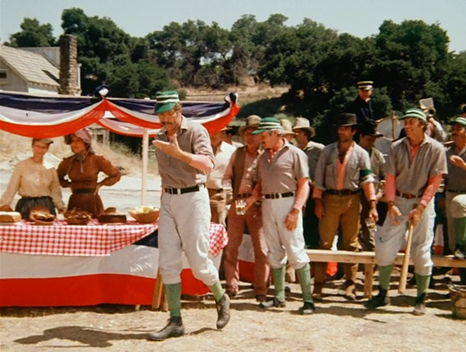
The head bounty hunter says they better start talking or he’ll tear the town apart house by house.
Despite this being what TV’s Vera would describe as “a murder inquiry, pet,” the Grovesters won’t talk.

Rev. Alden steps forward from the crowd.
DAGNY: Is Aldi gonna offer his body as a distraction?

Alden tells the bounty hunter they will have a town meeting to decide what to do.
The bounty hunter says they’ll have one hour for a meeting, during which Walnut Grove will be sealed off.
You’d think Aldi was just stalling for time, since they were literally in the middle of a town meeting when the bounty hunters approached. But no, apparently he is serious that another meeting is an essential part of the process.

Then Charles suggests this subgroup have another auxiliary meeting before the next big meeting.
WILL: Good grief.

Back at the Old Jenkins Place, Jesse James is staring out the door with increasing paranoia. Dennis Rucker is really very good in the part.

Frank comes forward and Jesse tells him he won’t be taken alive should the posse come for them.
DAGNY: This one is really weird. It feels like a stage play. It doesn’t feel like Little House at all.

Meanwhile, in school, we see the already identified kids, plus Hangover Helen, the Sharp-Faced Paranoid-Looking Boy, Not-Carl Sanderson, Sweet Colleen (I think), and a new Gelfling boy.


WILL: Where is Andrew Garvey?
AMELIA: He snuck out at the first sign of trouble.

Jonathan Garvey appears in the door and asks to speak to Miss Beadle privately.
Bob Ford and Mary stare daggers at each other.


The Bead comes back in and says school has been canceled for the day.
The kids cheer, and then, when she says next time they’ll start a new project on Shakespeare, they all scream “AAAAWW!”


Actually, Shakespeare wasn’t really studied in American schools until the Twentieth Century, except as something to memorize and recite. The plays were known, but were very much considered pop culture at the time.

As the kids are leaving, the Bead takes Mary aside and says she’s the only kid who really got the Civil War project.
WILL [as MISS BEADLE]: “You realized the war wasn’t just about slavery. In fact, it wasn’t about it at all!”

Outside, Laura and Carrie are playing pattycake again.
WILL/DAGNY/AMELIA/OLIVE/ROMAN: [groaning]

Laura finally speaks when Mary comes back! (But not much.)

Mary suddenly realizes she never even thanked Mr. Dankworth and Mr. Hobbs for their help on her school report!
AMELIA: Oh my GOD. . . .

(Actually, she calls Frank “Mr. Dobbs” instead of Mr. Hobbs.)

Laura tries to talk her out of it.
AMELIA: Laura’s only had two lines and she’s still crushing it.

As Mary departs, a creepy bounty hunter on the bridge checks her out.

Mary’s also headed the wrong direction if she wants to get to the Old Jenkins Place.

On the hill overlooking town, the head bounty hunter tells Not-Bill Clinton he’ll give the Grovesters twenty minutes then demand some information.
Addressing the leader as “Mr. Broder,” Not-Bill Clinton says he can’t believe the honest people of the Grove haven’t turned the perps in. (No shit!)

I’m not sure why Not-Bill Clinton is still hanging around, though I suppose maybe anybody could join a posse in those days.
Broder says the Grovesters better hand over the Jameses, or they’ll get them the hard way.
Broder is played by Michael Conrad, who for many years was a regular on Hill Street Blues. I didn’t watch that; but this supercut of his character is terrific:
He was also in Requiem for a Heavyweight, Car 54, The Twilight Zone, The Dick Van Dyke Show, I Spy, Gunsmoke, The Virginian, All in the Family, The Bob Newhart Show, and Scream Blacula Scream.

Then we see Laura and Carrie coming back into town via the shortcut. They’ve turned back because Laura forgot her “speller” at school.
She tells Pa Mary went out to the Old Jenkins Place.
When Mary arrives at the house, Frank James doesn’t want to answer the door, but Jesse, realizing the jig is up, thinks they should take her as a hostage.
OLIVE: Oh my God . . . is he Gordon Lightfoot’s dad???


Then we get a commercial break, and by the time we return, the James brothers have spilled the beans to Mary.
AMELIA: We don’t even get to see them telling her? What a cheat.

Neither Mary nor Frank likes the new dynamics of their relationship very much.

Actually, Jesse doesn’t seem to like it much either. He tries to reassure Mary there’ll be no violence, then locks her in a closet.

Back at the Mill, Charles has hatched a plan.
ALEXANDER: Is he gonna detach the wheel and use it to assault the house?


Garvey suggests telling the bounty hunters the whole situation, but Charles says his way is best.
So, whilst Garvey distracts the guard stationed on the bridge, Charles swims for it.


OLIVE: This is his plan? Just swim up Plum Creek?
ALEXANDER: Yeah, all the way to Mankato.

Back at the house, Frank confronts Jesse about keeping a child hostage. (By some accounts, the real Frank James did have a milder temperament than Jesse.)

Inside the church, the Grovester men have been joined by a few others, including Not-ZZ Top Guy.

Rev. Alden is yelling that the James brothers deserve a fair trial, saying turning them in would make the Grovesters murderers.
Mr. Ford, quite sensibly, points out the Jameses have a list of actual murder victims as long as your arm, and their guilt is not in dispute. (Paraphrase.)

Garvey comes in and says Mary’s being held hostage at the house.
WILL: If they had told the bounty hunter about the James boys, Mary wouldn’t be in danger. This is all their fault.
AMELIA: Not to mention if they had told the women, Mary never would have gone back there.
These points don’t occur to anyone, though, not even Ford (whom Garvey addresses as “Lewis” – more on this below.)

Ford still wants to go ahead and tell the posse, though, and Nels leaps up and screams “You keep your mouth shut!”
ALL: OH MY GOD, NELS!!!

Mr. Hanson and Carl the Flunky also jump up to back Nels’s position.


And the Reverend Alden, who Don Balluck seems to have mistaken for the supreme commander of this community, freaks out and declares they can do nothing that would jeopardize Mary’s safety (even though they already have).

You know, at this late stage in the game, I’m noticing the guy I thought was Ben Slick is actually Johnny Cash Fusspot. He’s wearing Slick’s costume, though.


While Aldi is huffing and puffing, Broder appears in the door. He’s smoking a cigar and does not remove his hat, etiquette no-nos in a church.

Broder shows them all pictures of Frank and Jesse from the Springfield Clarion.
WILL: Springfield has its own newspaper? I find that unlikely.
ALEXANDER: Well, Walnut Grove has one.
WILL: No it doesn’t. They read the Mankato paper.
ALEXANDER: I meant Walnut Groovy.
I love when Alexander participates in our project.

Actually, looking back through my notes, I see Mankato’s paper in the Little House TV Universe is also called the Clarion. I call that highly unlikely.

Broder also mentions there’s a $5,000 ($150,000) bounty on the Jameses, and promises half of it to the Grovester who turns them in.
DAGNY: Whoa, HALF the bounty? Wouldn’t the other bounty hunters be furious?WILL: Yeah. They didn’t have a town meeting about that.

Meanwhile, Charles has emerged from the creek (it wouldn’t have been very far, according to our map) and approaches the Old Jenkins Place on foot.
ROMAN: You can tell it’s a new writer. Anyone who knows this show would not have Charles keep his shirt on to go swimming.

Jesse James comes out, armed, and we see Charles’s shirt is actually ripped.
AMELIA: What, did he tear his shirt on the WATER?
OLIVE: I like it as a look.

Charles asks for Mary, and Jesse says, “She’s here. Had to keep her. Seen the posse.”
WILL: Is he speaking in haiku now?


Charles says they should just release Mary and keep him instead, but Jesse says they’ll keep them both.
AMELIA: Couldn’t Charles have brought a gun?
WILL: Nah, the powder would have gotten wet.
AMELIA: Ever hear of Ziploc?

Back in town, Broder is throwing a tantrum about how the Grovesters are LIARS, LIARS, LIARS! when nobody rats out the Jameses. Michael Conrad’s performance has been low-key and sinister to this point, but he pretty much ruins it now.

In response, Aldi puffs and quivers and quivers and puffs.

Suddenly Mr. Ford rises to confess, but Jonathan Garvey leaps up and knocks him unconscious.

Garvey then pretends he did this because he wants the reward for himself, and tells Broder he’ll take the posse to the house.
WILL: He should take them to Ellen’s house and trap them in the basement.

In fact, that’s just where he takes them.
WILL: Yeah! Take them to the House of Evil!


Garvey tells them they’re holding a young girl hostage, and the bounty hunters dismount and approach the house with guns drawn.
ROMAN: This is taking a Blood Meridian turn.


Broder shouts for the James brothers to come out.
ROMAN: Don’t Mrs. Kovack and Stanley Junior still live there?
WILL: Yeah, it should be like Bonnie & Clyde, where they come out and get riddled with bullets.

Meanwhile, while the posse is distracted, Garvey shoos all their horses away.

WILL: Do you think Mr. Edwards would have handled this the same way?
ROMAN: Nah, he’d just try to take them all.
ALEXANDER: He could probably do it.

Broder shouts that outlaws have to the count of five, but he only gives them three before everyone starts shooting.


Garvey rides back into town and tells all the men now’s their chance to get home.
Back at the house, Broder directs an underling, Slade, to check out the house.
OLIVE: He should come out and say, “There’s just a dead woman and baby in there!”

Overacting hilariously, Slade comes out to scream the house is empty.
We watched this a few times, the performance is so funny.


The actor is Bill Shannon, who was in Spartacus, Bonanza, Mary Hartman Mary Hartman, and a lot of other stuff.
Broder also has another sidekick named “Turner” who gets a credit; apparently he was the bounty hunter who checked out Mary on the bridge.
The reason such a small role gets a credit is probably that he’s played by Henry Wills, a legendary stuntman who was in literally hundreds of movies and shows. Mostly Westerns, but also Kung Fu, Father Murphy, Night of the Lepus (about giant killer rabbits), and Airplane!

(Roman and I actually watched Lepus recently. Its Little House pedigree is a deep one: directed by Clax, cinematography by Ted. But I think you can probably skip it.)

(Wills was another Green Stocking in “In the Big Inning,” too.)
In a map-ruining moment, Broder literally runs up a hill from the House of Evil and sees the Mercantile on the other side. We’ll just pretend that didn’t happen. (We had the H of E about a mile from town.)


Meanwhile, Garvey heads out to the Old Jenkins Place to tell the James Bros now’s their chance to escape.
Jesse James apologizes to Mary, but she and Pa just stare him down.


And off he and Frank go. Some moral confrontation.

WILL: Give up? It was Matthew Perry’s father.
ROMAN: Oh! What was his name?
WILL: Mister Perry.
That’s Mr. John Bennett Perry to you, an actor who was on Falcon Crest, Hunter, Murder, She Wrote, Independence Day, JAG, Veronica Mars, Days of Our Lives, and Love Boat.

He and Matthew’s mom split when Matthew was a baby, but he was involved as a parent and they even acted together a few times, including on Friends.

Poor guy – R.I.P. Matthew.
Back in town, Garvey makes some dumb excuses to Broder.
ALEXANDER: Wouldn’t they be subject to charges for harboring fugitives?

Then Garvey, Charles, and Mary do a weird three-way hug.
OLIVE: What was that? A groin tap?

The bounty hunters head off in defeat. (Wouldn’t they search the rest of the town?)
WILL: Does Mary go home and start making a Confederate flag?

In an epilogue, we see Rev. Alden, looking pleased as punch as he oversees a service. He pats himself and all the Grovesters on the back for protecting the Jameses from the “drumhead court” (an old-fashioned expression for military justice, especially in lieu of due process).
WILL: Where was Mrs. Oleson in this one? Where is she now?

Then he adds that maybe they were just idiots to let them go. (Paraphrase.)

Then we get shaky-voiced narration from Melissa Sue Anderson.
WILL [screaming]: WHAT! WHY IS MARY TALKING! ONLY LAURA GETS TO DO VOICEOVERS!

Voiceover Mary says the James brothers never returned to Walnut Grove, but Walnut Grove came to them with a vengeance when Bobby Ford murdered Jesse James six years later. (A fact confirmed by a title card.)

This part is nonsense. Well, not the part about Bob Ford killing Jesse James – that really did happen.

But Ford had no Walnut Grove connections, and he didn’t kill James out of revenge for a family war casualty.
After their escape from Minnesota, the James brothers headed to Tennessee. Eventually, Jesse formed a new gang, but by 1881 Frank had lost his taste for the outlaw life and quit it.
At that time, Jesse recruited some new blood, including Bob Ford and his older brother Charley, Missouri natives who became trusted members of Jesse’s inner circle.
(The Ford brothers’ father was named James, not Lewis.)
Well, Jesse was wrong to trust them, because in 1882 they worked with the Missouri government to take him down. The story goes that Jesse turned Christ-like when he realized he was betrayed, laying down his weapons and essentially allowing Bob Ford to shoot him while he calmly straightened a picture.

Ford received a full pardon from the Governor for the killing, but the public turned against him as a traitor, and in 1892 he himself was shot in a saloon he was operating in Colorado. (The murderer’s motive was unclear.)

As for Frank James, after Jesse’s murder, he realized the Missouri government wasn’t fucking around, and he turned himself in. He was put on trial twice for robbery and murder, but was acquitted both times.
Lucky enough to survive his own legend, Frank lived another 33 years, during which time he worked modest jobs but became a popular speaker, telling stories of his adventures as part of a “Wild West show” he put together with Cole Younger, another Northfield raid survivor who had served a long prison sentence.

And that, my dear reader, is it. Bum-Bum-Ba-Dum.
STYLE WATCH: Frank James wears a tie that’s more 1970s than 1870s.
Ma’s outfit at the Little House is coordinated to match the timbers and drywall.

Pinky seems very faded this week, and Miss Beadle wears a bonnet that seems cobbled together from leftover Christmas decorations. (By now, Mrs. Whipple’s retirement is taking its toll on this community.)
Charles appears to go commando again.
THE VERDICT:
OLIVE: Are they writing Laura off the show? All she did was eat and play pattycake.
This ass-backwards morality play is hard to rate. Everybody behaves like they’ve lost their minds, and its “balanced” approach to the Civil War actually amounts to a one-sided defense of the indefensible. The shadow of Solomon Henry looms large.

On the other hand, it’s undeniably entertaining, in many ways a more classical “Western” than we’re used to getting on this show. And Rucker and Perry turn in good performances as Jesse and Frank.
Longest recap ever, I know, but I had fun digging up the history. Sorry about all the politics, too – hard to avoid with a story like this.
Anyways, we might go back to Jesse James Days again this year. Maybe see ya there!
UP NEXT: The High Cost of Being Right
 Walnut Groovy
Excellent recap! Thank you for the history. Being Canadian, I knew very basic information. I enjoyed this episode even though it is a stretch on the suspension of disbelief.
I notice Melissa Gilbert’s teeth are nearly perfect at the end. Perhaps she had braces and was off for a while or had to hide them?
LikeLiked by 1 person
Thanks, Cindy! Now that you mention it, I noticed her teeth too. That does explain her absence from “To Run and Hide” perfectly – emergency orthodontic surgery to cure the gopher fangs! 😀
LikeLike
Great recap on a head~scratching episode. (Those who don’t learn from history are doomed to repeat it.). I was also thinking about the braces like the other commenters said. I hope everybody has a happy new year.🥳😬
LikeLiked by 1 person
Agreed, and same to you!
LikeLike
I know when I first saw this episode as a kid, I had no idea who Robert Ford was, and I accepted the script as presented. At some point I learned about Ford and Jesse James (some time before I saw The Assassination of Jesse James by the Coward Robert Ford, which is a good movie), and so now when I see this episode, I always wonder: did the writer not know anything about it, and just look up Jesse James in World Book and see that he was killed by Robert Ford, and so wrote the episode? Or did he know the facts and decide to give Robert Ford an alternate ulterior motive for joining James’ gang to kill him?
LikeLiked by 1 person
It is funny, isn’t it? Like, Jesse James is too famous to invent a fake history for, but Robert Ford isn’t? But it must have been a fun temptation for a writer, especially given the generic name. (“Anyman Robert Ford.”) Actually, here’s how I would work it. 1861, Ray County, Missouri: Mary Bruin Ford goes into labor, delivers healthy twin boys. Simultaneously, another woman in the same community goes into labor, but tragically that baby is stillborn. The family with the twins can’t handle two babies, so they conspire with the local doctor to give the “extra” to the other mother before she wakes up. (It happens: see “A Faraway Cry.”) Both families, while unrelated, have the surname Ford, and both babies are coincidentally named Robert. (It happens: see ‘Big Business.’) After what sounds like a decidedly unpleasant encounter with Quantrill’s Raiders, Bob Ford 2’s family moves to Walnut Grove, Minnesota, and the events of “The Aftermath” play out just as we’ve seen here. Years later, Bobby 2 manages to track Jesse James back to Missouri, where he finds Jesse’s right-hand man is now Bobby 1 – a man with his exact same face and name! So of course, Bobby 2 kills Bobby 1 and takes his place in Jesse’s gang, and, well, we all know what happened then. Not too shabby, huh? I call this story ‘The Assassination of the Coward Robert Ford by His Long-Lost Identical Twin Brother Who Was Also Named Robert Ford.’
LikeLike
This, now, is the definitive version.
LikeLiked by 1 person
You know, there’s a bonus part in keeping up with the reviews here, which is to learn these details about American History. We do study some of the broader parts of your History, but not at the level we get here, from individual battles to it local ramifications, to the contemporary context on X decade the episode of the week is set in.
I think your theory explains why this episode is so neutral about Civil War, in that it came just a few years after Vietnam War ended and the nation was still struggling to heal the wounds, handling traumatized veterans and the divisive between pro and anti-war. I’m only superficially familiar with this period but it seemed the consensus was that the country had only just left a traumatic and so the focus should be on burying the hatchet and forgetting about old grudges, pacifism vs war groups included. So I think the episode’s message is that everyone suffers from the war and should understand each other, and, despite the uncomfortable parallels with subsequent attempts to whitewash the South’s pro-slavery agenda, I don’t think it was in their intention to do so. If anything, the fact that slavery and the Black point of view is never so much as mentioned indicates that even back then they knew that this aspect would erase any intentions of analyzing the conflict from a neutral point of view. I doubt they were trying to imply Mary was a Confederate sympathizer, even if she’s usually the least invested in anti-bigotry stories, though sadly, there’s too many parallels with how average people are introduced to distortions of History which minimize or contradict objective truths, under the promise of a “different, forbidden perspective”.
Another thing I noticed is that Mary has had her share of Old-Man-Besties, but they diverge from Laura’s in this: Mary’s relationships with these men sometimes imply a certain crush on them, in an innocent from her part, whereas Laura never seems to crush on hers (granted, most of them are quite old and not winning any beauty contests). They’re usually handsome and polite on the surface but hide a dark secret which winds up alienating her in one level or another. The only exception is her bond with Mr. Edwards at the time he was to be her father-in-law, one that she shares with Laura.
LikeLiked by 1 person
Thank you – I find the history ones a lot of fun, even if my research is of the most superficial sort. I think your insights are great, as usual. And of course our dear Mary isn’t really a Confederate spy, but it is funny they also had her be so disinterested in Solomon when he was staying with them – yet another piece of subtext to go into our shadow version of the Little House Universe along with the Doc/Hanson marriage, Mrs. Foster the wanton, the Kid with Very Red Hair as the town Iago, and all the rest of our “discovered subplots.” I think you’re right-on about the different dynamics between Laura’s and Mary’s man besties – but they’re different archetypes, aren’t they? Laura the tomboy, who for some reason needs to rack up father figures by the score, and Mary the traditional princess, snared in the spiderwebs of innocence and sexuality that come with that stereotype. . . .
LikeLiked by 1 person
Interestingly, the real Eva Bedal’s father died when she was 12 in 1882 and, because her widowed mother (the one who possibly inspired the Beadle from the TV show) couldn’t afford to raise all of her children, one wound up raised by his grandparents and another was adopted and raised by… the Owens family, i.e. the same ones that inspired the Olesons. The more you know indeed
LikeLiked by 1 person
Yes, I have heard the story of the mysterious Frank Bedal Owens, which is nicely written up here: https://www.kelliwestmark.com/post/little-house-on-the-prairie-ties-to-tillamook. I’ll revisit it when we do “Here Come the Brides” later this season. It’s kind of funny Landon didn’t incorporate the Bead’s tragic fate into the show, but I suppose I’m glad he didn’t. Barbecuing Alice G was bad enough, I don’t know that I could handle Miss Beadle sending her own children packing as orphans to boot.
Plus if you read the post I linked to, you’ll see it contains this horrific detail: “Frank helped Willie, who was eight years older and had gone blind from a firecracker explosion.” I don’t know whether to laugh or scream at this; but I think we can assume Landon never heard this bit of the story, because if he had he surely would have added it to Willie’s storyline. It’s pure Little House.
LikeLike
I read about that while searching about about the real people who inspired the LH characters, and the first thing I remembered was that the TV show Willie did get involved with a firecracker incident: in “The Runaway Caboose” where he sells some to Carl Edwards, who lits it in the barn and almost gets himself killed. I wondered if that was a nod from Michael Landon to this incident (we know he had a twisted sense of humour sometimes). But then, “Caboose” episode was written by John Hawkins, not Landon.
LikeLiked by 1 person
Little deep into the Civil War for me but loved Dagny’s comment on Jesse James, and the girls with the Governor!
LikeLiked by 1 person
ya’ll miss the entire point of the episode?? The fact that theres too much hate in the world, and focusing too much on who’s right and who’s wrong only makes it worse? That killing ANYONE, criminals or not, is wrong? (Also it’s not off character for Charles to not tell the women and children, its his way of taking charge and protecting them. Im not saying it worked great but still. And Caroline isn’t stuck up shes just a Christian and doesn’t like swearing, its not that unheard of.) The whole episode tho is not about being historically accurate or all about Laura, its just to show how hate does terrible things and causes people to do terrible things to each other on all sides.
LikeLiked by 1 person
Hi Joan – no, I didn’t miss the point, I just don’t think it was convincingly made in this story.
LikeLike
I just can’t with this episode… it’s just so out of place with the rest of Little House. (Must be the new writer. 😝) I have always liked John Bennett Perry, though, from way back when he did Irish Spring and Old Spice ads. RIP Matthew.
LikeLiked by 1 person
Yeah, it’s a polarizing one. The only people I’ve ever blocked here both started their trolling after reading this recap. I feel a spike of fear whenever I see someone’s left a comment on it – so I was much relieved to read yours! 😆
LikeLike
I’m just excited that this episode mentions the town I currently live in (Lawrence, KS) and this recap mentions the town I used to teach in (Raytown, MO). Pretty unlikely coincidences for a girl who grew up in Pennsylvania.
Thanks for doing these recaps however many years ago you wrote them. Our family is currently watching this show together (for everyone but my husband, it’s our first time) and I randomly found your blog towards the beginning of season 1, and now my favorite part of watching the show is coming to read your recaps afterwards. 😆
LikeLiked by 1 person
Thank you! I’m so glad you like the recaps, and more importantly that you’ve joined the Cult of Little House! We’ve got about a third of the show yet to do, so you’ll probably finish watching it before we do. (I always say it takes longer to get through the recaps than it would just to watch the damn episode. 😆)
LikeLike