Noe Country for Old Men; or
You Gotta Noe When to Fold ’Em
(a recap by Will Kaiser)
Title: There’s No Place Like Home, Part One
Airdate: October 9, 1978
Written and directed by Michael Landon
SUMMARY IN A NUTSHELL: A fool named Toby Noe and his money are soon parted. Ma gives Laura an earful, and Mary turns Pa into a blubbering wreck. [Editor’s note: You better have some Kleenex on hand yourself.] Everybody decides to go home to Walnut Grove, then Michael Landon blows Winoka up.
RECAP: Well, last week we said goodbye to Olive and Roman as they went back to and started college, respectively.
And next week Alexander goes back as well, leaving us for the first time with a truly empty nest. (Mind you, not the popular sitcom starring Granville Whipple.)

We’ll miss them, but as in past years they’ll pop in and help with these recaps from time to time.
And on the bright side, with our daughter Amelia now graduated from college and working right here in Minnesota, she’ll have more opportunities to participate in The Project than she has the past few years.
This makes me smile, because, as longtime readers will recall, Amelia initially thought Little House sucked, but over time became a full convert to the cult.

On to this week’s entry in our saga.
ALEXANDER: Wow, Pa made the cover image for three episodes in a row.
WILL: Well, he was the star of the show.

I’ll confess, I’ve never been a huge fan of the Toby Noe stories. But when we spoke with Melissa Gilbert, she mentioned that working with Ray Bolger was a highlight of her Little House experience, so I’ll try to keep an open mind.

We start with some exceptionally wacky ragtime (fully orchestrated for once), as fast-moving horses (all Bunnies) charge through the Winoka streets.

DAGNY: Did they speed up the film like an old-timey newsreel?
WILL: No, it’s just the crazy music making it seem that way.
DAGNY: It is crazy. I don’t think we’ve ever had music like this before.


But then David Rose, who’s perhaps a little nervous for reasons we’ll discuss later, immediately shifts gears to a sort of Sousa-march effect.

He seesaws back and forth between these two modes a few times.
The streets sure are full of people and vehicles today.

DAGNY: Is Mustache Man in this one?
WILL: Yes.
DAGNY: That makes me happy for some reason. Good old MM.

Our story begins with what I assume is a craps game between Albert and Jeb “Junior” Standish. (Gambling is yet another of those topics I don’t know or care about.)

DAGNY: I’m beginning to hate this kid.
WILL: He’s better as Michael Myers.

A group of boys from the Winoka (Private) School is watching the game, the Babylon 5 Kid amongst them.
Albert shoots twice, losing both times.


He wants to continue despite being out of money, but Junior Standish refuses.
WILL: Cash on the barrel, Albert.


Albert says this arrangement being obviously unfair, he won’t be paying his debt at all.

Babylon 5 rises menacingly. I mean, he’s kind of a weedy kid, but he is bigger than Albert.

Fearless Albert also stands up, though.

ALEXANDER: Is he gonna come rammin’ and thumpin’?

Albert literally draws a line in the sand, daring Bab 5 to cross it. (This triggers 2019 State Fair PTSD for me.)


Bab immediately crosses the line, but Albert doesn’t really have a plan for getting away. (I think I’ve told you that I did have a getaway plan at the State Fair. But Dags dissuaded me from executing it. It would have worked, though.)

(Walz is a fantastic guy, by the way. We always visit with him at the Fair. And if you’re wondering, he’s just like he appears. Plus he’s from Mankato! Not born there, but he lived there for 20 years of so before becoming Governor.)


(This Minnesota State Fair actually began this past week. We still go every year . . . but every year I do get a twinge of unease at the thought of encountering those miscreants again. The line-cutting miscreants, I mean, not Walz and Flanagan.)

(From their accents, I believe the line-cutting bullies may have been from Anoka County. I suppose that scarcely matters now. Still!)

Anyways, Albert just tries to run, but he’s seized by Junior’s goons.

Charles, who of course isn’t working or anything, comes round the corner to rescue him.

(We see a flyer advertising a joint called “Urie’s Pavilion” “on Shadow Lake” that features dancing and entertainment by a band called the Melody Men. I couldn’t find a Shadow Lake in Dakota Territory, but if it was small enough, who knows, there might have been one. Minnesota has a Big Dick Lake and Little Dick Lake that don’t appear on most maps.)

Junior Standish quickly explains the situation, and Charles, annoyed, tells Albert to pay up.
DAGNY: Cash on the barrel, Albert.

Albert hands over his twenty cents ($6).
Charles gives him a sour look as the cello section plays a slow, reproachful version of Albert’s theme song.
DAGNY: Pa has to handle this delicately. He’s not Albert’s father, after all. He doesn’t want to go too far and have Albert be, like, “Fuck this guy, fuck this family, fuck this school.”
WILL: Yes. But he also can’t swallow his disgust at misbehavior from children. Especially IMMORAL misbehavior like gambling.


Meanwhile, Mustache Man pulls up at the Post Office with a mail delivery (told you!), as the Not-ZZ Top Guy passes in the background.

Mustache Man pushes through a crowd to hand the bag off to a clerk (not the same Postmaster from last week).
DAGNY: Mustache Man grew a beard. I like it.

Mustache Man shouts to the clerk, “That’s it! I’m gonna have a cup of coffee!”, then continues to say something in Yosemite-Sam-ese, but neither I nor the capable subtitle transcriptionist could make out what it was.

The crowd has gathered because apparently the mail today will contain the winning numbers for a lottery.
American lotteries in the early and mid-Nineteenth Century were private affairs, used to raise money for projects of various types.

They also sometimes just filled the pockets of fraudsters who sold tickets, then vanished into the ether.
I was interested to learn that by 1860, all U.S. states had banned lotteries. But of course, the Dakota Territory was not a state, and I found there were in fact still lotteries in the Territory around this time. In 1883, a soldier named Josiah Chance won $30,000 (approximately $900,000!) in a lottery near Bismarck.

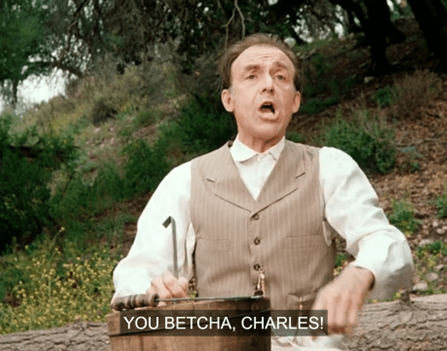
Well, the crowd clamors (or is it clambers?) forward, and we see that one of them, an elderly man in a shabby top hat, is Ray Bolger.


Do little kids still watch The Wizard of Oz today? I hope so. It would be sad if children, who now grow up with nearly limitless visual possibilities in their entertainments, didn’t also get to see what magic you could create with just makeup, lighting, theater tricks, and simple movie cameras. (Oscar producers take note: I am available to write such generic blather for awards presenters at very reasonable rates.)


Ray Bolger is of course the Scarecrow, a beloved character that came to define/overwhelm his career; it’s fitting the makeup he wore for the film apparently left permanent lines on his face.


Not that Bolger seemed to mind. He clearly enjoyed the ongoing celebrity his most famous role brought him, once saying that his legacy from the film was “no residuals . . . just immortality!”
A seemingly boneless dancer who began in vaudeville, Bolger went on to headline a number of Broadway shows after Oz (mostly forgotten today), starred in Babes in Toyland on the silver screen, and did guest spots and cameos in everything from The Partridge Family to Fantasy Island to Battlestar Galactica to Annie to Diff’rent Strokes.


(He was also on Love Boat – twice!)

The Wizard of Oz also of course starred Judy Garland, who was married to Michael Landon’s court composer David Rose for a few years in the 1940s.

I’m realizing that despite his being mentioned in nearly every one of these recaps, I don’t think I’ve ever given him a proper writeup.
Born in England, he was playing the piano professionally by age sixteen, and he worked in radio before moving into film and television.

In addition to our show, he wrote music for and/or music-directed specials with Fred Astaire and Red Skelton, the movies Please Don’t Eat the Daisies and Operation Petticoat (both of which I’ve heard of but know literally nothing about), Huckleberry Hound and Yogi Bear, Father Murphy and Highway to Heaven.

But what he’s best known for, of course, is Bonanza, sort of the TV godfather of Little House and Landon’s first smash entertainment success. David scored 376 episodes of the show, and many familiar tunes from our show (including the opening theme) were first written for the earlier program.
His marriage to Garland didn’t last long. When the relationship began is a matter of conjecture, but it was probably around the time The Wizard of Oz came out, in 1939. He married her two years later, when he was 31 and she was 19.

[Editor’s note: Scandalous the marriage may have been, but Rose’s execution of the formal white tie look here is flawless. No American has been able to pull this look off correctly since Ronald Reagan, except perhaps Tom Ford.]


Before that, David had been married to Martha Raye, aka TV’s “The Fresh Mouth.”
There are some unpleasant stories about David and Judy you can look up if you want to. But it seems one issue between them was simply generational: the young Garland was a bit of a party girl, whereas Rose was an introvert who preferred to stay home and work on his music. (That’s hardly surprising, given the rate at which we’ve seen him crank out scores for this show. I’m sure Georg Philipp Telemann, the most prolific composer in history, had similar stresses in his marriage, if he was married.)


This was all thirty years before he did Little House. Whether seeing one of the stars of The Wizard of Oz brought back painful memories for the Rose is hard to say.
This episode also features an actor named Frank D’Annibale, who’s credited as “Man #1.” I’m not 100-percent sure, but I think the guy at the front of the crowd here, who looks a bit like a Sicilian peasant, is probably him.


But back to Ray Bolger. He’s immediately recognizable; even more so when he starts gesticulating and shouting “Come on, hurry up, open it up!”

His character is unshaven and he doesn’t look the greatest generally, but he seems cheerful enough and jokes about dying of old age before the clerk has opened the mail.

All the Winokans push their way through to check the winning numbers, knocking the old man down on the floor.

When they’ve gone, the Postal Clerk, who doesn’t get a credit (unless he’s Man#1, but that seems unlikely), addresses the old guy as “Toby” and hands him the number.


Well, of course Toby’s numbers match – he’s won the $5,000 prize (about $150k today).

Toby begins singing his numbers and dancing, backed up by David Rose and His NBC Players.


Depending on your constitution, you’ll find either the routine delightful or very, very annoying.

I won’t reveal my own opinion – you know I like to keep a tone of detached objectivity in these recaps – but the dance got a 66 percent approval rating from our judging panel, which I would say is pretty good.

I used to work at a policy research organization, and we would have called that figure “overwhelming approval” in the press release.

We cut to the Winoka (Livery) School, where Laura has been taking some kind of collection and hands the proceeds, 55 cents (about $17 today), to Alice Garvey.

Apparently this fundraising campaign was to support the purchase of fireworks for the upcoming Fourth of July celebration, dating this about six months after the events of “The Man Inside.” (But if the Fourth of July is approaching, why are they in school?)
Albert grumbles that they won’t be able to buy much with that. (We see PFK is sitting behind him.)

Andrew Garvey chimes in, saying that in Walnut Grove, the city itself paid for the fireworks display. But I don’t know how that can be right.

The Walnut Grove we knew had no civic government, no general fund. . . . Major decisions were made by hastily organized ad hoc committees, and personally financed either by Mr. Hanson or Mrs. Oleson.


Mrs. G sighs and says Winoka’s “city fathers” don’t seem to have the same sensibility as the Grovesters about holidays.
Cynical Albert says there’s no community festival because Miles Standish wants everyone to observe the holiday by drinking and gambling in his saloon.
Mrs. G, another in a long line of Walnut Grove innocents, is skeptical anybody could feel that way.

Eventually she’s convinced, though, and she and Albert have a witty little conversation about how the leaders of Winoka don’t care about America’s birthday, nor Jesus’ either.


Then Mrs. G kind of shrugs and looks around – whether she’s furious, embarrassed, or laying an egg is hard to tell – and says, “Well! We’ll just show ’em.”

(I have to say, while I like the character generally, I don’t love Alice as the schoolteacher on this show. She’s kind of fussy, she makes fun of the dumb kids, and I’m not sure she ever seems comfortable or natural in the classroom. Come to us, Eliza Jane!)

After school, Laura, Albert and Andy encounter Nels, who’s sweeping the boardwalk in front of the saloon. Laura asks how much it cost to put on a fireworks display back in Walnut Grove.

(Presumably she means like the one we saw in “Centennial,” which was for the Fourth of July, not the one for “Miller’s corn-shucking,” which was financed privately by the mysterious Mr. Miller himself.)


Nels estimates they spent about $50 on it – $1,500 in today’s money.
That’s actually pretty cheap – one estimate I found suggested these days, a small-town display runs between $7,000 and $20,000. (Nels does say $1,500 was the wholesale cost, but still.)

Carl the Flunky passes by while they’re talking.

Good Old Nels offers to make a donation to the fireworks fund, but Standish suddenly appears and snaps at him to get back to work.
DAGNY: How old is Standish?
WILL: I don’t know. Sixty-five?
DAGNY: And he has a kid that age? Who’s the mom?
WILL: Probably some poor saloon girl.
(Leon Charles was sixty-three.)

Standish tells Nels to go wipe down the bartops. I thought Nels was the bookkeeper, but I guess I was wrong about that. It’s weird, though, because the three available positions when Nels applied were bookkeeper, maintenance man, and barmaid, and all we’ve ever seen Nels do in the line of his job is clean.


But before he lets Nels go, the old man makes him address him as “Mr. Standish.”


Nels exits sadly, and when Standish glares at the kids and says, “What are you looking at?”, Laura replies, “Not much, Mr. Standish.”


(Seems like kind of a modern usage for “not much” to me, but we’ll let it pass.)
Standish grits his teeth and says menacingly, “I’ve had about enough of your mouth, little one.”
Andrew Garvey warns Laura that Standish will go to Charles, but Laura says, “Oh, my pa won’t take nothin’ from him.”

Standish does indeed go straight to Charles, who’s setting tables, and orders him to summon Caroline.
WILL: I’m not sure Standish would know which street urchins had which of his employees for parents.

Ma comes out into the dining room just as Laura pops into the kitchen through the back door.
Standish says his complaint is about “your little one – the redhead.”
WILL: Redhead? What color would you call Laura’s hair?
DAGNY: Brown.
WILL: I would also describe it as brown – “nut brown” at best.
DAGNY: Yeah, maybe chestnut.

But I guess Melissa Gilbert once described it as “auburny red.” Probably it has red overtones that didn’t really pop on the old film. I am fairly color-blind as you all can tell from my graphics, so I’ll accept that.

Pa says, “Laura?” and Standish says with evil relish, “Yes, that’s her name, exactly.” (Leon Charles overdoes it for some reason through this whole episode.)

“She’s been sassing me, and she bullies my son,” Standish goes on, saying if these things happen again Ma and Pa can start looking for other work.
Standish also forces Charles to call him “Mr. Standish.” This is a trait we’ve never seen before; he must have picked it up since “The Winoka Warriors.”

When he’s gone, Pa turns and tells the eavesdropping Laura to shape up. Laura is surprised Pa didn’t tell Standish off (this is a Stupid Laura one), but Pa won’t hear her objections.

Then Ma says, “Laura, go and wake up your sister.”
WILL: Huh? Does Mary come over to the hotel to nap?
DAGNY: I think she means Carrie or the baby.
WILL: Oh. Okay then.

Ma goes back to work whilst Pa just stands in the dining room puffing and pouting because he can’t punch Standish in the face.

That night, Laura is polishing the oven . . . I’m sorry, but come on, in a busy restaurant kitchen there would be SO MUCH WORK TO DO, and yet here they really make it look like Laura has to invent tasks to keep herself busy. Why don’t they have her doing dishes, or mopping, or taking out the trash, all of which they would have to be doing constantly?

We haven’t really commented on this, but I don’t think two people could fully staff a restaurant as busy as the Dakota’s supposed to be, even with the part-time contributions of orphans and blind people.
Anyways, Laura says this week she’s reading Uncle Tom’s Cabin by Harriet Beecher Stowe. (A far cry from Walter Scott.)
Still famous as the anti-slavery polemic that agitated the Civil War, Uncle Tom’s Cabin continued to be widely read in the 1880s (next to the Bible, it was the best-selling book of the Nineteenth Century in the U.S.), so it’s not odd Laura would be reading it.

Apparently she’s reading it for school, saying Mrs. G told her Stowe said the book was “written by God.” (Stowe didn’t exactly say that, but she was deeply religious and claimed the book’s elements came to her in visions.)


Not exactly a woman of boundless imagination, Ma is like, “Whatever,” but points out the book “sure did get a lot of folks thinking about the wrongs of slavery.” (Maybe she should have handed Mary a copy when she was doing her Civil War school project!)

Okay – big scene now.
Ma starts to apologize for Pa being harsh earlier, but Laura snaps at her saying Junior Standish is “a brat and a bully” who deserves to be stood up to. (This I would say is a little unfair. Clearly he’s not the nicest child ever to toddle the Winoka boardwalks, but we haven’t really seen him do anything that bad. He didn’t even cheat in the football game, a claim the Winoka Warriors could hardly make themselves.)

In fact, I’d say at worst I’d probably put Junior in the “Lawful Evil” category, if this were Dungeons & Dragons.

Then Laura says, “Pa let [Standish] talk to him like he was dirt.” (To be fair, some of the Kaiser kids have no idea how the working world really operates yet either.)

Laura says Standish’s harangue was “like that Simon Legree in the book talking to a slave.”
WILL: Oh, is that where Simon Legree in Duran Duran got his name from?
DAGNY: That was Simon Le Bon.
Actually, Simon Legree is a monstrous, physically and sexually abusive slave-owner in Uncle Tom’s Cabin. Not a funny villain. At all.


Now here’s where it really gets good; because then Laura says: “I was ashamed of Pa.”
Ma stiffens instantly and says, “Don’t you EVER say that. Not EVER.”


I’ll give you the rest verbatim:
MA: Do you know how difficult it is for a man like your pa to take that?
LAURA: Then why did he?
MA: For you, and for me. For his family! Because he has us, he has to make do. That’s why he was so harsh with you – because he was hurt and angry inside. If your pa were on his own he’d give that Mr. Standish a dressing down, I can guarantee you that. Ashamed? If anyone should be ashamed, it’s you.

Grassle nails this speech, and then (just as my own mom would do) Ma suddenly changes the subject and, wrestling with her emotions, leaves to do other work.

Laura, meanwhile, looks as stunned as if Ma just hit her with a frying pan.

(I don’t think Laura’s super-well written in this one, but Gilbert certainly delivers the goods here too.)
In the other room, Pa is still brooding, or maybe just falling asleep, or, most probably, both.

Laura comes in. Pa wakes up and of course apologizes for being hard on her earlier, which he really wasn’t. (Today’s rebuke didn’t hold a candle to “Just get the fucking mop!”, for instance.)

Laura stops Pa and says no, she was in the wrong. She adds that no matter how badly any of them are treated, “nothing can hurt us as long as we’re together.” (No doubt she realizes quoting Charles the Father himself can’t hurt in this situation.)

On cue, Standish comes in again.
DAGNY: Wow, Standish has a big part in this one.
WILL: Well, he’s a big guy.
ALEXANDER: Yeah. He’s a big stander.

Laura greets him, politely but snidely.

Standish has Charles show him the restaurant receipts, then instructs him in subtle ways how to cheat their customers.

Toby Noe comes through the door then, puffing up like a bantam rooster and addressing Standish quite familiarly.

Standish, who obviously has experience with this person, tells Toby with disdain he won’t extend him further credit at the gaming tables.
ALEXANDER: Cash on the barrel, Toby.

Insulted, Toby says he’s actually come to settle his debt of $63 (about $1,900). In cash!

He tells them about the lottery, and of course Standish then turns oily and obsequious.
Giving the kingpin a taste of his own medicine, Toby sniffs that addressing him by his first name is too familiar. But Standish doesn’t know his surname.
Toby tells him it’s Noe, and they do a sort of “Who’s on first?” thing that Charles and Laura think is funny, but I don’t.


DAGNY: Is this one called “Toby Noe”?
WILL: No.
DAGNY: N-O-E?
WILL: Oh, not you as well.

DAGNY: In the first season it would have been called that. They had simpler titles then.
ALEXANDER: Yeah. Back in the olden days.

DAGNY: So what is it called?
WILL [as JUDY GARLAND]: “There’s No Place Like Home. . . .”
DAGNY: Oh Gawd, of course it is.

DAGNY: Wait! “Noe Place,” N-O-E?
WILL: No, but I bet Landon wished he’d thought of that.

[UPDATE: Looking back through this one, I realize I failed to mention that Noe was also the maiden name of Michael Landon’s then-wife, Lynn. – WK]

Standish departs with a comment that “Mr. Noe” is welcome to drink and gamble in his saloon anytime.
Toby and Charles, who seem to be on familiar terms, laugh about Toby’s turn of fortune. Charles warns him against losing it in the gaming halls, though.
Toby turns to Laura, whom he also seems to know, and says he wants to help the kids with their fireworks drive. In fact, he said he’s already ordered a big bunch of fireworks for them – the biggest “this side of St. Louis.”
I’m not sure if St. Louis was particularly known for fireworks displays in the Nineteenth Century. But it seems a fireworks factory did explode there in 1882, so maybe it was, till then.


Charles says he’s worked with explosives before, which is true enough, so Toby asks him to help with the display.
Then he starts to leave – forgetting his pile of cash on the hotel desk.

Charles gives it to him, and Toby laughs, “I used both my brains that time, didn’t I!”
If “both my brains” is or was a saying, it’s news to me; but surely this talk of brains is a winking reference to Oz.


Next we see Laura putting up a notice saying Toby’s fireworks display will begin at 9 on the Fourth at a place called “Holly’s Pasture.”

We see Ben Slick crossing the street at this point.

Albert, meanwhile, is putting up another sign outside Standish’s joint.
Mr. Standish, who seems to have a lot of time on his hands to fool around with kids in this story, comes out to yell at them.

Laura and Albert tell Standish about the fireworks display, adding for no good reason that Charles Ingalls himself will be personally overseeing the proceedings.

Well, Standish tells them to bugger off, and Albert sasses him for not giving the flyer back.

Laura apologizes to Standish for Albert’s idiocy, but that doesn’t stop him from making a crazy face at Standish as they leave.


DAGNY: The “cross-eyed stinger” from David was a nice touch.
Standish heads straight to Charles again. I never noticed before, but the Dakota has a fair amount of taxidermy on the walls.

WILL: They should send that head to John as revenge for cheating on Mary, since he’s afraid of deer.

(I call that one “John Deer,” uh haw haw haw haw haw.)
Well, Standish shouts that having an out-of-town event “on a Saturday night” will deplete his business. (The Fourth of July in 1881 was a Monday, but whatever.)

Standish rants and rages and tells Charles to skip the fireworks, or else. Then we get a break, but it isn’t much of a cliffhanger since Toby already told Charles he’d be able to get him out of his work duties that night.
When we come back, we see Toby, dressed in a new suit and carrying a stick, personally escorting the fireworks wagon through town.

In a cute touch, David Rose gives us a quotation from “Once in Love With Amy,” a signature song of Bolger’s that he first performed in the musical Where’s Charley? on Broadway.
Equally interestingly, we see Quint from Jaws is following behind the wagon.


Toby enters the saloon, where he nods to the French maitre-d’ looking Grovester.

The ZZ Top Guy and Not-Richard Libertini are there as well.


Standish comes over and orders Toby a bottle of whiskey from the bartender, whom he addresses as Fred.
Toby tells Standish if he doesn’t give Charles the Fourth off, he’ll never see a penny of the lottery winnings spent in the saloon.
Standish immediately agrees. Pleased by his newfound power, Toby then succumbs to the temptation to drink and gamble.

We see good old Josie the barmaid is there too.
WILL: He doesn’t tell her to call him “Mr. Standish.”

Next we see Alice Garvey, Laura, Andrew and Albert crossing the street. Your guess is as good as mine how much time is passing between these scenes.

We see Herbert Diamond riding a horse behind our protagonists.

Albert spots a crowd gathered at the door of the saloon and squeezes in to see what the buzz is about. But Alice won’t let Andy join him.

Albert finds Toby gambling, with Standish himself dealing, and with Herbert Diamond having magically teleported from his horse outside one second ago to a front-row seat at the table.


Toby is apparently playing well. Suspiciously well, in fact.
Back at the Dakota, the Ingallses and Garveys are all standing around in the empty dining room looking at a big piece of paper, which Caroline describes as “a beautiful card.”

It’s very unusual for Little House to include anything that isn’t explained to death. Was there a deleted scene where the purpose of this card was introduced?
Albert runs in and tells them all about the wonderful run of luck Toby is having in the saloon.
DAGNY: Albert would know better than this.
WILL: I thought the same thing.

Charles and Jonathan Garvey exchange worried glances, then Garvey heads over to the saloon to see for himself.

He finds Toby, who’s quite drunk by this point, with Standish’s net beginning to close around him. (We don’t learn anything about Toby’s history, but presumably it involves gambling addiction, alcoholism, or both.)

Garvey tries to rescue the old man from the trap by telling him his order at the restaurant is ready, but Toby just waves him off.

Standish furiously leaves the table, takes Garvey aside, and fires him for his meddling.

Garvey goes to collect his final paycheck from Fred, who is a classically sympathetic bartender and who resembles Peter Yarrow.


Nels appears, and Garvey tells him this is the final straw – he and his family are going to head back to Walnut Grove.

Back at Toby’s table, Mrs. Oleson passes by, and takes their order for another bottle of whiskey. Toby hands her a $5 tip ($150), then mimics her laugh (hilariously) as she rushes off.

At the bar, Nels whispers to Harriet that the Garveys are going home, but she doesn’t care.

Nels says he can’t understand how she can help get the old man drunk so Standish can fleece him.
Harriet says oh it’s just a job, then cruelly insults her husband, saying he’s just jealous of how well she’s making out as a barmaid.

She has really thrived in this environment, hasn’t she? I told you she would fit right in on Deadwood.

Nels then has a little existential conversation with Fred the barman, and orders a whiskey himself, despite saying he isn’t a drinker. (Which isn’t strictly true. While I wouldn’t count him getting drunk last season by drinking out of a water barrel that Garvey dumped some booze into, way back in Season One Harriet caught him taking pulls on the cough medicine in the Mercantile. And that might have had opium in it as well!)


Meanwhile, Albert stands by the piano player, whom we actually see playing for once. (I don’t know who the actor is. It isn’t David Rose.)

But what Albert is thinking remains a mystery. Commercial.
DAGNY: I’m beginning to understand how Charles feels.
WILL: About what?
DAGNY: About all the flippin’ ragtime.

When we come back, night has fallen, and Ma and Pa sit down in the dining room after a supposed hard day’s work in the busy restaurant.

They sadly discuss the Garveys’ impending departure.
Charles says he thinks it’s a mistake to go back to Walnut Grove, which must be a ghost town by now.
Caroline doesn’t seem to agree, and when Charles says they “won’t have anything to look forward to” back in Minnesota, Caroline makes a strange speech about how people “always looking forward to tomorrow” is what’s really wrong with Winoka. (It is?)


She talks wearily of the rat race in the city, though I’m not sure I would even describe their jobs as part of that. They have good honest occupations in the hospitality sector; what’s wrong with food service?
In fact, other than the hotel and saloon, we haven’t seen the workings of any other business in town, unless you count the Post Office. What rat race?

Then Caroline asks Charles if he wants to go home, but he says no.
WILL: This is like Ellen asking Chief Brody if they can go back to New York City in Jaws.


Surprisingly, Caroline accuses Charles of being a liar, though she does it gently.

And then Charles says, “We can’t, it wouldn’t be fair to Mary. Nothing for her in Walnut Grove. She’s got to teach. We can’t ask her to give that up.”
Ma looks at him steadily and says, “Charles – we wouldn’t ask her to give it up.”


I really like this moment, because I think neither Caroline nor the audience have really understood that this is Charles’s true barrier to leaving: losing Mary.
When Mary announced she was going to Winoka and Pa decided to follow her, he characterized it as a “what the heck!” decision based on the lack of options back home. We never understood until now how much the idea of Mary growing up and moving away forever hurt him, and frightened him. It’s clearly the real reason he pushed Caroline to go in the first place.


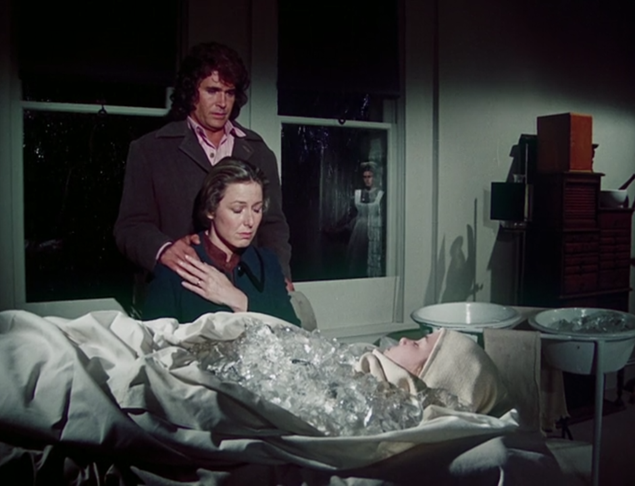


Pa looks up at Ma, and now he really does look frightened. He shakes his head no, but it’s a weak gesture, like a child who doesn’t want to take his medicine.

“We’re a family,” he says quietly. “We stay together.” (Landon is great in this one.)

Caroline looks at him with a mix of sadness and compassion. “Charles,” she says; but he interrupts her to make one of his trademark speeches about how everything will get better and be great again, just wait and you’ll see.
Ma closes her eyes. She is suffering: suffering to think of staying, and suffering to see the love of her life in such denial. (Grassle is great too.)

Pa talks about how someday they’ll have a little farm out in the country. He doesn’t say “just like we had back in Walnut Grove.” He doesn’t need to.

Caroline stands up then and leaves the room.

DAGNY: My goodness.
WILL: What?
DAGNY: Her top.

Indeed.


Caroline just keeps walking out the front door and away down the boardwalk. I don’t think we’ve ever seen her walk out of a conversation with Charles like this.


Back in the saloon, Toby Noe is losing (and sweating).

He no longer seems very drunk, though.

We rejoin him just in time to see Standish take the last of his money.

Toby asks for another chance to win it back.
WILL/DAGNY/ALEXANDER: CASH ON THE BARREL, TOBY!

But Standish says “no markers” – a gambling term for credit that’s maybe slightly anachronistic, but only slightly.
Then, quite cruelly, Standish says he’ll cut cards with Toby for the fireworks he bought (value: $100, or $3,000 today).
Stupidly, Toby agrees, and predictably, Toby loses.

Delighted with this turn of events, Standish buys everyone a round of drinks.
If he were Al Swearengen, he’d say, “Half-price pussy, next ten minutes!” But of course this is a 7+ family show (otherwise I’m sure Standish would).

The crowd disperses, leaving only Albert behind.
WILL: Would they really allow a kid in this place?
DAGNY: No. He doesn’t have any money to spend.

But then Standish gets an unpleasant surprise, because he finds Nels drunk and belligerent at the bar.

Nels quits and tells his now ex-boss off. Richard Bull’s drunk acting is perhaps marginally better than it was in “Castoffs.”

Nels staggers over to Harriet and tells her he wants to go back to Walnut Grove too.
She says he’s out of his mind.

Then Nels kisses her and says, “I’ll say goodbye to the children in the morning.”
ALEXANDER: Wow. You’d think he’d at least take Willie.
It does seem an almost inhuman decision for this character. Then again, Nels does have a dark side when it comes to his family.

Then Nels walks over to the Garthim-wheel and tells Josie he wants to play.

She’s surprised; and I think you can tell she’s also fond of Nels. (Because who wouldn’t be?)

Back in the Dakota dining room, Pa is looking out the window; then Mary appears.

She says she needs to talk to him, and they sit down.
She begins by reminiscing about “that time you went away with Mr. Edwards.” (Does she mean in “The Long Road Home,” when the two of them transported nitroglycerine across the country?)

(Or in “The Award,” when she nearly burnt down the barn on Ma’s watch?)

(Or when they went to deliver Christmas presents in “Blizzard”?)

(She can’t mean when they were digging tunnels through the mountains, because Mary was in a coma in the Mayes Clinic at that time.)

(Whatever she means, it was at least twenty years ago in Little House Universal Time (LHUT). “To Live With Fear” was in the D timeline, and we’re up to H now.)
(No matter. I think this is the first reference to Mr. Ed since Victor French left the show, right?)
Mary whispers that before he left, Pa said that “no matter how hard it was being away . . . as long as we held each other in our hearts, it wouldn’t be like we were really apart.”

She blah-blahs about love a little more, and we can see Pa is misting up already.


Then Mary says Ma came and talked to her. Pa starts to say “She shouldn’t have done that,” but Mary stops him.
This is a first, too – one of the kids shutting Pa down with a word.


Mary talks to Pa as if he were a child then. I mean that not harshly, but quite literally – she’s not condescending; instead, she sounds like a concerned, loving parent trying to help her kid through a difficult situation.

“You have to do what’s right for you,” she says calmly, and Pa begins sputtering that he is, that there’s nothing more right for him than them all being together.

His voice breaking, he looks down and says, “I don’t want my children spread out all over the face of the earth!”

Mary says, “Pa, look at me.” And, intuiting correctly that she needs to repeat the command, she does.
Mary whispers, “I’m not a child anymore, Pa. I’m a woman.”

Indeed, it’s hard to imagine a more rapid and radical evolution of a character than we’ve seen with Mary over the past seven episodes.


She’s been changed forever; and it suits her. (Melissa Sue Anderson has made perfect acting choices to get her there, too.)
As Pa weeps, Mary says, “I’ve got my own life – and I’m gonna be happy. I’m a teacher, Pa – doing what I love. That’s why I’m all right here. But not you, Pa.”

Then she points out that staying for her sake isn’t a gift, but a burden for her to bear. “That’s not fair to either one of us,” she says.
DAGNY: This is an intense episode.

Pa’s heart is breaking, but he takes his daughter’s hand, smiles in spite of himself, and says, “Where does the time go, huh? . . . It seems like yesterday I was holding you in my arms.” (With all our kids now gone from the house, I hear that, Chuck.)

Mary replies, “I’ll hold you in my heart, Pa,” and Charles breaks down.


But Pa smiles again, and they exchange I love yous.
And then, in a moment that’s frankly beautiful, we see Ma has been listening to this entire conversation in the other room. Tears are streaming down her face – but she’s smiling with joy.
This is why we watch Little House, friends.

Back at the wheel, Nels is having an amazing run of luck.

My understanding is that these wheels were commonly rigged to be controlled by the operator; in fact, we’ve already seen that on this show, in “Gold Country.”
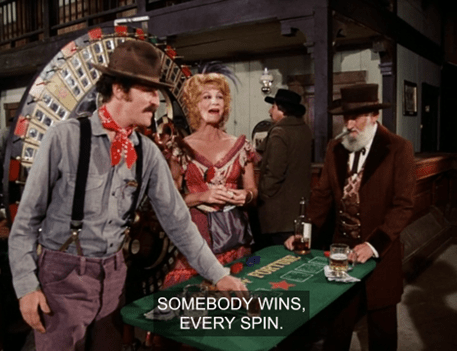
This supports my theory that Josie is very fond of Nels. I believe with Standish distracted, she’s letting him win. (Good old Josie!)

Realizing she can’t keep the ruse going forever, Josie encourages Nels to quit while he’s ahead.
DAGNY: Is he going to get a hooker now?
But, still drunk and depressed, Nels says he doesn’t care if he loses the money, so “let it ride.”

Then we see Fred the bartender carrying the fireworks crates – now Standish property – into an upstairs room.

Interestingly, there appears to be smoke rising from the lamp on the wall, as if it’s really burning oil. They better watch out or they’re gonna have a fire.

When Fred’s gone, Junior Standish and Babylon 5 sneak in from the hall.

Then we get a surprising and touching sight: Albert has invited the rueful Toby Noe back under his porch by the coffin factory.

Toby is lying on whatever Albert calls a bed, as the kid gently strokes his hair. It isn’t weird, though. Well, maybe a little, but I think it works.

Stunned, sobering up, and depressed, Toby says, “I don’t know why I done it.”
Speaking like a true Ingalls, Albert says, “It’s over now.”

But Toby goes on, saying, “I always lose it all. . . . And I wanted you kids to see the fireworks. . . . But I lost them.”
Then he looks at Albert and says hopelessly, “I’m sorry.” (I’m sorry, too. If you’re the sort who cries easily, the last six minutes of this show must have been very hard for you. In a good way.)

Albert then makes the observation, “Some folks just shouldn’t gamble,” very generously including himself under that umbrella to make it seem like less of a judgment.

Toby mutters a few more regrets, then goes silent and closes his eyes.

DAGNY: Did he just die?
ALEXANDER: It’s just like “The Gambler.”
WILL: Huh?
ALEXANDER: The song. [singing:] “And somewhere in the darkness/The Gambler, he broke even. . . .”
(This kid surprises the heck out of me sometimes.)
Anyways, Kenny Rogers kind of had a Merlin Olsen vibe in the seventies, didn’t he?

Back in the fireworks room, Junior Standish takes the glass cover off of a burning lantern and carries the flame across the room. If you happen to have a fireworks room in your own home, DON’T DO THIS.

This scene does explain why the wall lamp in the hall was smoking – Landon figured, we’ve got a real oil lamp, we might as well use it whenever we can!
On of the crates behind the boys is labeled Old Prairie Whiskey, and I was interested to learn this is an imaginary brand created for the TV show Gunsmoke.


Junior and Bab are going to shoot one of Standish’s rockets out the window . . . only when Junior lights the fuse, he startles and throws the lamp across the room. (Such things can happen; believe me.)


The oil ignites and sets the crates on fire.


Junior and Bab run from the room in terror.
And then, in an interesting foreshadowing of The Last Farewell, the whole saloon explodes.
Not the building, of course, but fireworks begin shooting out of the upstairs room.


Coming out of another room, Mrs. Oleson screams, and downstairs, Standish screams too.


WILL: He’s been a good villain this season, but he’s too buffoonish in this one. He’s like a cartoon character.
DAGNY: Well, this show doesn’t know how to sustain villainous characters. Think of all the back and forth with Mrs. Oleson being truly evil, then funny evil, then nice, and then doing it all over again.

For reasons that aren’t explained, the piano player keeps playing, like the band on the Titanic.


Meanwhile, Harriet gets Nellie and Willie out; but Nels just sits in the burning saloon waiting to die. People catching or almost catching on fire is becoming an obsession with this show.


(This whole sequence is perhaps inspired by the scene in It’s a Mad, Mad, Mad, Mad World in which Sid Caesar and Edie Adams accidentally set off fireworks whilst locked in the basement of a hardware store.)

Nels shouts at Harriet that without her coming back with him, he doesn’t have a reason to live. And when Harriet sees the pile of money he’s won, she agrees.
They literally grab up the money in their arms and escape the fire, with Harriet clucking and screaming the whole time.
WILL: They’re kind of the Thénardiers, aren’t they?


Everyone in town comes running into the street to see the fireworks. At first I thought this was an error, since Toby just lost the fireworks an hour ago and I thought the people would already have headed out to Holly’s Pasture for the show. But I suppose it isn’t the Fourth yet! That probably was obvious to you, but I’m a bit thick at times.


The Sicilian peasant seems to be enjoying the show.

Leon Charles’s performance in this final sequence becomes hammier and more Muppety with every appearance, and now we see Standish running around howling “Fire Department! Fire Department!”

Then a fire wagon actually arrives, the horses pulling it shying away from the fireworks, which must have been real. I’ve read that working with fire on soundstages in those days was actually VERY stressful, with everyone worried about burning the studio down or somebody getting hurt.


Standish runs around yelling “My building’s on fire! My building’s on fire! Water! Water!”
WILL: He’s like the Master in “Castrovalva.” [as ANTHONY AINLEY:] “My web! My web!”


The Fire Chief dryly tells Standish the fire engine no longer works. In a satiric jab at those who balk at government-funded public services, he says Standish knows this quite well, since he himself decided not to buy a new one when the firefighters called for it.

Standish grabs Charles and Jonathan Garvey and begs them to form a bucket brigade. But they tell him to get stuffed.
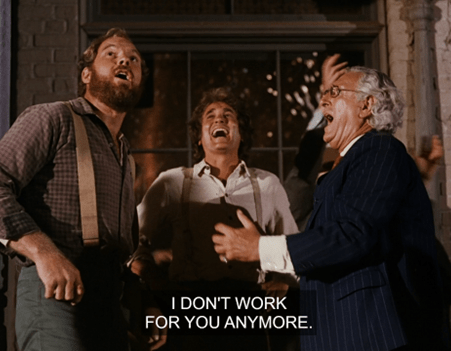
Then Charles turns to Garvey and says, “So what time do we start home tomorrow?”
Garvey can’t believe his ears.

They agree to depart at six a.m. (of course), and hug joyously.

In the crowd, Mustache Man turns to the Sicilian Peasant and says, “Better than the Fourth of July!”

Albert brings Toby Noe out to see them. Toby staggers and smiles, quite Scarecrowishly I might add.

The fireworks show goes on and on, with explosions from every window and door in the place. I’m not quite sure how that’s possible, but fine.

And then, out of absolute nowhere, we get Voiceover Laura saying, “If I had a remembrance book, I would write down that this was the most exciting night of my life – not because of the fireworks, but because we were going home.
We haven’t had a “remembrance book” reference since “Country Girls” in Season One!

And while this one works perfectly well as a standalone story, we then get a “Next Week Part II” title, so there’s more to come. (Like, maybe we’ll find out what the “beautiful card” was all about.)

STYLE WATCH: Caroline’s, um, top.

Mustache Man wears an extremely striking patterned shirt/neckerchief ensemble.
And Charles appears to go commando again.
THE VERDICT: Full review coming next time, but my compliments to all the actors for their fantastic performances in this one. (Except maybe Leon Charles.)
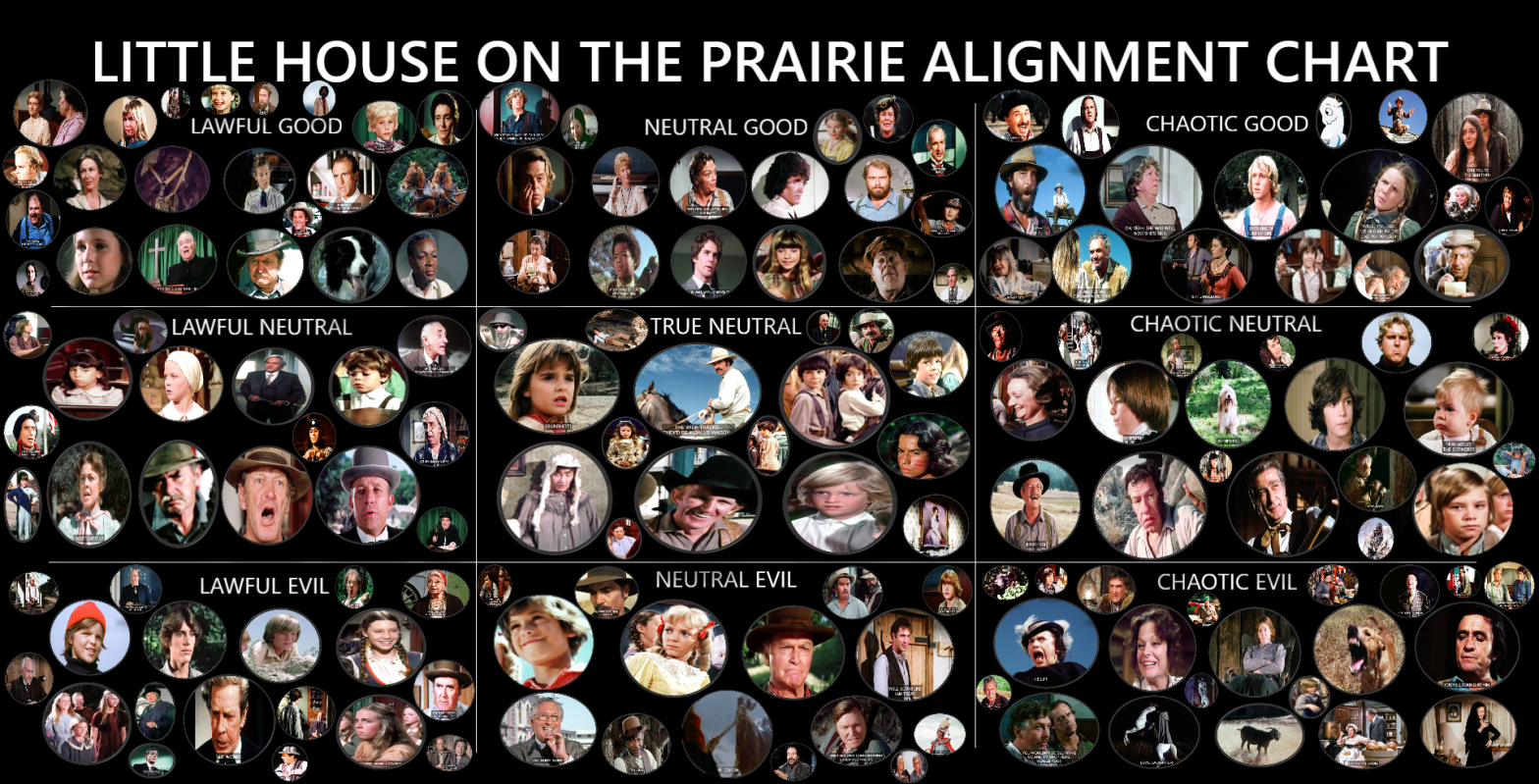
And for those of you who would like to have a key to the alignment chart thumbnails, here it is. The classifications are obviously debatable.
I’m sure I missed some good characters, so my apologies if your favorite got left out. See ya next time.

LAWFUL GOOD
Row 1: Minerva Farnsworth, Anna Jillberg, Elmer Dobkins, Olga Nordstrom, Yuli Piatakov, Henry Hill, “Gelfling” Ginny Clark, Julia Sanderson
Row 2: “Dumb” Abel Makay, Caroline, Bunny, Grace Snider, Nels, The Chonkies
Row 3: John Bevins, Adam Simms
Row 4: Ellen Fisher, Sue Goodspeed, Reverend Alden, Mr. Hanson, Bandit, Joe Kagan
NEUTRAL GOOD
Row 1: Jason R. The Scientist, Mattie Hodgekiss, The Widow Thurmond, Helen Tyler, Dr. Mayes
Row 2: Doc Baker, Miss Beadle, Hans Dorfler, Charles, Jonathan Garvey, Mr. Wing
Row 3: Mrs. Whipple, Solomon Henry, Adam, Christy Kennedy, Sam Shelby, Dr. Burke
CHAOTIC GOOD
Row 1: Papa Delano, “Tinker” Jones, Pony, Stanley Novack, Anna Mears and Bobbie Harris
Row 2: Mr. Edwards, Kezia, Luke Simms, Laura, Thomas the Blond Freckle-Faced Moppet, Jack Peters (English Guy)
Row 3: Carrie, Jonathan the Mountain Man/Angel/Whatever, Kate Thorvald, Andrew Garvey, Matthew and Anna Simms, Toby Noe
LAWFUL NEUTRAL
Row 1: Cloud City Princess Leia’s Brother Luke, Alfie/Happy, Monsieur François
Row 2: Not-Linda Hunt, Mary, Mr. Ames, H. Quincy Fusspot
Row 3: Little Crow, Soldat du Chene, Justice Varnum
Row 4: Not-Quincy Fusspot, Alice Garvey, The Alamo Tourist From Pee-Wee’s Big Adventure, Carl the Flunky, Ebenezer Sprague, Judge Picker
TRUE NEUTRAL
Row 1: Not-ZZ Top Guy, The Non-Binary Kid, Mr. Nelson the Gray-Haired Dude, Ben Slick
Row 2: Alicia Sanderson, Mustache Man, The Ambiguously Ethnic Kids (AEKs), Jonah
Row 3: Sweet Colleen, Not-Albert, Spotted Eagle
Row 4: Philomena Varnum, Not-Paul Rudd, Herbert Diamond, The Midsommar Kid, Lilly Baldwin Pike
CHAOTIC NEUTRAL:
Row 1: Wendell Loudy, Sam Higgins, Amos Pike, Paul and Eric Boulton, “Big Dumb” Luke Hoskins, Angela the Chicago Prostitute
Row 2: Mrs. Foster, Peter Lundstrom, Jack, Albert, Baby Grace
Row 3: Spotted Wolf, Old Zachariah and Lorraine, Johnny Johnson
Row 4: Lansford Ingalls, Busby, Granville Whipple, Jack Lame Horse, Carl Sanderson
LAWFUL EVIL:
Row 1: Jim, Mr. Watson, Grandpa Stokes, Madam Maria
Row 2: Jeb “Junior” Standish, John Sanderson, Jr., The Red-Haired Kid (Mean One), Cloud City Princess Leia
Row 3: Roger Whitehead, Esq., Hugh MacGregor
Row 4: Pigtail Helen, Nondescript Helen, Mona Lisa Helen and The Smallest Nondescript Helen of Them All, J.W. Diamond, Hannibal Applewood, Frederick Deering, Not-Joni Mitchell
Row 5: Horace Benson, Liam O’Neill
NEUTRAL EVIL
Row 1: Peter Ingalls, Mr. Griffin, The French Maitre-D’-Looking Grovester and Not-Richard Libertini, Timothy Farrell
Row 2: Willie, Nellie, Jud Lar[r]abee, “Uncle” Chris Nelson
Row 3: Miles Standish, L. Moody, Spot the Stupid Cow, Mr. Kennedy, Cass McCray
Row 4: Captain Anders, Shirna and Vorg
CHAOTIC EVIL
Row 1: The Bear, “Mean” Harry Baker, Nathaniel Mears, The Wobbly Older Lady at the Redwood County Fair, Will O’Hara, John Stewart, Jesse and Frank James
Row 2: Mrs. Oleson, Eloise Taylor, Miss Peel, Not-Nyssa (The “Tony Soprano” Feral Dog), “Brother” Caleb Hodgekiss
Row 3: Jim “Bull of the Woods” Tyler, Sandy “Kid Hideous” Kennedy
Row 4: George and Sam Galender, The Headless Horseman, Fred the Goat, Miz Schiller, Amy Hearn

UP NEXT: There’s No Place Like Home, Part Two
 Walnut Groovy
Well, I was with Dagny on “The Man Inside,” but I love TNPLH beyond any reason, so thanks for this thoughtful write up! Although I first saw this one later in my childhood due to the length of Part II, when I did finally see it the fireworks scene felt somehow familiar…like I wonder if I watched this one when it first aired, but was too young to remember it consciously. Not to be a downer for next time, but it’s too bad Part II doesn’t quite live up to this one, although maybe this one isn’t really that objectively great… but it’s a favorite of mine, whether it deserves to be or not.
LikeLiked by 1 person
Well, I have to admit, despite remembering the Toby Noe stories as kind of treacly, I enjoyed this one a lot more than I expected to. I actually think this and Part Two both contain stunning individual moments rather than working as a perfect whole. But tell me, what’s your verdict on “995 419”? 😀
LikeLike
It’s fine? : )
And yes, there are moments in Part II. Part II did not need to be any longer than a standard episode, I think was part of the problem.
LikeLike
Yeah, I agree with that for sure
LikeLike
A great episode featuring a classic song & dance man. I’m with you on the gambling. If I’m parting with my hard~earned money I want to get something in return. No giving away unnecessarily.
That’s so cool that you’ve met Walz. For a politician he seems like a good guy.
That carpet art work should win 1st prize at the faire. Loved it. 🏡
The love boat sure featured some classic movie stars. I think that show alone kept many older actors working & helping them keep their health insurance.
Watching Wiz of oz just once a year growing up made you appreciate how special it was. As a little girl, I think I had a crush on the scarecrow! I’ve always valued a sense of humor; something that time cannot make fade as easily as a handsome face.
I agree that other than Crabapple, Alice was LHOTP’s worse teacher.
That actor sure did look like Quint!🦈
Another stellar recap. Looking forward to part 2!
LikeLiked by 1 person
I thought the sympathetic bartender looked like Grandpa Joe from Willy Wonka. But I see the Peter Yarrow, too. I mainly came here to say, for some reason, I hoot when the famous State Fair bullies reference rears up. You have great timing, just when we’ve (well, not YOU) forgotten about it, it pops up. I’ll never not laugh. We’re going to rewatch the series eventually, so I need to find my verdict on the lottery number song. Lol.
LikeLiked by 1 person
Thanks Molly. I do worry people get sick of them, even though I never do, of course! And Grandpa Joe is definitely a better comparison. Wish I’d thought of it!
LikeLike
My husband and I thought the same thing about him looking like Grandpa Joe!
LikeLiked by 1 person
If I was able to respond to the poll: I enjoyed “995 419,” but only because it was Ray Bolger playing the character 🙂
LikeLiked by 1 person