
She Want That Cookie Real Bad; or
At Least She Doesn’t Have to Worry About Internet Brain Rot and AI
(a recap by Will Kaiser)
Title: “Someone Please Love Me” [sic]
Airdate: March 5, 1979
Written by Michael Landon
Directed by William F. Claxton
SUMMARY IN A NUTSHELL: In this Chuck-only episode, Charles ignites lust in an unhappy woman’s heart. But when he cures her husband of alcoholism, she decides to stick with her family.
RECAP: Well, reader and Original Friend of Groovy Maryann found us an AI treasure/monstrosity to share. I’m not sure if I think it’s the most beautiful thing I’ve ever seen, a sign of the coming apocalypse, or both.
OLIVE: Oh my God, Dad, you have to share this on the blog.
WILL: I know. I’m a little bit scared to, though. I can just hear the readers: “This is so much better than the garbage Walnut Groovy makes. . . .”
Thanks so much, Maryann.
Olive was home this week for spring break. She’d never seen this one, and I’m not too familiar with it myself, so let’s see where it takes us, shall we? (It’s our eleventy-first recap, for those interested in such things.)
We begin with a closeup of a fire.

I’m sure that, if you’re a Little House fan worth your salt, you’re asking yourself what horrific tragedy we’re beginning with this week.

But as far as we can tell, this fire does not contain any baby skeletons, nor did it destroy a whole year’s harvest.

For as the camera pulls back, we see it is quite controlled and being overseen by a blacksmith.
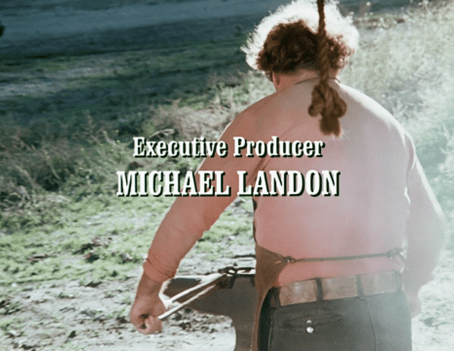
Is this blacksmith, who’s busy blacksmithin’ away, our old pal Hans Dorfler? We can’t see how rubbery his face is, so it’s hard to tell.


From behind, he actually looks more like Dumb Abel.


The Dumb Abel resemblance is a pleasant coincidence, as you’ll learn later. Don’t let me forget to tell you about it.

Actually, I’m sure I will forget, so I’ll just tell you about it now.
Like “A Matter of Faith,” a far better known Little House story, “‘Someone Please Love Me’” is actually based on an old episode of Bonanza.
That episode, “A Dream to Dream,” was a 1968 collaboration between Bonanza writer/star Michael Landon and our very good friend and regular director William F. Claxton. (The same duo that created today’s episode, as well as “A Matter of Faith.”)

Guest-starring Julie Harris (Eleanor from the sixties horror masterpiece The Haunting), “A Dream to Dream” was focused not on Little Joe, Michael Landon’s character, but rather on Little Joe’s big brother Hoss.

Hoss was played by Dan Blocker, father of Dirk Blocker, who played Dumb Abel! So you see, in case you’ve forgotten why I began this ramble in the first place, and I wouldn’t blame you, that’s why it’s such a funny coincidence that I thought the blacksmith was him!
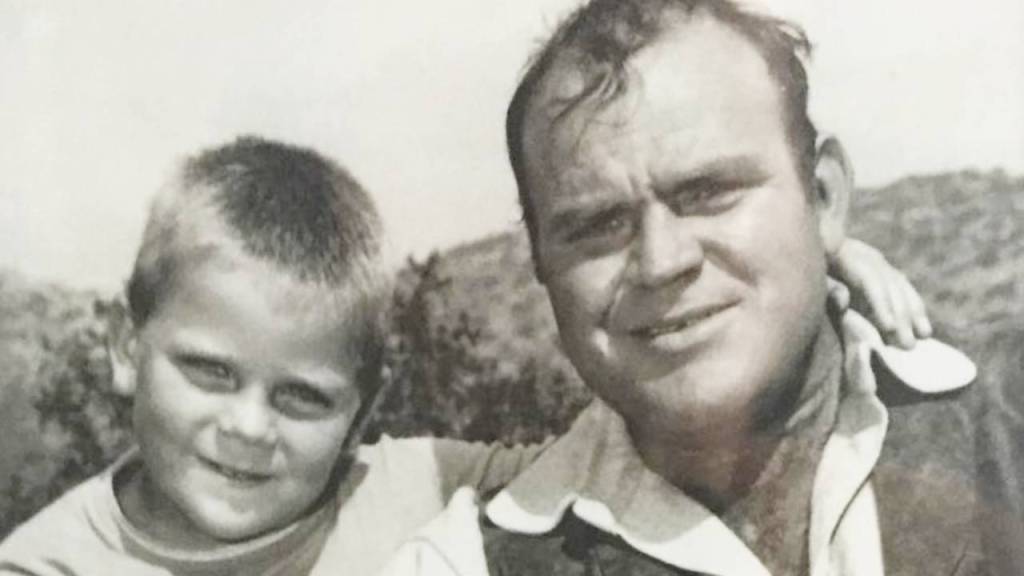
Well, I thought it was funny. All right, all right, let’s circle back to the trail. The blacksmith finally turns to the fire, but it’s neither Dumb Abel nor Rubberface Dorfler. It’s nobody we know, in fact.

This blacksmith takes a breather and notices Charles approaching in the Chonkywagon.

Behind him, a Medieval Peasant Woman and a man in a derby (Nels?) drive by in a (non-yellow-wheeled) buckboard.
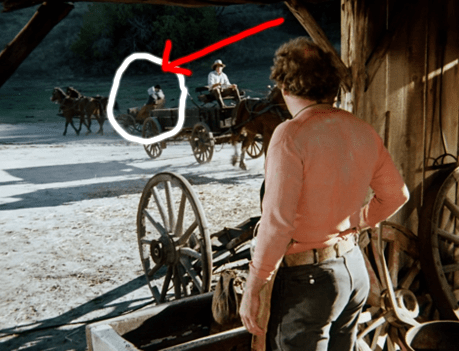
This blacksmith may not be known to us, but he is to Charles, who greets him pleasantly as “Sandy.”

Charles asks if somebody named “Gargan” is around.
If this is in fact Dorfler’s livery, it’s shot at an unusual angle, and we can’t see any other town buildings in the background.
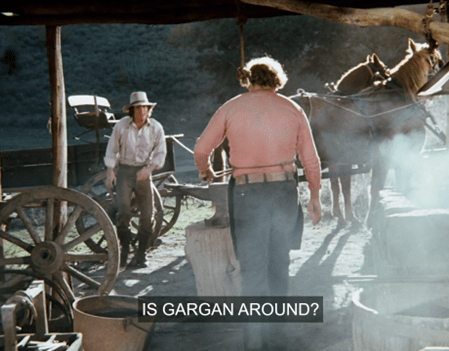
Sandy comments drily that Gargan is inside counting money.
Charles knocks on the door of the building, calling out that he’s here to collect payment for something.
Sandy, who looks a bit like Elliott Gould, or maybe André the Giant, makes another crack about Gargan hoarding cash.


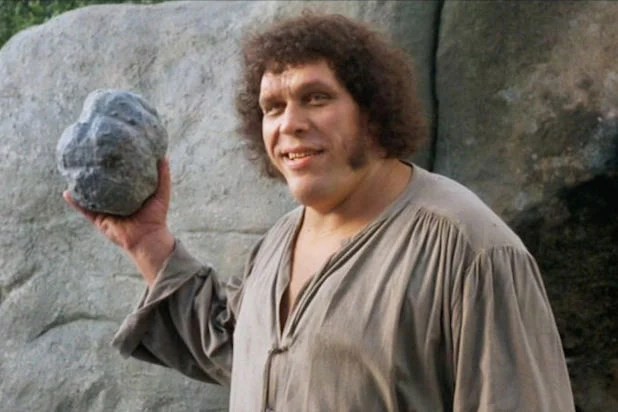
Sandy the Blacksmith is actually Edwin Owens, who appeared on The Waltons, Falcon Crest, General Hospital, Santa Barbara (I sort of thought that was still on today, but apparently it was canceled in 1993), and Law & Order, as well as in that notable Matthew Labyorteaux vehicle, Tarantulas: The Deadly Cargo.

Mr. Gargan, a little old man, comes out to see Charles.

If he looks familiar, it’s because we’ve met him twice before.
He’s Eddie Quillan, who played the poor arthritis sufferer Jed Haney in “To Run and Hide.”
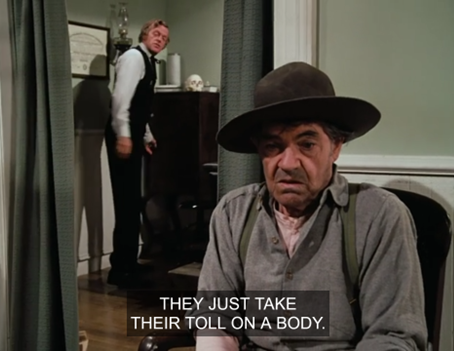
He also played Judge Picker/Pigger, who officiated at the Garveys’ divorce hearing in “The High Cost of Being Right.”

Gargan, who’s nervous but nice, gives Charles $250 in cash (about $8,000 today).
Charles, who apparently will perform some sort of service or errand for Mr. Gargan, is uneasy at carrying such a large sum. He says he wishes Gargan had given him a check instead.
But Gargan, who reminds me a bit of my ex-father-in-law, says he doesn’t have a bank account, since “I give them money, they give me a piece of paper” doesn’t make sense to him.
WILL: Is Charles going to explain to him how banks work, like George Bailey?


Mr. Gargan tells us in the audience that he’s sending Charles on a mission to purchase ten horses for him. I’m not sure we’ve ever seen him carry out such an assignment.
A born cynic, Gargan warns Charles not to let the seller cheat him, saying: “I never met the man, but he has a reputation for fair dealin.’ So I don’t trust him.”
WILL: Ha! Oscar Wilde would have liked that one.


Mr. Gargan goes on making witty observations, saying, “Folks with good reputations can cheat you a lot easier than folks with bad reputations.”
WILL: I like this guy.

Charles says he’ll be back in “a couple of weeks.”
Gargan tells Sandy to get back to work, and Sandy says, “You want it right or you want it quick?”
Mr. Gargan replies, “You want to get paid, or you wanna get fired?”
WILL: That was for the viewers at home who miss Mr. Hanson.


We cut then to a bustling street scene in a city never before depicted on this show. (We know this because it isn’t identical to Mankato, Sleepy Eye, Springfield, Winoka, and Boswell. Looks quite nice, though!)

The Chonkywagon appears, and drives through the intersection of Main Street and Fulton, passing a Douglass Saloon (est. 1857) as well as a Columbia Carpenter Shop and Nelson’s Columbia Candy Kitchen.

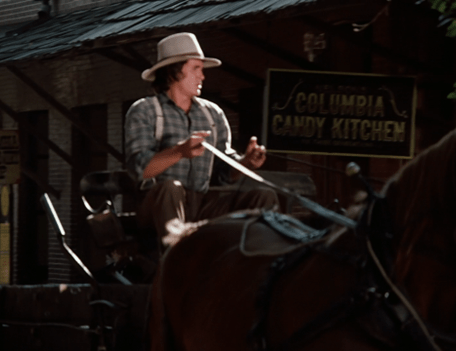
Columbia, modern-day South Dakota, about 200 miles west of Walnut Grove, did exist around this time. But since today its population is about 160 people, it seems unlikely it would have been a boom town in the Nineteenth Century.
Then again, neither would Columbia, Iowa, 350 miles south of Hero Township, if it even existed at the time, which it probably didn’t.

There is no Columbia in Minnesota, and our only other option, Columbia, Wisconsin, definitely wasn’t founded until the 1890s.

So I think we’ll just assume Charles is in Dakota Territory again. After all, he does say he’ll be gone “a couple of weeks.”
And I found a picture of Columbia, South Dakota, from 1912 that suggests it was a successful town at one point:

The real-life explanation for the Columbia signs is that this episode was mostly filmed on location at a place called Columbia State Historic Park in Columbia, California.
Similar to Alberta’s Heritage Park, which Dags and I visited last summer, Columbia SHP features preserved or restored historic buildings, reenactments, and the like.

Douglass Saloon – technically, Jack Douglass Saloon – is a real place there, though sadly it no longer seems to be open.

Nelson’s Columbia Candy Kitchen has had better luck. Still going strong as of spring 2025.

And I couldn’t find anything for “Columbia Carpenter Shop.”
Fun fact: Columbia State Historic Park will be the site of a cast reunion this June!

In a surreal scene, then, Charles enters some sort of small office where a man sits reading a book.

Posters on the wall advertise horse and tax auctions as well as a “marshal’s sale” of confiscated property, but I’m not sure that helps a great deal for determining the purpose of the business we’re in.
“Good afternoon,” Charles says, which gets no response from the reading man. (When I was in college, I worked a summer job at a gas station, and I would always get in trouble for reading on the job. I was about as attentive as this guy.)

Stepping closer, Charles repeats the greeting, and the man, without looking up, says, “What can I do for you?”
Charles says he’s supposed to see a man (named Harper) about a horse.
The clerk or whatever he is, who looks like W.H. Auden, is reading The Bleeding Hand Strikes Back, Laura’s favorite Farnsdale Fremont mystery.


(The copy on the back cover is worth noting. It’s titled “About the Author,” but if you actually read the words, they appear to be describing the plot of a 1946 movie comedy called Without Reservations. The story is about a woman named Christopher Madden who publishes books under the male pen name Kit Madden, or maybe vice versa – I haven’t seen it – and it starred Claudette Colbert and John Wayne. I would be highly surprised if it featured any bleeding hands striking back, though.)
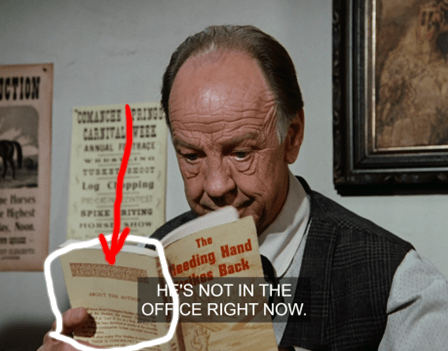

Behind the man is a poster for something called “Comanche Springs Carnival Week.” The only Comanche Springs I could find was in Texas.

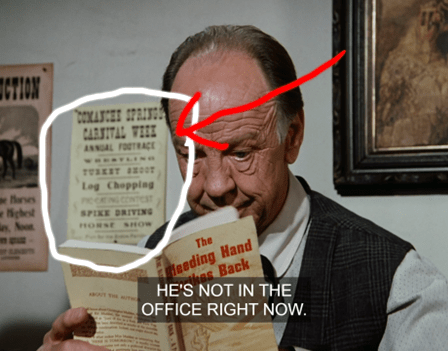
But maybe there was one in Dakota Territory too (even though there weren’t any Comanche people in the Upper Midwest) and it just didn’t stand the test of time as well as Nelson’s Columbia Candy Kitchen.

At first I thought Charles should tell Caroline about the Carnival, since at first glance I thought one of the contests listed on the poster was “leg chopping.”


But on closer inspection, it’s log chopping.
After some exasperated prompting from Chuck, Not-W.H. Auden tells him he’ll find Mr. Harper, the horse-trader, over at the saloon.
The Clerk is Bill McLean, who appeared on Gunsmoke, The Jack Benny Program, The Twilight Zone, Radames Pera’s Kung Fu, The Dukes of Hazzard, and many many many other TV shows.

Many movies, too, including Billy Wilder’s Stalag 17, and House, which was I’m pretty sure the first R-rated horror movie I ever saw, though it didn’t turn out to be a longtime favorite.

Well, Charles follows the sound of ragtime up the street, passing the office of the Columbia Gazette. (Also real, but defunct for about twenty years by 1885.)

On the sidewalk we see a man who resembles a genteel upscale Toby Noe, tipping his had to a lady.

There’s also another smiling elderly gent who’s smoking a cigarette (a novelty in 1880s America) and strutting like he’s cock o’ the walk, or something.
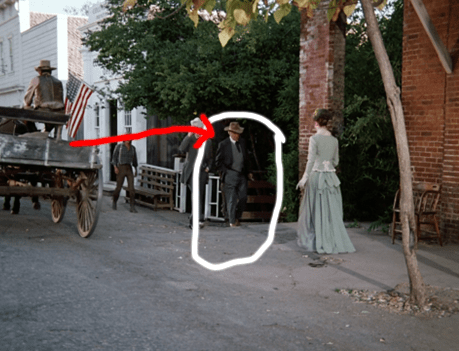
Entering the Douglass Saloon, Charles passes a sign advertising some performance by a Belle Bolton and someone named Ahmed (her accompanist?) at the Palace Theater. But I can’t make out anything more, so whether they’re musicians or comedy duo will have to remain unknown. (Belle Bolton doesn’t seem to have been a real person.)

There’s also a suspicious-looking little man who’s whittling until the Strutting Cigarette-Smoking Cock o’ the Walk Guy walks into his foot.


There also are photos of some boxers on the wall, but I can’t tell who they are. (Not Joe Kagan, though.)

Charles approaches the bar, where the Alamo Tourist From Pee-Wee’s Big Adventure appears to have had one too many.

Behind the bar are more boxer pics – including one that maybe is Joe Kagan. (Probably not, though.)

Before Charles can speak to the bartender, we once again hear the terrifying clicking of the Garthim!

They don’t break through the wall, though.
The bartender directs Charles to a back corner. I don’t recognize any of the other customers, though there is a guy who appears to be wearing 1970s eyeglasses.

There’s also a sign advertising a “Grand Colonial Ball.” Clearly Columbia is a hoppin’ town, like Winoka, only classier.

Charles finds Mr. Harper. A man of perhaps fortysomething, he’s hunched over a shot of whiskey whilst a prostitute strokes his elegant white sideburns.

Charles introduces himself, but Harper shows no recognition of the name.
Charles says, “I believe you had some correspondence with Mr. Gargan of Walnut Grove about buying some horses.” (So that first scene was in Walnut Grove after all. Did Hans Dorfler sell the livery to this Gargan person?)
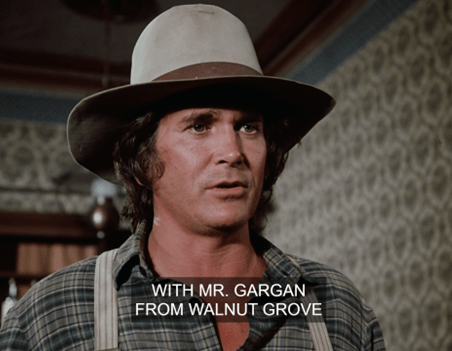
Harper, who has a very intense look about him, oh-yes-of-courses and invites Charles to sit down.

Unaccustomed to saloons, whiskey, or the company of sex workers, Charles politely suggests they discuss the matter during normal business hours the next day.
Harper clearly wants to buy Charles a bunch of drinks, and possibly some “strange” for the night to boot (as they used to say on Deadwood).

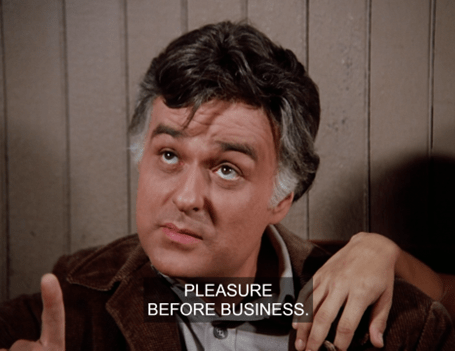
Charles again declines, saying he’s got to go check into his hotel.
But Harper says, “When you do business with Bret Harper, you stay at his place.”
Charles finds this odd, but agrees.

For a third time, Harper asks Charles to join them.
But Charles says he wants to take a walk around town.
Harper ultimately shrugs and says okay.
OLIVE: I ship them.

Bret Harper is played by Charles Cioffi, who would probably make my list of the five scariest villains in movie history, for his performance in a 1971 movie called Klute.
In Klute, Donald Sutherland is a detective who’s investigating a missing friend, and who teams up with call girl Jane Fonda to trap a serial killer. It’s normally considered a suspense film rather than a horror movie, but it’s real scary.


Cioffi was in many other things – mostly on television, though he was in Shaft (another iconic crime film as well as a Moses Gunn vehicle) and Newsies (hey).

Cioffi’s TV appearances include Kojak, Wonder Woman, Hawaii Five-O, St. Elsewhere, Simon & Simon, As the World Turns, The Equalizer, Thirtysomething, Murder She Wrote, Caroline in the City, Chicago Hope, and The Practice.

He had recurring roles on Days of Our Lives, Ryan’s Hope, and The X-Files.
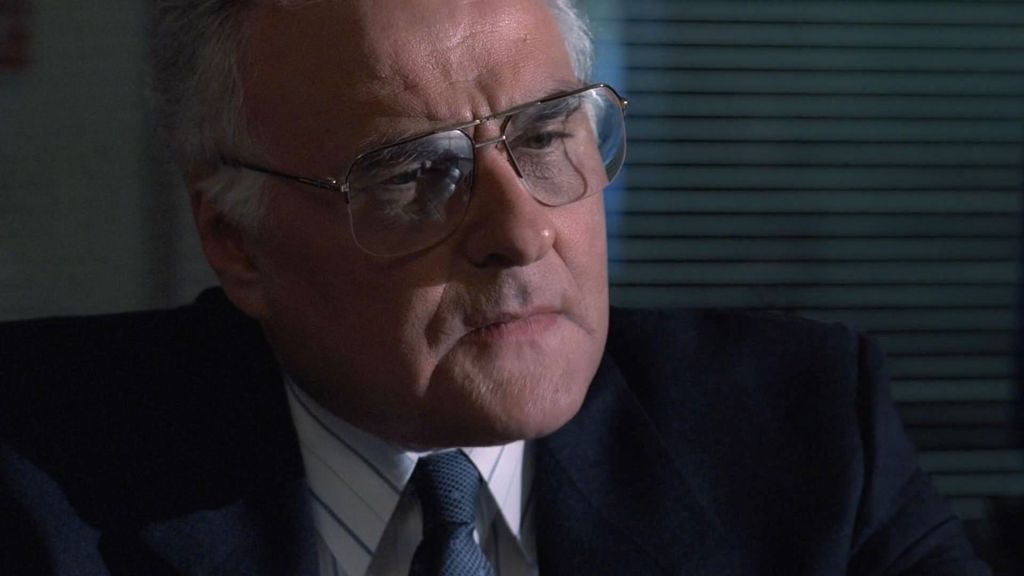
An audio sample of him from Another World was used for Pink Floyd’s The Wall.
He apparently has real Minnesota connections, having cofounded our famous Guthrie Theater in Minneapolis.

Olive and I were pleased to learn that as of this writing, he and his wife are still alive, and have been married for over 65 years.
Anyways, some time later, we see Charles (Ingalls, not Cioffi) sitting on a chair outside the saloon waiting for Harper to come out.
Harper eventually does, still accompanied by the saloon girl, who kisses him goodnight. (She doesn’t get a credit.)

Harper is very drunk, clutching a nearby fence as he tries to walk in a straight line.

Charles approaches him, but, again, Harper doesn’t recognize him.

Once reminded of their earlier conversation, he cheerfully suggests that Charles drive them both home.
At the house, which from its front hall looks rather grand, Harper staggers in, knocking over some figurines on a hall tree and breaking them.
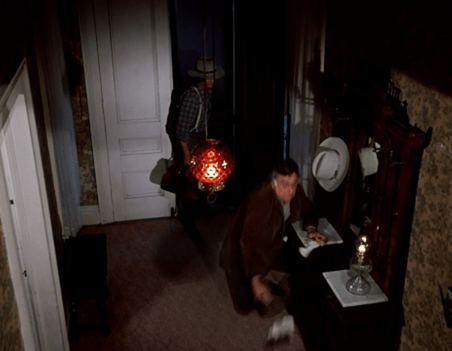
A thin, rather pallid woman in a dressing gown appears at the top of the stairs.

Making grotesque faces, Harper gets to his feet and climbs the stairs, saying, “Leslie, this is Mr. Ingalls. She’ll show you to your room.”


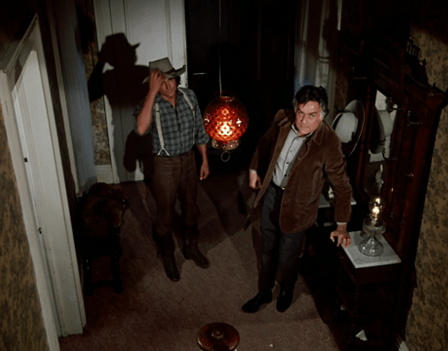
Leslie comes down to start cleaning up the broken statuary, and Charles makes an ill-placed joke how it must be difficult to have Bret Harper as her employer.

OLIVE: Why would he assume that? Look at that robe, she isn’t the housekeeper.
WILL: It is strange. Especially since he comes from a place where no one has servants. He wouldn’t walk in and make “sorry about the mess” jokes to the maid.
Without getting offended, Leslie introduces herself as Mrs. Harper.
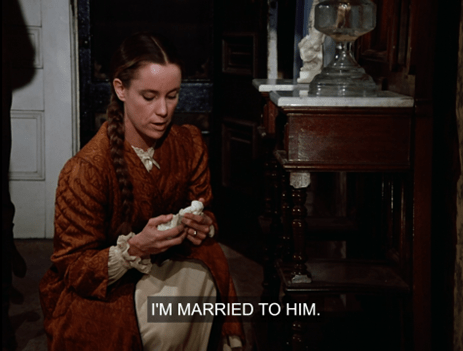
Charles looks surprised but doesn’t apologize, which I also find strange.

The next day, we get a squirrel’s-eye view of the house from the outside as birds warble and two smallish children, well, squirrel around in the yard.

The house is what you might call a Queen Anne or maybe Second Empire, if you’re the kind of person who goes around calling houses Queen Annes or maybe Second Empires.


From inside, Charles can hear that they’re playing “Witch.” (When we’d go camping when the kids were little, Alexander used to play “Witch” all the time; but his version meant toasting a marshmallow until it was literally nothing but cinders, saying, “Look, I made a witch!” and then eating it. He grew up fine, though.)
One of the Harper kids tries to give the other a time-out, but apparently “time-out” in this sense wasn’t used until the 1950s.

Charles enters the dining room, and he and Leslie Harper say good morning.
OLIVE: Wow, there’s an echo! They’re really filming inside this house, aren’t they?
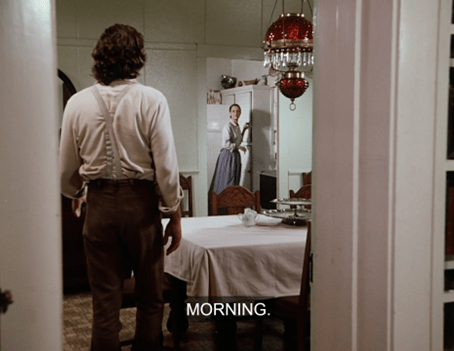
They are. It is an interesting effect – it sort of makes it seem like a different show. Maybe not cinematic, exactly, but more “seventies TV movie” than “seventies TV show.”

Mrs. Harper brings Charles some coffee, and he nobly tries to take the blame for Mr. Harper’s condition the night before.

This he does despite being famously sober, so much so that, if you recall, Laura even hesitated to give him whiskey as an anesthetic after shooting him in the chest.

Leslie, who in closeup is quite pretty though tired-looking, doesn’t buy it. She says there’s no need to say that, since Bret does it every night.

We hear the kids squabbling again, and Mrs. Harper steps out onto a very nice screened porch (my grandma had one) to check on them.

The kids are arguing over which one of them gets to hold the broom and be the witch.
OLIVE: They must have just seen Wicked.

The kids, a girl and a boy, are still at a little distance from the camera, but they’re close enough for any fan to recognize that the girl is Kyle Richards, our own Alicia Sanderson!

Whilst we have had many actors on this show performing multiple roles, this is the first time an ex-regular came back in a different part. (Ted Gehring and Don “Red” Barry did play other characters before they were introduced as Ebenezer Sprague and Jud Lar[r]abee, respectively.)

(I suppose if you want to be fussy about it, Ruth Foster also played Charles’s sister Ruby in the Pilot before taking on her eponymous role.)

I don’t think we did a full bio for Kyle Richards when Alicia was introduced, so let’s do a quick one here.

Today Richards is best known as a socialite who is, like her sister Kim (poor bullied Olga Nordstrom from “Town Party Country Party”), a featured “personality” on The Real Housewives of Beverly Hills. (I don’t understand the Real Housewives phenomenon, but since I like plenty of shitty shows and movies myself, who am I to judge?)

Young Kyle was a busy actor as a child, appearing in Escape to Witch Mountain with her sister Kim and on the TV shows Police Story, Fantasy Island, even Victor French’s Carter Country. (I don’t know why I say “even,” it’s not like Landon forbid the rest of the cast from ever appearing on it, as far as I know.)

Later, Richards starred on a sitcom called Down to Earth, about an angel who pretends to be a maid. I don’t think I’ve ever heard of that one.
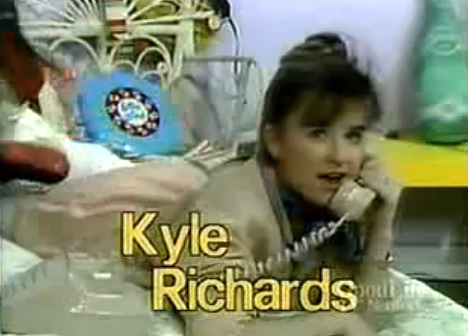
(Having watched that intro, I’m even less sure it’s real.)
(In another freak coincidence, Richards’s brother on the show was played by David Kaufman, who will take over the role of Alicia’s brother Carl a little down the road.)


Kyle Richards also appeared on 7th Heaven, ER, Days of Our Lives, and, you guessed it, Love Boat. (The Next Wave, but it still counts.)

Richards is a bona fide Scream Queen, having appeared in the horror films Eaten Alive (psycho with a pet crocodile), The Car (possessed car), The Watcher in the Woods (ghosts or aliens or something), and Curfew (home invasion).


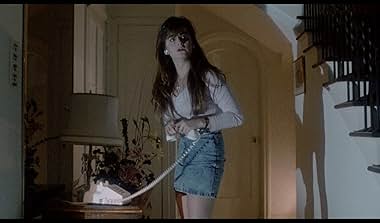
Most notably of all, to me anyways, she was Lindsey Wallace, the little girl babysat by Jamie Lee Curtis in Halloween. Richards has cameo appearances in a few other films in the series, including the most recent two.


She is the maternal aunt to Paris and Nicky Hilton, and has given a lot of money to charities including children’s hospitals.

As for why Alicia Sanderson and Samantha Harper might look so similar, it’s hard to say. Alicia is probably a bit older than Sam. If Alicia was six years old (Richards’s age in 1975) when we met her in “Remember Me” (set in 1878-A2), and this story is set in 1885(-I), that would make her at least thirteen now (or as old as 51 if we follow our timeline strictly – see Dating Controversies).
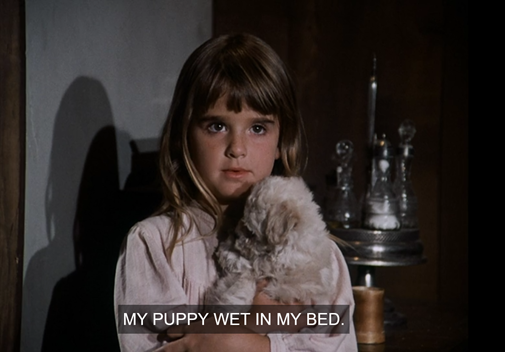
But Samantha Harper looks like she’s about 10 (Richards’s age in 1979), meaning she’d have been born in 1875.

In “Remember Me,” we aren’t told how long John Sanderson, Sr., had been dead, but since no mention is made of him having died recently I think we can assume it was at least one year previous.
That would make him still alive in 1874 (four years before Julia Sanderson learned she had cancer).
And since we know that, beloved as John Senior was by his family, he was also a Byronic antihero, it’s not out of the question he might have some illegitimate offspring scattered about. Perhaps he was doing some traveling in Dakota at that time.

(It would surprise no one to think John Junior inherited his uncontrollable sexual appetites from his father.)

Back to our story. Addressing Richards as “Samantha” and the boy as “Thomas,” Mrs. Harper speaks to them mildly.
Back inside, she and Charles laugh about the exhausting but fun task of raising small children. Quite true.

Charles says he’s gotta get ready for the negotiation with Mr. Harper, but Mrs. H says he won’t be up for a while and invites Chuck to stroll the grounds.
OLIVE: I love the house. It looks like it’s from The Music Man.


Charles walks over to a fence behind which is a herd of beef cattle (also huge).
OLIVE: Wow, a real herd of cows!
WILL: And real barns. Everything’s real in this one.

While Fagin the calf was described as being a Hereford, despite being the wrong color, these cattle are the genuine article.

Curious about the visitor, the kids stop playing witch and come out to meet him.
Charles greets them by their names, which he says he knows by magic, and Samantha cleverly replies, “Well, we don’t know magic, so you’ll have to tell us your name.”
OLIVE: I like how he tells people to call him Charles, even the kids. I doubt that’s historically accurate, though.
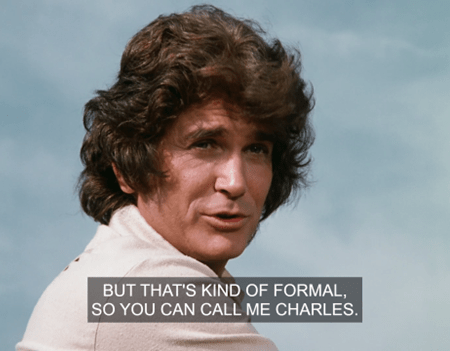
Charles the Father of Us All immediately bestows nicknames upon the two. Thomas quibbles about the appropriateness of “Sam” for a girl, but Charles says you’re the one pretending to be a female witch, dumbass. (Paraphrase.)

Thomas says he wishes their dad gave them affectionate nicknames. (He’s Bobby Rolofson, who was in The Apple Dumpling Gang Rides Again and on CHiPs.

Rolofson was in a lot of entertainments for kids in the final years of the seventies, including another series I never heard of called The Goosehill Gang. The latter was apparently a Christian version of The Bloodhound Gang, or something, and it was headlined by our own Allison Balson!)
[UPDATE: Tragically, Bobby Rolofson died on his sixteenth birthday while riding on the back of motorcycle driven by a friend. His mother La ura writes that “Bobby and Michael Landon developed a close relationship and remained friends until Bobby’s death.” Thank you for writing, Laura. He was terrific in this episode. – WK]
Samantha adds that because of their father’s illness (“he falls down and all”), they don’t like to bother him.
Charles looks at them sadly, and Mrs. Harper calls from the house that the kids shouldn’t bother Mr. Ingalls.
He calls back that they’re no bother, and, laughing, settles a dispute about which kid gets to be the witch next.
OLIVE: Nice conflict management, Charles.

Inside, Bret Harper has arisen.
OLIVE: Is his costume right? It’s kind of a modern look.
WILL: Yeah. Normcore?
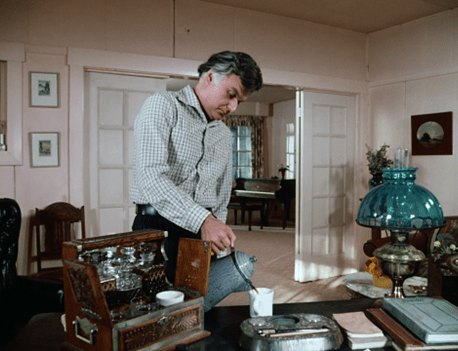
Charles comes in just in time to see Harper doctoring his own coffee with whiskey. (An interesting choice, since Michael Landon was known for drinking hard liquor from a coffee cup all day long whilst working.)

Harper asks Charles if he got a look at the horses, and he says he did.
OLIVE: Charles, you realize those were cows, right?

Unable to lie, unless it’s to foolishly protect somebody else, Charles says they’re wonderful specimens, surely worth more than he’s able to pay.
Harper reassures him he’s not going to cheat him, then apologizes for his manners and offers him an “Irish coffee.” (Mixing coffee with booze surely goes back to the Eighteenth Century at least, but it probably wasn’t called “Irish coffee” until the Twentieth.)

Charles declines politely, but Harper offers again, with the alcoholic’s refusal to acknowledge that most other people don’t drink like themselves. (As a recovering addict, I remember that feeling very well.)

Leslie Harper appears and says it’s time to leave for the picnic Bret promised the kids.
Mr. Harper has no memory of such plans and bites her head off, saying he’s too busy. What’s implied but not explicitly stated is that Bret doesn’t want to go because he won’t be able to drink on the picnic.
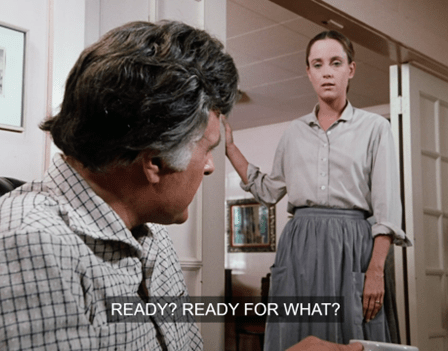
Charles protests that his business can wait, but Harper simply insults his wife, saying, “Isn’t it just like a woman? Wants all the things money can buy, but just can’t understand why her husband has to work all the time to pay for them.”
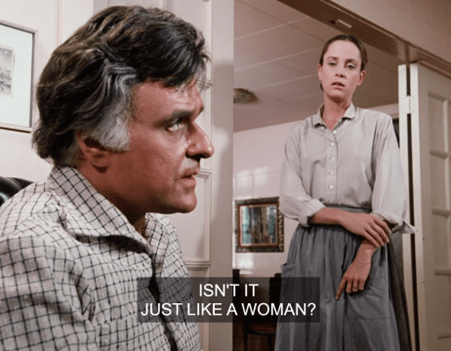
He’s quite nasty about it, and Charles sort of cringes, but Harper calms down and civilly tells him he can show him the best horses tomorrow.
Then he leaves for who knows where; and Leslie wrings her hands and disappears too; and Charles just stands there scheming about what to do with this unexpected domestic shit.

Well, he follows Mrs. Harper into the kitchen, and maybe this is a good time to point out that everything that happens from here on between her and Charles would have been considered outrageously improper for a man and woman not married to each other in the 1880s.

Charles compliments her on the smell of her cooking, and says he’d love to come along on the picnic if they’d have him.
She tries waving him off, but he insists.
Charles goes out and gets Samantha and Thomas all excited to go.
Then we get rather lovely location footage of Charles running around with the Harper kids near some large natural lake or river.

Chuck assigns them to go catch dragons. I have to say, while obviously pleasant, and possibly the best dad in the whole world, we’ve rarely seen Pa be this whimsical/fantastical with his own family.
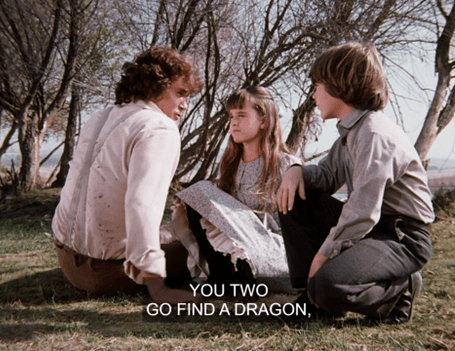
Pa says, “You’ve seen lizards, haven’t you? . . . Well, a lizard is nothin’ but a baby dragon!”
OLIVE: What lizards? In the Upper Midwest? They should have had a real Minnesotan on retainer to prevent mistakes like this.
I agree, and thought the same thing, but actually I guess there are a few species in these parts. Minnesota has some skinks, South Dakota has horned toads and the like, and Wisconsin has the slender glass lizard, which has no legs and can only be distinguished from a snake by its eyelids.


The kids run off, and Charles walks back to the picnic site, where he essentially spread-eagles his sweaty body right in Leslie Harper’s face.

Obviously needing a cooldown herself, Mrs. H pours out some iced tea as looks him over.
OLIVE: In modern lingo we would say, “She want that cookie real bad.”

Mrs. Harper says she supposes Charles has a wife and kids, which he confirms.
“Do you have them believing in dragons too?” she asks.
Charles says, “For as long as I can I will!” Then he giggles and for a second looks like the funny young man we met back in Season One.

Mrs. H says she can’t remember the kids having a better time, and Charles says it’s just the excitement of having a stranger in their midst. (This raises the question: Is Charles Ingalls the only fun person who’s ever stayed at their house? From what Bret H said, it sounds like there are people there constantly. But I suppose if they’re horse traders, they’re probably Ebenezer Sprague penny pinchers or Jim “Bull of the Woods” Tyler-type assholes. Neither are ideal for picnics.)


“The only other stranger they know is their father,” Lesley says, then adds, “I’m sorry – I’m afraid I’m not much fun at picnics.”
OLIVE: I think she’s good.
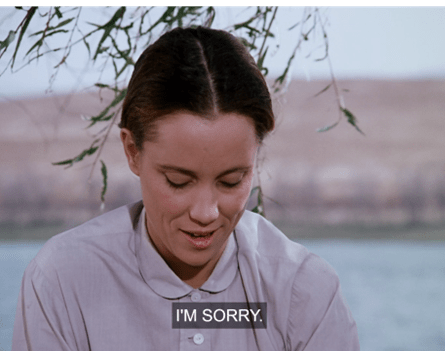

Me too. She’s Jenny Sullivan, who was in The Towering Inferno, Mod Squad, All in the Family, Rod Serling’s Night Gallery, Sanford and Son, The Waltons and Cannon.
Here she is with some of her leading men:


She had a featured role on V, which I loved, but which terrified me in 1983.

Her personal relationships are interesting: married to Jim “Loggins and Messina” Messina through the 1970s, and onetime sister-in-law to Jimmy Webb, who wrote “Wichita Lineman” (a favorite of Dagny’s) and “The Last Unicorn.”
(I loved that song when I was five.)
Leslie Harper starts talking about her marriage, but hesitates because Charles is a stranger.
“You know, sometimes it’s easier to talk to strangers,” Charles says, and leans closer to her with a shiteating grin.
WILL: Ol’ Busybody Chuck can’t wait to get the dirt. Look at him, he’s practically salivating for it.

As David Rose gives us some gentle music, Leslie gives us her tragic story. Bret was once a happy, doting father, but when their eldest child Michael (his favorite, it’s implied) was killed in a riding accident, he fell into severe depression and addiction.

Leslie says the horse just stumbled, but Bret blames himself and can’t forgive himself.
(Michael Harper is said to have died four years earlier, which throws our is-John-Senior-Samantha’s-real-father theory into question. (If Michael’s accident was in 1881 and the Harpers were happily married until then, it’s unlikely Leslie would have had an affair with Sanderson in 1874.))
Charles surprises Leslie then (and me too) by talking about Baby Freddie, who died when Doc Baker fed him cow’s milk. (He doesn’t mention that part, though.)


Chuck calls Freddie “Charles Junior,” even though technically he wouldn’t have been considered one, since their middle names were different.
He describes the events as taking place “about five years ago.”

In both real life and our TV timeline, Charles Frederic[k] Ingalls died in 1876. Since it’s unlikely Charles would have gotten the date of Freddie’s death wrong by four years, I think we must have time-jumped again, which would put us back in the spring of 1880-J. (This would make Samantha born in 1870, so that wouldn’t affect our John Senior paternity theory at all; but I don’t think an illicit Sanderson/Harper tryst would have been any likelier in 1869 than in 1874. In other words, John Senior being a horny brooding poetry-spurting libertine is probably a red herring.)

Leslie and Charles discuss coping strategies, with Charles noting he wouldn’t have gotten through the experience without his faith.
And when Leslie asks how he kept from losing that faith, he simply says he did it by “wanting to believe.”
The kids suddenly yell that they’ve caught a dragon, and as he goes to see, Charles says to Leslie, “You can even see a dragon if you believe hard enough.”
OLIVE: Oh, boy . . .

The camera pulls back from lovely Leslie sitting by the water under the trees.

That night, Charles and the three Harpers (not Bret) sit around the table.
OLIVE: The house is great, but sometimes it’s hard to make out the dialogue with the echo.

Others have noted you can see some modern light switches on the walls at times throughout this story. (A hazard of filming in a real house, I suppose.)

It’s bedtime, but Samantha and Thomas complain that their dad’s never home before they go to bed.
Omnipotent Charles takes things over then, saying he’ll “tuck you in and give you a little dream to dream.”
OLIVE: I think that’s weird. I don’t like that.

Up in the kids’ bedroom, Samantha cruelly exposes Thomas as a bedwetter, but Pa says so what, I was too.


He says there’s nothing wrong with that, and assures Thomas he’ll grow out of it. (Quite right he is, too.)

Then Pa says “I’m gonna give you that dream,” and begins spouting a wacky flight of images.

When he says this dream will be set “up in the clouds,” Samantha stresses out, worrying in the dream they’ll be dead and in Heaven. (Did Kyle Richards have it in her contract rider that her characters need to have panic attacks about Heaven?)
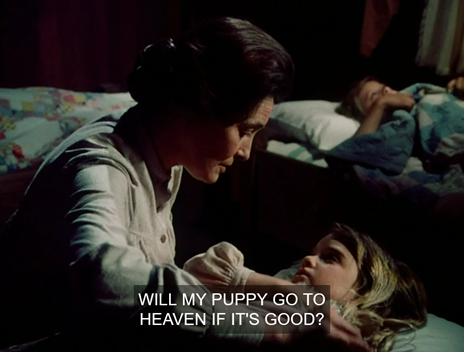


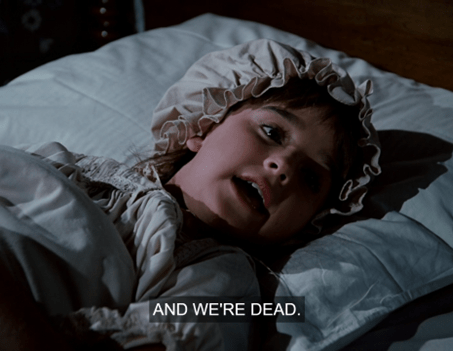
Pa continues his bizarre phantasmagoria, which involves clouds that are marshmallows but also pillows.

WILL: He never told the girls idiotic stories like this. Well, you know, he did once and it seemed weird then too.

As Pa heads out, Thomas calls him back and asks quietly if it’s really true he wet the bed.
Pa assures him it is, and bids him goodnight.


As others have remarked, this is an interesting inclusion, since Michael Landon’s mom famously shamed him for wetting the bed by hanging his sheets out the window for all to see.
I think it’s quite nice he included it.

Downstairs, Charles finds Leslie Harper deep in thought on the screen porch.
WILL: Is that a scar on her forehead?
OLIVE: Probably a papercut.

Leslie apologizes for venting at the picnic, and Charles says, “We all feel sorry for ourselves sometimes. I know I do.”
WILL [as CHARLES]: “I also wet the bed.”

Charles says despite what most people think, being happy doesn’t come naturally, it takes work. This is good advice, I think, though often hard to follow, for me anyways.

Leslie says it used to be easier, but she’ll work at it.
“It’s never too late to try,” Charles says, and they look at each other.
WILL [as LESLIE HARPER]: “Take me to bed!!!”

OLIVE: She’s complaining about being unhappy, but at least she doesn’t have to worry about internet brain rot and AI.
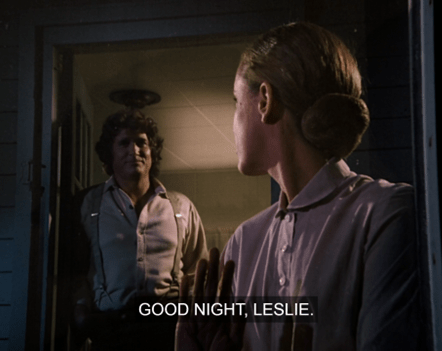
The next morning, Bret Harper, Charles and some underling ride out to see (stock footage of) Harper’s horses.

Charles can’t believe how many of them there are. It would be quite a sight (if it weren’t just stock footage).

Bret Harper is apparently a bigtime trader, because he says he’s supplying the U.S. Army with a thousand horses.
Harper, who’s chewing tobacco (a rare thing on this show since Victor French left), asks his underling, whom he addresses as “Rod,” to pick out ten of his best horses for Charles.

(Rod is Rod McGaughy, a veteran stuntman with a very distinguished resume, which includes all the old Westerns – Bonanza, Gunsmoke, The Rifleman, Rawhide and The Virginian merely scratch the surface – as well as The Waltons, Kung Fu and many other TV shows.)

(He was in a lot of interesting movies, too: Westworld, Paint Your Wagon, Blazing Saddles, The Man Who Shot Liberty Valance, and Night Moves, an interesting early-ish film starring Gene Hackman (R.I.P.) as well as Harris Yulin, the child-abusing alcoholic from “Child of Pain.”)

(Rod McGaughy was apparently a stuntman and extra on several other Little House episodes, but so far the only one I can line him up with is “There’s No Place Like Home,” where I believe he can be seen playing one of the Winoka firefighters.)

Well, Rod the Underling says “Get right at it, sir,” and rides down the hill a little.
WILL: Does the horse trip and kill the guy and the dad’s like, “NOOOOOOOOOOOO!”

(The three men are all riding Bunnies, by the way.)
Back inside, Leslie Harper is cooking lunch for the crew, and Charles sidles up behind her, some might say flirtatiously.
OLIVE: Is he gonna kiss her neck?

The stove is a very nice model – we can see “The South Bend” is etched on one of the oven doors, so we can deduce it was made by the South Bend Range Company. Based in South Bend, Indiana, it still exists today.

However, it wasn’t formed till the 1890s, and didn’t start using the name “South Bend Company” until ten or fifteen years later.

In an outrageous innuendo, Charles says he’ll take her pie out of her oven for her.
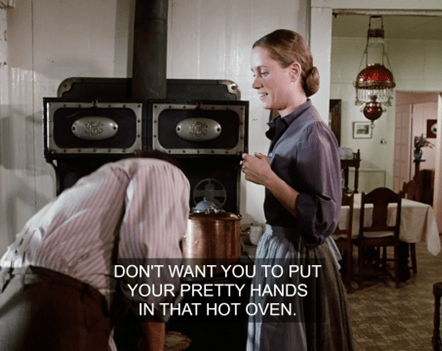
His explanation for helping is he doesn’t want her to “get your pretty hands dirty.”
Leslie says no one’s called anything about her pretty in years.
OLIVE: Girl, stand up! Stand up!

She kind of slinks up to Charles, but he just smiles naively and hands her a kitchen rag.

Leslie stares after him as he exits, playing with the buttons of her blouse.
WILL: Oh my God, she’s disrobing!

No, she isn’t. Instead, she goes to the mirror and starts pulling at her hair.

Later, Charles comes back in and looks into the kettle on the stove.
“Bret?” Leslie calls from the other room.
WILL [as CHARLES]: “Bread? Nah, looks like stew, heh heh heh.”

Charles says he’s very hungry, and Leslie appears, dressed in a rather beautiful dress and with her hair done.
OLIVE: Oh, she looks so nice!

“I could serve ya up a little to tide ya over,” she says, smiling.
WILL/OLIVE: . . .
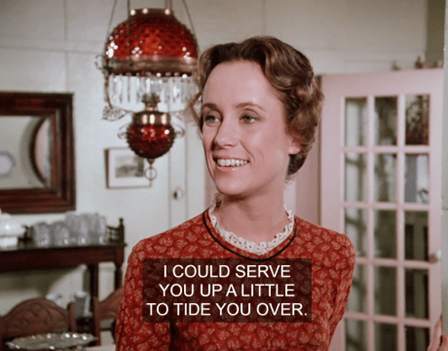
Charles stops and stares at her, saying, “Well, look at you.” It’s an interesting inversion of the scene in “For My Lady” where Caroline puts on a new blouse and lemon verbena and Stupid Chuck pointedly does not notice.

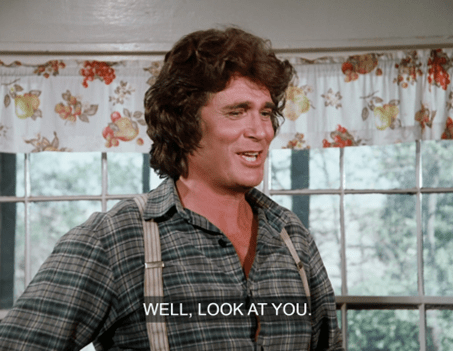
Well, “Stupid Chuck” is exactly the role Bret Harper gets to play when he comes in.

Hurt and embarrassed, Leslie goes outside, and Charles follows her. “I just . . . don’t exist anymore,” she says.
OLIVE: I think she’s prettier than Caroline. Don’t put that on the blog.
WILL: Okay.
OLIVE: I’m glad Amelia isn’t here, she’d be all like, “Don’t compare women’s looks, you’re a bad feminist!!!”

Thomas comes running up, and finds the two of them in a very indiscreet position, for the time.
OLIVE: He’s holding her arm? That’s weird.

Thomas tells his mother that Samantha was invited by someone named Patty Benson for a sleepover, and Leslie says that’s fine.
She goes inside, and Thomas tells Charles they know how unhappy their mother is.
So Charles takes Thomas for a Bunny ride along the lakeshore.

Thomas says since his brother Michael’s death, his dad won’t let him ride a horse at all.
I think you can all see where this is going.

Thomas asks about Charles’s father, and Pa tells him he’s passed on. (We dated TV Lansford’s death to 1879-C, though in real life he lived until 1896.)
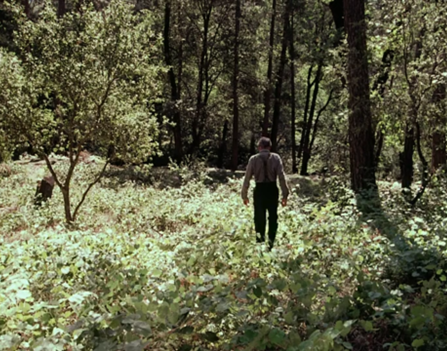
Then they have a pretty stupid conversation about Pa’s “I dreamed a dream” BS.

When they get back, Mr. Penguin Man, now apparently in Bret Harper’s employ, says Thomas has been missed.

Harper comes out and shakes Thomas, saying, “How many times have I told you not to get on a horse?”
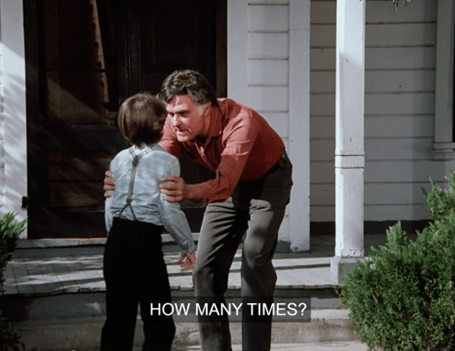
Charles protests, but Harper shouts him down and slaps Thomas across the face. (Looks pretty real.)

Thomas runs crying to hug Charles.

Pa tells Thomas to go into the house, then angrily challenges Harper about striking the boy. (He’s come a long way since the lady slapped her kid on the train and he just laughed.)


At the risk of jeopardizing the Gargan deal, Chuck goes even further.

But Bret Harper just scowls and lets the matter drop.
Inside the house, Harper marches past Leslie and the crying Thomas and heads straight for the liquor. (In a nice touch, the first bottle he picks up is empty, so he grabs another. Kingsley Amis once observed you can always tell an alcoholic at a party, because their glasses are always empty or full.)

But in a sudden burst of courage, Leslie Harper takes the (second) bottle and smashes it on the floor.

Harper sends Thomas to his room, then yells at Leslie in disbelief.
She screams back at him, building up to “Michael wasn’t your only child! Or did you forget that?”
WILL [as JULIE ANDREWS]: “Oh, the children just want to be loved! Oh, please won’t you love them, Captain!”

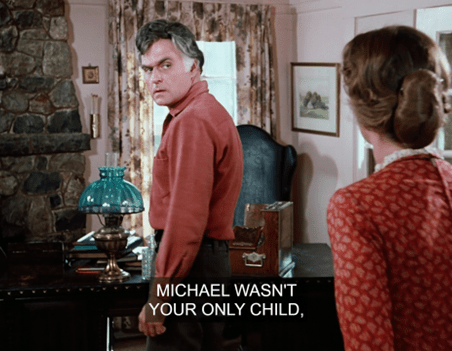
“I told you never to mention my son’s name,” Harper says, and Leslie hisses, “Your son? I was his mother.”
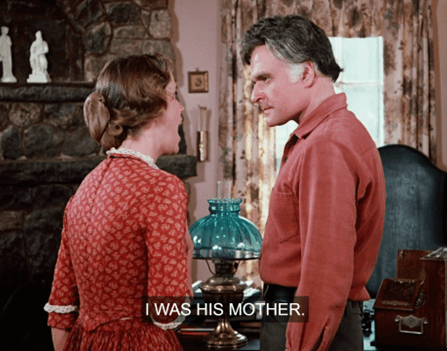
For all his slapping of Thomas, Harper seems more uncomfortable than genuinely angry during this conversation, as if he just wants everyone to go away and let him drink, which I’m sure he does.
Leslie screams that if he can’t be a husband and father anymore, they’ll leave him.
More pathetically than angrily, Harper says, “Leslie – don’t leave me.”
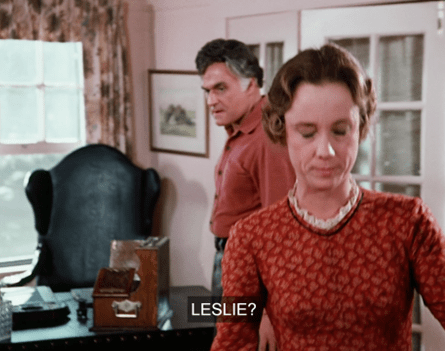
Leslie says he’s had more than enough chances, adding, “A stranger came to this house, and in a few days gave your children more love and understanding than you’ve given them in four years.” (If there’s one phenomenon Little House consistently gets right, it’s depression.)

“So it’s Ingalls,” Bret says, but he doesn’t really seem jealous.
I’m not sure what to make of Charles Cioffi’s performance in this. He underplays the part, a rare thing indeed on this show.

Admirable as this is, it makes Harper seem remote and inscrutable rather than like a man on the edge. Maybe that’s the point, but it might be too understated.

“He’s the reason why you’re leaving, isn’t he?” Harper says, and Leslie says, “I’m leaving because I have to.”
OLIVE: She should have said, “No, the reason is you.” That would have been a stronger comeback.

That night, Charles sits smoking his pipe and reading the paper in his bedroom.
There’s a knock at the door – it’s Leslie.
She tells Charles none of this is his fault, and she’s decided to leave Bret.
OLIVE: Is Charles going to invite them all back to live at the Little House? That would be a total Charles idea.

She asks if Charles will give them a ride into town the next morning. She says simply that the children “need someone to love them” – and she does too.
OLIVE [as LESLIE HARPER, whispering]: “My room’s on the right at the top of the stairs.”

Quietly, Leslie says she’s not leaving her husband because of Charles, but she adds “I do envy your wife” before bidding him goodnight.
OLIVE: Aw, that’s sad.

The next morning, as Charles hitches up the Chonkies, Samantha and Thomas come out and tell Charles to give them the straight poop.

The kids tell Charles their dad isn’t actually sick – he’s an alcoholic because he’s sad.
“But you can help him, Mr. Ingalls,” Samantha says.
WILL [as CHARLES]: “Well, I did cure an alcoholic once. He was crazy, thought he had bats crawling all over him. It was about five years ago.”


Then Thomas asks Charles to give their dad “a dream to dream.”
OLIVE: Ugh, enough already. . . .

Charles implies he can’t, then immediately heads inside to try.

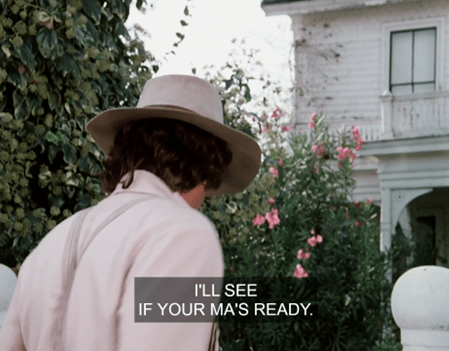
Charles and Harper complete their business transaction civilly, and Harper says he’s been chewing over ideas for getting Leslie to stay, but none of them seem good enough.
“You just can’t make another person love you,” he says, and Charles replies with bitterness, “You never really tried, did you.”
Instead of getting angry, Harper simply says, “No. Not since Michael died.”

He goes on to say he can’t ever forgive himself for what he did.
It’s actually Charles who gets angry, then, saying, “Do you think you’re the only person in this world who’s ever suffered?”
Charles lectures him a while about how he may think he’s punishing himself, but he’s actually punishing his family.
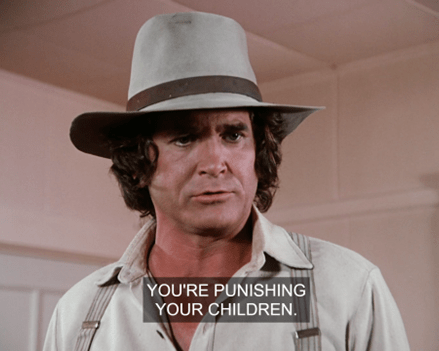
Harper tells him to go away, and Charles says, “You know, you don’t love your wife. You’re just afraid of being alone.”
Harper replies, “I’m not afraid of being alone, Ingalls. I spent the past four years working very hard at being alone.”

Charles leaves then, but something about Harper’s lack of anger must have touched him, because he goes to Leslie and says they need to talk. (There’s a big gross fly on his shoulder.)

Charles shocks Leslie and all us viewers at home by saying Bret “loves you and you love him” and she should give it another try.
[OLIVE’s jaw drops.]

Charles says if that isn’t true, Leslie should say it out loud.
WILL [as CHARLES]: “Say it! SAAAAAAAY IIIIIIIIIIT!!!!!!”


He grabs her by the face, then gives her a patronizing lecture.
OLIVE: Hm, I loved this one up until this scene.


Charles reminds her that people need to work at being happy, and says, “I think your husband’s ready for that work.”
OLIVE: I don’t know why he would think that. Because he hasn’t had a drink in one minute?
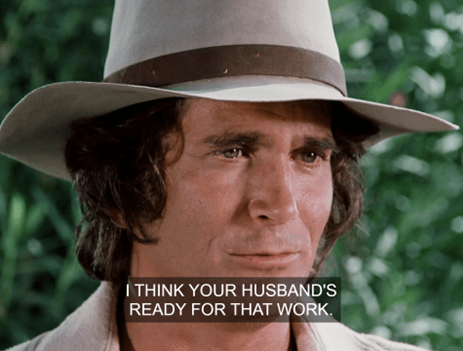
Leslie crumbles, though.
WILL: Do you think Mrs. Oleson will hear about this story and revive Harriet’s Happenings?
OLIVE: She’s probably in the bushes right now.
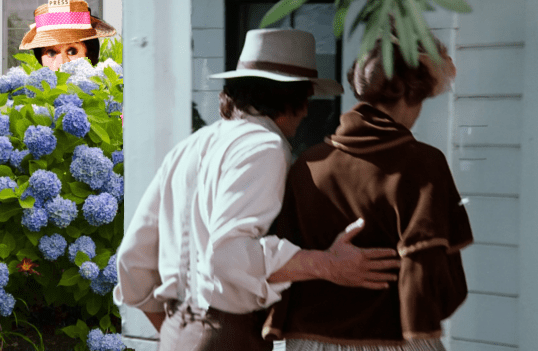
Leslie goes back in. She says she’s not leaving, and Bret says he’ll try to be better.
Busybody work done, Charles goes out and tells the kids the “good” news.
After an emotional goodbye, the kids go running in, Thomas even yelling, “I love you, Charles!” to his bedwetting BFF.
OLIVE: Oh my Gawd . . .

Charles drives away, followed by the ten fine horses.
OLIVE [as VOICEOVER LAURA]: “Both kids were killed in a wagon wreck the following week. . . .”
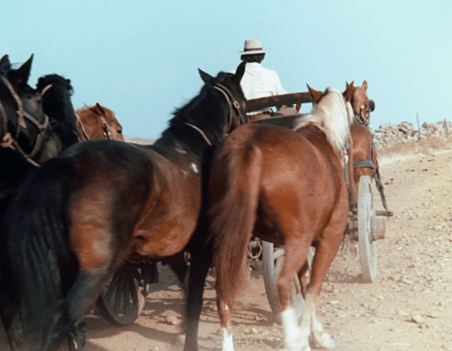
Actually, Voiceover Laura tells us Pa kept up a friendly correspondence with the Harpers, who reconciled successfully, and even had another child: Charles Michael Harper.
OLIVE: You’ve gotta be kidding.

STYLE WATCH:
The Harper house has some cool wallpaper, and there are roses on the stairway runner.


Thomas Harper wears the same robe we’ve seen both Albert and Willie wear.

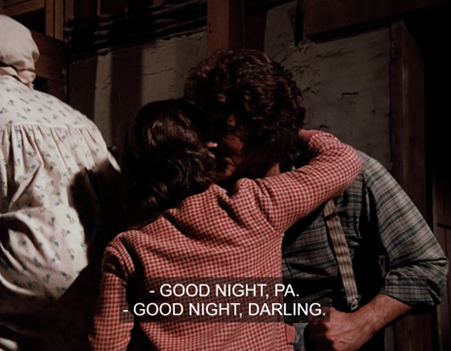

The Real Pinky is back in this story, and Charles appears to go commando again.
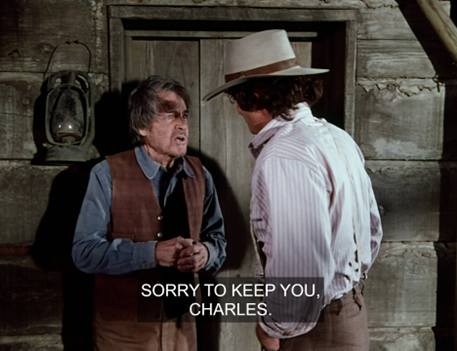
THE VERDICT:
OLIVE: I liked that one, except for the ending. It’s not that he told her to stay, it’s that the husband didn’t have any real character development. I don’t believe he would be changing.
WILL: I agree with you one hundred percent. Otherwise it’s a great story.
It’s a unique episode, one whose beautiful location filming makes it feel a bit alien from the world of Walnut Grove. Landon and Jenny Sullivan are terrific, and the script is moving and deep. But as Olive said, the resolution remains unconvincing.

UP NEXT: Mortal Mission
 Walnut Groovy
I am so sorry for you that you missed out on Down to Earth! I didn’t click on the link, but I can still hear the theme song in my head, and I haven’t seen an episode since at least 1988, right?
I always thought this episode must have had some shared mental space in Landon’s head with Landon’s own affair which must have been starting around this time. Maybe the affair is why he shot this episode in a new location without any of the rest of cast!
LikeLiked by 1 person
You know that is possible. Think about it; Charles was next to perfect but of course, like everyone else, Michael Landon wasn’t. He smoked too much, drank too much, & while he was definitely a great dad to his kids he wasn’t able to stay faithful to his first two wives.💁🏻♀️
LikeLiked by 1 person
When I saw the blacksmith it made me think of the actor who played Jacob in the “hundred mile walk” which I believe was in season one. I’ve always liked this episode, but I also agree that it’s ibetter to leave than to stay in abusive relationship like this. But you know it is TV so there’s gotta be a happy ending.
The next episode is a doozy!🐏🐑
sorry I had to blow your mind with that AI little house on the Prairie🤯
LikeLiked by 1 person
I watched the Bonanza episode that inspired this one ages ago, and while I remember very little of it, I have a vague memory of the equivalent father from there looking more pitiful and pathetic than here, making it a little easier to feel sorry for him than for Brett, who comes off as hard to feel sorry for compared to his suffering wife and children. The show usually has an optimistic view of family relations which often helps make these resolutions where a wrecked marriage reconciles, but I think it reaches the limit of suspension of disbelief here, among other things, because not only is the father never given any kind of depth, what’s shown of him doesn’t really paint him as a redeemable soul. Not only is he arrogant and neglectful, he’s implied to cheat on his wife, making it all the uarder to root for his family keeping together.
Ironically, while this story uses one of the actors from the Edwards family with little concern if viewers would be reminded of them, the backstory here predicts the Edwardses’ fate when Mr. Edwards comes back to the show: the eldeston son dies, the patriarch falls into alcoholism out of grief and destroys his marriage along with his relationship with his surviving kids. I wonder if the writers took inpiration from this episode when they had to come up with events bring Isaiah back to the show but write his family out.
Another tragic event this episode predicted was that Bobby Rolofson the actor who plays the son, had a similar end as his character’s deceased older brother: he died from a bike accident, in his 16th birthday.
LikeLiked by 1 person
The similarities to the Edwards storyline didn’t occur to me, but of course you’re right. I think this one could have worked better if they had expanded it to a double episode. (Usually I say the reverse!) They could have used the extra time to humanize Harper, which is quite badly needed for the ending to work. As much as I liked Charles Cioffi in Klute, I think his performance here is part of the issue too – it’s clear he doesn’t want to play Harper as a villain, and yet he doesn’t really seem to have figured out exactly where to take him instead. I think more time might have helped.
As for Bobby Rolofson, I saw that too. I originally mentioned it when I was writing this, in fact, but took it out, as I found it too much of a bummer. The poor family . . . I can’t imagine. Very sad. I think he was pretty good in this story, too.
LikeLike
I’m Bobby Rolofson’s mom. Bobby was killed by a drunk driver on his 16th birthday. Thank you for mentioning him. Bobby and Michael Landon developed a close relationship and remained friends until Bobby’s death.
LikeLiked by 2 people
Thank you so much for this comment, Laura. Bobby was great in this story. ❤️
LikeLike
For some reason I always hated this episode. The wildly inappropriate familiarity Charles takes with the family, combined with social worker Charles just bugs me. The happy ending is horrible. 🙄
Another thing that is a bit of a pet peeve for me: I know Leslie Landon is sprinkled throughout the series. Michael Landon must like the name Leslie. But as a 20th Century Leslie, hearing my name used for females in the 19th Century just… feels so very weird. (I am named after my great-grandfather.) Perhaps there were girls of that name back then, but to me it was a boy’s name until the 20th Century.
LikeLiked by 1 person
Well, I’ve noticed a pattern in my own responses to these stories, and it’s that I often remember hating the episodes that only lightly feature our regular Grovesters, or, like this one, that focus only on one regular. The Toby Noe stories, “The Fighter,” “The Man Inside” and “If I Should Wake Before I Die” are others that come to mind.
That said, I admit that as we go through the series in this formal, sequential way (after neglecting those “standalone” stories for many years), I’m often finding I enjoy them much more than I remembered. “The Man Inside” is kind of a (belly!) flop, but the other four I mentioned I ended up liking quite a lot, and even “‘Someone Please Love Me'” wasn’t nearly as bad as I was expecting. (Though I agree with ALL your specific criticisms of it!)
As for Leslies, I once met the soprano Lesley Garrett after a performance of Orfeo ed Euridice, and she was very nice. I’m sure you know more about your own name than I do, and glancing at a list of famous Leslies, it does looks like you’re right, the ones born in the Nineteenth Century tended to be male, not female. Whether that is more a reflection of naming practices of the time or the fact that men were more likely to become famous back then, I couldn’t say, though. . . .
LikeLike
I have come to love your “Style Watch!” I was quite proud of myself for spotting the Willie/Albert/Tom robe 🙂
LikeLiked by 1 person
Thank you! I know “Style Watch” is a silly thing to call it, but somehow that’s where I wound up. Thank you again for reading. ☺️
LikeLike