
Et Tu, Mustache Man?
(a recap by Will Kaiser)
Title: Freedom Flight
Airdate: December 12, 1977
Written by Ron Chiniquy and Richalene Kelsay
Directed by Michael Landon
SUMMARY IN A NUTSHELL: Some of our beloved Grovesters are revealed as vicious racists when a band of Dakota comes looking for help.
RECAP:
WILL: Wanna watch another Little House? We’ve got one to catch up on.
DAGNY: Maybe.
WILL: . . . Giving up on The Project so soon?
DAGNY: Ha! No. Okay.
WILL: Call it up, Roman.
ROMAN: What’s the next one?
WILL: “Freedom Flight.” Or is it “Freedom Fight”? I can never remember.
It’s “Freedom Flight.” And oh dear, it’s another racism one. I’ve said before that I don’t particularly like doing these, not because I don’t think it’s a worthy topic for Little House, but because I don’t wanna offend anybody.
I hate to think of someone being hurt because I’m an old white guy who’s clumsy with words and has a warped sense of humor.
Believe it or not, I also don’t really wish to annoy people who have different values than my own and who view my interpretations of these stories as “political preaching.” (We’ve received more complaints from this camp than from the other . . . for now, anyways.)
I think anybody who’s dipped a toe into the Little House fan phenomenon is aware the show attracts people from all ideological backgrounds and “from all walks of life” (to use an expression I despise). That’s one of its great strengths.
But those who want to pretend the show is some kind of 1870s artifact without a viewpoint of its own simply aren’t paying attention to it.
And I find it odd that for some people, analyzing (or goofing on) the historical or aesthetic elements of the show is just dandy, but discussing the social commentary is a dealbreaker. Why should that be off-limits? It’s a huge part of the show; in fact, my understanding is there was this guy called Landon who sort of wanted it that way.
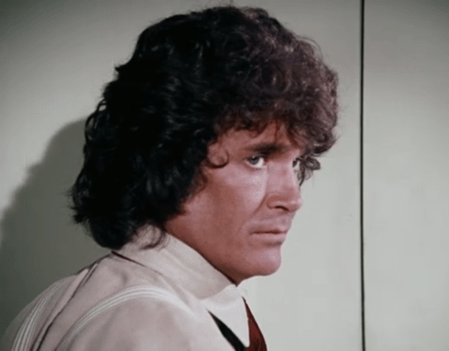
I’ve also said before that I’m sure Walnut Groovy contains something to annoy everyone. So I ask you, reader, to pardon my offenses; I hope you can overlook them and soldier on with us. (I want this to be fun for everybody.) If you can’t, of course I wish you the best as you look for something that’s a better fit with your sensibilities.
And your complaints are always welcome, even if I don’t act on them. Keep those cards and letters coming!
Now let’s begin. We start with David Rose at his most terrifying, as a lone rider descends a hill.
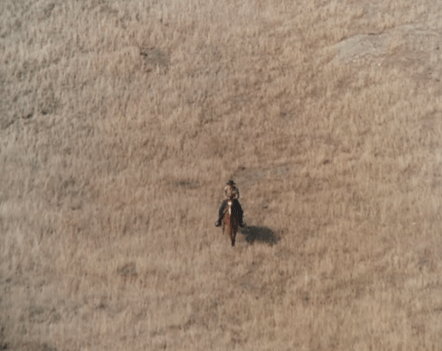
While the rider looks to be a youngish white guy, the music can only be described, sadly, as “Mondo Tonto.”
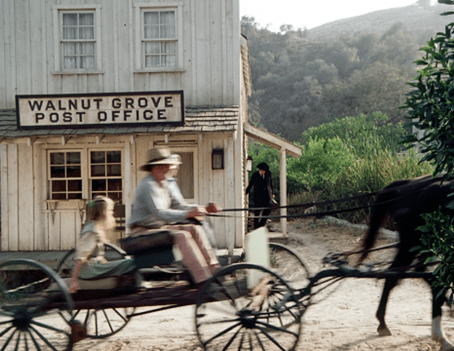
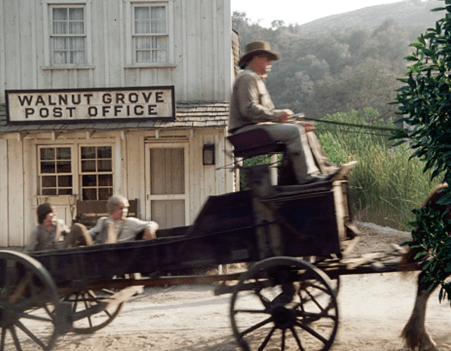
Meanwhile, to town, Doc Baker is a-readin’ his mail in the thoroughfare as Mustache Man and Carl the Flunky pass in a wagon. (This episode will not prove the latter two’s finest hour, but I’m getting ahead.)

A couple other gents are hangin’ out on the Post Office porch, but I can’t tell who they are.
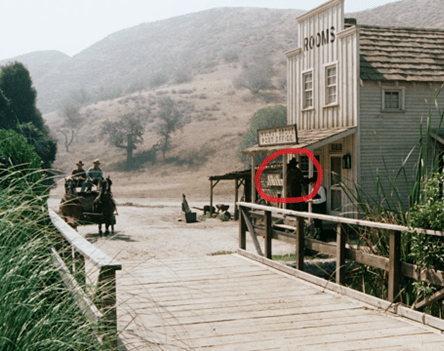
Now, there’s an optical illusion here that I can’t quite figure out. Carl’s wagon is rolling down the thoroughfare quite slowly, and we can see there’s nobody on either side of it in the background, or on the hill.

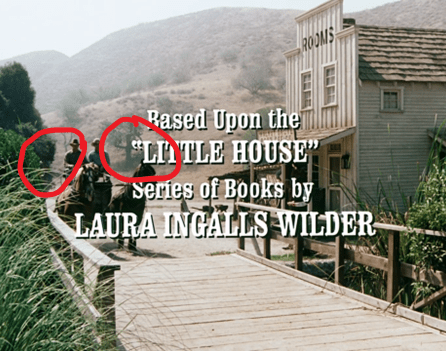
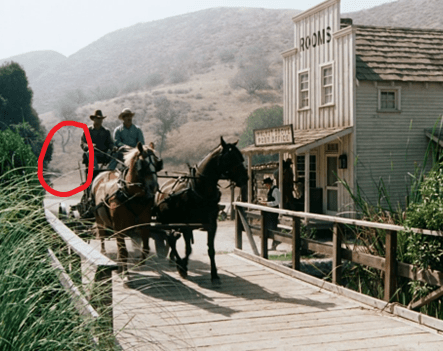
But when the wagon passes through, it reveals the youngish whitish Grovester racing down the bottom of the hill in the middle of the shot, without a cut. Where did he come from? It’s a good trick.
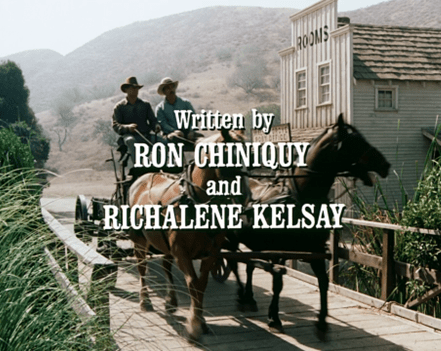

Youngish Whitish is screaming “Indians!” Without a cut, he crosses the bridge into town at very high speed, attracting Jonathan Garvey’s attention.


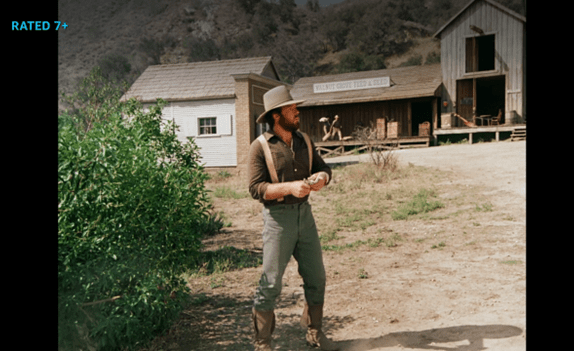
Youngish Whitish arrives at the school, veritably tripping over himself to ring the emergency bell.
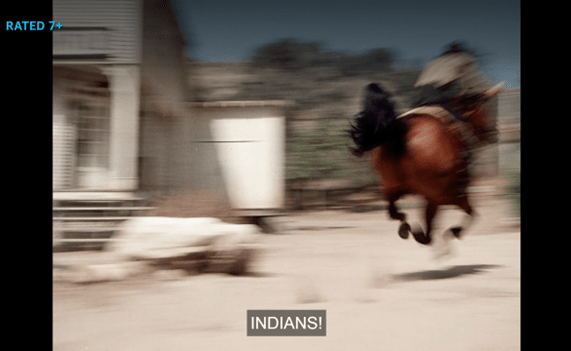

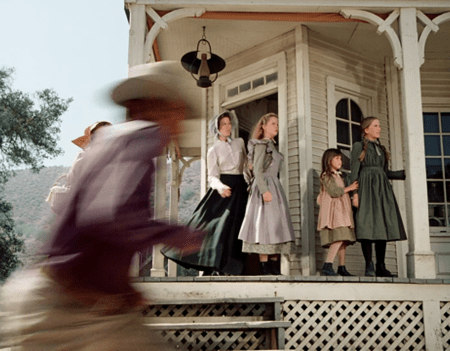
People at the Mercantile, including the French Maitre D’-Lookin’ Guy and a highly refined-looking blonde woman I don’t think we’ve seen before, look on.
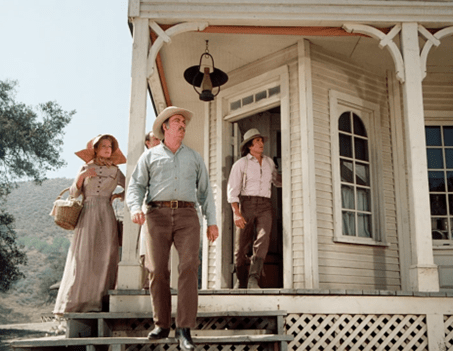
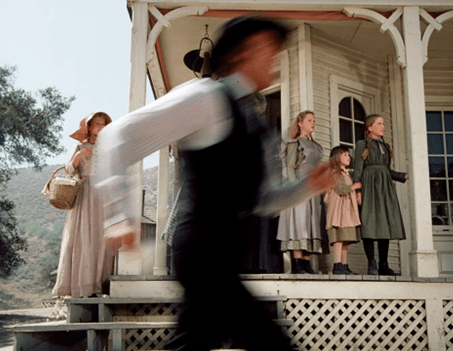
Charles and the Ing-Gals emerge from the store with Nels, and all the men run to see what’s up.

The Highly Refined-Looking Blonde Woman is so highly refined, she doesn’t even drop her pose of exquisite boredom at the commotion.

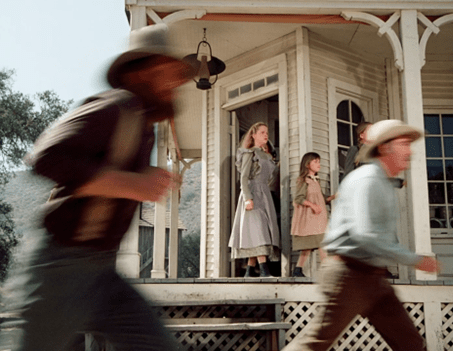
Jonathan Garvey, Johnny Cash Fusspot, Herbert Diamond, and Doc also run by.

One interesting thing to mention before we get further in: This one is written by two sort-of newcomers, Ron Chiniquy and Richalene Kelsay.
I say “sort-of newcomer” because Richalene Kelsay actually was the head of the Little House costume department for its first seven seasons – at least, for the women’s costumes.

This seems to have been her biggest show business gig – she did costumes for a small number of movies. This is the only script she ever wrote for anything.
Charlotte Stewart tells a funny story about her in her wonderful book. Apparently one day Stewart got a wasp up her skirt, and Kelsay was able to fish it out for her. Which was good, because the alternative was to undress in front of the cast and crew – and Stewart wasn’t wearing any undergarments that day.

As for Ron Chiniquy, his only credit for Little House at the IMDb is for this story, but in Alison Arngrim’s book, she recalls him as a crew member whom she observed topping off Michael Landon’s “coffee” with hard liquor throughout the day, beginning in the early morning.
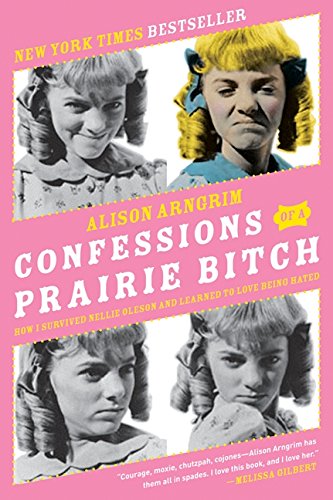
Apart from that, he worked in the props department for a few other movies. Interestingly, both he and Kelsay worked on The Loneliest Runner – Michael Landon’s blistering, barely fictionalized account of growing up with a mother who tortured him because he wet the bed. (Lance Kerwin and Melissa Sue Anderson starred as the “young Landon” character and his girlfriend, respectively.)

Landon’s mother was still alive when the movie aired in 1976. I wonder how that went over in the family.
Anyways, apparently Chiniquy enjoyed racing cars in his spare time. Unfortunately I couldn’t find a picture of him.

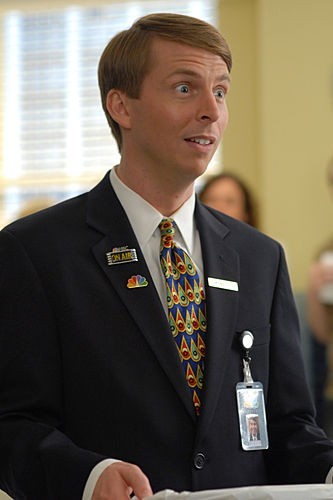
Well, Charles asks Youngish Whitish, whom he addresses as “Benjamin,” what’s going on.

Benjamin reports there’s a bunch of Indians coming into town. It’s odd the actor doesn’t get a credit, since he plays a named character who has speaking lines. But he doesn’t.
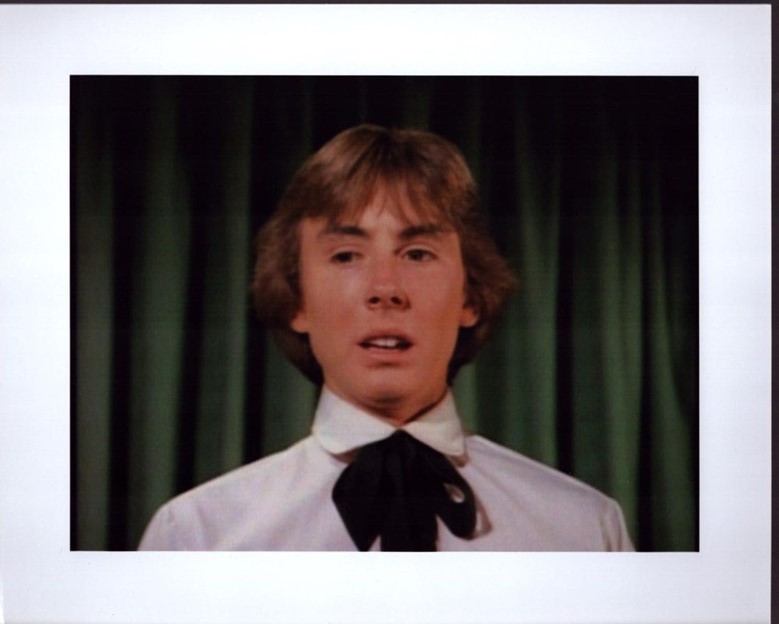
DAGNY: Benjamin looks like Kenneth from 30 Rock.
WILL: Ike Eisenmann, I thought.
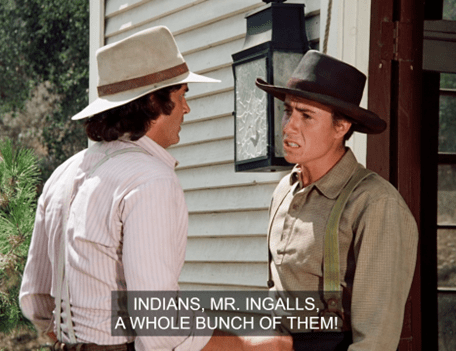
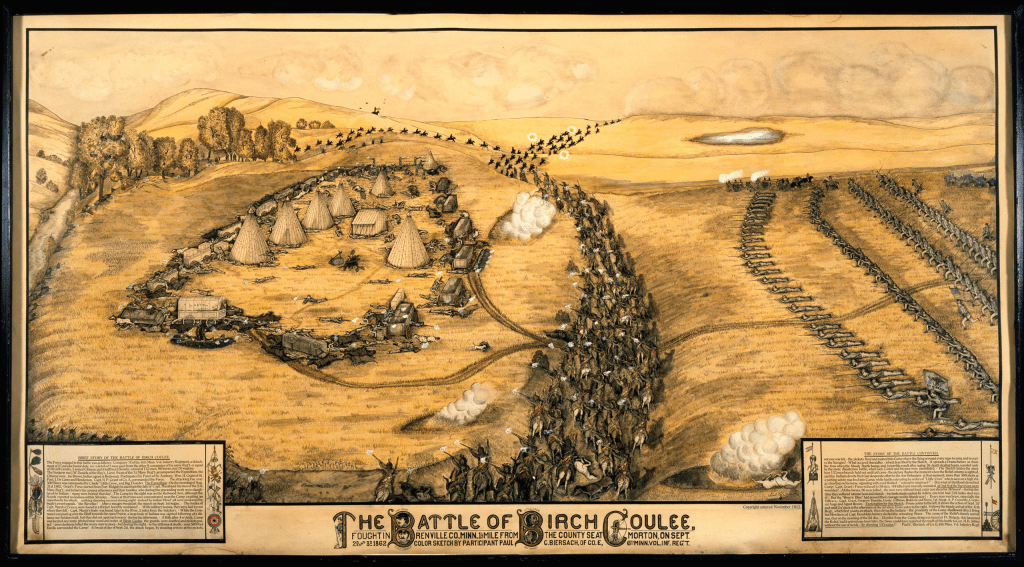
Charles says there can’t be any Indians, because they were driven away long ago. (Like “I─── Kid,” this story is set in the aftermath of the U.S./Dakota War of 1862, the events of which I wrote up in detail for that story.)
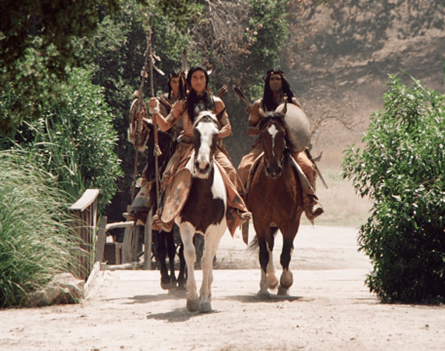
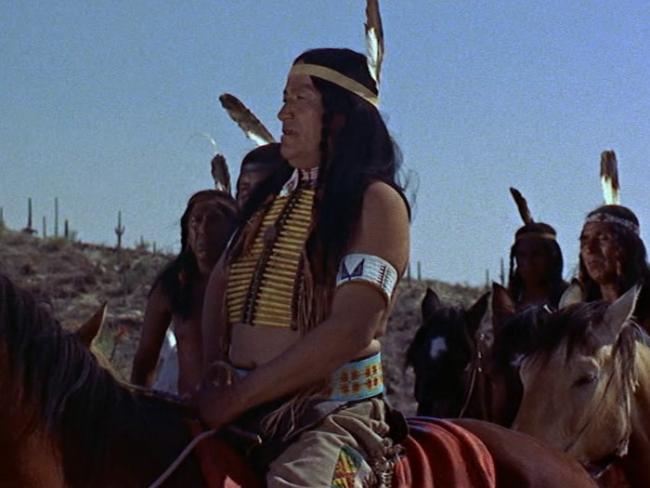
But with the immortal line “Then what in the heck are THEM?”, the kid points up the street, and indeed, we see three Indigenous men riding slowly into town. They’re armed – with traditional weapons, not guns.
The camera then cuts to a wonderful panoramic shot of all the men of Walnut Grove, who stand silently in front of the church, staring. (What are they all doing in town at once?)

In addition to those already mentioned, we see the Alamo Tourist from Pee Wee’s Big Adventure, an AEK, the Midsommar and Non-Binary kids, at least three Not-Carl Sandersons, the Gelfling Boy, and a couple men we’ve not seen before.
There’s also a man with a huge mustache who at first I thought was new. But upon some reflection I think he’s actually Not-Richard Libertini, who’s simply shaved the lower part of his facial hair.


Missing are Mr. Hanson, Willie, Andrew Garvey, Reverend Alden, Joe Kagan, Jud Lar[r]abee, Adam and Luke Simms, Patrick (whom we surmised last week is now dead), Hans “Rubberface” Dorfler, Lewis and Bobby Ford, Jed Haney, Bailey Farrell, Cal Taylor, Tom Carter, Ben Slick, the Kid with Very Red Hair and his younger brother (“Peeping Tommy”), Mr. Nelson the Gray-Haired Dude, Not-ZZ Top Guy, Busby, Not-Frank James, Not-Jesse James, the Random Guy Who Cheered For Nellie In The Horserace, Not-Paul Rudd as a Middle-Aged Insurance Salesman From the Midwest, the Tall Guy Who Looks Like a Scarecrow in Somebody’s Garden, and the Man With a Bit of a Tummy. (And those are just the male Grovesters who’ve appeared this season!)
WILL: And where is Kezia? If you lived in a hole in the ground next to the emergency bell, wouldn’t you come up?
DAGNY: Yah. You’d pop up like the gopher on Groundhog Day.
From the porch, the women watch the Indians approach. (Mrs. Oleson has come out too.)
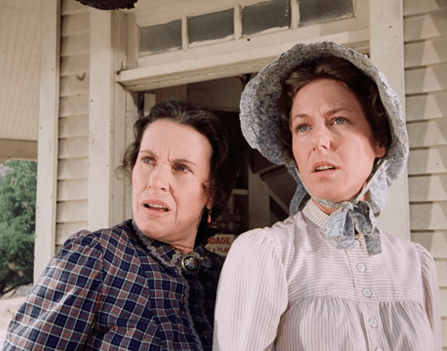
As usual, Carrie keeps her emotions well-guarded.

So do the three newcomers – presumably Dakota/Sioux. Their costumes look great, but I’m not fit to judge how authentic they are.
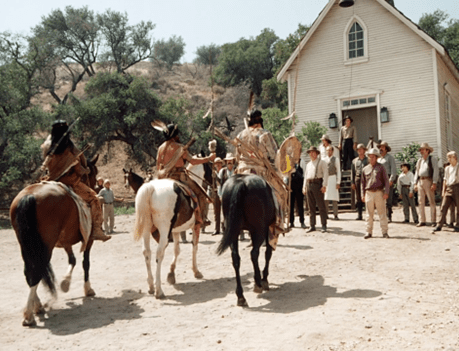
Under the shadow of the American flag, the Native leader, who resembles Ricardo Montalbán, introduces himself as “Little Crow, son of Long Elk.”

Others have pointed out, as an error, that Little Crow was a real Mdewakanton Dakota chief who reluctantly led the Sioux in the 1862 war and was murdered in 1863.

However, since there were at least two other chiefs of the same name, I see no reason to assume this Little Crow is meant to be the same person. (For one, the famous Little Crow’s father was also named Little Crow, not Long Elk.)
This Little Crow says they are “Santee – people of the Lakota.” Again, I pretend no expertise, but it seems from my reading the Santee and Lakota people were different, though they both identified as Sioux and spoke a shared or similar language.
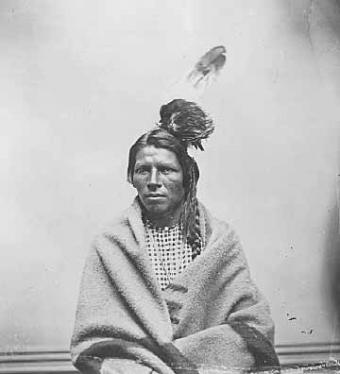
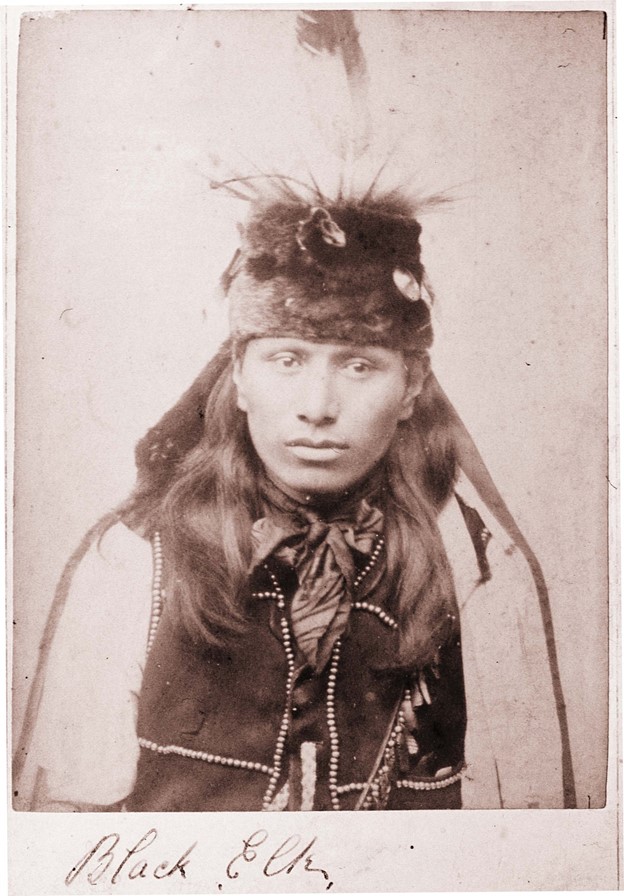
At any rate, Charles is right that their presence in Walnut Grove would be unusual, since the Dakota were exiled from Minnesota at the end of the 1862 war.
Little Crow states they have come in peace. The actor may look like Ricardo Montalbán, but he’s really Indigenous – of the Blackfoot people of Montana and Alberta (not related to the Dakota).
His name is Nick Ramus. Usually cast in Indigenous roles, he was in The Apple Dumpling Gang Rides Again and Star Trek IV: The Voyage Home, and he had recurring parts on Falcon Crest and Dr. Quinn, Medicine Woman.

He also was on an episode of Monsters, which I loved when I was a kid.
Anyways, Jonathan Garvey, who seems to think he shares a community leadership role with Charles (dream on, dude), says, “What do you want here?”
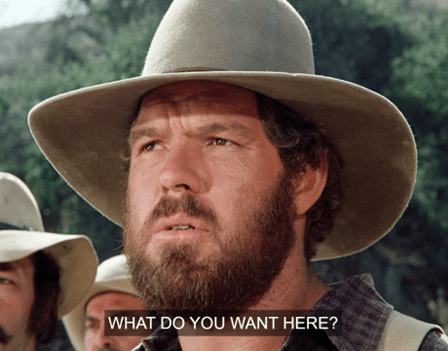
Little Crow says he and his people are “moving north to a new land,” but “have stopped only because we have need of a white man’s doctor.”
This is a geographically mysterious statement, since at this point (summer of 1881-F by my calculation), the Dakota had been banished to the Dakota Territory (modern-day North and South Dakota – west of Minnesota) for nearly twenty years, and Walnut Grove would be quite out of the way for any exodus north from there.

Moreover, even if the Dakota were headed in that direction, there would have been several other communities closer to the Indian Territory than Walnut Grove (fifty miles away). None of them had doctors?
Well, no matter. Doc Baker immediately volunteers to help, but a fleshy man we’ve never seen before interrupts him, saying, “You do not have to do nothin’ for these savages.”
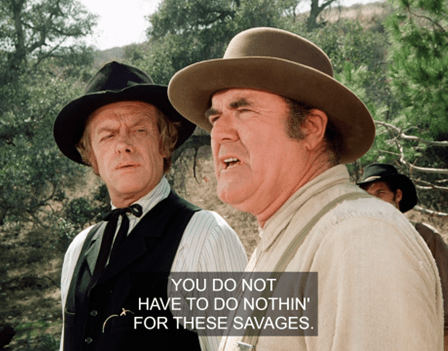
The man suggests they attack, but Jonathan Garvey, addressing him as “MacGregor,” points out the town is surrounded by Dakota warriors.
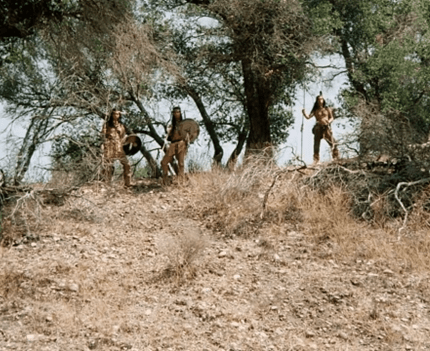
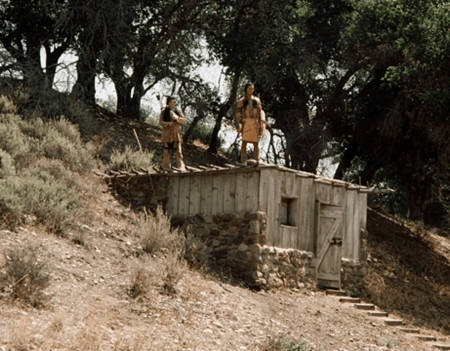
Carrie hides bravely behind Laura.
Doc and Charles says they’ll go with the Dakota. Doc says he’ll get his medical bag.
DAGNY [as DOC]: “And my lip balm.”
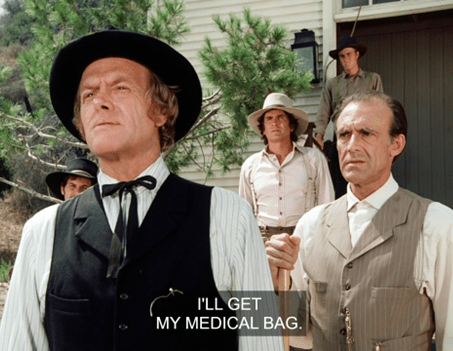
ROMAN: Why is Charles going along?
DAGNY: Because Doc is a member of an interdisciplinary team and has to bring his social worker.
To more screaming “Native” music, they arrive at the Dakota camp.
WILL: I know it’s colonialist, but I love the score. It’s so crazy.
DAGNY: Yah. David must have done some hard drugs before writing this one.
A huge bluff stands up in the middle of the field. It’s quite beautiful to look at, but doesn’t bear much resemblance to the real southwestern Minnesota.

To chanting – again, I can’t judge the authenticity – Doc and Charles enter a teepee where an old lady is standing guard.
ROMAN: Are we hearing her thoughts?

We see MacGregor has also followed them to the outskirts of the camp (so they can’t be too far from town).
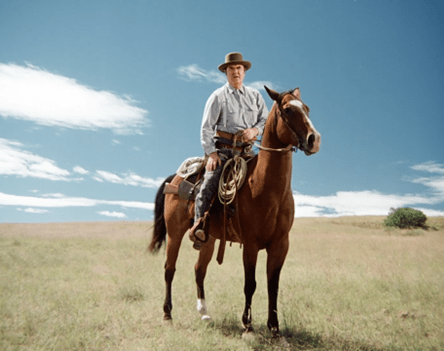
Inside the teepee, we see the chanting is actually coming from (presumably) a medicine man, who’s singing over an old man lying on a bed made from reeds (or something). I don’t know the Dakota language, so I can’t say whether the speech and songs we hear in this one are accurate.

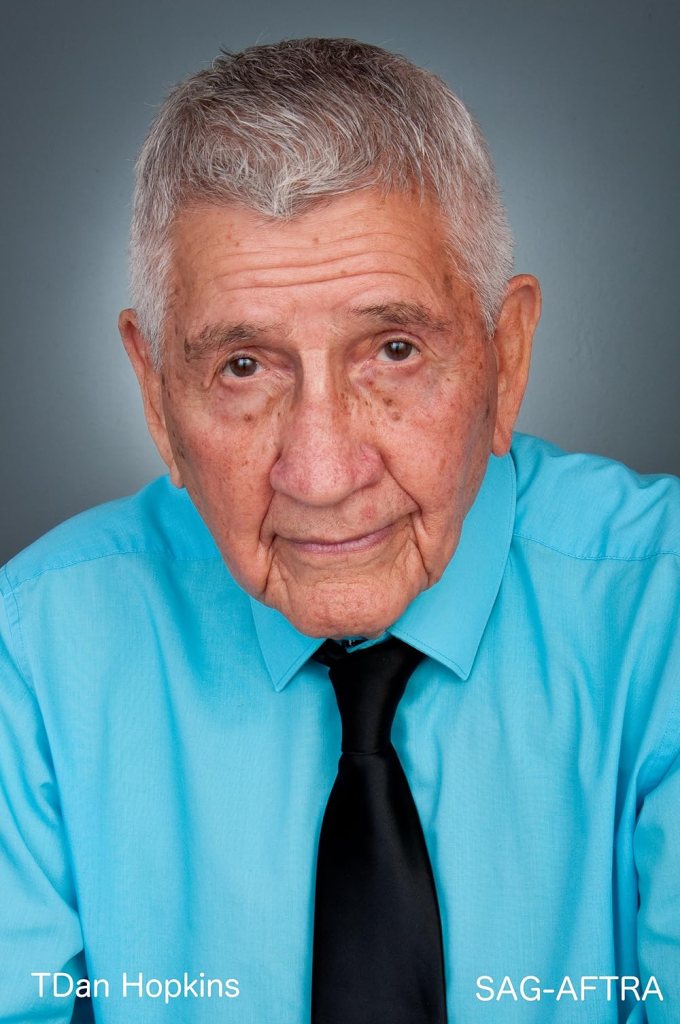
(The actor playing the medicine man is TDan Hopkins, a member of the Kiowa tribe of Oklahoma.)
Apparently it’s Little Crow’s father and the chief of the tribe, Long Elk, who’s sick. Doc tells Little Crow his father has suffered “an apoplectic stroke.” (Strokes have been pretty well understood by physicians since the Seventeenth Century.)
Doc says the chief may be okay eventually, but he certainly can’t travel at present.
Little Crow says that puts them in a pinch, because they’ve got to get out of Minnesota. “Did you jump the reservation?” asks Charles, and Little Crow responds, “Our people were starving.”
Now, my understanding is there were no true Indian “reservations” in Minnesota at this time – they wouldn’t be established by the U.S. Federal Government until 1886. But from the 1850s through the 1862 Dakota war, Indian communities were “managed” by federal “agencies,” which would later become reservations – after 1862, technically all the Dakota were supposed to leave on account of the ongoing Sioux Wars, which continued in the Dakota Territory. (I know this is an oversimplification, and I welcome any help to explain it better.)
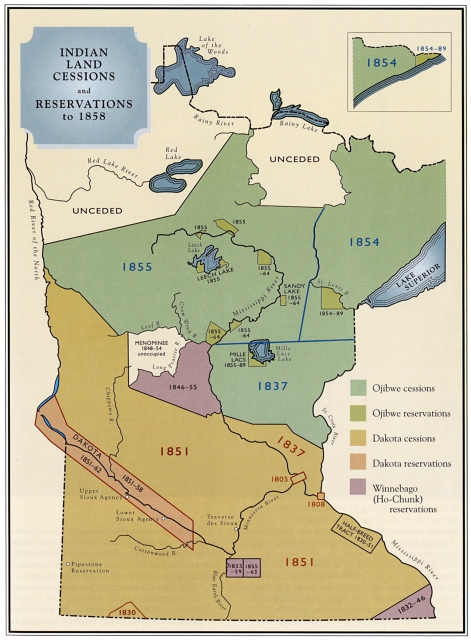
Of course, not all the Native people did leave, and there were established Dakota communities in the same general part of the state (one near Redwood Falls and another near Granite Falls).

But both of them were fortysomething miles north of Walnut Grove, so if this group is heading north, that can’t be where they’re coming from.
“How can that be?” asks Charles. “I thought the government just gave the Indians another big piece of land, or something.” He sounds almost annoyed. For the past ten years or so, my job has involved projects in Minnesota Indian Country; and I can tell you, resentments about “ungrateful rich Indians” continue to this day. (It’s amazing the things white people will say to one another when people of color aren’t around.)

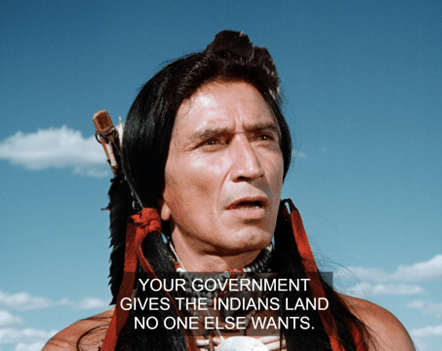
“Your government gives the Indians land no one else wants,” Little Crow answers flatly. That’s true today too. Sometimes, they even make the land worse. A recent work project of mine is in the Prairie Island Community, a Dakota community about 160 miles east of Walnut Grove. In the 1940s, the U.S. Army established, essentially right on top of the Indian Community, a coal-burning utility plant that by the 1970s had been developed into, you guessed it, a nuclear power plant.

But Doc is firm, advising Little Crow to stay put until Long Elk has recovered.
Doc and Charles depart, and Little Crow addresses his people in his own language.
When our heroes get back to Walnut Grove, Benjamin informs them MacGregor’s called a town meeting.
Inside the church, we see Carl the Flunky chatting with a long-haired young man with a mustache. A lot of mustaches in this one.

Mrs. Foster is there too. No mustache on her, though.
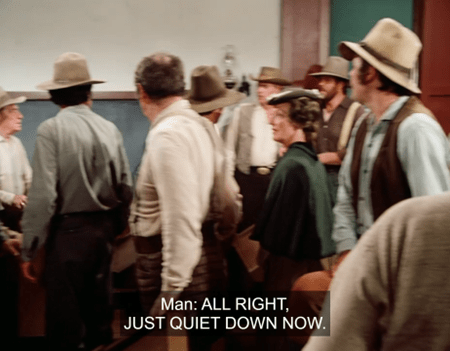
Doc starts to tell the Grovesters about the chief’s situation, but The Original Mustache Man interrupts, yelling, “Well, what’s he got? Is it catchin’?”
(The Amazon subtitles misattribute these questions to MacGregor.)
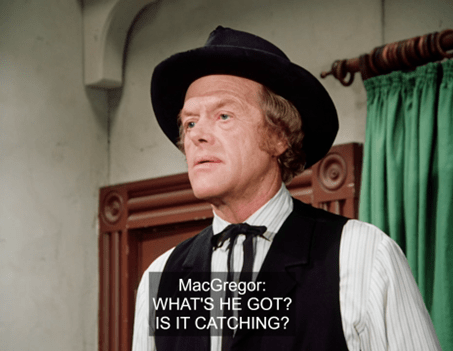
Doc quickly finds himself on the defensive, as MacGregor screams only “a colored doctor” should practice on Indians. (You’ll recall Doc Baker’s friend Dr. Tane in “The Wisdom of Solomon” already informed us of this racist custom.)


“The murderin’ savages!” MacGregor adds – more to keep the momentum of his messaging going than to contribute to a cogent argument.

Mustache Man angrily shouts along with him – wow, we’re seeing a different side of him today.
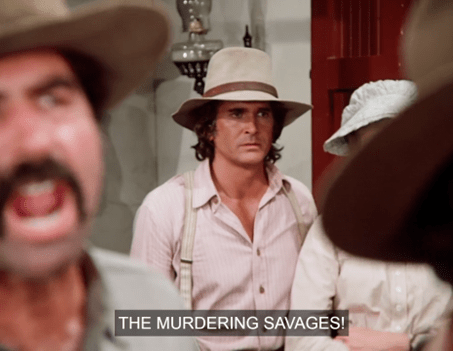
Realizing the ultimate authority is required here, Charles Ingalls steps forward to settle everybody down.

But MacGregor screams, “What do you know about Indians, Ingalls? You were not here when the settlers were massacreed.” Yes, he actually says “massacreed.” I don’t know if this is ignorance on the part of the actor, or if he’s suggesting MacGregor doesn’t know how to pronounce it.
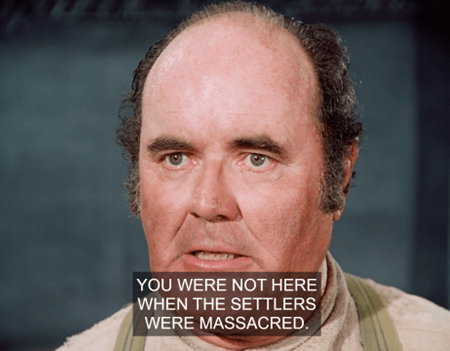
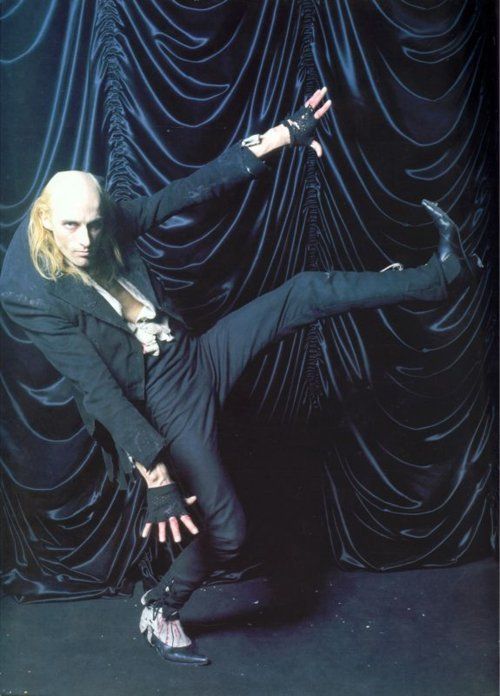
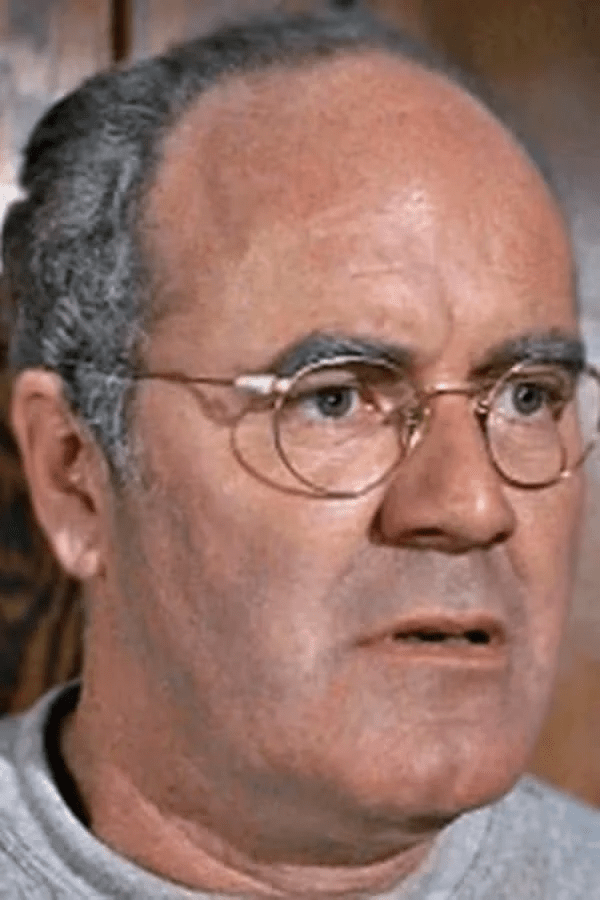
I think the latter. The actor playing MacGregor is Richard O’Brien. (No, obviously not the one from Rocky Horror. Although wouldn’t that be great?)
This Richard O’Brien was in a lot of stuff – TV shows from The Fugitive to Trapper John, and movies including The Andromeda Strain, The Shaggy D.A., and Looking for Mr. Goodbar, the last of which I saw when I was WAY too young and which traumatized me.
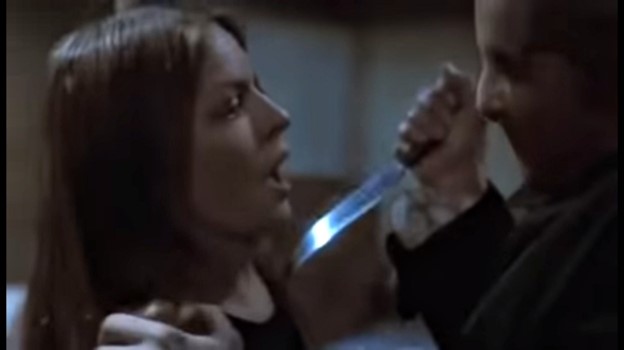
MacGregor snarls at Charles that he wasn’t around for the Dakota War, and I realize the show’s been on for four years now, but it’s unusual for us to have a scene that’s an exact retread of one from a previous story – namely, Charles’s conversation with Jeremy Stokes in “I─── Kid.”
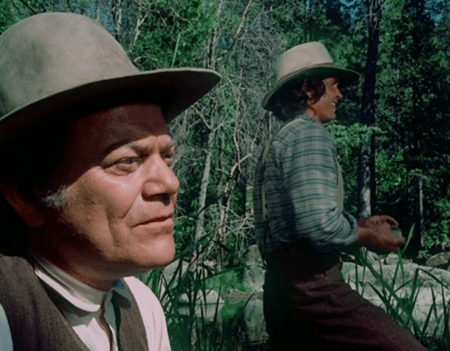
Charles snarls back that that’s true, he didn’t see the Dakota atrocities against white farmers nor the “whites hang[ing] hundreds of Indians either.” (In reality, while over 300 Dakota men were condemned to death at the end of the war, only 38 were hanged – with Abe Lincoln’s blessing, at Mankato.)
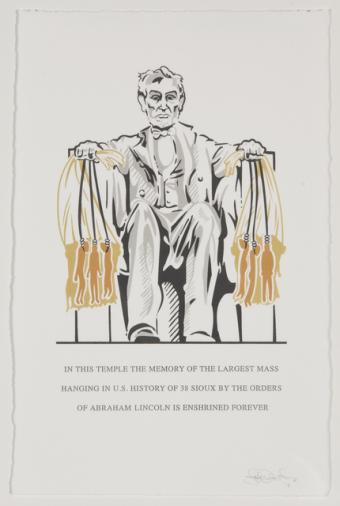
(Then again, Charles is likely including “private” lynchings in his estimate.)

“Don’t listen to ’im!” hollers MacGregor. “I’m for wipin’ ’em out!” And most of the men – notably Mustache Man and Carl the Flunky – scream their approval for his suggestion.


And out they go to get their guns.
Disturbed by this outcome as well as being unaccustomed to losing such debates, Charles frowns unhappily.

(I think we can assume Rev. Alden is out of town; surely he’d be a part of all this otherwise.)

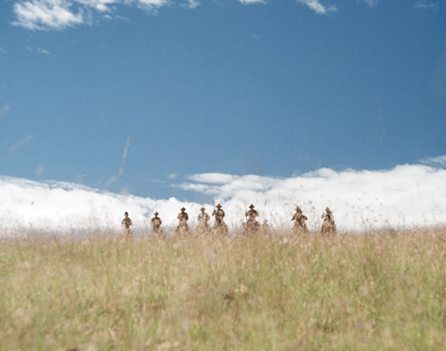
So, the posse of Grovesters rides out to the Dakota camp, under a beautiful sky.
DAGNY: These old white farmers are going to get their asses handed to them.
WILL: Well, they do have rifles.
DAGNY: I’m sure the Indians do too!
WILL: Okay, you’re getting ahead of the story.

But when they arrive where the Native people had been camping, they’ve gone.
DAGNY: MacGregor has GREAT pants.

Correct me if I’m wrong, but I think we’ve seen these pants before. They’re the same plaid pants as the stone quarry foreman Tom Cassidy wore in “100 Mile Walk,” years earlier.
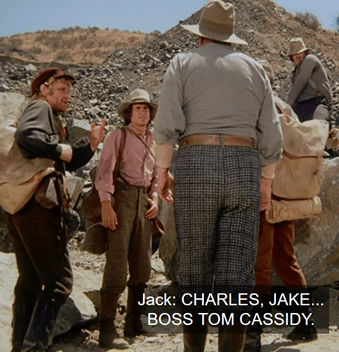
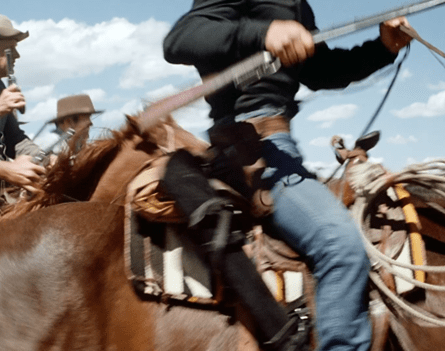
DAGNY: And it has to be said, the horseback-riding scenes are FANTASTIC in this one.

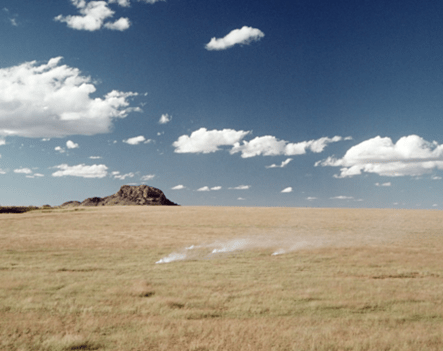
Back in Walnut Grove, we see the Chonkywagon and Doc’s phaeton arrive at Casa Dell’Ingalls.
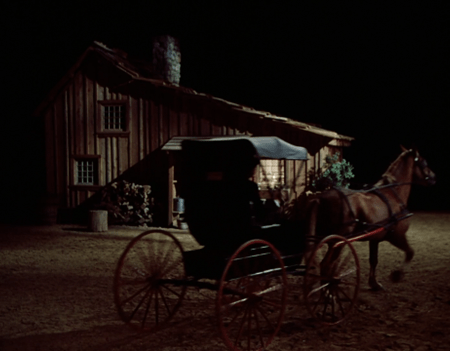
Well, the surprise is that Charles and Doc have concealed Long Elk and his entire inner circle, chief and all, under a tarp in the Chonkywagon.
WILL: How’d they pull this off? We’re supposed to believe the second the mob left the church, Charles and Doc raced out to convince them to pack up and leave . . . which they did, instantly, before the posse could arrive?
DAGNY: Sure. They were very efficient. Those assholes from town probably took an hour and a half to get their shit together.

Furthermore, Charles would have needed to take an alternative route home so as not to meet their pursuers along the way. And wouldn’t MacGregor and company have been able to follow the horsetracks of such a large party?
Oh well, TV. Caroline, who unfortunately doesn’t have much of a part in this one, tells a little Indigenous girl not to be frightened. (Karen Grassle makes the most of the weak writing for her role.)
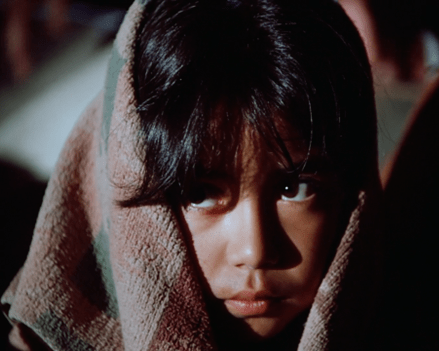

The Ingallses put the Indigenous people up in the soddy, which as we’ve seen in the past is a very comfortable dwelling.
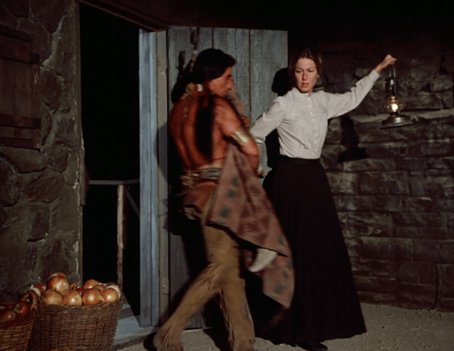
Long Elk does NOT look too good.
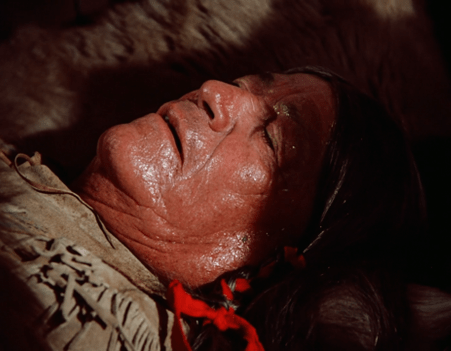
Caroline does ask if she can help. It’s clear she’s come a long way from her initial fear of Native people as we saw in The Pilot.

Inside the house, we get some unusual cinematography, as if someone realized what with the kitchen being finished, they could now put a camera in there.
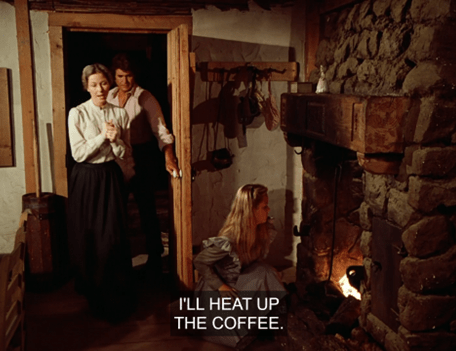
Ma says she’ll make coffee, of course, and Laura runs around crazily, asking if Pa can confirm he’s “an honest-to-goodness Indian chief?” You’d think she’d be a little more blasé, given she’s met Indian chiefs at least twice before.


Even more surprisingly, Mary then starts screaming, “They’re all nothin’ but heathens!”
You know, it’s always jarring when this happens, but for whatever reason, Michael Landon decided at some point to make Mary the mouthpiece for viewpoints the show would roundly reject. Punishment for hating to kiss Radames Pera, perhaps?

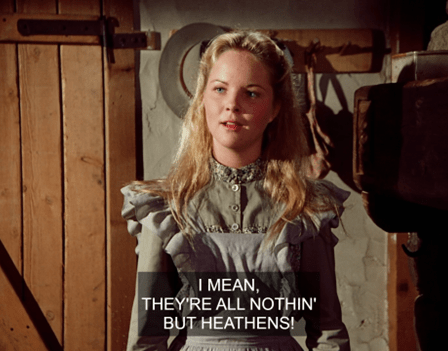
Charles Ingalls says, “Mary, they may not read the same Bible we do, or worship God in the same way, but they’re His children, too.”
WILL [singing]: “They’re CAAAAAAAAALLED bui doi. . . . ‘The dust of liiiiiiiiiiiife’. . . .”

DAGNY: He really looks disgusted.
WILL: I think that’s the angriest we’ve ever seen Charles get at a family member.
ROMAN: Yeah. Caroline’s been angrier. About Dumb Abel.

Pa and Mary stare each other down for quite some time. It’s kind of a bummer, actually.

But of course Mary blinks first, and then Pa and Ma have a five-minute conversation that’s basically just (liberal) propaganda about how no one can understand what Indigenous people have been through.
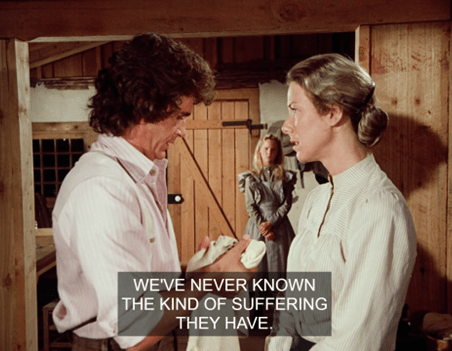
At the door suddenly, Doc announces the posse is approaching.
MacGregor asks if they’ve seen any Indians, and when Charles asks what’s wrong, he says, “There’s trouble!”
ROMAN: Right here in River City!
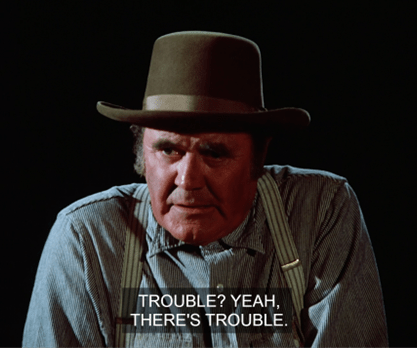
Then MacGregor says until Charles sees fit to join the anti-Dakota Grovester faction, he’ll be taking charge of the town now and thank you very much for your past service.
Then we cut to the schoolyard, where all the kids are playing. (So, it’s September?)
DAGNY: Look at Laura. That’s hard – skipping rope and running at the same time.
ROMAN: She’ll be a contender for best stunt at the Walnut Groovies for sure.

We see Jim, the young asswipe played by Michael Landon, Jr., in “The Election,” is back and hanging out with Not-Albert, the Non-Binary Kid, and another dark-haired youth we’ve never seen.
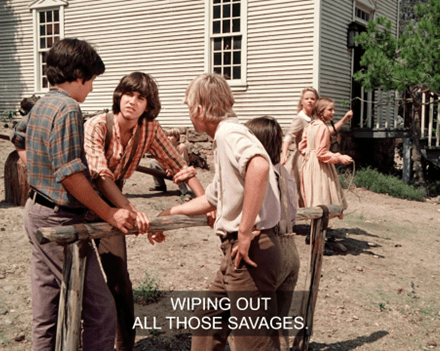
The new dark-haired youth says if it weren’t for his father’s defense of the town, they’d all be dead already. “Rob MacGregor, that’s not so!” screams Laura from a little ways off.
DAGNY: Another low-cut shirt.
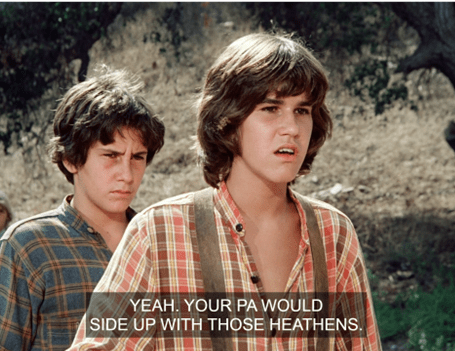
Rob (played by Brett Ericson, whom we’ll see again in a different part next season) then says “everyone knows” the great Charles Ingalls is “an Indian-lover.”
WILL: He looks like Adric.
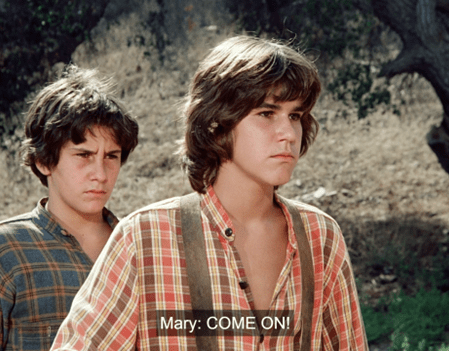

This explodes into the inevitable fracas, which ends with Rob MacGregor trying to strangle Laura and Mary kicking him in the balls.

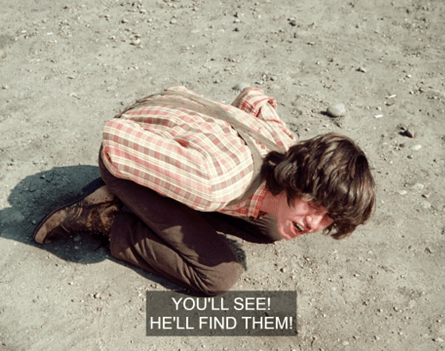
Despite being made to eat dirt, Rob says, “My pa’ll find ’em!” and Laura yells, “Your pa can’t find his way to the outhouse!” Which, as Little House comebacks go, I’d say is pretty strong.

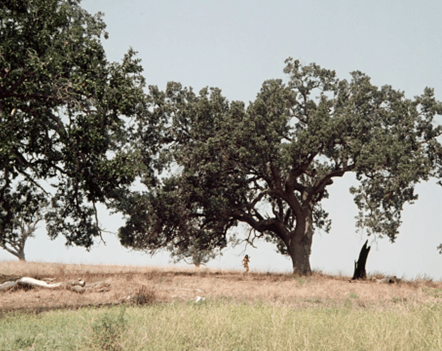
Meanwhile, Charles himself is driving through the countryside, when he sees a Dakota youth hunting under the oak trees. “That fool kid!” he says to himself.
Charles bursts into the soddy and yells at Little Crow for letting his son wander around the property, and LC says he didn’t realize the little idiot was gone. (Paraphrase.)

But suddenly the little idiot is back, sassing his dad and giving mean side-eyes to Charles.
DAGNY: These wigs are horrible.

Credited as “Spotted Wolf,” he’s played by Guillermo San Juan (presumably not an Indigenous person?), who appeared on Starsky and Hutch and Hill Street Blues.

Little Crow apologizes for his son being an idiot and Charles says that’s fine.
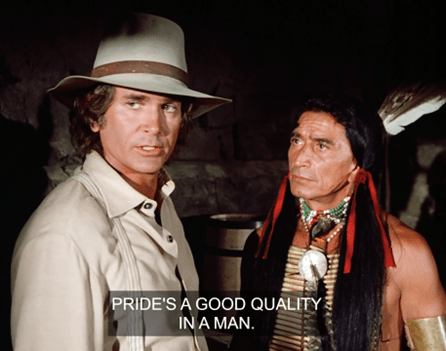
Back at the Little House, Caroline puts supper on the table and says she’s made some of her Miracle Soup for the chief.
Then, in an interesting device, Pa and Laura have a nice little moment in the Ingalls kitchen . . .

. . . that leads right into a shot of Little Crow with his arm around his ailing father.
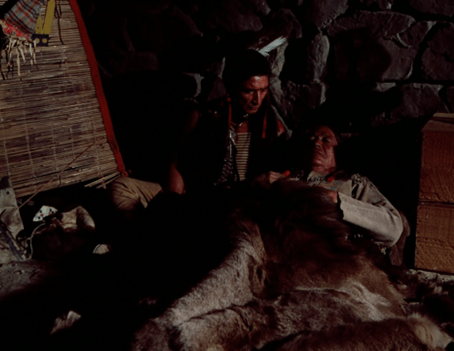
Pa and Laura bring supper out to their visitors.
WILL: Charles needs a color treatment.
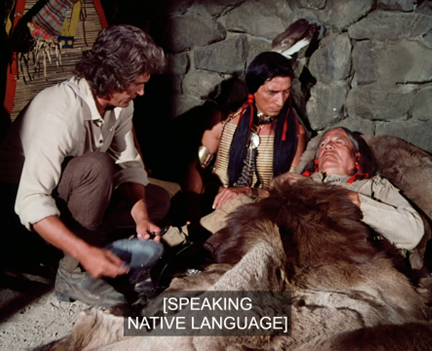
Long Elk himself pipes up and tries to talk. He asks, basically, what’s the buzz out in Greater Groveland, and Charles says he doesn’t have any news, good or bad.
Meanwhile, Laura tries to push cookies on the little Dakota girl, Yellow Feather, and Spotted Wolf snips, “She is afraid of the people who killed her mother,” even though she doesn’t really look very afraid to me.

Laura and Pa step outside, and Laura blubbers a while about how being hated by a cute little baby like Yellow Feather makes her feel.
Then she hands Pa a surprising fuck-you, saying she wishes he’d named her something awesome like “Yellow Feather” instead of basic Laura.
WILL: He should slap her. [as CHARLES:] “As if I don’t have enough on my plate!”
ROMAN: Yeah. She should be glad she didn’t get named Hoggatha or something.
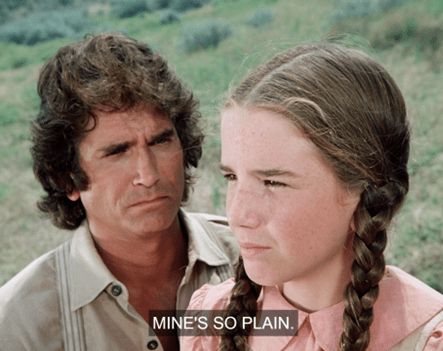
Laura then throws her arms around Pa’s neck and starts weeping how she’s afflicted with liberal guilt. Pa reassures her that’s the right way to feel.
DAGNY: Fake tears, huh?
WILL: On this show? Never.
DAGNY: Well, that one hasn’t moved.

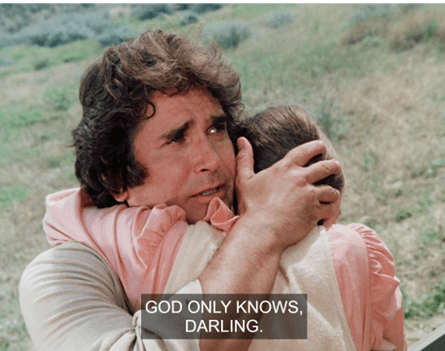
Pa also says “God only knows” why people are so hateful.
DAGNY: They should have played The Beach Boys there. Missed opportunity.
After a break, rather silly “sneaky” music takes us into a shot of all the Ingallses except Laura loading up into the wagon and departing for town.

Once they’ve gone, Laura runs out to the soddy.
She politely asks Long Elk if he’s feeling better, and, seemingly equally politely, he replies in his own language.
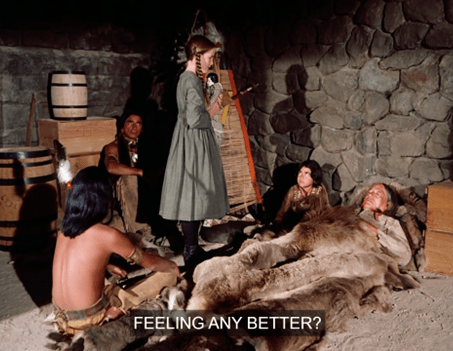
Smalltalk concluded, Laura confesses the real reason for her visit: to give Yellow Feather one of her dolls.
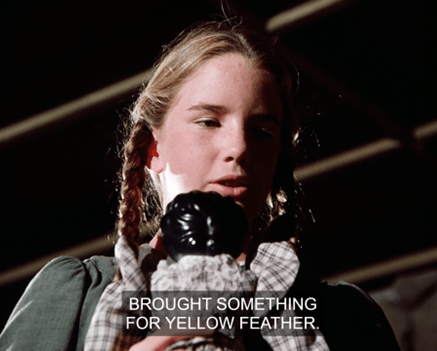
The doll, we see, is good old Janet, whom we’ve met twice before.
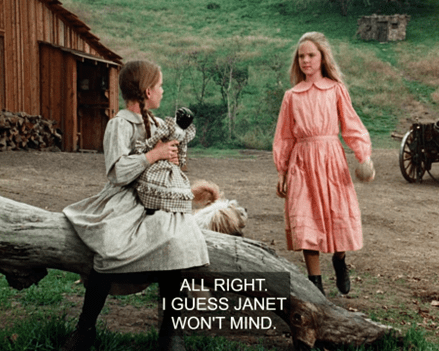
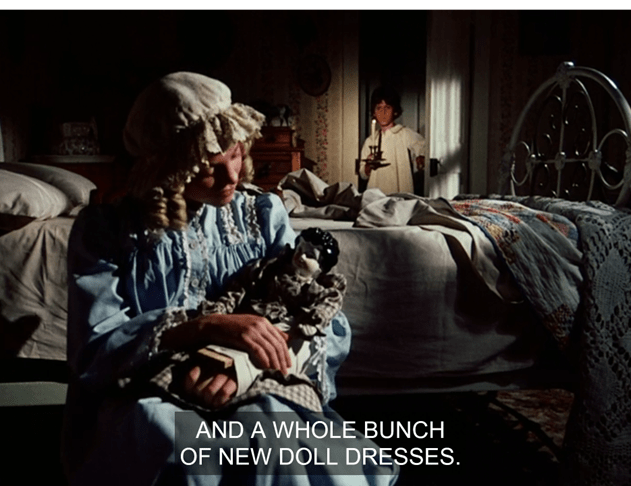
Actually, this Janet, Laura mentions, is called “Sally.”
DAGNY: So this one’s Sally?
WILL: Yeah, well – Janet’s dead.
It’s true. Janet must have a curse on her, since both of her previous appearances culminated with her head being destroyed.


The Mercantile must keep an inexhaustible supply of Janets lined up in the storeroom like an army.
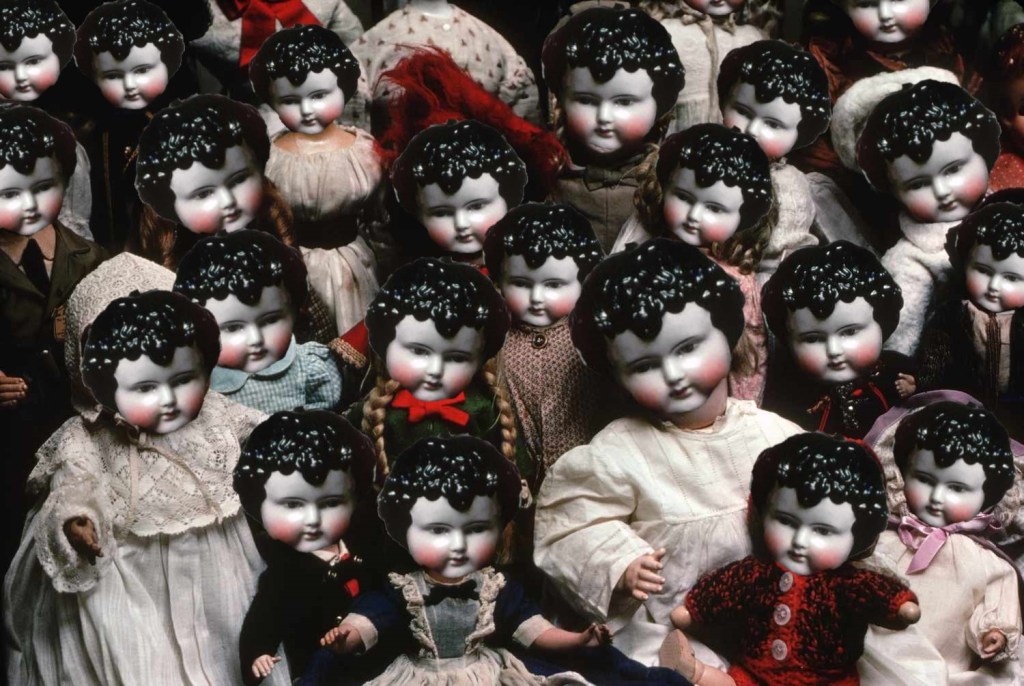
Well, we’ll see if third time’s the charm and Janet manages to survive the episode this time.
Little Crow smiles slightly; but once Laura’s gone, Spotted Wolf angrily seizes the doll.
WILL: See? He’s gonna break her.
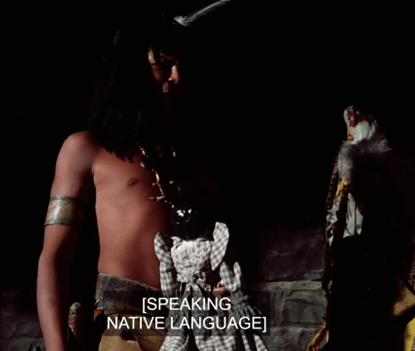
But with equally sudden anger, the Chief, who’s dripping with sweat, shouts for him to return the doll to his sister.
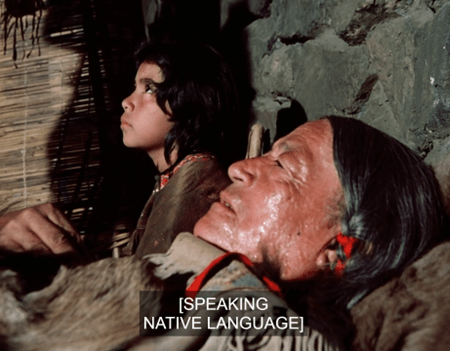
The actor playing Long Elk went by the name “Chief” Geronimo Kuth Le, and he apparently claimed to be the grandson of the famous Apache warrior Geronimo, though this was disputed by some.
Meanwhile, in the Mercantile, Mrs. Oleson is making racist comments of the “ungrateful rich Indians” variety I mentioned earlier as the Ingallses shop.
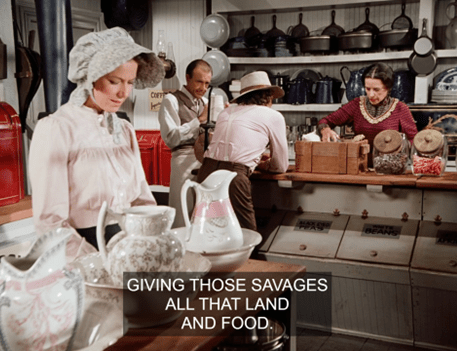
MacGregor is also there, and says the Dakota are surely “headed toward Canada.”
“You think they got across?” Charles asks. How much time has passed? The border’s more than 350 miles away from Walnut Grove.

“You’d like to see that, wouldn’t you?” MacGregor snarls back. I wonder if Don “Red” Barry was unavailable for this episode? MacGregor’s dialogue is obviously scripted in the same style as Jud La[r]rabee, who has played Walnut Grove’s heavy in the past and will again.

MacGregor rants for a while, and Charles can’t resist mocking him for letting his quarry get away.
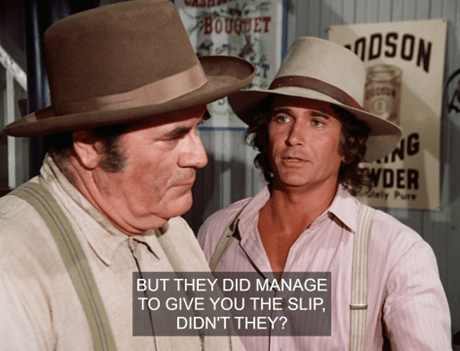
(Incidentally, “the slip” has been around in more or less the same sense since Shakespeare’s time at least.)
Caroline tries to get in on the taunting fun then, telling MacGregor, “See you in church tomorrow.”
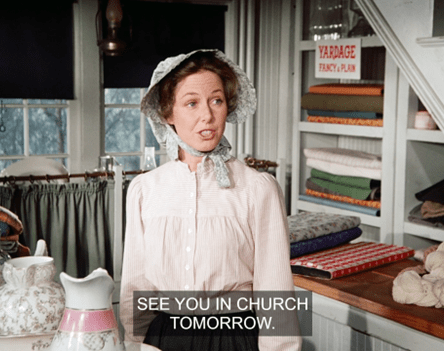
ROMAN: I’m not sure that has quite the same sting.
DAGNY: Well, it’s a zinger for her. She just doesn’t realize nobody cares about church as much as she does. Well, except Alden.
WILL: Not even Alden. He has Thanksgiving dinner in the Catholic part of town, for crying out loud.

Out in the thoroughfare, everybody in town is driving wagons today – revealed in a moment to be Sunday, before church. (The wagons carry passengers in weird combinations, as usual.)
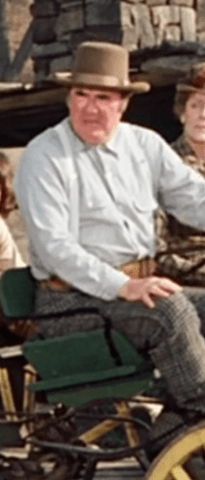
Doc Baker is getting into his phaeton when MacGregor and his family appear in the yellow-wheeled buckboard.
It’s probably a trick of the light, but MacGregor appears not to have eyes in this shot.
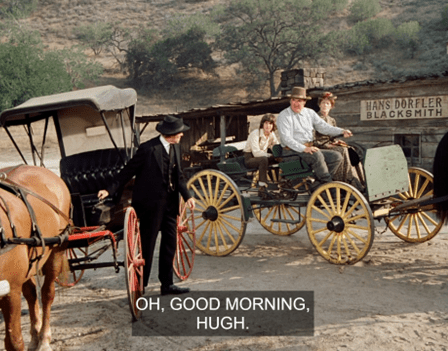
MacGregor demands to know where Doc’s been lately, but he’s not suspicious, he just has a “carbuncle” (a severe boil) on his ass that “needs lancing again.” This is surely the most disgusting medical reference since Andrew Garvey suggested the Creeper of Walnut Grove ate so much because he had “worms.”


Doc lies to MacGregor, saying he can’t lance the carbuncle today because he’s got to pay a call on “the Widow Fraser.”
WILL: Frasers and MacGregors! Does Walnut Grove have a new Scottish ghetto or something?
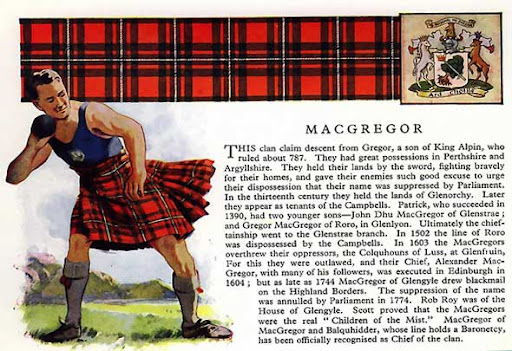
DAGNY: That explains his pants. It’s the MacGregor tartan.
(A lovely thought, but the pattern doesn’t actually match any of the four officially sanctioned tartans for that clan.)

MacGregor’s glum-faced wife says nothing, but she does give Doc a smile as they drive away. (She gets a credit – she’s Vivian Brown, who acted on Police Story, Lou Grant, Days of Our Lives, Father Murphy, and last but not least The Facts of Life Goes to Paris.)


In front of the church, all the Grovesters are arriving, and we see Mustache Man flirting with the Highly Refined-Looking Blonde Woman. He does get around, doesn’t he?


After parking, Mr. MacGregor looks down the street at Doc as he drives out of town.
“Hugh?” says his wife, and he tells her to go on in to church and he’ll be along presently.
“That’s not the road to the Widow Fraser’s,” he says.
That may be so – but it also isn’t the road to the Ingallses’, if that’s indeed where Doc’s headed. We’ve pretty definitively established at this point that the Little House is located about two miles east of Walnut Grove’s downtown. Charles usually heads south out of town on the main road, which bends to the east once you cross the bridge, to get home. And sometimes he heads due east on the shortcut path behind the Mill, which is also how the girls usually walk home from school.
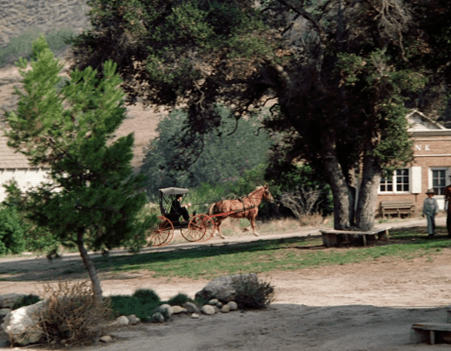
But Doc is headed due west on the road that runs between the Post Office and the Bank. (I should say defunct bank. Fuck you, Sprague!)

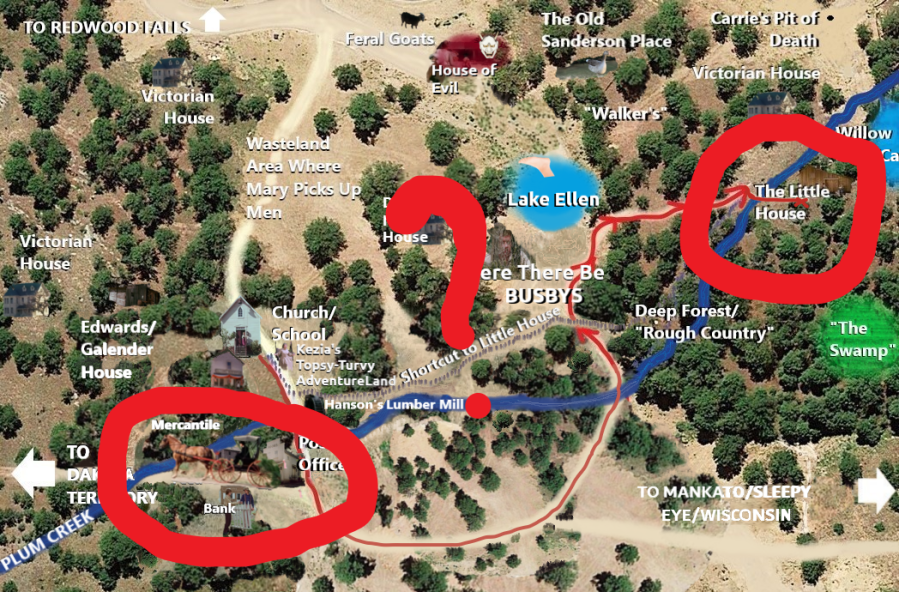
I suppose it’s possible Doc left on this road to throw MacGregor off his scent. But if so, he’s been too clever by half.
Because MacGregor follows him. Rather than taking his own wagon, he approaches Carl the Flunky, who’s (strangely) just arrived on a horse (rather than in his usual wagon).
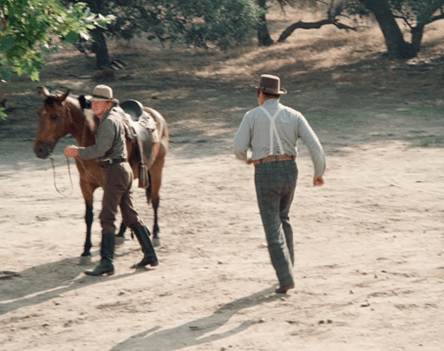
(Equally strangely, Mustache Man arrived for church this morning on foot.)
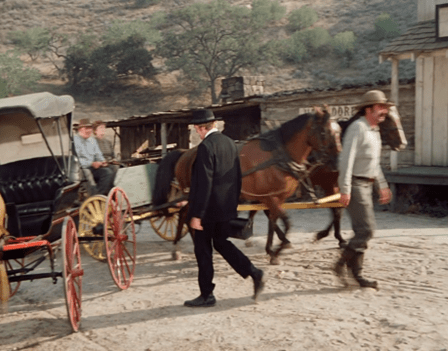
(EVEN MORE STRANGELY,) MacGregor now addresses Carl as “Tom” and demands to borrow his horse.

“Sure thing, Mr. MacGregor!” says Carl/Tom at once. This suggests that, though we’ve never seen him before, MacGregor is a man of some standing in this community.
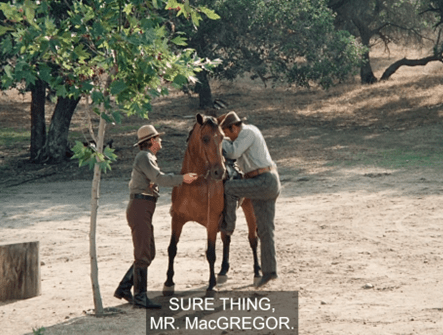
Well, yes indeedy, Doc arrives out at the Little House. It’s at least a twenty-minute drive from town, so it’s strange that the family’s still there, since we’ve just seen everybody already lined up by the church for services to start. (Do crowds really start gathering an hour before the kickoff? I suppose that’s not impossible.)
(Also, who is going to conduct the service today? It’s clearly one of Aldi’s off-weeks.)
Charles greets Doc, and the two of them laugh rather nastily about MacGregor’s carbuncle. Doc says he’s going to “let him wait a while” before he lances it.
WILL: Isn’t that against the Hippocratic Oath or something?
DAGNY [laughing]: Maybe.

Then Charles says “You oughta let him wait a year!”, which is even worse.
They meet Little Crow in the doorway of the soddy – but immediately they notice MacGregor has followed Doc out there.

Urgently, Charles says, “Hiram, get him ready to move.” It’s the first time he’s called Doc by his first name!

Doc protests, but Little Crow agrees it’s the best plan.
DAGNY: Are those chili peppers drying on the wall? Would they really have had those?
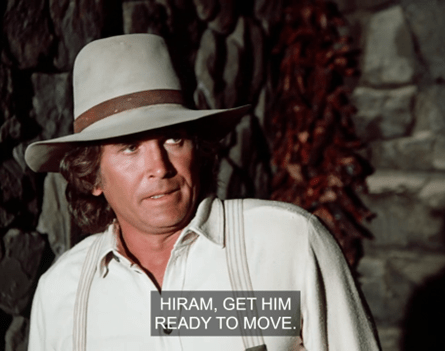
Well, it’s unlikely. Minnesotans today are notoriously spice-averse, and food anthropologists speculate that’s because a) they’re descended from Scandinavians, whose cuisine doesn’t feature strong seasonings, and b) back in the old days, white immigrants were so poor, they couldn’t afford spices – leading to generational preference for bland foods.
Furthermore, Minnesota’s climate is unfriendly to growing hot peppers. It can be done, but usually the plants need to get their start in an indoor hothouse.

Given its old-west associations, I wondered if chili, the stew, wouldn’t have been around in the Little House days, but it seems that didn’t really take off outside Mexico and Texas until the Twentieth Century.

Back in town, MacGregor hastily reassembles his posse. But Charles and the gang are already racing through the hills in the Chonkywagon, with the cover up.
[UPDATE: Boy, did I miss a big one. Reader rosebud92rs notes that as Charles and Doc discuss the situation, you can see a pair of hands shaking the wagon to make it look like it’s moving. This goes on for a good thirty seconds!]
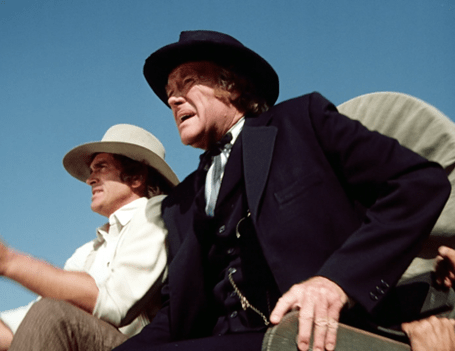
[Not only that, as rosebud92rs also points out, you can see the crew member’s modern wristwatch as well.]
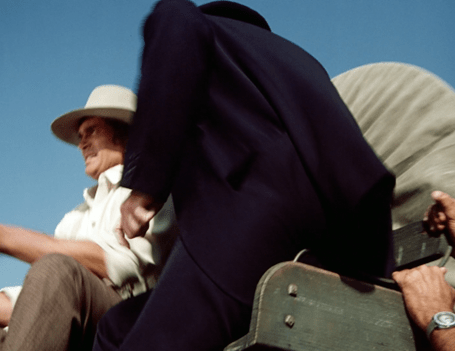
[Thank so much! Corrections like this make my day. – WK]
Arriving at the Little House, MacGregor and Carl interrogate Caroline.
WILL: She should uncross her legs like in Basic Instinct to distract them.
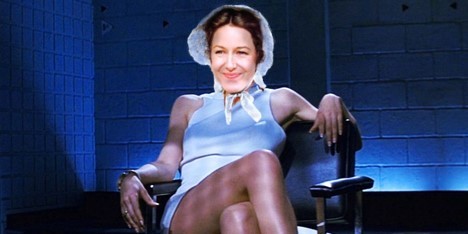
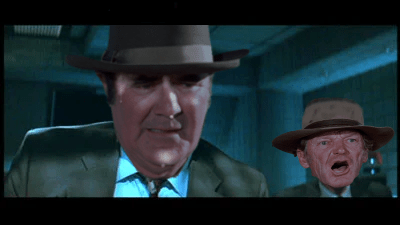
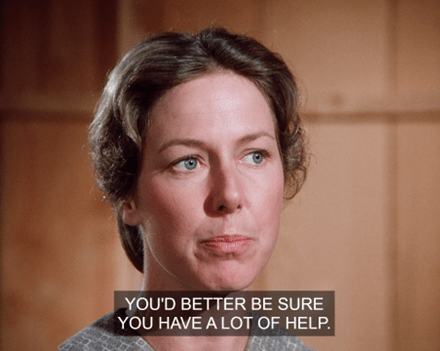
Seriously, though, MacGregor literally threatens to torture her if she won’t walk. Nobody else is made to endure scenes like this on this show. It’s a little much.
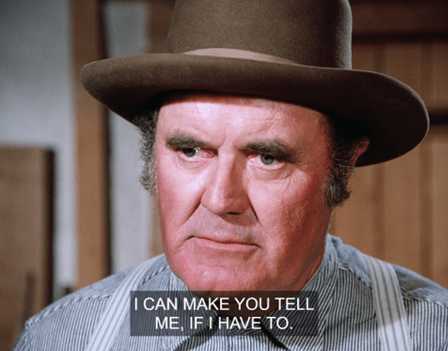
But Caroline threatens him right back, which is great.
Mustache Man suddenly appears at the door, saying the trail’s been found.
MacGregor and Carl run out, and then we hear Carl’s voice giving precise information about the fugitives’ whereabouts, which makes no sense, since he was inside with MacGregor for the entirety of the previous scene.

Meanwhile, in the back of the Chonkywagon, Doc and Yellowfeather watch over the chief.
Charles meets another wagon. It’s a goofy old gent with an ear trumpet who says he’s driving to California.

DAGNY: The shots of the sky are really pretty in this one.
WILL: Well, guess who directed it.
DAGNY: Yeah, Landy. It’s pretty obvious.

Charles notes the guy’s horses are old and broken-down, and says he’ll trade wagons with him. (Goodbye, Chonkies???)
The old guy notes the strangeness of this opportunity, but can’t refuse. I believe he’s played by Roy Gunsberg – he receives a credit, as “Caleb.” He was also on Father Murphy and in Robert Altman’s O.C. and Stiggs.
Later, the posse arrives at the scene of this conversation, and Mustache Man (whom MacGregor addresses as “Jack,” which goes along with what we’ve seen before), identifies the Chonkywagon’s tracks. He and Carl have a lot to answer for in this one.
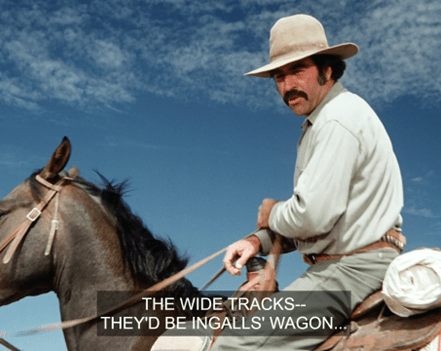
In an interesting shot, then, the Goofy Old Gentwagon appears as a growing dot on the horizon.
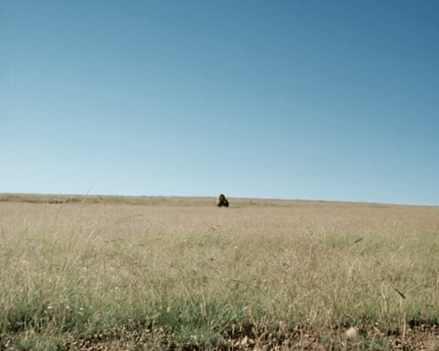
Well, Charles, Little Crow & Co. meet up with the rest of the Dakota band. I’m not sure where they’re supposed to be.
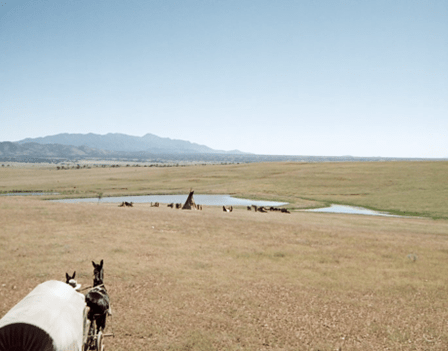
Charles says they must leave immediately, but Doc says the old man can go no further. Little Crow decides they will stay and take their chances with the posse. Charles says the Dakota will be massacred since the Grovesters have guns . . . but Little Crow points out he has guns too.
WILL [to DAGNY]: See, you were right. I didn’t want to tell you. I wanted to preserve the suspense.

I have to say, while it must have been difficult to act the stilted “noble savage” writing typical of Western entertainments of the time, Nick Ramus injects a lot of personality into his line readings, and brings Little Crow to life quite beautifully. While soft-spoken and gentle, his character is also deadly serious, and has an enlightened, almost aristocratic “above it all” quality – no small feat for an actor to capture in a few fairly stereotypical utterances.
Meanwhile, the posse catches the Goofy Old Gent, turns around, and races back.
Then we get a rather amazingly composed shot. The camera is placed next to Long Elk’s pillow, and we can see Charles and some Dakota people through a hole in the teepee. Spotted Wolf and Little Crow stand guard at the door, and the freckled hands of Doc Baker apply a compress to the chief’s brow as Yellow Feather watches.
ROMAN: Did Peter Greenaway direct this scene?


A scout rides urgently into camp, saying the posse’s been spotted on its way.
Little Crow shouts instructions to his people and tells Charles he should go home now. Very upset, Charles tells him his people cannot win this standoff, but Little Crow replies, “The sun will still rise tomorrow.”
The Dakota grab their rifles . . . and Charles does too.
WILL: Now this I do not believe for one second. Charles wouldn’t risk leaving Caroline a widow and orphaning the girls for these people.
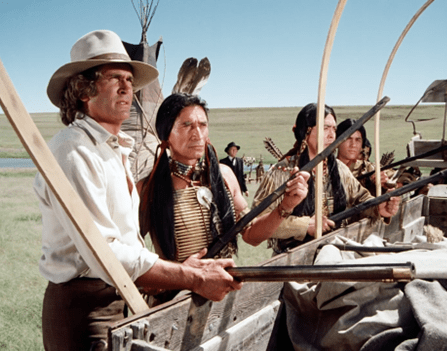
Well, the posse arrives – but they stop short when they realize the Indians have guns too.

[UPDATE: Eagle-eyed reader Meridith points out that the Dakota are not actually armed, but rather are bluffing by holding up long sticks. Not sure how I missed that – thanks, Meridith! – WK]
Charles says to Little Crow that the attackers seem to be “buffaloed.”
WILL: Wouldn’t that be offensive to a Native person?
The bison are sacred to the Dakota.
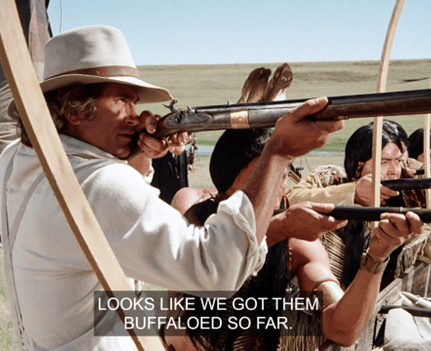
It must be noted, many of the riders are men we’ve never seen before. Presumably they’re hardened, violent, Cormac McCarthy types who eschew sissy activities like church services and town meetings.

MacGregor calls out to Charles, and they meet in the middle of the field for an unarmed parley.
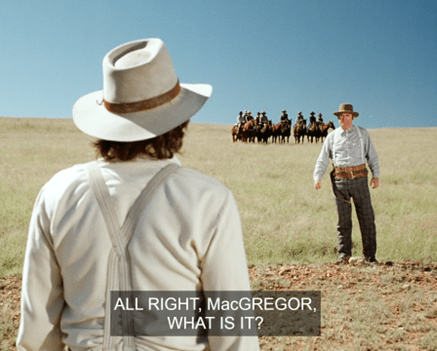
MacGregor says if the Dakota throw down their guns, they won’t be harmed, but Charles calls bullshit.
He says if MacGregor wants violence so badly, he should come and get it.
“You’d shoot your own people?” MacGregor says, and Charles replies in disgust, “You’re not my people.”
(MacGregor, sure – but Mustache Man and Carl?)
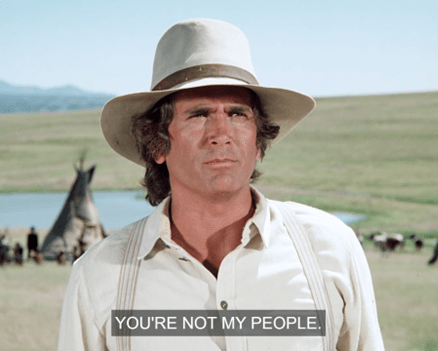
MacGregor says they’ll go . . . only to return with reinforcements from the U.S Army, which he says can be found at a never-before-mentioned “post east of Sleepy Eye.” (I’m not sure what he’s referring to. There were a few Army forts in that general vicinity at one point, but they were all defunct by the late Nineteenth Century.)
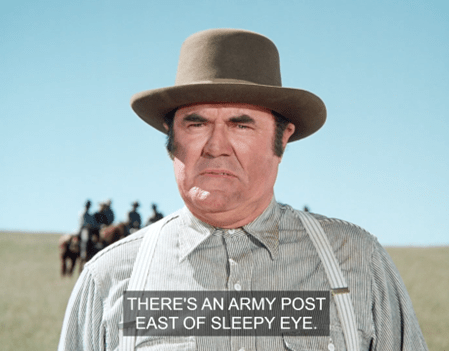
Maybe he’s just bluffing, of course. Either way, he says the Army will bring their Gatling gun – a precursor to the machine gun.

So MacGregor and the posse leave.
Charles tells Little Crow, “They’ve gone for the soldiers. You’ve got three, maybe four hours at best.”
WILL: This is ludicrous. It would take days to fetch anybody from “east of Sleepy Eye” as this point. It’s a full day’s drive from Walnut Grove.
DAGNY: Well, they’ll send a telegram.
WILL: From where? This field?
DAGNY: No, they’ll go back and do it from the Olesons’.
WILL: They don’t have a telegraph yet. You know who does have one? SLEEPY EYE!

Little Crow tells Charles they’re done running – but suddenly a voice speaks behind him. It’s the chief, who’s now dressed and out of bed.

Speaking haltingly but firmly, Long Elk says something to Little Crow, then walks around looking into the faces of his people: first the pretty girls, then the kids, then the old ladies.
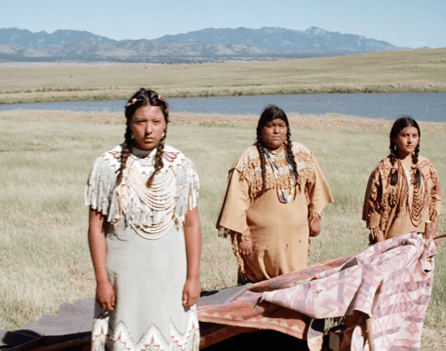
WILL: Is that Albert?
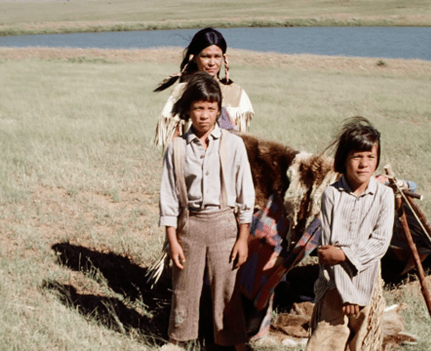

Then he kneels down and begins to sing. Little Crow tells Charles the song says the chief is ready for death.
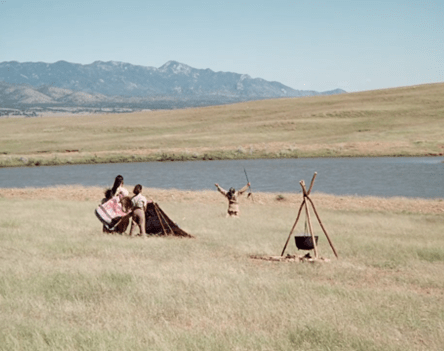
Charles, Doc, Spotted Wolf, and Yellow Feather all watch the chief. Touchingly, Yellow Feather has a glue tear on her face.
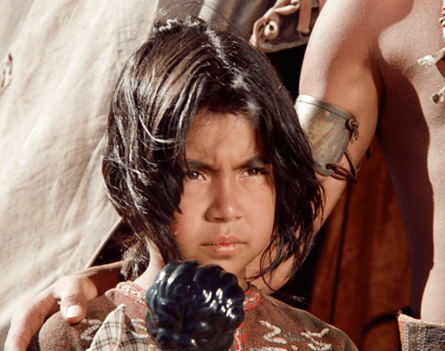
And sure enough, now we see the posse coming back with a wagon full of soldiers and a Gatling gun.
WILL [as ANNOUNCER]: “Two weeks later.”
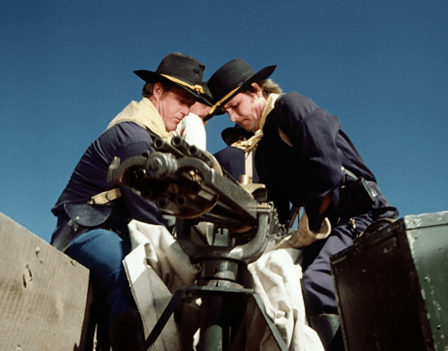
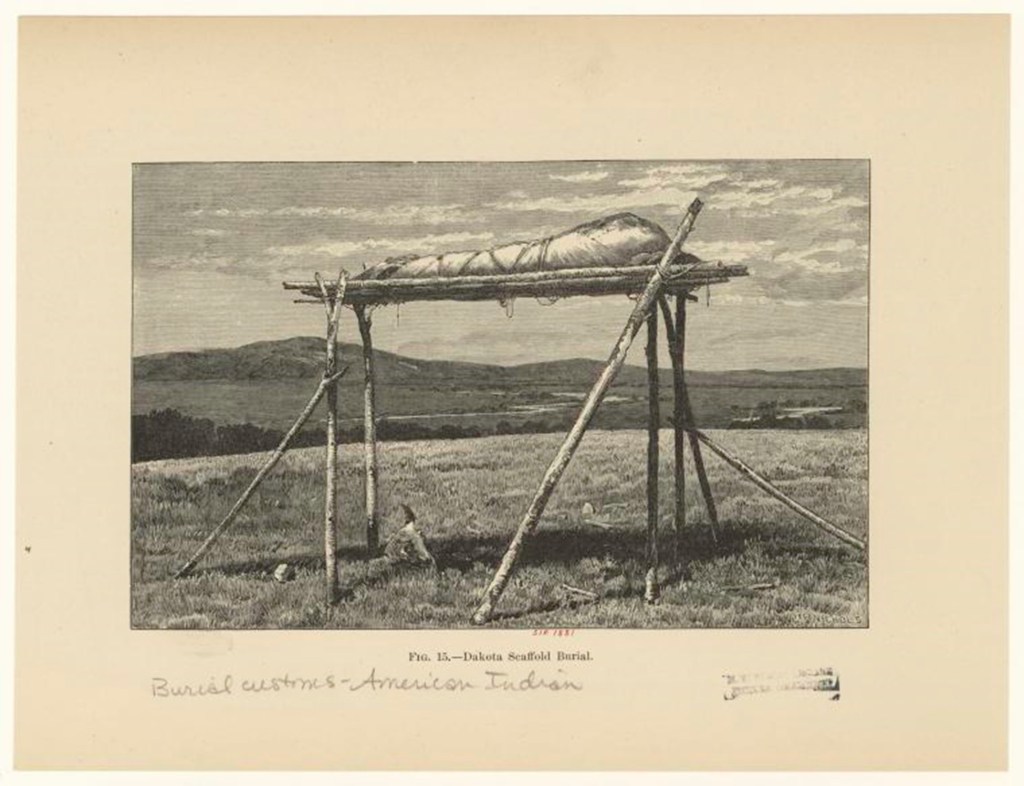
But all they find at the campsite are Charles, Doc, and a burning structure. Clearly some research into traditional funeral practices was done, since the Dakota did build a sort of scaffold on which they placed a body for the death ceremony. They do not burn the bodies of their dead, but it does seem there’s a tradition of burning certain of their belongings, so we’ll assume this is what’s happening here.

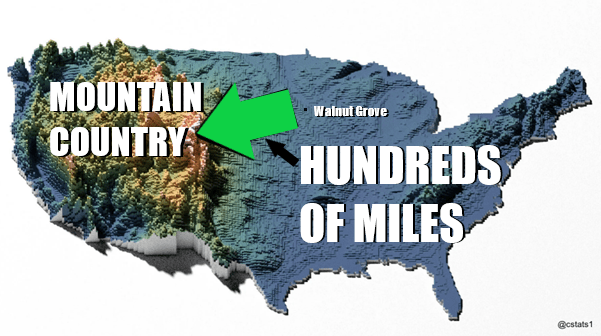
Charles says the rest of the band will be in the mountains by now, though if you’re a regular reader I don’t have to tell you there are none to be found in that part of North America.
MacGregor orders the soldiers to give chase, but the sergeant, played by Dick Alexander of Father Murphy fame, tells him to shut his pie-hole, the chase is over.
And speaking of pie-holes, the Sergeant hilariously adds he wants to get home in time for a delicious kidney pie his wife is making for supper.
WILL [as VICKI LAWRENCE]: “He said, ‘Supper’s waitin’ at home, and I gotta get to it.'”
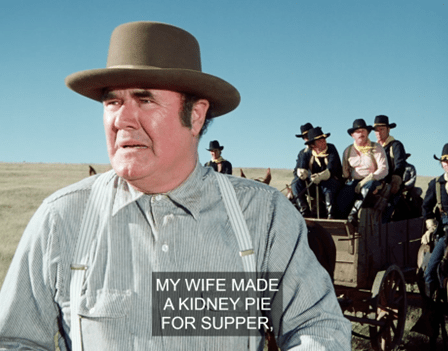
(The sergeant’s dinner may sound gross, but I’ve eaten kidneys and don’t mind them.)

Charles smirks at MacGregor, who weirdly looks like he’s going to cry.
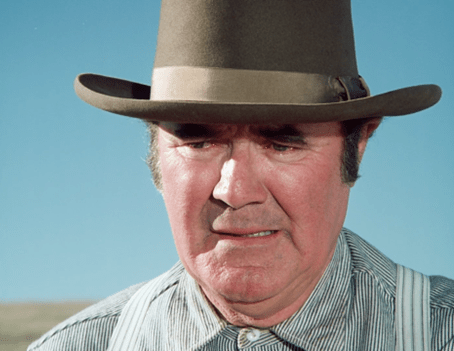
In a curious ending, then, everyone drives away except for Charles and Doc – and we hear the dead chief’s mysterious song again on the soundtrack.

STYLE WATCH: Charles appears to go commando again.
THE VERDICT:
DAGNY: That was good. I liked that one.
It is a worthy story, if slightly dull. It’s beautifully shot and well written – Long Elk’s sacrifice shouldn’t leave a dry eye in the house – but the characters on both sides of the central conflict are fairly flat.
It’s hard to imagine Charles ever making up with Mustache Man and Carl the Flunky after this, but he does.
UP NEXT: Apple Boobs


I enjoyed reading this!, but I got nothing to add except to voice my affection for The Facts of Life Goes to Paris (and The Facts of Life Down Under and Family Ties Vacation….oh, the late 70’s/early 80’s!).
And to say that Ma’s telling off MacGregor is what I remember from this episode. Karen Grassle is great. I’m so glad she got so much appreciation at the anniversary event.
LikeLiked by 1 person
Agreed! I’m sure Ma had her leg-amputatin’ knife concealed under her skirt for just such situations.
LikeLike
Plus Laura could have sprung from the loft and blinded MacGregor with lemon verbena.
LikeLike
No matter what you do, you’re not going to make everyone happy. Just keep doing you. Maybe in the future, people might say that we did too much or too little anyway! I’m looking forward to the next one especially, after that TITle! 🍎🍎😆
LikeLiked by 1 person
Thanks! 😁😁😁
LikeLike
Hmm…interesting but not a favorite!
LikeLiked by 1 person
Wow, if I had a nickel for every time Mary Ingalls beat up a bully boy in the playground, I’d have two nickels, which isn’t a lot but it’s weird that it’s happened twice.
I’ve rewatched this one last year around the same time I saw “The Fighter”. It was a fine episode, if somewhat predictable, from the Indians turning out to be well-meaning to the bigoted townspeople’s reaction to the Ingalls family and other good guys’ friendliness and sympathy towards them. At the same time I started searching what kind of fanfiction material the Little House on the Prairie community tended to produce, and I stumbled upon one authro named Marla Fair, who publishes fanfics of Bonanza and Little House, and one of her stories, “The Price of Freedom” serves as a direct sequel to the events of this episode. In it, Doc reveals details of MacGregor’s past to Charles while they’re still on the landscapes, saying that his older children were killed by Dakota warriors during the Dakota War, fueling his hatred of Indians which continues to cause mayhem throughout the events of the story as MacGregor takes out his frustration from being denied the chance to exterminate the tribe on the Ingalls family. Now, I don’t think that’s exactly what the writers had in mind for MacGregor’s past, but I do think there’s something implicity in his final appearance as he seems on the verge of tears, which combined to his brags about what happened in the war, might indicate there’s something more tragic about his bigotry, even if he’s meant to be completely unsympathetic through and through.
I can sympatheize with your resevations about such stories, given the way that even modern works that tackle racism and bigotry often risk to take the wrong course failing to see the source of the problem or making clueless comments or portrayals that wind up insulting some of the people the work talks about. It’s especially hard when not everyone involved agrees, I’ve seen productions get equal amounts of praise and criticism for how the handled such subjects, so the conclusion is, it’s hard to make everyone satisfied, but nevertheless, I still think you were respectful and sensible enough throughout the review, while not robbing the viewers of our laughs despite the heavy themes here.
Now that you mentioned La(r)rabee, I wonder how he reacted to the events of this episode? He’d certainly be okay with pursuing and massacring the Dakota group, but he’d probably be too cowardly to join MacGregor’s posse (other episodes will show that he’s nobody’s idea of brave).
LikeLiked by 1 person
Thanks, Vinícius, I appreciate that. As for MacGregor’s motivation, well, first of all I wasn’t aware Little House fanfiction was a thing. I’ll have to look Marla Fair up! (Does she call her website “Meet Me at the Fair”? A missed opportunity if not.) Details about MacGregor’s history would go a long way toward raising this one in my estimation (and “The Price of Freedom” is an excellent Little House-style title for a follow-up). But I understand it’s a show for kids, plus they only had 48 minutes in which to do these episodes – you’d have to tone things down and make them “black and white” for it to work. It’s easy to judge from the sofa 150 years after these stories take place, but certainly the horrors of war upended people’s morality, then as now, and the settlers’ rage is understandable to a large extent. The Sioux Wars are a painful topic here in Minnesota to this day (although most white people don’t think about them much – it’s the winners’ privilege to forget).
LikeLike
Looking now, the fact that the writers are newcomers may have contributed to Mary’s uncharacteristically hostile reaction to the Dakota tribe, but her reaction to MacGregor’s son threatening Laura and change of heart seem to invoke something you mentioned in your review of “Indian Kid”: that sometimes an insult to a family member is all it does take for people to forget their bigotry. I doubt the writers from here watched “I-Kid”, but it’s an interesting coincidence.
I started seeing fanfiction to see if other fans would have any interesting takes on alternative scenarios or explore moments that didn’t get handled in the show, but as with most fandoms, a lot of what I found can be very…. bizarre to put it mildly, and not always in a fun way. But I was fortunate to find two authors, Marla Fair and one Cheryl C. Malandrinos, whose Little House stories lived up to the show’s spirit and characterizations (it helps that both of them are professional writers). Another one that called my attention was one Lukas Miller, who created an alternate series of events where Mary and John Jr remain a couple. I stumbled upon his YouTube channel where among other things he’s been posting piano arrangements of melodies from the show: he’s done one from The Lord Is My Shepherd, Journey in the Spring, Remember Me and The Music Box.
I must ask, did you change the comment section to make italic and bold available? I liked it better, makes it easier to highlight certain parts without using the CAPS LOCK and giving the impression we’re SCREAMING whenever we want to emphasize something.
LikeLike
Oh goodness no, I’ve never touched the settings for the comments. I’m not even sure if I’m able to change them?
LikeLike
wish I had a picture, but you missed a fuck up. When Charles & the Doc are escaping and the Doc says he’d better check on the chief, you can see a hand in the lower right of a crew member who was shaking the rig, complete with a very fancy looking watch. 😆
LikeLiked by 1 person
I’ll check it immediately
LikeLike
How could I have missed that! Thanks so much. 😀
LikeLike
Longtime lurker here… I might be completely wrong, but weren’t the Dakota just handling darkly stained sticks? I thought the threat of guns was just a bluff, especially as MacGregor and crew never came close enough to confirm. Maybe these were just cheap props that were actually meant to be guns.
Anyhow, thanks so much for providing this blog. I’m a fan of the old blogspot from the mid-naughts and really enjoy the simple format. My husband likes to tease me about my Walnut Groovy reading after my (almost) nightly episode!
LikeLiked by 1 person
Thank you, Meridith, you made my day. From the stills, it looks like there may be truth in what you say. Dagny and I are traveling this week but I’ll take a look and consider the question when I get home. Welcome to Walnut Groovy!
LikeLike
Just checked it out and you’re certainly right. I’ve updated the recap – thanks again!
LikeLike
No problem! Nothing like putting all this work into the blog, just to have strangers chime in pointing out a mistake or two lol. Appreciate the recaps as always!
LikeLiked by 1 person
Nah, I love it. I need all the help I can get. ☺️
LikeLike