
Whoa, We’re Halfway There; or
When Ames the Heart
(a recap by Will Kaiser)
Title: Blind Journey, Part One
Airdate: November 27, 1978
Written by John T. Dugan
Story by Carole Raschella, Michael Raschella, and John T. Dugan
Directed by William F. Claxton
SUMMARY IN A NUTSHELL:
RECAP:
ROMAN: Sixteen-plus??? What’s happened to this show since I’ve been gone?

Yes, Little Baby Roman (the closest our family has to a Carrie – sorry, Romesly), returned from college for this two-parter.
First things first, though. Hey, hey, we are at the halfway point, people!
Counting the Pilot, A New Beginning, and the final movies, “Blind Journey,” Part One, is considered the exact center of the complete series.
I kind of can’t believe we’ve come this far.
And the thought that we still have half the show to go, I believe even less.
But The Project hasn’t killed me yet, so let’s continue until it does. On we stagger, friends!
We open on a familiar face – Joe Kagan!
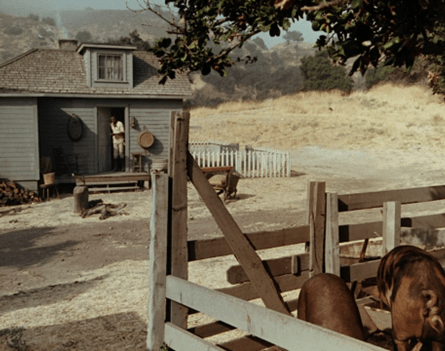
I was wondering when Joe would be back. After all, he was introduced 24 episodes ago as a new permanent resident of Walnut Grove, and hasn’t even been mentioned since. That’s at least thirteen years in Little House Universal Time (LHUT).

It’s a long time for a semi-regular to go without being seen, though it’s not without precedent: Kezia hasn’t appeared or been mentioned for even longer. (Nineteen years LHUT.)
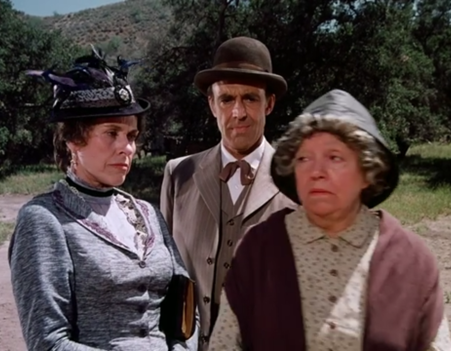
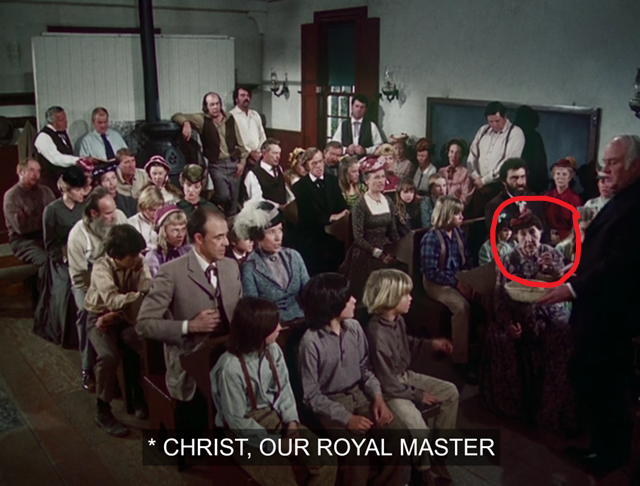
Amy Hearn, of course, had the opposite situation: mentioned several times but only seen once. (Unless the Simply Ancient Lady from “To Live With Fear” and “Times of Change” really was her after all?)

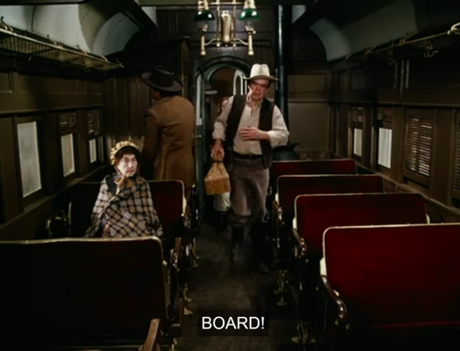
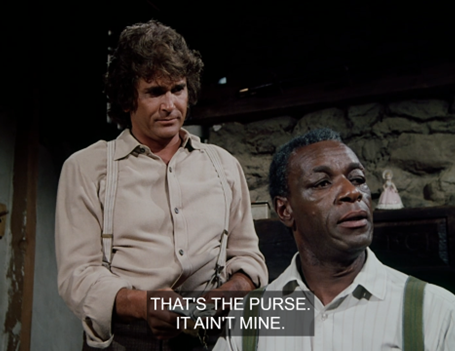
Well, I’m happy to see Joe back at last. While “The Fighter” wasn’t a favorite of mine before, this time around I really fell in love with it.
No need to relitigate its virtues now, of course. David Rose, who gives us a flourish that sounds a bit like the theme to Newhart, is obviously also happy Kagan’s back.
Unless Joe tells us otherwise, and since obviously he didn’t accompany the Ingallses on their adventures in Dakota Territory, we’ll assume he’s been here the whole time and survived the Great Crash of 1881-G.
Perhaps he did so by providing pork to those who could afford it – because he appears now to own a pig farm.
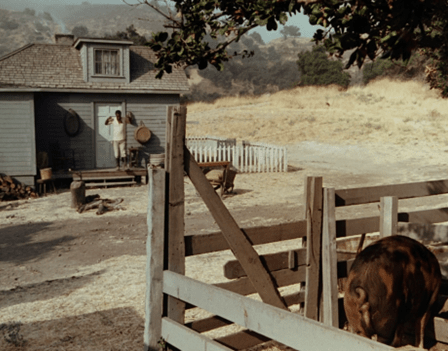
In fact, the attentive amongst you will recognize both house and pigs as formerly belonging to Adam Simms and his son Luke, better known as husbands to Miss Beadle and Nellie Oleson, respectively.
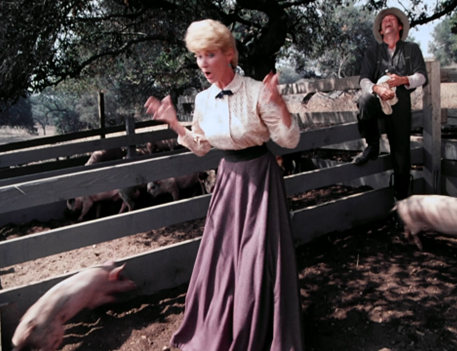
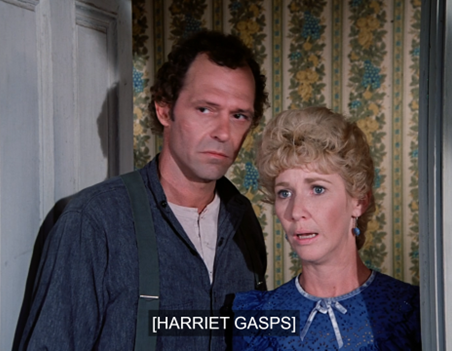
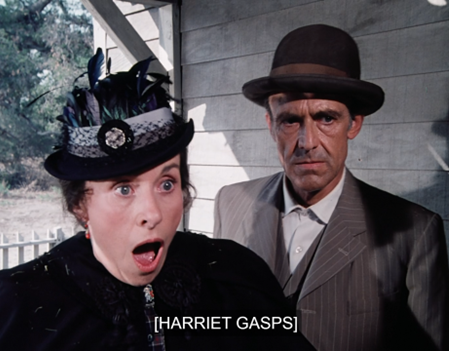
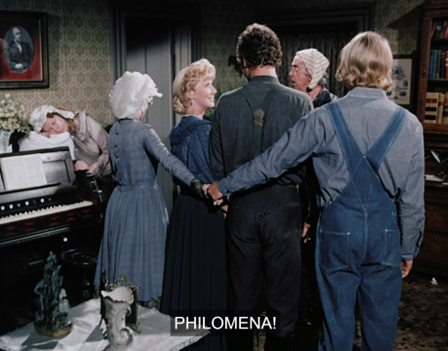
The Bead-Simmses must have sold Joe their farm when they moved.
Now remember, in “The Fighter,” Joe Kagan wanted to buy a farm from someone named Harper; but we never saw him finalize that purchase, and as I said, some time has passed since then.
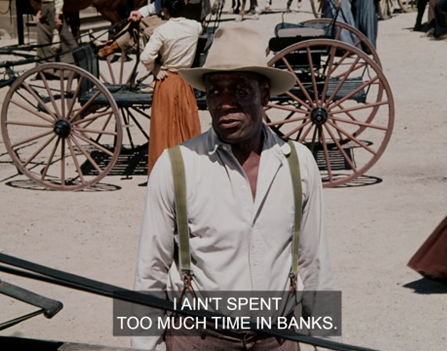
It’s unclear if this is the same pig farm originally owned by the Hobson family. Laura visited that property at one point, you’ll recall, trying to sell Dr. Briskin’s Homeopathic Remedies.
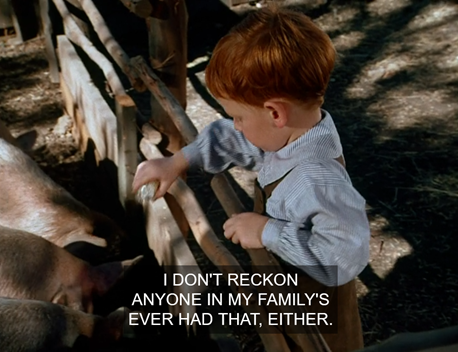
Poor Elmer Dobkins was once thrown into a pigpen there as he was innocently passing by, too.
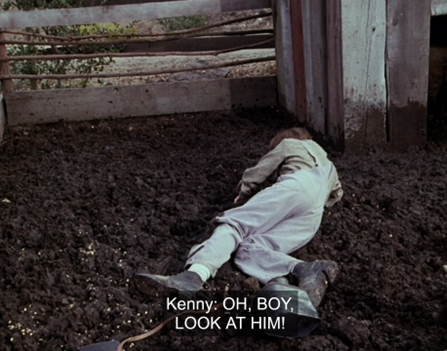
But I don’t think we got a good look at the house on either occasion.
Well, let’s assume it’s the same farm, but it’s changed hands a few times over the years.
I do like the idea that Simms & Beadle would sell their place to Joe. Not everyone in town would, of course, as we shall see.
DAGNY: That pig has quite the curly tail. Don’t they chop them off in modern times? I wonder where they found these?
AMELIA: Michael Landon must have raised them himself for the episode.
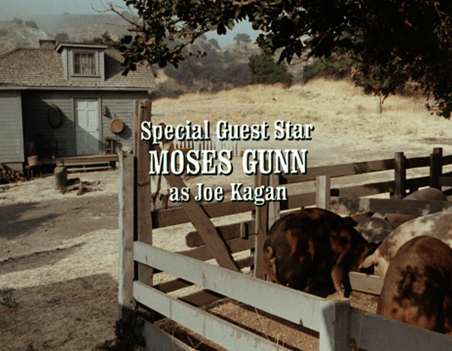
They do clip, or “dock,” pigs’ tails these days, to prevent the pigs from biting each other’s tails off, which apparently does happen. People have differing views of the practice, of course.
Well, on with our story. Kagan yawns and stretches and tries to come to life, then gets to work feeding the animals.
He talks to the pigs for a little bit, addressing one as “Gertrude” and another as “Henry,” and laughing to himself like Yoda.
This script was a collaboration between John T. Dugan and the Raschellas. (They should have named the pigs Carole and Michael, don’t you think? Missed opportunity.)
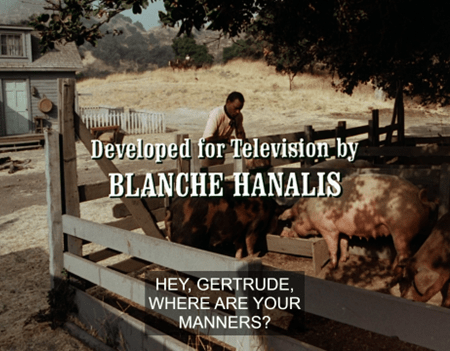
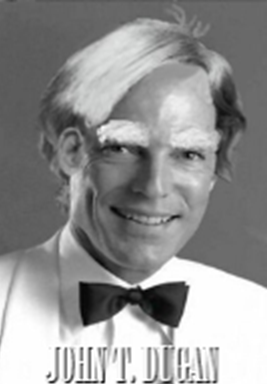
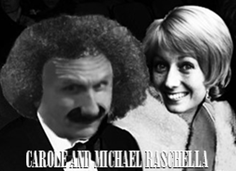
Clax is back as director.
Charles Ingalls pays a visit, telling Joe “the Elders of the church” will be voting on his application for membership tonight.
This again. The last time this device was used, the Elders were debating whether to admit Kezia to the congregation (a controversy that made little sense).

Given the racism of the times, which thank goodness we’ve completely left behind in today’s society, it is conceivable there would have been heated discussion about Joe’s membership.
I’m not sure they would vote on it several times, which this conversation suggests has happened.
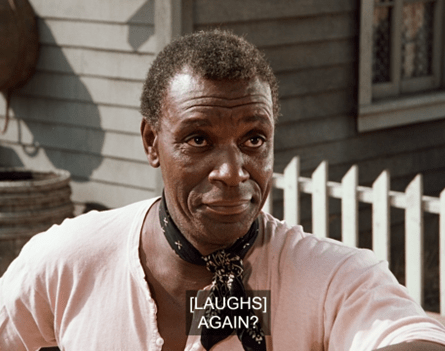
Joe shrugs and says whatever the outcome, he’ll keep praying to God wherever he can – a good attitude to have.
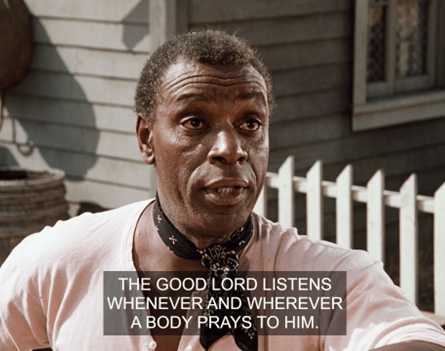
But when Charles departs, Joe turns bitterly to his pigs, saying, “Some folks think the only place for a n─── to say his prayers is right here.”
WILL: There’s your sixteen-plus.
A devastating line. But then Kagan gives a half smile, says “Oink,” and chuckles again.
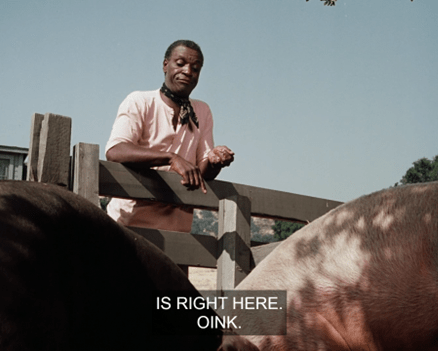
“The Fighter” saw great development in Joe’s character, and he emerged from the searing events of that story with a wry humor that suits him well.
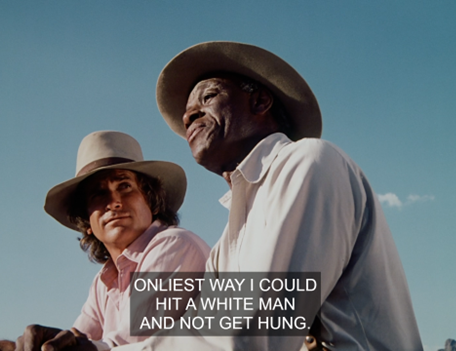
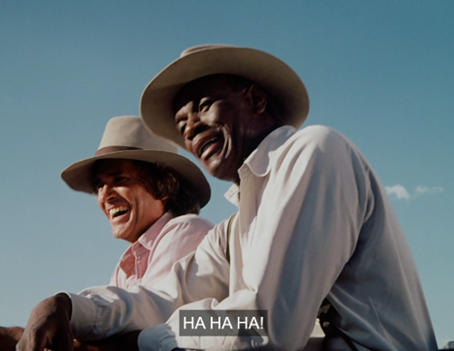
Okay, Classic Carrie Moment, dead ahead.
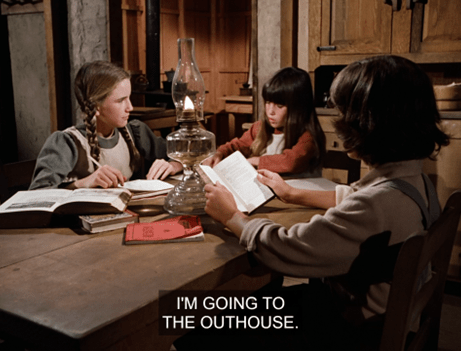
At the Little House, the three kids are studying, and Carrie slurps, “I hate dibision.”
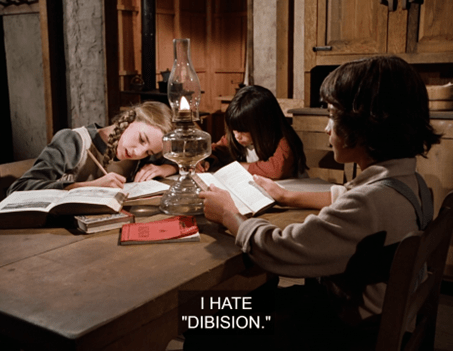
“What’s ‘dibision’?” Albert says, and Carrie screams “Arithmetic!” as if he’s the stupidest fucking idiot ever to cross the Little Threshold on the Prairie.
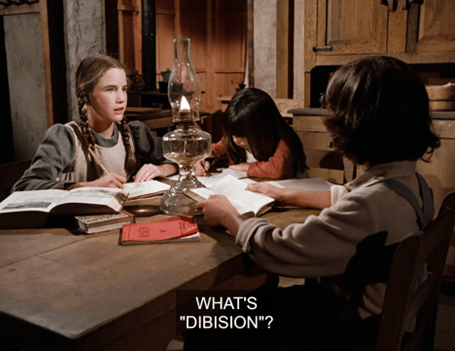
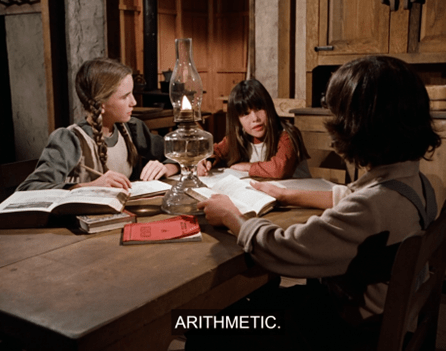
Laura laughs and says, “You mean division.” (No, I don’t believe Alice Garvey has Carrie doing division either.)
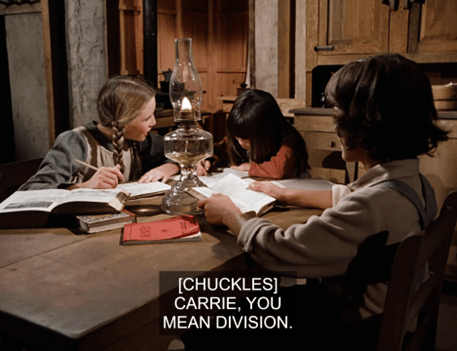
Albert says he likes division, and Carrie slurps, “That’s because you’re always getting A’s.”
WILL: Is he going to start failing math so Carrie will like him better?
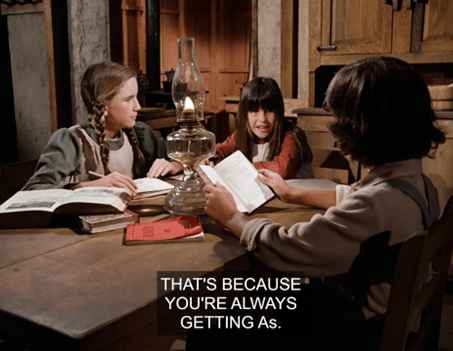
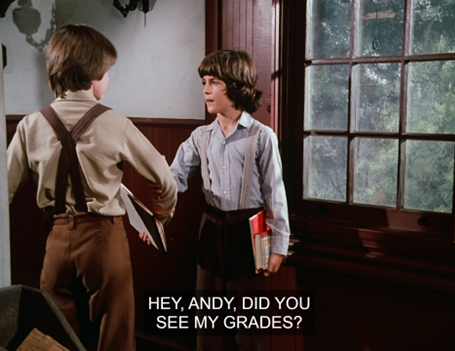
Slapping down her pencil in disgust, Carrie snorts “I’m going to the outhouse,” and exits.
WILL: Do you think this scene was scripted, or did Landon just film the actors doing their schoolwork?
Outside, Ma tells the audience this is Charles’s third attempt to get Joe accepted by the congregation. They’ve been back from Winoka about three years now, so it’s not a stretch they would have been involved in the previous disputes.
DAGNY: Boobilicious.
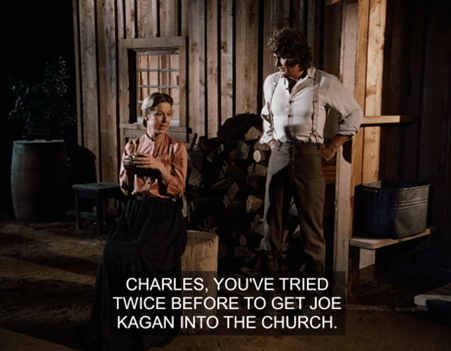
Caroline says at each meeting, there’s been a stalemate, with Garvey, Doc Baker, and himself comprising one faction, and Mrs. Oleson, Nels, and Jud Lar[r]abee the other.
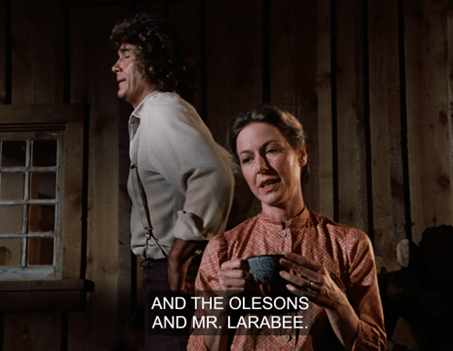
Presuming it was also the Board of Elders voting on Kezia’s application, it used to be a significantly larger body, comprising Mrs. O, Nels, the Bead, Carl the Flunky, Mrs. Foster, Hans “Rubberface” Dorfler, Johnny Cash Fusspot and his sister (Not-Quincy Fusspot’s Rather Beautiful Mother), and Not-Paul Rudd If He Were a Middle-Aged Insurance Salesman From the Midwest.
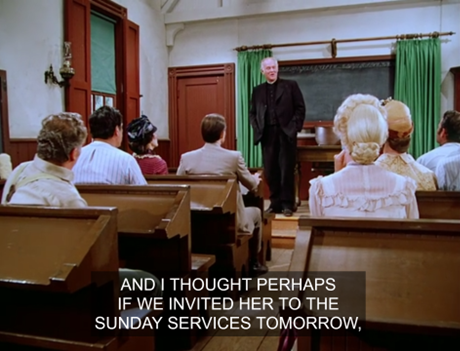
Miss Beadle, of course, got married and blew town some time ago.
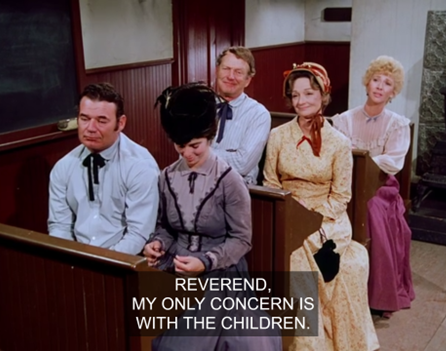
I’m not sure if Dorfler, whom I’ve always liked, is still around. He was when the recession hit, but he may have moved away since then.
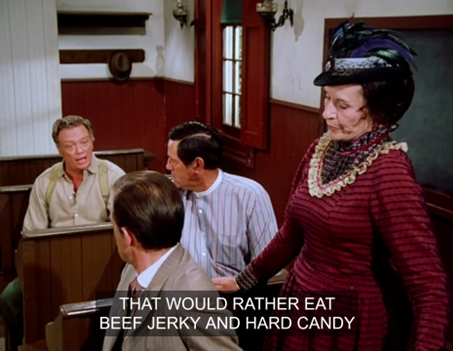
Johnny Cash Fusspot’s Rather Beautiful Sister we know moved to Winoka after her son, Not-Quincy Fusspot, went blind in an untelevised adventure.

I thought I might have spotted Not-Paul Rudd in “Harriet’s Happenings,” but I make no promises I was right.

The others are all back in town, but I suppose some were term-limited out or dropped off the board because of other commitments.
As for Jud Lar[r]abee (as of this story he hasn’t added the second R yet), we haven’t seen him since “The Wolves” (LHUT score: -18).

Lar[r]abee is a sheep farmer, and, as with Kagan, his activities during the financial crash are unknown. We don’t really know much about him at all, except that he’s an asshole who has some bad history with Jonathan Garvey.

That said, he did ultimately pitch in to help during the crisis of the Feral Dog Invasion.

Ever the Eeyore, Ma asks Pa why he thinks this vote will be any different, and Charles, ever the Kimmy Schmidt, says, “Hope springs eternal.”
This is a quote from Eighteenth-Century wit Alexander Pope’s poem An Essay on Man, which observes that the human race represents a) the coolest beings that exist on Earth, and b) a huge annoying rabble of complete fuckups. And that most people are actually both.

The poem ultimately is optimistic, but it’s still pretty bitchy, and so is a good thumbnail of Pope’s personality and artistic spirit. (He’s not a favorite of mine, but I read a lot of his stuff when I was young.)

Anyways, the main point of An Essay on Man is “Just shrug and hope for the best,” which is literally what Charles is doing here.

Charles says Mrs. Oleson is forcing Nels to vote her way.
AMELIA: I can’t believe Nels would vote no on this.
DAGNY: I don’t either. He’s welcoming of all people, probably because he has a fat sister. In fact, you could argue he’s Walnut Grove’s DEI officer.
ROMAN: Yeah. And he’s the whitest guy in town.

I also don’t believe Nels would join the racist faction under any circumstances – I don’t think any Little House fan could picture that.
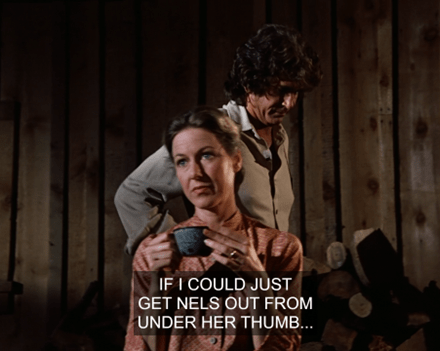
The notion that Harriet’s motivating him by withholding sex, which I’m sure was the first to come to your diseased imaginations, is doubtful, since she seems to have a healthier libido than he does in the first place.
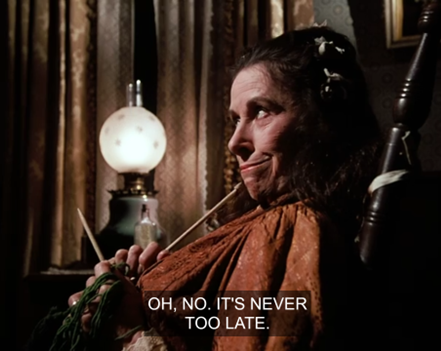

In “Castoffs” they explained Nels’s failure to join Team Kezia by having him accidentally get drunk and pass out. Maybe the same thing has been happening recently? We did surmise he developed a drinking problem in Winoka.
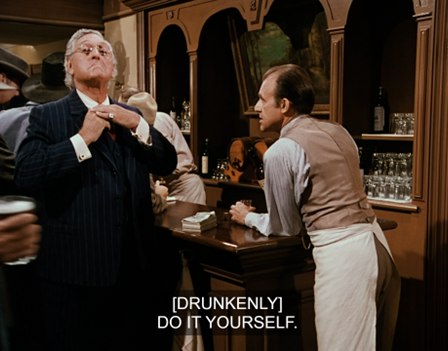
“It’s a shame the Board of Elders isn’t the same as when Mr. Hanson was alive,” Caroline says, implying Hanson used to be the tie-breaking seventh vote on the board. (Why wouldn’t they have replaced him with another? After three years? Kezia herself has no fear of Harriet Oleson, for instance.)
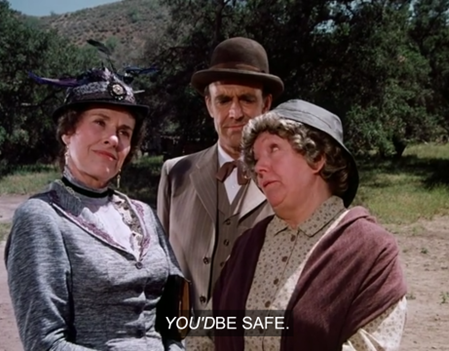
Well, no matter. I am glad they suggest Hanson wasn’t a racist, though. He was mostly absent from the racism stories so far, though he did have a comedy cameo in “The Fighter” (which wasn’t primarily about racism anyway).
Of course, maybe Doc would have withheld sex to get Hanson to vote his way.

Meanwhile, in the Oleson residence, Nellie is studying at the dining room table. (Presumably she’s still being monitored so she doesn’t decorate her garments with illegal data again. We can’t see if she has an ankle bracelet.)
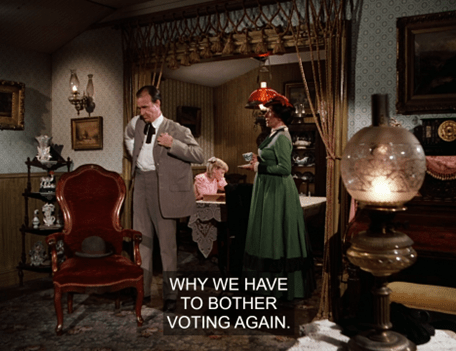
Nels asks Harriet why she objects to Joe Kagan, and she says she doesn’t. She says he’s a great person considering he’s a . . . well, she uses an extremely offensive old racist term you hardly ever hear today (unlike some others).
If you must know what it is, you can find it in the lyrics of “Mississippi Mud,” a Jazz Age standard that is in other respects a great tune.
The song is still performed by jazz singers – with updated lyrics.
Here’s Ray Charles doing it (a while ago):
Nels and Harriet then launch into a surprise debate about the meaning of the Song of Songs, or, as Nels calls it, “the Song of Solomon.”
Many of you I’m sure are familiar with this book of the Hebrew Bible/Old Testament. It’s an oddity, eclipsed in out-there-ness in the Christian Bible only by the end-of-the-world dance party that is the Book of Revelations.
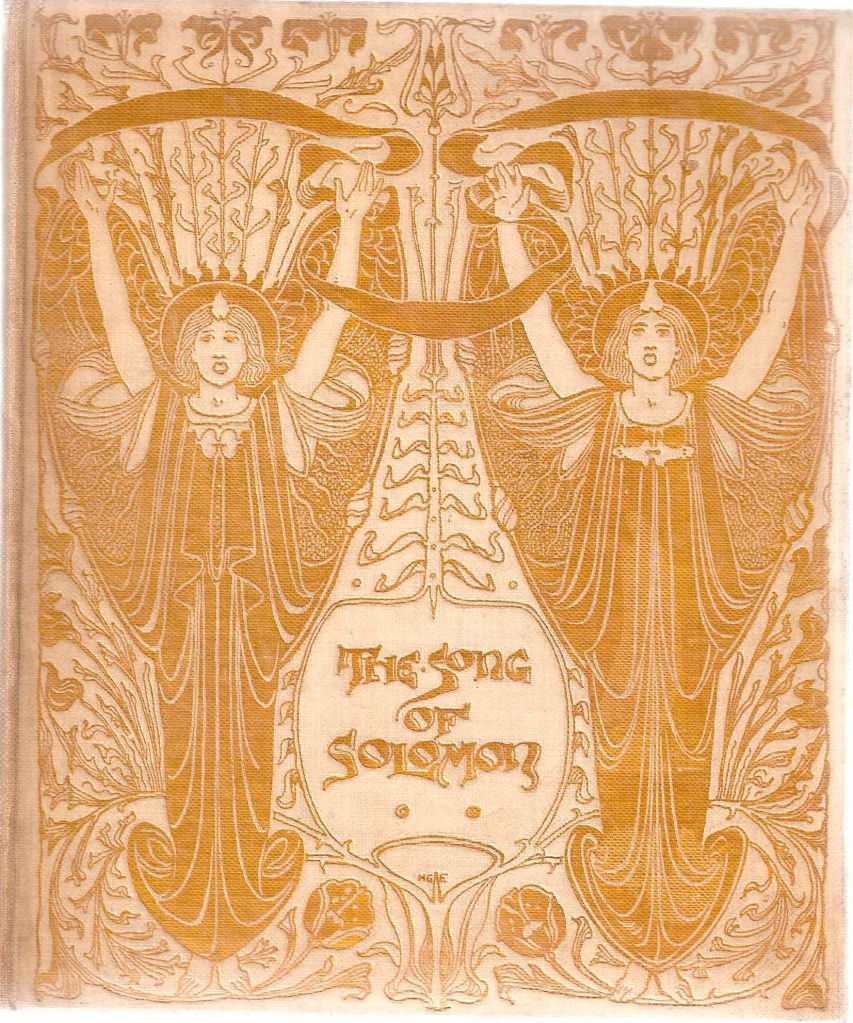
Allegedly by the wise-but-maybe-mythical King Solomon (the one who wanted to cut the baby in half), the Song of Songs is unusual amongst Books of the Bible in that it is a book of true poetry, isn’t didactic, and is specifically (and specifically positive) about sex.
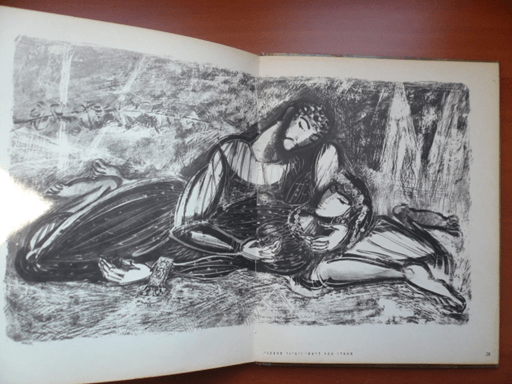
People have always argued about whether it’s meant to be taken literally or metaphorically, and of course different translations tamed it down, but certainly it reads today like a fever dream by a fin de siècle aesthete (which is why a lot of them illustrated it).
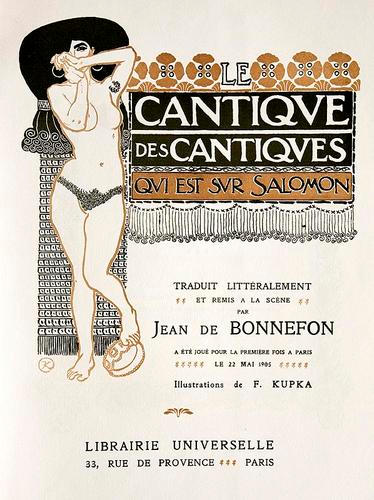
Many people have convincingly argued it contains references to specific body parts and, um, activities you don’t learn about in Sunday School. (While it’s highly regarded for its literary merits, it’s rarely analyzed in sermons.)
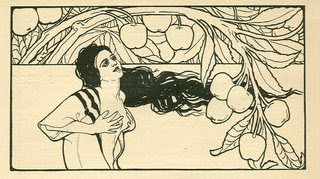
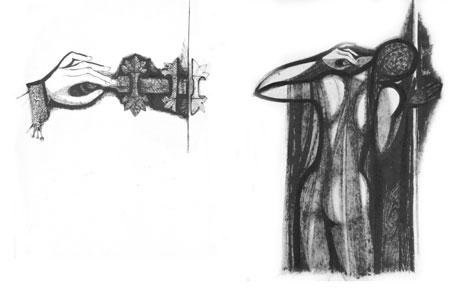

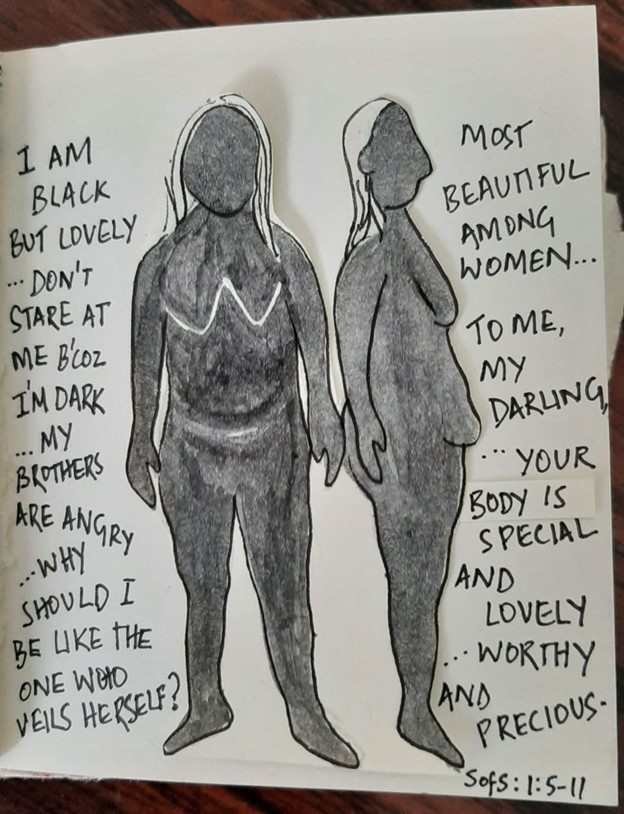
Anyways, the specific verses discussed by Harriet are about “blackness,” but people debate whether that refers to race, a sunburn from working the vineyards, or something else altogether.
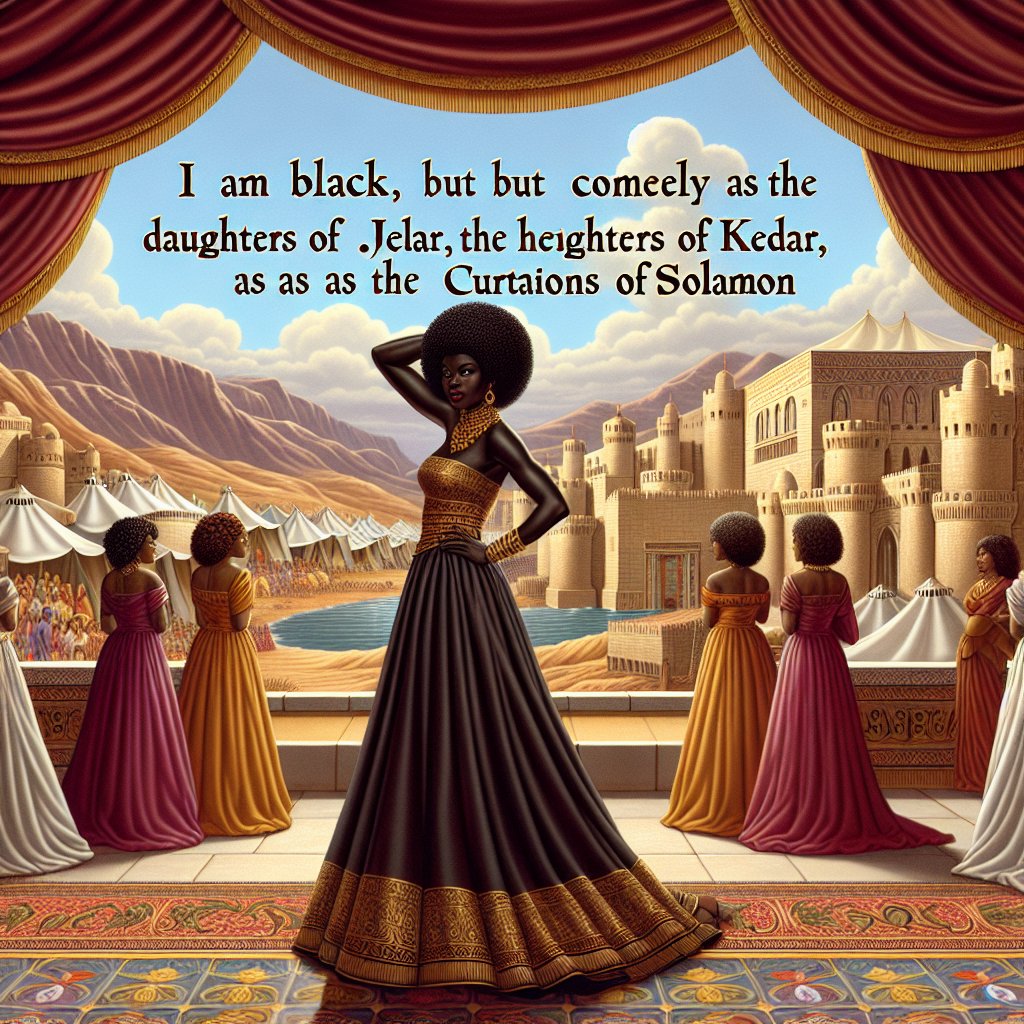
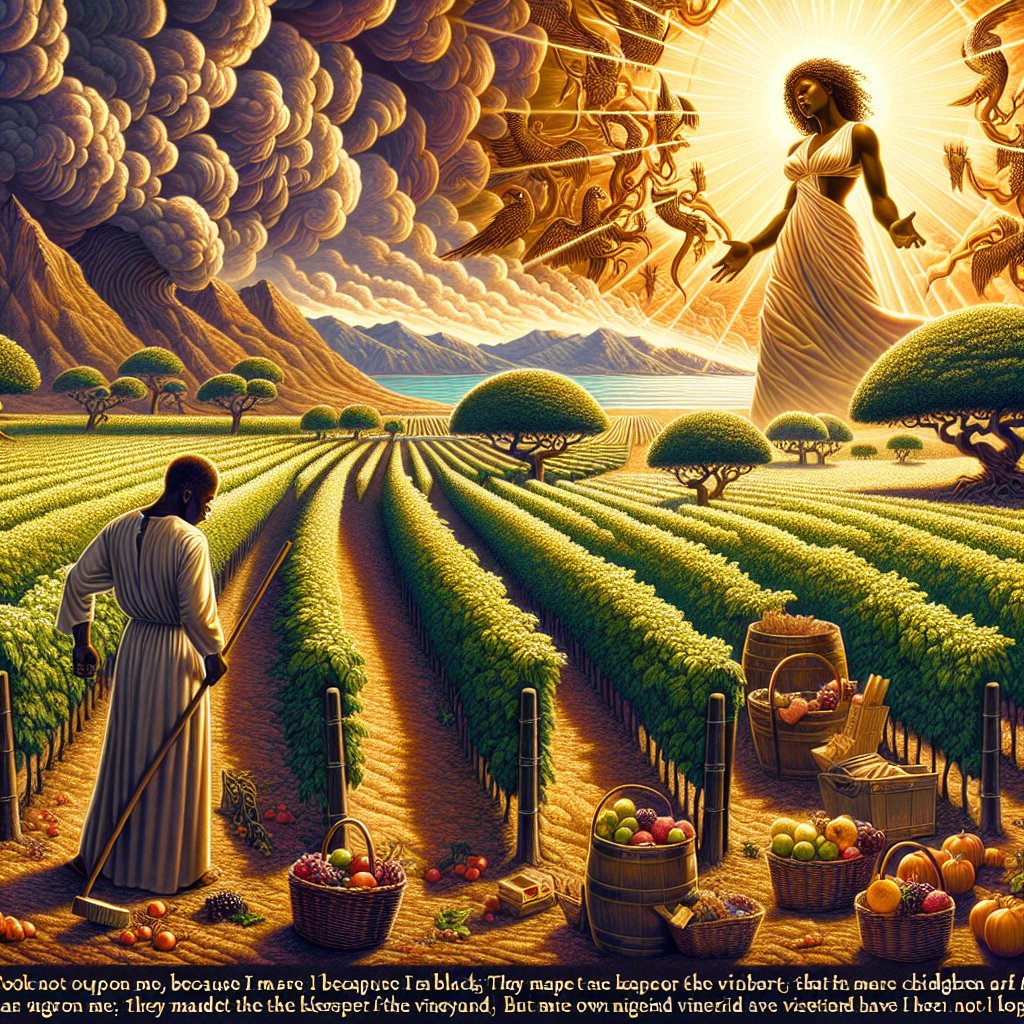
The version of the Bible quoted on this show has not always been consistent; but Americans of the Grovesters’ time would likely have known the famous “King James” translation.
The narrator of the passage in question is a woman – often interpreted as a bride anticipating her wedding night. Here it is:
Let him kiss me with the kisses of his mouth: for thy love is better than wine.
Because of the savour of thy good ointments thy name is as ointment poured forth, therefore do the virgins love thee.
Draw me, we will run after thee: the king hath brought me into his chambers: we will be glad and rejoice in thee, we will remember thy love more than wine: the upright love thee.
I am black, but comely, O ye daughters of Jerusalem, as the tents of Kedar, as the curtains of Solomon.
Look not upon me, because I am black, because the sun hath looked upon me: my mother’s children were angry with me; they made me the keeper of the vineyards; but mine own vineyard have I not kept.
Tell me, O thou whom my soul loveth, where thou feedest, where thou makest thy flock to rest at noon: for why should I be as one that turneth aside by the flocks of thy companions?
If thou know not, O thou fairest among women, go thy way forth by the footsteps of the flock, and feed thy kids beside the shepherds’ tents.
I have compared thee, O my love, to a company of horses in Pharaoh’s chariots.
Thy cheeks are comely with rows of jewels, thy neck with chains of gold.
We will make thee borders of gold with studs of silver.
While the king sitteth at his table, my spikenard sendeth forth the smell thereof.
A bundle of myrrh is my well-beloved unto me; he shall lie all night betwixt my breasts.
My beloved is unto me as a cluster of camphire in the vineyards of Engedi.
Behold, thou art fair, my love; behold, thou art fair; thou hast doves’ eyes.
Behold, thou art fair, my beloved, yea, pleasant: also our bed is green.
The beams of our house are cedar, and our rafters of fir.
No popcorn mentioned, but you have to admit it’s steamy stuff, exactly the sort likely to get devout readers like Caroline Ingalls going. (“Spikenard,” in case you weren’t aware – I wasn’t – refers to a type of flower that releases a fragrant oil. If you take my meaning.)
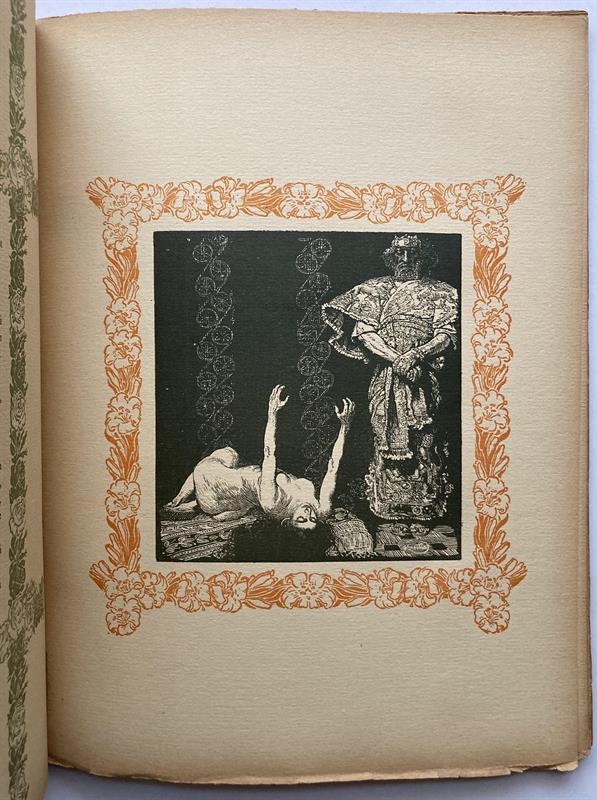
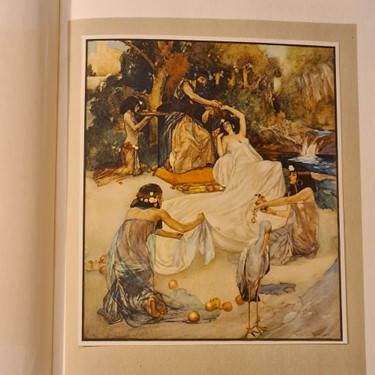

Scholars, whether approaching from a theological perspective or an outsider’s, seem to agree there’s no irony or judgment in the text. (God doesn’t suddenly appear and denounce the woman as a Jezebel, for instance.)
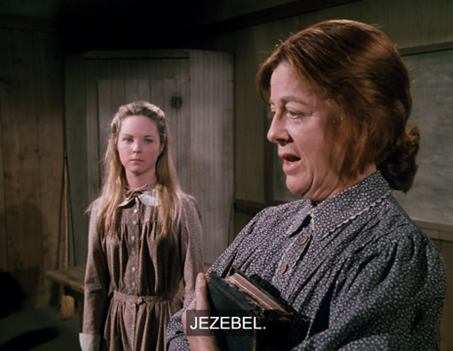
The consensus is the book is just what it appears to be: a joyous celebration of romantic and physical love, bestowed on humanity as a gift from God, a miracle.
(You know, if religious tradition actually did include reflections on this in their sermons, we might live in a more forgiving world; then again, maybe not.)
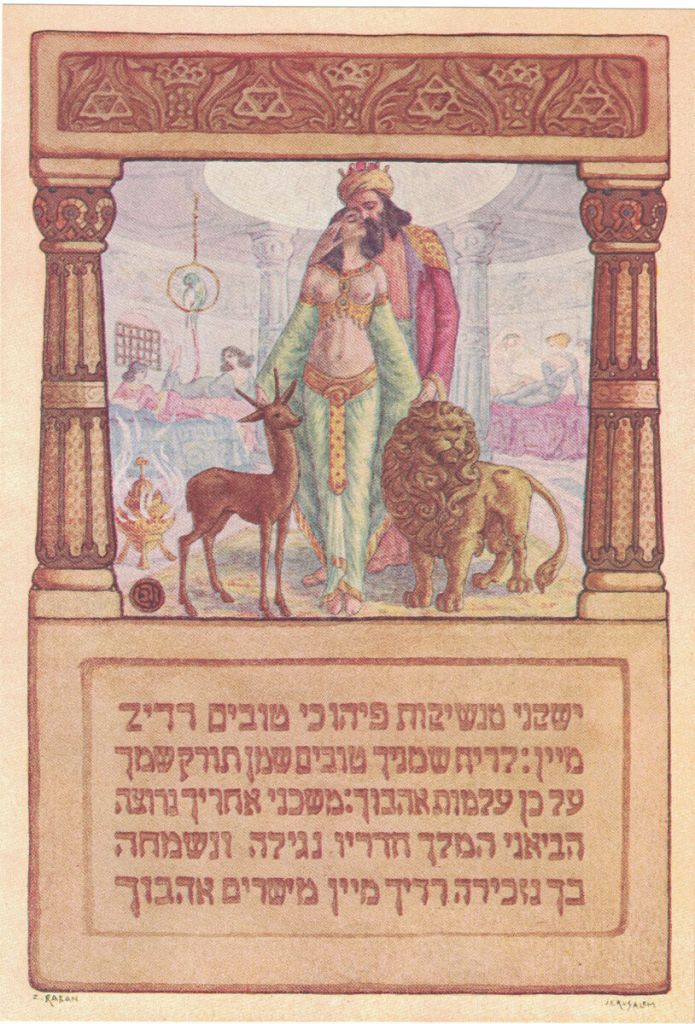
Well, all that’s just background for understanding this conversation. Harriet begins by saying the Bible endorses racial segregation, quoting the line “Look not upon me, because I am black.”

Nels, who probably has all the dirtiest parts of the Bible memorized, says she’s completely misinterpreted the passage in question.
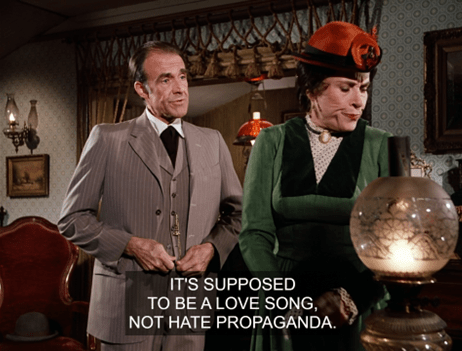
He gives her a brief lecture on the “blackness” passage in context. Remember, Nels is one of the rotating lay ministers at church. We were just wondering what his sermons were like; well, here you go.
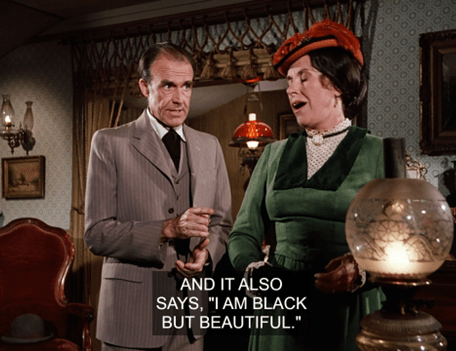
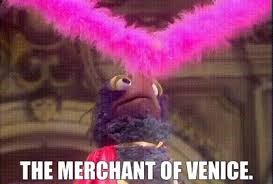
Well, says Harriet, “that only goes to prove even the Devil can quote the Scriptures!” – a popular saying from a line in Shakespeare’s Merchant of Venice. Sorry, I didn’t mean to turn this recap into English or Art History class, even though I do miss English and Art History classes and wish more things in life spontaneously turned into them myself.
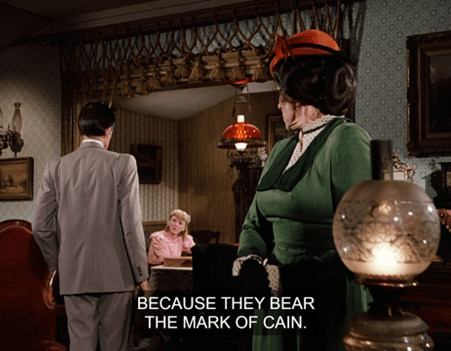
But suddenly we jump back to the Religious Studies category. Nellie very helpfully pipes up, saying, “Mother says that colored people are that way because they bear the Mark of Cain.”
You may remember this one as well. Cain and Abel were the sons of Adam and Eve, but Cain murdered his brother out of jealousy.
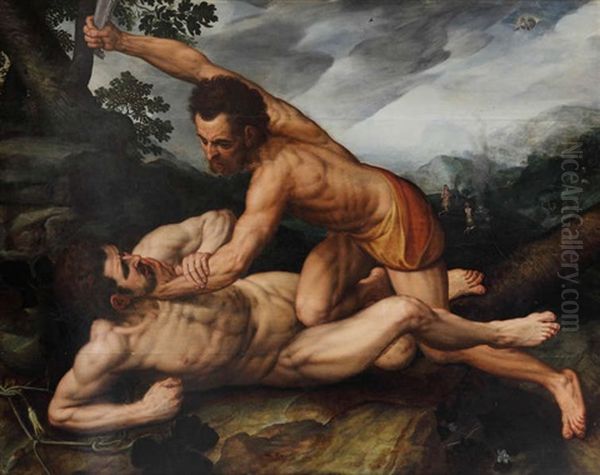
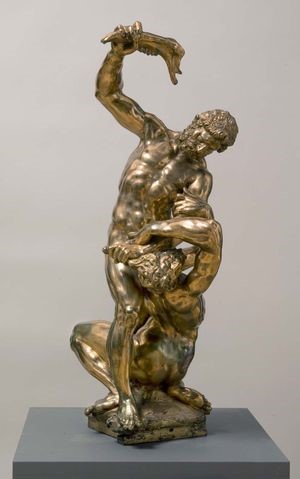
God punished Cain by cursing his property, leaving him to wander the Earth unhappily, though apparently he did eventually become a successful city planner of sorts. (I’m not sure where the people who lived there were supposed to have come from.)
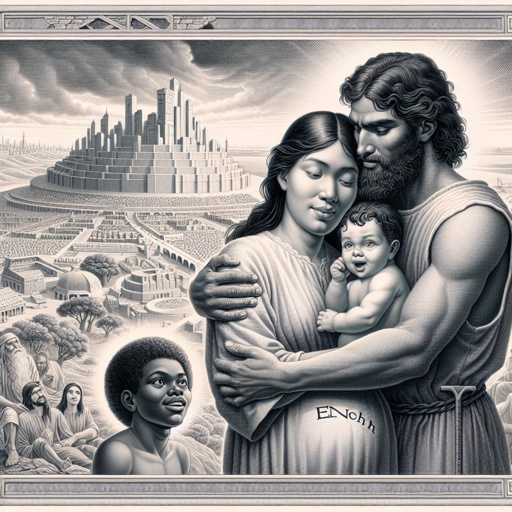
But God also “marked” Cain so others (again, what others?) would know not to harm him and he would suffer from guilt the rest of his days.
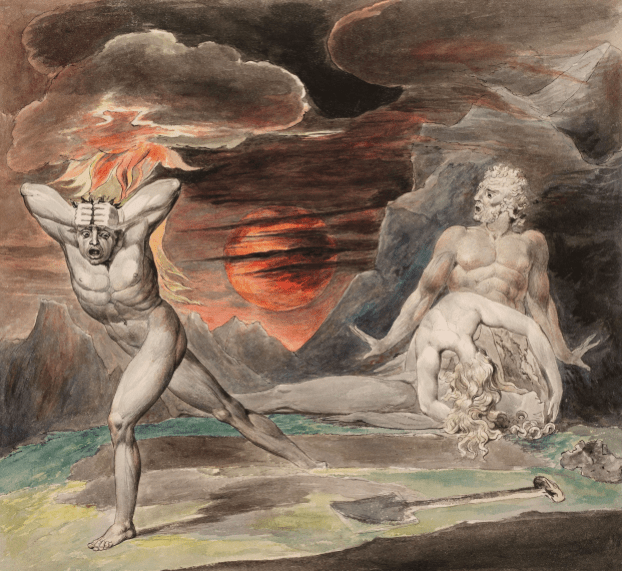
The nature of God’s “mark” is opaque – one tradition says it was God’s initials sort of tattooed on Cain’s forehead. This would blend in fine today, but would be pretty noticeable if there were just three people on Earth, and two were your non-inked parents.

But in North America before the U.S. Civil War, where large sectors of the economy had been dependent on slave labor for three hundred years, some quite major religious denominations – notably Baptists and Mormons – adopted the view that the Mark of Cain was black skin.
While not universally accepted, this notion was widely believed, and used to justify enslavement, racial segregation, and the like. In the Southern United States, this continued into the 1960s (at least). (In 1995, the Southern Baptist Convention publicly apologized for teaching this interpretation of Scripture, and the Mormons eventually abandoned the concept.)
In my shallow researches, I couldn’t find anything articulating Nineteenth-Century Congregationalists’ views on the subject. Since Congregational churches were locally administered, maybe it varied?

Nellie goes on to say Mother also told her Black people don’t have souls or go to Heaven. While I’m sure there were people who still believed this in the late 1800s, even the Southern Baptists had given up this claim by then. (They did claim Heaven was segregated by race, of course.)
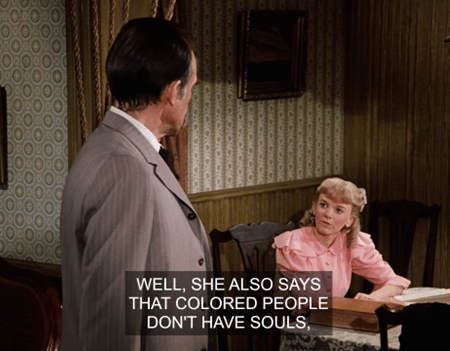
Nellie quotes her mother as saying Black people “aren’t made in the image of God.”
Nels turns around and dryly asks how she dare presume to speak for God – which I’d like to ask a lot of people today too.
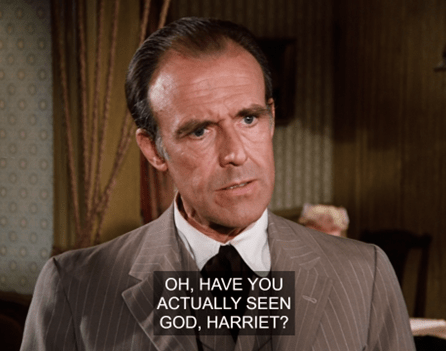
Harriet replies that “everyone knows” God is white and male, and they bicker nastily until Mrs. O terminates the conversation and they head to the meeting.
We cut to the middle of the meeting then, where Mrs. Oleson is saying Black people should stick to “their own religion,” which features “witch doctors,” “voodoo drums and dancing,” “spells” and “masks.”
WILL: She’s like Opal from the BBC. “I mean, they have their own sort of religion, don’t they. . . .”


“And eating people!” Mrs. Oleson adds dramatically.
WILL/DAGNY/AMELIA/ROMAN: What about eating cats?
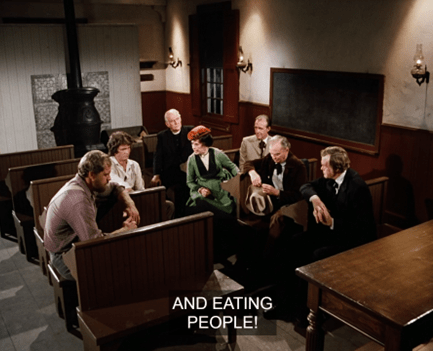
The Kaganite faction say if these things were ever true for Africans, and they don’t know that they were, Joe is generations removed from his ancestors.
Doc Baker points out Black people are full citizens since the war, and Reverend Alden says Joe is a devout and sincere Christian.
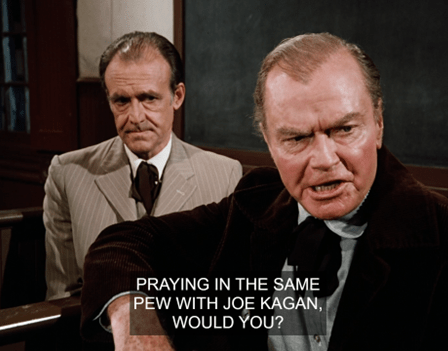
Jud Lar[r]abee says, “You wouldn’t want your wives and children praying in the same pew with Joe Kagan, would you?”
This goes over about as well as you’d think.
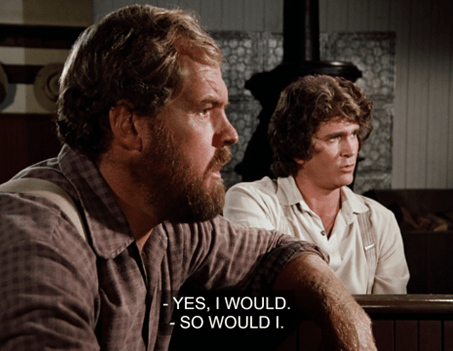
Then Mrs. Oleson argues that Kagan’s career as a boxer was somehow an attack on Christianity.
They all take shots at each other for a while, and then Alden says, “If I may remind you of the Gospel: ‘God so loved the world that He gave His only begotten son that whosoever believeth in Him should not perish but have everlasting life.” (The famous John 3:16.)
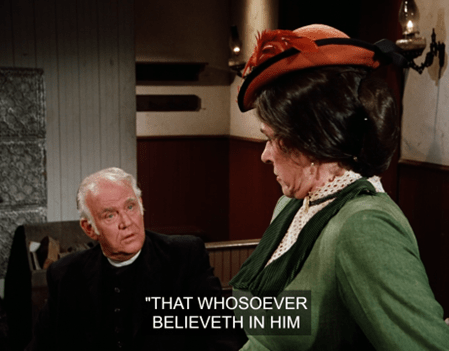
Mrs. Oleson sits down and quietly says, “And may I remind you, Reverend Alden . . .”
AMELIA: Ope, she’s winding up.
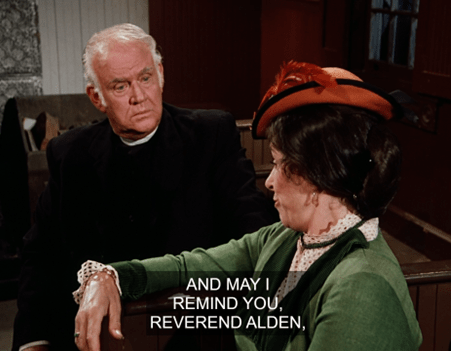
“ . . .that you have no vote here,” she finishes.
Mrs. Oleson tells Aldi the Elders have the power to dismiss him as minister of their Congregation. (Congregationalist churches do give Boards of Elders authority over their clergy.)
WILL: They’d fire him? Who would they replace him with, Rachel Peel?
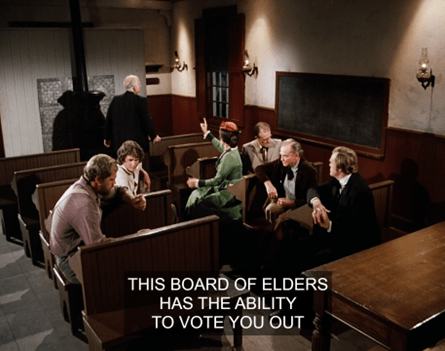

Doc, who is apparently the chair, tries to restore order.
Echoing Mr. Kennedy’s screams in “The Voice of Tinker Jones” (of which this episode is reminiscent in a few ways), Charles says, “What it all boils down to, is this the church of God or the church of Mrs. Oleson?”
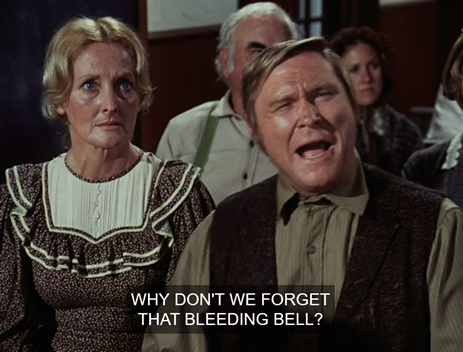
Insulted, Mrs. O shouts that the non-bigoted faction have “thick heads,” and calls for a vote.

At first it appears the racists have won, but then Nels comes through.
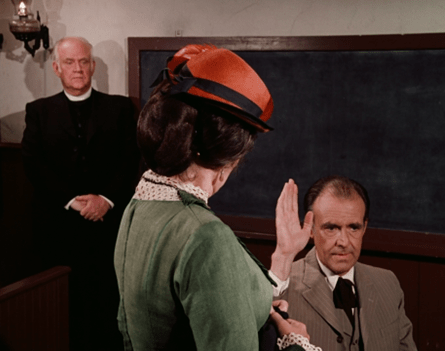
General rejoicing!
DAGNY: Doc’s lips look pretty good so far. You can tell it’s early in the episode.
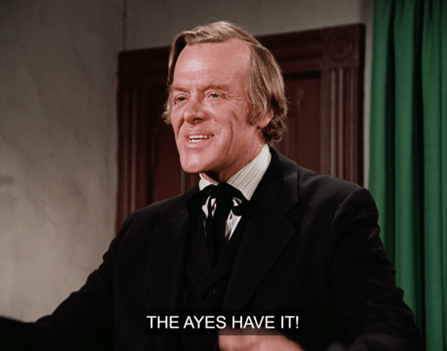
Harriet storms out, and the good guys hug their pal Nels.
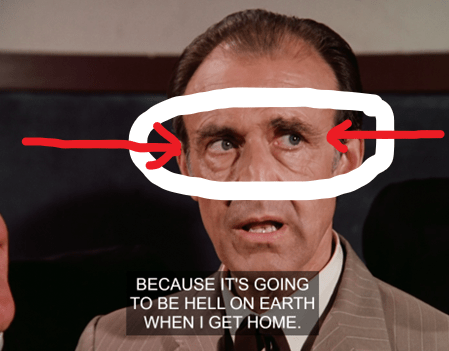
DAGNY: Nels has crazy-long eyebrows today.
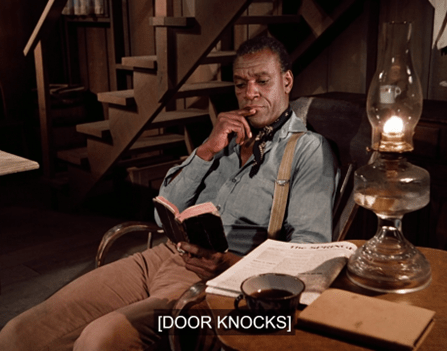
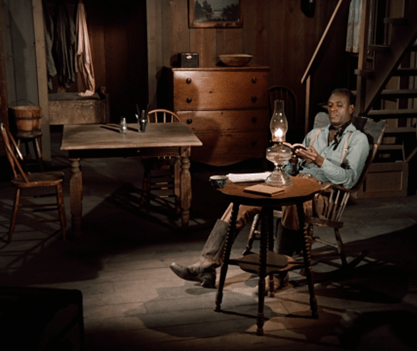
Back at the Old Hobson/Beadle/Simms Place, Joe is reading his Bible with a cup of coffee and a copy of the Springfield Clarion at his side. A very civilized way to spend an evening.
Then there’s a knock.
Now, Michael Landon’s shocking sense of humor is well known, and he famously played a prank here where he covered himself in a white sheet and said, “It went that bad, Joe!” when Moses Gunn opened the door.
It’s featured in this compilation of outtakes:
I’ll leave it to you to decide whether that’s funny or not. I have a fairly ghastly sense of humor myself, but certainly such a joke would not be well-received today.
In the aired version, it’s just plain old Charles and Garvey at the door, looking dour.
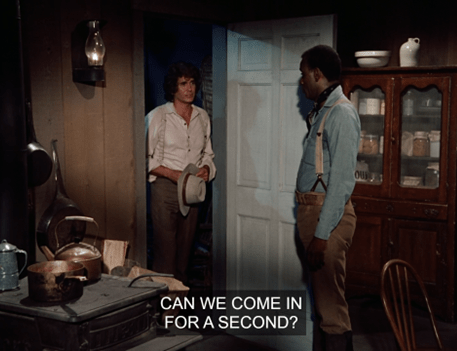
They do play a prank of sorts, letting Joe think he’s lost the vote again before sharing the good news.
Joe is very sweaty. (Must have been reading from the Song of Songs this evening!)
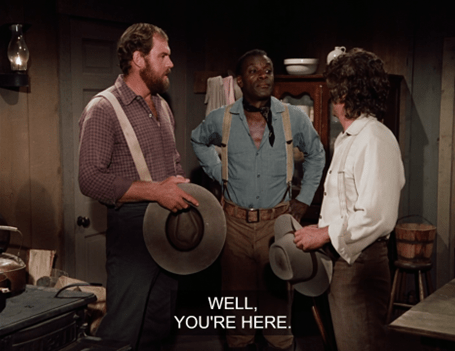
“Congratulations!” Charles says. “You’re a bona fide member of the Community Church of Walnut Grove!”
This is the first time in the series the church has been given a formal name. I’m going to stick with Groveland Congregational, though. I like the ring of it.
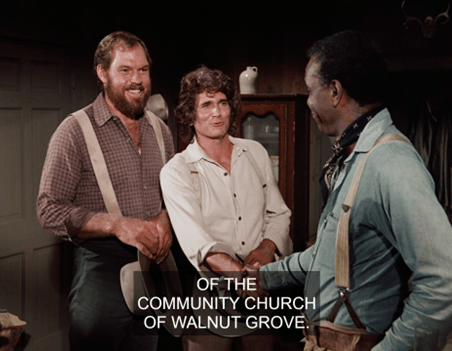
Joe quickly points out that this single act won’t cure everybody in town of their racism; but he’s pleased and grateful anyway.
As they head out the door, Kagan calls, “See ya in church, Charlie-Boy!” Which I loved.
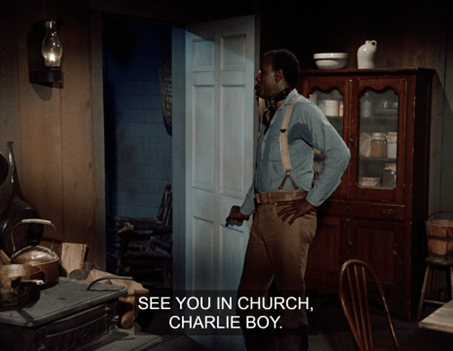
Looking more thoughtful than pleased, then, Joe sits down and picks up his book, which we now see is not a Bible, but rather The Small Roman Missal! I would not have thought him a Catholic; if he is, why does he want to join the Protestant church?
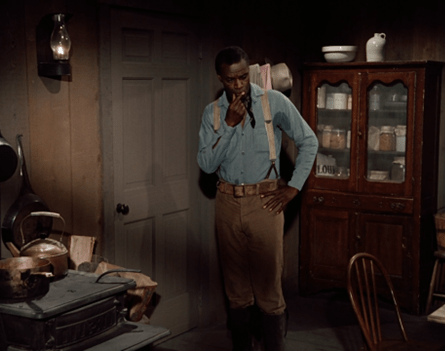
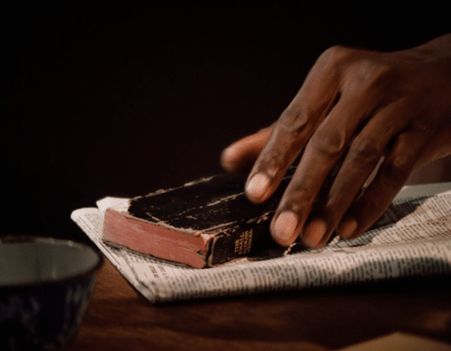
You’d think he’d be more likely to simply seek out and have private services with other Catholics like Amy Hearn, if she’s still alive that is. She’d only be 125, so it’s not impossible in the Little House Universe.

David Rose, sounding more pleased than thoughtful, gives us a cadence that ushers us into the break.
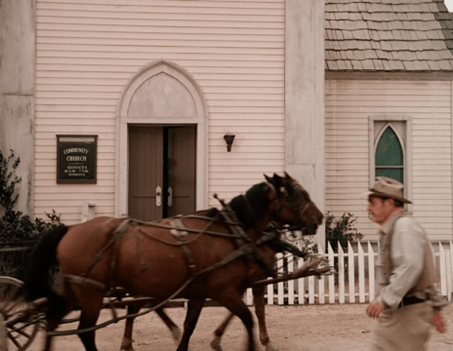
Speaking of Community Churches, when we come back we unexpectedly find ourselves outside Winoka’s.
And who should emerge from it but Mr. Ames.
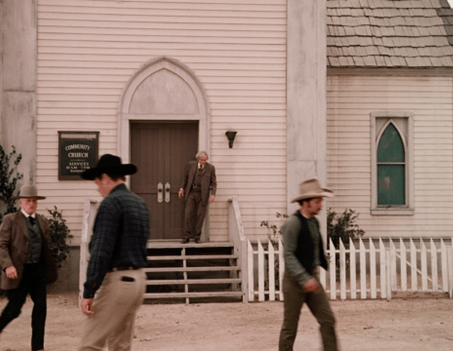
A number of people, as is always the case in Winoka – surely the busiest metropolis ever depicted on this show, including Chicago – are driving or walking by.
One of them I think is the Generic-Looking Older Man We May Have Seen A Few Times from last week, but I could be wrong about that.
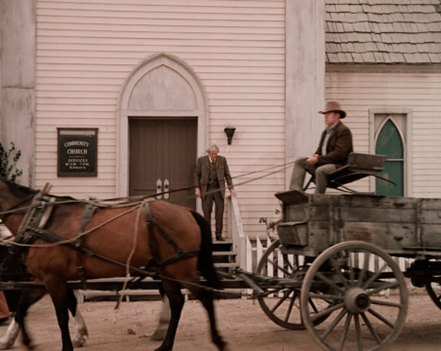
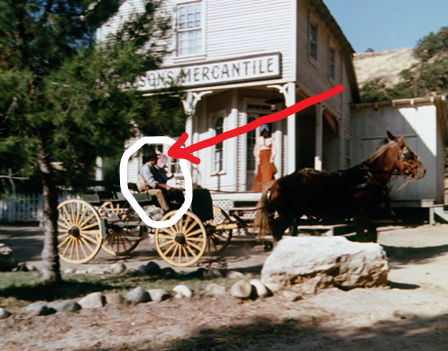
Looking more thoughtful than pleased, Mr. Ames descends the steps.

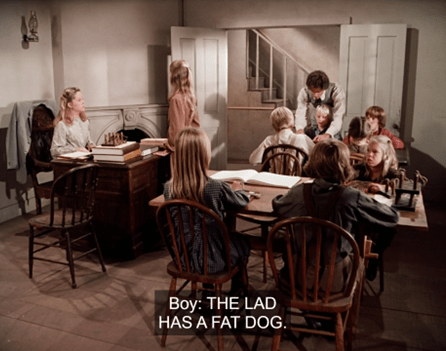
Next door at the Winoka (Blind) School, class is in session. Adam is helping Thomas the Blond Freckle-Faced Moppet with his reading.
“The lad has a fat dog,” Thomas reads.
DAGNY: Oh, so do we.
And Mary is telling Goodie-Goodie Goodspeed she got 100 on an assignment, of course.
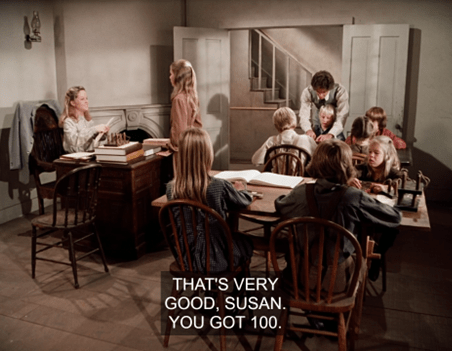
“Thank you, Mrs. Kendall!” says Sue.
ROMAN: Oh yeah, she’s Mrs. Kendall now.
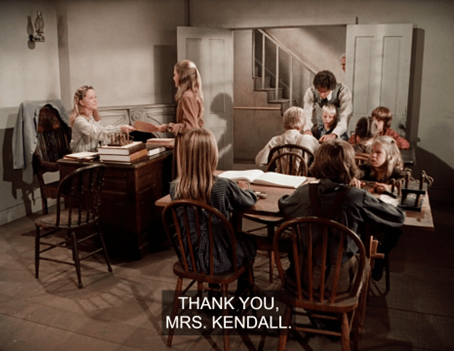
“Nat and Rab run,” Thomas reads on. He must not be that strong a reader. (“Rab”?)
Mr. Ames, looking more displeased than pleased, enters.
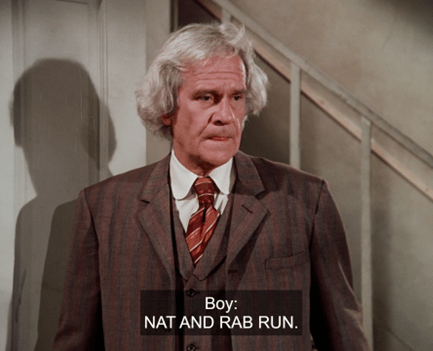
“Mary, Adam,” he says.
WILL: Don’t you think whenever a new character sneaks into the classroom and speaks, everyone should scream?
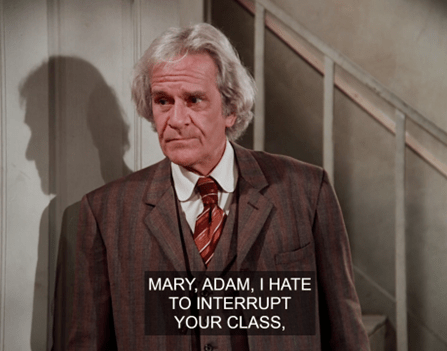
Mr. Ames says he brings distressing news.
Speaking in his Mid-Atlantic FDR accent, Ames tells us that the church, which owns the school building, has been forced to sell it because of hard times.
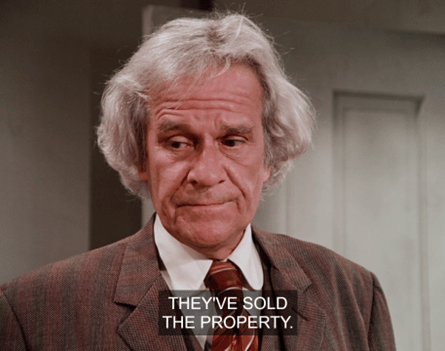
Among the students, we see Pigtail Annie, who was one of the kids clapping along to Pa’s fake harmonica playing in “The Wedding,” as well as Distraught Polly, a, well, distraught-looking girl who we’ve also seen a couple times.
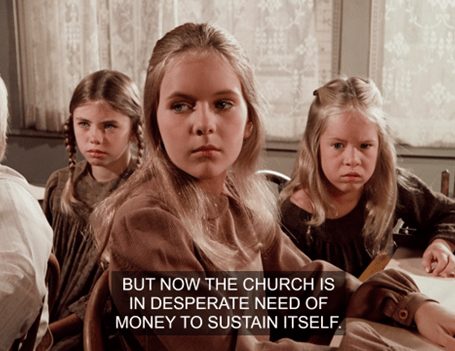
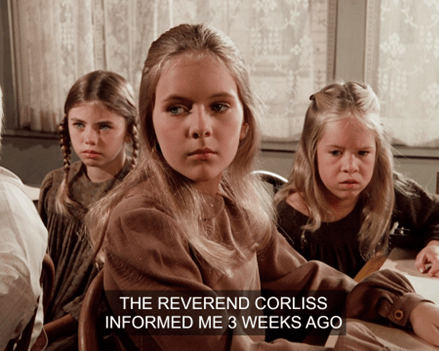
Mr. Ames says Reverend Corliss (the Captain Stubing-looking minister from “The Wedding”) has been talking to him about this for the past three weeks.
DAGNY: He’s been sitting on this for three weeks?
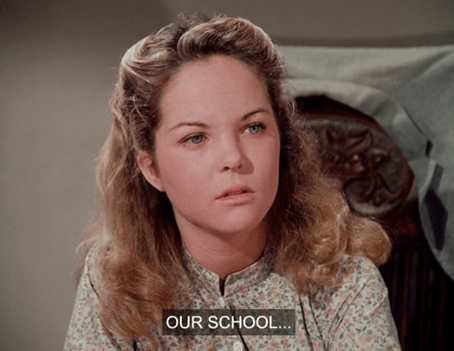
Looking surprised as well as displeased and thoughtful, Mary says, “Our school!”
WILL: She’s quick.
Adam asks if they could find another location, but Mr. Ames says there’s too much to get to in this episode’s plot, so he’s already tried, and no luck.
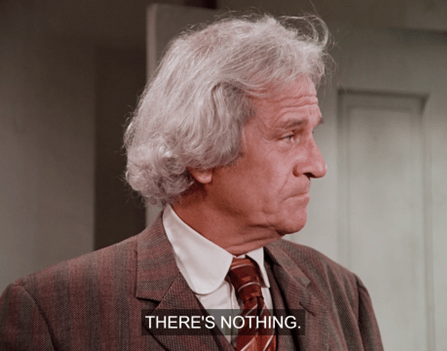
“I’m afraid it means the end of the Winoka Academy for the Blind,” Mr. Ames says. (The first time we’ve gotten this full name too.)
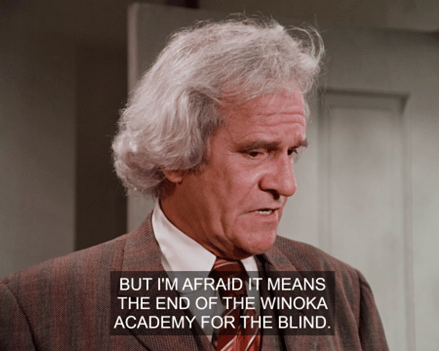
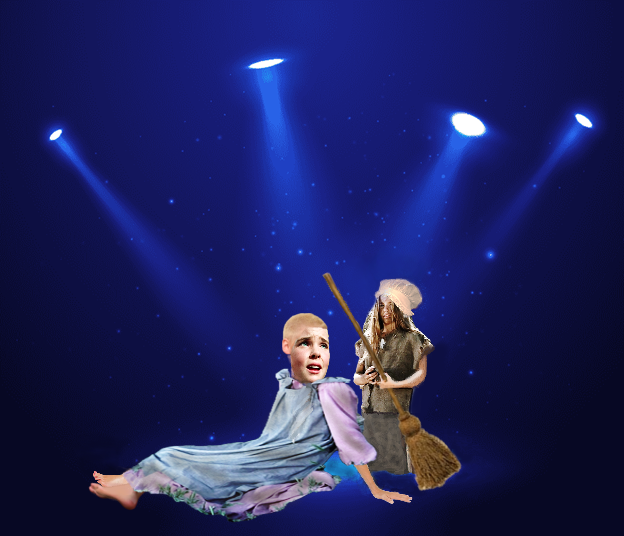
AMELIA: Mary’ll have to sell her hair, like Les Miz.
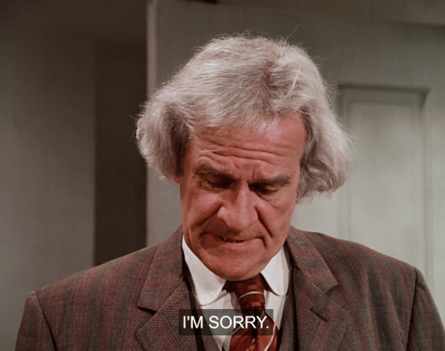
Looking achingly sad as well as thoughtful and displeased, Mr. Ames apologizes for failing them.
He makes to go, but Mary stops and asks how long they have.
ROMAN [as MR. AMES]: “Till sundown.”
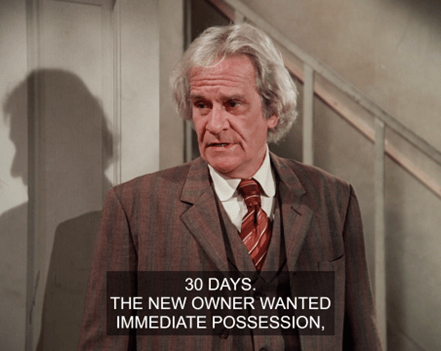
Actually, he says they’ll have to be out in one month.
DAGNY: Have you noticed that Mary’s eyes are always red since she turned blind?
WILL: What? No!
DAGNY: Well, look at them.
AMELIA: She is crying. . . .
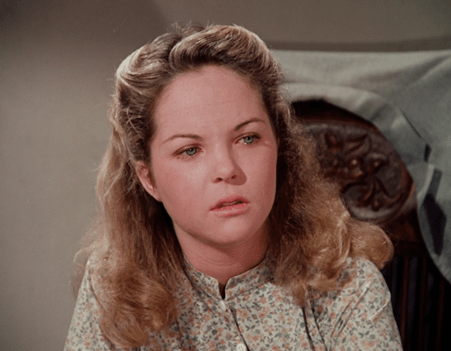
We cut then to Mr. Ames’s office, (presumably) the very heart of the school.
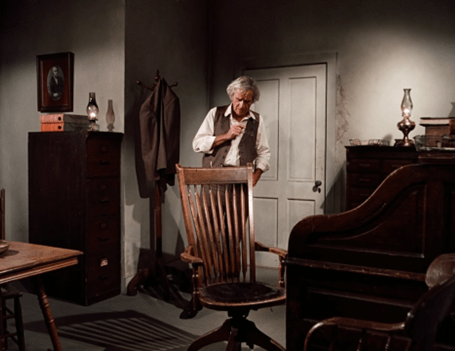
David Rose gives us that melody that sounds like the Force Theme from Star Wars, but listening to it, I realize it’s pretty much just the Little House on the Prairie theme played in a minor key.
It’s striking how similar the two tunes are. David Rose’s estate should sue John Williams for royalties, or vice versa.
Adam comes in and says he and Mary have an idea.
“I’d grab at any straw to keep this school afloat,” Mr. Ames says in blank verse.

Adam’s idea isn’t exactly a gamechanger: negotiate with the buyer.
Ames says you might as well negotiate with a crazed walrus, since the new owner is Miles Standish.
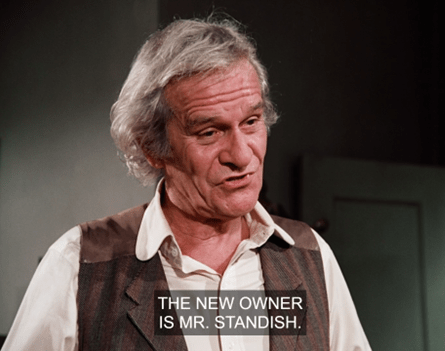
Then Adam says, “If we don’t find somewhere to go, it’s going to mean the closing of two schools – ours and Mrs. Terhune’s.”
AMELIA: What the hell is he talking about?

Apparently the Winoka Academy had volunteered to absorb the students from another closing blind school.
Mr. Ames said he had big plans for Mrs. Terhune and himself to make a splash as an administrative power couple.

Adam says the kids will suffer the most.
“Yes,” says Mr. Ames gravely: “the children above all.”
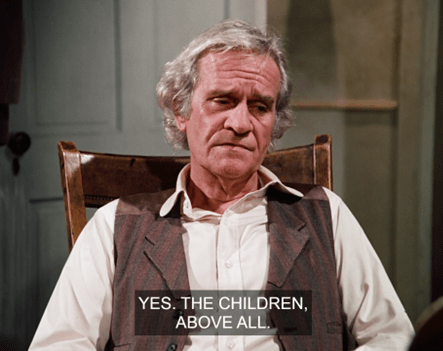
“I can’t believe this is happening,” Adam says.
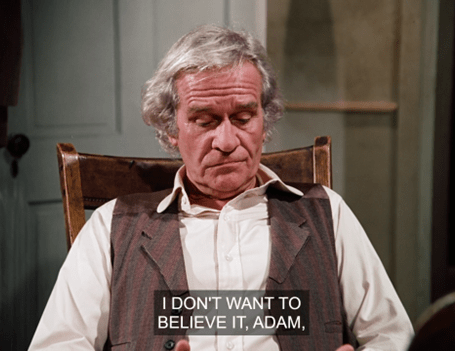
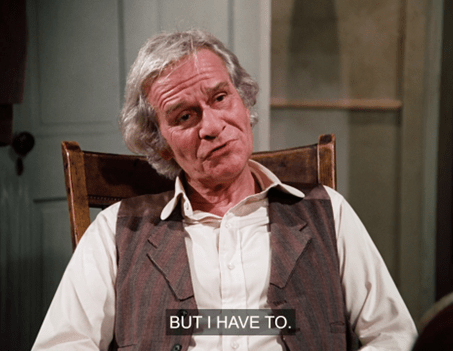
“I don’t want to believe it, Adam,” Mr. Ames says, “but I have to.”
(David Hooks is just destroying things with his acting here.)
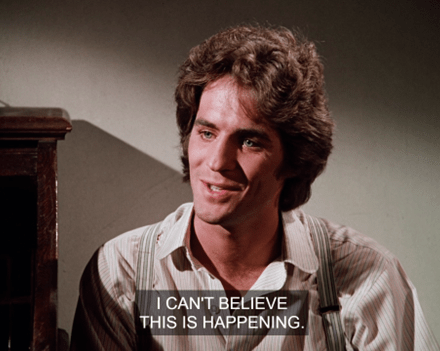
The Force Theme plays again, and Mr. Ames says, “Goodnight, my boy” – Obi-Wan to Adam’s Luke.
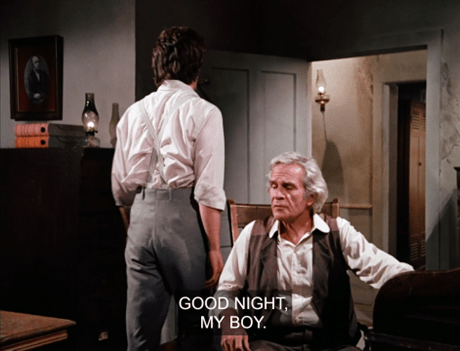
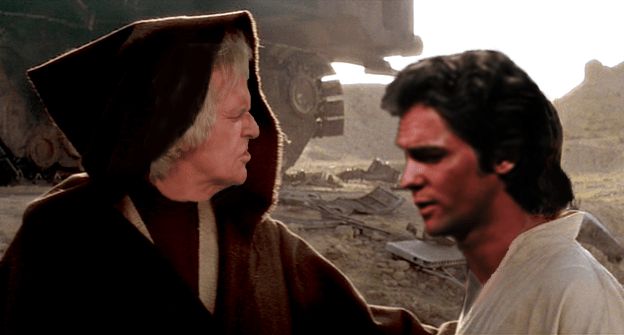
And thankfully we get another commercial break, so we can recover emotionally from that scene.
ROMAN: You know what they should do? Move out, but blow up the school!
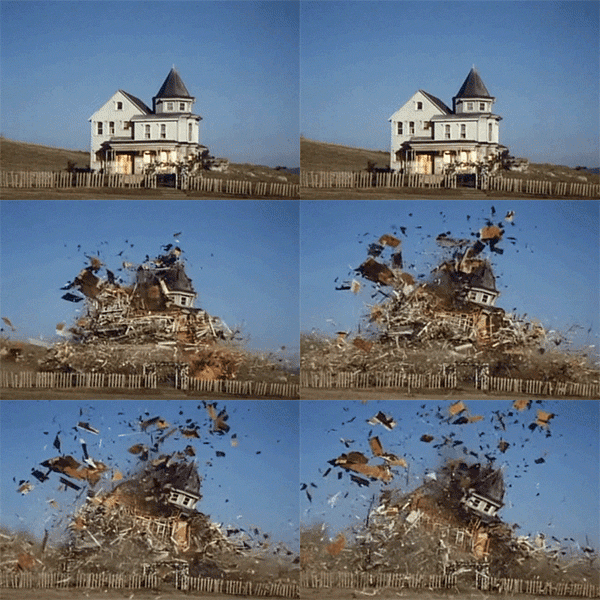
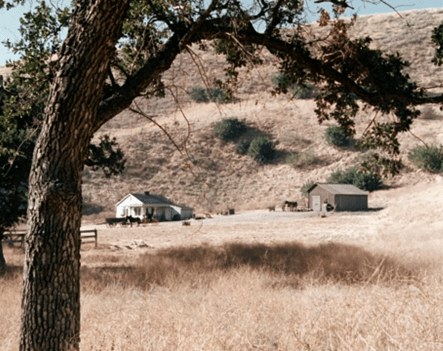
I don’t want to give you all whiplash, but suddenly we find ourselves back at the Old Sanderson Place, which looks like it’s recently been repainted.
The Garveys are having a deck party, and Charles is reading a letter from Mary.
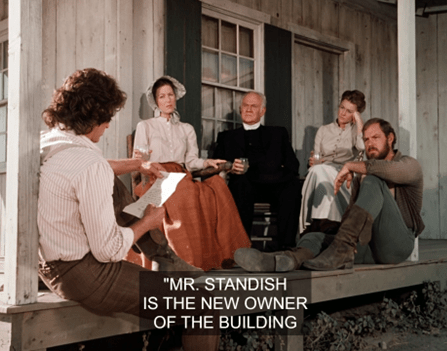
Mary implores Charles and The Gang to come up with a scheme that gets them out of this crazy mess.
The Winoka veterans tell the Rev he can’t understand this Standish without experiencing him in the scaly flesh.
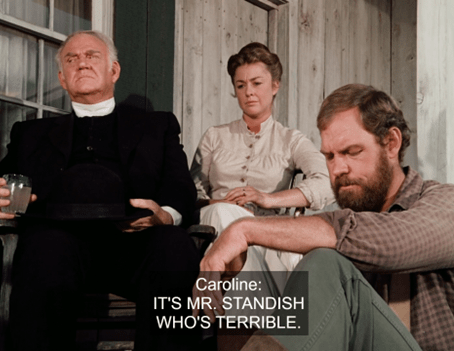
Garvey apologizes to Alden for comparing Standish to a skunk, and Aldi says, “You may be doing an injustice to the skunk.” Epigrammatic wit isn’t really this show’s thing, but that’s not bad.
DAGNY: Why does the Reverend’s glass look so sandy? Is he drinking river water?
ROMAN: It’s his thumb magnified by the glass.
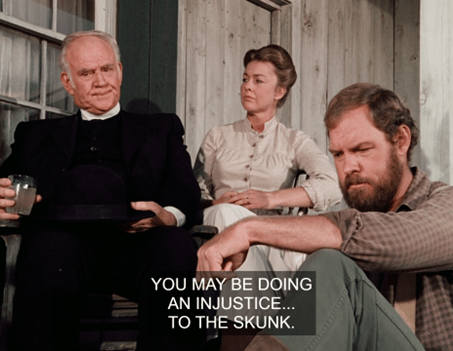
WILL: Is his collar also magnified by the glass?
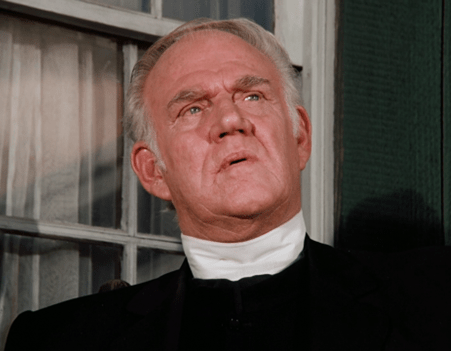
Rev. Alden says they should move the school here, to Walnut Grove, and he knows just the spot.
DAGNY: Oh, Kezia’s place?
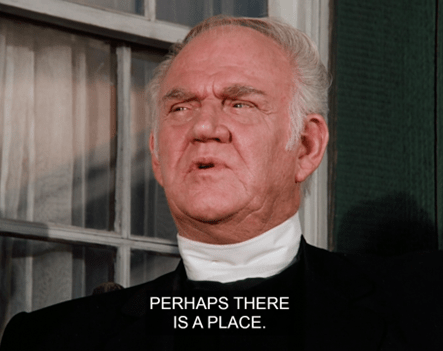
The Rev says when Mr. Hanson died, he left the church “that big house.”
Presumably he’s referring to the Big Victorian House Doc Baker briefly lived in when he had his identity crisis.
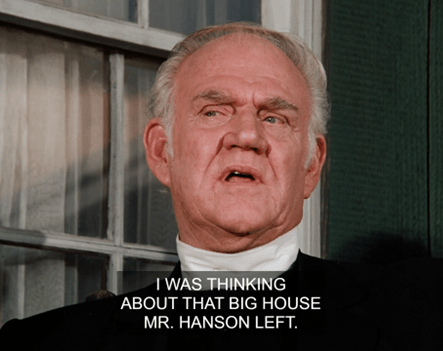

Originally belonging to somebody called Jenkins, the property was acquired at some point by Mr. Hanson, who installed Doc in it to recover from his breakdown.
Possibly Doc and Hanson lived there together for a while, but clearly by the time of “There’s No Place Like Home” Doc had moved him into a room above his surgery so he would have access to medical care at all times.
I think it’s conceivable that before Hanson died, Doc told him he didn’t want to be left the big house. Too many memories, you know.

Anyways, Alden says the house has had no buyers today because it’s “too big for a family,” which seems absurd for a Nineteenth-Century character to say.
Aldi says it would make the perfect blind school.
Everyone gets excited about the prospect, and you’re sort of feeling we’re building to a musical montage.
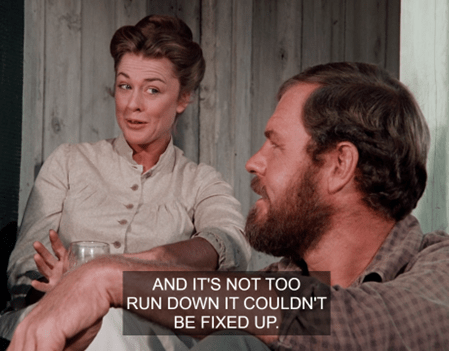
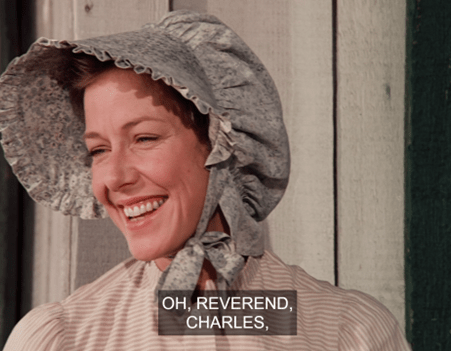
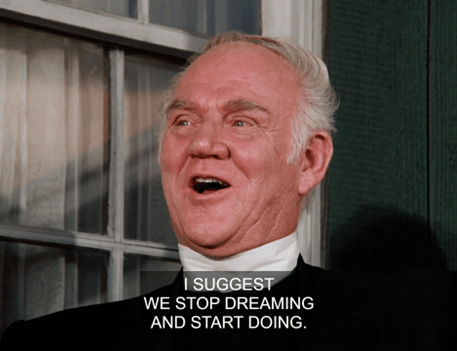
But none ever comes.
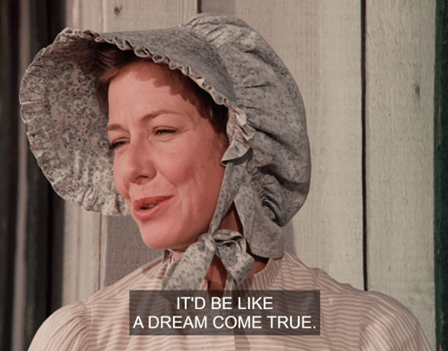
“It’d be like a dream come true!” Caroline says Southernly.
Now, I hesitate to even bring this up, and wouldn’t stoop to do so if it weren’t for the readers of this blog having come to expect a certain thoroughness, but throughout this scene Alice Garvey, who looks gorgeous, is sort of stroking her glass up and down, slowly.
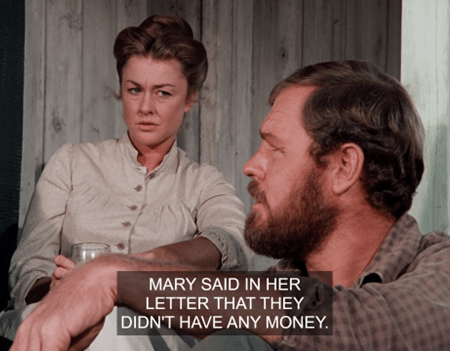

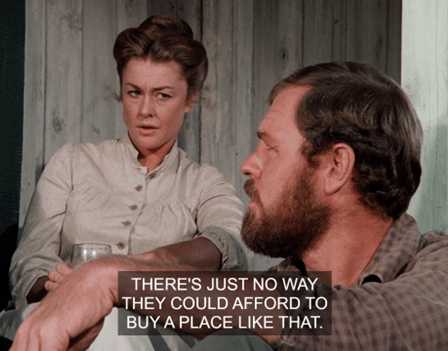
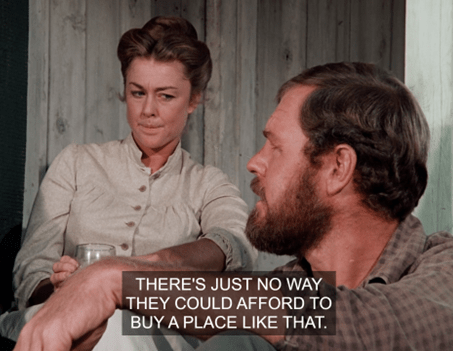
All right, I mentioned it, so all you dirty-minded readers out there can hold your cards and letters, this time at least.
So the audience doesn’t get overheated, we cut to the church.
In the congregation are Ma, Pa, Laura, Albert, Carrie, Baby Grace, Mrs. Oleson, Nels, Nellie, Willie, Jonathan, Alice and Andrew Garvey, Doc, Joe Kagan, Carl the Flunky, Mustache Man, Jud Lar[r]abee, Johnny Cash Fusspot, the French Maitre d’, Mr. Penguin Man, Not-Ellen Taylor, the Sharp-Faced Paranoid-Looking Brother, the Misbehaving Girl, an AEK, the Midsommar Kid, Miniature Art Garfunkel, and the Kid with Very Red Hair (Mean One).
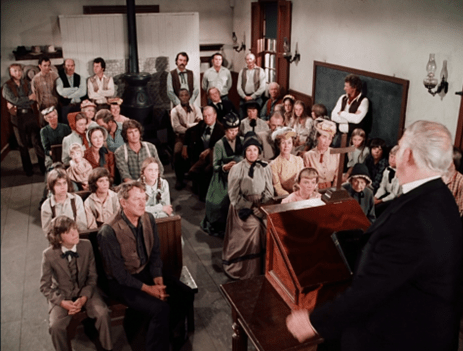
There are also some surprises. First, there’s someone who looks like she might be America’s First Female Bounty Hunter, or something.
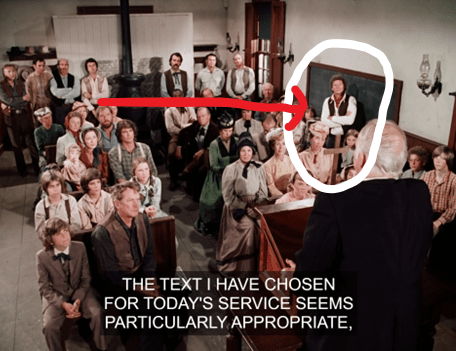
There’s also Hangover Helen – not seen since “The Fighter”!
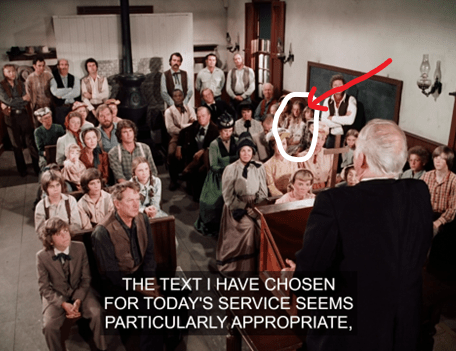
And there’s the Simply Ancient Lady, who I think now we have to accept as Amy Hearn. Clearly she and Joe wrote the Vatican asking for permission to just attend Protestant services instead, and got it.
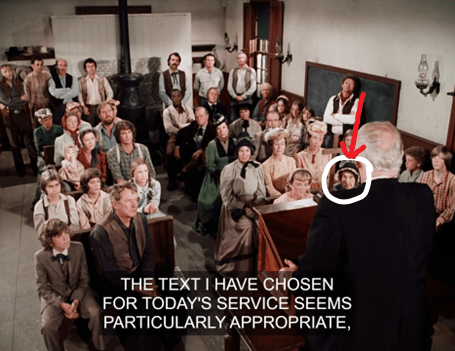
Aldi jumps up to the lectern and fires into more of St. John the Apostle’s Greatest Hits.

He welcomes Joe into the Congregationalist, um, congregation.
DAGNY: I hate how this lectern looks. It’s so badly painted. I’ve always hated it. I can’t stand it!
ROMAN: You’ve been sitting on this for five seasons?
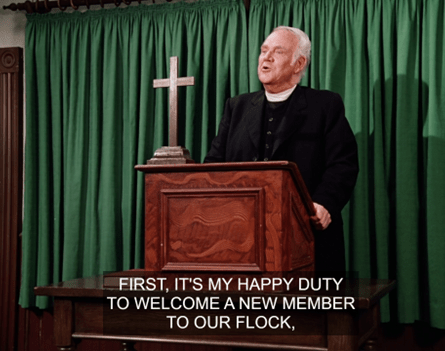
WILL: Is that paint, or just the natural whorls of the wood?
DAGNY: It’s not the natural whorls of the wood! It’s just bad painting. It looks like somebody painted it with Amy Klobuchar’s comb.

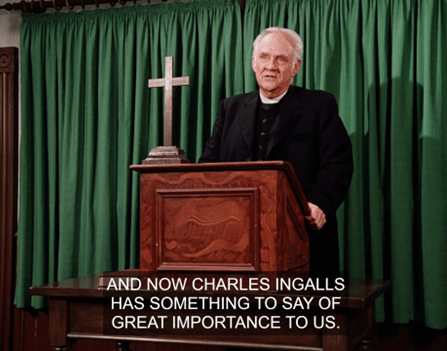
Rev. Alden invites Charles up, and they tag-team their Blind-School pitch.
The Rev refers to Mr. Hanson as “late and much loved.”
DAGNY: Is Doc gonna break down crying?
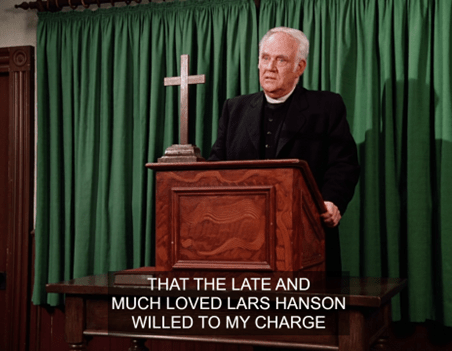
Obviously thinking about lunch already, as one does in church, Aldi switches to the Book of Matthew, saying, “I was hungry, and you gave me meat.”
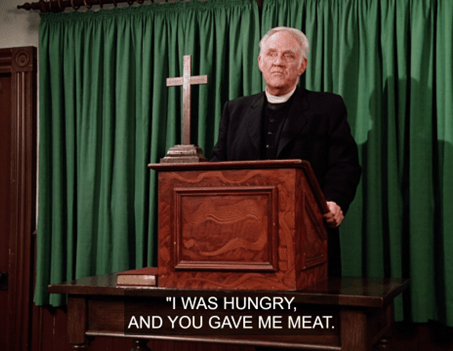
Rev. Alden quotes Jesus as saying you should help people who are “the least” of humanity, rather than judging them. Jesus’ most salient point, essentially, is Treat them as you would treat me.
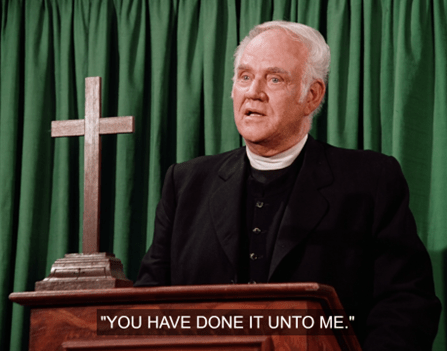
I remember Jesus saying stuff like that when I was growing up. I mean, he didn’t say it to me, but that was the kind of thing I read about him saying.
I don’t remember him saying anything about taking a bloodthirsty revenge upon people who don’t share your views, even though that’s how many of his supposed followers seem to feel today.
Not all, thank goodness.
Then Alden warns everyone that he technically has the power to make this decision unilaterally, so get out of his fucking way, people.
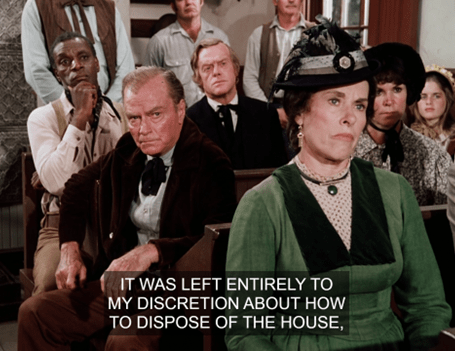
Everybody voices their support, and Joe Kagan, who turns out to be one of those people who talk the first time they come to a meeting, says everyone who can should donate food and supplies for the students.
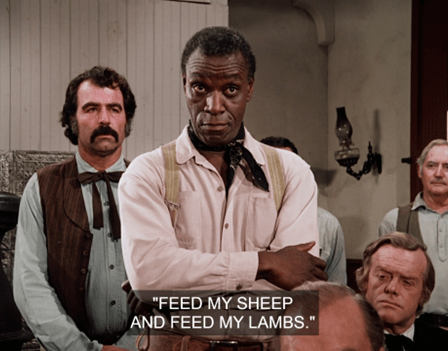
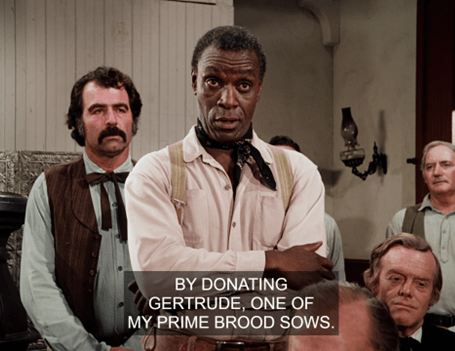
Kagan says he’s going to donate Gertrude the Pig.
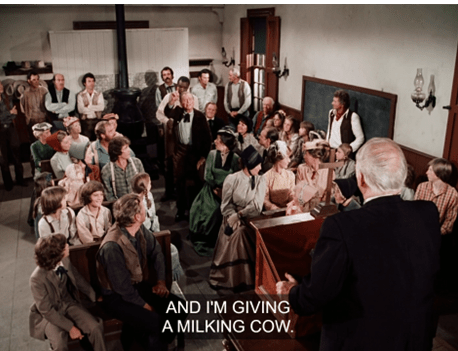
Jud Lar[r]abee says he’ll give a cow – a revealing decision, since he’s a sheep farmer. (Probably an old broken-down one that’s of no use anymore.)
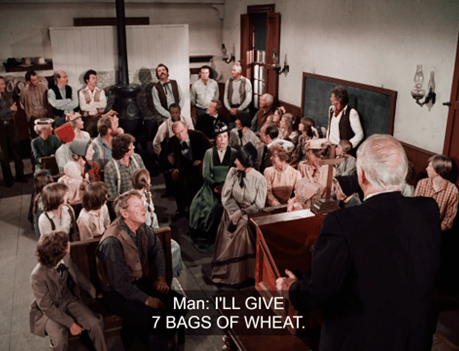
The Grovester bros speak up then. Mustache Man gives seven bags of wheat, and Carl the Flunky five bushels of corn. (MM’s a driver and Carl a lumberman, so these gifts also seem a bit odd.)
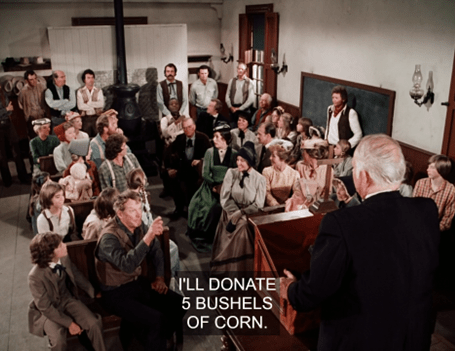
Mrs. Oleson says, “Reverend Alden, it seems to me that everybody has ignored the real problem here.”
AMELIA: Is she going to say there’s a Black person in our church?
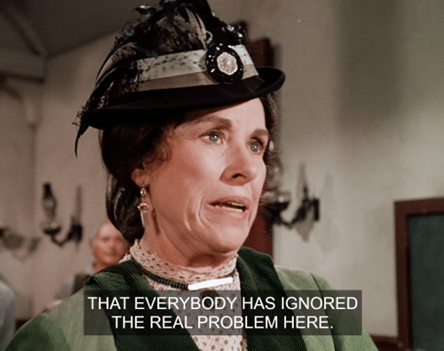
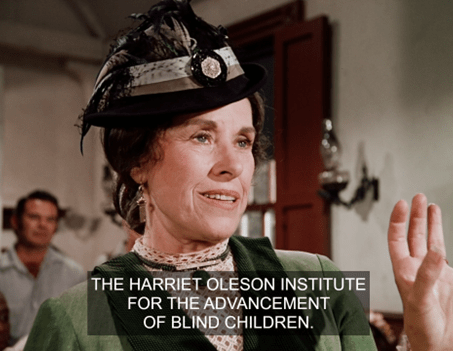
But Mrs. O just wants to say the house needs restoring – and she volunteers to donate the cost of the repairs herself.
And a plaque bearing the school’s name: “the Harriet Oleson Institute for the Advancement of Blind Children.” (More shades of “Tinker Jones.”)
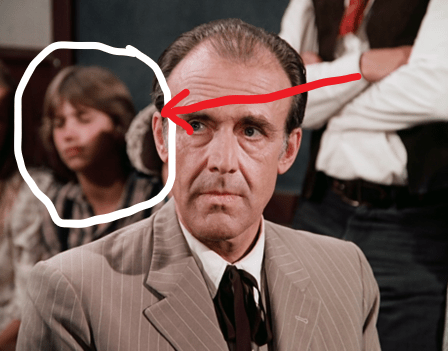
Behind Nels, the Sharp-Faced Paranoid-Looking Brother shakes his head in disapproval. (Why would he care?)
“Mrs. Oleson, that’s really too much,” says Reverend Alden, helplessly.
Harriet grins and replies, “I know it is.” (I used to work for somebody who was a lot like Harriet Oleson. I suppose a lot of people can say that.)
Anyways, it’s a knockout season for Mrs. O stories so far, isn’t it?

Back in Winoka, a handsome young deliveryman crosses the street with a telegram.

The music – I always get very excited when this happens – is “Bum-Bum-Ba-Dum,” the Little House on the Prairie End Credits Music!
HYD delivers the telegram to Mr. Ames at the Blind School, who, I notice, does not tip him.
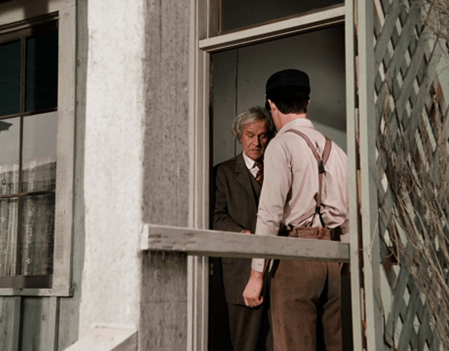
Mr. Ames bring the telegram into the classroom. You know, last week we were wondering who Michael Fiore, who was the red-haired toddler Bertie Hobson in “The Gift,” is playing in this episode cycle. (It’s a long story.)
I notice there is a red-haired kid at the Blind School. Could that be him?
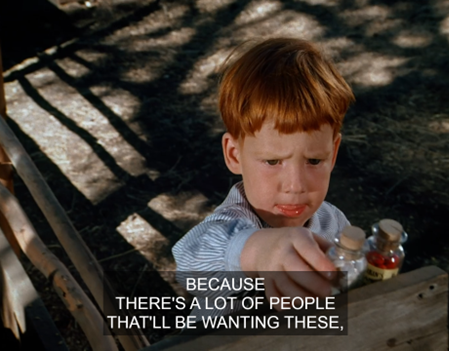
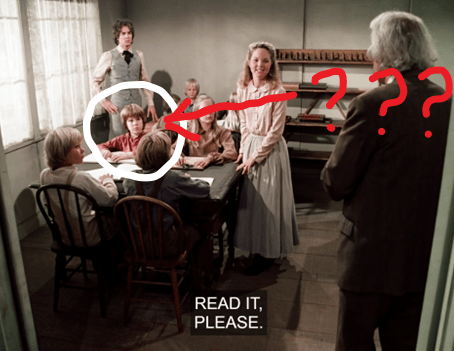
Mr. Ames reads, “Walnut Grove has adopted your children and your school donating building and supplies.”
DAGNY: What a weird tie.
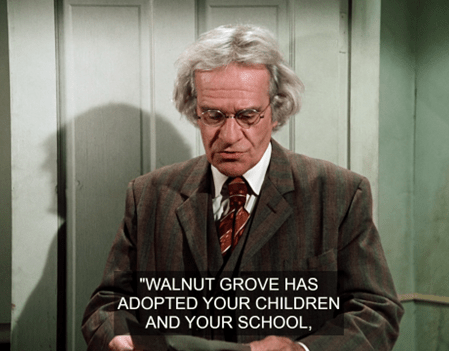
Mr. Ames continues, “Will come to transport. Letter following. Love, Pa.”
WILL [as MR. AMES]: “Who on earth’s ‘Pa’?”
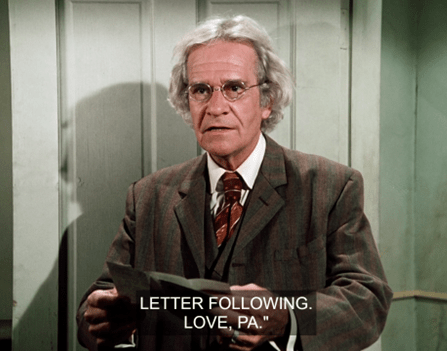
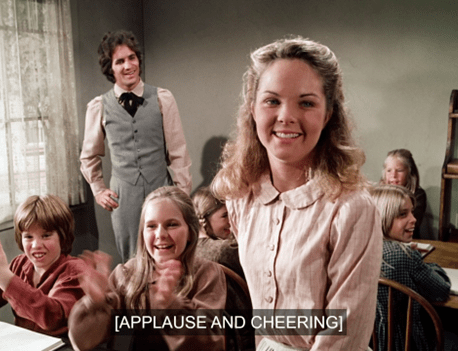
Everyone whoops and cheers that Charles Ingalls has saved the day once more.
AMELIA: Now, I don’t understand. Where are all these kids from? Wouldn’t they need to get the parents’ permission to move them to another state?
DAGNY: They’re from all over. It’s the only blind school in the country.
WILL: What about the one Mary went to in Iowa?
DAGNY: Well, I didn’t say it’s the only blind school in America.
WILL: . . . Yes you did!
I know you may feel we’re going in circles, but once again we transition from a Mr. Ames classroom scene to a Mr. Ames office scene.
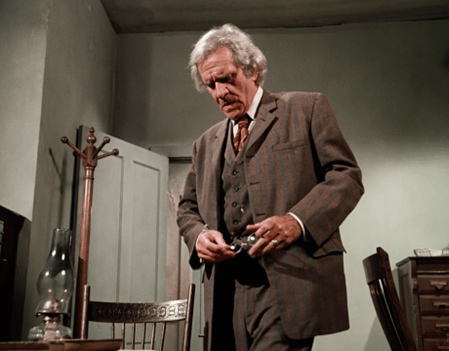
Swiveling his hips jubilantly, Adam comes in and says, “Well, isn’t that wonderful news!”
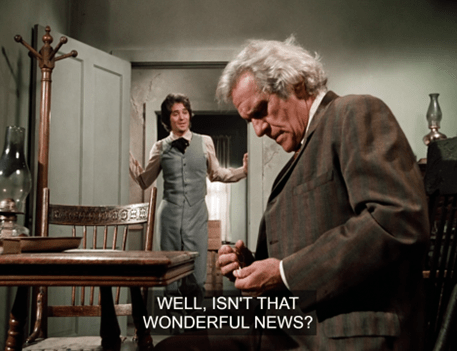
But Mr. Ames is sober, saying, “I’m very happy for you.”
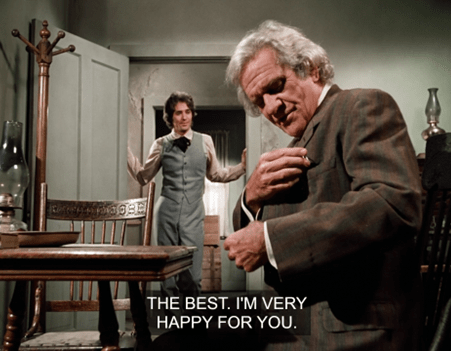
Mr. Ames says he’s giving the school to Adam and Mary; he won’t be coming along for the move.
DAGNY: Now look at HIS eyebrows!
ROMAN: That’s his hair.
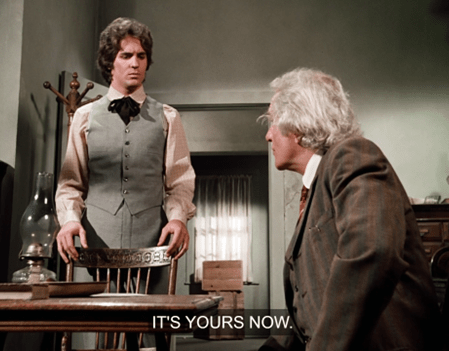
Adam is confused, but Mr. Ames smiles and says he can’t imagine the school in better hands.
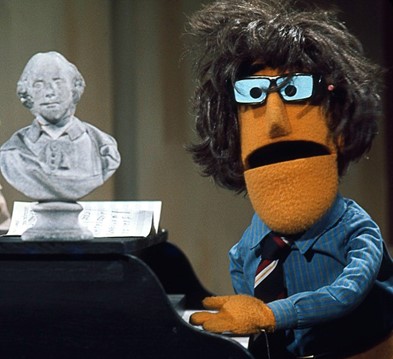
DAGNY: Mr. Ames has hair like the piano player on Sesame Street.
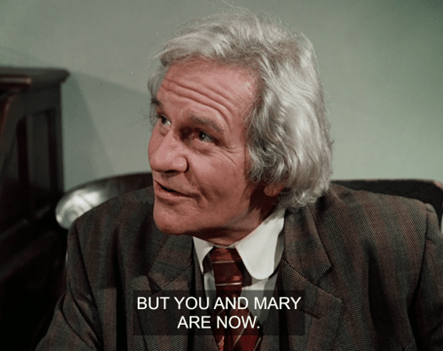
Then Ames drops the bomb that he’s dying.
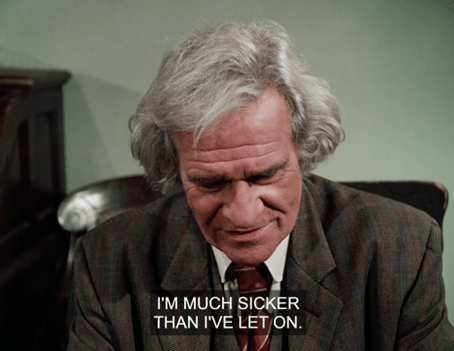
Very upset, Adam says he doesn’t think he can run the school up to the Ames Gold Standard.
Mr. Ames says he knows that he will, and excuses himself to take a nap.
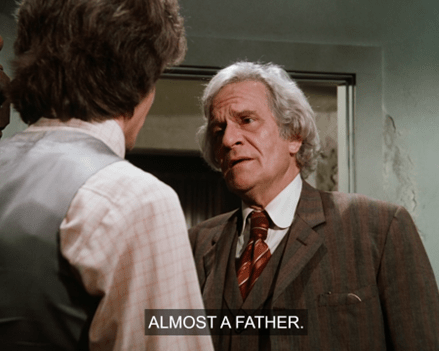
Struggling with words, Adam says he’s been honored to be guided by such a leader and teacher as Mr. Ames, who’s “almost a father.”
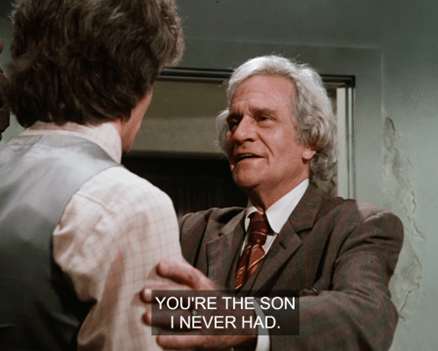
Mr. Ames touches Adam on the shoulder, says, “You’re the son I never had,” and leaves the room.
DAGNY: Landon really had father issues, didn’t he?
DAGNY: You know how you can tell this show was written and run by men? Because there aren’t really any episodes exploring Laura and Ma’s relationship or the problems they would have with each other. It’s always about the fathers and the siblings.
WILL: Yeah. The closest they came was Laura saying she was ashamed of Pa, and Ma biting her head off.
DAGNY: Right. And even that was about Pa.


Back in Walnut Grove, all the Grovesters are cleaning up the old Jenkins/Baker/Hanson property.
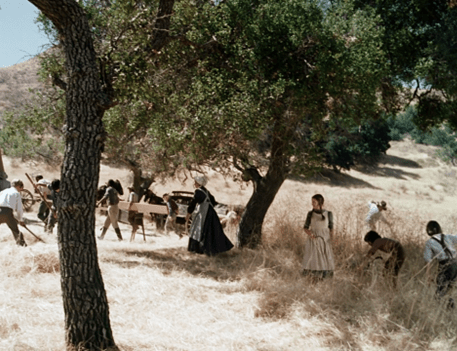
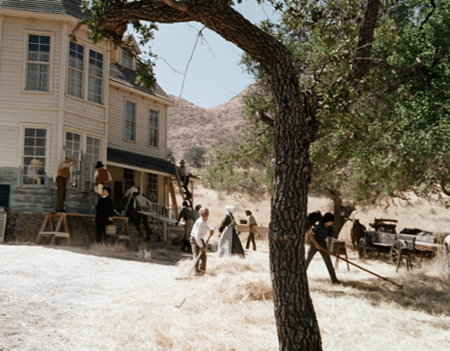
Caroline appears with a letter from Mary. It explains that the other blind school they’ll be absorbing comes from St. Louis, and that there will be a rendezvous in Butler, Dakota Territory.
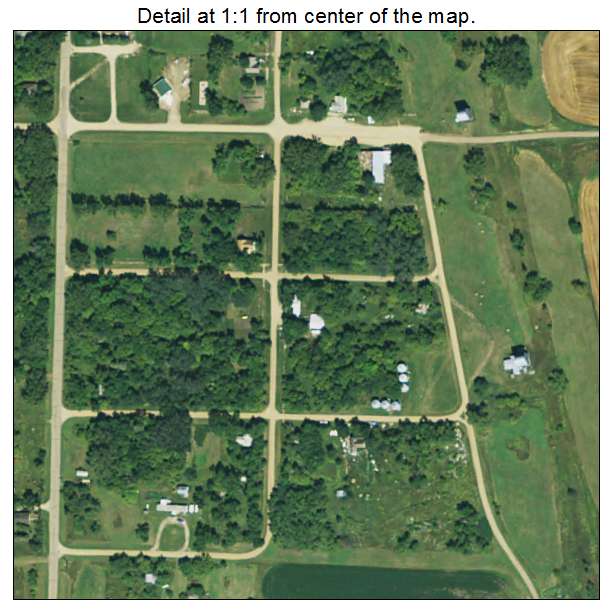
This makes little sense. Butler, South Dakota, is a real place, but it’s over 100 miles north of where we had located Winoka.
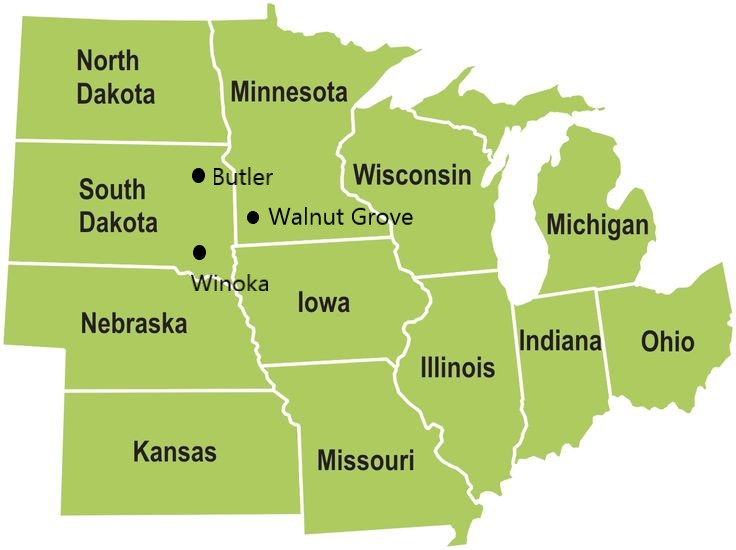
It also didn’t exist yet in 1885.
Today, its population is four people.
St. Louis, Missouri, is some 600 miles southeast of Winoka – more than 700 from Butler. In fact, both Winoka and Walnut Grove are in between St. Louis and Butler. Why wouldn’t the St. Louis school personnel just meet them in Minnesota?


Well, never mind that. Mrs. Oleson gets excited, and then some, when she hears the leader of the other school is a “Hester-Sue Terhune.”
DAGNY: We rarely see Harriet just wearing a regular bonnet like that.

Apparently the Terhunes are a prominent St. Louis family.
Mrs. Oleson says she has family in St. Louis herself – previously she’s implied she was from Indiana, but that doesn’t mean she couldn’t have connections in Missouri as well.
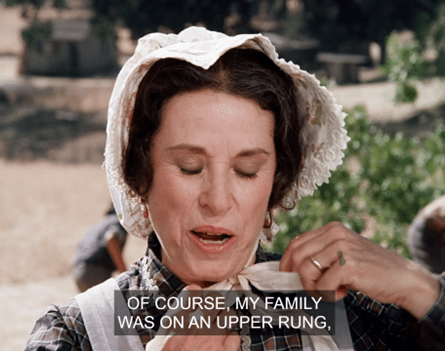
Charles says that hardly makes sense, because if the Terhunes are so rich, why didn’t they save the blind school in St. Louis?
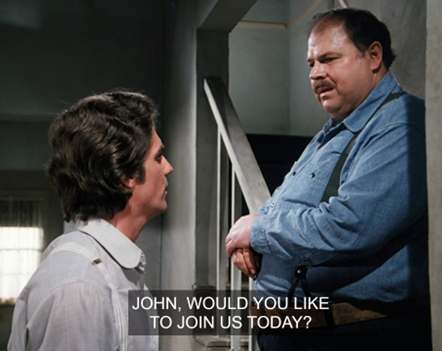
Then Charles goes to ask Joe Kagan if he would like to come along on the trip and drive one of the wagons.
Kagan says sure.
ROMAN: Who’s going to take care of his pigs?
DAGNY: Harriet.
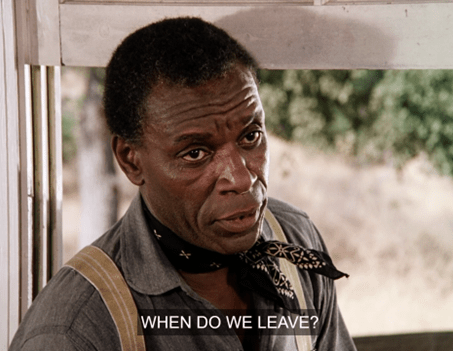
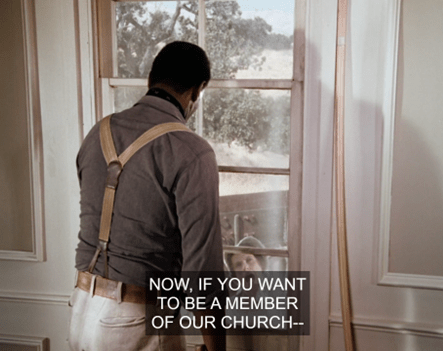
Joe’s stopped work for this conversation, and Mrs. Oleson reappears and accuses him of loafing. He just closes a window in her face, though.
Commercial.
WILL: “It’s Jiffing good”? Our culture is really decaying.

AMELIA: Do you ever share what we say about commercials on the blog?
WILL: No. Nobody wants to hear that.
When we come back, Harriet Oleson is doing her nightly beauty regimen.
DAGNY: I have a housecoat like that in gray.
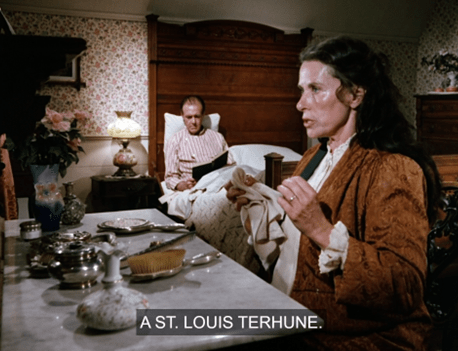
She announces to Nels, who’s reading in bed, that she’s so excited to meet this Mrs. Terhune that she’s going along on the Blind School adventure.
She says she’ll spend a little time in Brookings, Dakota Territory – a city that is indeed on the road between Walnut Grove and Winoka as we figured ’em, more or less.


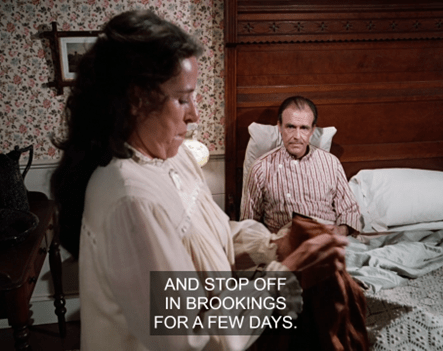
Apparently there are some outlet malls near Brookings that she wants to check out.
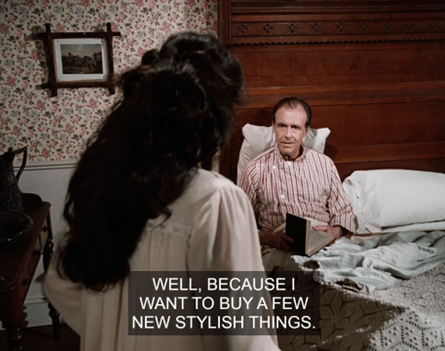
Harriet also says the furniture available for Mrs. Terhune’s chambers was unacceptable, so she’s donating their own bedroom set.
She says there’ll be a brief hiatus between the pickup of the old bed and delivery of a new one, so he’ll just have to sleep on the couch for a while.
Harriet jumps into bed and snuggles up to her husband. I like very much that she gets frisky like this.
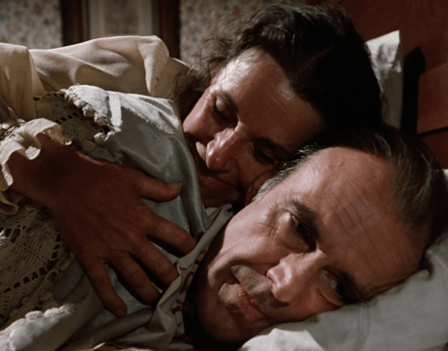
HARRIET: You gonna miss me?
NELS: Like a crutch.
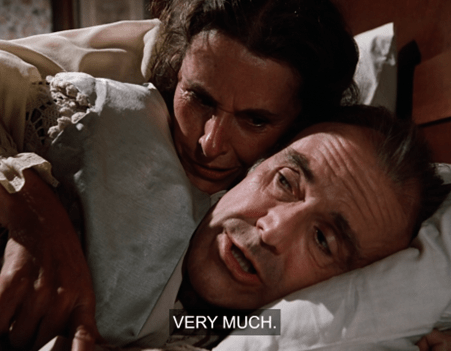
HARRIET: What’d you say, darling?
NELS: Very much.
Rappin’ Nels, ladies and gentleman, and not a bad rhyme this time.
Then we get a sunny montage of Charles and Joe Kagan making their journey.
They cross a river, but there are a few of ’em along the way. (Could be the Big Sioux near Sioux Falls?)

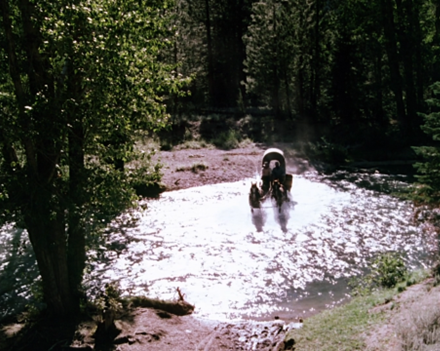
They arrive in Winoka. It does seem like a lot of trips back and forth to Winoka (at least a week each way), but remember, Little House Universal Time (LHUT) operates differently. It’s been at least a year since Mary’s wedding in LHUT.
In fact, I think we’re going to have to date this one to 1885, since late fall seems a strange time to take on a huge project like this.
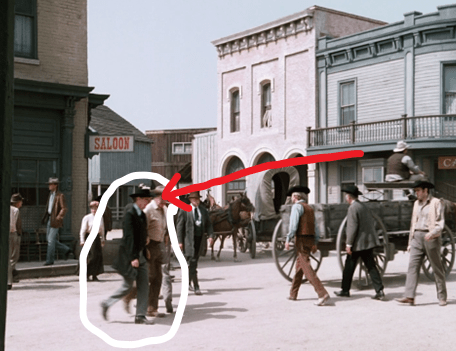
Anyways, you know who else has been making a lot of trips back and forth to Winoka? The Alamo Tourist from Pee-Wee’s Big Adventure.
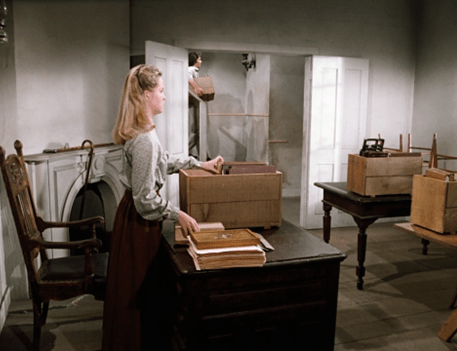
At the school, Mary and Adam are packing up boxes.
DAGNY: Man, it would be hard to pack up a whole school if you were blind.
WILL: Yeah. Especially with Ames out of commission to help.
Charles and Joe come in, and Pa says, “Excuse me! Are Mr. and Mrs. Kendall receiving?”
WILL: See, everyone should have screamed. A running gag!
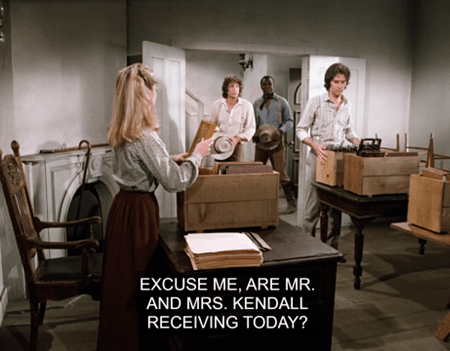
Mary says she remembers Mr. Kagan, though the two of them never met in “The Fighter” (which Mary was barely in).
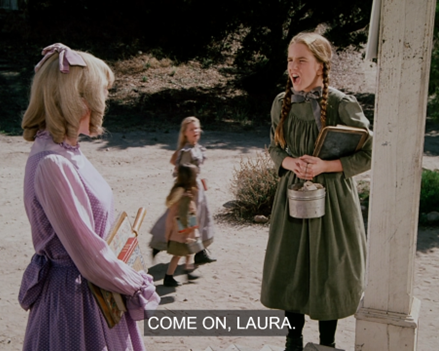
A few years have passed, of course, during which Joe is supposed to have been around the whole time.
[UPDATE: Reader Ben notes, quite correctly, that Mary was present when Joe came to have supper at the Little House. Thanks, Ben!]
Adam apparently bought a wagon and horses, which he describes as “the best,” to bring all their stuff to the Grove.
Joe goes out to check on the horses, and raises an alarm.
DAGNY: Whoa, those horses look terrible. Are they sick?
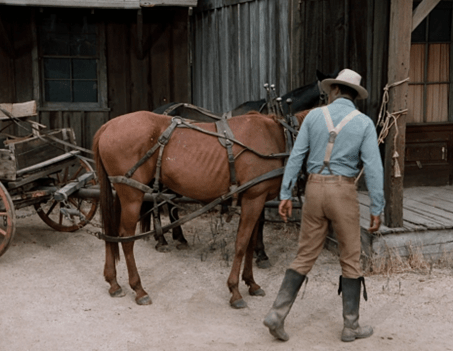
Pa makes a tasteless joke about how blind people shouldn’t walk into buzz saws. (It’s more tasteful than the KKK joke, though.)
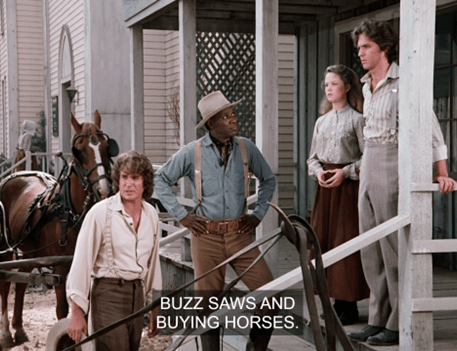
But Adam is able to see the humor in the situation.
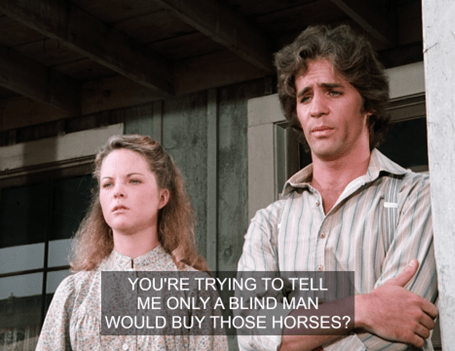
Kagan asks Adam who sold him these “spavin beauties” – spavin being a bone condition that lames horses.
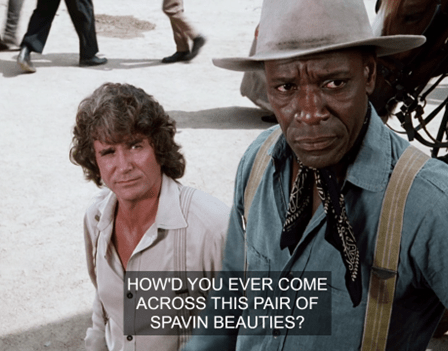
WILL: I bet you can guess who they bought them from.
DAGNY: Oh my God, Mr. Mason!
WILL: Who?
DAGNY: Whatever he’s called. Sturgill Simpson?
Yes, Mr. Standish.
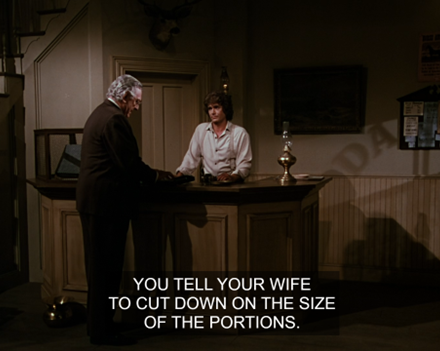
Adam says in exchange, Standish got “all the school’s furnishings.”
He says Standish promised him in writing the horses were “the finest team in the livery.”
Eager for another confrontation with his old foe, Charles says, “The four of us are going to go see Mr. Standish.”
AMELIA: The four of them?
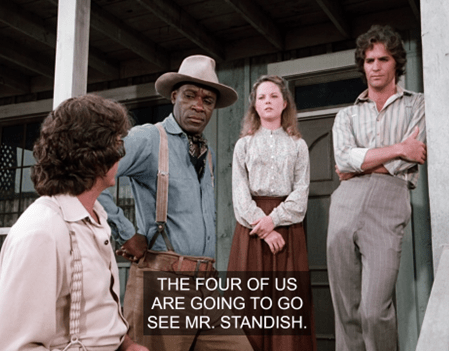
Yes, the four of them. Charles and Joe lead the two dying horses right into the saloon.
ALL: Yeah!!!

Also back in Winoka are Not-Richard Libertini and Herbert Diamond, both of whom have been seen in Walnut Grove since everybody came back.
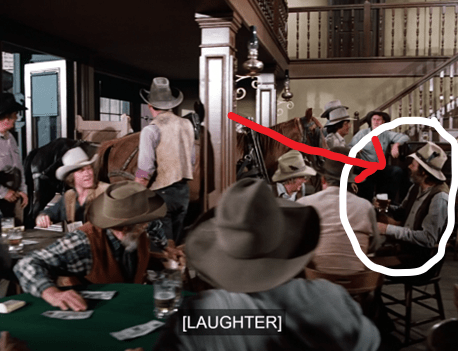
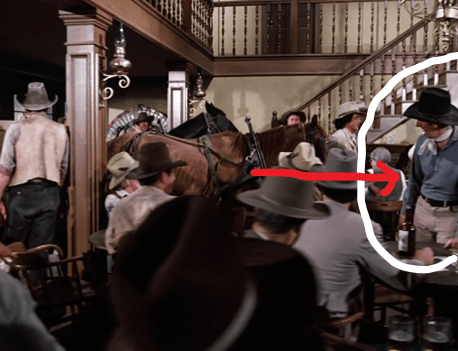
Fred the kindly bartender is also working.
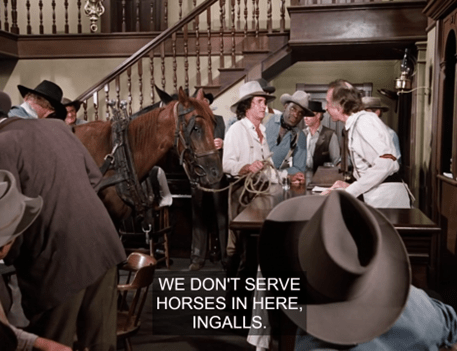
The saloonists roar with laughter.
“We don’t serve horses in here, Ingalls,” Fred says, and Chuck says, “Then you must have changed your menu.” (It’s a good joke, but dude, your wife was the cook!)
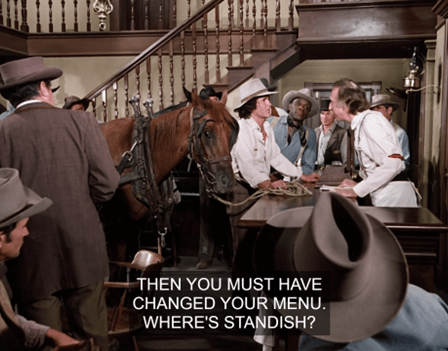
Standish charges in wearing his summer suit (more proof that it’s 1885).
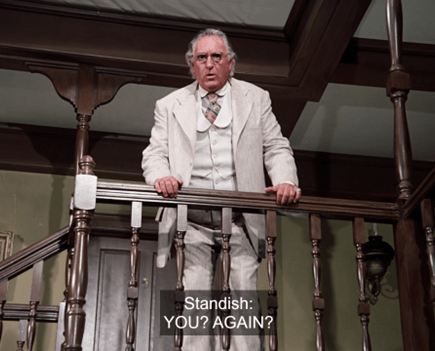
Joe starts sassing Standish, and Charles introduces him as his friend.
“I might have known,” says Standish. I interpret this more as a reaction to Joe’s cheeky attitude than overt racism, since Winoka is the most diverse community we’ve seen so far on the show, and we know the saloon allows people of all races to gamble there.
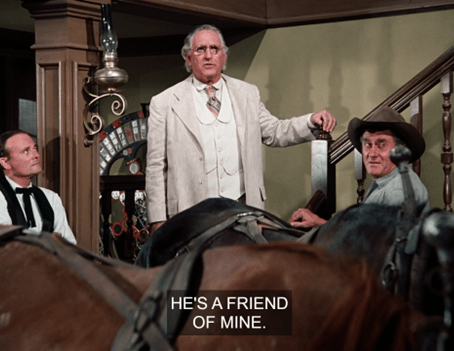
Standish says the horse sale is old business.
Joe says, “The only way you’d get this crowbait to Minnesota is in the wagon, not pullin’ it,” and the crowd cracks up.
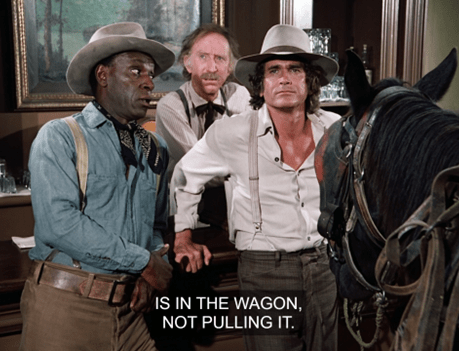
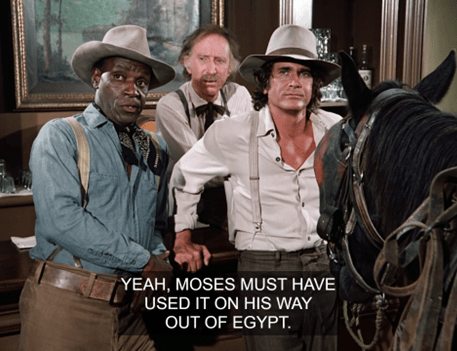
Then he adds the wagon looks like it could have been driven by Moses “on his way out of Egypt,” and the gamblers hoot and pound the tables again.
AMELIA: Mr. Standish should offer him a job doing stand-up.

Charles barfs some sanctimonious sputum about how humiliated Standish must be to be exposed as a cheat in front of his customers.
DAGNY: Did he forget everyone knows what Standish is like?
WILL: Yeah, he got hit on the head in the dust storm.
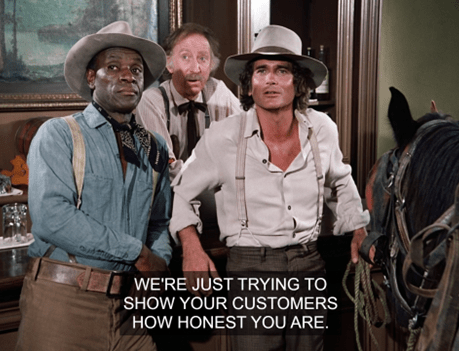
But sure enough, the chorus all join in, and Standish tries to save face by giving them better horses.
ROMAN: That went very well!
AMELIA: Yeah, improbably so.
WILL: I don’t believe it in a million years.

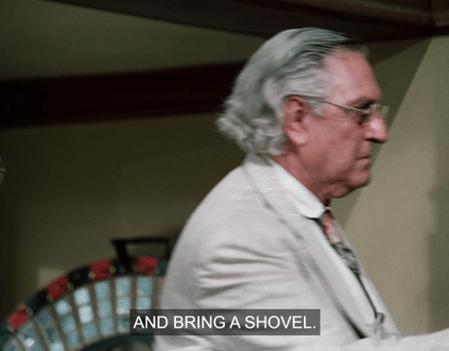
Still cracking wise, our heroes exit, and Standish calls for a shovel. (Which is funny.)
After a final break, David revisits “The Winoka Rag” for what’s probably the last time.

At the school, Mr. Ames is helping a group of students down the stairs that includes Sue Goodspeed, Thomas, Pigtail Annie, and another girl who reminds me of Janice from the Muppets.
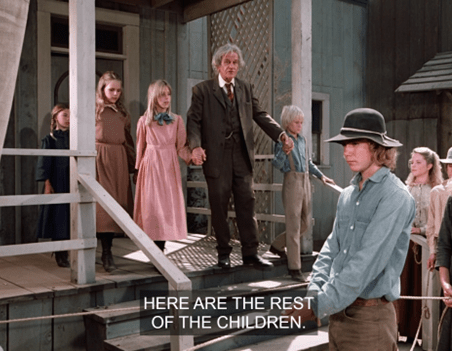
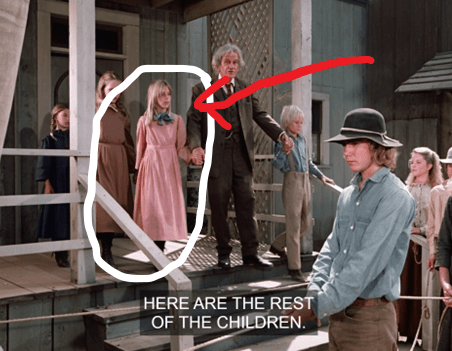

We see all the little kids, plus Mary and Adam, are standing behind the wagons, holding or tied to a tow-rope.
DAGNY: All those little kids have to walk? This will take a month!
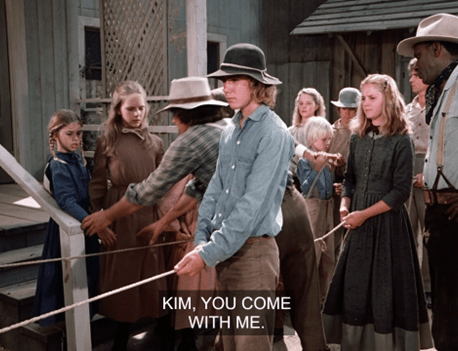
Suddenly Harriet Oleson’s voice rings out.
DAGNY: That’s a great hat.
WILL: She bought it in Winoka, I think.
Mrs. O is indeed wearing the periwinkle-or-lavender “fit” (as the young people call them) from “There’s No Place Like Home.”

Attended by a steward or something who’s carrying her bags, she invites herself along for the rest of the journey.
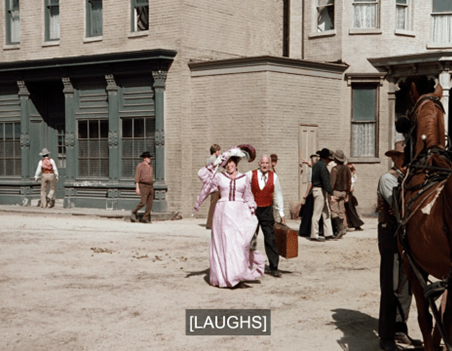
But she balks at sharing the seat with Joe Kagan, saying a white woman and a “colored person” sitting together would be improper.
Charles shrugs and says she’ll have to grab the tow-rope, then.
WILL: I don’t understand – if Standish got all the furniture, and all the kids are walking, what the hell is in the wagons? A box of files, some kids’ clothes, and eight Braille writers?
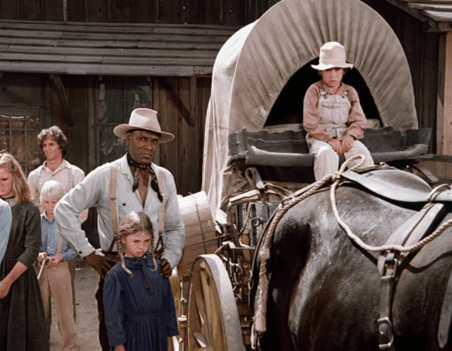
Charles suggests Joe have “Kim” (Pigtail Annie) sit next to him instead.
One by one, Mr. Ames walks up the line, touching each child (nicely, not creepily).
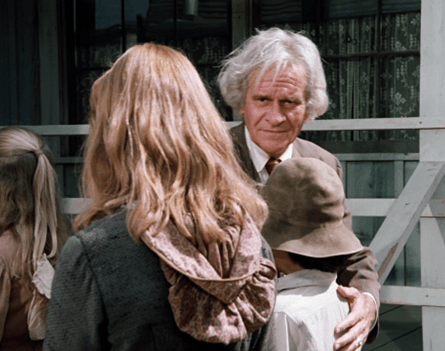
DAGNY: Is the fat handyman gonna come say goodbye?
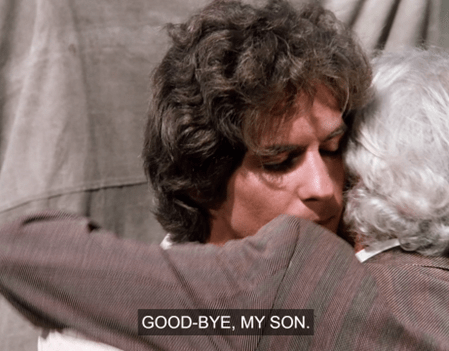
He bids farewell to Mary, then embraces Adam, saying, “Goodbye, my son.”
WILL: Oh, Mr. Ames! This is so tragic! I feel like we hardly got to know him.
AMELIA: Every time we saw him before this episode, you said he was boring.
To epic music, the wagon train departs, leaving Mr. Ames standing in the street, alone.
WILL: Was he just lying about having a wife, then?
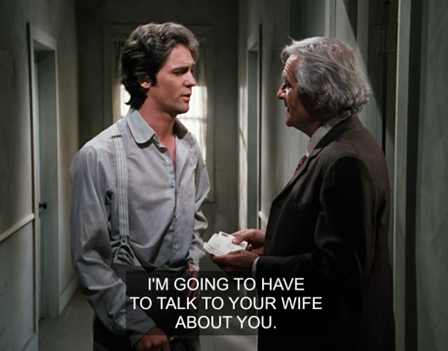
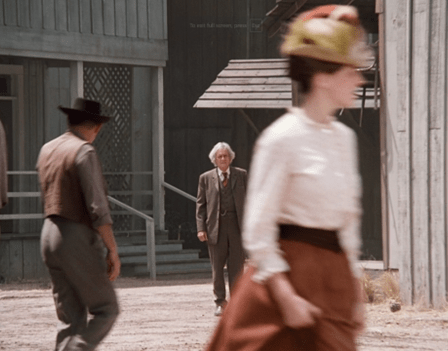
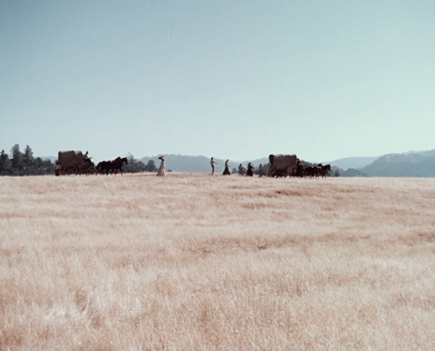
The pilgrims journey on.
DAGNY: Mrs. Oleson’s parasol was up and now it’s down. Continuity error.
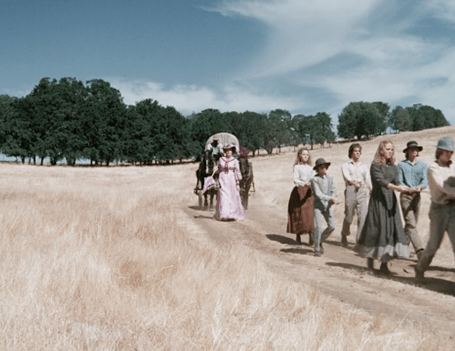
Mrs. Oleson loses a heel on the dirt road.
They stop for lunch, and Harriet tries putting on another set of heels, but Joe Kagan grabs them and breaks the heels off so she’ll have an easier time walking.
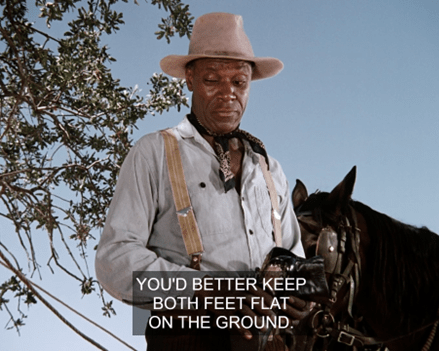
Ominous kettledrums bring us to another river crossing. Doesn’t look too bad, though.

Pa tells everybody they’ll have to wade across. Adam seems nervous.
AMELIA: Ah, look at the moon.
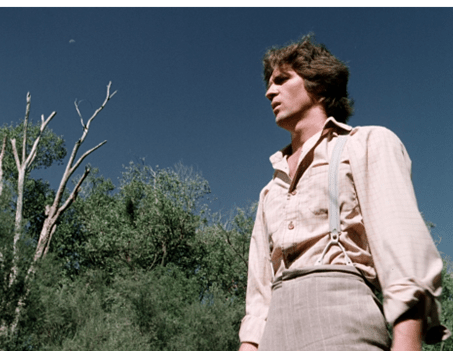
Adam freaks out even more as they make the crossing.
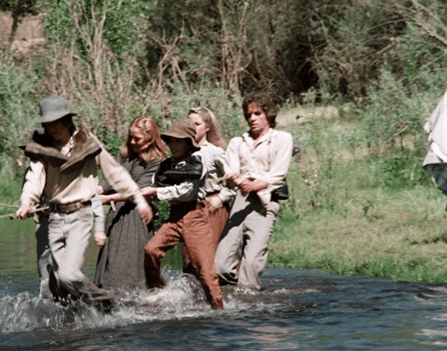
Mrs. Oleson falls in, and Joe helps her up.

WILL: Now why did it switch to Hulu? With two seconds left? That’s madness.
[Our dog Nyssa sat on the remote, that’s why.]
Adam anxiously asks if “the children” have to worry about any other river crossings, and Charles says a few, but not bad.
A weak cliffhanger, but we’ll have to take it. Bum-Bum-Ba-Dum!
STYLE WATCH: Joe Kagan wears a jaunty neckerchief.
Jeb Lar[r]abee wears a handsome corduroy jacket.
THE VERDICT: Tune in next time to find out. Buh-bye!
UP NEXT: Blind Journey, Part Two
 Walnut Groovy
I could have sworn there’s a dinner scene in The Fighter when Mary is with Joe and the family at the table, but I’m not going to go rewatch The Fighter to find out for sure!
I always told myself that Mr. Hanson never lived in the blind school house (in The Aftermath he says he’s the agent of a house for rent; I think I just told myself it was abandoned by somebody…the hermit whose wife is buried in the yard?). When eventually they try to say Laura’s boarding house house was Hanson’s, too, I just had to throw up my hands, as I have to at almost all of A New Beginning.
LikeLiked by 1 person
Ah! Of course you’re RIGHT. Mary was in the “that’s the purse, it ain’t mine” scene. I’ll make the correction, thank you!
And as for the huge Victorian houses, there are a few of them – remember Mariette Hartley lived in an identical one, which she said her husband built (so it can’t be the Amos Pike house, which he said HE built). But presumably these are all houses built from some standard blueprint, and having probably built many of them himself (and repossessed a few), Mr. Hanson probably owned more than one.
LikeLike
With all of these Victorian homes around (at least three or four, right?) how could anyone take Nellie’s essay seriously from season one? Her home is the nicest home in Walnut Grove? Not likely. (And i dont think we ever see Willie riding a horse, for that matter. Those Oleson kids are just a couple of liars.)
LikeLiked by 1 person
Ha! Well, on the map I made (which I can’t add to this comment, dammit), there are four – the one that Doc lived in for a time, the Widow Thurmond’s, Amos Pike’s, and a fourth unknown one. The first three for sure are identical, but we haven’t seen the fourth one so far. . . . (Is it the one that becomes Laura and Almanzo’s AirBnB, which had a different design than the others? We’ll have to wait and find out.)
LikeLiked by 1 person
Perfect Star Wars References. I think the picture that you made with Linwood Boomer made him look like Hayden Christiansen who played the young Darth Vader? Now as for Michael Landon’s gag, I have seen it on YouTube. I found hysterical myself. I like it when people make fun of ignorant things that people do; like how Mel Brooks did the “springtime for Hitler” musical number in “the producers”.
Growing up in a fundamentalist Christian group I found the song as Solomon to be extremely sexy! And I agree, they rarely “touched” on that book of the Bible!🫣💁🏻♀️
I’m really looking forward to when you’re reviewing season six. It’s one of my favorite seasons of LHOTP. 👒
LikeLiked by 1 person
Thanks Maryann! And you’re right, Boomer totally looks like Anakin (pre-accident).
LikeLike
I’m confused.
Is Moses Gunn’s character supposed to be the same character as the boxer? I ask because Joe Kagen’s wife Janie Kagen is played by Ketty Lester. Ketty Lester also plays Esther Sue. Why have her come back as a completely different character, and for not a reunion of the Kagen family? And didn’t they also have a son?
It was pretty common to have the same actor play different roles, especially secondary characters. For example, Michael Pataki who played Stanley, comes back as a new character (I won’t reveal who so not to spoil anything).
I always thought this version of Joe Kagen was a new character with an off screen backstory. That makes sense when Esther Sue is also a new character.
Continuity isn’t one of the show’s strong points.
LikeLiked by 1 person
It certainly is not a strong point! But that’s one of the pleasures of the show. You’re right, Ketty Lester plays both of them, but Joe never seems to notice that she’s identical to his dead wife. We’ll get into that question next week – stay tuned! 🙂
LikeLike