
This Might Be the Oldest Person Charles Has Ever Been Fatherly To; or
The Acorn Doesn’t Fall Far From the Tree?
(a recap by Will Kaiser)
Title: The Craftsman
Airdate: January 8, 1979
Written by Paul Wolff
Directed by Michael Landon
SUMMARY IN A NUTSHELL: Another Albert one: This time, he apprentices to an aphorism-spouting Jewish woodcarver, and learns what antisemitism is.
EDITOR’S NOTE: This recap quotes (evil) characters using racist slurs.
RECAP: First things first. This week we caught Melissa Gilbert’s episode of Love Boat, titled “Rocky,” on Pluto TV.

MG plays a tomboy who’s crushing on a friend, but her efforts to be feminine and attractive only repulse him. The plot is quite similar to “Apple Boobs,” in fact!
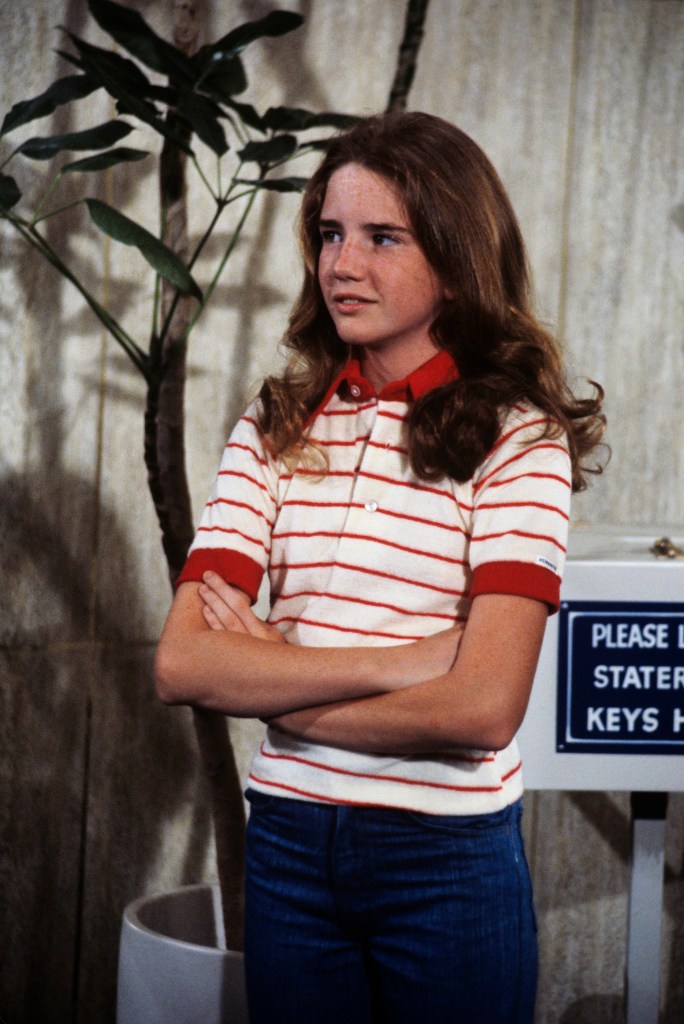
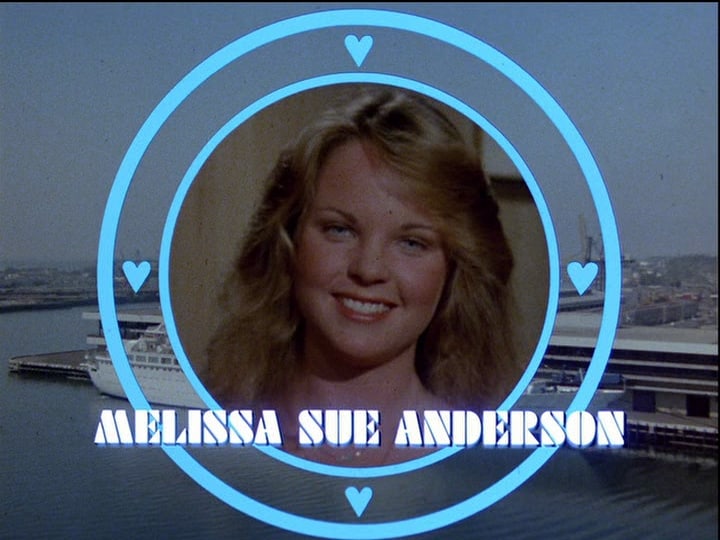
Gilbert’s character’s nickname is “Rocky.” That’s better than “Chubs,” which is what Melissa Sue Anderson was called in her episode (titled “Chubs”).
Rocky’s love interest in the story is played by Jimmy Baio, Scott Baio’s real-life cousin.

Jimmy’s mother is played by Ellen Travolta. Oddly, she played Scott Baio’s mom on three different shows: Happy Days, Joanie Loves Chachi (same characters), and Charles in Charge. (The last one was my favorite.)

When I saw her playing Jimmy Baio’s mom, I assumed she must really be his mom or Scott’s, but she isn’t. Just a Baio family hanger-on, I guess.
Anyways, Melissa Gilbert is good in the episode, though she is forced to deliver lines like “And when I dress like a girl, I’m an object of ridicule!”
It’s also weird to hear her saying “Mom” rather than “Ma.”

But enough of this airy persiflage. Happy New Year 1979!

The year would prove one of terror and malaise; but on the bright side it’s the year The Muppet Movie, the first movie I saw at the cinema, was released. (Still fantastic, too.)

We have a new writer today. He’s Paul Wolff, who also worked on Highway to Heaven, Remington Steele, Fame, Family Ties, Life Goes On, and Home Improvement.

We get started on a somber note, or a whole bunch of them rather, as David gives us a sad, sweepingly Slavic theme, balalaikas and all.

[UPDATE: As I’ve said many times, I adore the readers of this blog. One called friedkitten writes:
The “sad, sweepingly Slavic theme” at the opening of this episode is the classic Jewish lullaby “Oifn Pripetchik” (which means “On the Hearth” in Yiddish). The first few bars vary somewhat from the melody but then it quickly becomes the actual tune of this song.
The song is about children in a small schoolhouse, learning the Hebrew alphabet from their teacher.
Wikipedia says: “By the end of the 19th century it was one of the most popular songs of the Jews of Central and Eastern Europe.” So it’s an appropriate choice for the Little House time period.
You can listen here (instrumental):
And sung beautifully here:
I didn’t go back to rewatch the episode but I believe this melody is used again later as well.
I sang this song to all of my children at bedtime when they were little.
[Thank you so much, friedkitten! – WK]
The opening shot is of an acorn or some other small woodland nut, sitting on a windowsill.
DAGNY: Landon?
WILL: . . . Yes.
DAGNY: You can tell. Look at the light glimmering on that nut.

The camera crawls down to a workbench, showing us a bunch of carving tools followed by some carved pieces including a dog and a ram.

There are also more mundane things like staircase posts and other home goods.

Finally, the camera shows us two men working on the most mundane object of all: a coffin.

Coming to rest on the older man’s face – well, I mean, it doesn’t actually touch him.
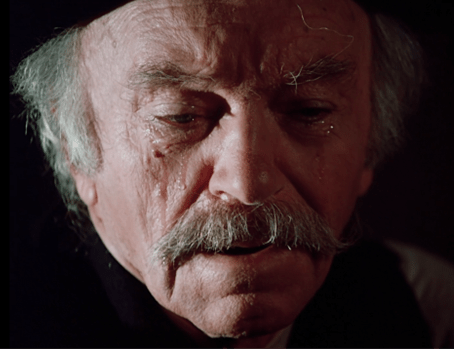
He’s quite elderly, and we see his eyes are streaming with tears. (A fair amount of crying in this one.)
We cut to the same two men, I assume, driving the coffin through downtown.

In front of school, some boys are playing (slightly anachronistic) dodgeball as Carl the Flunky drives by in the Yellow-Wheeled Buckboard.

Patrick Labyorteaux is not in this episode, but they’ve stuck in a couple brown-haired kids with their backs to the camera, to fool all but the most observant viewers.

The players include Albert, an Ambiguously Ethnic Kid (not the one who went blind), and a boy I thought was Thomas the Blond Freckle-Faced Moppet. (But since he’s blind, I suppose he wouldn’t be playing dodgeball.)


(On the other hand . . .)

A very old(-acting) man with a cane, a stranger to us, tromps through, screaming at the kids to get out of his way.

When he passes, the AEK takes aim and throws the dodgeball at him from behind.

It’s a perfect shot, tipping the old man’s hat off without knocking him down or killing him.

Making a terrifying face, the man charges at the kids, brandishing his cane.

At the coffin wagon, the two men from the woodwright’s shop watch with concern.
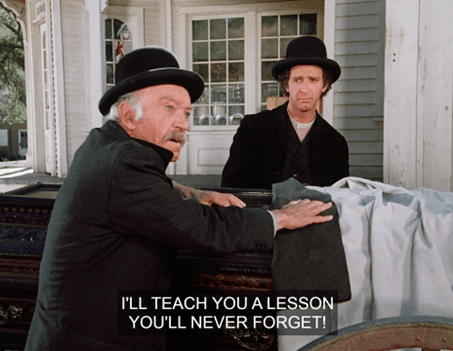
Most of the boys skedaddle, but the old man catches the AEK, first trying to smash his head with his cane and then trying to strangle him.

The elderly coffin maker, though, comes over to calm the old man down, addressing him as “Mr. Brower.”
Brower says the AEK deserves to be strangled, and goes about his business, which is strangling him.

(Brower is played by Frank DeKova, a character actor apparently mostly typecast as Indigenous people, despite not being Native himself. His resume includes The Lone Ranger, Rin Tin Tin, Gunsmoke, The Rifleman, Rawhide, Alfred Hitchcock Presents, Daniel Boone, and F Troop.)

(He was also in The Ten Commandments, in which he played an Egyptian.)

(DeKova will also return to Little House next season, playing a Native chief in an episode best not spoken or thought of till we get to it . . . and best forgotten immediately after.)

The other old man, who has an Eastern European accent, a gentle voice, a persuasive manner, and a white mustache, says all little boys are troublemakers, but quotes “the Holy Book” as saying, “If you must beat a child, use a string.”
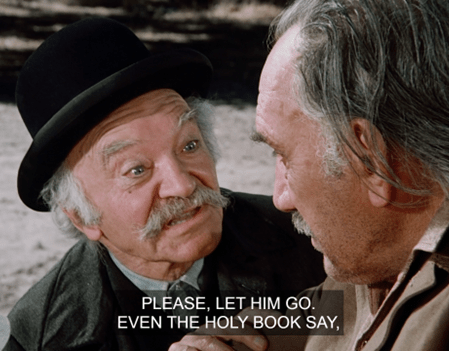
This concept does indeed come from a holy book, but it isn’t the Christian Bible. It’s the Talmud, which does says, “When you strike a child for educational purposes, hit him only with the strap of a sandal [sometimes translated as “shoestring”], which is small and does not cause pain.”

I’ll say up front I’m not Jewish myself; and although I was an excellent tailor Motel Kamzoil in my school’s production of Fiddler on the Roof (if I say so myself), obviously this is no substitute for the real thing.
I hope readers will forgive my ignorance – I am an expert in nothing – and certainly I invite you to correct anything I get wrong this week.
The coffin-maker pops his eyes out and sticks his face breath-smellingly close to Brower’s.

And yet, this soothes Brower somehow.

Only then the AEK stomps on Brower’s foot and runs like hell.
WILL: It’s the Baltimore Foot Stomper!


Ha! These kids are such little shits, aren’t they?
The old coffin-maker changes his tune then, screaming after the kid and telling Brower if he catches him, he should give him an extra-heavy beating after all.

I don’t know quite what to make of this scene of shifting tonality and child abuse; but it is Little House after all.
I think we’re supposed to gather that the coffin-maker is a nice guy, but not too nice – a little crazy, but not too crazy. And Jewish, if you recognize the shoestring quote I suppose.
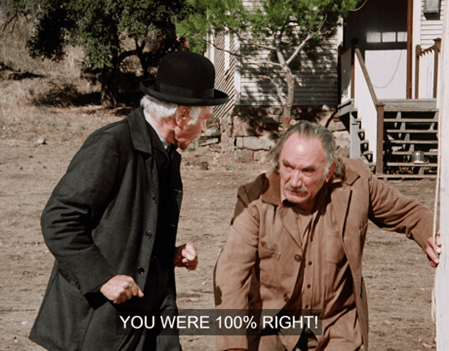
Cut to that rat bastard Jud Larrabee (two Rs this time) in his cool corduroy jacket waving a gun around in the Mercantile.
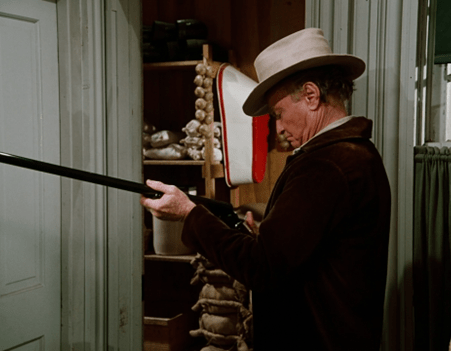
You’ll recall in “Blind Journey” Lar[r]abee’s rat-bastard credentials were established once and for all (by Harriet Oleson of all people).

(You never know who this show’s gonna rehabilitate, though.)


Jud’s not shooting up the place, yet, just considering the purchase of a new shotgun, apparently.
He observes the two woodworkers carrying the coffin into Nels’s storeroom.
“Here come the Hebes,” he says to Nels. “Hold your nose and hang on to your wallet.”
Whoa. Boy oh boy, they do jump right into things on this show, don’t they? That’s almost always a strength, and yet it can hit like a punch in the face when what they’re jumping into is racist slurs.

Nels winces but says nothing. He’s pricing a piggy bank shaped like Uncle Sam . . . symbolism for the U.S.A.’s historic (and not-so-historic) tolerance of antisemitism?

This is a timely episode, since in our country and elsewhere we’ve seen a shocking increase in publicly expressed antisemitism – violence and harassment too – and not just from the usual suspects. The Israel-Hamas War triggered something truly appalling in the rest of the world.
And of course actual Nazism is ascendant in several governments around the world at the moment. Unbelievable in this century; or maybe all too believable.
Anyways, just like she did in “The Wolves,” Harriet Oleson cackles in delight at Larrabee’s terrible comments.
WILL: This is strange. It’s only been a few months since she became best friends with that little Black kid and stopped hating Black people.
DAGNY: Yeah. But they were at least Christian.


Well, Nels shows his distaste for this exchange by walking behind his wife and elbowing her in the back.

Once again foreshadowing Elon Musk, Harriet says aside to Nels what’s the matter, bro, no sense of humor?

Rather than speak up to his wife, Nels whispers that “old Isaac” is a terrific woodworker. This show wants it understood that despised minorities make great contributions to society, but of course, even if they didn’t, it wouldn’t be okay to mock them, say they smell, etc. Isn’t our common humanity enough? (Do we not bleed?)
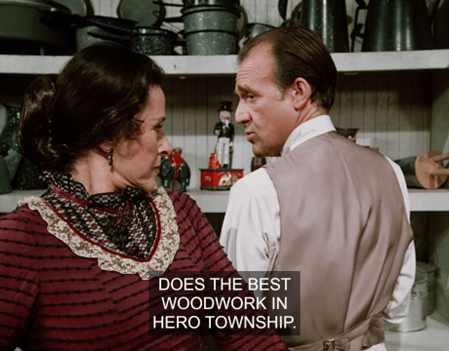
Ignoring Nels, Mrs. Oleson goes over to Larrabee and says they do business with “the old Jew” (good grief) simply because he’s a good craftsman. (We discussed Western Nineteenth-Century attitudes about Jews, a little, in our recap of “Fagin,” which I invite you to revisit if you wish.)
Unexpectedly, Larrabee turns and speaks to two middle-school-aged kids – his sons!

I’m sure lots of viewers find this strange. Larrabee has never been shown to have a family, and seems so unpleasant one can’t imagine anyone volunteering to climb into bed with him.
Then again, plenty of men just as bad do have wives, and they don’t always strictly volunteer for the position. (And some are just as bad as their husbands, of course.)
Anyways, we never meet a Mrs. Lar[r]abee, so I think we can assume Jud’s a widower. Or divorced, I suppose, but that seems unlikely for the time.
(On the other hand . . .)

We’ll have to keep an eye on these Larrabee boys, whom their father addresses as “Lem” and “Zeke.” One has red hair, and red-haired children tend to be evil in the Little House Universe.


“Old Isaac” comes into the showroom then, and Larrabee growls that he’ll be back “when the air clears.”
Old Isaac, clearly a man of a million sayings, says quietly, “May all his teeth fall out except one – and in that one he should get a toothache.” (Apparently a real expression from Yiddish.)

Nels likes the joke. He howls with laughter, in fact.
WILL: You could never laugh too crazily for Michael Landon.


After an untelevised stop at the Post Office, Isaac and (I assume) his son are driving home. Isaac opens a letter and reports that their cousin Rachel, who despite being “homely” and hairy is also “sweet,” happily has now found a husband.

Isaac’s son asks “What about a girl?”, and Isaac goes on to read that “my brother Ezra and his wife have found a girl for you to marry.”
But Isaac does not seem happy about this news.

All the son wants to know is what’s her body like?

“Am I her tailor?” Isaac snorts, and hands the letter over.

It turns out Isaac is upset because the letter suggests the son go “back there” (to Europe?) to meet his intended.
The son pleads with Isaac to let him go, since “there isn’t a Jewish girl for five hundred miles.” (Today Minnesota has quite a large Jewish population; Jewish immigrants had trickled into the state since the 1850s, but they weren’t really an established community till the 1880s.)

Isaac pouts and says he isn’t angry, go ahead if you want to break your father’s heart. (Paraphrase.)

They briefly revisit the respective arguments made by Charles and Caroline in last week’s episode.


The son, identified by the impatient subtitle transcriptionist as Aaron, says he should come back with him.

But Isaac, in tears, says he cannot leave the place where his late wife is buried.
DAGNY: This is the second or third time a man has refused to leave his wife’s grave.
WILL: Yeah. There was Charles’s father who set himself on fire.
DAGNY: Him, and I was thinking of that gold miner.
WILL: Oh yeah. He also set himself on fire, actually.


Later, we see Aaron pacing around what’s presumably their home.
WILL: He looks to be what, late twenties?
DAGNY: Early thirties.

Aaron goes outside and finds his father standing by his mother’s grave out in the field.
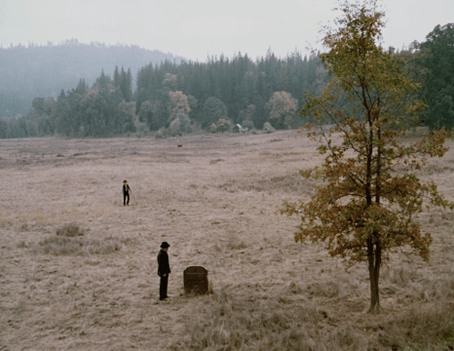
He tells him he’s decided not to go to New York after all. (Guess that’s where he was headed, not Europe.)
WILL: Is the dad gonna say, “All right, you can go” like Caroline did last week?

Isaac does tell him to go. In a nice speech, he says it’s indeed breaking his heart, but he says Aaron must go because everyone should have children to recite the Kaddish when they die.

The actor has a fascinating face, I think. His bright eyes are so communicative . . . even his wrinkles are!

He is John Bleifer. Born in Poland, his screen career dates back to the 1920s, though I’m afraid I don’t know many of his films.
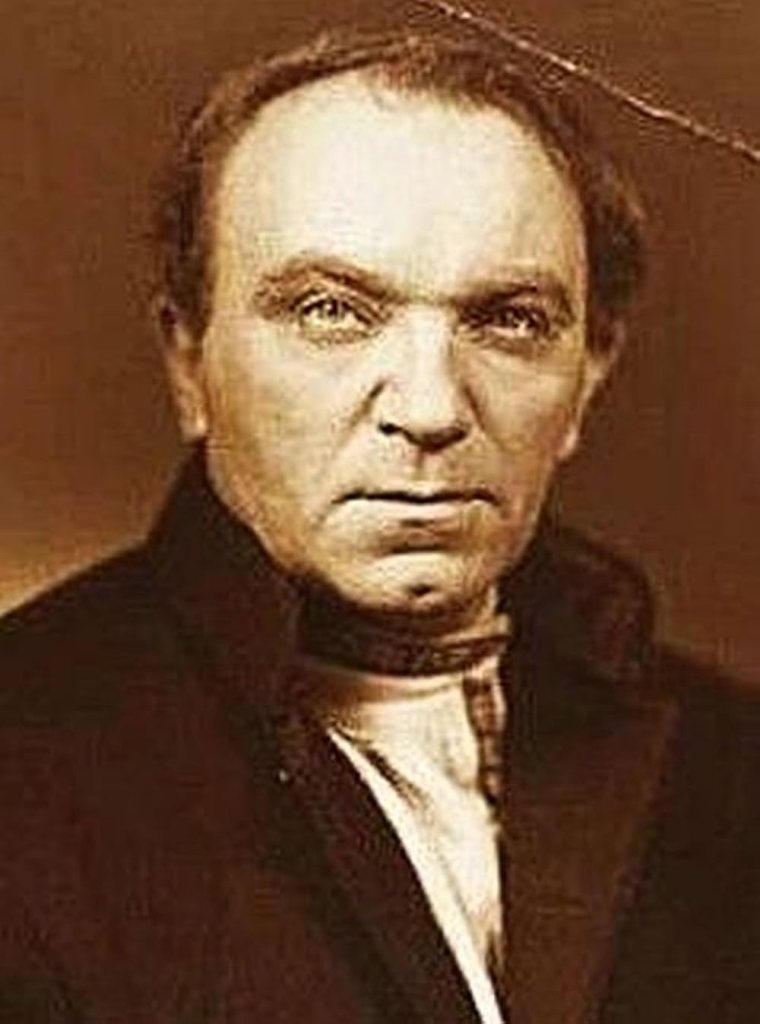
He was in Kismet, Alfred Hitchcock’s Torn Curtain, and some Charlie Chan and Mr. Moto pictures. (I know we have some old-movie buffs out there, so feel free to chime in with a comment if you’re familiar with better or more significant examples.)
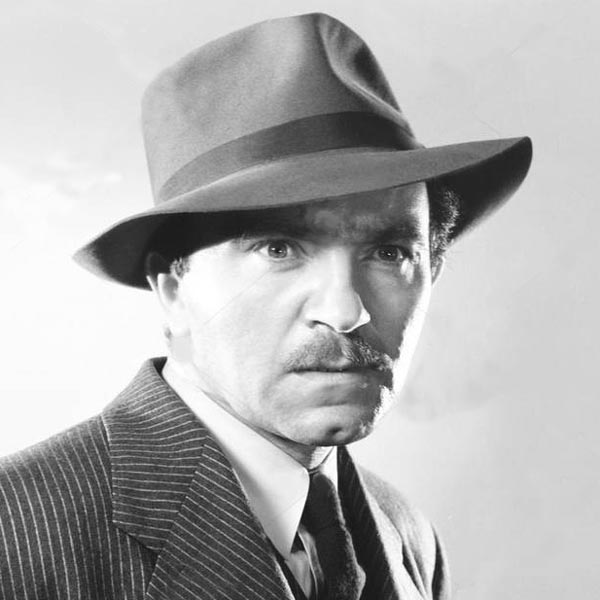
On TV he appeared on I Love Lucy, Perry Mason, Peter Gunn, The Untouchables, Dr. Kildare, The Man From U.N.C.L.E., Kolchak: The Night Stalker, The Hardy Boys/Nancy Drew Mysteries, and Highway to Heaven, among many others.


Bleifer apparently was proud of his “unplaceable” accent, which allowed him to play European nationals from all over the continent.
“Besides,” Isaac tells his son, “it is written in the Zohar, a man is not a man until he is united with a woman.”
Aaron, a nice enough guy from the look of things, protests; but Isaac insists.
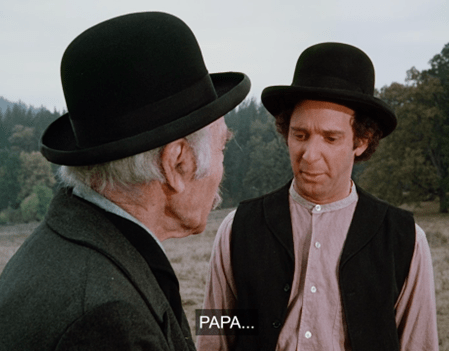
Aaron starts walking back to the house to pack up his things. Isaac calls “Don’t forget your socks!” after him and gives him a sad smile.
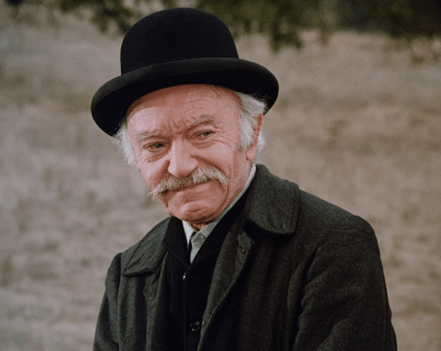
Pleased to have received his papa’s blessing, Aaron smiles back.
Aaron is played by Alvin Kupperman, who appeared on Police Woman and The White Shadow.

Cut to another closeup of the acorn.
WILL: Do you think there’s religious significance, or just “the acorn doesn’t fall far from the tree”?
DAGNY: That’s “apple.”
WILL: Well, whatever.

You really shouldn’t bring acorns into the house. My mom once gave us a bunch from their tree, which she thought we could use for fall decorating. We put them in a glass vase on the table, and one day we noticed it was just crawling with grubs that had hatched out of them.

DAGNY: But it might be a chestnut.

In front of the house, Aaron is saying goodbye to the old man.
“Go with God, my son,” Isaac says as he watches Aaron leave.
We cut then to Albert running. David Rose has arranged the Albert Theme in the style of the Miss Marple intro on this occasion.

Albert arrives at Isaac’s workshop, where he addresses the old man as “Mr. Singerman.”
DAGNY: Mr. Cinnamon?

Albert introduces himself, and declares he’s come to pay Mr. Singerman for a chair he recently made for Charles.
Mr. Singerman friendlily but creepily invites Albert to stay for tea and an apple. (Were Little House writers awarded a bonus if they worked apples into the script?)


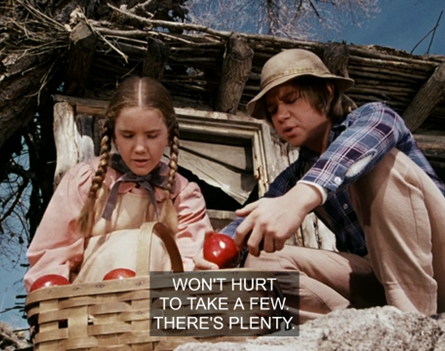


(That apple, by the way, suggests this story immediately follows the events of the previous one. I’d guess we’re in October of 1881-I.)
Albert quickly takes an interest in Mr. Singerman’s trade, noting he’s done some carving himself.
“You work with wood?” Singerman gasps theatrically.
WILL: Do you think it’s weird how he’s always leaning in and screaming into people’s face when he talks to them?
DAGNY: No. I like it.
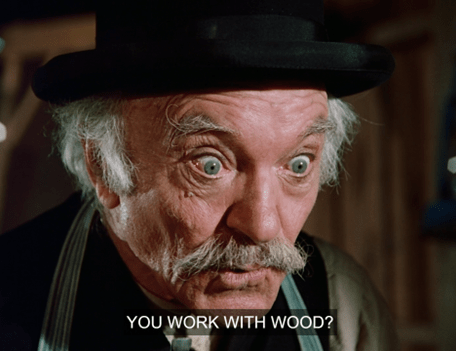
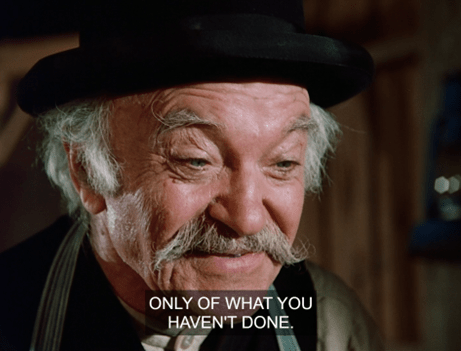
He tells Albert he should bring over his carvings, and when the kid says they’re not all that good, he adds, “Albert, never be ashamed of any work you’ve done, only of what you haven’t done.”
It’s good advice, and Albert smiles, seemingly enjoying his chat with this Yoda of the Prairie.

As it happens, Albert has one of his whittled doodads in his pocket right now.
Of course what Overachiever Albert has carved out of some random stick is a perfect, fully operational whistle (!).
WILL: Now how would he know how to make that? You’d have to understand how it’s designed, you couldn’t just start carving and have it work. And you couldn’t google it.
DAGNY: Well, he probably stole whistles in Winoka and sold them on the black market.

Mr. Singerman, whose bug-eyed attention rides the fence between friendliness and madness, immediately offers Albert a job. (The whistle is pretty awesome.)
WILL: Albert should tell him he’s already somebody’s surrogate son and isn’t taking applications.

Continuing to stare insanely at Albert, Mr. Singerman says he should ask his pa if he can take the apprenticeship.

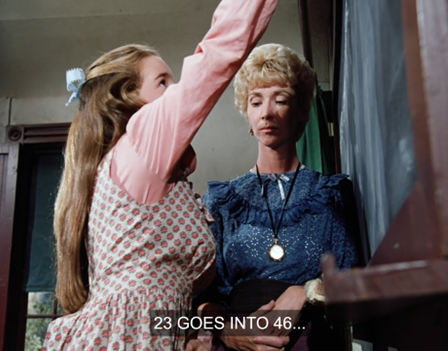
Albert takes a bite of the crunchy Granny Smith he’s been given.
WILL: Do think Laura blushes every time she hears that sound?

That night in the Ingalls barn, it’s Arm Day for Pa once more.
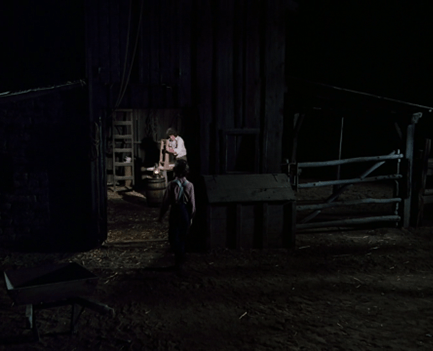
Pa gives Albert his permission, saying he doesn’t quite get the sudden interest in woodworking. (Neither do I.)
Albert says Mr. Singerman’s son leaving has depressed the old guy, and he considers that sufficient reason to meddle in his private business.
Naturally, Charles agrees with his analysis.
WILL: Is Charles going to start weeping tears of joy?
DAGNY: Yeah. Albert’s a true Ingalls now.

Now we see Mean Old Man Brower sitting on his porch, scowling.

Isaac Singerman and Albert drive up in a buggy.
Isaac and Old Man Brower have kind of a hilarious old-man conversation.
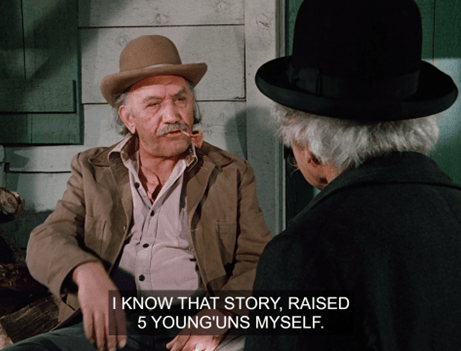

Isaac quotes another proverb: “One father can support ten children, ten children can’t support one father.” (The internet isn’t sure if it’s a father or a mother or a Hebrew proverb or from Cameroon.)

Wherever it’s from and whatever it means, Old Man Brower says, “Amen to that, brother!”

Isaac notices a rusty paint can or something, and says he would like to offer something in trade for it.
He produces a beautiful walking stick with carved horse head on the handle, to replace the one Brower broke in the schoolyard fracas.

Brower is dubious about this “even swap,” but he accepts.

Later, as they drive through some autumnal oaks (October confirmed), Albert asks why Mr. Singerman made such a dunderheaded deal.

Singerman tells him about the Jewish concept of rachmones – a combination of compassion, empathy, forgiveness and pity.

WILL: Do you think that’s where the Ramones got their name?
DAGNY: Yeah. They started as a klezmer band.
(They didn’t. They were Jewish, though.)

He says he offered the cane in trade for the worthless bucket because “you must give so the person receiving the charity feels no shame.” (Put that in your pipe and smoke it, Harriet Oleson.)


Then we see the evil Jud Larrabee driving the Yellow-Wheeled Buckboard to the Mill.
DAGNY: Those horses look nervous.

It’s hard to say why, but she’s right, they do – especially the one closest to the camera.
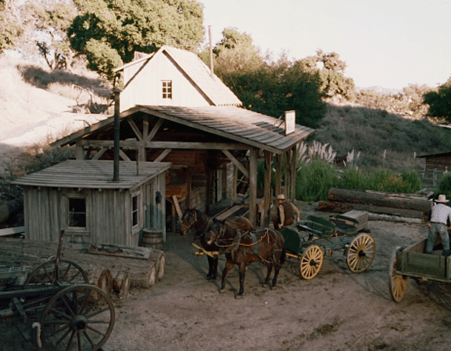
Larrabee stomps inside and says, “I want a word with you, Ingalls!”
(As nasty as the character is, I like Don “Red” Barry. I can’t wait to see if he says “twarn’t” again this time.)


Larrabee has come to question Charles about Albert associating with Mr. Singerman. (He expresses it more racistly.)
Charles waves away Larrabee’s opinions, so he turns to Jonathan Garvey for sympathy (aren’t they supposed to be archenemies?), saying, “Whole Ingalls family’s gone Jew-crazy!”


Very helpfully, he explains to Garvey that since there’s nothing wrong with discriminating against Jews, he doesn’t feel bad about it.

Garvey says quietly that he’s prejudiced himself.
“Y’are?” says Larrabee gleefully. “Against who?” (He’s a little too gleeful: People who are bigoted don’t usually see themselves as bigots. It is an irony of our culture, and a tragedy of it.)
Garvey looks him hard in the face then and says calmly, “Against short, rednecked farmers.”


Larrabee exits suddenly. I don’t know why he would be afraid of Garvey today; he didn’t used to be.

In the schoolyard, then, any doubt we had whether the Larrabee kids are evil gets snuffed when we see them crossing the playground with Nellie Oleson.

Meanwhile, Willie manspreads on the steps.

It’s lunchtime, and Laura and Albert are on the steps too.
The Larrabees approach and begin taunting Albert for being a “Jew-lover.”
Albert tells them to piss off, but they’re bigger than he is, so they don’t.
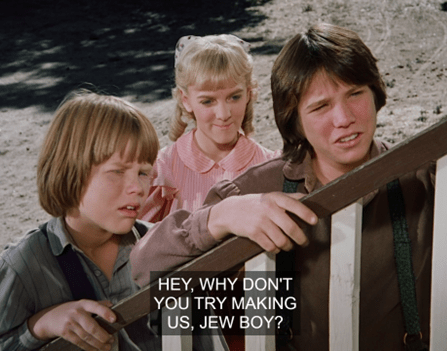
Zeke, the older brother, is played by Tony Becker, who would go on to appear in a number of interesting things.
He was a regular on The Waltons and on the Vietnam War series Tour of Duty (I don’t remember that one – I thought Tour of Duty was a video game), and he made appearances on M*A*S*H, Matlock, Murder, She Wrote, Melrose Place, Justified and NCIS.
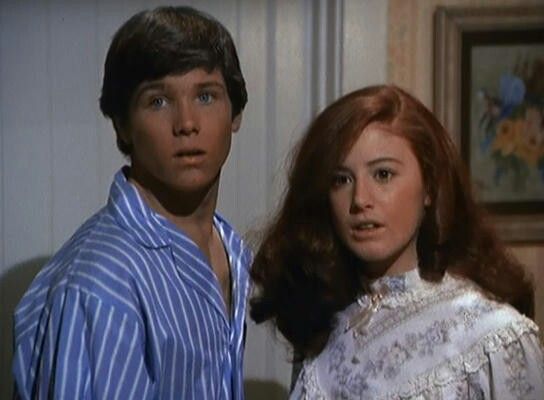

He also played a cowboy in this delightful SuperBowl commercial from 2000.
The younger brother Lem is Christian Berrigan, who doesn’t have as expansive a resume, but who was in the notable TV movie Elvis, for which director John Carpenter and his muse Kurt Russell worked together for the first time.

But Albert, the Winoka-trained streetfighter, isn’t afraid of the bullies.
WILL: Watch out, he’ll come rammin’ and thumpin’.


Annoyed, Laura points out they aren’t actually Jewish, but Nellie says as an orphan, Albert might be.
“Albert’s not Jewish,” Laura says with force; but Albert turns on her and says angrily, “How do you know?” (I love Albert. Clearly he doesn’t need any namby-pamby Nels Oleson rationalizations to like Jews.)


The conversation then takes an even nastier turn, as Willie says, “Eh, Albert ain’t no Jew. Everyone knows Jews have horns on their head, like the Devil.”
WILL: I remember finding this really disturbing when I was a kid, that they thought he had horns.

This vile notion, popular in the Middle Ages and eagerly revived in Nazi Germany, apparently comes from the writings of Early Christian Father Saint Jerome, who uses the word “horned” to describe Moses. (I had to read some Jerome many years ago, but don’t remember much about it. Pretty sure we didn’t go into the horn thing, though.)

Scholars argue about whether this was an example of Jerome’s antisemitism, a metaphor he intended as a compliment, or a simple mistranslation of the Bible’s original Hebrew.
Whatever the intent, the concept caught on with those who wanted to portray Jews as bestial or monstrous.
During the Renaissance, Michelangelo made a famous sculpture of Moses with horns, though as with Jerome, people debate whether it’s antisemitic or something else altogether. (Some people say they aren’t supposed to be horns at all.)

Willie’s also eating a Granny Smith, which don’t grow in Minnesota, but which are obviously preferable to the disgusting Red Delicious apples the show normally uses.

An auburn-haired girl appears at the head of the stairs. She frowns and rings the bell.
DAGNY: That girl’s like your mom, shutting down tension by moving everyone on to another subject.

The kids all head back into school. As I mentioned, Andy is absent today, but the Midsommar Kid, Not-Linda Hunt, the Non-Binary Kid, and the Misbehaving Girl are all there.
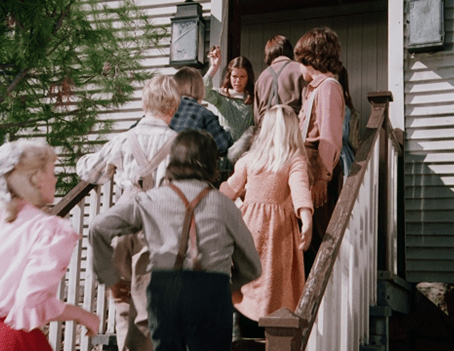
But Nellie keeps Albert behind, telling him he can’t be sure Mr. Singerman doesn’t have horns unless he looks. (Nellie of course will completely repent of her antisemitism later in the series.)

Albert suddenly makes Doubtful Face, because Mr. S never removes his hat.

After a commercial, David Rose gives us some “Ashkenazi” melodies in the Phrygian mode.
WILL: David always likes scoring the “ethnic” stories, doesn’t he?

Albert and Mr. Singerman are in the workshop, and Albert tries a number of tricks to get Mr. S to remove his hat.

But Singerman is even cleverer than Albert, and easily deflects his questions.
Finally, Albert takes a deep breath and just asks Isaac if the horn thing is true.
WILL [as MR. SINGERMAN]: “No. Eating cats on the other hand . . .”


Mr. S is not angry, and he explains to Albert that “we cover our heads to remind us that man is no big shot.”
WILL: Did they use the expression “big shot” in the Nineteenth Century?
DAGNY: No. Billy Joel hadn’t come up with it yet.

(They didn’t.)
Mr. Singerman says Jewish men always keep hats on because it makes them aware that “there is something above him.”
He laughs and says, “Horns! A mishegoss!” (Yiddish for “craziness.”)

Sensing, perhaps, that it would be insulting to press the matter further, Albert doesn’t ask again.
That night at dinner, Albert tells his family what happened.
Pa and Ma laugh at the idea of Jews having horns. They don’t seem too concerned about it.

But Laura, who isn’t laughing, says, “I don’t know why you have to spend so much time with that old man.”
WILL: She should talk!
DAGNY: Yeah, she’s Queen of the Old-Man Besties.


Laura goes on to say Albert’s friendship with Mr. Singerman is making both her and Albert unpopular at school. “Nobody likes Jews!” she says.
DAGNY: Now that Mary’s gone, she has to be the racist one.


Pa snaps at her, saying, “So then, rather than be made fun of, you go along with the rest of them and dislike someone just because they’re a Jew?”
WILL: Do you think Landon did this one as revenge when a tabloid reported he was Jewish?

Michael Landon really was bullied as a child for being Jewish, a fact that surely informs this entire episode, even though he didn’t write it.
Laura starts to protest it isn’t about disliking anybody, but Pa says, “Half-Pint, if you don’t speak up to people, bigots, then you’re no better than they are. Worse, in fact, because you know that it’s wrong and you allow them to think that you feel the same way they do.”
WILL: People have been speaking up to bigots for the past ten years. It’s only made them worse.

Then Pa looks down in disgust and says, “Finish your supper.”
DAGNY: So, there are people who deny that this is a liberal show?
WILL: You’d be surprised.

You can tell from Laura’s face as she absorbs this that she won’t be on the dark side for long.
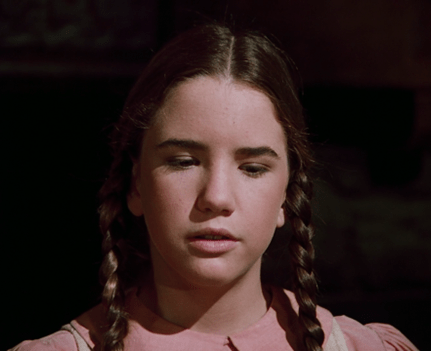
Then we cut to a jowly fellow, though not necessarily a jolly one, driving a wagon down the shortcut into town.

Correct me if I’m wrong, but I think this is one of the random Grovesters who cheered for Nellie in “The Race.”

And who comes running along behind it but the Care Bear herself!

I’m sorry, but I have more affection for her after last week’s episode. Even more, I should say.

Carrie doesn’t get anything to do in this one, but I’m sure you’ll agree after last week, she’s earned a break.
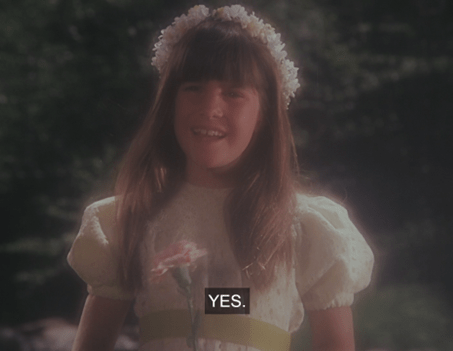
Laura and Albert come walking behind her, with Laura saying she’s not really an antisemite, she was just having a bad day.

Albert says no worries, and then in a nice exchange, Laura says:
LAURA: Thanks.
ALBERT: For what?
LAURA: For not hating me.
ALBERT: Oh, hate is for people like the Larrabees. I got better things to do.

Good advice. I’ll try to pay attention to it myself.
You’ll never get me to like “Circus Man,” though.

They bump into Nellie and Willie, and Albert says, “I just wanted to tell you, Willie was right! . . . Mr. Singerman . . . he does have horns!”
Nellie, who actually rarely truly believes her own bullshit, is alarmed at this.

Albert tells them Mr. S’s horns are tiny under his hat, but they expand when he takes it off.
Then Albert offers to show them after school.

DAGNY: I like this one. I love the ones where they humiliate someone who deserves it.
WILL: You’ll be happy when Kezia comes back this season, then.

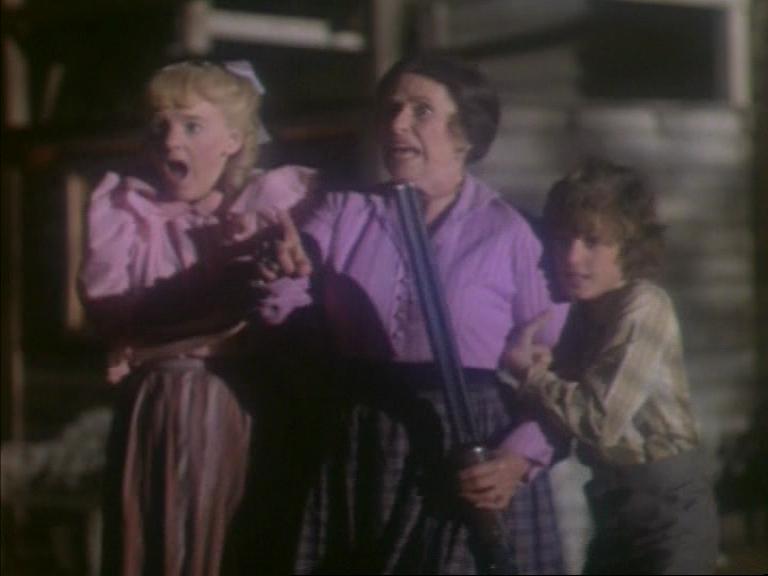
Well, after school, Albert sneaks Nellie and Willie up to Mr. Singerman’s house.
Along the way, he lays on the terror talk a bit.
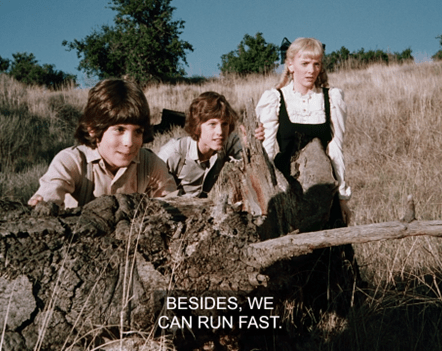
And when Nellie approaches the door, Laura pushes some deer antlers through it, resulting in the Olesons running away screaming. (Those two big hams Alison Arngrim and Jonathan Gilbert are clearly trying to outdo each other.)


(And then David Rose tries to outdo them with some Psycho-ish swooping in the strings.)

Later, we see Mr. Singerman and Albert working together on a coffin.
WILL [as ALBERT, conversationally]: “You know, I used to live under a coffin factory. . . .”

[UPDATE: Reader Leslie notes that with Jewish characters, a coffin shop, and Albert, this story almost seems intended for the big-city Winoka cycle. It’s a persuasive theory; I wonder if the order of the stories was shuffled around before production for some reason?]
Albert complains that the work has been harder because of Isaac’s insistence on not using nails.
DAGNY: No nails? How does he keep it together?
WILL: Wood glue.
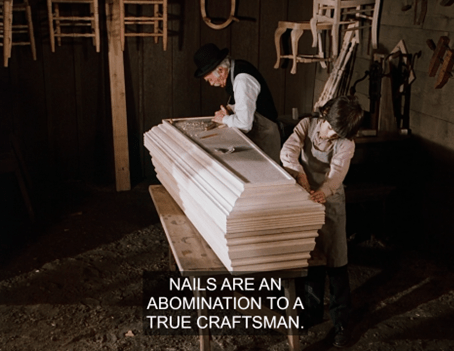
Singerman gives Albert an inspirational lecture about working hard.
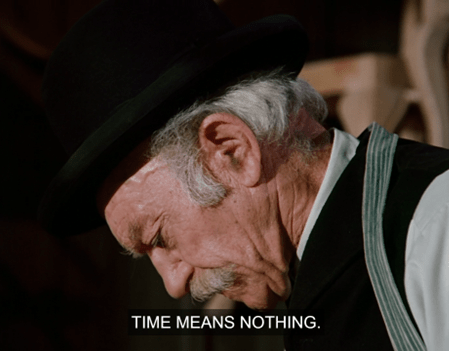
Albert notices the old man is crying. (Personally I didn’t find it that inspirational. . . .)

Mr. Singerman says in his family, the coffin-makers always cry.
Albert says he can’t understand crying when nobody’s even died.
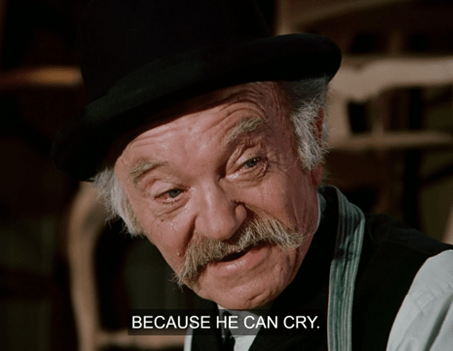
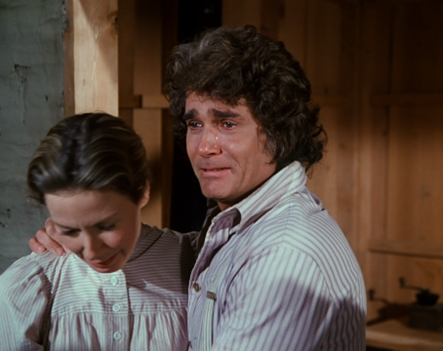
Isaac says, “Some men don’t cry, because they fear it’s a sign of weakness. I was taught that a man is a man because he can cry.”
(I think we all can agree Michael Landon added that line himself.)

Then Mr. Singerman walks across the room and picks up guess what – the nut!

He takes Albert out to plant it in a clearing between a bunch of oak trees.
DAGNY: I guess it wasn’t a chestnut.

Singerman says only a schnorrer takes something without giving anything back in trade. He’s very interested in the etiquette of charitable transactions, isn’t he?
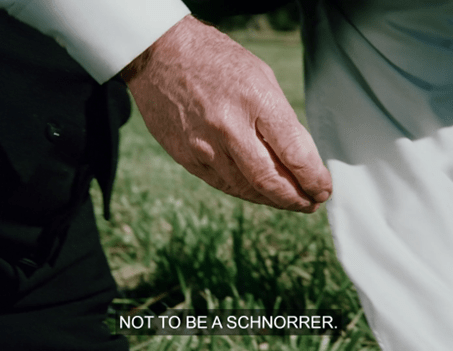
He says because he uses trees in his work, he must plant some as well.
Then he has a heart attack!
DAGNY: Oh my God, Mr. Cinnamon!

He breathes through it, though, and then seems embarrassed Albert saw it happen.
He even makes a joke.

Albert seems skeptical, but goes home, and as we cut to the Larrabee residence (the Larrabee Lair? the Lair-A-Bee?), David’s music crescendoes from worried-sounding to downright chilling.

Zeke Larrabee is a-sittin’ on the front porch, a-eatin’ an apple. (Red Delicious. It figures.)

With a heavy Hollywood Western accent, like his father’s, Zeke yells, “Hey, Lem, look who’s here!”

For he has spotted Albert taking a shortcut through their back yard. Seems unwise.


We’ve never had much indication where Jud Lar[r]abee might live, but now we can deduce it’s between the Little House and Singerman’s workshop.
Unfortunately, since we’ve no idea where the shop is, that doesn’t help us much.

Zeke makes racist comments and points out to his brother that Albert is trespassing.
That night, Albert returns home in the middle of dinner, beaten and bloodied.

“Albert! Land sakes, what happened to you!” Ma says. (Her first line of the episode, I believe, and practically her last.)

Albert tells them what happened, but surprisingly he ain’t too upset about it.
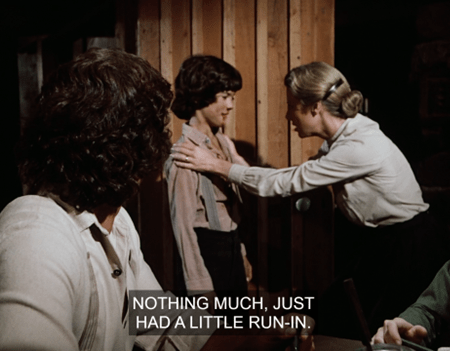
I’m also surprised they started dinner without him.
Next, we join an Old Cat game in front of the school, already in progress.
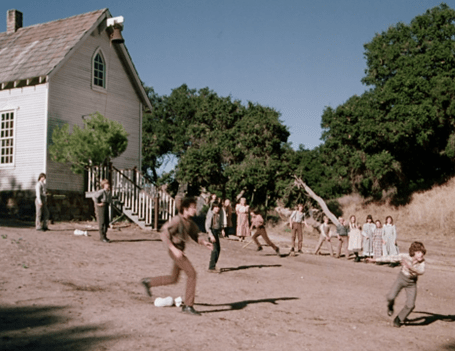
The Non-Binary Kid, apparently the umpire, calls a play (?) in Albert’s favor.

Zeke questions the call, and Lem quickly turns the conversation to race.
They move menacingly towards Albert, but Laura leaps forward with the bat and threatens the bullies.
DAGNY: That’s more like it. Crack some skulls, Laura!

For good measure, she shouts that she’s a “Jew-lover” herself.
WILL: I am Spartacus!
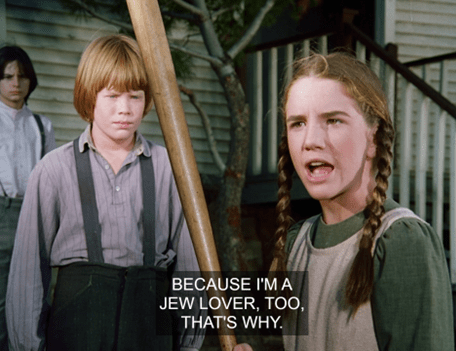
Making snarling faces, the Larrabee brothers skulk off.

Clearly this incident has had a major impact on the little girls of the class. Good for Laura.

Albert thanks her, and she says, “You were out, you know.” (The Non-Binary Kid should grab a bat and threaten to brain her with it.)


Meanwhile, at Doc’s office, Isaac Singerman is being examined.
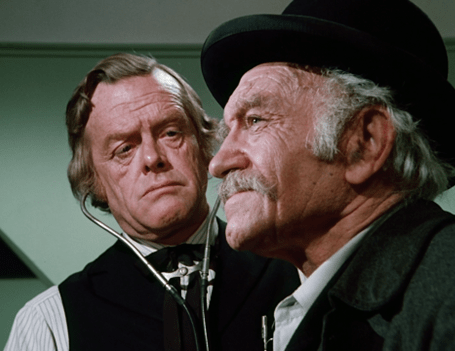
WILL: Do you think all these actors were doing clinical trials for eyebrow-growth serum?
DAGNY: Yeah. It was like The Peanut Butter Solution.


Mr. Singerman asks for the bad news.
DAGNY [as DOC]: “You have ten minutes to live.”

Doc tells him he has a heart condition, and he’s like, wow, no shit, Hiram.

Doc encourages him to retire. Singerman says he’d eat pork first.

Singerman gives Doc a cute patronizing slap on the cheek. I wonder if he and Amy Hearn would get along?


DAGNY: Has anyone ever touched Doc’s face before?
WILL: Kate Thorvald.

WILL: This guy’s crotchety ways probably remind him more of Mr. Hanson.
DAGNY: Yeah. And his eyebrows.

In a curious transition, then, we see and hear Isaac praying in Hebrew, with lighted candles around him.

Albert is there, watching intently, or maybe intensely. No, intently.
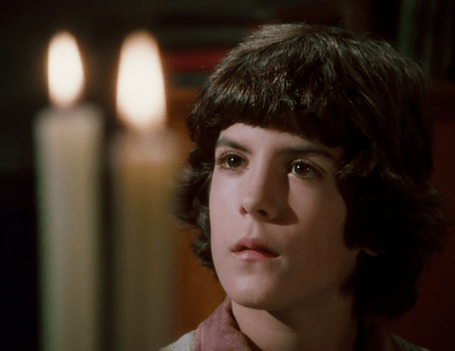
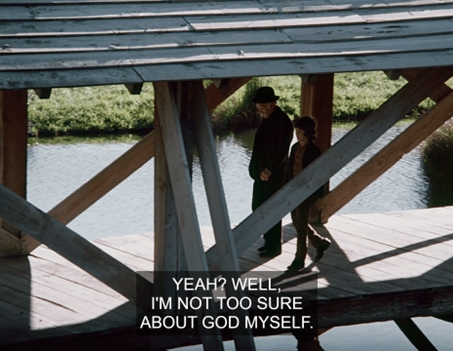
Later, the two cross the Old Rustic Bridge as Mr. Singerman explains his Sabbath observances to Albert.
Albert says he probably believes in God, but finds Him to be cruel and capricious. (Paraphrase.)
Then the two launch into a discussion of theodicy – the paradox that an omnipotent God would allow evil to exist on Earth.
Isaac gives the classic answer to this, which is that evil must exist in order for human beings to freely choose good.
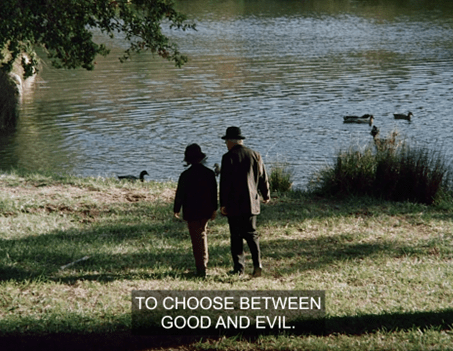
John Milton, Mary’s favorite poet (that she didn’t date), wrote this exact argument into Paradise Lost. (It might be Satan who makes it, though.)

“I reckon I never thought of it that way,” says Albert. (That sounds less like Milton.)
They stop to watch the ducks paddling on Plum Creek.
DAGNY: Another great Landon shot. It’s like a Bob Ross painting.


Isaac tells Albert never give up trying to find the meaning of life. “Keep asking,” he says. “Keep searching, Albert.”
WILL [as STEVIE WONDER]: “Keep smiling! Keep shining!”
That night, when Mr. Singerman is lighting a fire (in the stove, unlike some people, Lansford Ingalls), he suffers another attack.

He manages to make it to his rocker.
He must feel better the next day, though, because we see him driving with Albert across that same old bridge.
Mr. Singerman tells Albert they have to make another coffin, because “Dr. Baker is going to lose one of his patients.”
DAGNY: So? That happens every three days on this show.


Albert asks who the dying person is, but Isaac will only say it’s “a very wonderful person.”
WILL [as MR. SINGERMAN]: “Harriet Oleson.”

At the Mill, Carl the Flunky and Mustache Man are stacking boards whilst Charles and Jonathan Garvey help Mr. S with his purchase of wood for the coffin.
Singerman has fun being picky about the wood, which he says is “one of the pleasures of the old.” Reminds me of Mrs. Whipple, that does.


Then he tells Charles he wants to close his account since he’ll be traveling soon. Charles asks if he’ll be seeing his son, and he replies, “Older relatives first. My son eventually.” (There’s elegance and wit to the writing in this one.)

They go into the Mill office (who exactly owns it now?), and Mr. Singerman tells him Albert has been a wonderful worker and person. “You should be proud,” he says.
Charles smiles, eating up the compliment.
WILL [as CHARLES]: “I know. He raises one hell of a cow, too.”

Then we see Albert and Mr. Singerman finishing the coffin in the woodwright’s shop.
Mr. Singerman is singing a song, but I don’t know it.

Albert goes to get another carver, or whatever, and when he comes back he finds Isaac, collapsed.
DAGNY: This part is just like Steel Magnolias.
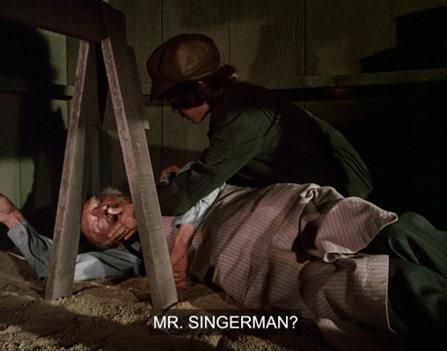

To terrifying scales and trills from the piano, Albert rushes to get help!
WILL: David!!!
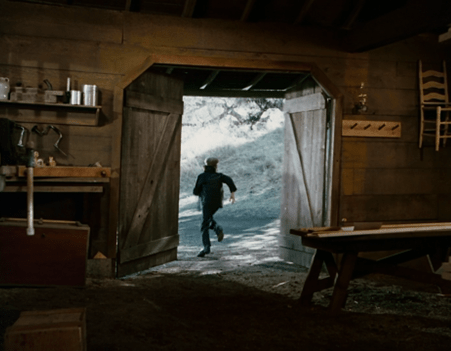
After a final commercial break, we see Doc, Albert, Laura and Charles at Mr. Singerman’s house.
WILL: Now this music sounds like it’s from Fargo. The movie, I mean.
DAGNY: It does.

Charles goes into the bedroom, where Mr. S is still alive. Charles holds his hand.
WILL: This might be the oldest person Charles has ever been fatherly to.

Mr. S asks Charles to send his most meaningful belongings to his son after his death.
Then he tells Charles he loves Albert like a son too. Seems intense for a relationship that’s probably only existed for a month. But like I said, that was one hell of a whistle.

Charles sends Albert in, and David Rose gives us the most tragic arrangement of his theme to date.
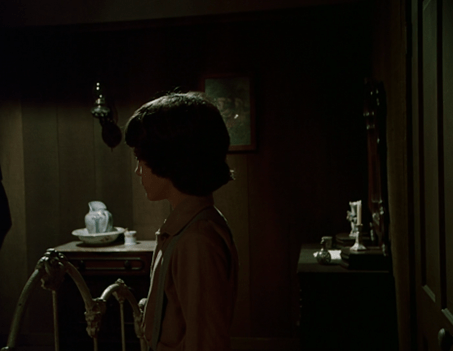
DAGNY: I wonder if Melissa Gilbert was mad Albert got his own theme. Not many characters have them. I think Mr. Edwards was the only one.
WILL: Winoka had its own leitmotif.
DAGNY: Yeah, that made sense. The town was its own character.

Not knowing the best way to act around a dying person (though I suppose no one really does), Albert moves to the bedside.

Mr. Singerman speaks of death with a frankness that Albert finds hard to bear.
They have one more brief existential conversation, then Mr. S tells Albert he must finish the coffin alone. A pretty heavy request to lay on a ten-year-old.
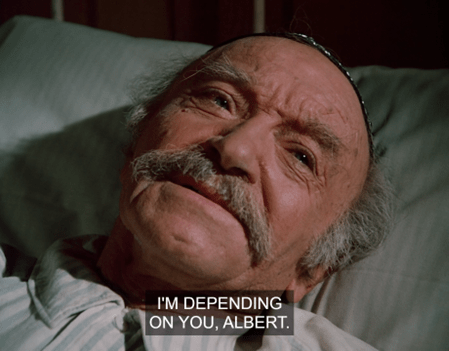
Albert nods, kisses the old man on the cheek, and gets up to leave.
But Isaac stops him, waggling his finger impishly and saying, “No nails. . . .”
WILL [as ALBERT, sobbing]: “Just wood glue! . . .”

Albert manages a smile through his tears.

He walks out, and keeps on walking right out of the house, surprising Doc.

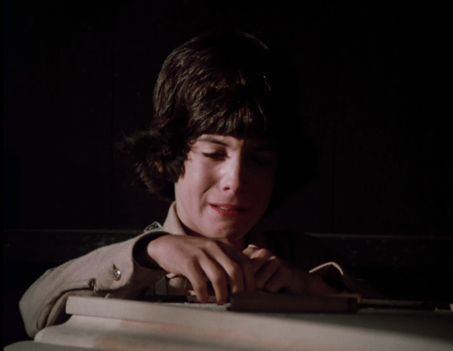
We cut to Albert working on the coffin at night.
DAGNY: So does he inherit the woodwright’s shop?
WILL: I don’t think so. I’m not sure he ever shows interest in woodworking again, actually.
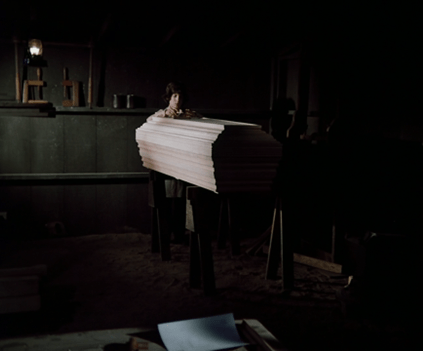
Pa comes in quietly and says, “He’s gone.”
Albert does begin sobbing then.
DAGNY: I love when Albert cries. He’s the best crier on the show. Even better than Landy, I’d say.
Finally, we see Albert planting another acorn by Mr. and Mrs. Singerman’s graves.
Albert smiles at the grave with his cruel sharp teeth, and then Voiceover Albert sums everything up for us.

DAGNY: Voiceover Albert! I bet Gilbert WAS pissed about that.

And on this sad note, I say to you: Bum-Bum-Ba-Dum.
STYLE WATCH:
WILL: Willie has a new outfit.
DAGNY: He must have grown.
The Midsommar Kid also has a new costume, possibly for the same reason.

Mr. Singerman wears a very fancy yarmulke.
Albert wears a beautiful jacket by Mr. S’s grave.

Charles appears to go commando again.
THE VERDICT: Admirably complex and featuring a sparkling performance from John Bleifer, this one is lovely, if a little subdued to hit all-time-classic status. The cinematography is beautiful, as is the writing; and Matthew Labyorteaux is great, as always.
Happy holidays, everybody.

UP NEXT: Blind Man’s Bluff
 Walnut Groovy
My literary criticism professor demonstrated reader response criticism to us by proving The Muppet Movie was the greatest movie ever made. I didn’t need much convincing. The death of Jim Henson is still I think the only celebrity death that has elicited my actual tears (I may have also cried when Adam Schlesinger died; I can’t remember…I was super bummed). I mean Kermit himself actually died, it felt like. I did not cry when Michael Landon died a year later, but I had had mental prep time for that one.
I read comments from Paul Wolff once, that Landon was surprised to learn he was Jewish (didn’t Wolff write Little Girl Lost also?), and then encouraged him to write the Jewish aspects into The Craftsman. I seem to recall he remembered Landon talking about how weird it was that he was such an icon of the Western genre as a Jewish man, and he was apparently excited to have a storyline about a Jewish character.
LikeLiked by 2 people
i’ve cried over a handful of celebrity deaths so I can relate. The ones that come to mind are John Lennon, George Harrison, John Ritter, & Jimmy Stewart. There may have been others, but those are the ones I can recall. When it’s time for Ringo and Paul to go I’ll probably have to be put in a straight jacket for a year. Jim Henson was one of those people that just seem to be from another world. And he made this world a lot better place while he was here.💁🏻♀️
LikeLiked by 3 people
Whew! You had me worried, but “Little Girl Lost” was Paul W. Cooper. Don’t get me started on The Muppet Movie; I like most of the Muppet entertainments, but TMM is the only one that’s truly sophisticated in a grown-up way. I actually wrote a review of it myself once – now lost to history – where I talked about its themes of loss of innocence, and what a person sacrifices when they give themself over to a life making art. The ending always makes me cry (and then laugh again immediately). I’d rate it up with the many many movie masterpieces that wonderful decade produced; I love it!
LikeLiked by 1 person
i’ve always liked the humor in this episode and Mr. S’s character, but it’s never been one of my favorites. I think I’ve come to like it a little bit more as I’ve gotten older. Love the Bob Ross touches. As someone who had to read the Bible a lot growing up, I always found it so confusing. I feel like it was full of so many contrary things. But I found out now I’m older that everyone interprets it differently, depending on what language & who was transcribing it. (makes me happy to be an atheist)! Since I’m not sure if you’re going to put another one out before the holidays, have a merry Christmas & a happy new year (in keeping with the situation). (I just love the quotes From a Christmas Carol☺️)
LikeLiked by 1 person
Thank you and the same to you! You know, when I was young I always preferred the horror stories and the funny ones, but as I’ve become old I enjoy stories like this better too. Despite some accusations I’m not really anti-religion, but the things I like are the things Little House celebrates about it: community, believing in something bigger than yourself and your own wants, forgiveness, love, being helpful to your neighbor, and trying to understand him rather than immediately judging him or wanting to snuff out his beliefs/way of life because they’re different. I like how Charles points out in “Freedom Flight” his philosophy that everyone is a child of God. Plenty of religious people also view their faith this way; but plenty don’t.
LikeLiked by 1 person
😎❤️
Get Outlook for iOShttps://aka.ms/o0ukef
LikeLiked by 1 person
This is an episode I only got to watch once when I saw the show on TCM, and then a second time years when I found the show on Prime. No idea why I postponed a rewatch for so long, but probably because having watched it once meant it didn’t impact me as much as the ones that I got to watch multiple times. And yet a lot of it was still fresh in my memory, Albert’s friendship with Mr. Singerman, the Larrabee and Oleson kids claiming that Jews have horns and Singerman’s amused reaction to Albert’s questioning about it, and he and Laura pulling a prank on Nellie and Willie with antler horns. What stuck on my mind the most was Singerman’s character though, who somehow reminded me of Gepetto, probably because to his woodcraft occupation and kindly old man characterization.
It’s a pretty solid episode as far as anti-bigotry stories go, and I think it holds up well from a 21th Century perspective; some older productions that seeked to tackle bigotry and preach respect to marginalized groups ended up falling on stereotypes or dated ideas of how to address the theme despite their intentions, but this one seems to have avoided that as far as I could see.
Larrabee’s attempt at rationalizing his antisemitism reminds me of how most displays of anti-Jewish rhetoric are usually said to have a “motive” to their hostility, but they’re usually either excuses or conspiracy theories about shady secret societies controlling the media, economy or the “space laser that’s causing the fires in California”! At the end, they’re all excuses to pick on people who don’t match the same profile as those of your community, whether ethnically or religiously.
LikeLiked by 2 people
The “sad, sweepingly Slavic theme” at the opening of this episode is the classic Jewish lullaby “Oifn Pripetchik” (which means “On the Hearth” in Yiddish). The first few bars vary somewhat from the melody but then it quickly becomes the actual tune of this song.
The song is about children in a small schoolhouse, learning the Hebrew alphabet from their teacher.
Wikipedia says: “By the end of the 19th century it was one of the most popular songs of the Jews of Central and Eastern Europe.” So it’s an appropriate choice for the Little House time period.
You can listen here (instrumental):
and sung beautifully here:
I didn’t go back to rewatch the episode but I believe this melody is used again later as well.
I sang this song to all of my children at bedtime when they were little.
LikeLiked by 1 person
THANK YOU SO MUCH! I will update the post! ☺️
LikeLike
Glad to help!! There are other Jewish details I can fill in a little later.
LikeLiked by 1 person
Thank you. I truly appreciate it. 🙂
LikeLike
Big Shot is Billy Joel’s acknowledgement of the impact of Marty McFly on vernacular in the 19th century. (*Obviously* Marty’s travels warped the shape of time, and the DeLorean’s wake is the cause of the instability of GroveTime – and likely the cause of spatial distortions like the appearance of mountains on the prairie.)
LikeLiked by 1 person
Quite obviously! 😀 😀 😀
LikeLike