
How Do They Get the Body Back to Walnut Grove, in a Backpack?; or
He Was Just Doing His Job, Chuck!
(a recap by Will Kaiser)
Title: The Odyssey
Airdate: March 19, 1979
Written by Carole and Michael Raschella
Directed by Michael Landon
SUMMARY IN A NUTSHELL: This week’s summary is a direct quote from Olive Kaiser.
“Charles takes a kid who’s dying of cancer away from his mom, then magically takes him to California with no money.”
Couldn’t have said it better myself, kid.
RECAP: First things first: I saw last week that the redditors recently did a poll to create the perfect Little House alphabet.
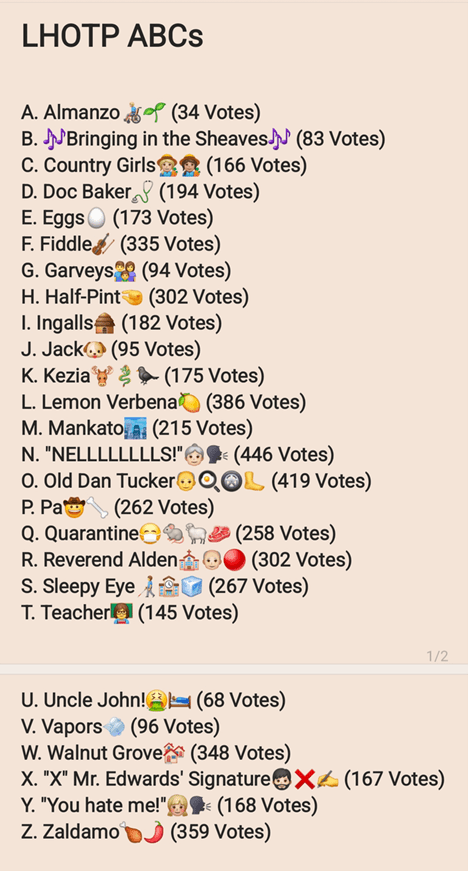
Excellent choices all. (And the emojis are hysterical.)
Okay, Season Five finale, all hands on deck!
We begin with a shot of Plum Creek flowing fast.

A voice on the soundtrack is giving us a mythological origin story (just like the opening of The Dark Crystal).
This OS, however, is a myth from our real world. Whoever’s speaking is telling us the story of Homer’s Odyssey.

I’ve never read The Odyssey. This is a plus for you, reader, because the space I devote to it will probably be more like eight sentences than eight pages.
The Odyssey is an “epic” poem allegedly by the ancient Greek poet Homer.

Scholars today believe multiple authors may have contributed to the works of “Homer.” Even so, there’s a lot of lore about the supposed original Homer, much of which has mythological elements itself. (Some said he was descended from emperors, or even the gods.)
Homer is usually depicted as having been blind (just like You Know Who), but nobody really knows anything about him, including if he existed at all.

As for The Odyssey, people throw epic around pretty freely these days, but the term once referred to a genre of poetry involving long, multi-chapter stories about heroes and their adventures, principally.
To make a modern comparison, epic poems are less like TikTok snippets (that would be William Carlos Williams) than like Marvel movies, though unlike Marvel movies, some epic poems are actually good.
Epic poetry was pioneered in ancient times, by which I mean classical antiquity, by which I mean history before the year 500 A.D./C.E. or so in our modern calendar.


The invention of proper clothing in the year 501 brought the era to an end.

The Odyssey and Homer’s other greatest hit, The Iliad, are among the most famous, though other writers would continue using the epic form for centuries after.

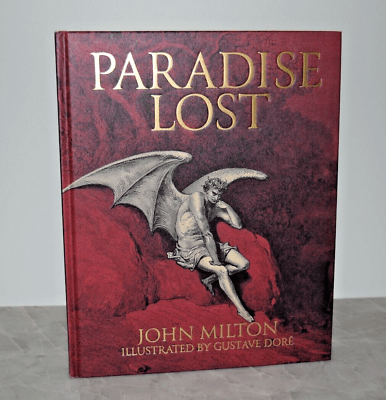
Paradise Lost, Mary’s (supposed) “favorite book,” is John Milton’s famous crack at the genre from the 1600s. (Milton was also blind like You Know Who.)

Milton kept the longness and dullness of the ancient form, but dumped the Greek mythology in favor of Bible stories. (Paradise Lost is better than it might sound from that description. Satan is actually sort of the lovable antihero; it’s a pretty weird poem. I once won a prize for an essay I wrote about it!)
I guess Christopher Nolan is making a movie out of The Odyssey now, with Matt Damon as Odysseus.
Personally, I’d rather rewatch Jason and the Argonauts or Clash of the Titans, but never mind that.

Anyways, back to our episode.
The voice, which sounds like a kid’s, tells us that Odysseus made an enemy of “Neptune, the sea god.” (Not sure why he uses the Roman name rather than Greek – should be Poseidon, right?)
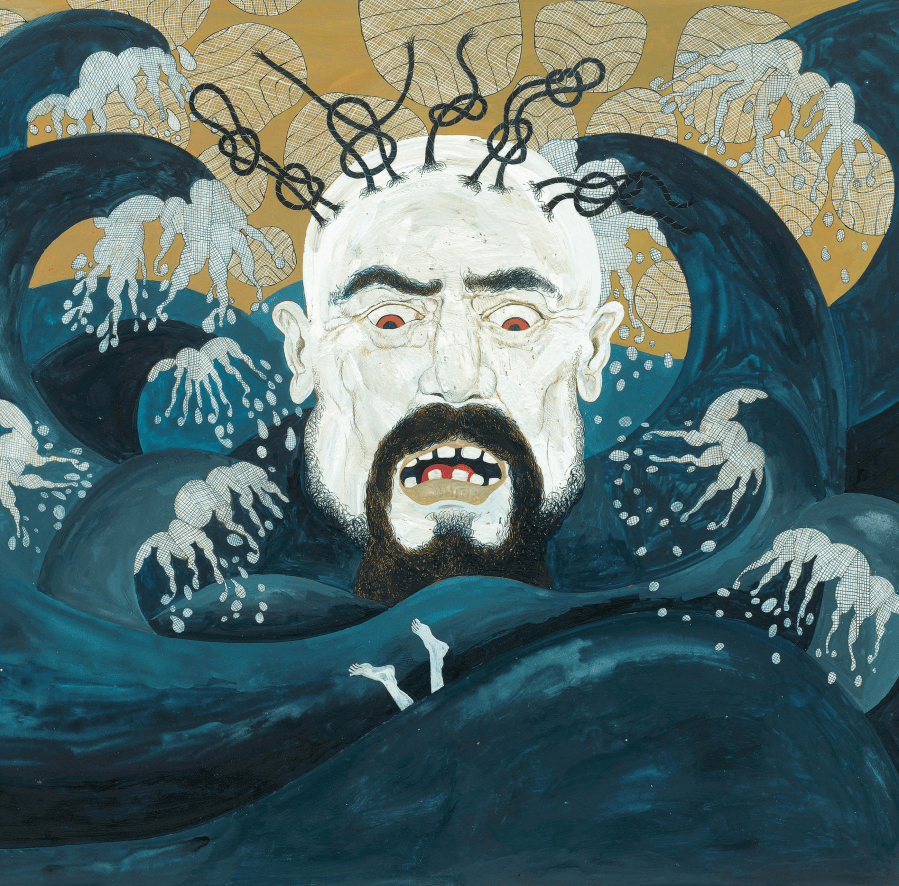


Well, Odysseus conspired with the wind god Aeolus to escape from sea storms.


Aeolus gave Odysseus a bag containing all the winds in the world, or the relevant ones anyway, which also were somehow his sons. (There’s no point in trying to explain it. Ancient times!)


This should have given O mastery over the seas, but his fucking idiot crew opened the bag and let all the bad winds out.


Apparently Albert is in the audience for this story, because we hear him remark that with friends like that, you wouldn’ta thought they’d win the Trojan War, would you.

(He clearly has read the recap of the events leading up to The Odyssey.)
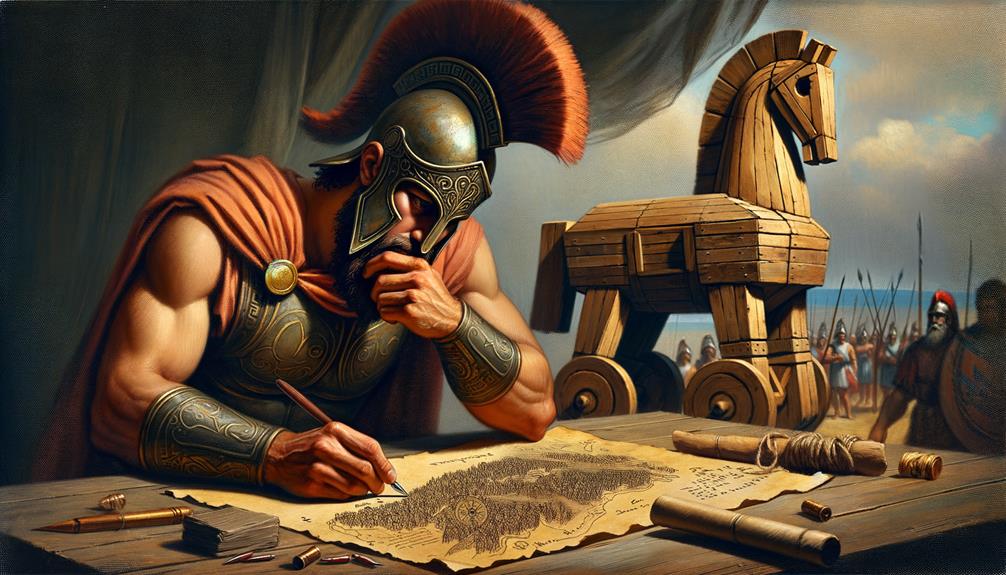
Well, the other voice continues, everything went kittywampus, and Odysseus’s fleet wound up in“the land of the Laestrygonians” – “cannibals” who ate the sailors for supper. (First reference to cannibalism we’ve had in a while.)
(It’s debatable whether the Laestrygonians were cannibals, since they were giants and probably not the same species as humans. But they did eat many of Odysseus’s sailors.)


The camera has been creeping through the forest for a minute or two by this point, and we see a boy or young man (fourteen or so?) sitting in front of an easel (paintin’-type) with Albert and Laura.

Laura asks if that’s the end of the story, and the kid says knowledgeably, “Oh, no – he eventually made it back to his home in Ithaca.”
OLIVE: Who is this know-it-all?

“It took him ten years, though,” the kid adds sadly, as if Odysseus was a close friend who gave him this story firsthand, on his deathbed.
OLIVE: Nice little rat mustache.
DAGNY: I was going to say the same thing.

Still sounding wistful, Rat Stache says, “Wish I could do it.”
Albert replies, “Get eaten by cannibals?”
ALEXANDER: Albert would make a good Walnut Groovy commentator.


“No,” Rat Stache says, as we fully absorb the painting he’s in the midst of creating. “See the ocean.”
It is a landscape, or I suppose I should say a seascape.
DAGNY: He’s like Teen Bob Ross.
OLIVE: Yeah. His hair’s on the way.
ROMAN: This is probably where he got his squirrel.


Rat Mustache says his dad had wanted to take him to see the ocean, implying that the dad is no longer alive.
Then Rat Stache laughs to himself, “Well, there I go dreamin’ again!”
OLIVE: Yeah, get a life.

Laura and Al take off, and Rat Stache looks at his painting, which I think is pretty good as far as such things go.

Then he whispers, “I’ll do it someday, Pa.”
At first I didn’t notice, but there are seabird noises dubbed over the ocean painting, which I think is a nice touch.

Then we see Ratty at home in the evening, working on a different painting – another seascape.

DAGNY: Is he painting that scene from The Little Mermaid?

Ratty’s mother, a blonde woman in a sort of macramé cape, tells him it’s almost bedtime.

But Ratty is pondering the ways in which a small touch might transform his picture.
WILL: This is just like Mr. Turner, the story of the Victorian painter J.M.W. Turner.
ROMAN: Oh, I was thinking the same thing, Stepfather.
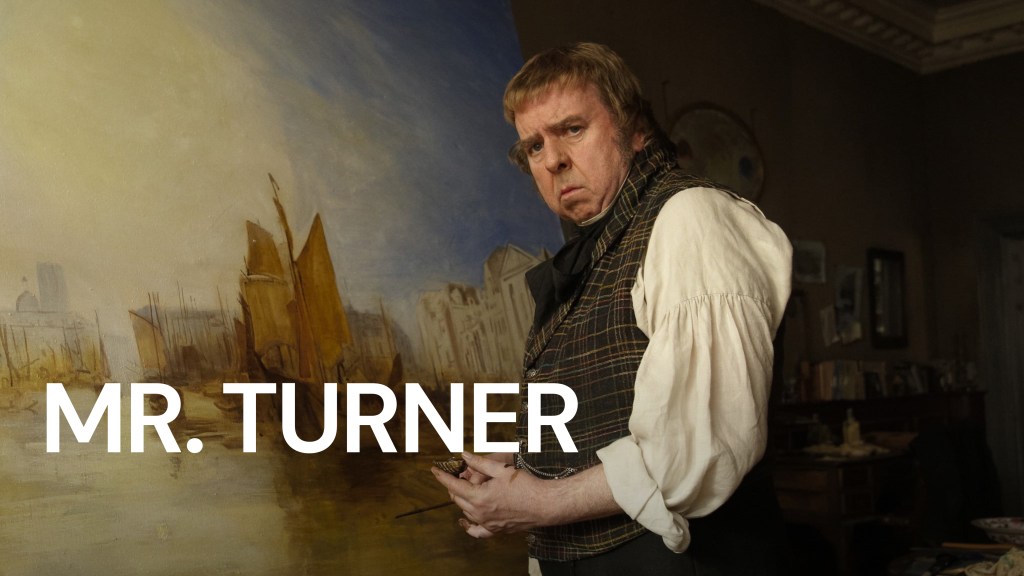
Finally addressing the kid by name (“Dylan”), the mom says it’s too late for him to keep working.
But she quickly caves and says she’ll make him some hot chocolate.
When she leaves the room, though, Dylan gets a serious nosebleed – “another” one, apparently.

His mom says he’s had so many nosebleeds lately, she wants him to see Doc Baker.

The mom helps the kid to bed, and the camera zooms in on the Little Mermaid painting.
ALEXANDER: He should have added the blood to the picture. It might be what it needed.
WILL: That’s what Mr. Turner would do.

Next we see Doc peering into a microscope.
WILL: He’s been using that microscope a lot lately.
ROMAN: He’s come far since knocking jars off the table to scare his patients.

Doc turns back to his patient. It’s Dylan, who’s got his shirt off.
OLIVE: Nudity!

Dylan is telling Doc how he’s sort of an artsy pansy-type who hangs out with girls and enjoys schoolwork. (Paraphrase. Don’t give me a hard time about “artsy pansy-type.” I was one myself. Still am! There’s no shame in it.)

DAGNY: Doc’s office is the perfect medicinal green. That’s what color it actually would have been in those days.
WILL: . . . Really? Says who?
DAGNY: It’s a well-known fact.

(There may be something to what she says, though its use in Doc’s surgery is probably anachronistic. I’m sure Dags got an update about this exhibit from one of her Canadian public health listservs.)


Dylan answers a couple questions about his general health, which isn’t the goodest.
Doc claps him on the back and tells him to get dressed.
OLIVE: Whoa, Doc! Hands to yourself!

Doc steps out into his foyer to share his thoughts with Dylan’s mom.
WILL [as DOC]: “My diagnosis – he’s a wuss, just like John Junior.”
ROMAN: Yeah. [as DOC:] “Or J.M.W. Turner.”


Addressing the mom as “Mrs. Whittaker,” Doc observes that Dylan isn’t a very sporty or physical kid.

Doc asks if he’s been sick a lot lately, and the Widow Whittaker (try that one five times fast) confirms he has.

Doc rambles on for a while about how Dylan might have a specific disease, but he doesn’t say what it is.
WILL: Oh, spit it out, Hiram.
OLIVE: Yeah, Doc, stop speaking in riddles.


Still hemming and hawing, Doc mentions the disease used to be mistaken for “rheumatic fever.”

Sounding relieved, Mrs. Whittaker says, “But it isn’t?”
“No,” Doc says. He does not sound relieved.
ALEXANDER: . . . Does it turn out to be dehydration?

Doc says the only treatment for her son’s condition is rest, followed up with a death chaser.

For the disease is leukemia.
ROMAN: Did they really call it that then? Or would it have had an old-timey name?
WILL: Yeah, you mean, like, did leukemia used to be called “Horace McGillicuddy’s Disease” or something?
ROMAN: Exactly.

Leukemia was pretty well understood by the late Nineteenth Century, and had been known by that name since the 1840s. Innovations in the 1870s made the disease easier to detect by microscope.
Stunned, Mrs. Whittaker trembles with horror.

She’s Melinda Cordell, who was a regular on General Hospital as well as a sixties medical drama called The Nurses. She was also on Cheers and Quantum Leap and in the movie Bloody Birthday. (That last one, about killer ten-year-olds, is worth a look.)

Doc says he doesn’t know how much time Dylan has left, but it isn’t long.
Innocent Dylan comes out and says, “Did ya tell her to stop worryin’, Doctor?”
AMELIA: You don’t think he could hear that? He was ten feet away.
DAGNY: Oh, Doc’s curtain is soundproof.
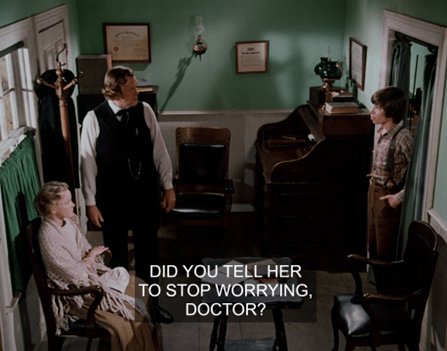
The Whittakers depart.
DAGNY: Cadmium green!
WILL: Now you sound like Bob Ross.
AMELIA: Yeah. Prussian blue, pthalo blue, titanium white . . .


DAGNY: They were obsessed with leukemia in the seventies and early eighties. There were a lot of scary TV shows about it.
WILL: I remember that.
It’s true. Susan Sontag even wrote about the phenomenon in Illness as Metaphor.

That night, at home, Dylan realizes something’s wrong – with his mom.

He says he doesn’t understand why he has to stay home and rest, and she snaps at him.
DAGNY: Her bun-piece is a little fake-looking.

Dylan calls her out on not sharing what Doc said to her.
AMELIA: Parents on this show always lie about Doc’s diagnoses.
WILL: Yeah. He probably puts a note recommending that on his invoices.
DAGNY: Or writes it in his weekly e-newsletter.
ROMAN: Yeah. Hiram’s Happenings.


“If something’s wrong,” Dylan says, “why didn’t Dr. Baker give me any medicine?”
OLIVE: He kind of looks like Justin Long, doesn’t he?


The Widow W, who communicates her suffering in this scene by moving her mouth around a lot (I’m not criticizing, it works!), says the only thing for Dylan’s condition is to rest.

“And then what?” Dylan says. “It goes away by itself?”
DAGNY [as MRS. WHITTAKER]: “In a manner of speaking . . .”

Well, Dylan gets it, and hugs his mom – to comfort her, not himself. (Already we can tell he is more mature than the typical violent, greedy, bullying, scheming, backbiting, candy-coveting, aggie-hoarding, injury-and-blindness-faking Groveland Elementary kid.)
OLIVE: Poor Dilly Bar.


It is a good scene. If you think you recognize “Dilly Bar,” it might be because we’ve met him before. Back in Season Three, the same actor played Sam “Uncle Sam” Delano, a friendly Italian immigrant child who had to watch his father die, murdered in a stream.
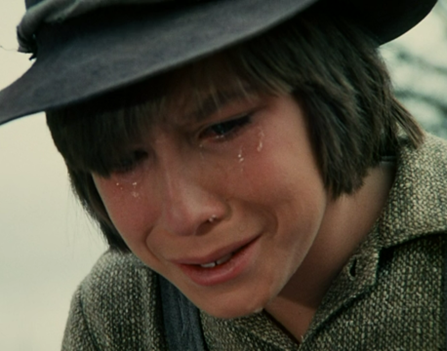
As a kid, Steve Shaw appeared on Barnaby Jones, The Waltons, The ABC Afterschool Special, and Three’s Company.

Later, he went on to become a regular on Knots Landing. (Speaking of Knots Landing and odysseys, Donna Mills was just on Doctor Odyssey this past month. Anybody watching that?)


Unfortunately, Shaw was killed in a traffic accident when he was only 25.
Well, he’s pretty good in this story, I think.
A theatrical glissando on the harp transitions us into the next scene.
WILL: Is the Last Unicorn going to appear???
We cut to the Big Oak in the forest.
WILL: I love when they go to this tree. They don’t use it very often. Mary sat in it once.


Dilly Bar is painting yet another seascape under the tree.
ROMAN: He cranks these out, huh?

Albert and Laura are keeping Dylan company again. (Andy must not like him.)

Dylan tells them if you’re quiet enough, you can hear the ocean wherever you are in the world. (Quite preposterous. You totally can’t.)

Then he quietly announces he’s making a trip to see the ocean – tonight.
DAGNY: Albert looks like a puppet there.

Dylan begins telling them the whole story.
WILL: He’s going cuckoo.
OLIVE: Is that the medical term?
ROMAN: Today it is. Then it was known as Horace McGillicuddy’s Disease.

Later, Albert and Laura discuss this plot setup as they walk through the (beautiful) forest.

Albert declares a) he will not be telling the Widow about Dilly Bar’s plan, and b) he’s going to join him on the trip himself.
Fairly logically, Albert points out Dylan will need a streetwise guide to the Wild West, or he’ll never make it.

Also logically, Laura says they’ll never make it anyway.
But Albert won’t hear any arguments.
Back home, Pa is making a jigsaw puzzle – an elephant.
OLIVE: Oh, I love those puzzles!

Presumably it’s for Baby Grace, but Carrie I’m sure will also want it, and Laura will probably steal it, given her track record.

But actually, Pa immediately says it’s a birthday present for Carrie.
Except for Albert, who’s new on the scene and probably has no clue when his birthday is, we’ve had episodes built around the birthdays of all the other Primary TV Ingallses.
The time of year rarely matches that of the real-life family.
In “The Long Road Home,” set in October, TV Caroline forgets it’s her own birthday. (IRL Ma was born in December.)

In the September-set “To Live With Fear,” Mary ruins TV Charles’s birthday when she gets kicked by a horse. (IRL Pa was born in January.)


Pa’s horrific bungling of Laura’s birthday gift sets into motion the events of “The Music Box,” which takes place in an unseasonably warm February. (IRL Laura’s actual birth month!)

In “A Most Precious Gift,” TV Baby Grace was born in October. (IRL Grace Ingalls’s birthday was in May.)

And in “‘As Long as We’re Together,’” the family celebrates TV Mary’s birthday in Winoka – also in September. (IRL Mary was born in January – in fact, she and IRL Charles had the same birthday.)

I’ll admit, “The Inheritance” muddled things a bit by suggesting TV Charles’s birthday might have been in July; but we’ll just ignore that.
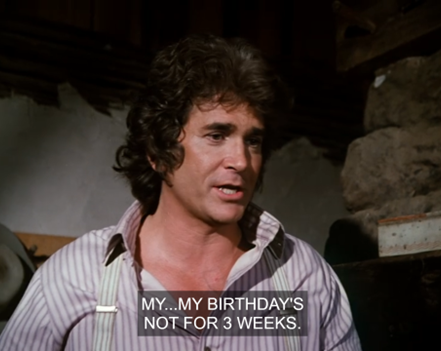

Pa asks Laura how work is going on a doll dress she’s been making. (Seems strange. We haven’t seen Laura play with dolls in a long time.)
[UPDATE: Logical reader Michelle points out this is likely a birthday present for Carrie. Sometimes I miss the forest for the trees. . . . Thank you, Michelle! – WK]

But Laura surprises him by changing the subject, asking, “Pa . . . what would you do if you had a month to live?”
Laura says she’s asking because it’s “a summer project for school.”
AMELIA: Sounds like a cheerful assignment.
WILL: It wouldn’t surprise me. Remember when the Bead asked them to say what they hated most about themselves?


Anyways, we can deduce from this that TV Carrie’s birthday is in the summer. IRL Carrie was born in August, but given the subsequent events of this story, I’m going to say it’s June of 1881-J.
Pa, who after all isn’t really much of a planner, says he never thought about his bucket list.
Finally, acknowledging up front this will be an idiotic answer to her question, Pa says, “I’d like to live long enough to see all my children grow up, be happy, have families of their own.”

He’s right, Laura doesn’t like that answer, but she lets it pass, saying, “Do you think they should try, no matter what?”
“Sure they should,” Pa says.
WILL: Did he say “Sure as shit”?
DAGNY: Yeah. “Sure as shit they should!”

Like today’s pollsters, scientific researchers, and others of that ilk, Laura has been careful to ask questions leading to the conclusions she wanted, and she exits, satisfied with Pa’s “organic endorsement.”

Late that night, Albert packs Pa’s severed-head bag whilst Laura writes a note to the family. She’s decided to join the boys on the journey.


Albert questions the wisdom of the note, but Laura says she’ll hide it in Carrie’s birthday presents so it won’t be found immediately.
“A girl on the trip,” Albert says, shaking his head.
AMELIA: Oh, grow up, Albert.

The Last Unicorn harp again brings us into the next scene.
It’s morning, and Carrie begs to open her presents at once.

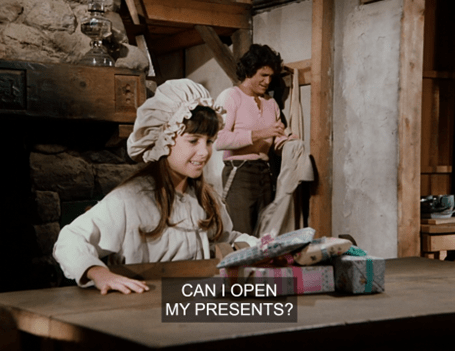
OLIVE: Pour some hot coffee over her head, that’ll simmer her down.
AMELIA: Yeah. She’s so greedy.
WILL: Yeah. Like when she was gobbling that pie and dropped it on the floor.
ALEXANDER: Yeah. “Oh, damn.”

Carrie finds the note.
ALEXANDER: I don’t find this very believable.
ROMAN: That they’d hide the note in Carrie’s present?
ALEXANDER: No, that Carrie can read.

Cut to Laura, Albert, and Dilly Bar clomping through the woods (to Albert’s theme). Though Laura said it was summer, they’re quite heavily dressed.

Laura is carrying what looks like a suitcase or briefcase, but made out of wood.

They happen upon a one-eyed, bearded peddler who talks a bit like a relaxed Popeye.

They tell him they’re trying to earn a little cash, but the peddler says, “Zacchaeus McCabe works alone.”
WILL: Laura should say, “McCabe? Where’s Mrs. Miller?”, ah ha ha heh heh heh.
ROMAN: Excellent, Stepfather.


Albert, who hasn’t lost his touch, goes into a full pitch, and Dylan explains they’re trying to get to a railroad station.


Zacchaeus McCabe, who isn’t friendly but also isn’t unfriendly, exactly, says riding the rails “ain’t a very likely place to find your pot of gold.”
WILL: Laura should say, “I found a pot of gold once, but it turned out to be fool’s gold. And once I told a guy about a woman’s coffin that was full of gold, and he dug it up, and then the dead lady’s husband killed himself.”
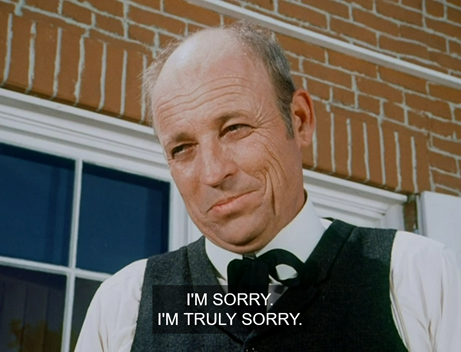


I know, she never found out about that last part.
Dylan begins coughing, and McCabe looks at him wide-eyed.
ALEXANDER [as McCABE]: “You got smallpox, kid?” I think they’d be worried if they heard somebody coughing like that.
I agree.

But McCabe looks at Dylan with compassion, saying he’ll take them to the train himself.
WILL: He’s a pirate with a heart of gold. He looks like Ted, actually.
(Those of you who read last week’s recap will recall Ted is Amelia and Olive’s “other dad” at their mom’s house.)

The actor is J.S. “Joe” Young, who appeared on Highway to Heaven and The Dukes of Hazzard. We’ll meet him again on Little House too. (Three times!)

OLIVE: The patch is a bit much.
WILL: Well, you would have seen some in those days. More than now, at least.
ROMAN: You don’t really think about people only having one eye these days.
AMELIA: They have pretty realistic prosthetics.
OLIVE: Yeah. Talk about catfishing.

Actually, I feel comfortable saying the patch is a witty reference to The Odyssey itself, since a cyclops features prominently in the story. (Not a very nice one, though.)
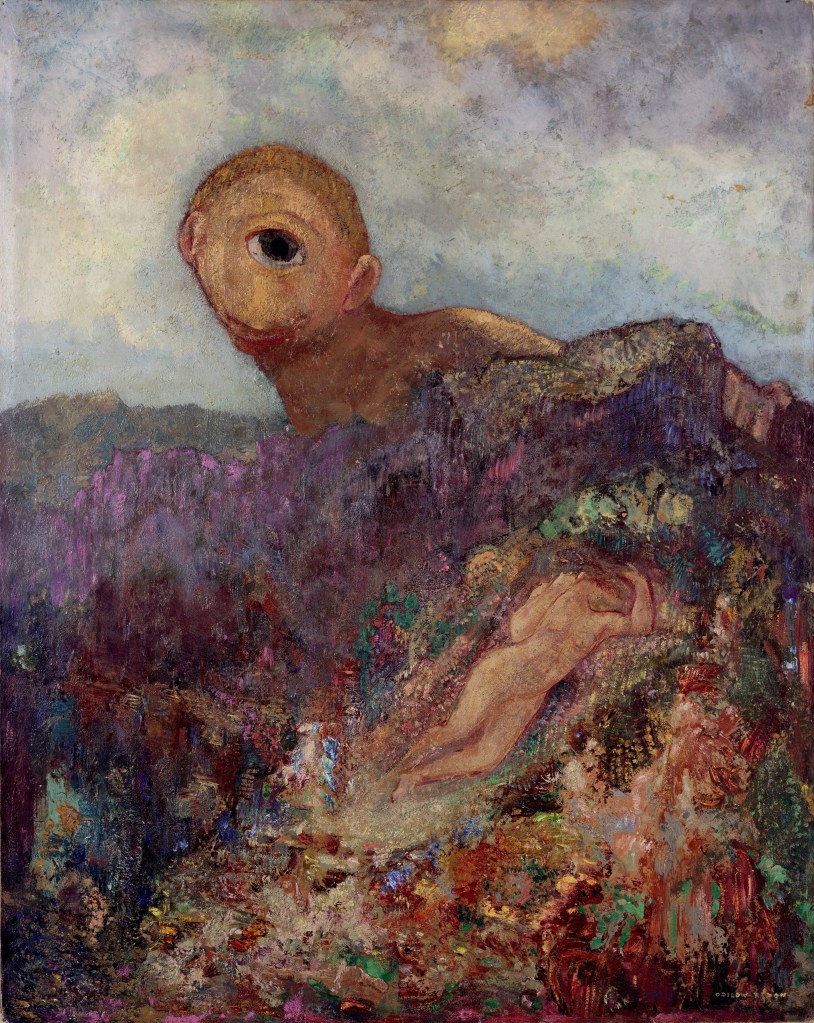

In a fun coincidence, that part of the adventure was also painted by none other than J.M.W. Turner!

If you squint, you can see the giant cyclops behind the mountain.

The cyclops is covering his face with one hand because Ulysses (the Roman name for Odysseus), the little chap waving to him from the boat, poked his eye out with a stick earlier that day. It’s a fun story.


We cut back to Walnut Grove, where Pa is sleuthing it with Dilly Bar’s mother.
AMELIA: That mom must feel terrible. He ran away and left a note with somebody ELSE’s parents? That’s gotta sting.

The room they’re in is filled with Dylan’s artwork.
AMELIA: How would he know what the ocean looks like?
OLIVE: From books.
AMELIA: Oh, all those great art books at the Walnut Grove Public Library?

OLIVE: Well, he probably saw a photo of the ocean in the newspaper.
WILL: Oh please. In 1881? They just had drawings. They weren’t even in color. I know today you kids are all addicted to your “Sunday funnies,” but things were different back then.
ROMAN: You have an uncanny understanding of youth culture, Stepfather.
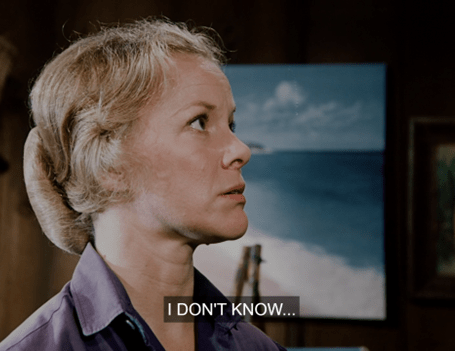
AMELIA: How did they afford the paints and canvases?
WILL: Oh, that’s easy. Nels gave them to him for free.

The Widow W realizes with horror the kids are actually trying to get to the ocean.
Charles can’t believe they’d pursue such a stupid plan.
ALEXANDER: Because they’re just like you, Chuck.

Making a decision, Charles then says, “Pack some things. Stay with Caroline while I’m gone.”
OLIVE: He kind of just told her what to do. I didn’t like that.
AMELIA: Yeah. Why does she have to stay in a different house?

Anyways, at a train station – it’s unclear where – we see people wandering around the Sierra Number Three train.
Amongst them are Johnny Cash Fusspot, who’s conducting a woman to the passenger cars, as it were har har.
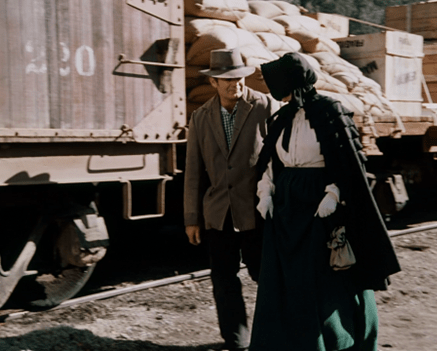
The woman is not J.C.’s Rather Beautiful Sister, so perhaps this is another sister visiting from elsewhere.

This sister looks like she may be in mourning. We know J.C. and Rather Beautiful survived the anthrax outbreak, but we didn’t see what happened to the Fusspot kids, Quincy and Not-Quincy. Here’s hoping they’re okay.


We’re distracted, then, by a scuffle between two rather alarming-looking men in a boxcar.
One, some employee of the railroad, carries a club and has grizzled sideburns as well as, I kid you not, huge sharp teeth.

The other, apparently a hobo, is making faces like Toby Noe.


The grizzled, toothy guy throws the hobo off the train.
ALEXANDER: I wish I had a hat like that with my name on it.

The guy’s hat is labeled Brakeman, but in fact, that’s this guy’s title, not his name. Chasing hoboes off trains was just a small part of a brakeman’s job. The main part was operating the train’s brakes, as you might guess, but it seems brakemen were sort of all-purpose workers, making sure connections were stable, performing semaphore in emergencies, etc.

Nobody says this brakeman’s name in this episode, but the credits tells us it’s “Snake.” He’s played by James “Jim” Driskill, who also appeared on Adam-12, Cannon, Wonder Woman, Father Murphy, and The Krofft Supershow.

(Those Krofft puppets freaked me out. I remember one appearance on The Barbara Mandrell Show that traumatized me.)
The camera pans down and we see the three kids are eavesdropping under the platform.
OLIVE: Albert’s not even hiding.
DAGNY: No, he loves this. He’s in his element. He’s back to his old street-urchin ways.
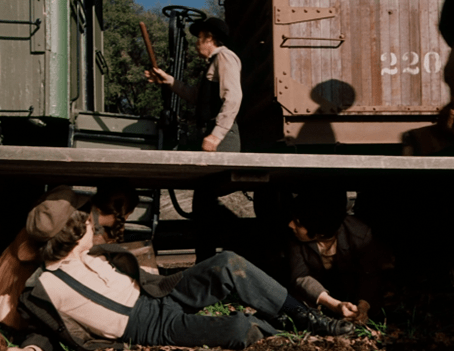
Meanwhile, Zaccaeus McCabe creates a diversion by crashing into the Brakeman carrying a bunch of pots and pans.
The Brakeman calls him “old man” and “you stupid old fool!”
ROMAN: He’s not really that old, he just has a big beard.

Once the kids have sneaked aboard the train, McCabe shitcans the nonsense.
Behind him, we see Bret Harper’s Underling Rod in a quick cameo appearance.

“Next stop, California!” Laura says as they settle in for the journey.
“And the Pacific Ocean,” Dilly Bar sighs.

OLIVE: I think this is a terrible plan. Going to the Pacific Ocean from Minnesota? They’ll never make it!
DAGNY: It’s just like that movie from when we were kids, Will, do you remember?
WILL: The Journey of Natty Gann?

DAGNY: No. It had Dudley Moore in it. It was really good. The plot was just like this.
Dagny is referring to Six Weeks, a 1982 film that critic Roger Ebert (a fave of mine) called one of the worst films of the year.
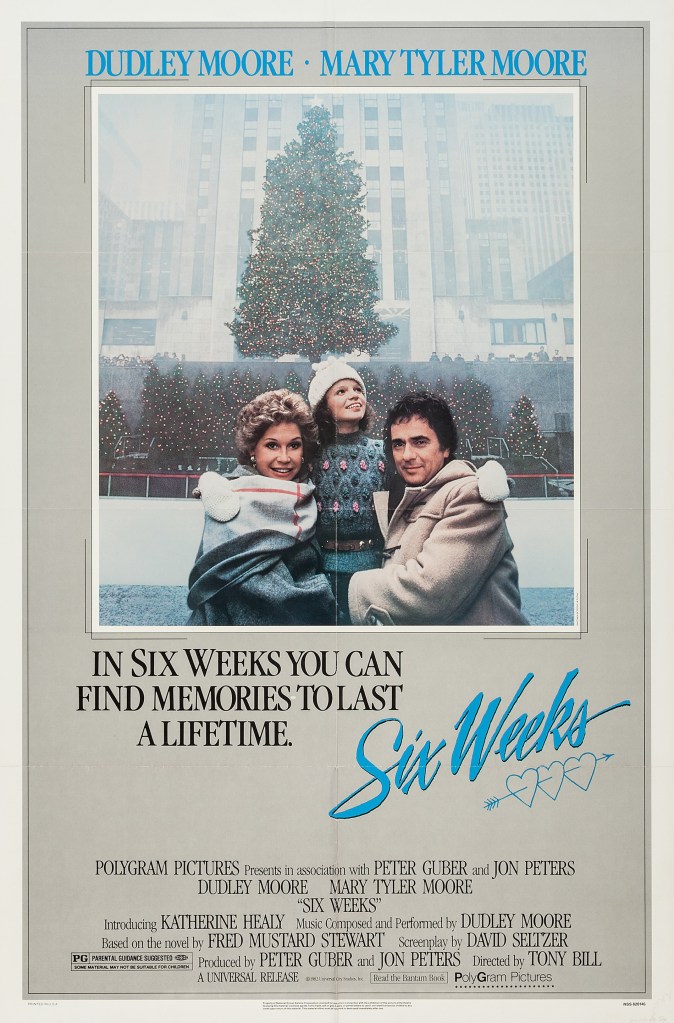
The plot is similar, only the guy who takes the leukemia kid on a bucket-list vacation is a philandering politician.
The movie came out after “The Odyssey” aired, but it was based on a 1976 novel by Fred Mustard Stewart, and it’s possible the idea for this episode was ripped off from that.
Interestingly, Fred Mustard Stewart was first cousin once removed (through his mother, Dee Jeanne Mustard Stewart) to the notorious war profiteer and suspected murderer Colonel Mustard.

But that’s another story. Urgent music from David Rose brings us back to the depot. We never find out where it is, but Springfield is the most likely bet.
Wherever it is, we see Carl the Flunky driving away.

Charles comes driving up in the Chonkywagon.
Charles approaches the stationmaster and asks about westbound trains.
ROMAN: How does he know which ocean they’re going to? They’re equidistant from Minnesota.
ALEXANDER: Actually, I’d think it would be easier to find a train going east. They were still building railroads to the west at this time.
It’s a good point. Plus Walnut Grove is closer to New York by a good 500 miles. But Charles’s instincts are rarely wrong about such things.

The stationmaster, who has a fake Irish accent, gets huffy when Charles suggests the kids could have slipped by him onto the last train.

(He’s Gavin Mooney, who appeared in 9 to 5 and on Police Story, Dallas, and Father Murphy.)
But the conversation’s been overheard by that not-unfriendly cyclops, Zacchaeus McCabe.

ROMAN: He should talk like Willem Dafoe in The Lighthouse.
WILL: Yes! [as WILLEM DAFOE, hysterically:] “Arrgh! Avast! ’Twas ye, ’twas ye!”

Once McCabe’s confirmed that Charles means the kids no harm (a nice touch), he tells him they were on the train that just left, which is headed towards a place called “Caldwell.”
Then he takes him to rent a saddle horse to pursue them.
WILL: Ted would totally do this. He’s very helpful. But he’d insist on going along.
AMELIA: Yeah. [as TED:] “Now, of course I’ll lead the expedition myself. . . .”

Meanwhile, in the boxcar, the kids are chillying down in the hay.
OLIVE: This is such a bad idea
ROMAN: I’m sure nothing will go wrong.

Dilly Bar is feeling weak, so Albert passes out some sandwiches.
Suddenly a man leaps into the car!

It’s the hobo we saw the Brakeman chase away at the beginning. He must have been hanging on to the caboose or something.
The hobo, who looks like a nasty customer at best, and very possibly a psychopath, hisses at the kids to stay away from him.

The three just stare at him. I wouldn’t know what to do either.

The hobo, whose name according to the credits is “Ferret,” notices they’re eating, and says, “Gimme them sandwiches.”
Albert, who is tough but should know better, scoffs at him.

In an instant, “Ferret” leaps forward and snarls, wide-eyed and possibly foaming at the mouth, into Albert’s face.
OLIVE: Oh my God!

Laura pushes the sandwiches at the hobo, and he almost literally slithers through the hay to eat them, staring with crazed paranoia at the kids while he does.

Dylan says, “I wasn’t hungry anyway.”
ALEXANDER: Sour grapes much, Dilly Bar?

Cut to Charles on a Bunny, racing along the railroad tracks!

It’s recently rained, it seems.

We backed it up to see if it was Michael Landon or stand-in Hal Burton. It’s Burton, I think, but the likeness is very good.
OLIVE: I don’t believe Pa would find them once they got on the train. If he didn’t catch them on the way to Sleepy Eye or wherever, he never would.
WILL: He never does. Actually, we never see Laura or Albert again.
ROMAN: No, Jason Bateman and Shannen Doherty are introduced in the next episode to take their place.

Meanwhile, back on the train, “Ferret” is getting drunk. I don’t think it’s top-shelf Lord Epping’s Scotch he’s drinkin’, either.


The kids watch the hobo warily.
Suddenly “Ferret” takes an interest in the wooden case – Dylan’s paints, presumably? Not sure why they would bring those.

The kids say they don’t know why he keeps bothering them.
In a growly grumble, “Ferret” says, “You’re here, ain’t ya? That bothers me.”
AMELIA: Is that Bob Dylan?


It’s not Bob Dylan. It’s Ken O’Brien, who was much better known as an animator and voice actor than an onscreen performer. (In fact, “The Odyssey” may be the only time he showed his face in a project.)
His resume is simply amazing. He worked for Walt Disney Studios during its animation heyday in the mid-Twentieth Century, including on Pinocchio, Fantasia, Bambi, The Three Caballeros, Song of the South (the banned one), Cinderella, Alice in Wonderland, Peter Pan, Lady and The Tramp, Sleeping Beauty, The Aristocats and Robin Hood. I’m not one of those Disney People, but I do respect their royalty.


As if that wasn’t enough, he also worked on Mr. Magoo (an old girlfriend of mine was nuts about that one), The Huckleberry Hound Show, Underdog, A Boy Named Charlie Brown and Race for Your Life, Charlie Brown, The Cat in the Hat, The Flintstones, Scooby-Doo, and He-Man and The Masters of the Universe.

Anyways, “Ferret” demands the case, but Albert refuses.
WILL: They should have brought along an extra box full of explosives, then given him that one, so he’d blow up.
ROMAN: Yeah. Take that, TSA.

“Ferret” strikes immediately, seizing Albert.
AMELIA: Spray nose blood all over him, Dylan!
OLIVE: Yeah, like Lucy Westenra!


“Ferret” tries to throw Albert overboard.
OLIVE: Oh my God!

Albert fights back.

“Ferret’s” eyes are wild and scary as the two grapple on the side of the train.
WILL: If I was a director, this is what my director’s cameos would be like.


DAGNY: Why would he do this when he could just take the box away from them? I don’t buy it.
WILL: You don’t? Why not? Oh, I forgot how much Canadians love hoboes. You don’t like seeing the hobo community disparaged.


OLIVE: Have the kids ever been attacked by somebody like this before?

Andrew Garvey was also knocked unconscious by Jud Lar[r]abee, and Mary once got punched by Bubba Galender, but I don’t think those are really the same thing.


But Laura rushes up behind “Ferret” and attacks.
OLIVE: Wow! This is crazy!


He shoves her, but, enraged, she runs back and pushes him off the train!
OLIVE: Oh my God!


We can’t actually tell if the guy lived, in fact.

Albert doesn’t care, though. “I’ll never make fun of girls again,” he says.
The train stops at a small station in the middle of nowhere.
OLIVE: I wonder if they’re going the same route we did on Amtrak?
WILL: I don’t know. They can’t have gotten far yet.
ROMAN: Ted said Caldwell was the next stop. Is that a real place?
WILL: I don’t know.

Dylan is coughing, and Albert says he’s gonna jump off and find them some water.

On the boardwalk, an old man with a marvelous rumpled face is playing the harmonica.
DAGNY: That guy’s got the drinkingest nose I’ve ever seen.

Albert approaches and gives him the old “Men Will Be Boys” treatment, saying his pregnant mother is suffering on the train, and asking if he could borrow a cup for water.

“Folks what borrow never return,” the old man says sensibly.

Credited as “Jasper,” he’s played by John Steadman, who the IMDb notes was typecast as “crotchety old coots.”
He appeared on Barnaby Jones (a lot of Barnaby Jones vets lately – was that on NBC?), Bonanza, Adam-12, The Waltons and The Incredible Hulk, and was in the classic movies Bedknobs and Broomsticks and Wes Craven’s The Hills Have Eyes as well as the Alfred Hitchcock oddity Family Plot.

[BIG UPDATE! I don’t know how I missed this on my initial pass through this episode, but John Steadman also played Frederick Holbrook, Caroline’s stepfather, in The Pilot!]

Albert tries trading his cap for the cup, but Old Jasper says, “Cap ain’t worth nothin’.”
“How about my Barlow knife?” Albert asks. (The Barlow pocketknife is something of a mystery. No one knows who invented it, though it was around and called “Barlow” as early as the Seventeenth Century (according to some). It was apparently a prized possession for boys during the Nineteenth Century; Abraham Lincoln and Mark Twain both carried them as kids.)

Old Jasper says he’ll trade his cup for both items.
“Just for an old cup?” Albert says, annoyed.
“Ain’t your dear mother worth it?” Old Jasper says sardonically. HA!
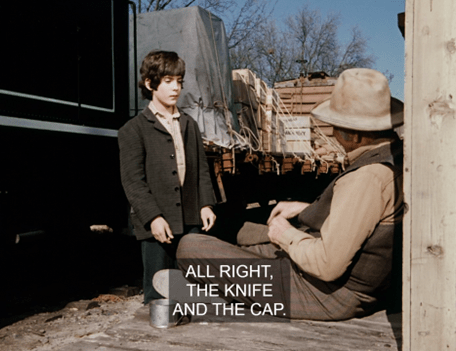


Outfoxed, Albert takes the cup and goes as the old man cackles behind him.
DAGNY: I do love hoboes, though. I used to beg my parents to buy me Boxcar Willie tapes, but they never would.

Albert sneaks back to the train (Penguin Man and Ben Slick are there) . . .

. . . only he’s caught by Snake the Brake!

Snake finds the other kids and, bearing his terrible chompers, kicks them off the train.

Laura helps Dilly Bar, who’s bleeding and coughing into a kerchief.

Well, guess what, Pa comes riding right down the hill.
ALEXANDER: Wasn’t he just following the railroad tracks?
OLIVE: Shortcut.

Passing a Medieval Peasant Woman, Nippin’-out Chuck walks straight to the kids’ boxcar, but of course they’re gone.

OLIVE: How did he know which car they were in?
ROMAN: He’s Charles Ingalls.

Charles finds a clue; for in their haste, the kids missed grabbing their severed-head bag.
DAGNY: I love the puppy ears on his boots.

Charles wanders around the train, approaching the Medieval Peasant Woman and another lovely lady and asking if they saw the kids.

This Medieval Peasant Woman is no ordinary one. It’s Mrs. Lavish, the woman with atypical-for-the-period makeup from Walnut Grove! What’s she doing here, I wonder?


(Maybe that’s why Charles was nippin’ out.)

ROMAN: Looks like Caldwell’s in Idaho.
ALEXANDER: . . . Charles rode a horse all the way to Idaho?


Well, Pa finds the three younguns. He says he should give them all a “whippin’,” but of course he never does.
Pa says he’s going to take them all home. (On that horse?)

But Dilly Bar firmly says he won’t go back with him.
Pa says he promised Mrs. Whittaker he’d bring him home to her, and Dylan says, “To do what? To watch me die? Like she watched my pa die?”
AMELIA: What did his pa die of?
ALEXANDER: He drowned in the ocean.

Well, Dylan makes his case in a one-minute speech, saying he promised his father he’d go, and it doesn’t matter if he dies during the journey because he wants his mom “to remember me the way I was.”
Pa asks some questions, but you can tell he’s already onboard. Or I suppose aboard would be more fitting!

Albert says the brakeman is a candy-ass and they should just get back in the boxcar.

“I don’t know how I got talked into this,” Pa says imbecilically.
OLIVE: Wait, so Pa is going to TAKE HIM TO THE OCEAN? Against the mom’s wishes? I can’t believe he’d really do that.
ALL: [murmurs of agreement]
But sure as shit, there they are sneaking aboard the train.

“God bless you, Mr. Ingalls,” Dilly Bar sighs once they’ve settled.
DAGNY: The plan in Six Weeks was just as crazy. The story’s exactly the same. Landon should have sued for royalties.

The Number Three departs the station. We notice that on the boardwalk, some guys are stealing Charles’s horse.

Commercial!
WILL: Ugh. I didn’t like that at all. The commercial, I mean. I would eat the peanut-butter cup.
ROMAN: Yeah. Separate the art from the artist.
When we return, Charles and the kids are sleeping in the hay. It may look comfy, but don’t be fooled. At a French and Indian War reenactment I was forced to attend in the 1990s, I had to sleep in it myself. Pure torture.

Albert and Dilly Bar wake up, and Albert says he’s going to go fetch breakfast.
Then we get the fun sight of Albert walking along the top of the train.

In the passenger car, Albert appears and tells the conductor he wants to buy quite a lot of food ($1.08, or $30’s worth).
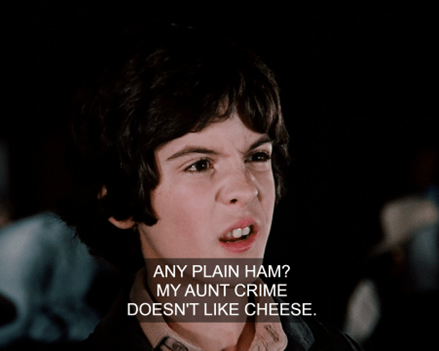

The conductor is Bill Quinn, the same not-dying-of-typhus train conductor from “Blind Journey.”

Albert says he’s buying it on behalf of his “Aunt Crime,” a passenger in the next car.
(We see Not-Neil Diamond is also a passenger.)

But when the bill is totaled, Albert just runs out of the car screaming “Crime doesn’t pay!”

(The origin of “crime doesn’t pay” is disputed, but it might have been around by this point.)
Albert escapes, but is tracked back to the boxcar by Snake the Brake.
WILL: Do you think it would be fun to chase hoboes off trains for your job?
OLIVE: Yes.

Pa wakes up and is pissed at Albert, saying the $1.08 will wipe him out for the rest of their trip.
Snake the Brake appears, swinging his club and saying, “How come I wasn’t invited?”
WILL: You know, this is basically the same plot as “The Watchman’s Gone.” [as GORDON LIGHTFOOT:] “The watchman’s oot/Kickin’ the bums aboot.”

Snake the Brake says, “You all wouldn’t take my advice, would you?” There’s something about how the actor’s voice is overdubbed that’s strange; the synch is very imperfect, but the effect only makes him scarier.

“Listen, Mister,” Pa says in a let’s-all-be-reasonable-adults voice, but Snake interrupts him, saying, “No, you listen, friend. Nobody rides my train for free.”

He steps forward with his club, but Pa attacks first! Ma klounkee!
OLIVE: Oh my God, Charles coming in hot!
ROMAN: My God, Charles, is this ethical?


Charles beats the shit out of him, leaving him lying on the floor with a bloody mouth.

OLIVE: This is a pretty gory episode.
ROMAN: Well, season finale. They could spend all the money they had left on fake blood and train stunts.

WILL: Yeah. That’s probably why the snow last week looked so shitty, in fact. They were saving blood money.

Charles firmly informs him he won’t be giving them any more trouble, then throws Snake’s hat at him.
OLIVE: He throws his hat at him in disgust? That’s a bit much.
ALEXANDER: Yeah. He was just doing his job, Chuck!

The kids look stunned. Well, Albert and Dylan look stunned, Laura merely looks impressed that Pa has delivered yet again.

Pa catches his breath. He doesn’t even bother giving them a lecture about how they shouldn’t fight anybody.
That night, Dylan’s illness worsens.
WILL: What is Pa going to say to Ma when they get back? She MUST think they’re all dead by now.

Pa wakes up and gives Dylan his hanky for his nosebleed. Just like last week’s episode, this one is foreshadowing Albert’s ultimate fate in very strange ways.
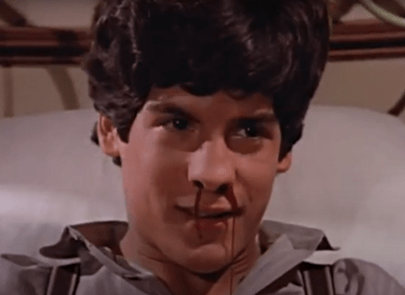
Albert and Laura tell Dilly Bar he’d better not die on them.
AMELIA: Whoa, that’s nice.

Dylan says he won’t, since “I have a better team than Odysseus did.”
AMELIA [as CHARLES, to LAURA and ALBERT]: “What the fuck is he talking about?”
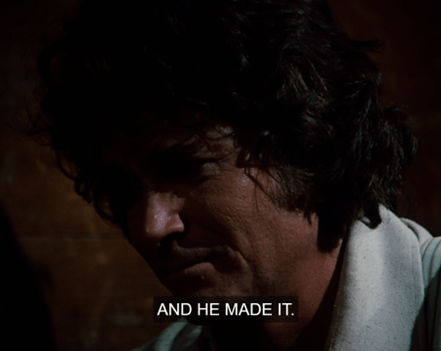
Then suddenly, here we are, San Francisco!
OLIVE: I would never in a million years have thought this show would have an episode where they go to San Francisco.
Now, according to our handy map, a rail trip from southeast Minnesota to San Francisco would take at least three weeks.

Others have noted that unless they changed trains at some point, the little Number Three went all the way to San Francisco, which does seem a little improbable for the St. Paul Minneapolis Manitoba railway.
Well, we do get a set of vintage San Francisco. We see the offices of The Daily Alta California – a real paper of the time.


We also get another weird cameo here. For there on the curb is Amy Hearn, who’s apparently now relocated to San Francisco and is selling newspapers in the street!

By my calculation, Amy would be 131 by this point in our saga. How she wound up with this fate, even I can’t imagine.

We see our protagonists emerge from the door of a mission, where they’ve had a free hot meal. That’s another thing – apart from this, Albert’s breakfast is the only food we’ve seen anybody consume over the three-week journey. (Except “Ferret.”)
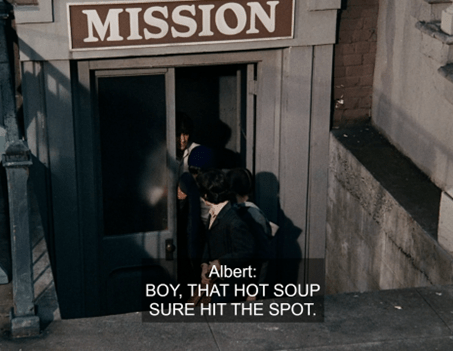
Dylan can barely stand at this point, so speed is of the essence. (Not to mention, we’ve only got seven minutes of runtime left.)

A carriage is parked in front of the mission, and Charles overhears the young man inside tell his traveling companion that he’s going to take a drive down the seashore. (The companion is played by Maurice Hill, who was in Airplane! and Airplane II.)


The companion says, “Yes, sir, Mr. Hearst.”
Charles leaps forward and tells the young man Dylan’s story, asking if they could please share his carriage to get the ocean.
DAGNY: Michael Landon’s hair is a character all in itself, isn’t it?

The young man agrees. (To take them, not about Landon’s hair.)
WILL: So that’s supposed to be William Randolph Hearst. He was the Rupert Murdoch of his day, and he inspired the movie Citizen Kane.
OLIVE: Ooh, his face is chiseled.

It is. The actor, who is perhaps unusually good-looking both for this role and for this show generally, is Bill Ewing. Acting in bit TV parts on shows like this as well as WKRP in Cincinnati, Family Ties, Automan, and Korg: 70,000 B.C. in the 1970s, he soon transitioned into production, working on movies like Dino De Laurentiis’s King Kong.

In the 1980s, he rose to be a Sony Pictures VP for the entirety of the 1990s.
In that capacity, he oversaw production of many notable movies of the era, including Awakenings, A League of Their Own, Groundhog Day, The Age of Innocence, In the Line of Fire, Little Women (the Winona Ryder one), Air Force One, both Men in Black movies, both Stuart Littles, Mel Gibson’s The Patriot and Tobey Maguire’s Spider-Man.
At the turn of the century, Ewing left Sony to start producing Christian films through his own company. (His son, Blake McIver Ewing, was on several episodes of Full House, notably singing “Yankee Doodle Dandy” on one episode.)


On the way down to the beach, Dylan falls asleep on Charles’s shoulder. Hearst watches them thoughtfully as Pa takes the boy’s hand.

Hearst orders the driver to stop (despite his top hat, sideburns and goatee, we see it’s Carl the Flunky).

Laura and Albert thank Hearst, who smiles nicely, and run down to the shore.
As Pa tries to wake Dylan, Hearst says he wants to pay Charles for their story so he can run it in his newspaper.

Charles refuses, but Hearst gently suggests it will solve the problem of how to get back to Minnesota. He gives him at least two twenties ($1,200).
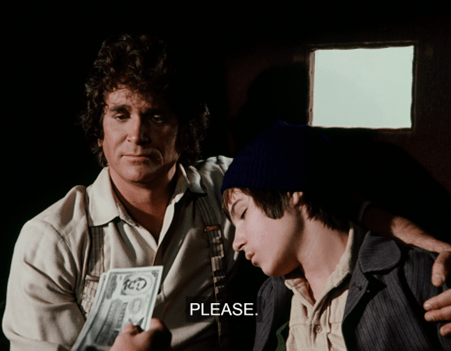
However, the twenties have Abe Lincoln’s picture on them, and while there was a twenty issued in the 1860s that had Lincoln on it, the design was quite different.

So who was this handsome do-gooder William Randolph Hearst? Well, in real life he wasn’t so great.

Handed a newspaper by his father, gold baron and U.S. Senator George Hearst (depicted as a blood-chilling villain on Deadwood), he was a pioneer of modern tabloid-style muckraking, biased, deliberately misleading journalism.

A populist progressive who became a populist conservative (and Nazi sympathizer), Hearst worked to influence the opinions of the American public, and engaged in battles with rival publishers around the country. His opinion pieces regularly trashed San Francisco’s Asian immigrant community.
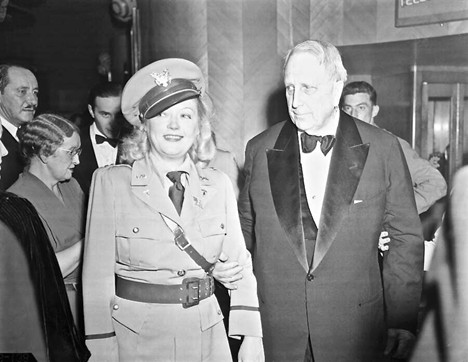
On the other hand, Hearst is positively remembered for introducing what today we might call “human-interest stories” to daily newspapers, and the writers he employed included Mark Twain, Jack London, and Ambrose Bierce (a favorite of mine).
Hearst had financial ups and downs through the early Twentieth Century, but he survived the depression and worked till the end of his life on the never-completed Hearst Castle, a monstrous mansion in San Simeon, California.

Hearst’s life (and house) inspired Orson Welles’s famous 1941 film Citizen Kane, which satirized Hearst’s life and empire, depicting him as a talented young visionary who eventually became a bloated, nearly insane recluse living alone in his godawful “castle.”


Hearst, who lived until 1951, had tried to kill the film before its release. (Citizen Kane really is a masterpiece, and very entertaining to a modern viewer too, if you’ve never seen it.)
Hearst’s paper wasn’t the Daily Alta California, though; it was the San Francisco Examiner (which still exists), and he didn’t take it over until 1887. In 1881, he was still going to school in New England.
His inclusion in this story is strange, especially given Landon’s fierce attack on tabloid chiefs like Murdoch earlier this season in “Harriet’s Happenings.” I can’t really make heads or tails of it.

Well, Pa carries Dylan down to the beach, where Laura and Al are staring at the sea in astonishment.
DAGNY [looking at her phone]: Hey, you know what Boxcar Willie died of? Leukemia!

“It’s just like I pictured,” Dylan says.
WILL: David.

“It runs right into the sky,” he goes on. “It doesn’t have an end.”
ALEXANDER: They should have just taken him to Lake Superior. He’d never have known the difference.

DAGNY: Is that the same blue toque the blind circus kid wore?
WILL: Good eye. Yeah, I think it is. A reader wrote in to comment about that too.
DAGNY: It’s very Canadian-looking. It’s very Relic.


Dylan walks towards the water.
OLIVE: Or there should be a twist ending where he’s eaten by a shark.
WILL: Yeah, or where he says, “You know what I’d REALLY like to see? HAWAII!”

WILL: Actually, does this turn out to be a dream? He should wake up and still be in the first scene in front of his painting.
OLIVE: Yeah. Or frozen to death on a stoop like the Little Match Girl.

ROMAN: Oh my God, what’s happening! Is he dissolving into sea foam like the real Little Mermaid story?
Because what’s happening is for a moment, Dylan’s body goes translucent.

It’s likely a green screen/CSO malfunction, but who knows? It is a magical story in a number of ways.
ALEXANDER: I guess maybe he really was dead already.

Still translucent, Dylan walks and walks.
OLIVE: All right, The End. . . .

David brings the harp from the beginning back in.
OLIVE: I’m surprised Michael Landon doesn’t take his shirt off and go swimming.

Dylan runs out into the surf and raises his arms in triumph.
OLIVE: So he dies there, in California? How do they get his body back to Walnut Grove, in a backpack?

And that’s Season Five cashed! Bum-Bum-Ba-Dum!
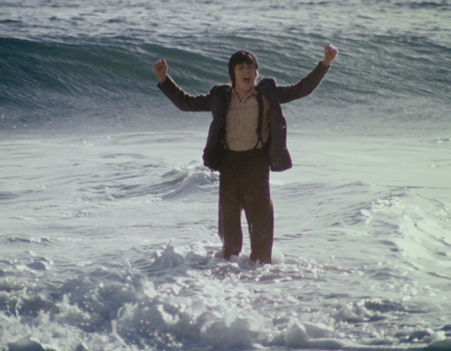
STYLE WATCH: Albert wears Carl Sanderson’s old costume.


Charles appears to go commando again.
THE VERDICT:
OLIVE: Well, that one was good, but ridiculous.
WILL: That’s fair.
As an adventure story, “The Odyssey” is quite satisfying, with crackerjack fight scenes, good performances and fun side characters. But in the end, our panel found the concept a little too hard to swallow. (Not to mention there’s some very questionable ethics on display.)
DAGNY: Poor Boxcar Willie.

UP NEXT: The 1979 Walnut Groovy Awards

 Walnut Groovy
I know it was corny, but my favorite line of this episode was “Crime doesn’t pay!” I love Albert 🙂
LikeLiked by 1 person
I love Albert too. He really dominated this season – gave the show a new sparkle that allowed it to fly even higher.
LikeLike
Even as a kid, I wondered why they didn’t go to the Atlantic ocean. Never gave a thought to the Great Lakes that were practically around the corner! Another great recap on your part. Very sad to hear that this young actor died at such a young age.😢
LikeLiked by 1 person
Well, yes, Walnut Grove is closer to the big lake than to Deadwood or Chicago. But I suppose Dylan might have figured it out if he tasted the unsalty water. (“Hey, wait a second . . .”)
LikeLike
I enjoyed reading that so much more than the episode! I really hate this one. Could it be the least believable episode thus far? Or are mountain angels who look like Ernest Borgnine less believable?
LikeLike
Ha! Thanks Ben. I will tell you this one got some low marks in our house, too, though I enjoyed it more than I expected to (which is almost always what happens). I actually find the Jonathan episode more believable, because it has a supernatural explanation. In “Odyssey,” we’re supposed to accept that all this really happened WITHOUT divine intervention. Angels I can believe in; surviving three weeks on one meal and one cup of water I can’t. Plus Pa not giving a second thought to Dylan’s mother bothered some of us.
LikeLike
“TV Baby Grace was born in October”
That’s odd, I remember you deducing her birth happened in April, 1880. I do think it makes more sense that she’s born in late 1879 since she’s an infant in September 1880 when the Ingalls and co move to Winoka. Though it’ll become less plausible once we make it to 1886 when Grace makes her final appearances and should be 6-7, yet she’s still sitting on a high chair and the twins who played her were about 4. At this point, it seems the timeline keeps moving the kids’ approximate birthyears forward, i.e. first Willie was of school age circa 1875 so he would have been born in the late 1860’s, but by S9 it’s late 1880’s and he’s still a teenager in school, meaning his birthyear was moved to early 1870’s.
I really love this episode. I admit I overlooked the absurdities in their quest, from making it to San Francisco in a train to Charles catching them up in a horse and the deus ex machina that was William Randolph Hearst giving them a ride and paying for Dylan’s story (by the way, Hearst was in 1863 IRL, meaning he should be in his late teens by now; the Hearst from the episode reminds me of Cillian Murphy, I even once joked that he was Tommy Shelby’s grandfather!!). The premise was just so engaging and the catharsis and payoff of getting Dylan to the sea ending the episode having the time of his life in the beach was so palpable it overshadowed the problems in the journey. Also Laura and Albert rock as a team.
Hard to believe we’re about to get in the LauraxAlmanzo phase already, for better or worse 😬. I like their relationship, though having revisited that phase and read other opinions, I admit that part is full of ups and downs. Until the WG Awards, Happy Easter!!
LikeLiked by 1 person
What a strange thing to remember! I had to look it up, but in fact what I said is the BEGINNING of “A Most Precious Gift,” with the bird eggs and Ma learning of her surprise pregnancy, was set in April. Grace was born, then, that fall.
The timelines are so fun to track, but there’s no way to reconcile all the data. A reader once suggested the stories are all out of order because Grownup Laura’s memories of the saga are hazy, and I think that’s as good an explanation as any.
I was just saying to Ben that I liked this one better than I remembered, and it is super-fun in its way. I think it’s one “classic” that people think of as an example of Little House at its cheesiest, and while I prefer other types of stories, I’m not immune to this one’s charms.
LikeLike
Oh, and happy Easter to you as well. 🙂
LikeLike
Such a good episode, imo, even if it’s really sad. Much better than the last one, which to me just felt like satire of the show’s darkest and most depressing scenes.
LikeLiked by 1 person
Well, I love the darker Little House stories, but you’re certainly right that “Mortal Mission” feels like self-parody at times. My daughter Amelia’s take on it was similar to yours.
LikeLike
This is a very random thing for me to comment on, but I think Pa asking Laura about the doll dress implies that it was something she was working on as a birthday gift for Carrie. Great recap as always!
LikeLiked by 1 person
Duh, of course! You know, sometimes I do miss the forest for the trees. . . . 😀
LikeLike
I have updated the post. 🙂
LikeLike