
Only You Can Prevent Four-Eyes Fires; or
Please Save My Nepo Baby!
(a recap by Will Kaiser)
Title: The Third Miracle
Airdate: October 8, 1979
Written by John T. Dugan
Story by Kenneth Hunter
Directed by Michael Landon
SUMMARY IN A NUTSHELL: Ol’ Four Eyes – excuse me, I mean Mary – is BACK!
And thank goodness she is, because the lives of Adam and a pregnant Leslie Landon depend on it.
(Featuring another fire!)
RECAP: Let’s go, let’s go, let’s go!
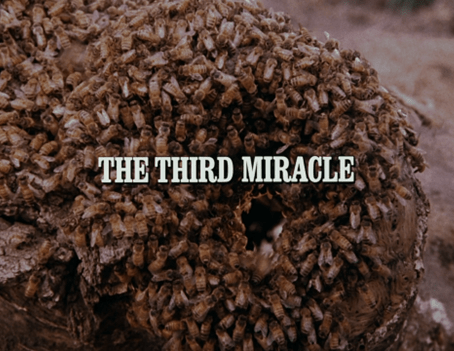
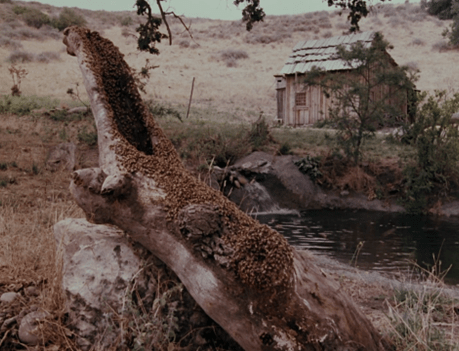
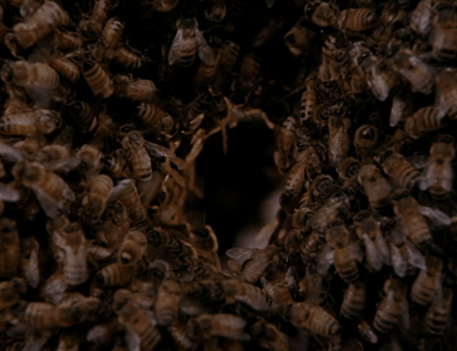
Tremulous “beehive” music brings us into a shot of, well, a beehive.
The first-chair flute, who now that I think of it has been acting up this season, plays snatches of the famous “Flight of the Bumblebee” over the buzz.
“Flight of the Bumblebee” is by Nikolai Rimsky-Korskov.


I like Rimsky-K. In my view you’re more likely to encounter a bad Little House episode than bad music by a Russian composer; and that’s saying something.
We will of course hear “The Flight of the Bumblebee” again in the series, in a quite different context.
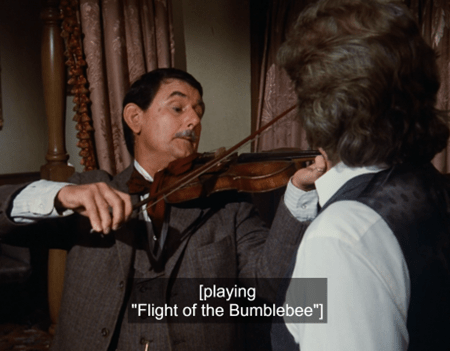
“Flight of the Bumblebee” comes from a little-remembered opera called The Tale of Tsar Saltan, inspired by a poem by Aleksandr Pushkin. I don’t know it myself. (The opera, I mean, not the poem.)
(Though I don’t know the poem either.)
It’s hard to understand why it’s little remembered, since the story is great – full of magic swans, kings who order their wives and children to be drowned, and that sort of thing.
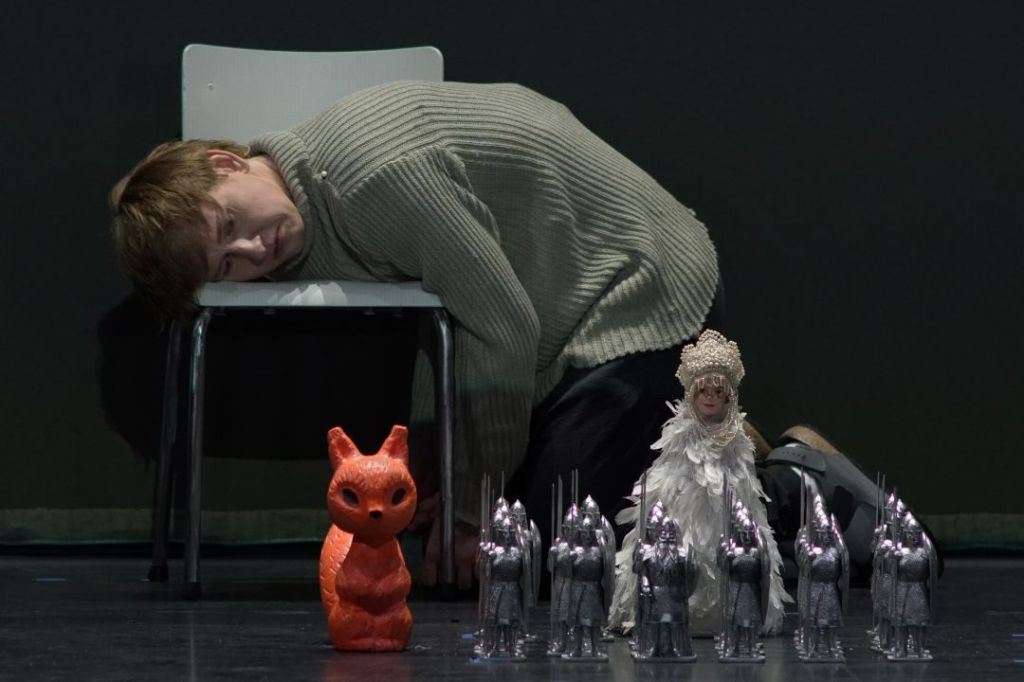
Despite the attempted wife-and-baby-murdering, it has a happy ending. (I mean, spoiler alert. Sorry if you planned to rush out tonight to your local production of The Tale of Tsar Saltan.)

And in addition to all those attributes, Tsar Saltan has the fucking “Flight of the Bumblebee” in it! I’m not sure what else anyone would need to recommend it.
Anyways, back to the bees. There are thousands of ’em, I’d say, crawling over a hollow tree on the west bank of Plum Creek.
As the camera withdraws, the tree is revealed as one of those weird logs that litter the Ingalls property like a bunch of pianos, if someone had just dropped a bunch of pianos out of a plane, that is.
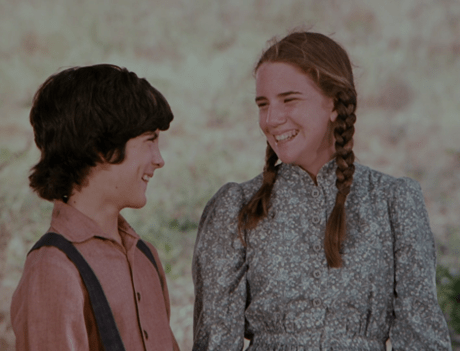
We’re only a little ways off from the Casa dell’Ingalls, and though the music is nervous-making, Laura and Albert don’t look concerned.

They’re standing just on the other side of the Creek, where they’ve placed a table and a bunch of white (plastic?) buckets.
One doesn’t need a degree in apiculture to deduce it’s beekeeper’s stuff.

This one was written by John T. Dugan, based on a story suggested by Kenneth Hunter – like last week’s writer Vince R. Gutierrez, another of Landon’s key crew members.
Hunter was a camera operator who joined the team this season. His Hollywood work was almost exclusively under the umbrella of Landoniana – in addition to Little House, he was a cameraman on Father Murphy, Highway to Heaven, The Loneliest Runner, and (yet another) Landon autobiographical foray called Sam’s Son.

(Sam’s Son explores Michael Landon’s youth. Interestingly, Landon uses his birth name, Eugene Orowitz, for the main character, but calls Gene’s shrewish mother Harriet! Ha!)
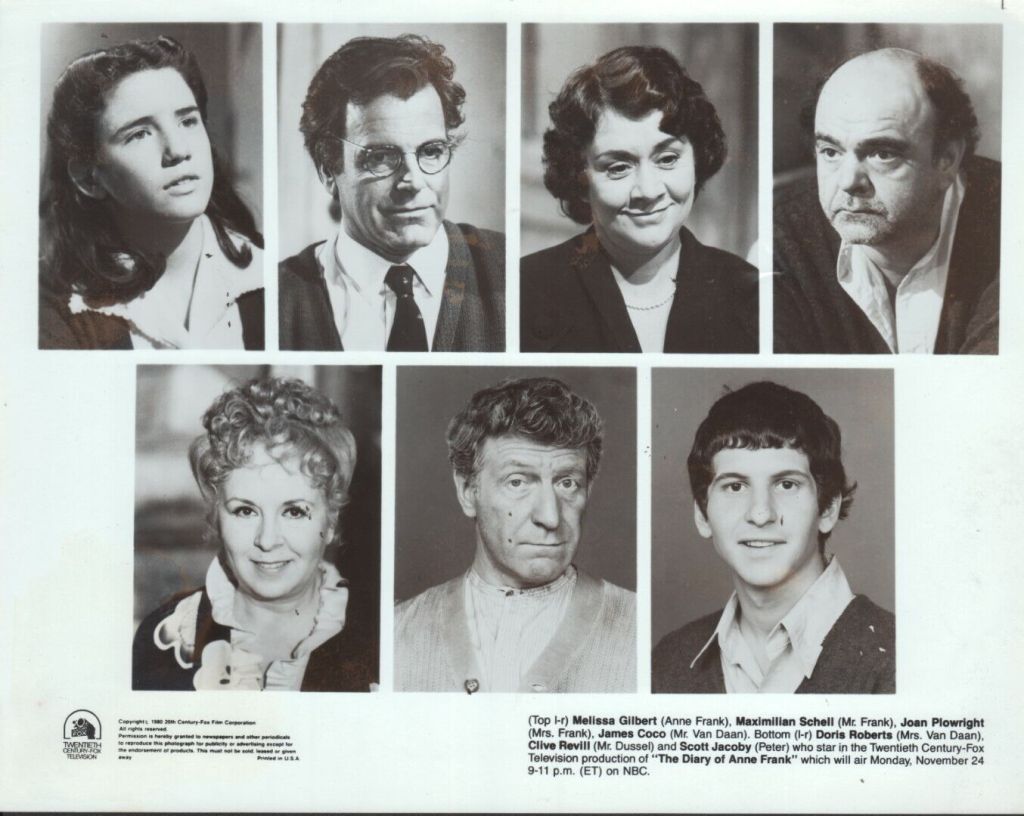
Furthermore, although Landon was not involved, Kenneth Hunter also worked on the version of The Diary of Anne Frank that starred Melissa Gilbert as well as Doris Roberts, James Coco, and – a personal favorite of mine – Joan Plowright. (I’ll have to ask MG about Plowright if we interview her again. She was Lady Olivier!)
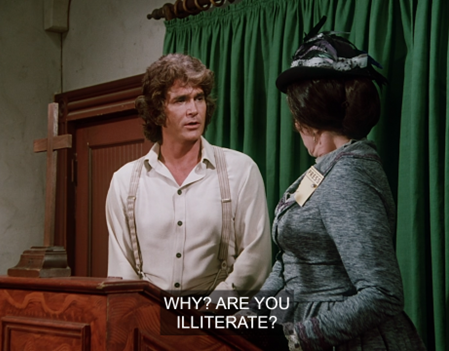
We get closer to Laura and Al, and we see I was right about the beekeeping. Laura even wears a “beekeeper’s hat,” though without veil or mask for protection, I don’t see what good it would do.
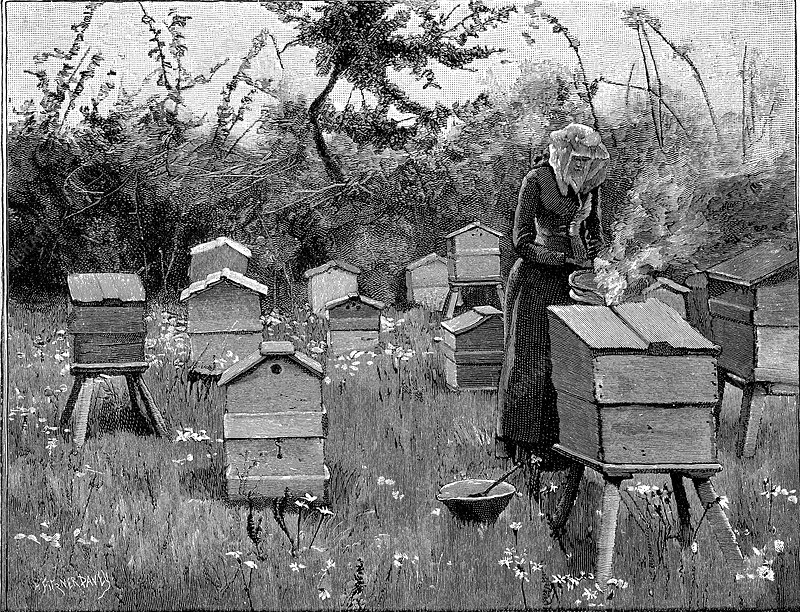
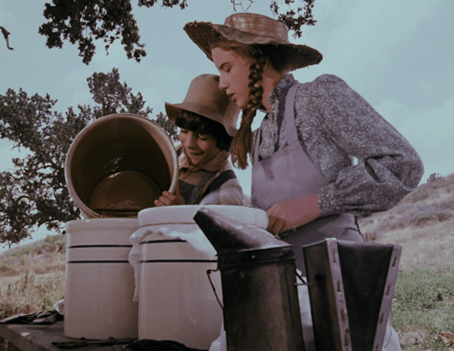
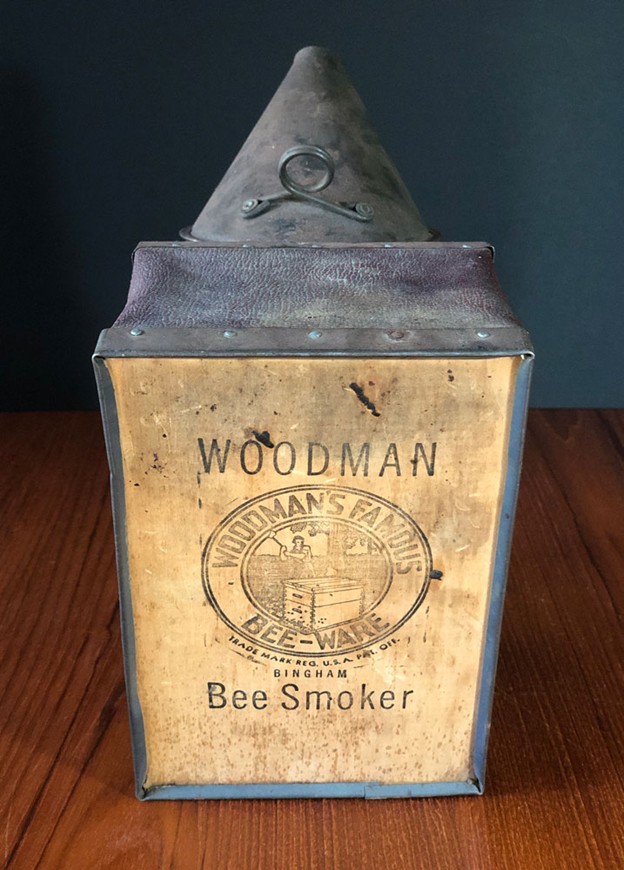
There’s also a funnel-topped tin canister next to what looks like a little accordion. This is a smoker. You burn material such as pine needles, mushrooms, etc., and the bellows pump the smoke through the funnel into the hive, smoke being known since antiquity to calm bees. (This specific device was invented in 1873.)
The “plastic” buckets are actually big ceramic crocks – for honey.
DAGNY: Is that Red Wing pottery?
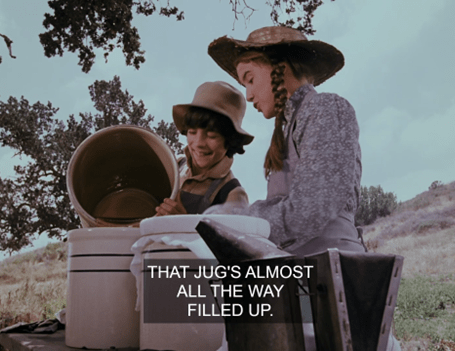
Probably yes! Red Wing is a famous stoneware company, based in Red Wing, Minnesota, that was once the largest in the nation. In 1881 or -2 (which is where we presumably have arrived in the J timeline), the company existed, and it wasn’t until 1906 that they began stamping pots with the familiar red wing logo; so I’m comfortable saying yes, this is Red Wing pottery.

(Red Wing the town is lovely and I highly recommend checking it out if you ever visit our state.)

Albert says they’ve collected nine large crocks of honey.
OLIVE: So these bees aren’t dangerous at all?
DAGNY: Bees can be tamed.
WILL: Yeah, you have to abuse them when they’re young to destroy their wills.
ALEXANDER: Yeah. Like dogs.
WILL: Exactly. Or children.
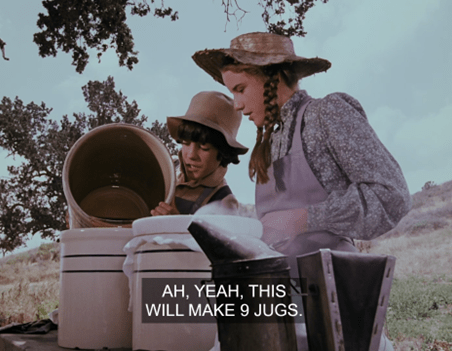
Laura tries doing the math, but Prodigious Albert instantly calculates: two hundred sixteen pounds of honey!
(We questioned that. What I found was that beehive output varies considerably, with 200 pounds being at the very top of the range. That’s today, with modern tools for hypnotizing the bees and so forth.)
(It’s also the annual output, with honey typically being harvested a few times a year; but never mind that, we’ll say 216 pounds is just barely in the realm of possibility.)
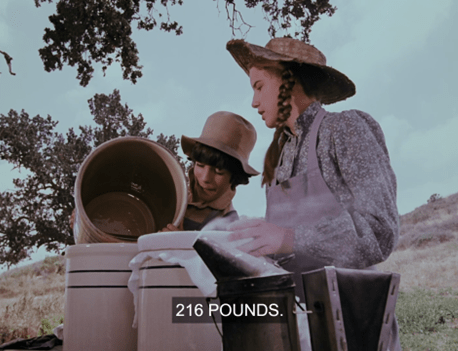
Laura and Al explain to the audience they’re trying to earn extra money selling honey, though not how or when they came by this beehive in the first place.
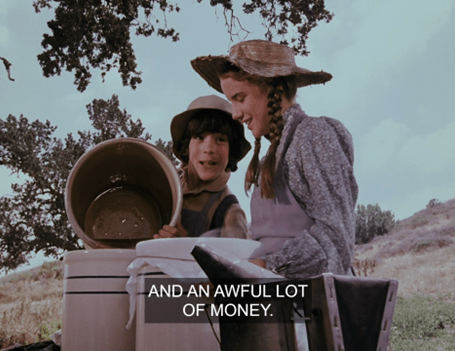
I think we can conclude that we’re into 1882, since last week’s story ended in late October 1881 and that’s not early enough for honey-harvesting. Plus, it looks like summer, though that’s never much help on this show.
From the door, Ma announces she’s going to town, and, after staring down her siblings with a look of surly menace, Carrie follows her.
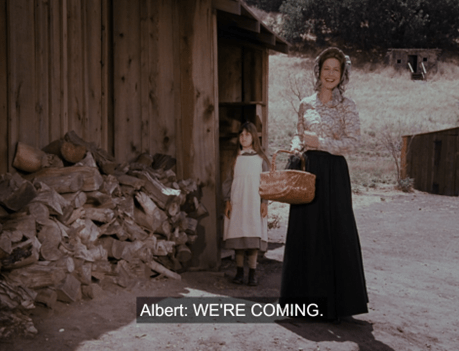

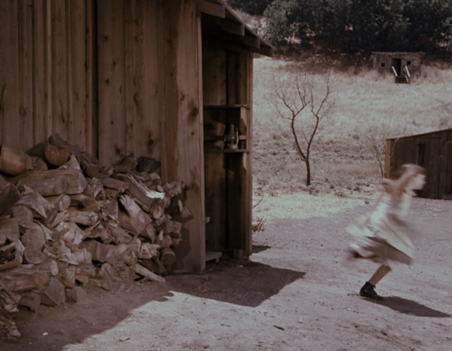
Carrie slurps that Laura and Albert won’t let her, er, bee-keep, and Ma tells her that, as a child, she’d surely get stung.
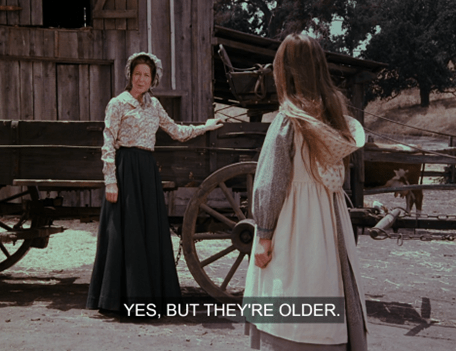
Carrie points out that Laura and Al are also children, a reasonable argument.

(Then again, I’d point out Laura was already carrying the fucking show when she was Carrie’s age. So don’t press your luck, Care Bear!)
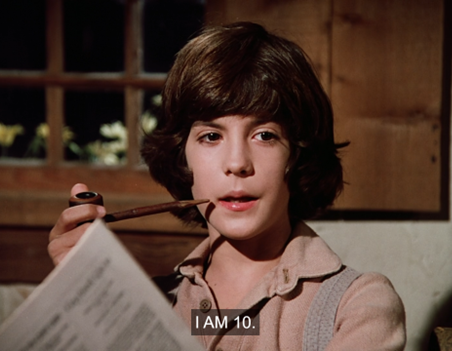
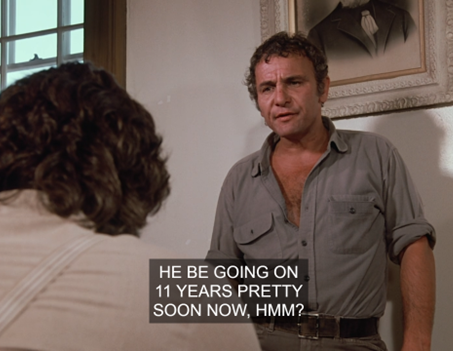
(As for Albert’s age, we know he’s permanently ten, which is not that much older than Carrie even if it isn’t believable.)
Anyways, Carrie cracks wise and retreats.
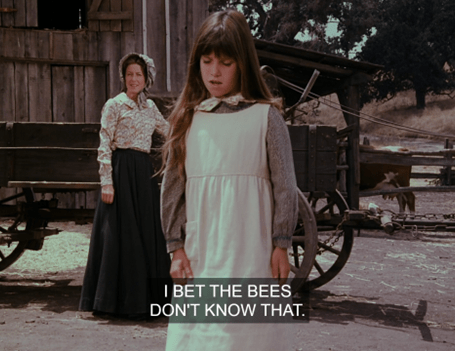
Laura and Albert carry some crocks over (you can tell they aren’t really very heavy) to say goodbye to Ma.
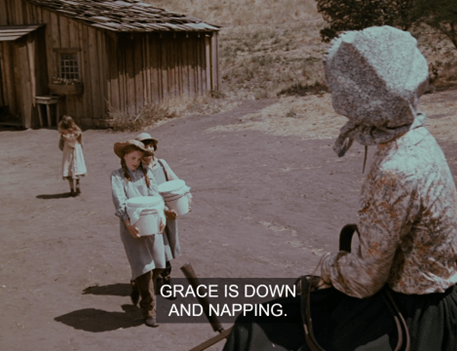
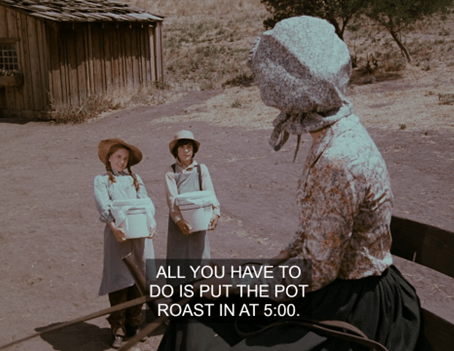
Ma tells Laura to watch Grace and “put the pot roast in at five.” Five seems late to start a dish that takes hours to cook. What time do they eat in this house? I thought they all went to bed at, like, eight. I suppose it could be for tomorrow, though.
In the barn, despite Pa having done everything short of branding his children on the arm with CASH ON THE BARREL, Laura and Al are already spending their money.
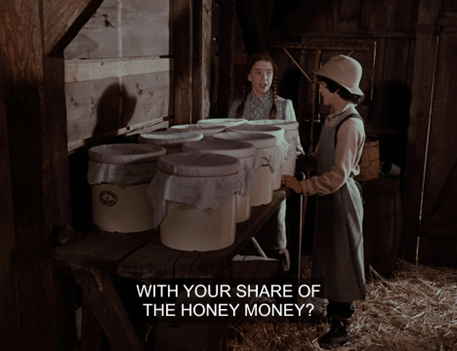
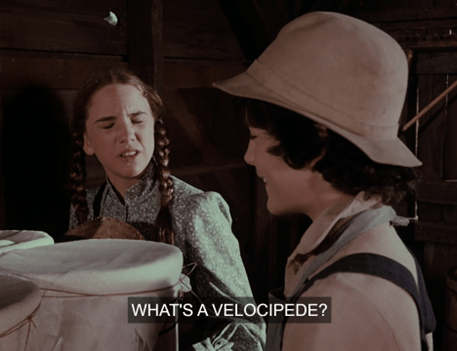
Albert wants a telescope and “a new velocipede.”
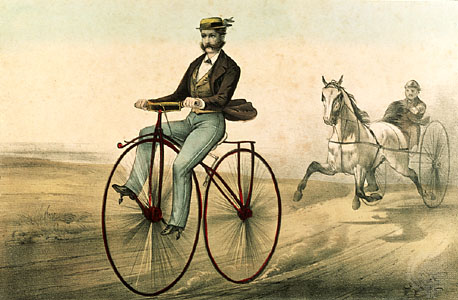
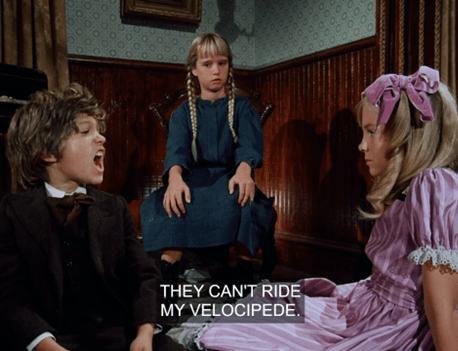
Laura doesn’t know what a velocipede is, which seems unlikely to me. Willie Oleson knew what one was in Season One, and he was like four years old.
As for Laura, she says she wants “a whole new outfit – dress, hat, gloves, everything.”
OLIVE: A dress and gloves? Laura? Wouldn’t she want a gun or something?
WILL: No, this is the season she becomes a feminine woman.
OLIVE: I don’t like that.
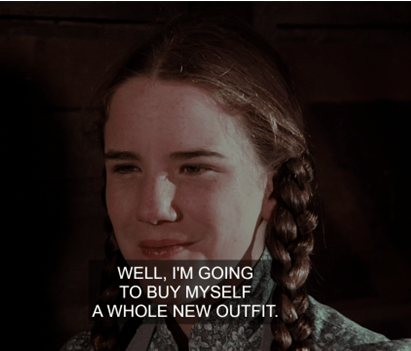
(I think Melissa Gilbert’s ear looks pierced here, but she’s said she never got piercings till she was eighteen, so maybe it’s just a freckle or earwig bite.)
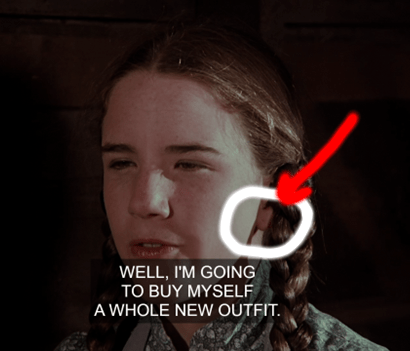
Albert already knows why Laura wants the dress.
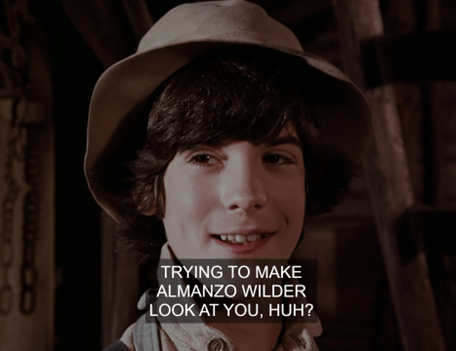
But Laura says actually, they should use the money for Christmas presents, and Albert agrees.
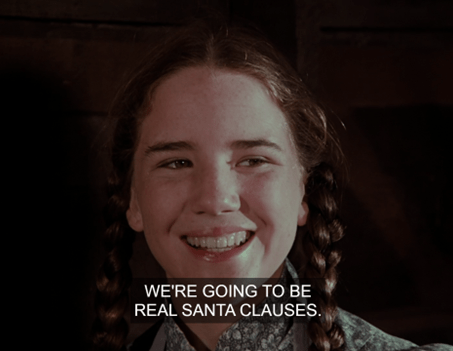
We cut to the roar of a wagon rattling through the thoroughfare.
DAGNY [looking up]: Oh, I thought that was Olive blowing her nose!
OLIVE: Haw haw.
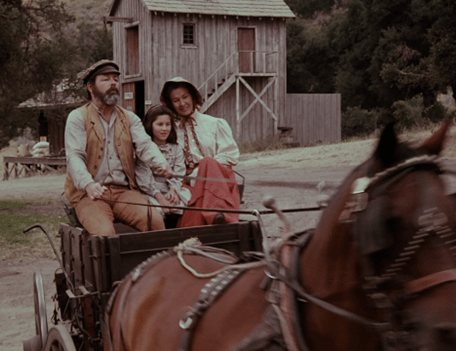
The wagon is driven by Not-Richard Libertini, but I think his companions are new.
The woman has a poppin’ bonnet and a wry expression on her face, sort of like Jane Lynch might make.
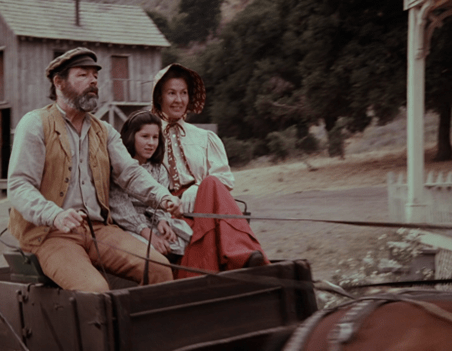

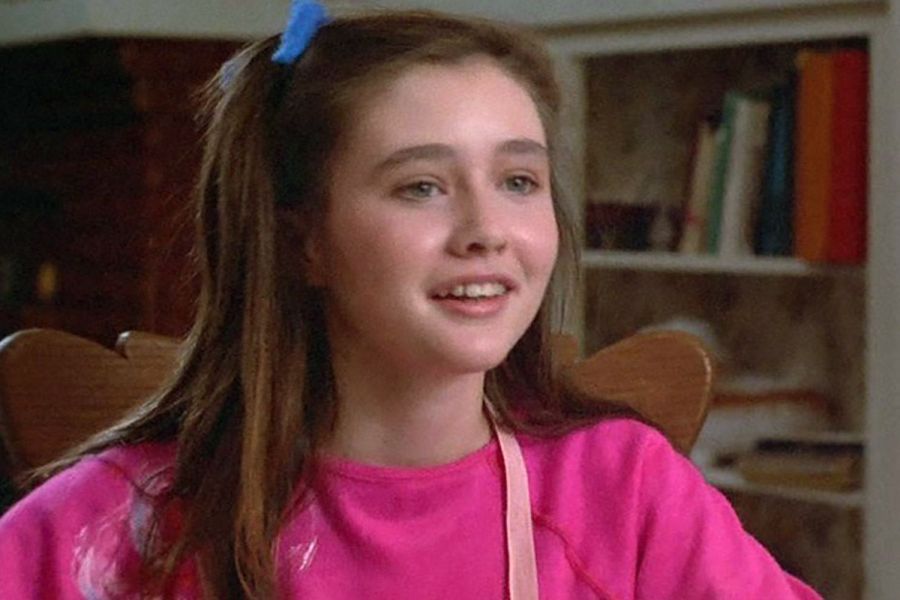
And the girl looks like she might be a prototype Shannen Doherty, or something.
At Nellie’s, the proprietress is screaming and 86-ing all the customers for complaining about her cooking. (Did Caroline quit?)
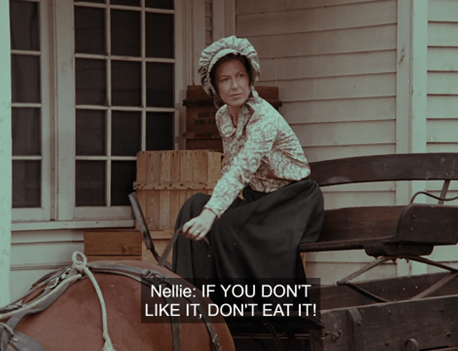
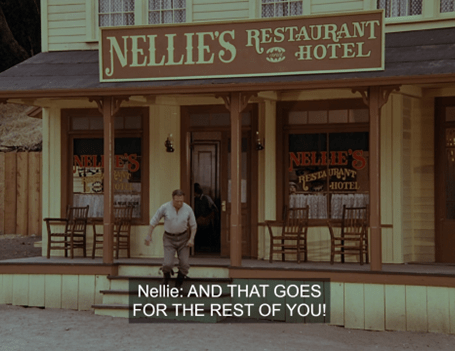
The customers include “the Customer,” J.C. Fusspot, a few strangers, and most exciting of all Hans “Rubberface” Dorfler!
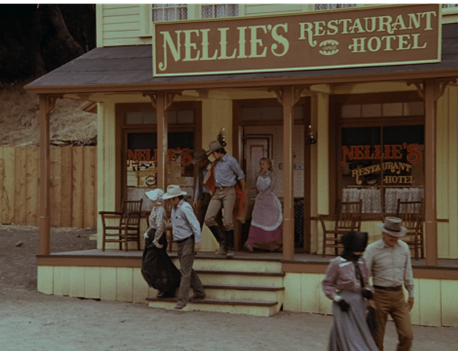

Dorfler hasn’t had a proper role in a story since “Castoffs” at the start of Season Four, though he was mentioned in “‘I’ll Be Waving as You Drive Away.’”
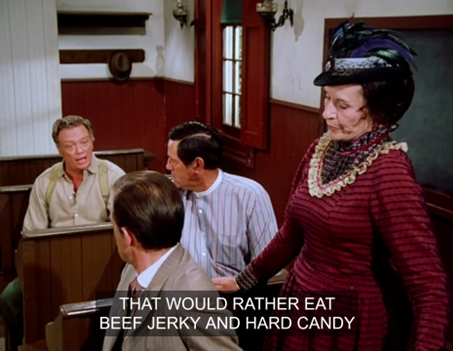
(I would argue we also saw him from behind in “The Sound of Children.”)

As the camera follows the disgruntled group out, we briefly see the Kid With Very Red Hair (Mean One) walking with an unknown girl who has hair of deepest auburn and is dressed all in greenish-whitish.
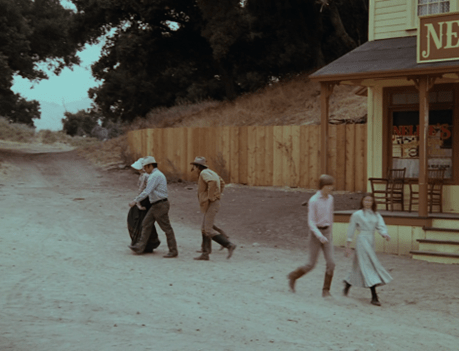
Perhaps with her similar-hued hair, she’ll be a mellowing agent for Very Red, one of the nastier Grovester kids. (Or maybe she’s just as bad as he is.)
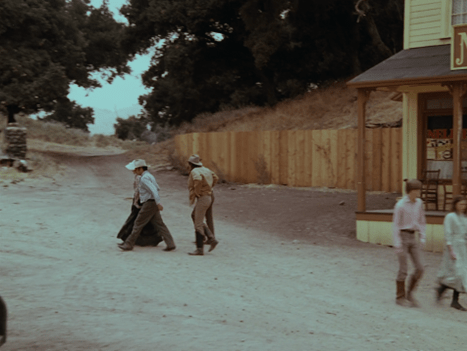
As Ma giggles, Nellie’s ejected customers pass by the ruins of Kezia’s Topsy-Turvy Adventureland and on out of this story.

We shift gears again, then, cutting to Mrs. Foster transcribing telegrams in the Post Office.
WILL: You’re telling me she can really understand those clicks?
OLIVE: Yes, Dad! Morse code is a real thing, we go over this every time.
Hm. Evidence inconclusive.
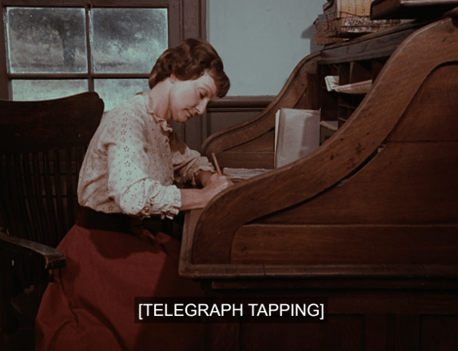
Outside, Ma has fired up the Chonkywagon again, but Mrs. F comes rushing out to give her the telegram, or “telegraph,” as telegrams are always called in the Little House TV Universe.
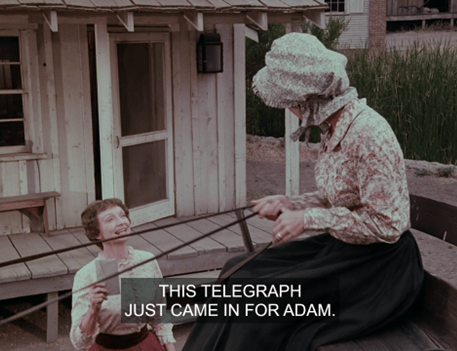
(Okay, Merriam-Webster says telegraph is an acceptable alternative term for telegram, so this is the last time I’ll mention it. Probably.)
Mrs. Foster gives Caroline the, uh, telegraph, saying it’s for Adam and is good news. Seems unethical, but you know – Walnut Grove.
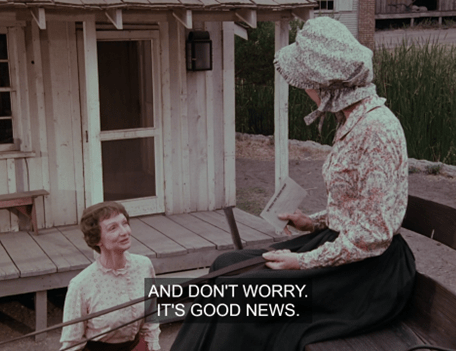
The ladies chit-chat a little, noting that Charles returns today from a Mankato work trip, and Ma takes off. (Others have observed Karen Grassle’s operation of the wagon’s parking brake here is incorrect. I’ll take their word for it.)

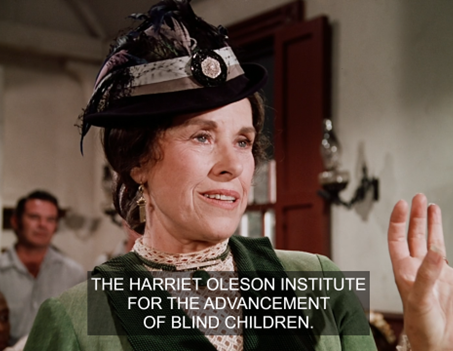
Meanwhile, at the Harriet Oleson Institute for the Advancement of Blind Children, Adam is grading papers and remarking that the class is doing well at math.
Mary compliments his teaching skills, and he starts stroking her arm hornily.
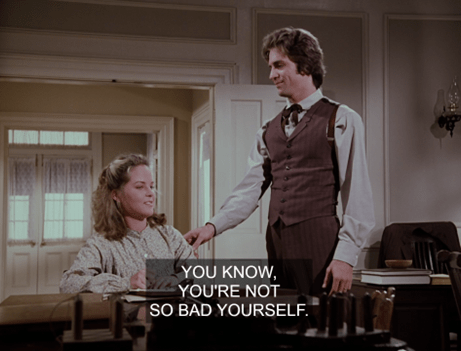
Rising, Mary says “Thank you, Teacher” rather sexily, and they start sucking face. Hoo hoo! This is a pretty spicy scene for Little House.
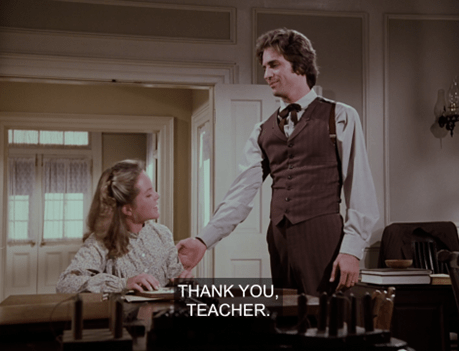
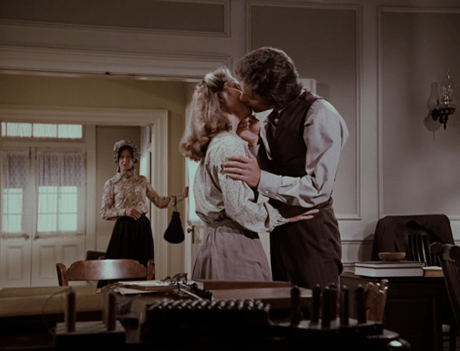
Unfortunately for the Kendalls, they’re interrupted by Ma, who comes in to deliver the telegraph (grrrrrr).
Ma giggles quietly, then announces her presence. As weird as scenes like this and Pa watching Mary make out under the porch are, it’s nice the senior Ingallses are pleased their daughter’s marriage is full of affection.
I am, too.
WILL: Adam humanizes Mary, I think. I like her better when they’re together.

Ma opens the message and smiles, delighted. For Adam has been chosen to receive a Louis Braille Award – the highest honor a blind-school teacher can attain!
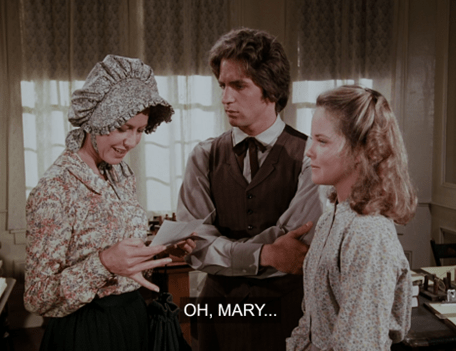
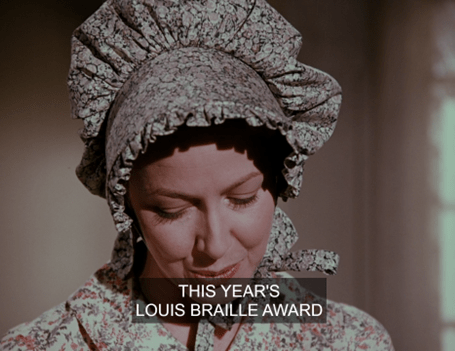
The award is being bestowed by “the National Association of Blind School Educators.” There wasn’t an association of that name in the U.S. at that time (and still isn’t), but there was an American Association of Instructors of the Blind which was founded in 1871. That’s close enough for me.
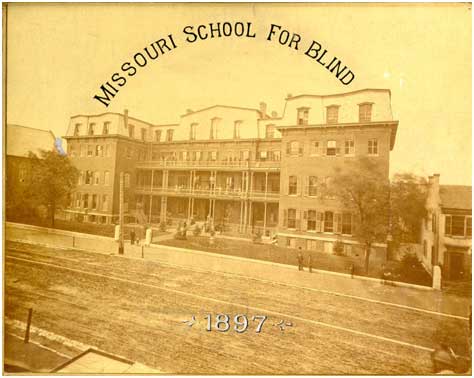
However, there definitely was no Louis Braille Award at that time I’m the United States. There are a number of them now, but as we noted when we did “‘I’ll Be Waving as You Drive Away,’” braille wasn’t widely accepted as a written language here until the early Twentieth Century. (Interestingly, it was used in Missouri, which is where Hester-Sue’s school was.)
I’ll also note that while Adam pronounced Braille’s first name as “Lewis” in “‘Waving,’” this time both he and Caroline pronounce it the French way (“loo-EE”). (Neither attempts a French pronunciation of Braille, though.)
Mary, a little sweated up from her recent snog, is thrilled.
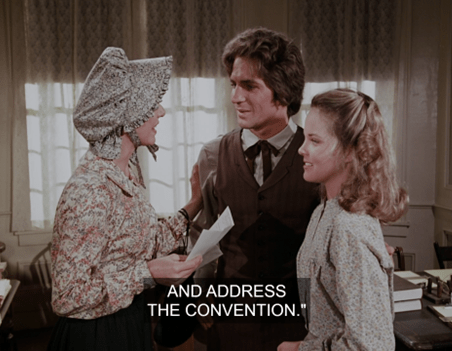
Ma goes on to read that Adam is the first teacher who’s blind himself to receive the award.
She says the ceremony will be held “next Saturday” in St. Paul. (If you’re just joining us, St. Paul is also the nucleus of Walnut Groovy’s operations.)

Ma continues reading, saying Adam is invited to give a speech at the ceremony. (This is a very long and expensive telegram. NABSE must be rolling in it.)
At this point, Hester-Sue brings the kids in from outside. (They include the Sharp-Dressed Kid, Blind School Princess Leia, Distraught Polly, and the Blind AEK.)
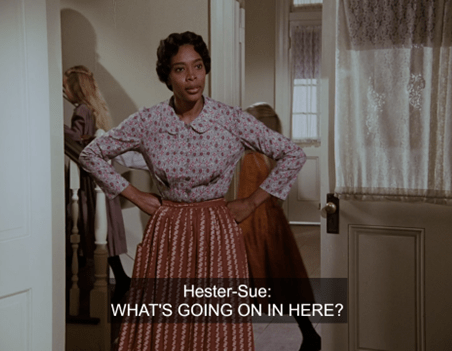
Hester-Sue is also pleased by the news, and she and Mary tell Adam they nominated him for the award.
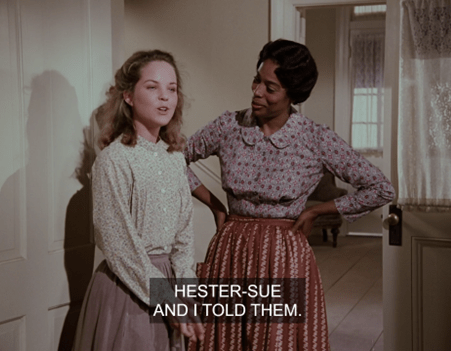
Adam takes their hands and thanks them warmly.
OLIVE: He should accidentally kiss Hester-Sue.
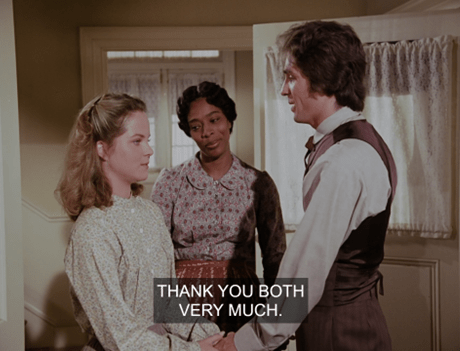
WILL: Yeah, “accidentally.” He could work his way through the whole town that way. Hester-Sue, Alice, Nellie, Mrs. Foster . . .
DAGNY: Caroline.
But Adam says with the cost of the train and the stagecoach to Sleepy Eye (why can’t Pa just take them? he goes there every other week), they can’t afford the trip.

Mary says she doesn’t have to go along – a sensible suggestion – but Adam shoots this idea down.
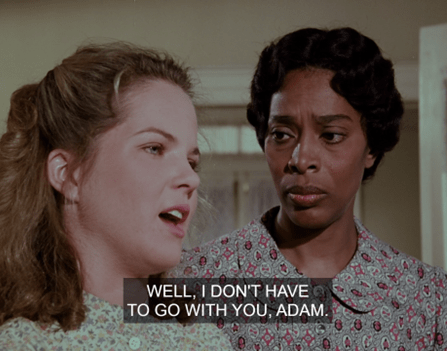
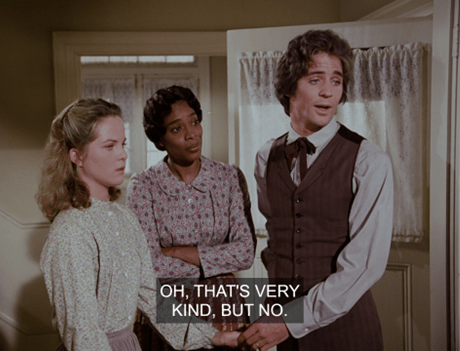
Hester-Sue offers to donate $4 ($125), but Adam says they’ll need “fifty or sixty” for the trip, and he only has twelve. “That would only get us to New Ulm!” he says. “One way!”
OLIVE: How much was sixty dollars?
WILL: Um, like, close to two thousand dollars.
OLIVE: What? Why would they need that much money?
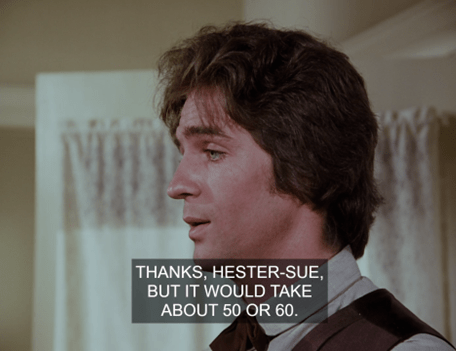
I don’t know. Glancing at some of my trusted sources, I estimate a round-trip stage ticket for two to Sleepy Eye could cost as much as $10, and the train from there to St. Paul, again for both of them together, would be about $12. So, $22 total transportation costs; $11 if Adam went alone.
(I didn’t calculate the one-way fare to New Ulm, since Adam may be exaggerating and not really mean it when he says that’s all they can afford.)

As for lodging, in True Grit Mrs. Floyd’s boarding house asks 75 cents ($24) per night – a reasonable rate for budget travelers like Professor and Mrs. Kendall. (And in True Grit, that included meals!)
So add it up, we’d be talking $23.50 total for the trip, and that’s assuming the boarding house charged double for two occupants. That equals about $740 in today’s money – not a small sum for a poor family, but hardly what Adam estimates.
You might wonder why they don’t appeal to the patroness of the Oleson Institute herself to finance this trip (which after all is work-related).

But if you’re a regular viewer, you probably don’t wonder that.
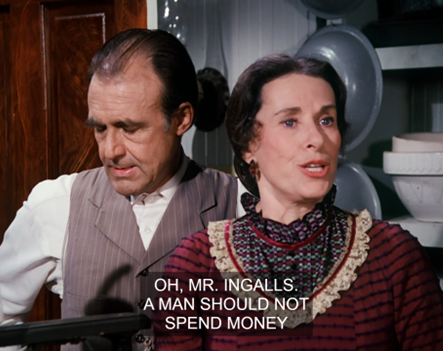
And in fact we’ll get an idea pretty soon in this story how that conversation might have gone if they had tried.
Then again, the Braille Award obviously confers prestige upon the Institute, so it’s possible Harriet would have gone for it.
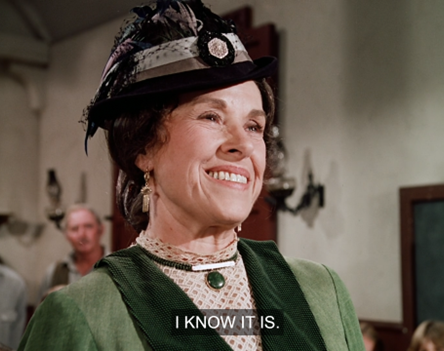
Actually, as the founder of a blind school, you’d think she’d be invited herself! NABSE would be hitting her up for donations all the time.
Ma says she and Pa may be able to contribute, but Adam won’t hear of that.
Back at the Little House that night, a Chonky breaks the Fourth Wall to give us a knowing look.
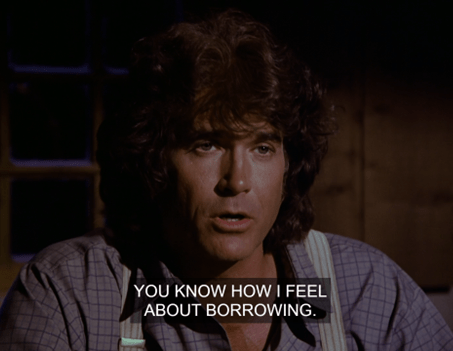
At dinner, Pa says with frustration that they can’t afford to help with the trip. He’s kind of annoying about it, huffing “Cash on the barrel!” sanctimoniously. (Paraphrase.)
Ma, on the other hand, is nice and submissive, apologizing for bringing the topic up, and fetching coffee as a penance.

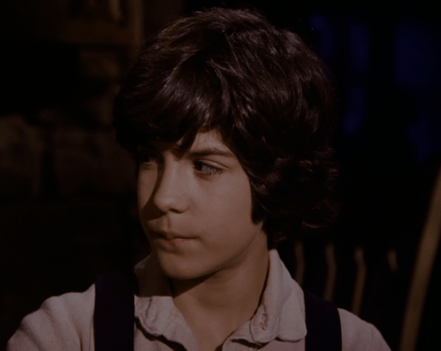
Albert looks glum.
ALEXANDER: Poor Alb.
Laura too.
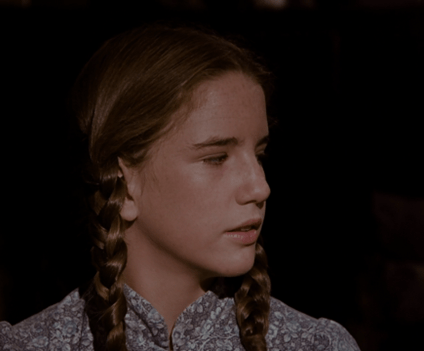
ALEXANDER: Do they take their honey to the station and see how many pints they’ll take for a ticket?
More or less! Later, in their loft apartment, Laura and Alb do agree to give their honey money to Mary and Adam.
They wake up Ma and Pa and tell them, saying Nels agreed to buy the honey for $57.60 ($1,805.86).
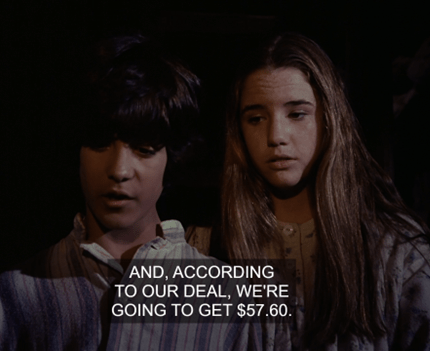
“You two worked a long time for that money,” Pa says.
OLIVE: Why is the beehive theirs instead of Pa’s in the first place?
It’s a good question. Given how they’re always complaining about money, I can’t imagine Pa would let a cash cow like that get written off as a kids’ hobby.
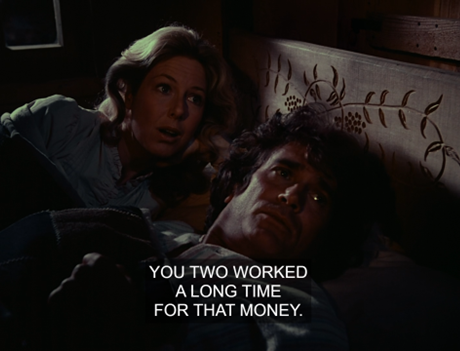
But written it off he apparently has, and when Albert expresses sappy regret that they no longer can buy Christmas gifts for loved ones, Mother, Ma bursts into a smile and says (rather hoarsely – it is the middle of the night), “Doing this for Mary and Adam is the best present you could give us.”
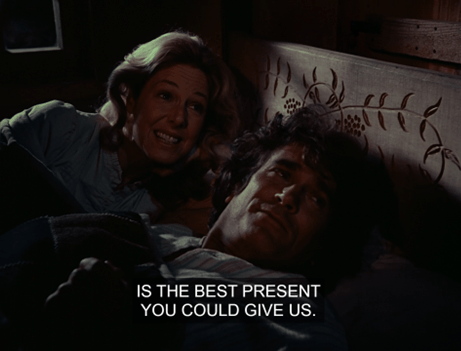
Just like he did in Burton, Iowa, Crazy Chuck jumps up and says let’s go wake Mary and Adam up and tell them.
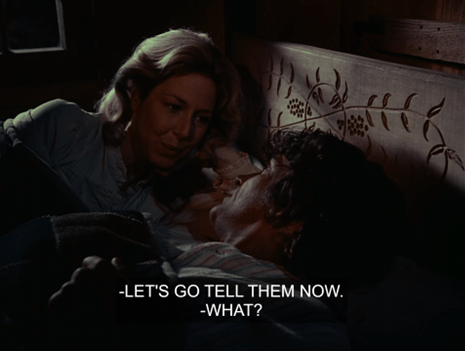
But as the four important Ingallses ready to go, Carrie slurps from offscreen, “Ma? Can I go?”
And this is one of the all-time funniest Little House moments, if you ask me. Because here’s what happens.
MA: Oh, Carrie . . . you stay and take care of your baby sister. We won’t be gone long.
CARRIE: But Pa said we’d all go!
MA [gritting her teeth and widening her eyes]: CARRIE.
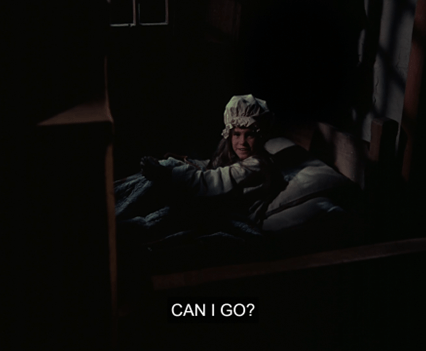
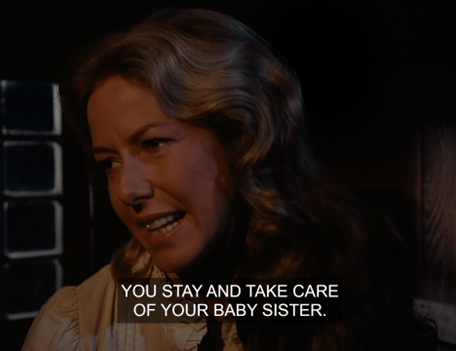


We watched this part like seven or eight times. Not only are Grassle and Linz/Sid perfect in this scene, there’s a fundamental absurdity to the exchange that adds to the humor, since they easily could have just brought Carrie and Grace along.

In other words, there’s really no need to have this little dispute in the story: They introduced it simply to give us the pleasure of seeing Ma growl at our favorite little dunderhead! Ha!
At the Oleson Institute, then, a loud knocking brings Hester-Sue down the stairs, soliloquizing as she goes.
ALEXANDER: The blind kids don’t wake up?
WILL: Their hearing is hypersensitive because they’re blind, so they wear earplugs to bed.
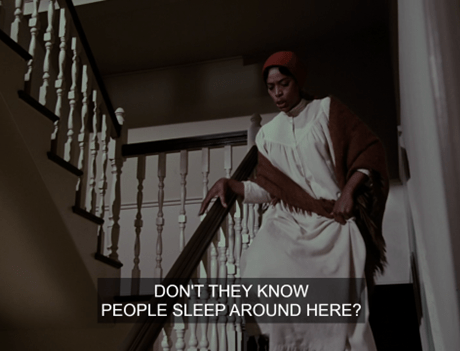
The Ingallses burst in, and the Kendalls appear at the top of the staircase.
OLIVE: Does Mary eat shit on the stairs?
WILL: They both do.
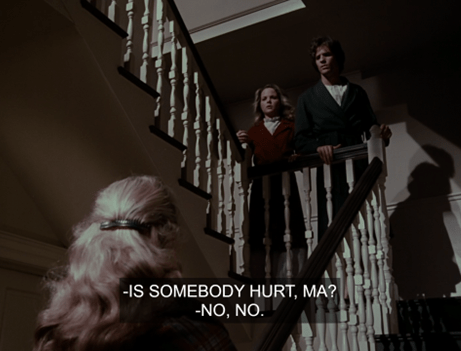
WILL: No, actually Adam should have a gun.
ALEXANDER: Yeah. They should both start shooting blindly, ha ha.
Laura and Alb share the news, and Hester-Sue proposes some hot biscuits and tea in the kitchen to celebrate, kind of like when Bertie Wooster rides his bike eighteen miles in the middle of the night and finds everybody having bacon and eggs and champagne at Brinkley Court.
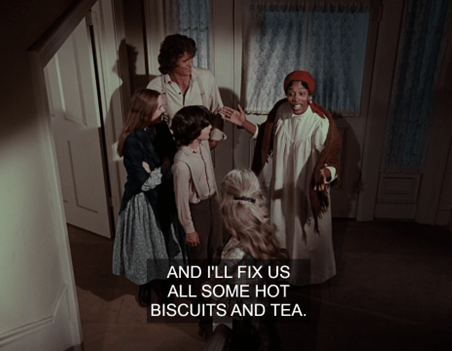
Laura and Mary embrace.
ALEXANDER: So, did they just come up with lamer and lamer plots for Mary after she went blind?
WILL: Melissa Sue Anderson wondered the same thing.
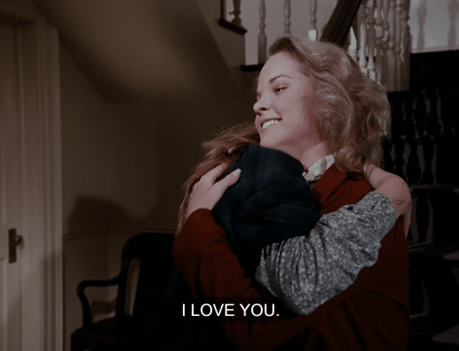
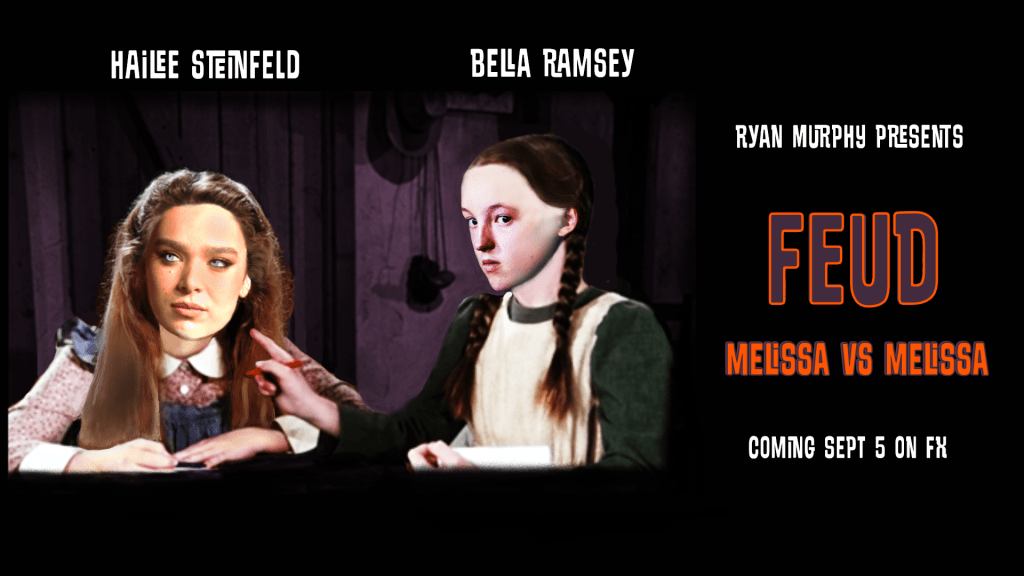
DAGNY: You know, Ryan Murphy should do a show about these two, like when Susan Sarandon and Jessica Lange were Bette Davis and Joan Crawford.
(I agree, this is a great idea.)
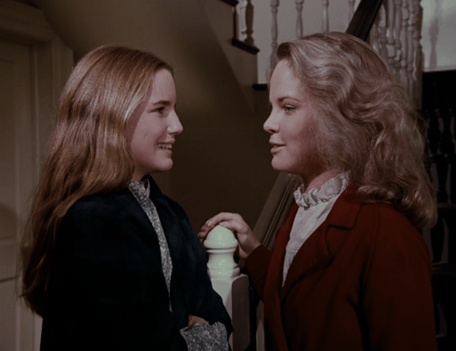
The next day, Albert and Laura drive into town by themselves! I’m quite sure this is the first time that’s happened.
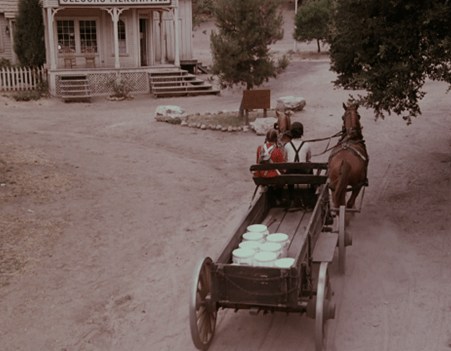
Out of the Mercantile come the Customer, the Unknown Bonnet-Wearing Woman (I think) and, correct me if I’m wrong, Seth Johnson from “I─── Kid.”
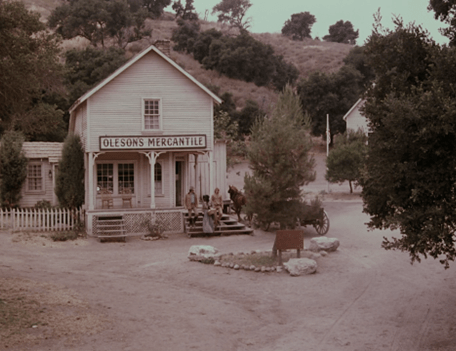
Inside, we see Harriet Oleson finishing a transaction with a woman whose face we can’t see. According to Mrs. Oleson, she’s “very amusing.”
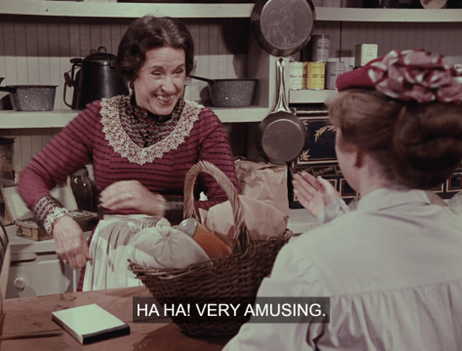
The kids come in asking to sell their honey, saying Nels promised them 30 cents a pound.
OLIVE: Would they really have made that much?
Well, just like today, honey was a valuable and expensive commodity, but I was able to find one price sheet suggesting the value of honey in the United States in 1882 was just nine cents per pound. That adds up to $19.44 for 216 pounds, or about $600 in today’s money. I know it makes no difference to the story, I just wonder why the dollar amounts for everything are so inflated in this one. They’re usually much closer to reality.

Anyways, Nels is out of town, and Mrs. O, also wondering why the amounts are so inflated, offers 15 cents a pound instead. (That’s still better than nine!)
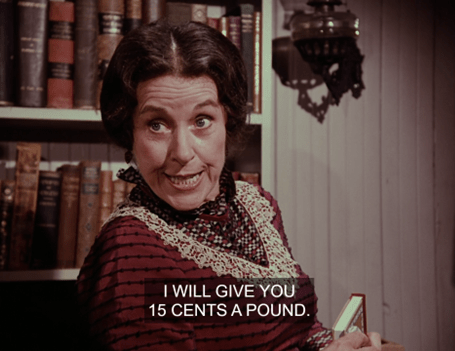
This stops Laura in her tracks, but Albert has an idea. He says if Mrs. Oleson will pay full price, they’ll sell her the hive as well.
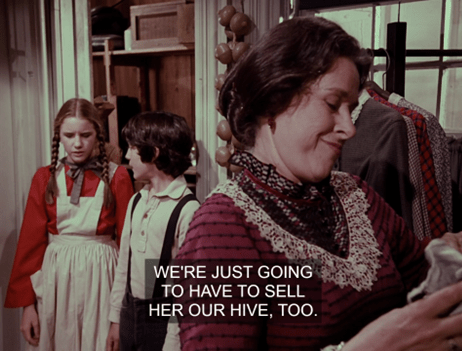
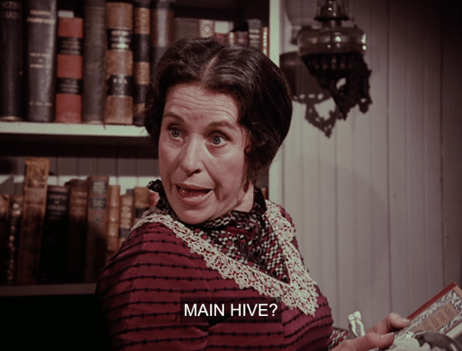
He says it like it’s some big trick, but no, they really do sell it to her. (We’ll discuss the wisdom of that in a bit.)
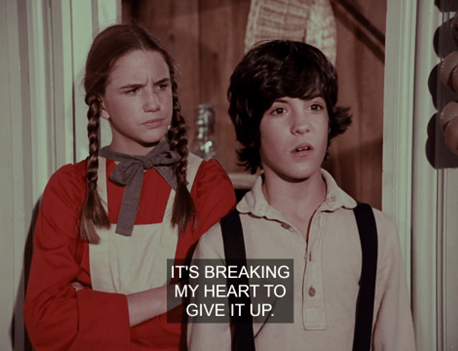
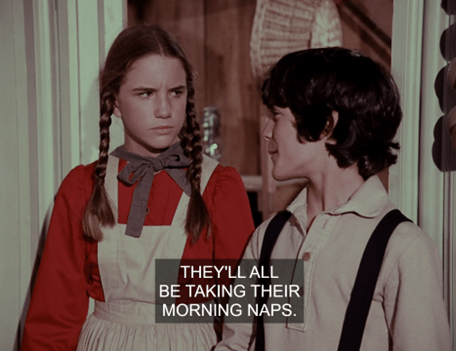
The only trick is that Albert apparently is recommending they pick it up at a time of day they’re likely to get stung, though he doesn’t exactly say that. (This whole business seems a little odd to me, but MacG is a scream as usual.)

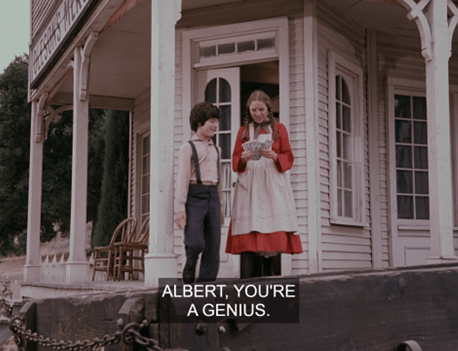
Albert and Laura exit, counting their money. “Albert, you’re a genius,” Laura says.
OLIVE: This annoys me. Laura used to be the problem-solver, now it’s always Albert. They’ve gotta have a boy figure it out somehow.
Menacing Rimsky-Korsakan music culminating in a Rose-y flourish takes us back to the bees before we head to a commercial.
We return to the Oleson Institute, where Adam is twiddling nervous fingers in bed whilst Mary tries to sleep.
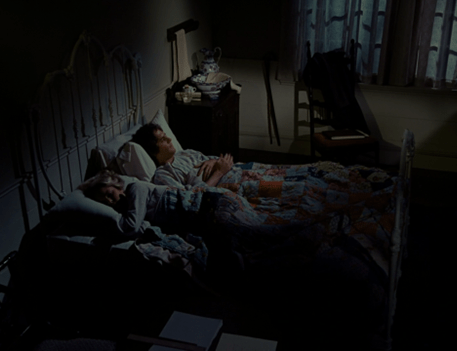
David again gives us his moody piano solo, “Adam’s Un-Cozy Dressing Gown.” Not sure how Mary and Adam’s bedroom wound up with its own musical theme – a depressing one at that – but here we are.
OLIVE: Is that their poop bowl? It’s quite nice, if so.
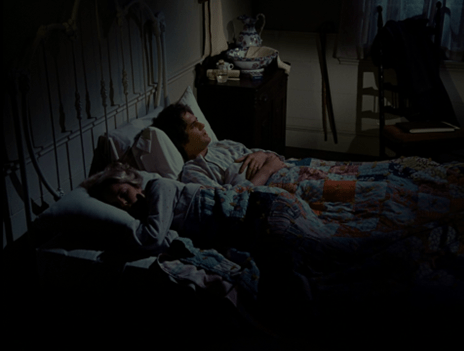
Adam gets up and starts wandering around the room, which wakes Mary up.
“I’m worried,” Adam says, and Mary replies, “About what?”
WILL [as ADAM]: “The water, THE WATER!!!”

Actually, it’s having to give a speech that’s frightening him this time, even if he will have to cross streams and rivers to reach St. Paul. (Including the mighty Mississipp’!)

(Come to that, how did he handle the trip from Iowa to Winoka?)
Anyways, Adam goes on and on about having to speak, saying he has no idea what to say to all the important people in the audience.
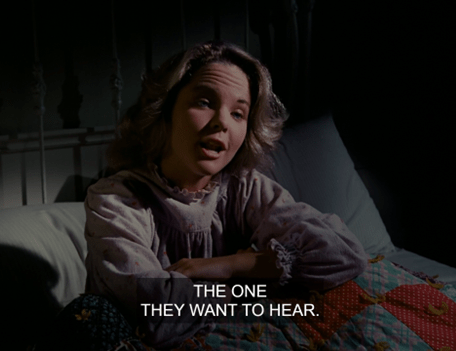
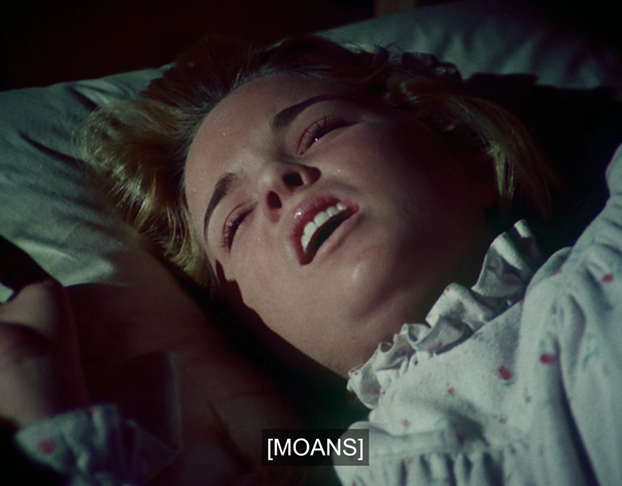
Mary, whose hair and makeup look beautiful for somebody waking up in the middle of the night, says, “Adam, you’re the one they’re giving the award to, the one they’re coming to hear. The one they WANT to hear!”
OLIVE: Yeah, he could say anything he wanted. He could just tell a bunch of dirty jokes.
Mary suggests he talk about how he’s the first blind teacher to get the award. (Well, I expect they’ll mention that in his introduction, Mare.)

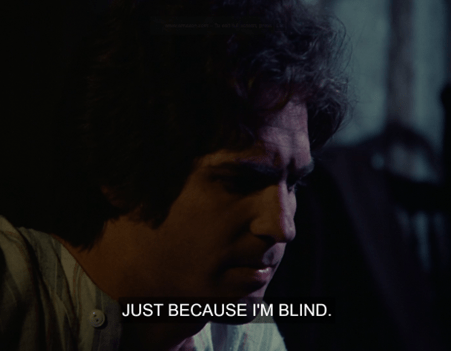
Adam objects, because “I don’t want people to think I’m something special just because I’m blind!”
OLIVE: That’s a pretty stupid objection. It’s a blind-person event!
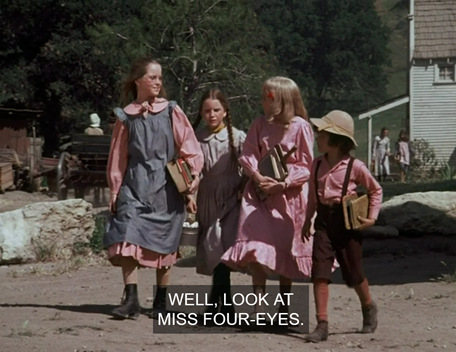
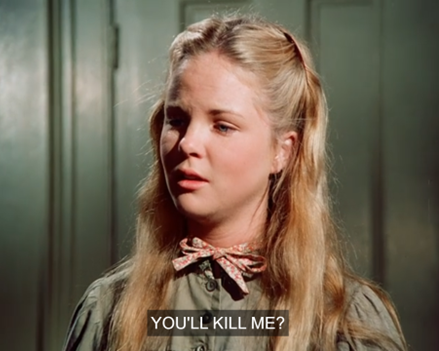
Out of nowhere, Mary starts reminiscing about how she was called Four-Eyes in school.

(It’s true, this did happen.)
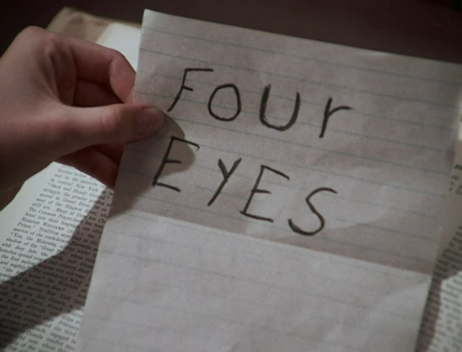
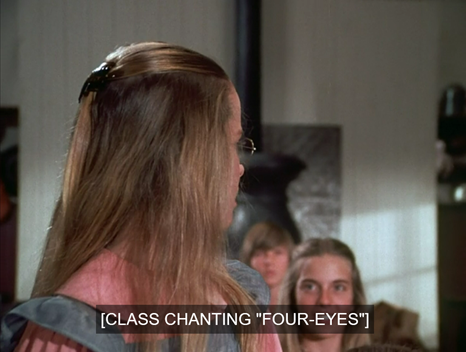
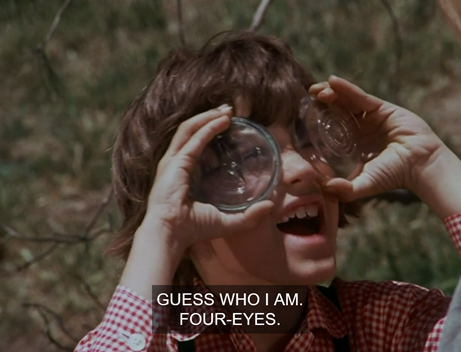
Mary says at the time, she thought life couldn’t get any worse. (Ha ha! Ha ha ha!)

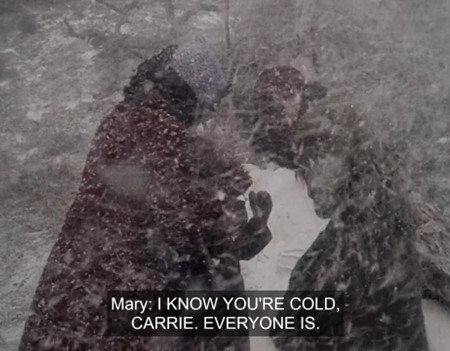








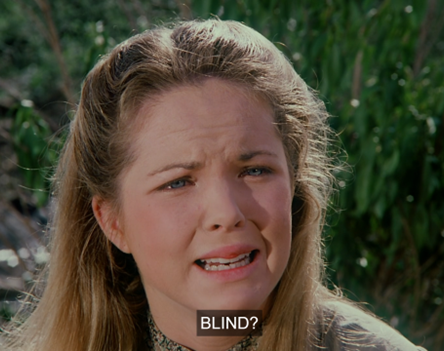
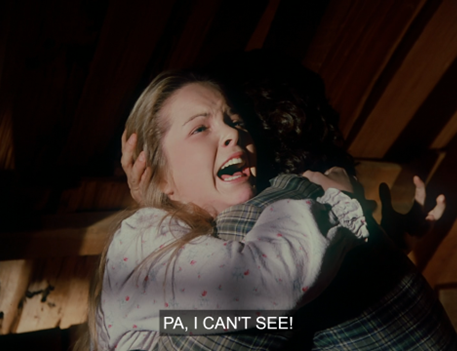

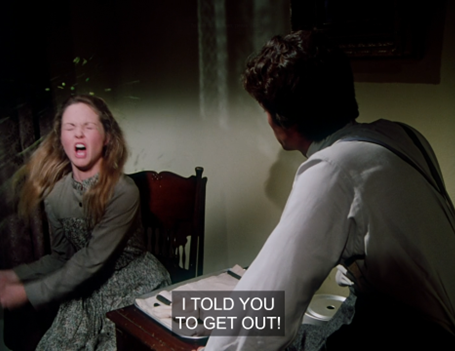
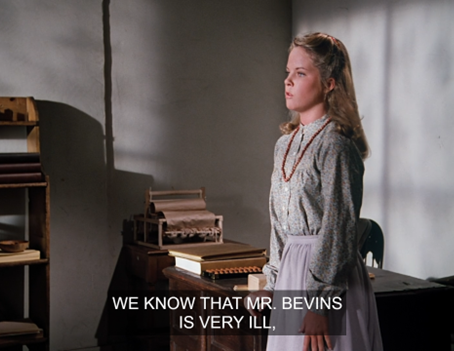
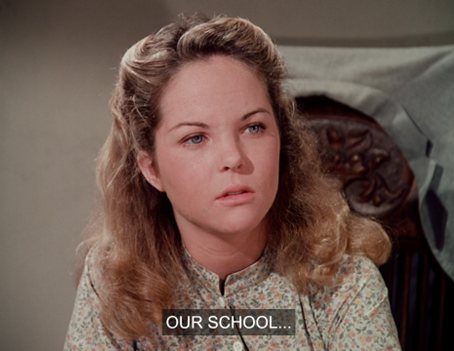


As an idea, it’s barely worthy of inclusion as a single sentence, much less the basis for a whole speech; but Adam gets very excited and says it’s perfect, and actually, Mary should give the speech for him!
OLIVE: Is he serious? They couldn’t do that. They’d get booed off the stage.
WILL: Nah, she could just do a deep voice. [as MARY playing ADAM:] “I’m proud to accept this award. I’d like to thank my wife Mary in the audience. . . .”
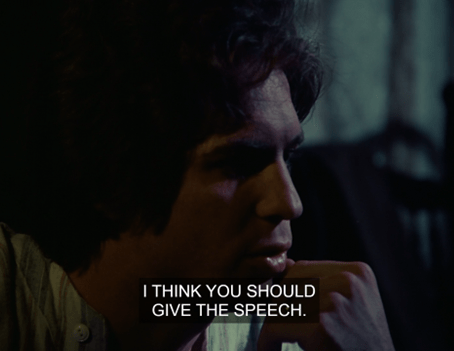
Adam goes on and on, suggesting Mary’s old glasses would be great to wave for emphasis during the speech. It’s an odd thing to fixate on, but it’s necessary to the plot, and they continue talking nonsense like this for a while.

Well, the day of their departure arrives, and we see a familiar face exiting the Post Office.
It’s Ned Watkins, the Bill Clinton-looking stage driver we met in “The Aftermath”!
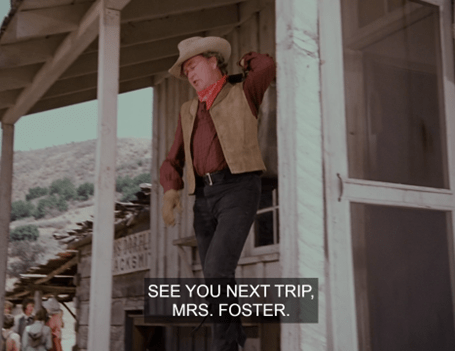
You’ll recall he was one of the only characters in that crazy story who demonstrated any sense. (Troy Melton returns as Watkins.)

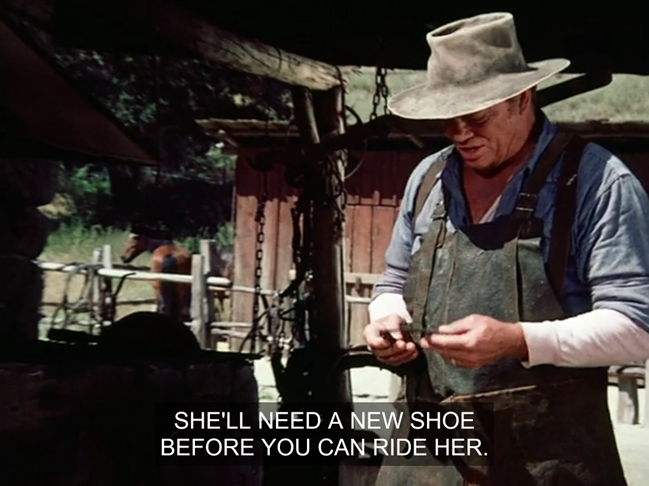
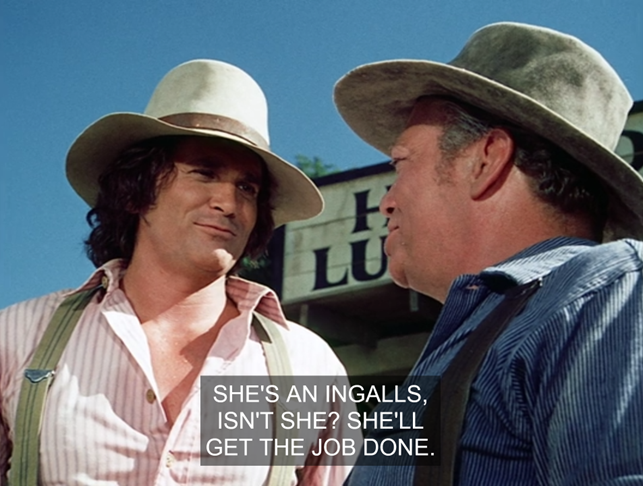
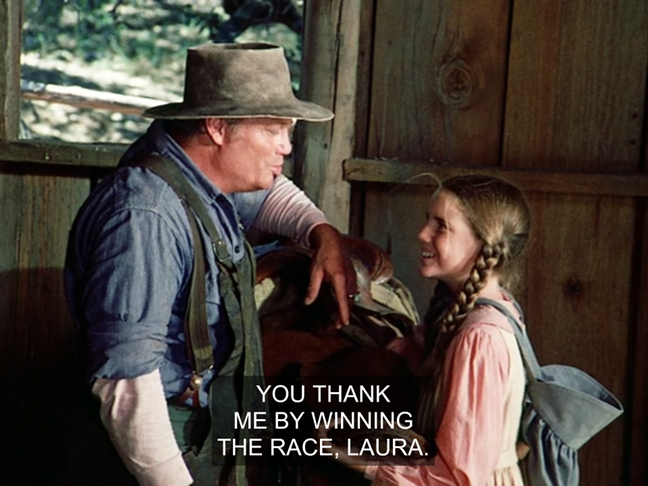
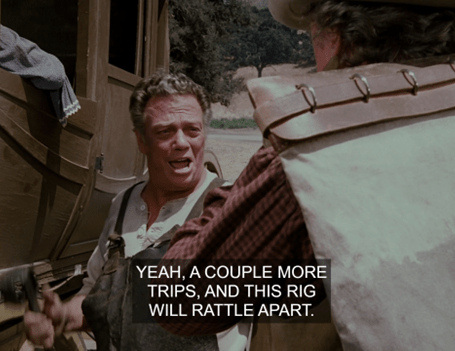
In the thoroughfare, Hans Dorfler is servicing Watkins’s stagecoach.
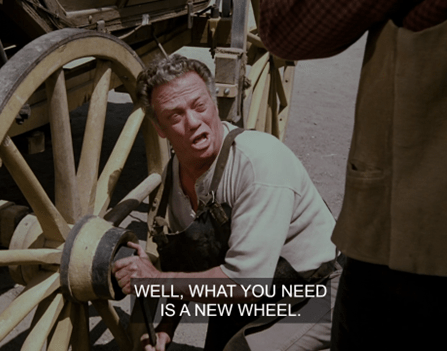
Dorfler says the vehicle’s in rough shape, and Watkins says the company doesn’t like paying for repairs.
(Sadly, this is James Jeter’s final appearance as Dorfler. Farewell, old friend!)
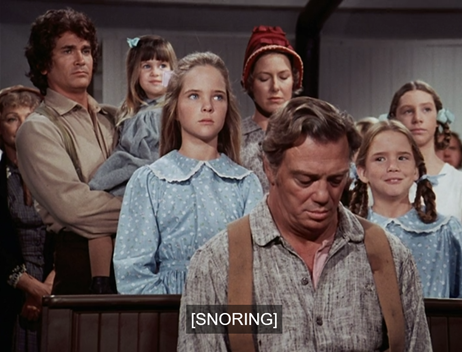
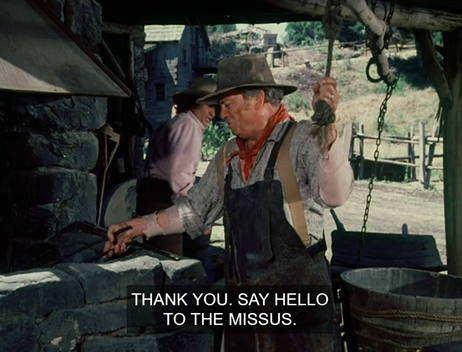



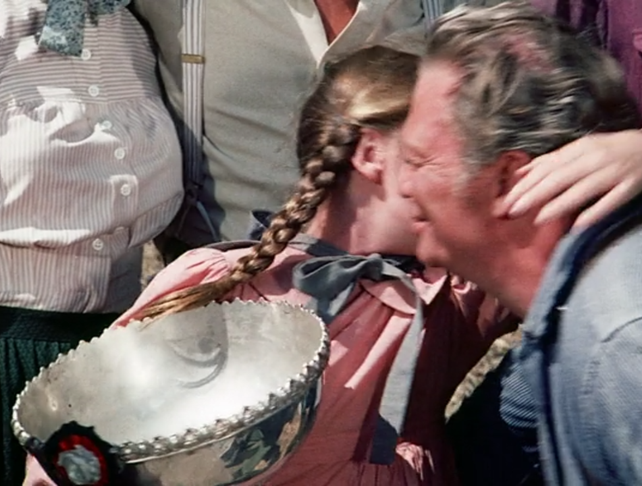
[UPDATE: I’ve been reminded that we do meet Dorfler one more time this season. Stay tuned. – WK]
Charles takes Watkins aside and discreetly tells him Mary and Adam are blind and might need extra help.
WILL: He should throw in a jar of honey for taking care of them.
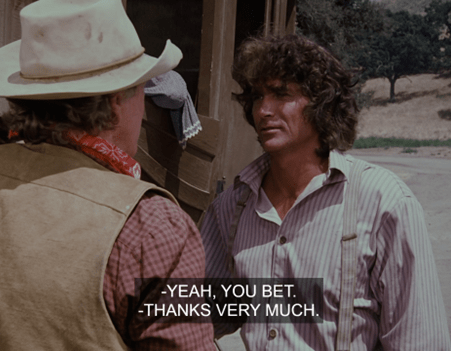
As they say goodbye, Adam jokes again that Mary will be making the speech at the ceremony.
OLIVE: I like Mary’s bonnet. It’s cute.
WILL: She always has favored straw hats.
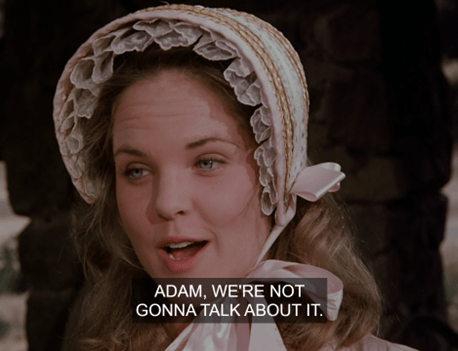
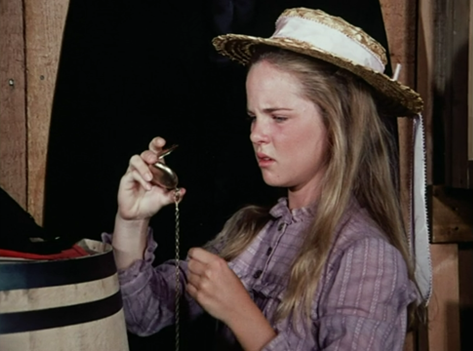
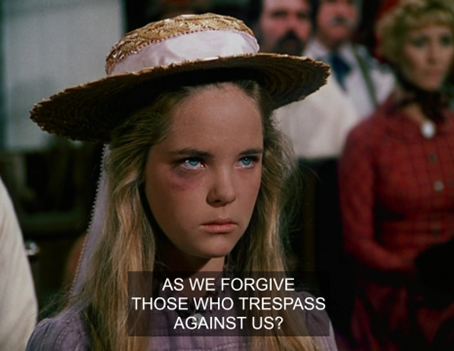
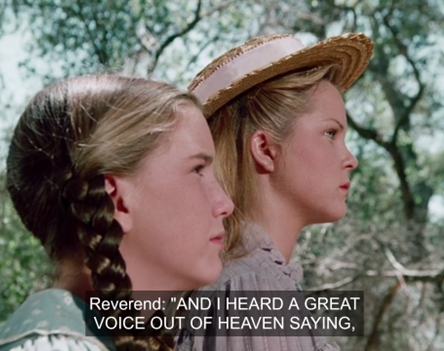

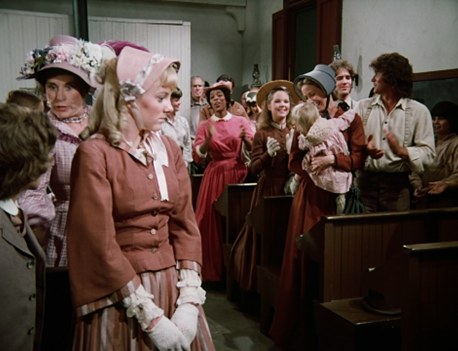
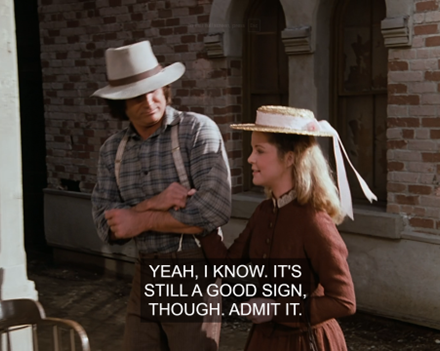
With thanks, Mary and Adam bid farewell to Laura, Albert and Boobilious Ma. Ma gives Mary her old spectacles, saying Adam told her she’d want them. (Mary doesn’t roll her eyes, of course, but you can tell she wants to.)
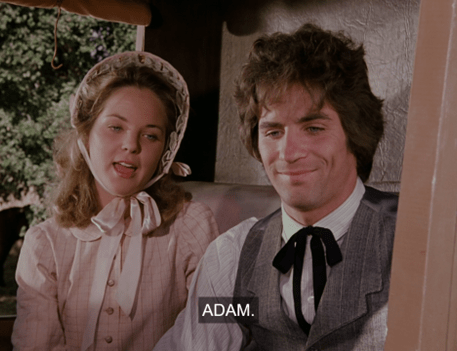
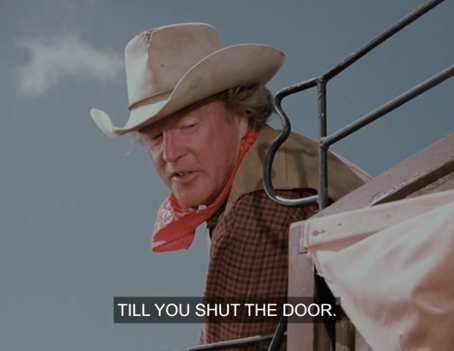
Ned Watkins says, “All right, folks, we can’t pull out till you shut the door.”
ALEXANDER: Sure you could. It was the Wild West.
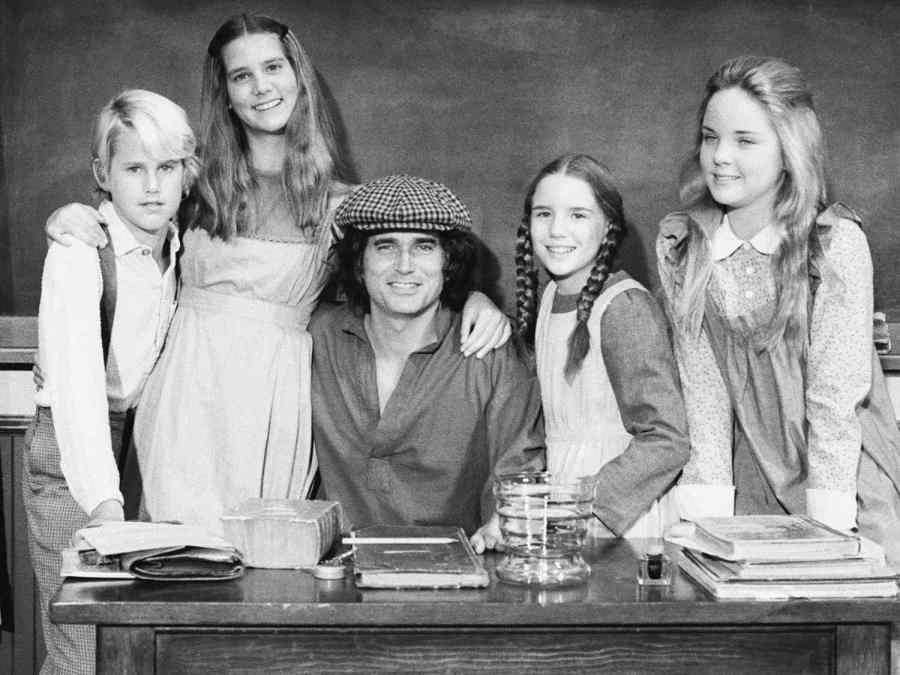
There’s one other passenger in the coach, and it’s another familiar face: Leslie Landon!
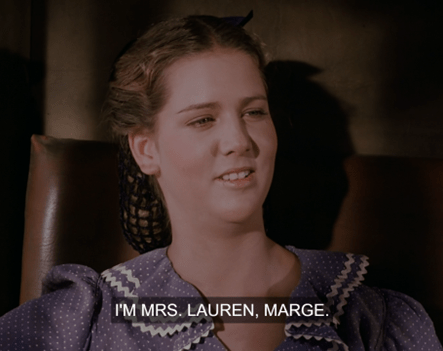
She introduces herself as “Mrs. Loren – Marge.”
Marge says she’s headed to Minneapolis to join her husband, Stan, who’s just gotten a job as a mill worker. (We went into Minneapolis’s history as the “Mill City” in another recap.)
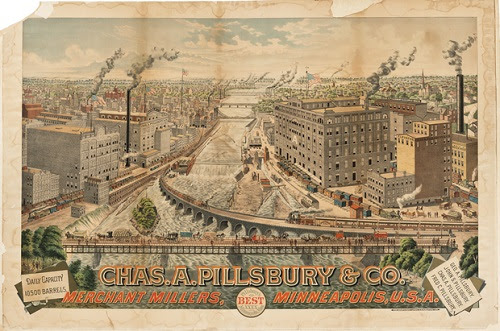
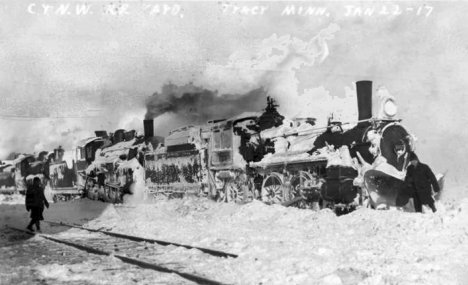
Marge says they’re from Tracy – a real town that’s been mentioned before.
We only see Marge from the shoulders up, but she tells the Kendalls she’s seven months pregnant. (Leslie Landon was only sixteen when she filmed this one, but you know – Little House.)
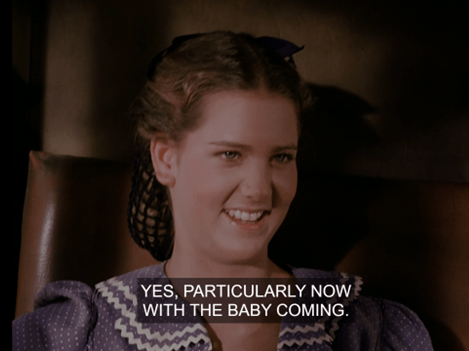
This is Leslie Landon’s most substantial part to date, though we have met her twice before, in “Plague” and “The Election.”
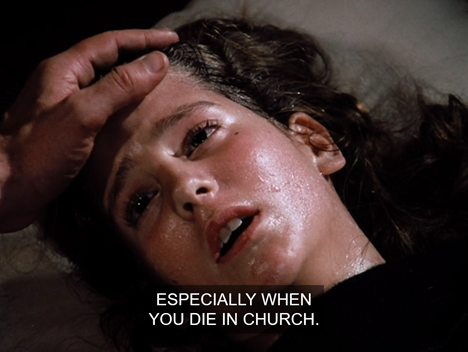
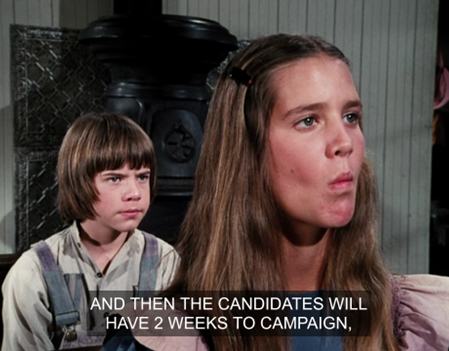
Plus of course she’ll return as Miss Plum later on the series.
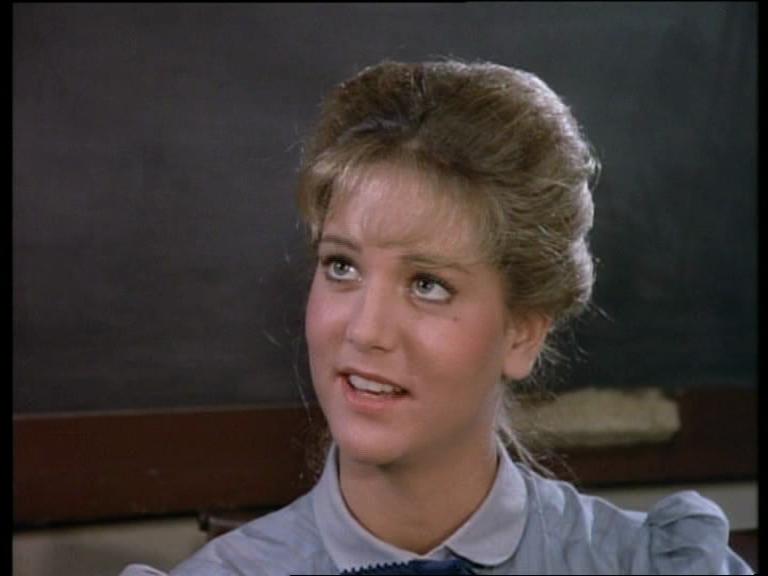
Her performance in that role gets mixed reviews from fans, but LL is by all accounts a nice and smart person (she has a therapy Ph.D) and she’s always popular on the Little House convention circuit. (She was in Walnut Grove when we were there for the fiftieth last year.)
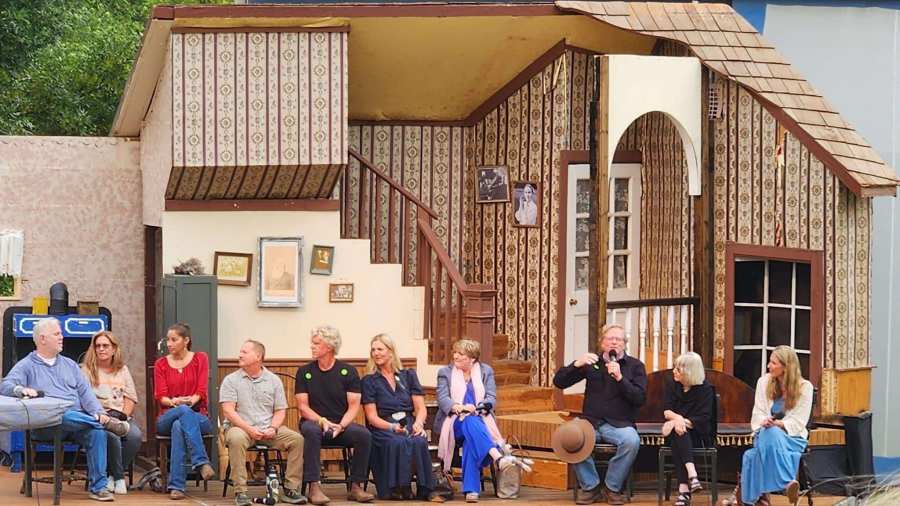
She also was probably Melissa Gilbert’s closest friend on the set.
Anyways, the passengers complain how bumpy the ride is, though I imagine that was to be expected in those days.
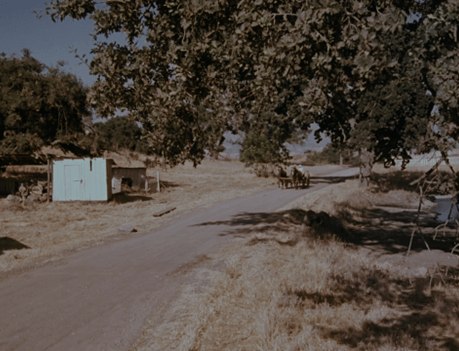
Back in Hero Township, Mrs. Oleson and Nellie drive out to the Little House to pick up the beehive they just bought.
OLIVE: This is such a dumb plan. Give away the hive when they’re so poor, just so Adam can go to the Twin Cities? Pa would never let them do it.
ALEXANDER: Yeah. It would be like giving away the chicken coop without asking.
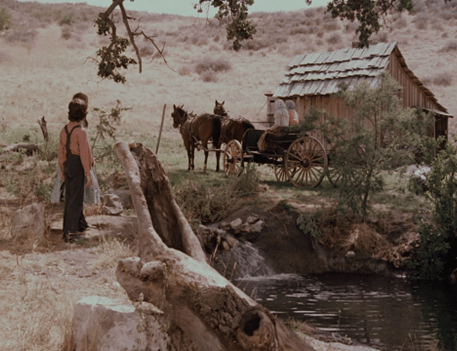
Albert points out the hive and says in addition to the honey, it produces beeswax, which they can have at no additional charge.
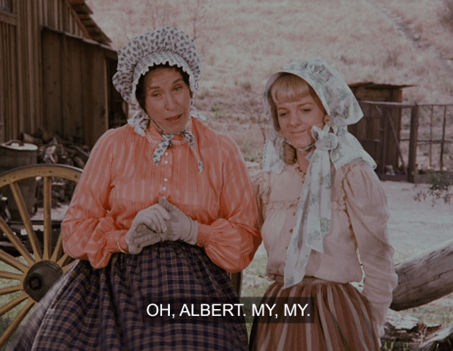
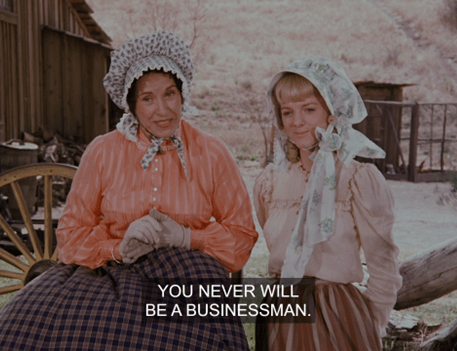
“Oh, Albert, my, my!” Mrs. O says hilariously. “You never will be a businessman!”
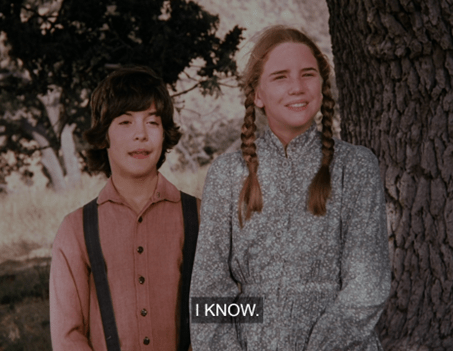
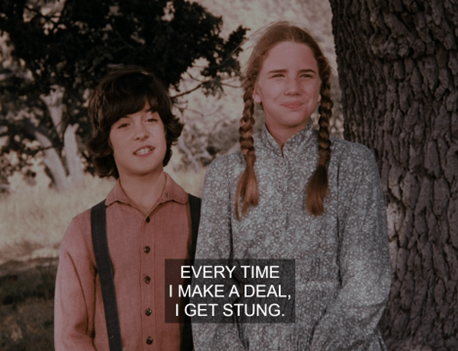
“I know,” Albert replies. “Every time I make a deal, I get stung.” Ha! On-the-nose, but I love it.
(I wish Katherine MacGregor and Matthew Labyorteaux had more scenes together. They have good chemistry.)
Anyways, beeswax is a substance with a million different uses, then and now. (I myself used it on the connecting parts of musical instruments in a past life.)
Elsewhere we discussed the expression “Mind your own beeswax!”, which supposedly originated from people using the substance to fill in facial scars from smallpox and shouting “Mind your OWN beeswax!” if anybody noticed. (Preposterous and untrue, of course, but I love the story.)

So Mrs. Oleson and Nellie pick up the log (others have pointed out two normal humans would not have the strength).
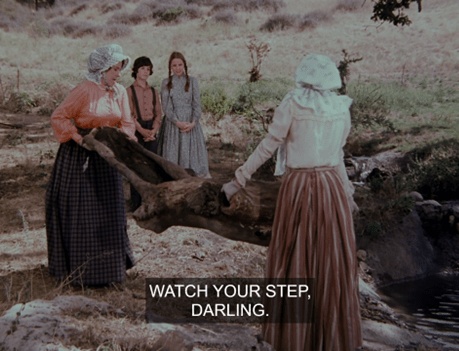
It’s buzzing, but there’s no sign of any bees. (This is also not explained – perhaps the kids gave them the smoke treatment first?)
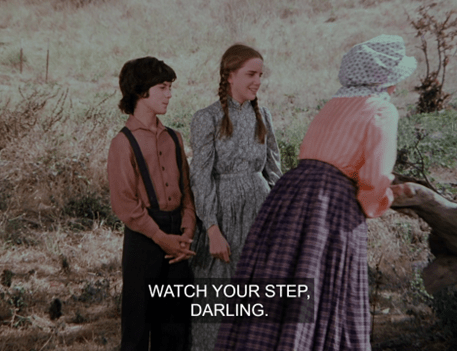
David gives us his “farting trombone” arrangement of Albert’s theme as the ladies depart and Laura and Alb fang out.
Unusually, then, the trombone jumps up to play the solo in a waltz as the Olesons drive away with their purchase.
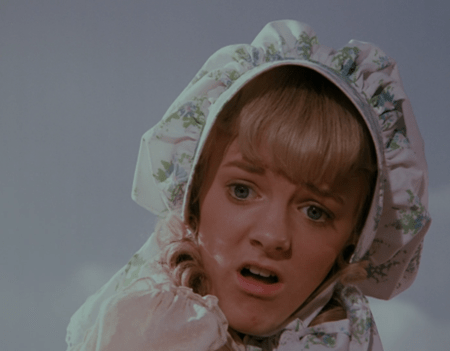
Well, the bees go crazy and attack.
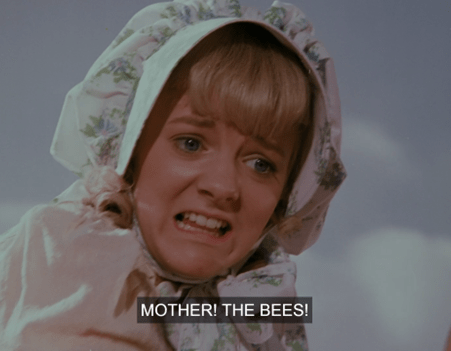
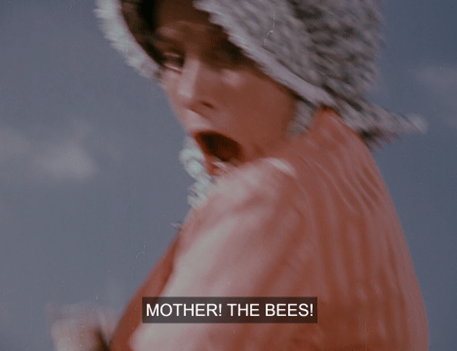
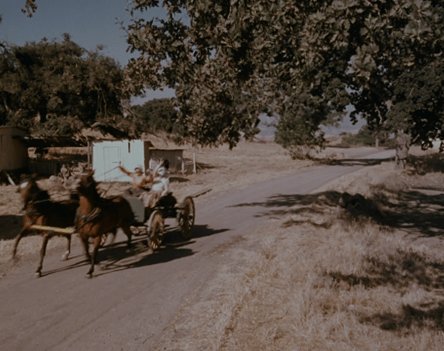
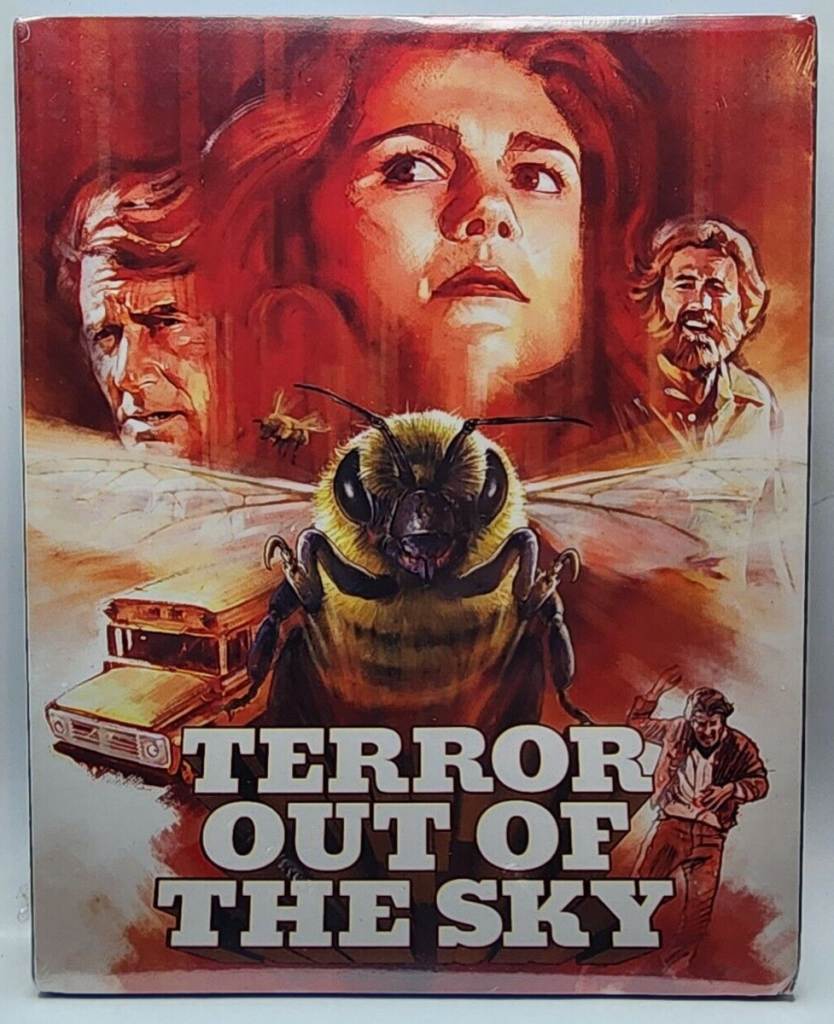
The 1970s and early 1980s were kind of the heyday of panic over killer bees – more properly known as “Africanized” honeybees, as they were genetically engineered in the hopes of making European honeybees better at making honey in hot climates. They were bred in Brazil, but escaped the lab (or whatever) and have now spread into several southern U.S. states.

I remember a teacher frightening us with stories about them when I was a kid. In personality, essentially they’re normal bees who’ve gone off their meds; they are fairly nasty and they have killed a number of people over the years.
There were a few horror movies made about them in the seventies, and it’s not impossible to think they might have provided a germ for this episode.

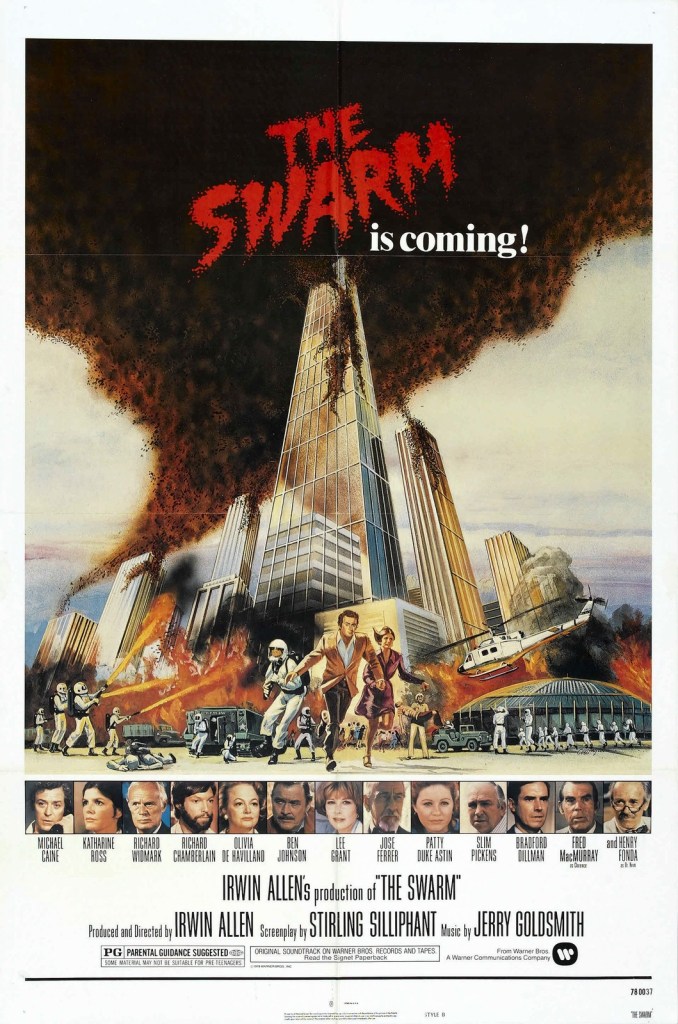
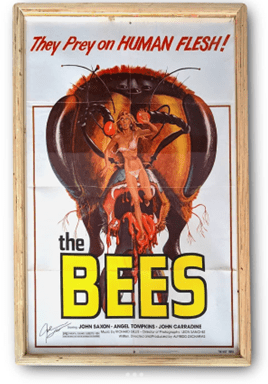
After another commercial, we rejoin the stage on the road to Sleepy Eye.

The Kendalls and Mrs. Loren continue making idiotic smalltalk.
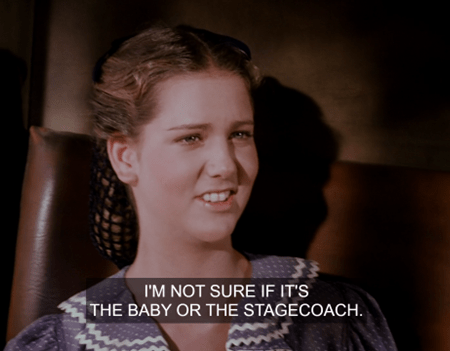
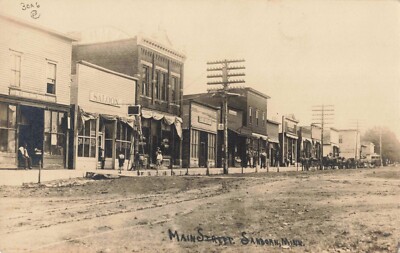
In the driver’s seat, Ned Watkins hears one of the wheels squeaking and tells the passengers they’re detouring to Sanborn for a repair. He reassures them they won’t miss their train.

Sanborn’s a real place too, about halfway to Springfield from the Grove.

Adam complains about still having to make his speech, and Mary says, “Oh, you!” (Which cracked me up.)

Well, they don’t make it to Sanborn, because the stagecoach suddenly starts falling apart.
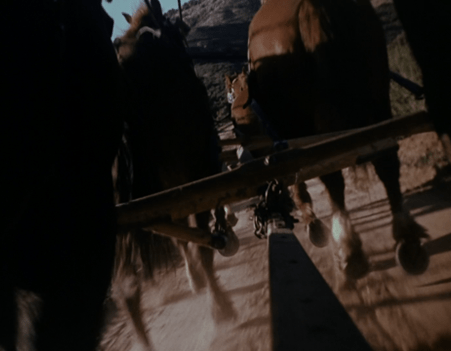

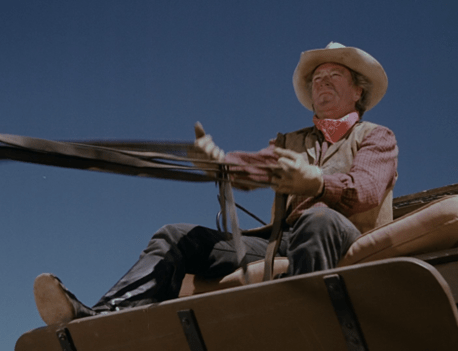
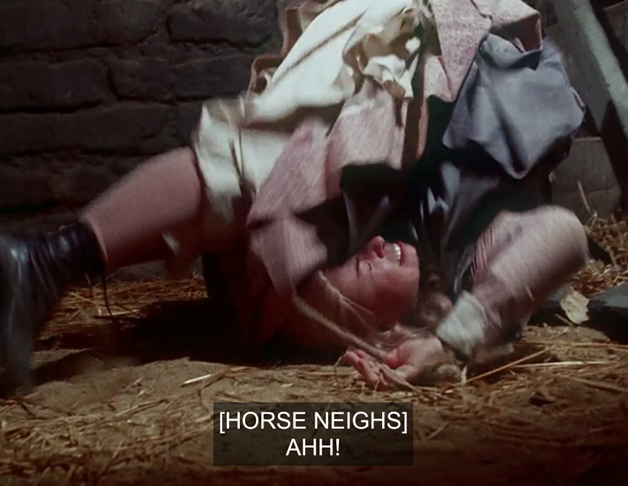
The horses run off, and the vehicle somersaults crazily down a hill. (The production team always does this well, both in shooting the actual coach catastrophe – how do you even get a stagecoach to somersault? – and in putting the camera in a washing machine to film to the interior shots.)
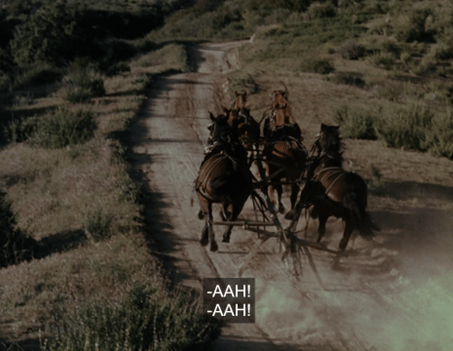
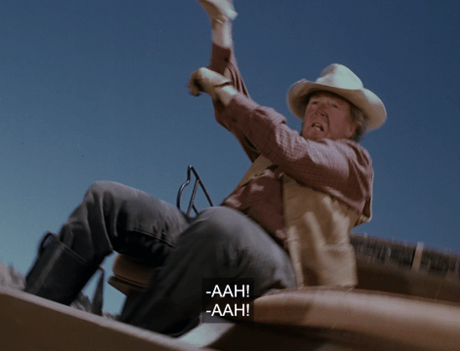

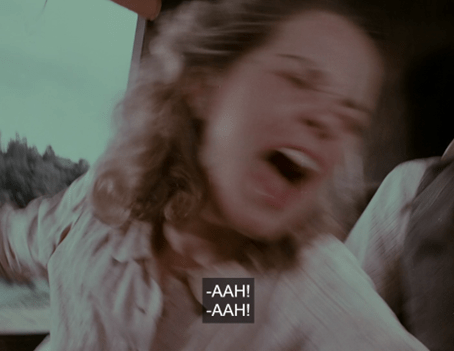
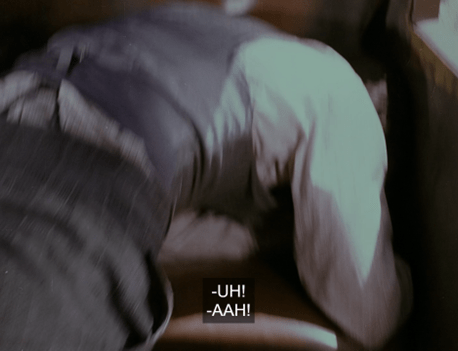

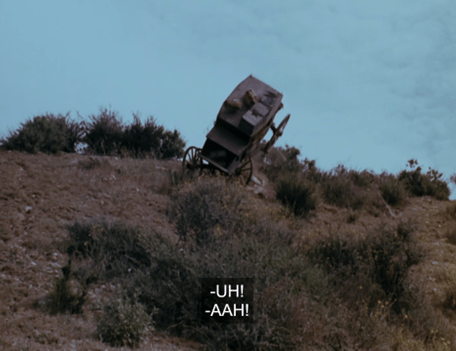
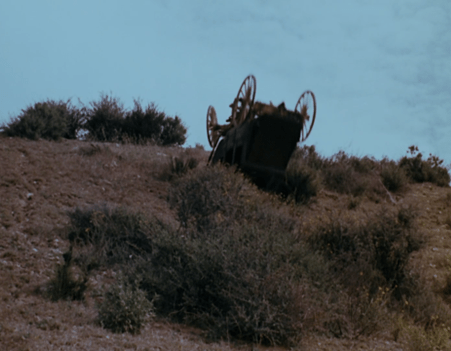
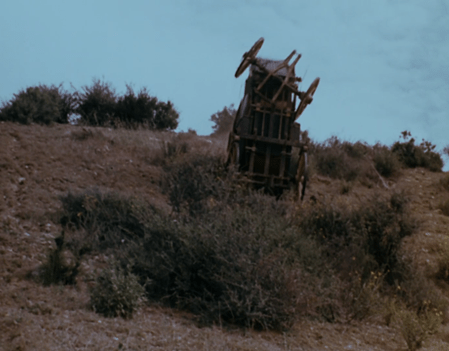
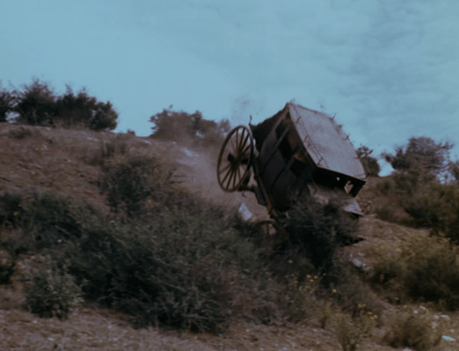

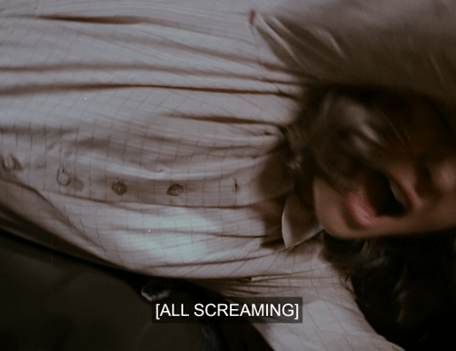
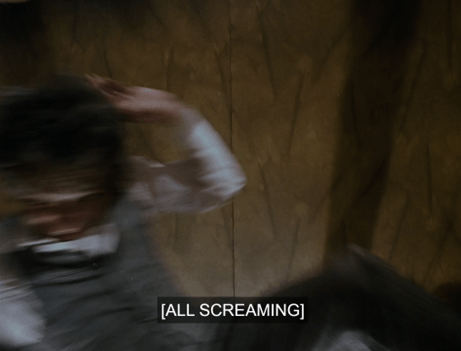

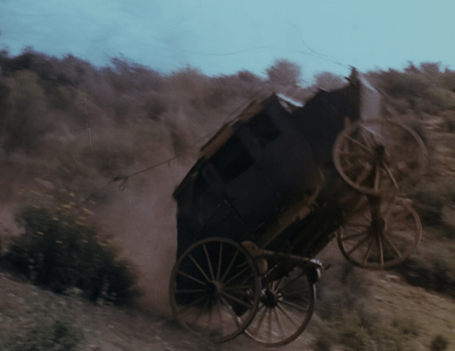
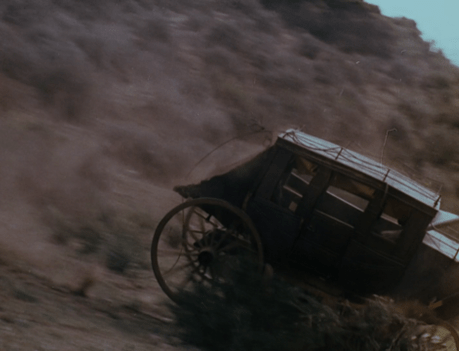
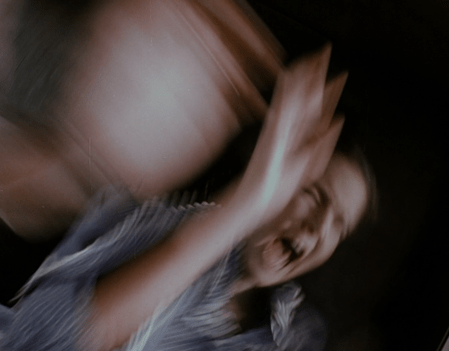
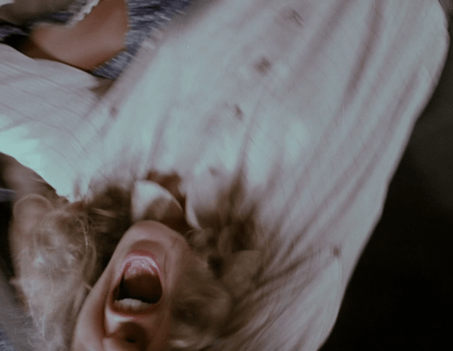

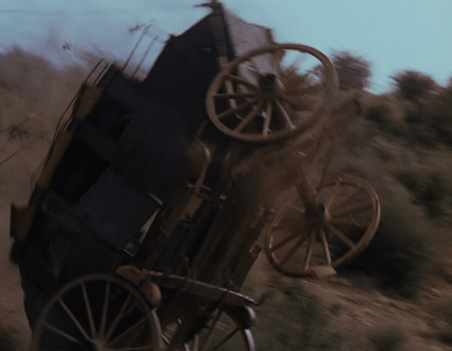
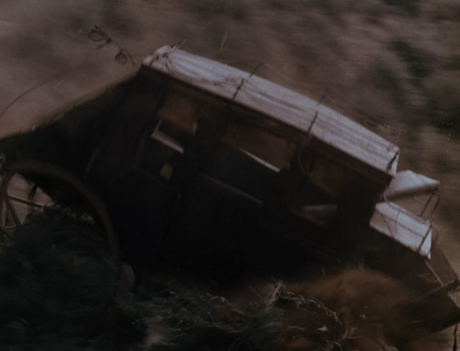
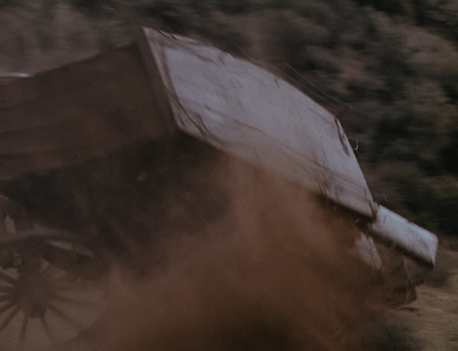
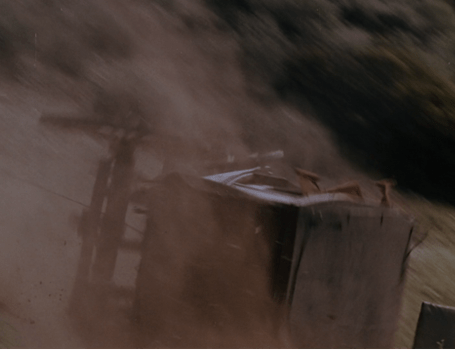
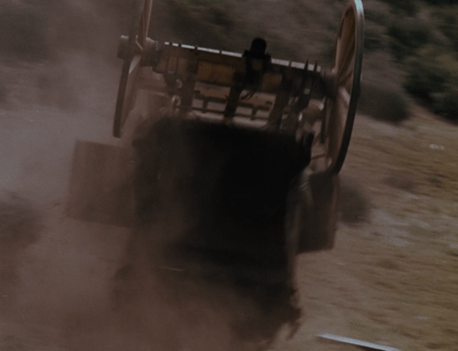
In fact, I’d rank this one amongst the great Little House crashes, up there with Alan Fudge’s seedcorn wreck, the upcoming accident that kills Jason Bateman’s parents (spoilers), and, of course, Miss Beadle’s wild ride in Season One (the gold standard).

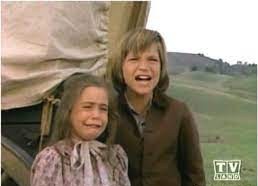
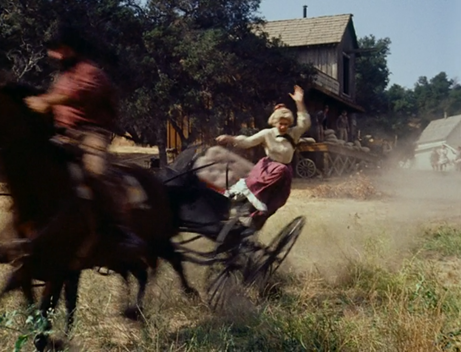
As the stage comes to a stop, Adam is thrown from the door.
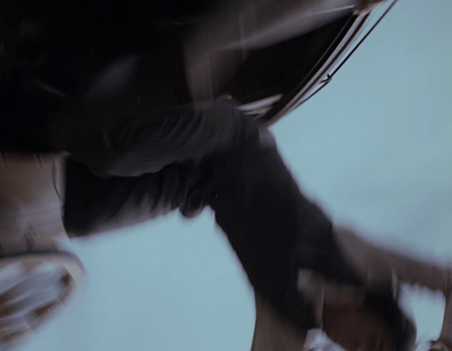
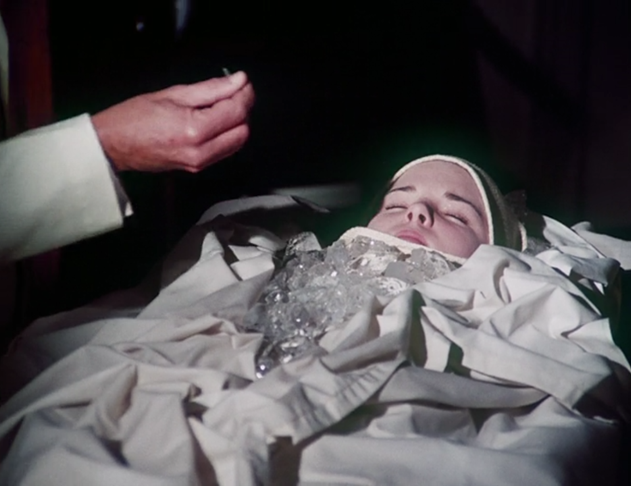
Mary and Marge are knocked out in the crash, but Mary comes to pretty quickly.
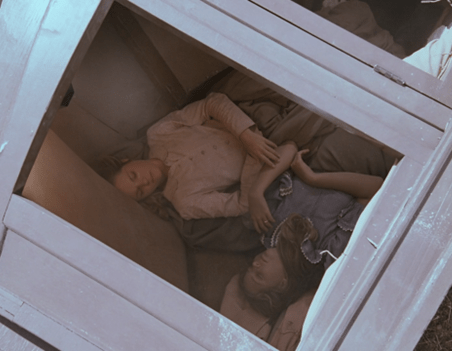
She pokes Marge in the face, then she and Adam start yelling to each other.
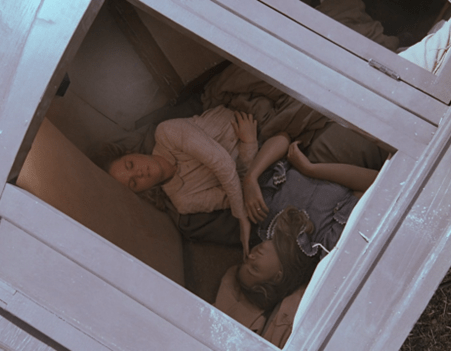

Mary feels her way through the door and climbs up onto the outside of the stagecoach. This is Little House, so you know she’s going to be okay, but for the rest of the episode Landon milks suspense from when, where and how she’s going to fall on her face.
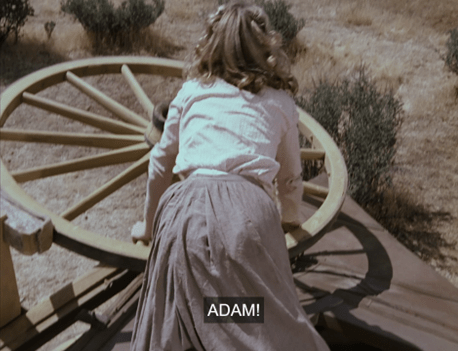
Mary finds Adam alive but pinned to the ground, his legs crushed under the vehicle.
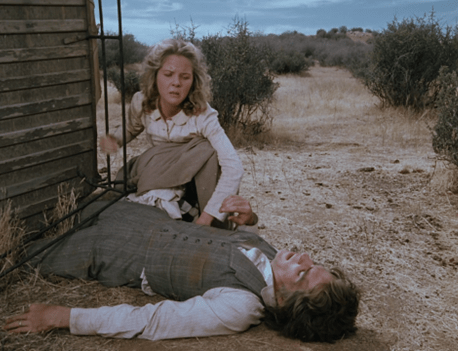
I’m not sure if he could have ended up in this position based on how the coach rolled. But what am I, a physicist?

Mary vainly tries to lift the stage off her husband. So much for the supposed incredible strength people gain in near-death situations!
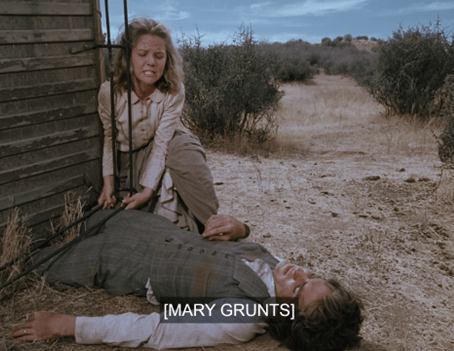
Adam, who doesn’t seem to be in much pain, yells at Mary to knock it off. That’s gratitude for you.
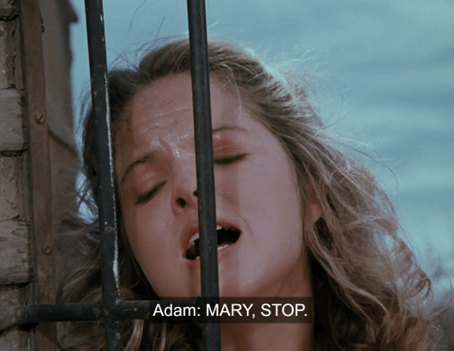
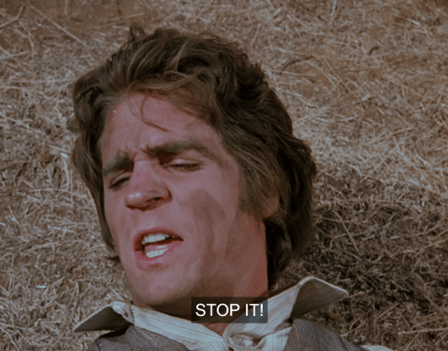
Then Adam asks about Marge, and Mary says she could tell by poking her in the face that she wasn’t dead. (Paraphrase.)

Then he asks about the driver, about whom Mary apparently hasn’t spared a thought.
Mary calls for Watkins, but as the camera backs away we see he’s lying on the ground some distance from the stagecoach, oozing gore.

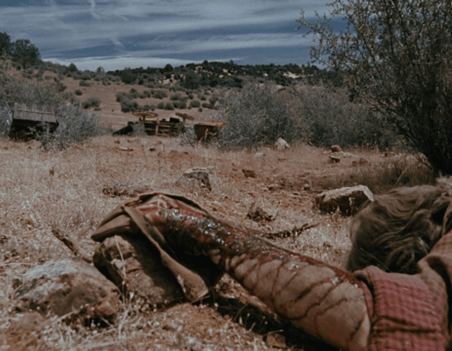
ALEXANDER: This is pretty gruesome for Little House.
OLIVE: Yeah, what is this, Ravenous?

I know what you’re thinking, and I agree. Thank God it wasn’t Mustache Man!
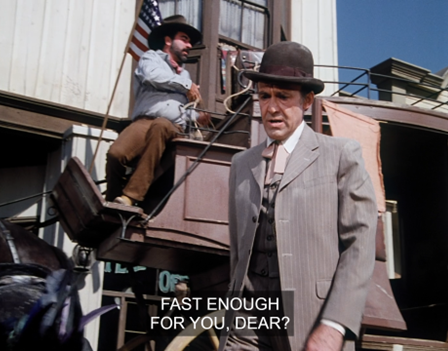
Back in Walnut Grove, Mrs. Foster is taking down another message.
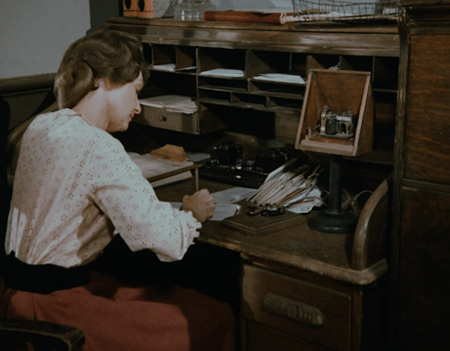
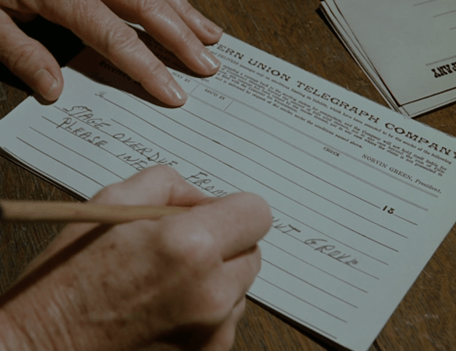
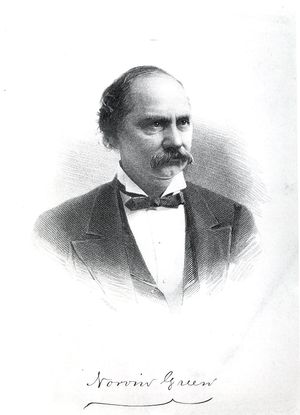
We see the tablet she’s writing on, indicating the system is Western Union’s, the telegraph company that dominated the U.S. by this time. (It also correctly identified the company’s contemporary president as Norvin Green.)
Alarmed by the message, Mrs. F rushes past Mustache Man and out into the thoroughfare.
ALEXANDER: Poor Mustache Man.
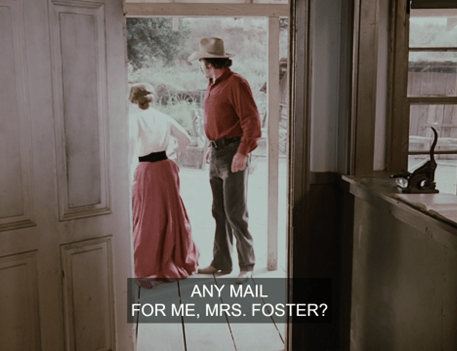
She flails her way over to the Mill, where Charles and Jonathan Garvey are working.

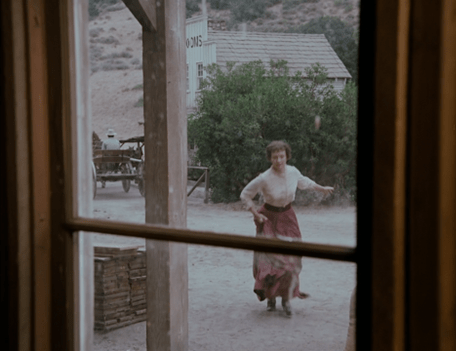
Addressing Charles by his first name, which is interesting, she tells him the Watkins coach never arrived in Sleepy Eye. (Is this the next day? It’s a good full day’s drive to Sleepy Eye – a good full day’s drive – so Adam and Mary wouldn’t have been missed until after dark that day. And they probably wouldn’t have raised an alarm immediately, especially given all they’ve had to put up with from Walnut Grovesters and their associates over the years.)
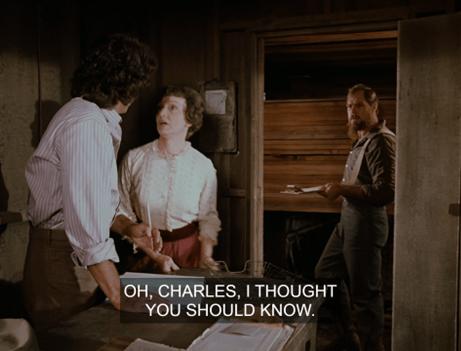
Charles isn’t overly concerned, but he and Garvey shut down the Mill to head out a-lookin’ for them. (No wonder they’re poor, if that’s their work ethic.)
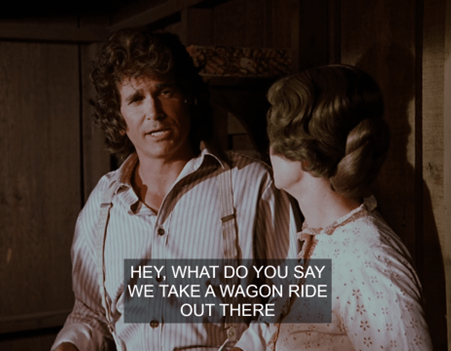
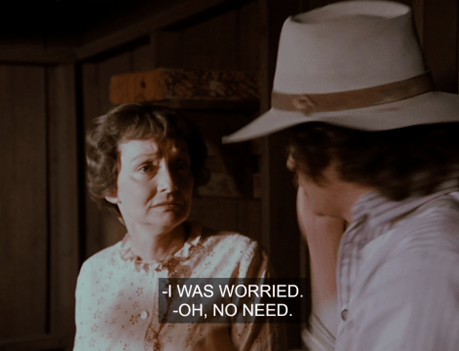
Charles thanks and comforts the worried Mrs. Foster. It’s always nice when she gets a good part in the story.
Out on the road, the sun is baking, and Ned Watkins is still dead.

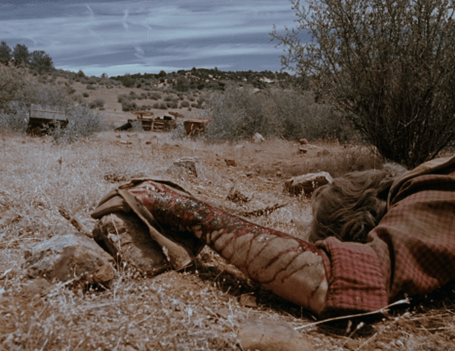
(Not to flog a dead Ned, but the timing is a bit of a puzzle. Sleepy Eye is about fourteen hours from Walnut Grove on foot, obviously somewhat faster by stage. But if the crash happened at the turnoff to Sanborn, that’s only about halfway there. We don’t know what time the stage left, but it must have been early in the day, since the sun was up at the time of the accident. But the vehicle wouldn’t have been due in Sleepy Eye until evening. I think we’re forced to conclude that one night has indeed passed with our protagonists – and Ned’s corpse – unmolested by animals, and this is the next day.)

High above in the sky, a vulture screeches.
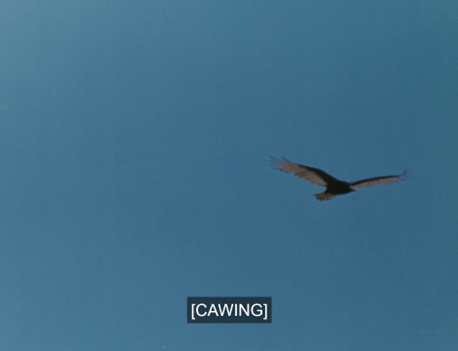
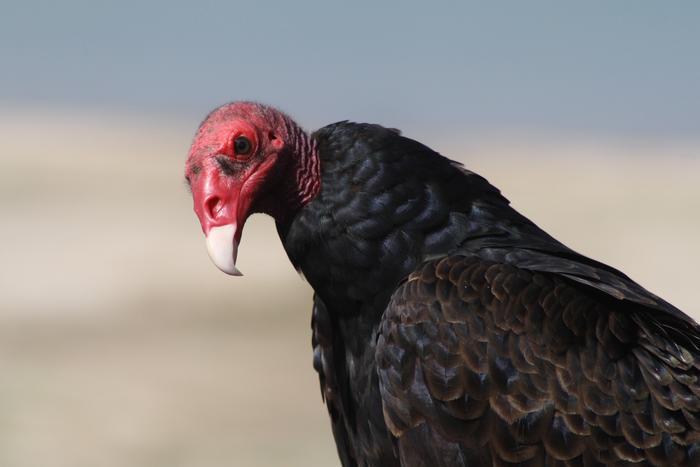
WILL: Turkey vultures don’t actually make sounds. They don’t have a syrinx – which is a bird’s voicebox.
DAGNY: Sometimes I wish you didn’t have a syrinx, my love.
Mary gives Adam some water from a canteen.
WILL: Careful, Mary! He’s scared of water!
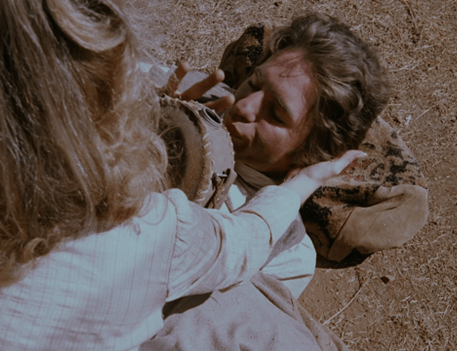
Adam is not optimistic about their chances of survival.
DAGNY: Oh, he can be such a baby.
ALEXANDER: Yeah. [as ADAM:] “Just go ahead and eat me.”

Speaking of babies, inside the stage Marge Loren starts screaming “My baby!”
“Marge, what is it?” Mary cries, and Marge yells, “My water broke!”
OLIVE: Oh, NOW she’s worried?
WILL: Well, she just woke up. You know how in the old days when someone fainted they’d throw water in their face? When her water broke, it must have splashed her face.
DAGNY: You were present at the births of your children, right?

Actually, since Mary doesn’t ask Marge any basic questions like “Are you all right?” in this scene, I think we can presume Marge came to consciousness in a deleted scene.
Marge tries to get up, but her broken bones are too painful.
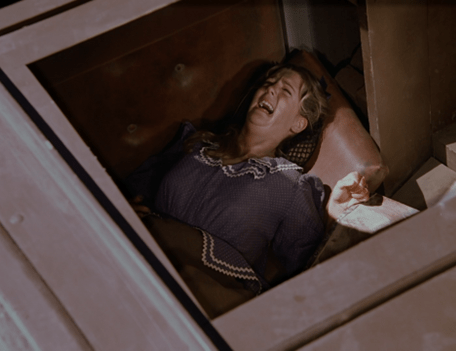
With a look of resolve, Mary declares she’s going to go find somebody.

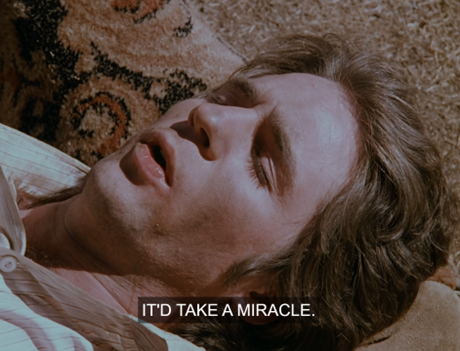
Adam pooh-poohs this, saying it would take a miracle, but Mary says she can tell by the warmth of the sun which direction to go. (We know from “The Enchanted Cottage” that for a person who’s totally blind, her sensitivity to sunlight is fairly extraordinary.)

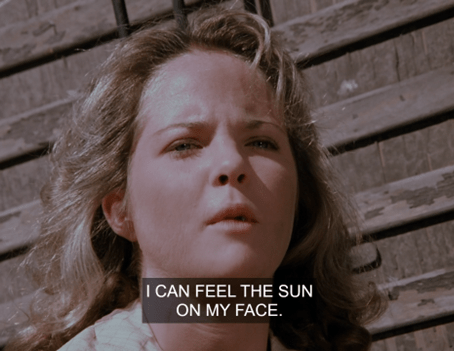
With spirit and spunk, Mary jokes he just doesn’t want her to go because if she gets help he’ll still have to give his speech. I like that quite a bit.
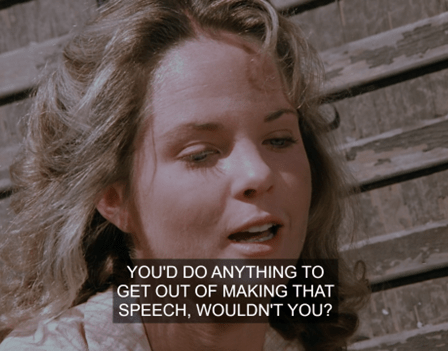
Not knowing if she’ll ever see him again – you know what I mean – Mary sets off.
Meanwhile, Pa, Garvey and the Chonks are heading east on the main road.

They meet some riders who tell them they’re also looking for the missing stagecoach. Presumably they were dispatched from Springfield? Again, Sleepy Eye is way too far away for them to have made it all the way to the Sanborn area from there.
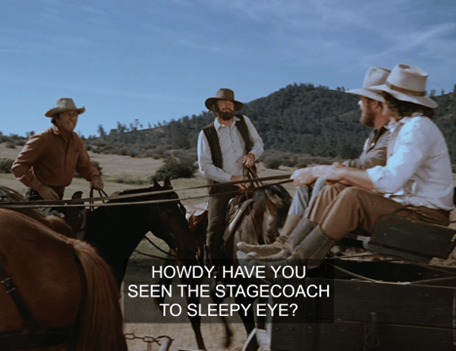
On the other hand, they might have come from Elmsville, since we don’t know where the hell that is, and since one of the riders is Alex Sharp, who played Sloan, an Elmsville goon who tried to foil Charles’s rescue mission in “Quarantine.”
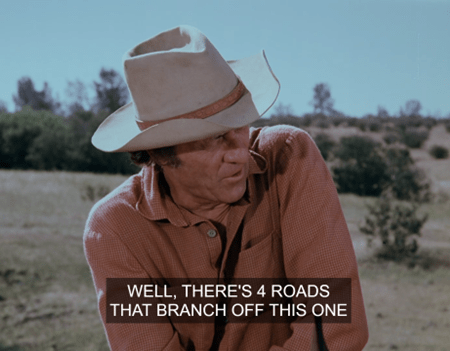
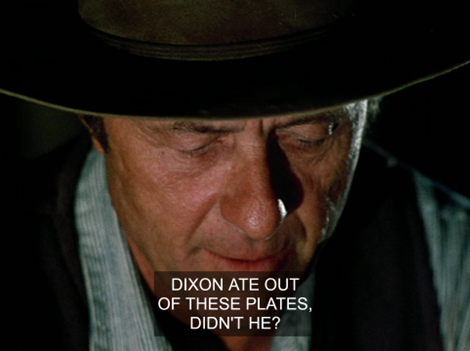
(Elmsville did appear to be accessible only by water, though, so maybe not.)

The same character also once tried to cheat Garvey at cards in Mankato.
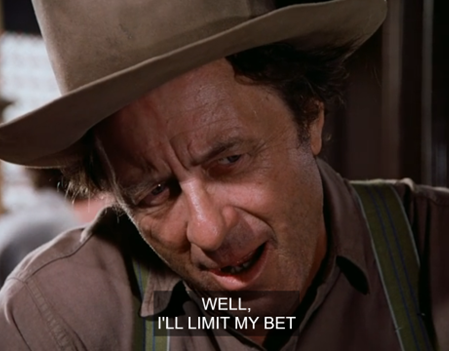
But neither Charles nor Garvey seem to recognize him today, or perhaps they’re just choosing not to address old enmities given the urgency of their current sitch.

As for the other rider, he’s Carl the Flunky in a fake beard.
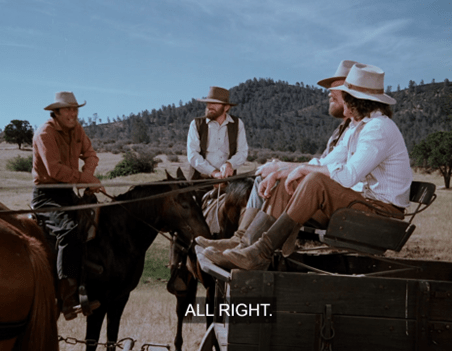
Charles tells them they probably stopped for repairs, and Sloan says that means they must have gone to Sanborn, Rowena, Clements or Hartland. (Rowena and Clements actually are near Sanborn, but Hartland is over 100 miles southeast – further away even than Mankato.)

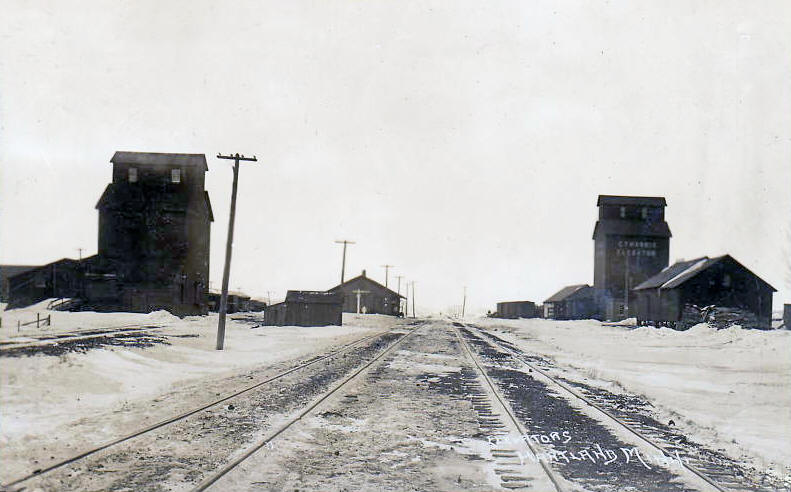
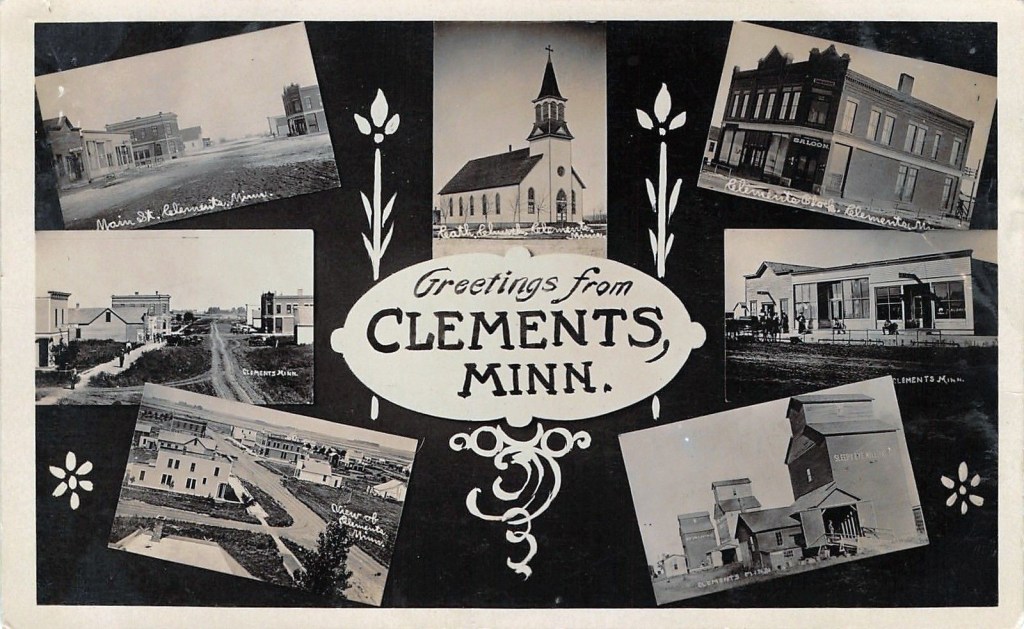
As for why they’re all assuming this is the exact spot Ned Watkins decided he needed to fix the vehicle, I have no idea.
The group splits up to investigate the various side roads.
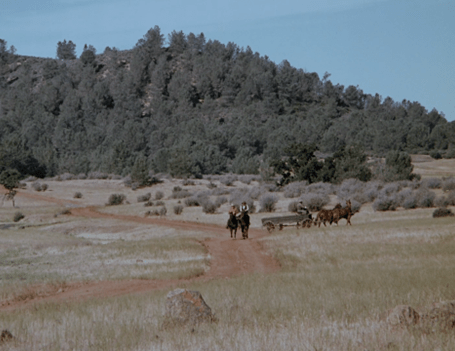
Back in the wilderness, Mary is simply walking forward, quite fast, with her arms outstretched.
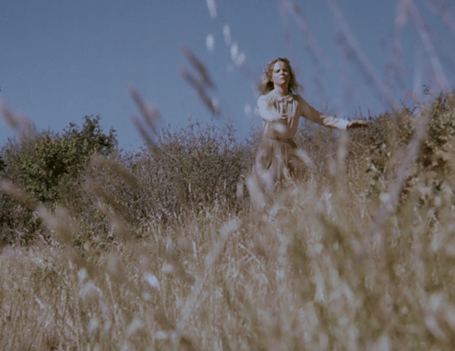
This works about as well as you’d think. She falls down a hill, then gets up and walks straight into a pricker bush.
OLIVE: She’s lucky she didn’t lose an eye.
ALEXANDER: It wouldn’t have mattered.
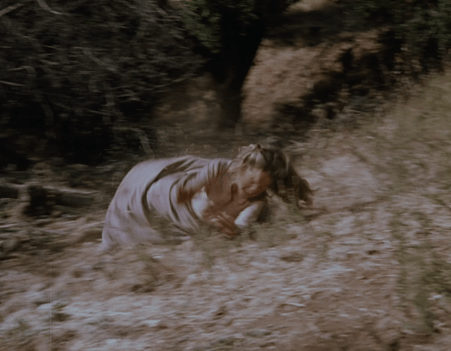

Then she falls face first onto some rocks.
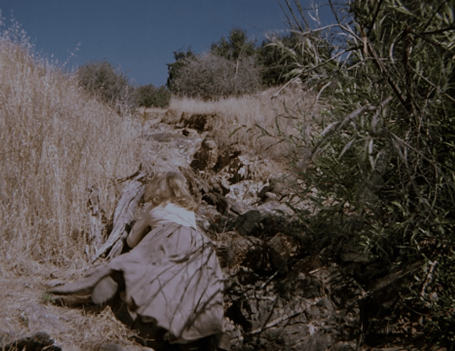
Twice.
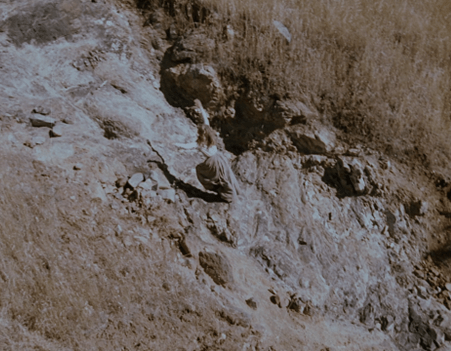
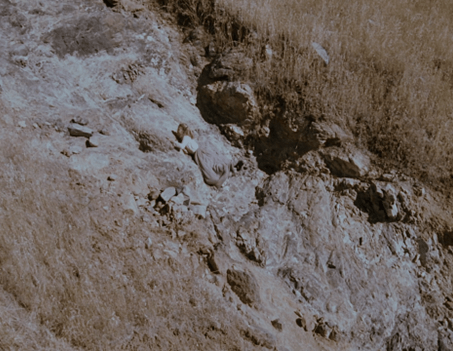
Then she starts crawling.
OLIVE: I don’t understand this strategy. She could crawl right off a cliff.
ALEXANDER: Yeah. Or get eaten by a puma.
WILL: And why isn’t she yelling for help? Does she think Carrie’s just gonna spot her from the air in her balloon?

Meanwhile, Charles and Garvey are choosing their own adventure.
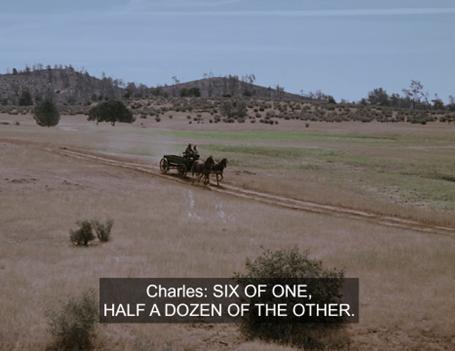
Charles says it doesn’t matter which road they pick first, as it’s “six of one, half dozen of the other.” (A saying which dates to the Eighteenth Century.)
We’re cutting rapidly back and forth between the characters now, with Mary floundering in some gulch or gully.
WILL: This IS a pickle.

After rolling over a half dozen more times, Mary tries climbing a bluff, but she just falls into the ravine again.

She loses her old glasses, which she’d been carrying in her pocket, or apron, or someplace.

Knocked unconscious, or perhaps just napping, Mary lies silent as we get our final commercial break.
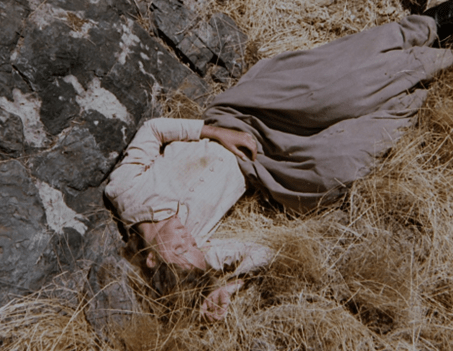
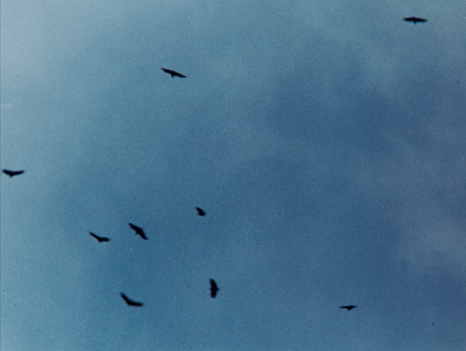
Back at the accident scene, more vultures are circling.
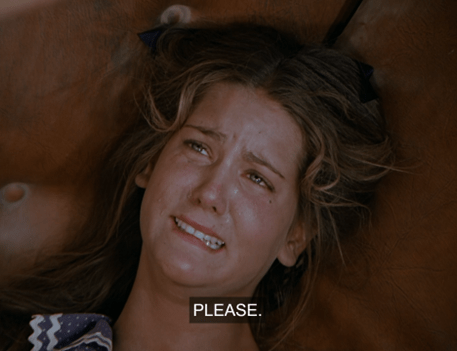
In the coach, Marge (who’s green-eyed like Michael Landon) says, “Dear God . . . please save my baby.”
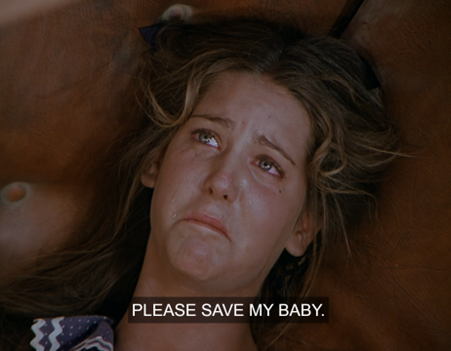
A few times, actually.

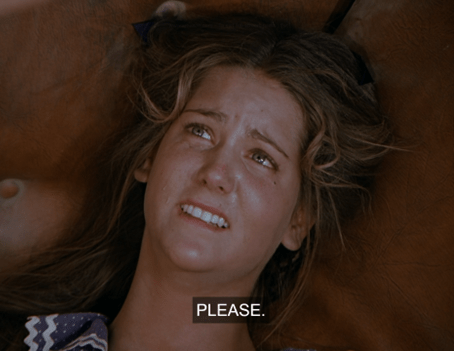
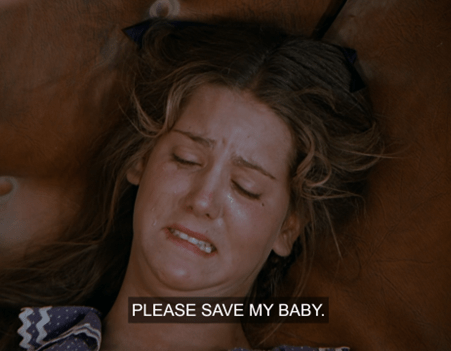
WILL: I’m not sure about Leslie Landon’s acting.
ALEXANDER: Yeah. “Please save my nepo baby.”
And wherever Mary is, her glasses magnify the sunlight and ignite a huge wildfire. (Apparently impossible with eyeglasses, but who cares.)
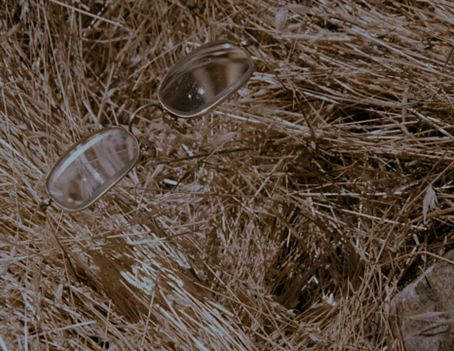

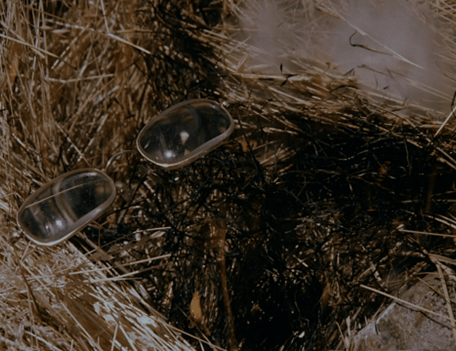
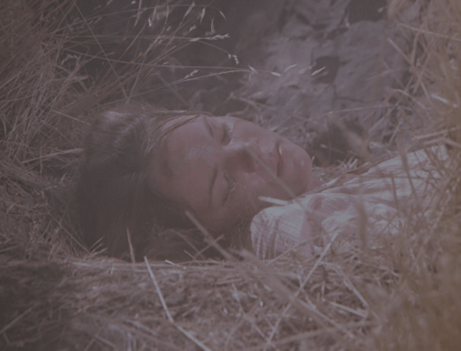
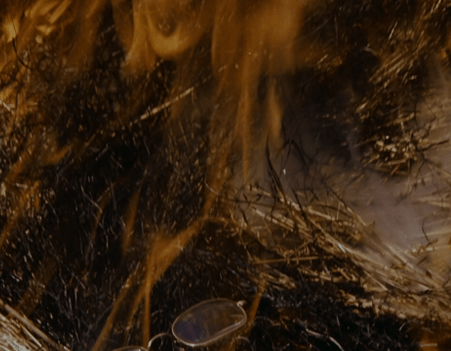
[UPDATE: There’s been some debate in the comments about how many pairs of glasses Mary had, and which one it is. Reader Leslie notes the fire-startin’ pair has oblong lenses, whilst Mary’s original Four-Eyes lenses were round.]
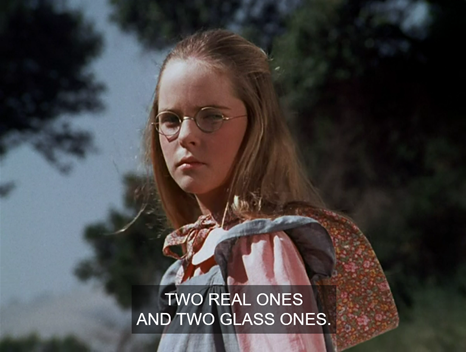

[Reader Jens adds that Mary did get a new pair of glasses in “‘I’ll Be Waving as You Drive Away.'” That was one way they could tell she was going blind.]

[But – as Reader J also observes – her new lenses were round too.]
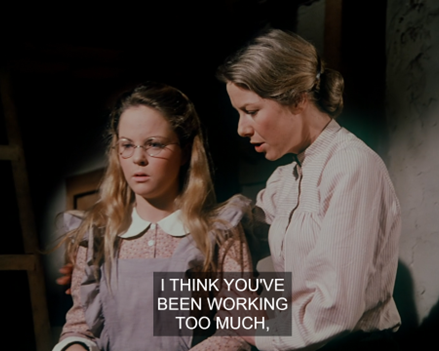
[These oblong ones are more like what Gary Oldman wears in Bram Stoker’s Dracula.]
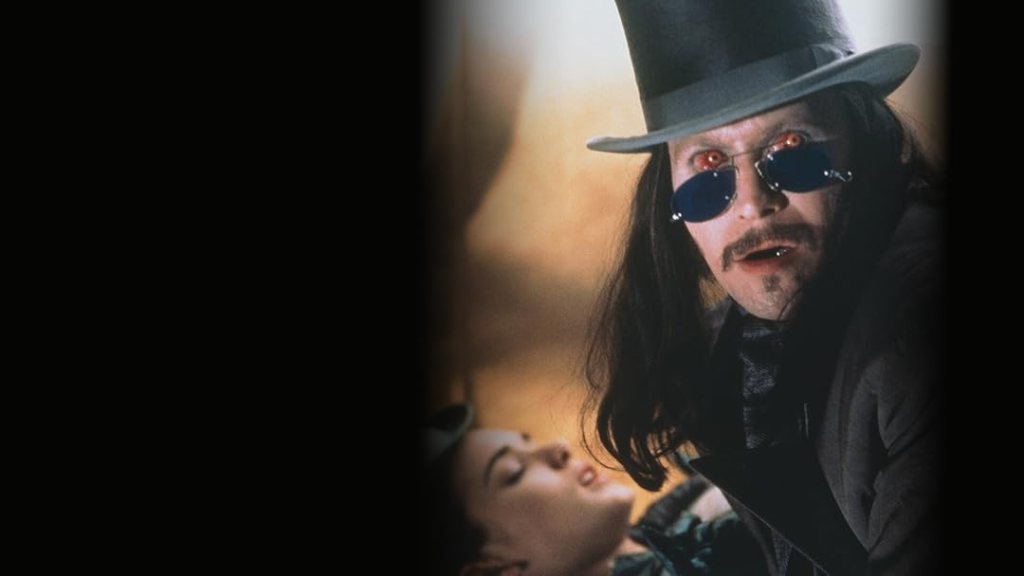
[One might suggest it was a miracle which changed the shape of the lenses; but this story has enough miracles as it is. – WK]
Mary wakes, surrounded by flames, and starts screamin’.
OLIVE: Oh, jeez. She really can’t catch a break.
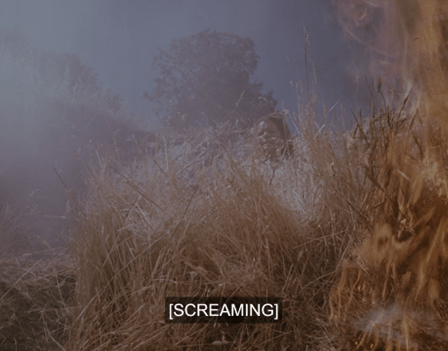
At the turnoff to Sanborn, Jonathan Garvey notices the smoke.
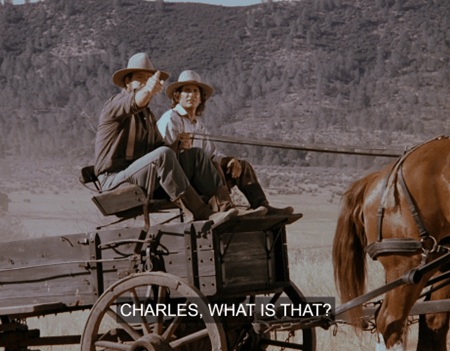
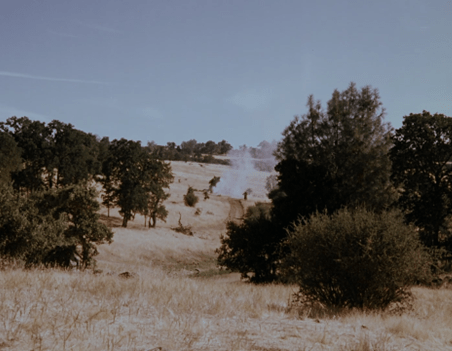
Pa says they might as well go that way, since it’s “six of one, half dozen of the other.”
ALEXANDER: How many times is he going to say that?
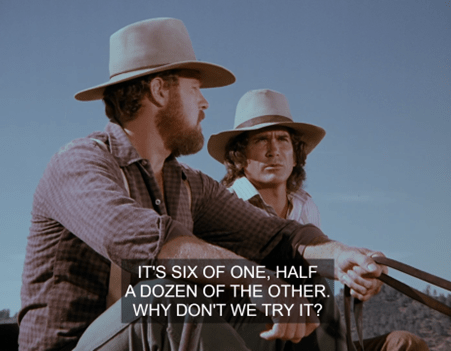
And within seconds, they hear Mary screaming.
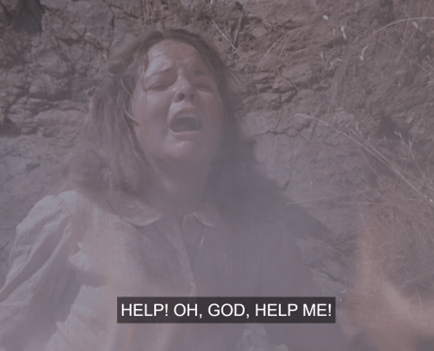
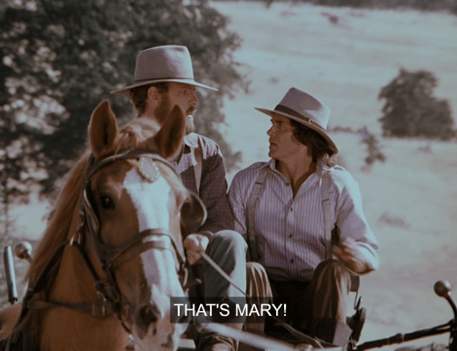
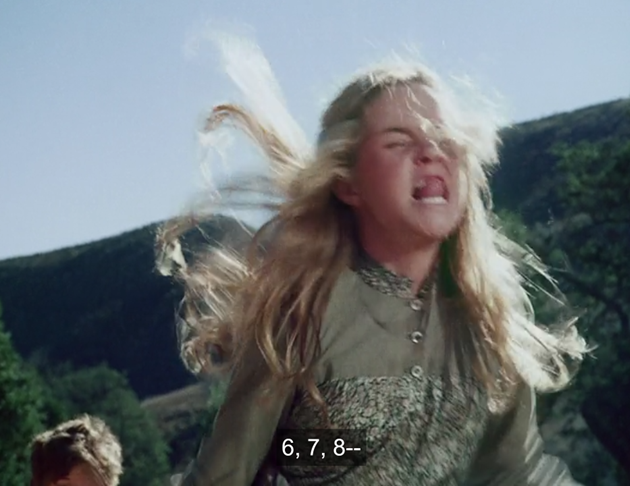
Pa comes running down the hill yelling. Mary gives a look of agonized relief at his voice (it’s quite satisfying), and screams, “Pa, help me!”
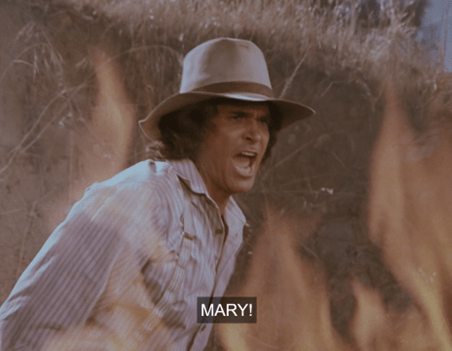
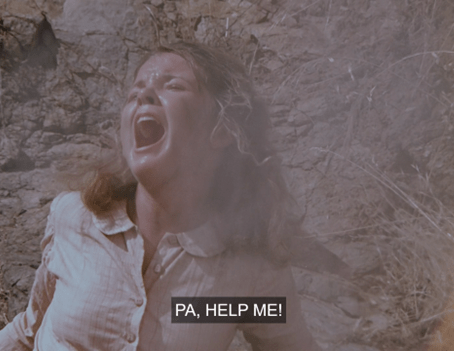
Well, Mary gets rescued.
ALEXANDER: So the wildfire was a good thing?
OLIVE: Yeah. I mean, it’ll probably burn down half the state, but at least Mary will be alive.
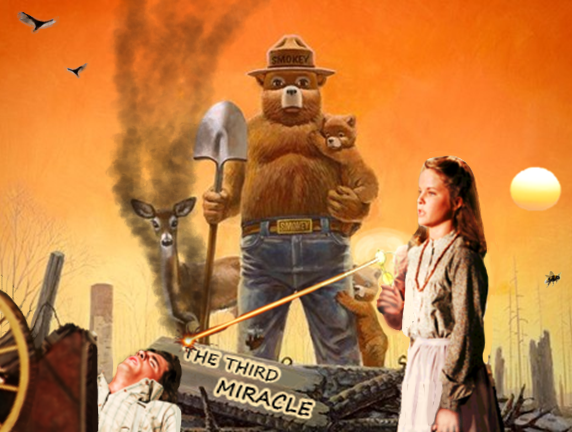
And suddenly, everybody’s at the Oleson Institute at night.
Doc Baker comes down from upstairs and says Adam will be fine.
WILL: Don’t you think he would be permanently disabled?
OLIVE: After that weight being on his legs for days? Amputation for sure.
DAGNY: I dunno. I bet Adam has good calves.
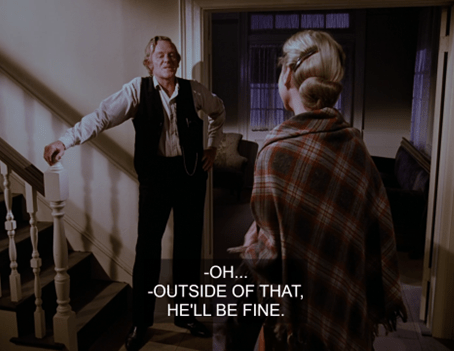
Whilst attending to Adam, Doc apparently also delivered Marge Loren’s baby – a healthy boy, if presumably a small one.
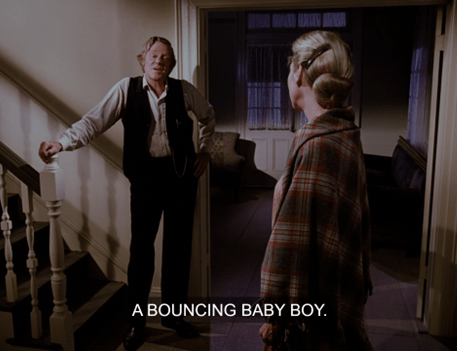
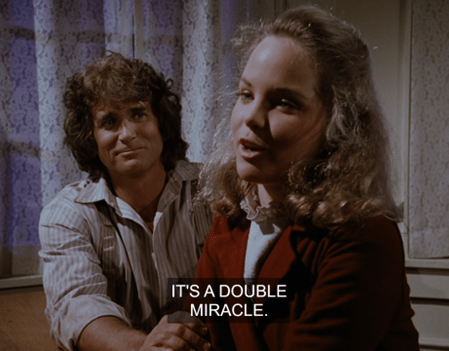
“It’s a double miracle!” Mary says.
WILL: But this one’s called “The THIRD Miracle.”
ALEXANDER: What was the first miracle?
OLIVE: Well, scamming Mrs. Oleson.
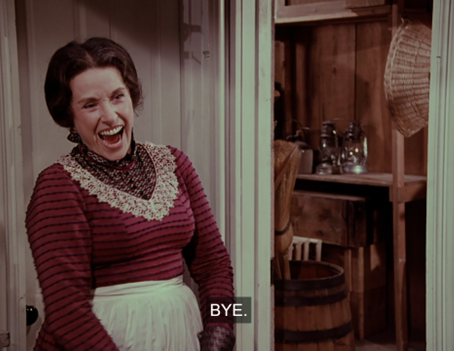
Pa remarks that if Mary hadn’t set the fire, no one ever would have found them. But she says she didn’t.
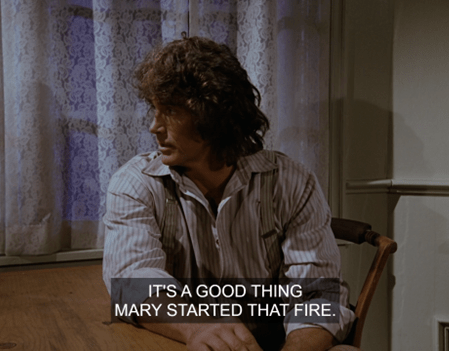
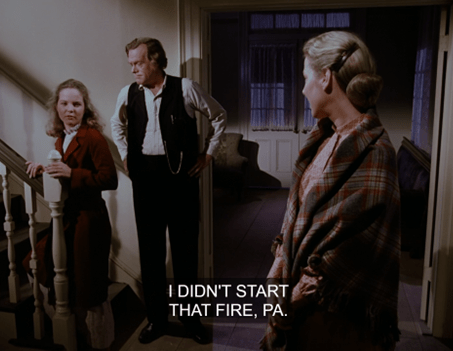
In all seriousness, the “three miracles” in this story are somewhat debatable – not whether they’re really miracles or not, but what and how many they are. Mary describes Adam and Marge’s prognosis as “a double miracle,” and fair enough.
And earlier, whilst lying under the stagecoach, Adam says it would take a miracle for anybody to find them.
Add them up and that makes three; but now Pa implies that the spontaneous wildfire is another miracle, which would make four total. (Or does the impossibility of normal eyeglasses igniting a fire make that a double miracle?)
Actually, one might argue that Adam and Marge surviving Doc’s care at all under any circumstances would count as an additional miracle apiece. That adds up to as many as six or seven miracles.

Furthermore, I would argue the telegram alerting the Grovesters to the coach’s disappearance should count as a miracle as well, since as we discussed it seemingly arrived before the stage was due in Sleepy Eye in the first place. That would explain why we had no scenes of Mary, Adam and Madge surviving a long dark night on the prairie.

And as I already mentioned, it’s also fairly miraculous that Pa and Garvey met up with the search party so close to the scene of the accident.
But I suppose “The Third, Fourth, Fifth, Sixth, Seventh, Eighth or Possibly Ninth Miracle” would make a cumbersome title.
Oh well, the last shot is of Mary’s Four-Eyes glasses, all smoked up and lying in the burnt grass.
OLIVE: Hold still, cameraman!
WILL: Yeah, come on, Kenneth Hunter!
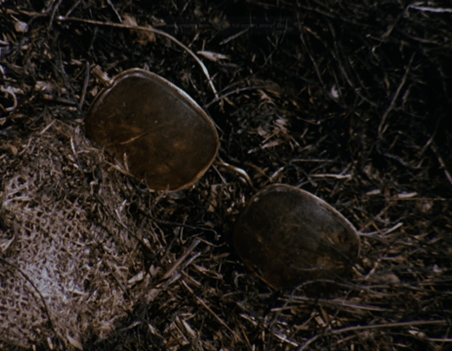
He probably was just nervous about it being his first screenplay. Bum-Bum-Ba-Dum!
STYLE WATCH: Laura wears another new Laura Ashley top, in lavender.
At first I thought Ma was wearing Boo Berry again, but on closer examination it appears to be a combination of white and black, or very dark green? The overall effect looks grayish to me, but I’m quite color-blind.
Marge Loren wears a cool snood.

Unusually, Mrs. Oleson wears a traditional bonnet rather than a hat in the bee scene.
Ma’s tartan blanket makes a reappearance.
Charles appears to go commando again.
THE VERDICT: I love this one. Wild and a little ludicrous, “The Third Miracle” is a crucible, or fondue pot if you prefer, in which some of the best Little House elements are melded perfectly. The first half is so dippy and innocuous, with its “bee-plot B-plot” and all the silly banter about the speech, then it suddenly lurches like a cartwheeling stagecoach into suspense/horror territory. A personal favorite.
See you next time!
UP NEXT: Annabelle
 Walnut Groovy
Great, as usual.
Aren’t Mary’s glasses (as seen in Four Eyes) near perfect circles, a la John Lennon’s? These are clearly more square-ish. I know there was talk of Mary getting a second pair when she “lost” the first pair. But she never did, did she? (This has always bugged me since the first airing of this episode. I feel much better having gotten that off my chest after all these years.)
LikeLiked by 1 person
I think you’re right! This pair is more like Gary Oldman’s in Bram Stoker’s Dracula. I’ll double-check and update the post. Thanks!
LikeLiked by 1 person
Mary did get a new pair of glasses in the episode where she went blind. They helped for a little while, but pretty soon she was having the same issues. IIRC, the new glasses were the same John Lennon style as the OG pair, but maybe not. She didn’t wear them for very long.
LikeLiked by 2 people
The post has been updated. Thanks, team.
LikeLiked by 1 person
I know I saw this one when it aired, because I played lots of stagecoach accidents. Eventually I got a molded plastic stagecoach, and it had lots of accidents, always dragging the horses with it, since they didn’t come apart.
I hate to burst your bubble, but I had heard that the stagecoach accident exterior shots were lifted from an episode of Gunsmoke, and at some point I found the moment on YouTube that makes me believe it’s true.
You’ve mentioned Albert’s theme several times; do you know that there are Mary and Laura themes? Mary actually has two. This episode ends with her first theme; it was first heard in Four Eyes. Then she has the “Blind Mary” theme. We first hear that, actually, the minute Dr. Burke tells Charles she’s going blind.
I tried to see if I could think of moments when we hear Laura’s theme, and maybe I should be embarrassed, but I can think of a few: in the Lord Is My Shepherd, Laura’s theme plays right after she finishes her first prayer on the rock up on Borgnine’s Mountain. At the end of My Ellen, we get a quick snatch of Laura’s theme when she appears back in braids, bringing the book to Busby. In Fagin, amid the montage with crazy Albert theme, we get melancholy Laura theme when we see her at the barn door. (We hear the the two themes close together again in Look Back to Yesterday, right after the silliness with Jason’s kiss on the mountain top). My favorite use of Laura’s theme is in A Christmas They Never Forgot, when the choir voices actually hum it during Laura’s flashback. It proves they hired singers instead of using stock Christmas songs.
These are dramatic uses of Laura’s theme; I know it plays serenely in millions of moments, but I can’t place any of those specifically.
LikeLiked by 2 people
Dammit, man, I’m going to have to investigate this! Stay tuned, please
LikeLike
Well, I’ve spent a most satisfying hour or so looking things up and listening. Thank you so much for sharing your observations, Ben. It really makes me smile that people are interested in such things!
So yep, I recognized all the tunes you mentioned, I just didn’t associate them with particular characters. Do you know if that was David R.’s original intent?
“Laura’s Theme” first. You’re right that this one is played in half the episodes. I would call it a variation on the main theme itself. (I recently saw a post somewhere saying something like 90 percent of the music on the show falls into the category. I’m not sure if it’s 90 percent, but it is a lot of the tunes!)
The “Mary Goes Blind” theme I am quite aware of. If its first occurrence was in “‘Waving,'” and I’ll trust you that it is, I see I described it simply as “an English horn honking mournfully in the orchestra.” I guess it didn’t really make much of an impression on me then, but by the time it recurred in “The Winoka Warriors,” I’d realized that it reminds me of “Binary Sunset,” aka The Force Theme from Star Wars. But even I wouldn’t seriously suggest David was influenced by John Williams, because I think the mournful melody is simply another variation on the Little House theme, but played in a minor key. Changes the character of the tune tremendously. D used this motif a lot in Season Five, I noticed.
And finally, the “Mary’s Glasses” theme I recognize too – I don’t know that I ever commented on it, though. It always reminds me of “It’s Raining, It’s Pouring”!
I would argue Mary has a third theme tune – the one I call “Mary the Nerd,” introduced in “The Award” and usually played on a harpsichord. I think it was originally associated with Mary specifically, but over time became a more all-purpose academia/nerdery anthem.
As for the stagecoach wreck, bah, that bums me out a bit. But still, it’s fantastically done, no matter when they did it. Do you have any idea how they controlled how the coach would roll? Or did they not control it, just film it a thousand times and keep the one take where it actually looked good? 😀
LikeLike
I agree about the Mary Nerd/studying theme. And I do think the themes were David Rose’s original intent, yeah. He was brilliant! I agree that Laura’s theme is a variation on the main theme, and it plays so often I think I used to just clock it as “Little House”….I can’t remember how I figured out it was actually Laura’s, but it makes so much sense that Laura’s theme basically IS Little House.
I have no idea how they did the wagon wreck; I wish I did. Did you find the Gunsmoke scene? I’m pretty sure I just put Gunsmoke stagecoach accident or something into YouTube; I can look for it later. But I do think the Money Crop and Lost Ones wrecks were legitimately staged by the LH team!
LikeLiked by 1 person
Laura’s theme is actually the very first piece of music we hear in the pilot and (briefly) the very last piece of music we hear in “The Last Farewell.” It was definitely one of DR’s go-to themes, sometimes even in scenes where Laura wasn’t featured. One of my favorite things that DR did at least twice was blend Laura and Albert’s themes together. When Charles looks over their sick bodies in “Mortal Mission,” their themes play back-to-back over the thumping heartbeat bass that underscores much of the episode. Then, in “The Family Tree,” when Laura and Albert are crying their heads off as Albert prepares to leave, there’s a sort of soft back and forth between the phrases of the two themes.
The “Blind Mary” theme always makes me think “Oh lord, tragedy befalls the Kendalls again.” It’s one that has a tense “drama” arrangement as well as a much more cheerful arrangement (like in “I’ll Be Waving,” it plays over the montage of Mary finally making progress learning how to function without her sight).
There are some other character themes that are used much less often but are still pretty much tied to particular characters. I think everyone knows Harriet’s theme. I would have sworn it was used throughout the series, but I think it first showed up somewhere in season five. Rev. Alden’s theme is heard at the beginning of “The Collection” and “The Preacher Takes a Wife,” at the beginning of the final scene of “I’ll Be Waving” Part 2, and at the very end of “Faith Healer” (and some other times). Joe Kagan’s theme is obviously heard in “The Fighter,” but it’s also in “Blind Journey” and “Barn Burner.”
The Sandersons had a theme that played all throughout “Remember Me” and in a few other episodes featuring the kids, but then in the very last season, David pulled it out for the episode where the youngest Carter boy befriends the dying old lady. John Jr. also had a piece of music for him that played in “I’ll Ride the Wind” and “Times of Change.”
I’ve read that having character themes like this is sometimes frowned upon because instead of always creating completely brand new scores, composers just rely on the regular themes, but to me, that’s exactly what the charm of LHOTP is! The music is just as familiar as the characters and settings.
LikeLiked by 1 person
It would be fascinating to do a project identifying and comparing different motifs in the score. And I completely agree about the character themes.
LikeLike
I *think* Harriet’s theme first shows up in Harriet’s Happenings. I can definitely remember it in Blind Journey.
Thanks for pointing out those other observations, especially that it all ends with Laura’s theme! Of course it does.
LikeLiked by 2 people
I’ve been pondering these questions a bit, and I have to thank you gents for a wonderful hour or so I just spent looking up the places where these tunes appear in the series. (It reminded me that “Mortal Mission” and “The Collection” are musical masterpieces, at the very least.)
I’m embarrassed to admit missing some of main musical motifs. For all my pulling out questionable musical references from the score, I never noticed “Laura’s Theme” before, or at least, I noticed it but thought of it simply as a “luscious” variation on the main theme. And the melody of “Blind Mary” always makes me think of “It’s Raining, It’s Pouring,” if I’m thinking of the one you mean. Rev. Alden’s Anthem – I don’t understand how I could have missed that one. Forest for the trees, I suppose.
Albert’s Theme hits me like a punch in the face, of course.
But can you give me some precise scenes with the Harriet and John themes? I want to make sure I’m listening to what you’re hearing.
LikeLiked by 1 person
So, not to get ahead of the action, but in “The Werewolf of Walnut Grove,” when Laura and Manly are saying their not-at-all-icky goodbyes, do you consider that the Almanzo Theme? It always sounds a bit to me like the theme from Growing Pains.
LikeLiked by 1 person
Sorry, I’m noticing some of these comments are repetitions of what I said back in June – my apologies! After nearly five years of doing this Project, my brain these days is the consistency of cottage cheese.
LikeLike
Yes, that is definitely the Laura/Almanzo ooey gooey love theme. It is first heard in “Back to School” immediately after Manly asks Laura, Andy, and Albert if school has dismissed for the day so that he can pick up Eliza Jane, and then it goes on to me, in my opinion, one of the more ubiquitous pieces used for the remainder of the series. I would say David leaned on it just as much as he did “Albert’s Theme” and the original Mary theme (which you are correct, it definitely has a sing-songy “It’s Raining, It’s Pouring” type of melody!).
Little House music is one of my favorite super obscure/niche topics to discuss, so I am ready for any and all questions or comments you have! Up until my reintroduction to the show a year and a half ago (which probably would not have happened as intensely if not for Groovy), the only character theme I could identify was Harriet’s. Once a poster in a Facebook group pointed out Albert’s and how frequently it was heard, I couldn’t not pick up on the rest.
I’m going to open up Prime Video and do some hunting and pecking for examples of when certain themes are used so I can point you in the right direction for some of them.
Original Mary Theme – I like to think of it as “Young Mary’s Theme,” and reiterating what I said above, it was used pretty regularly throughout the first four seasons. It probably plays at least once in every episode, but of course, the Mary-focused stories feature it all throughout in various arrangements reflecting our favorite nerd’s moods. “Whisper Country” is a good one for it. The episode starts right off with a very sweet, cheery version of it as she excitedly runs out of school to tell Ma and Pa about the teaching job. Then, when she and Rev. Alden ride into Willow Prairie, we get it in an ever-so-slightly less cheery, more “let’s see what happens” version (because now we know that there’s a Miss Peel who’s about to make shit difficult), and that version practically melts into a more suspenseful version as we get a good look at the creepy kids and Caleb Fisher. Then, after the first Mary/Peel scene, we get a tense version so as to say, “And this, folks, is our conflict.” Later, when Mary walks into the empty schoolhouse, we get it in those great high-pitched 70s horror movie strings that remind me so much of the score from “Carrie,” especially paired with the “cross” imagery from the window. It’s just such an awesome use of music to me, it’s like the theme gets beaten and worn down scene by scene just like Mary herself does.
Once she goes blind and we get Adam in the mix, I find the “uh oh Kendall drama” theme gets more play, but the young Mary theme is still brought out from time to time. In fact, for Mary and Adam’s final scene as regular characters, we get this really emotionally-charged mix of both themes as Mary bids adieu to Hester-Sue, Laura, Pa, and Ma, then it we get the upbeat version of the Kendall theme before they ride out of town to one last triumphant arrangement of the young Mary theme. It’s just awesome because hearing it calls you back to so many classic Mary moments. It’s like a flashback montage without the flashbacks – if you’re a regular viewer, the music is all you need to remember every scene.
Harriet’s Theme – Off the top of my head, it is definitely used in a bombastic march style early in “Back to School” as Harriet leads all the schoolchildren out to the reveal of Nellie’s Restaurant, and then it underscores the rest of the scene. But Ben is absolutely right, it opens up “Harriet’s Happenings,” and that’s probably its first time being used. It also closes out “The Cheaters” as Harriet chases Nellie out of the schoolhouse following the big reveal of the cheating scandal. I can’t remember it ever being used outside of wacky comedy arrangements, but if David had rolled out a somber minor-key version at some point, it would have gotten me right in the feels.
Sanderson/John Jr.’s Themes – This is where things get tricky as there were several themes used in their scenes over their time as regulars. The first one plays throughout “Remember Me,” especially once we know that Julia is dying and then as she languishes on her deathbed. For the purposes of this conversation, let’s call it “RIP Ma Sanderson.” Then, we hear it again a few times in “His Father’s Son,” such as at the end of the scene where John is in bed and tells Grace that he doesn’t know how to relate to Edwards and then near the end when John reads his letter to Edwards and they hug it out. But then…that particular episode opens with John reading up in the tree, and the piece used there floats in and out of the episode and then is used throughout “The Runaway Caboose,” like the super melodramatic scene of Carl gazing out the window, sad because he can’t go on the train ride. Let’s call this one “The Sanderson Boys.” It’s heard in “The Long Road Home” when Edwards prepares to leave for the transport job, but the scene also weaves “RIP Ma Sanderson,” and then when he actually leaves and Alicia runs after him, we roll all the way back to yet another theme that was originally heard throughout “Remember Me,” especially after the plot turned toward Isaiah bonding with Alicia. Let’s just call that one “Alicia’s Theme.”
But then!! “I’ll Ride the Wind” opens with what starts off as something new, but then it includes a phrase from “The Sanderson Boys.” Is it supposed to be one piece? Or is it really a new theme (“John Jr’s Theme”) just easing into “Sanderson Boys?” Because later on, we hear the whole “Sanderson Boys” theme again, and then “John Jr.’s Theme” again, and they just blend together for the rest of the episode. Then, we get to “Times of Change.” “John Jr.’s Theme” plays when Mary reads John’s letter to Laura up in the loft, then toward the end when Mary cries in her hotel bed after John breaks up with her, and then at the very end as the train heads back to Walnut Grove.
I feel like at one point, I had let a string of season nine episodes play long enough that I picked up on a theme from the Carters, but I don’t watch that season nearly enough to say that with certainty. I guess I’ll have to get it done some day!
LikeLiked by 1 person
Thanks so much for this, toddward. I used to be a musician but it’s been a long time. You’re certainly right that music is a critical part of this show’s success, almost a character in itself. I’ll look up these other leitmotifs and give them some study. Thanks again!
LikeLike
Oh my goodness, I actually laughed out loud when you mentioned the “pinky, Garvey, chonkie trifecta!” Also, do you think Ma’s bonnet was made out of the same material as Laura’s dress that has the bit of lavender in it? They look kind of similar but I couldn’t be 100% sure.🍯👓
LikeLiked by 1 person
Hi Maryann – I really don’t know. For all my observations, I really don’t know anything about clothes and clothes-making. I did notice that this season has a lot of these Victorian floral-patterns added – Ma’s top, Hester-Sue’s top, a couple of Laura outfits. Dagny calls them “Laura Ashley.” Whatever material it is, I think all the costumes are really popping this season, don’t you?
LikeLike
I certainly agree. I guess being so popular at the time they had more of a budget for clothing.💁🏻♀️
LikeLike