
Son of Mustache Man!; or
You Give Ugg a Bad Name
(a recap by Will Kaiser)
Title: The Halloween Dream
Airdate: October 29, 1979
Written and directed by Michael Landon
EDITOR’S NOTE: Literally everything about this episode is offensive. (Well, almost.)
SUMMARY IN A NUTSHELL: In what’s regarded by many as the worst Little House story of them all, Albert has a comically racist dream.
RECAP: I have been doing this Project for four years and four months now. (173 years two months in Kaiser Family Universal Time.)
There are times when I feel the weight of every minute of those years, and times when it feels like we’re clipping along at a cheerful brisk place.
And then there are the days when I wish the time went even slower, so I never got to the next story.
Like today.
Because, well, here we are:
“The Halloween Dream.”
A couple of you sent cards and letters wishing me luck recapping this one – thanks, guys. It is a tricky prospect, one I’ve been dreading.
Alrighty, enough stalling. Screw your courage to the sticking place, Kaiser! Let’s do it.
We open on a closeup of a little Plum Creek waterfall, and the title appears: “The Halloween Dream.” (Some readers have already commented that among this story’s disappointments is how little it has to do with Halloween.)

David Rose gives us some bizarre and messed-up but emphatically non-scary music. (Clockwork soldiers? Munchkins?)
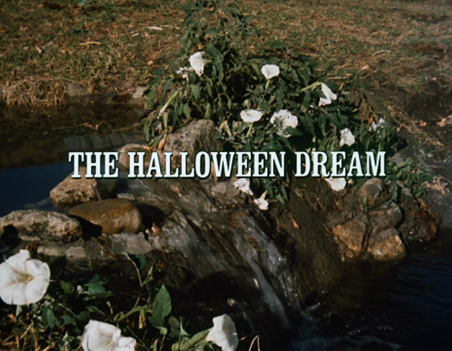
This one apparently features a character called “Commander Kaiser.” (Some ancestor?)

Our first indication we’re in danger comes when we see there’s also a character named “Chief Kilowatt.”

More about him later.
Anyways, the camera zooms in on Pa, who’s carving a jack-o’-lantern for Carrie in the yard.
ROMAN: That’s a well-carved pumpkin. Must have used Ma’s leg-cutting knife.


Carrie slurps that Halloween’s too scary a holiday for her to enjoy, but Pa says that’s stupid. (Paraphrase.)


Inside, Laura and Albert are putting finishing touches on their costumes in preparation for a party Nellie’s throwing. (At the hotel? I can’t really picture Nellie inviting mere children to a gathering at this point in the series.)
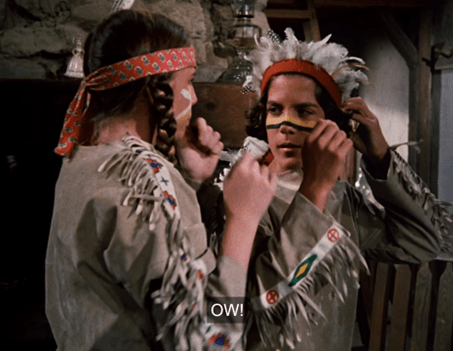
Laura and Alb are dressed as Native Americans, or Indigenous Americans if you like, or “American Indians,” which some people find offensive but which was preferred by the Native people I worked with in Minnesota Indian Country in the 2010s. (Canadians use “First Nations people,” which I like but which has never really caught on in the States.)
So, Halloween. It is a touchy business these days. You may remember the “My Culture is Not Your Costume” meme, which encouraged people not to dress in ethnic/national clothing for Halloween because it could be hurtful to individuals from those groups.

(Of course, this was followed immediately by a zillion images mocking that sentiment.)

Apparently, the very first example of the meme shared was about Native American clothing – for many decades a popular costume choice for American kids. (I never wore one myself, though I was a Scotsman at least twice.)


No one would accuse a child dressed up for Halloween of hateful intent. But it also shouldn’t be hard to understand why darkening your face, using towels to approximate turbans and the like, and doing “hilarious” accents would be offensive to the people you’re imitating. (This I have been guilty of myself, notably when I attempted what I thought of as a Pythonesque Ali Hakim in Oklahoma! in high school. I am glad I was young before the internet existed. . . .)

That said, as far as Halloween is concerned, I like the idea of a night for violating social taboos and shocking people. It’s probably what I like best about the holiday, in fact; and personally, I don’t get too upset when I see even deliberately offensive costumes at that time of year.
I know this is not a popular opinion. But practically everything about Halloween is subversive – it is its anthropological purpose! Even putting up skeletons and ghost decorations mocks the dead in a way that would horrify people in any other context. (Imagine showing up at Grandma’s funeral dressed as the Crypt Keeper, for instance.)

So, I tend to cut people slack on Halloween, for the same reason I cut comedians slack. Then again, it’s easy for me to do that.
A lot of people wouldn’t, which is fine. Nobody would accuse me of being the most tasteful or considerate person they ever met, and I know that if you are being deliberately vile, you shouldn’t be shocked by anyone’s criticism.
Well, Albert complains that Laura is sticking him with pins as she makes final tweaks to his costume.

The costumes look nice enough, but the kids have also “browned up” – Albert, a pale youth possibly of “Black Irish” descent (Quinn), especially.


You see why I’ve been dreading this. Viewed as a “lecture series,” Walnut Groovy is tedious enough to begin with, with social commentary one of its least popular features.
It is necessary, though, given the show’s interest in issues, and given how many problems in the 1970s are still problems today.
But I know it isn’t fun to have the story interrupted every ten seconds with rants about blackface being bad or whatever. I don’t like doing it, either.
I always think of “blackface” as specifically referring to racist “minstrel shows” rather than a generic term for “using makeup to resemble someone of a different race.”
Nevertheless, these days it’s used indiscriminately, at least here in America, our people being notoriously uninterested in context. (Though we’re not the only ones!)
But what else should it be called, I suppose? And the history of blackface as a satirical but grotesquely racist art form practiced all over the country (in Britain, too) makes it top-of-mind for many people when they see any white person pretending to be a dark-skinned one.
As far as Halloween costumes go, face-darkening [reader Jordan notes that blackface is used for Black or African people, yellowface for East Asians, and brownface for pretty much everybody else] has a nastier edge than simply wearing “ethnic” clothes. If the latter offends, the former will really, really offend. And again, if you do it, you’ve asked for what you get.
The other thing, though, about the Ingalls kids wearing Halloween costumes is that they probably wouldn’t have. Halloween is not mentioned in the Little House books (right?), and you’ll recall from our discussion of “The Monster of Walnut Grove” that some 1800s North Americans carved pumpkins, but that costumes, trick-or-treating and associated festivities were rare until the Twentieth Century.
(“Monster” got this right. Remember that the kids did not wear costumes in that story, and went pranking rather than trick-or-treating.)
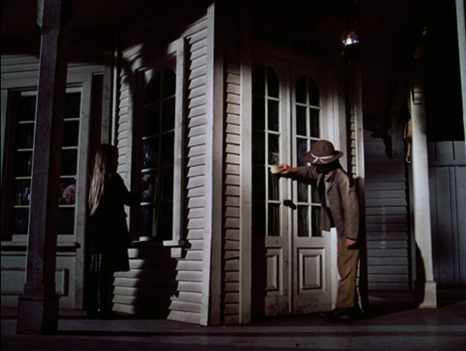
Oddly, then, Ma tells the kids they should have a nap to prepare for the late night – a thing I think which has never happened before, and which seems extra-strange given Laura is supposed to be fifteen or so.

Laura actually comments on the oddity of this.

Albert is worried there will be other fake Indians at the party, but Ma tells him he looks like a chicken and the kids trot out to show Pa their costumes.

Ma sends them back inside, and Carrie starts slurping how her siblings have been scaring her with ghost stories.
ALEXANDER: Isn’t Carrie getting a little old to be this stupid?

Her comments start out conventionally enough, but, like most of Carrie’s utterances, topple over into weirdness almost at once.

Rather unbelievably, Ma and Pa seem angry about this and send her in to fetch Laura and Albert out again.
But once she goes, they immediately start laughing at her idiocy behind her back. Nice parents!

You would have thought it looked like a pleasant day, if suspiciously warm for late October. (There are fucking flowers growing, for Heaven’s sake.)
But from inside, the weather looks gray and weirdly blank, like in Stephen King’s The Mist.


Carrie immediately sees a “ghost” and runs out screaming, but it’s just Baby Grace under a sheet.


(They just let Grace wander around without supervision? With a huge fireplace in the center of the room, and all the knives and guns and oil lamps?)

Upstairs, Laura and Albert are falling asleep. We see that Alb is reading a book with a chapter titled “Massacre at Stony Pass.”

If this refers to a real incident, it’s news to me (and the picture doesn’t tell us much).

But Stony Pass is a real mountain pass in the San Juan Mountains of Colorado, and the book may refer to events from the Colorado War between the federal forces and a band of several Indian tribes in 1864 and 1865.

The preceding chapter, we can see, deals with the 1868 Battle of the Washita River, also known as the Washita Massacre.

Under orders from General Philip Sheridan (who was name-dropped in “If I Wake Before I Die”) and commanded by George Custer (mentioned by Mary in “Ma’s Holiday”), U.S. troops attacked and destroyed an encampment of Southern Cheyenne people on the Washita River in Oklahoma.


The leader of the encampment was Black Kettle, known for peacemaking and urging cooperation with the U.S. government. (He was killed, of course.)

I have made a pledge not to get carried away investigating historical references that don’t have much to do with these stories (like circus sideshow performers and the Loch Ness Monster).


But among the people and places mentioned in this passage are the Kiowa and Comanche people (allies of the Cheyenne); Fort Cobb (Custer’s base during the war – relationship to Julie Cobb, if any, unknown); White Bear, Lone Wolf, Kicking Bird (who appeared as a character in Dances With Wolves) and Woman’s Heart (Kiowa chiefs); and “Staked Plains” (Llano Estacado, a traditional homeland of the Cheyenne, Kiowa and Comanche in the southwestern United States).

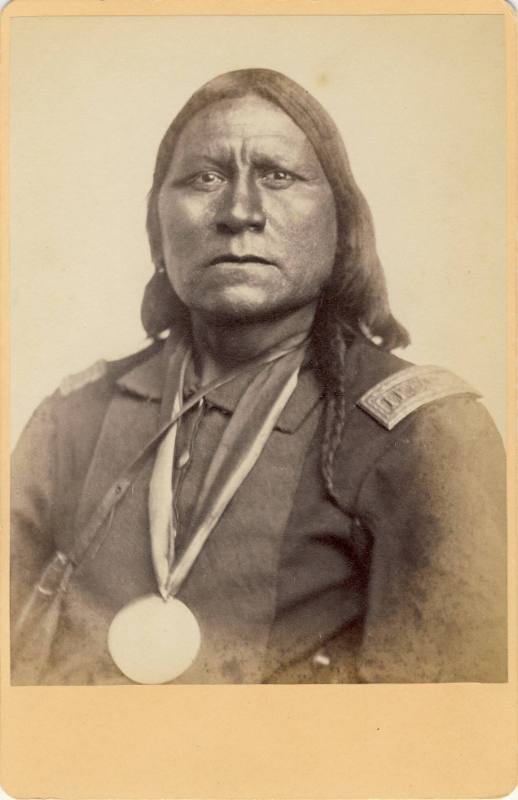


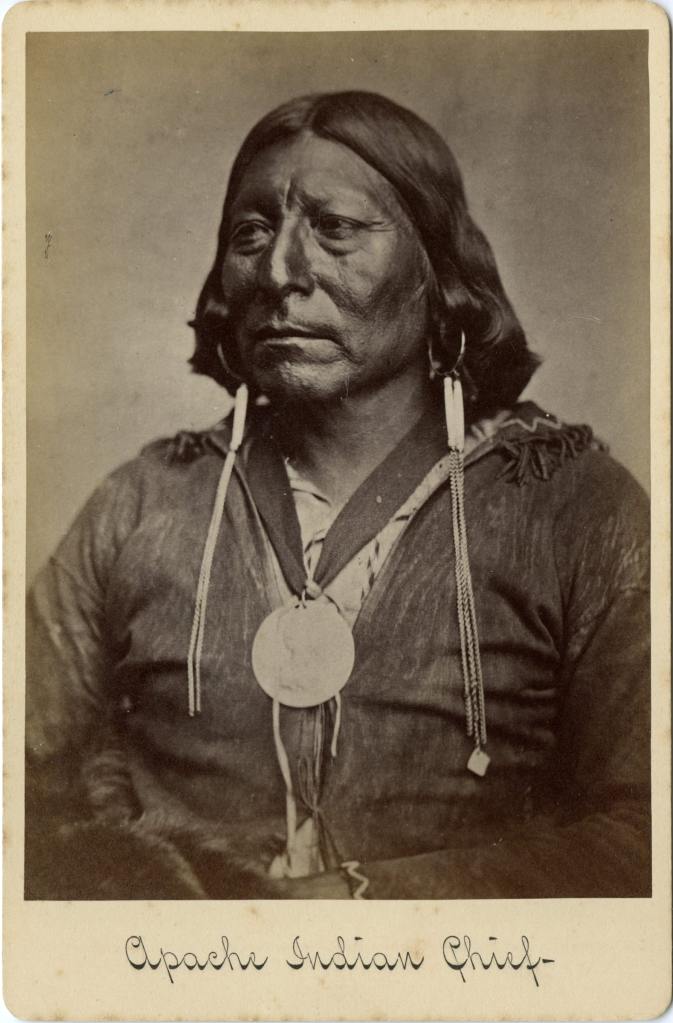

Like the Dakota War of 1862 here in Minnesota, Washita remains a painful and bitterly debated historical event in Oklahoma; in fact, at about the same time as this episode aired, some commentators were drawing comparisons between Washita and the 1968 My Lai Massacre in Vietnam.
The American Indian Wars don’t have a great deal to do with our story, but I remind you that it’s not just a fun boys’ adventure story Albert’s reading. These wars were relatively recent (this episode being set in 1883-J) and would have been very real and frightening to people in southwestern Minnesota at this time.
Albert turns the page to a chapter on Sitting Bull, the leader of the Sioux at the Battle of the Little Bighorn (who was also referenced in “Ma’s Holiday,” in which Mr. Edwards pretends to be him, kind of).


Now, those of you who watch this show regularly – well, I suppose that describes anyone who would bother reading this – will know that “exotic” textures based on ethnic music of various sorts are a tasteless if glorious specialty of our old friend Mr. Rose.
We get a taste of that now, as he gives us Albert’s theme with thrumming drums and “primitive” parallel fourths in the winds.
Albert puts the book down, and we see Massacre at Stony Pass is actually the title of the whole thing.

ALEXANDER: They go to sleep in their costumes and full makeup?

And now, an ethereal change in the music tells us we’re entering the dream world. Oh boy, here we go!

Now, I’m not sure if your dreams usually begin with elaborate prologues in which you don’t appear (mine don’t), but Albert’s apparently do.
The first thing we see is some American Indians in full warbonnets passing around a pipe. (Since this is a dream, I’m not going to comment on the authenticity of anything from this point on, or I’ll try not to at least.)


There are a few younger men who are not so fancily dressed. They’re all sitting together in a teepee.
The Indian elders debate about whether to attack somebody. One faction, led by a chief named “Sly Fox,” says they should wait for “Son of Running Bull,” another chief who has not yet arrived.

(Sly Fox is Henry K. Bal, who appeared on Kojak, Remington Steele, Hill Street Blues, and Highway to Heaven.)

An older chief says he doesn’t think Son of Running Bull, apparently a very young man, is coming, but Sly Fox is sure he is, and reminds the others he will be bringing “repeating rifles.”

A chief even older than the first old one falls asleep during this conversation.

“We shall kill the white man!” Sly Fox says, and begins ululating. The chief who’s still awake covers his ears.

And now our dream narrative-proper begins, with Laura and Albert on horseback on a plain.

(In a macabre touch, Laura is riding Bunny.)
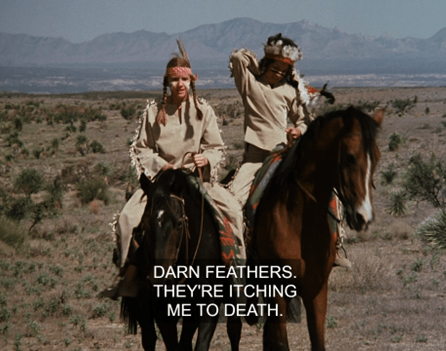
Despite the remote and arid-looking landscape, the kids are apparently still on their way to Nellie’s Halloween party.
Three Indians on horses appear, and Albert starts bitching how he knew they wouldn’t be the only Indians at the party.

These Indians are some of the younger men from the teepee, who blandly order the kids to come with them.

The three braves all get credits. They’re George Aguilar (Grizzly Adams, Star Trek: The Next Generation, the Demi Moore Scarlet Letter, and a completely bonkers-looking nineties indie called Lunatics: A Love Story) . . .

. . . Bryson G. Liberty (Northern Exposure) . . .

. . . and Ramon Chavez (Just One of the Guys, Knight Rider, My Name is Earl). (I couldn’t find a picture of him.)
Interestingly, both Henry Bal and Ramon Chavez were in an Indigenous-themed horror film called The Ghost Dance in 1982 – as was Victor Mohica, who played Soldat du Chene in The Pilot!
(Warning, this one is a little gory:)
The Ghost Dance looks about as culturally sensitive as “The Halloween Dream,” but it might have its points too.
Laura remarks that the braves look “a little old to be goin’ to Nellie’s party,” and Albert says he’s sure Mrs. Oleson hopes one of them will marry her and take her away.
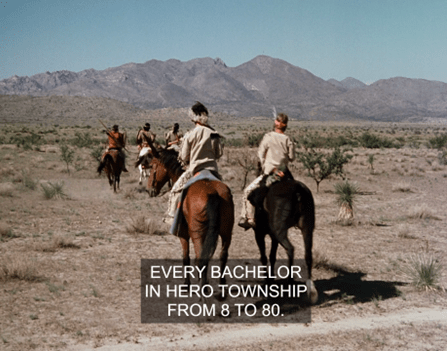
Laura also says the braves don’t look like real Indians and their costumes aren’t very good. Ha!
Soon they arrive back at the Indian village, and about thirty armed riders on horseback suddenly appear.

Some of the horses are quite interesting-looking.

ROMAN: That’s a toothy horse.
ALEXANDER: Yeah. I bet he could devour an apple.

The kids finally realize these people aren’t going to Nellie’s party.
The older chief who didn’t think Son of Running Bull was coming rides forward.
In “Hollywood Native” broken English (known to some as “Tonto-Speak”), the chief welcomes Albert as “Son of Running Bull.”

Laura whispers that Albert should just play along.

“Ugg!” says Albert.
ROMAN: Oh dear. I remember this one now. I think this is where we turned it off.

You may wonder why there came to be a stereotype that Native Americans say “ugg” and “how.” I did.
Well, supposedly they’re both versions of the same word. Early explorers who met various tribes claimed they often used a one-syllable word as a greeting, and sometimes in other ways.
In their accounts, these writers styled the word as “how,” “háu,” “howgh,” and other spellings. Today it seems like a gross stereotype, but apparently some tribes, including the Dakota, did in fact use the term through the end of the Nineteenth Century, though its origins are disputed.
James Fenimore Cooper, the American novelist who wrote The Last of the Mohicans in 1826, popularized the term, which he originally spelled “hugh.” (I read that once, but don’t remember much about it.)

Apparently in later editions of his works, editors altered the spelling to “ugh,” so as to prevent confusion with the name Hugh.
Well, “ugh” and “how” then became sort of pop-culture shorthand, meaning anyone writing American Indian characters had some good alien-sounding words to use without worrying what languages they really spoke.
The fantasy Indians of Peter Pan use “ugg” in the novel and its film and stage adaptations, which helped spread its use amongst children, I’m sure. (Professional productions of the musical today sometimes rewrite the Native scenes or omit them altogether; excellent commentary on the “Indian” songs of Peter Pan here.)


Well, there’s more to come on that front – the “ugg” front, I mean, not the tedious-lectures-about-racism front. (Though there’s more to come on that front too.)
Off Laura and Alb go with the warriors.
Then we cut to Ma and Pa back home in the Common Room. I’m sorry, but I can’t help laughing about how this “dream” is so formally structured, with a prologue, side plots, large supporting cast, etc.

There’s a knock at the door. It’s Jonathan Garvey, accompanied by a soldier he introduces as “Commander Kaiser.”
WILL: I don’t think he’s any relation to our family, since that’s not our real name.
ROMAN: Yeah. Plus he’s a fictional character.
ALEXANDER: Yeah. In a dream. He doesn’t even exist in this story.

Requiring no further explanation, Charles says, “Commander, I’ve heard a lot about you.” (I snorted at this. It’s the sort of ridiculousness which makes me think what a funny episode this might have been without the stereotypes.)

Commander Kaiser is a sort of upright authoritative classic TV colonel/police lieutenant/dad-type, and he’s played by Philip Carey. (The opening credits misspell his name as Phillip.)


Carey was a veteran of many movie Westerns, including at least two dealing with the Indian Wars: The Great Sioux Massacre and Tonka.

He appeared on The Virginian and was a regular on its spinoff Laredo, plus he did The Rifleman, Daniel Boone, Cimarron Strip and Gunsmoke.

Non-Western-wise, he was on a famous 1971 episode of All in the Family, playing a “man’s man” friend of Archie’s who comes out as gay, and he appeared on Ironside, Kolchak: The Night Stalker, and The Bionic Woman.
He was also the lead on a short-lived series based on Raymond Chandler’s Philip Marlowe stories.

He’s probably best known as a regular on One Life to Live, even returning for guest appearances after his character was killed off.
Ma offers the Commander some coffee.
Kaiser tells them the tribal armies are massing, saying they include members of the friendly “No-Shoot” and unfriendly “Lightfoot” nations.
DAGNY [passing through]: Gord’s at it again, huh?

(Gordon Lightfoot, the noted Canadian troubadour, was popular at the time, and he still is in our house. Dagny and I went and saw him once, this song being our favorite. It’s criminal it isn’t better known.)
(Gord wasn’t of First Nations descent, though.)
Kaiser says Chief Running Bull (“I’ve never met him,” Charles says hilariously) is sending his warlike son to join the party, and bringing advanced weaponry too.
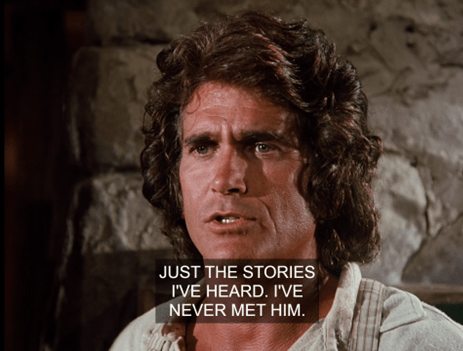
He says the Army’s set up a base in the nearby ghost town of Stony Pass and that all Grovesters are being evacuated to it for their own protection.
Charles is concerned that his kids are partying at Nellie’s, but Garvey says logically, “Well, then they’re probably already at Stony Pass, Charles.”

Back at the Indian camp, Laura and Albert are strategizing.
Then, in a moment that’s beyond the pale, Albert discovers a grotesque human scalp hanging as a decoration.

He shrieks, and, when Laura asks what’s wrong, screams, “It’s a scalp, you knothead!” (I know I said I wouldn’t authenticate, but scalping was of course a real practice. It was not limited to American Indians in world history, though.)

The “other chiefs” appears in the teepee, with the leader saying, “I heard war cry!”
He introduces himself as Kilowatt, chief of the Lightfoots. (As a mockery of Indigenous names, it’s not terribly clever.)

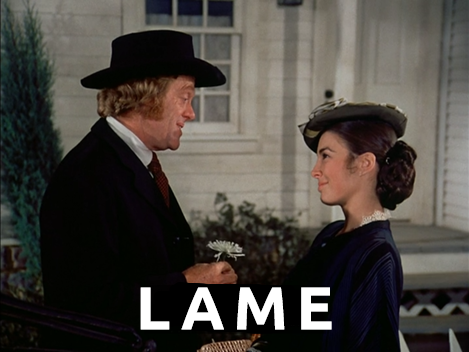
(Besides, the term kilowatt didn’t exist until the 1890s.)
We’ve met the actor playing Chief Kilowatt before. He’s Frank DeKova, who had a memorable turn as the grumpy but loveable child-beating old man befriended by Isaac Singerman in “The Craftsman.”

(We did his detailed resume in that story. He was actually of Italian heritage, but was frequently cast in Native roles.)
Kilowatt formally introduces Chief Sly Fox as well as Big Wolf, the old chief who fell asleep in the earlier scene. (Big Wolf is played by Hiawatha Hood, who didn’t act in any other film or TV productions, but who was involved in some successful activism in the 1970s.)

Then Kilowatt introduces Albert as Running Bull’s son, and, referring to Laura, “his brave . . . uh, Knot Head.”

I know it’s making fun of Indigenous names, but I give the script points for this exchange, since it’s a scream thinking of Laura being mistaken for a boy, and since “Knot Head” is a funny description for a girl in braids.
Chief Kilowatt says it’s time for the chiefs to confer, to which Albert replies, “Ugg!”
Kilowatt hands over a tobacco pipe, which the kids smoke. This is the second of three times Albert smokes a pipe on this show; this has to be a sick joke of Landon’s, right?
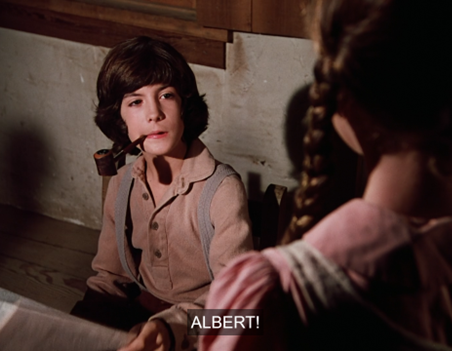


Chief Sly Fox asks Albert where the promised guns are, and Laura immediately answers, “They’ll come in two sunups.”
Sly Fox is satisfied, and says their plan is to attack the Army encampment at Stony Pass.
Chief Kilowatt assigns the task of planning the siege to Albert.
“Ugg,” Albert says.
They exit, and two giggling little girls come in carrying plates of food.

The first one is Yellow Feather, the little Dakota girl from “Freedom Flight”!


At first I thought maybe Albert remembered Yellow Feather and that’s why he’s now dreaming about her, but then I realized Albert wasn’t even around for that earlier story.
Anyways, she introduces herself as “Tana,” so she is in fact a different character, but she really is played by Dawn Biglay, who was Yellow Feather.

In a deep voice, Laura starts to introduce herself, but Tana says she already knows he’s called Knot Head.

The other girl is chubby and giggles constantly. She’s probably what the Widow Mumford was like as a kid.


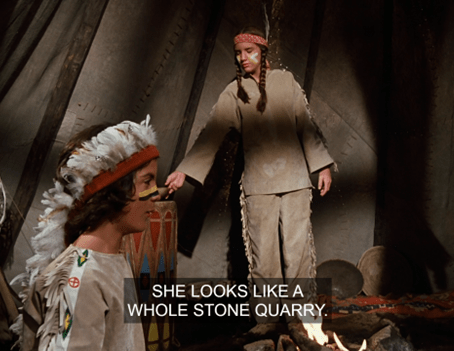
“You want more, you call for Tiny Pebbles!” the girl says, barely getting through the line without laughing. (Fat Joke #48.)

The girls withdraw, and Albert says, “Tiny Pebbles? She looks like a whole stone quarry.” (Ouch! #49.)
Laura says they should go to sleep (in a dream?), and Albert says he’s so hungry he could eat a horse (an expression used by at least the early Nineteenth Century).

Laura then tells him he is eating a horse. God, Landon!
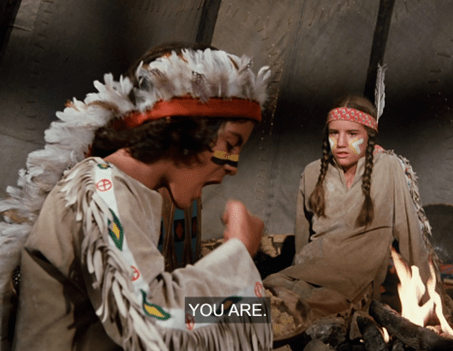
Apparently some tribes, including the Kiowa and Comanche, did occasionally eat horses, but this was usually need-based. (White people did the same thing, as we’ve seen on this show before.)


Meanwhile, in Stony Pass, presumably, a large company of soldiers rides into town carrying a red and white flag with 7B on it.
ROMAN: They must have had a big budget for this one.

There is an international maritime flag 7B, indicating the bearer is carrying dangerous cargo, but I assume this 7B actually is the number of the company, or battalion, or whatever.
I can’t tell if we’ve seen this set before. It could be it’s on the outskirts of Old Tucson Studios. Then again, it could not be.

David Rose gives us a pompous military march with a little quote from “The Stars and Stripes Forever” thrown in for spice.

The soldiers march into one of the buildings; the doorway is adorned with the American flag and another bearing the Great Seal of the United States, or its beloved characters, anyways. (The latter was first used in 1782.)

Inside, Charles is telling Commander Kaiser that Nels said the Ingalls kids never arrived at the Halloween party. (Michael Landon chose to play Chuck utterly straight in this dream, which is pretty funny.)

Kaiser says, “The only thing we can do is hope for the best.” He tells Pa the men will look for the children, but it’s not a priority mission. In the meantime, he says, stay put.

Then the Commander summons a sergeant and places Charles under house arrest!

The Sergeant, a man with a fleshy neck and a great mustache, takes Chuck away.
In another curiosity, he’s played by Dick Alexander, who was also the kidney-pie-loving sergeant in “Freedom Flight.” (But since neither Albert nor Laura met him in that story, it’s odd he should guest-star in a dream too.)
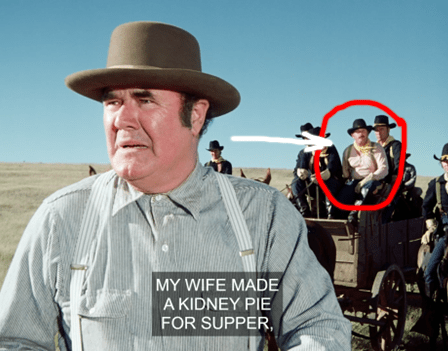
Alexander was a dead ringer for another actor who went by Dick Alexander, but according to the IMDb they’re unrelated.


We get a commercial then, and when we return, we’re back at the Little House, where the dear old Chonkies are standing around, Ma is coming down from the loft and Pa is eating dinner.

You may have thought they should have been evacuated, but no, we’re back in the real world, and Ma tells us Laura and Albert are still sleeping.

Ma says she’s proud of Laura for doing such a great job making the costumes. This is the second time this season, as well as the second time ever, that Laura’s seamstressing abilities have been mentioned.

She says she hopes they win a prize in the costume contest, and Pa says, “I just hope they don’t start an Indian uprising!”
Then we see Albert sleeping upstairs again, and we set a spell with him. (In addition to its many known defects, this one suffers from too little material for an hourlong show.)
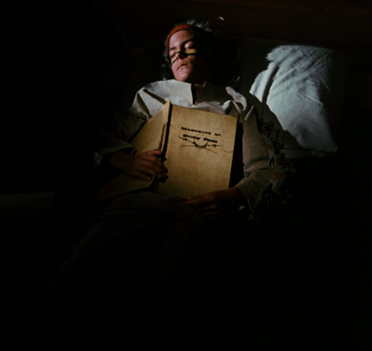


Back in dreamland, we see Albert and Laura riding along with the three chiefs and a number of braves.
They spot the town on the horizon, and Chief Sly Fox says, “There is Stony Pass! It protects Walnut Grove!” (The idea that Walnut Grove is their true target I find very funny.)

The Rose gives us a bugle call, and we see some sort of heavily mustached Army scout riding fast into town.

Hearing there are Indians approaching, Commander Kaiser looks through his telescope, saying there’s a “small man” amongst them who must be the Son of Running Bull.

Charles looks through the glass himself, and informs Kaiser it’s his children impersonating Son of Running Bull and his attendant.
And the next thing you know, ol’ Chuck is meeting the Indian party under a white flag.
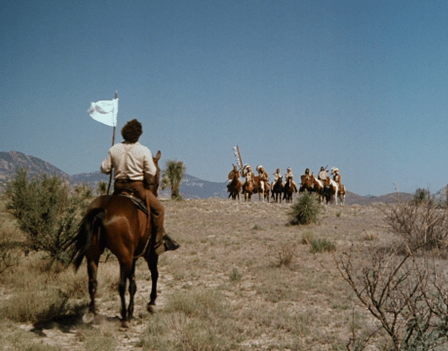
Laura cries out, “It’s Pa!”, which confuses the elders until Albert says, “Itspah. Mean ‘much dust in air.’” (Make of that one what you will.)

Sly Fox says they should kill him, but Chief Kilowatt suddenly says, “No! It is Charles Ingalls! He was friend of my father!”

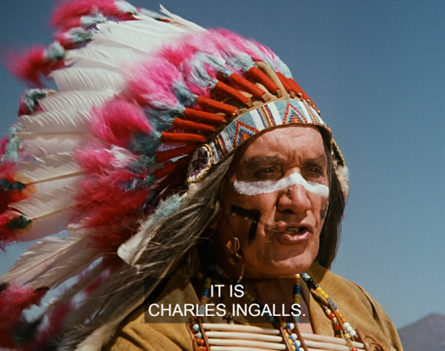
This is actually several layers of funny: first, Frank DeKova’s dry delivery; second, that Charles is a hero everyone knows and worships, even in a dream; and third, that Charles is supposedly an old friend of Kilowatt’s father. (DeKova was 69.)

Sly Fox disregards this, but Albert exerts his authority as chieftain and says he will speak to this Ingalls alone.
Sly Fox says they will all speak to him, but at least he drops his suggestion that Pa be immediately killed.

When Pa arrives, Albert introduces himself as “Son of Running Bull.”
Charles says, “Son of who?”
“Ugg!” Albert replies, and winks. (Fourth ugg so far, and we aren’t even halfway through.)


Pa urges peace, but the Indian party turns and rides off.
That night, at camp, Laura says she wonders what happened to the real Son of Running Bull. (This story sort of reminds me of “The Curse of Pelandon,” a funny Doctor Who adventure in which the Doctor and Jo impersonate ambassadors from Earth. “Peladon” has a similar tone to “Halloween Dream,” but less racism, except maybe against Ice Warriors.)

Giggles announce the arrival of Tiny Pebbles and Tana with more food.
“Ugg,” Albert says.
Tiny Pebbles then frames her face with her hands, adoringly watching Albert eat. (She’s played by Rosa Hamilon – a scene stealer.)

Tana, on the other hand, starts stroking Laura’s hair, commenting on the “strange color.”
“Ugg,” Laura says.
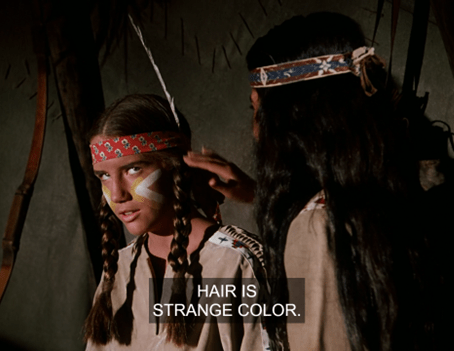
It’s not clear if Tana is romantically interested in the young “brave,” but Laura excuses herself either way.

But in fact, Laura’s gender-bending gives Albert a crazy idea, and he bares fangs optimistically.


So, they tie up TP and Tana, put blankets over their heads and simply walk past the guards, giggling away. (A nice touch.)

Back in Stony Pass, Pa and Commander Kaiser are debating what to do when in come Laura and Alb.
Even though they’re in his Sergeant’s custody, Kaiser suddenly screams “INDIANS!!!” and hides under his desk blowing a bugle.


(Alexander laughed his head off at this.)
Pa reassures Kaiser they’re just children in costumes.
The kids report that the real Son of Running Bull has not yet arrived.
The adults have a dull filler conversation just to eat up time.

Albert proposes he and Laura return to the village and say the rifles have been intercepted and the Indians’ plans foiled.
Commander Kaiser loves this idea, and shakes Albert’s hand.

To another grand march (this one reminiscent of the “Triumphal” one from Aïda), the kids depart.

“You’ve got two fine children, Mr. Ingalls,” says Commander Kaiser, and Charles replies gravely, “I know, Commander. I know.” HA!


Back in the real world, supposedly, we see a tortoise crawling by the creek.
ROMAN: Mike Sheldon!

There are turtles here in Minnesota, but no tortoises, except in Olive’s bedroom.

And a turtle in October?

Up in bed, Albert is still sleeping. What time must it be by now?

Meanwhile, in the dream world, Albert and Laura return to the Indian camp and deduce Tiny Pebbles and Tana haven’t been discovered yet. (Poor kids, having to sleep the night tied up. Still, it’s just a dream.)
Laura and Alb are greeted by Chief Sly Fox and a party of guards. Sly Fox asks if there’s news of the rifles.
Albert starts telling them the rifles will never arrive; only Laura looks to one side and sees that they have already arrived.

Out of nowhere, a small child appears and runs at them, ululating and waving a tomahawk.
With a droll look, Albert says, “The Son of Running Bull. . . ?”


Fans will be delighted to learn that this kid is played by Clint Lilley – son of Jack Lilley, our beloved Mustache Man!
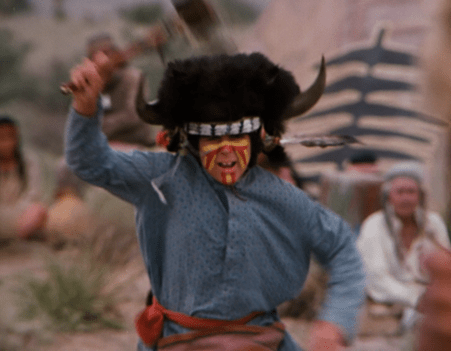

When he grew up, Clint became a very successful stuntman and animal wrangler like his father, working on such movies and shows as Highway to Heaven, Masters of the Universe (the 1987 movie), the Patrick Labyorteaux vehicle Ghoulies Go to College, Bram Stoker’s Dracula (family fave), Buffy The Vampire Slayer (the 1992 movie), The Last of the Mohicans (that’s a coincidence, hugh?), Robin Hood: Men in Tights, Starship Troopers, Walker, Texas Ranger, Star Trek: Insurrection, Nemesis and Enterprise, the Tim Burton Planet of the Apes, Skins, Alias, Hulk, Looney Tunes: Back in Action, Entourage, Thor, NCIS, Longmire (Dags and I made up an original theme song to that one), Key & Peele, Community, Hail, Caesar!, Martyrs, Days of Our Lives, Westworld, and Fear the Walking Dead.

Well, just when you thought this one couldn’t get more bizarre, we cut to a shot of Laura and Albert literally crucified (just tied, not nailed), with all the Indians dancing in the background.

(Again, it’s a dream, but I did look up the history of crucifixion to see if Native Americans ever did this, and the short answer is, they didn’t.)
Laura and Alb sadly discuss whose fault this whole situation is, but they perk up a little when they agree Nellie Oleson is to blame. Ha!


Albert quickly discovers his cross isn’t very secure. He’s able to detach it from the ground, but he’s still tied to it.
He shuffles over to Laura and is able to untie her.

But the drumming and dancing stop suddenly, and they realize they’ve been caught.
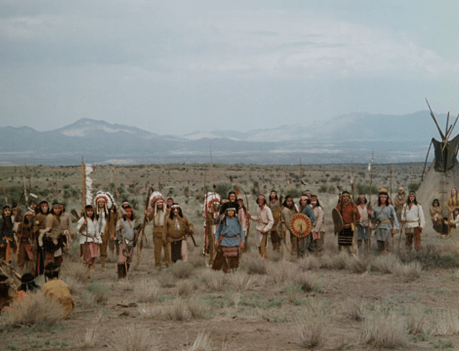
Laura takes off running, and Albert drags his cross after her.

This episode would make a good collectible action figure set.

The Indian band pursues them, and we get a closer look at Son of Running Bull. I am about 85 percent sure Clay Lilley is our most frequently featured Ambiguously Ethnic Kid.


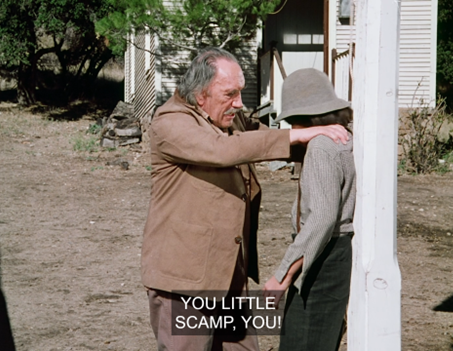


If the AEK is Jack Lilley’s son, I think this also confirms my theory that it was him stunt riding as Andrew Garvey in “Barn Burner.”
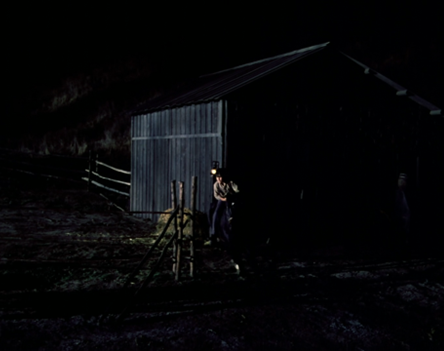
Well, Laura gets Crucifix Albert up onto the wagon of stolen weapons and they tear off in it.

In my favorite moment of this whole mess, Son of Running Bull notices and chases them, ululating wildly.
He tries to jump on a horse, but is too small, so without missing a beat he just keeps running and shrieking.


The warriors all join the pursuit. If you watch in this scene, you’ll notice a rope fence has been erected amidst the riders, presumably to give the horses a little space so they don’t hurt themselves or each other.

We get a wonderful shot then of the wagon, crucified Albert and all, thundering at top speed through the desert followed by the massed armies.

Back in Stony Pass, a sniper keeps watch on the roof.

Inside, Commander Kaiser is playing with a revolver. He looks to be going a little Jack D. Ripper.


Back on the wagon, Laura hands Albert, who of course can’t move his arms, the reins so she can jettison some excess weight from the vehicle.
ALEXANDER: Why doesn’t she untie him?

Meanwhile, Son of Running Bull keeps chasing his horse, with David Rose giving us the Kentucky Derby trumpet flourish (“Call to the Post“).
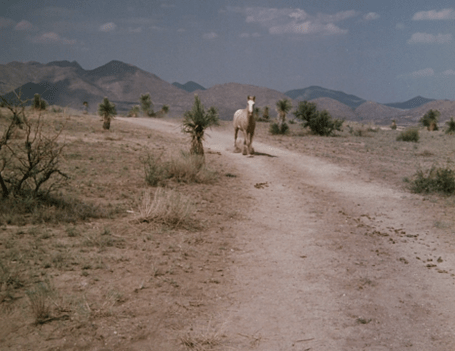
Laura starts throwing barrels of gunpowder out the back and shooting them so they explode, Jaws-style.
ROMAN: “Smile, you son of a bitch!”


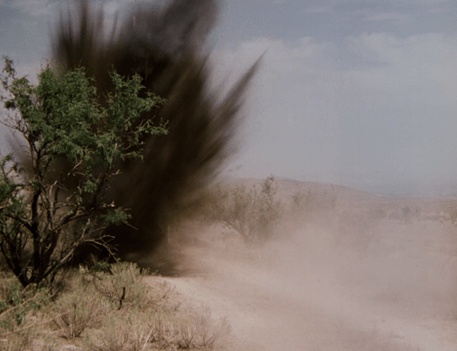
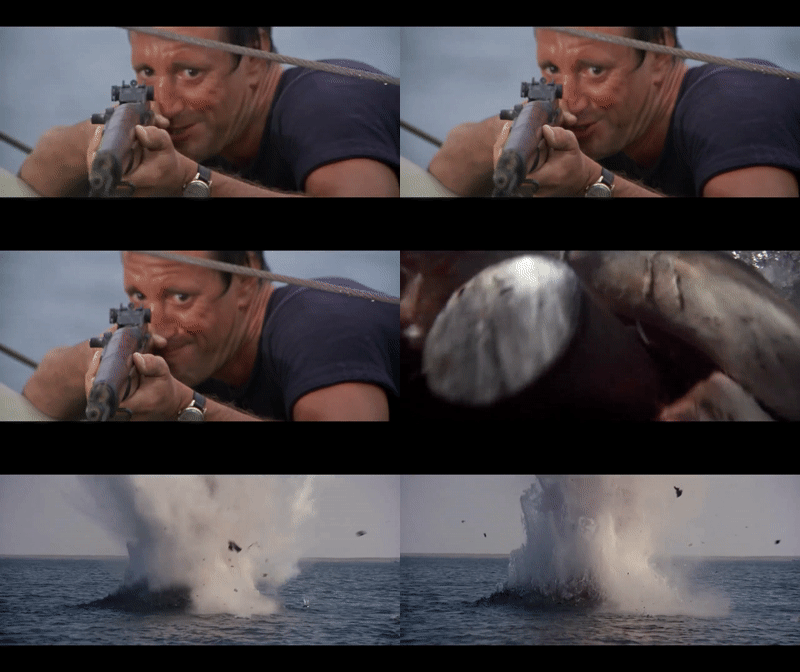
At the explosion, Chief Kilowatt falls off his horse, but he literally hits the ground running.


Unable to steer anyway, Albert faints, and we go to a commercial.
[watching the new Star Wars-themed Coke commercial – in its way, just as idiotic as “The Halloween Dream”:]
WILL: No Bib Fortuna? That’s a missed opportunity.
ROMAN: No, that’s a missed Bib-Fortunity.

Back at Stony Pass, we get this delightful exchange:
CHARLES: Something must have happened, Commander, they should have been back by now.
COMMANDER KAISER: All we can do is wait and hope.
CHARLES [rolling his eyes]: Why do you always say that?
COMMANDER KAISER [shrugging]: It’s all I can think of to say.


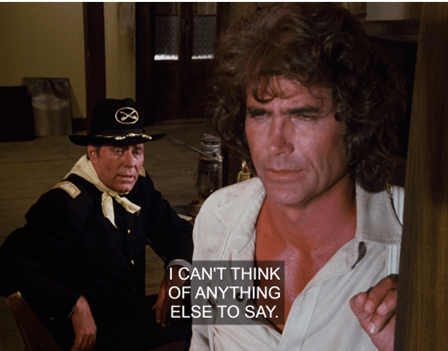
Hahahahahahahaha! Like it or not, this story has a satirical edge. It giggles at many of the conventions of classic Westerns: the hackneyed dialogue, stock characters like the brave commander and taciturn Indians, etc., etc. I’m sure there are plenty of specific references I missed, since classic Westerns aren’t really my thing.
Back on the plain, Laura continues to throw bombs. She’s a pretty good shot.


An Indian brave is thrown from his horse into a ditch, but he jumps right up again screaming.
As the wagon races on, David Rose brings in – you guessed it, the slide whistle.

Back in Stony Pass, Charles says he’s heading out in search of the kids.
Kaiser says “All we can do is wait and hope” again, and Charles snaps, “Oh, Commander, please!”


Kaiser looks through his telescope, and if you look closely you can see crew members reflected in the lens.
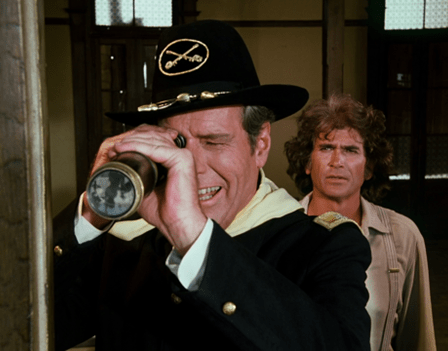
He sees the wagon and the warriors approaching, shouts to everyone to prepare for battle, then runs upstairs and hides in his bedroom.
WILL: This is like Zulu.


Everybody races around town for a while.
WILL: This is also the most elaborate chase we’ve had since Mrs. Oleson test-drove the racehorse.


Just as Son of Running Bull is arriving, a squad of Army reinforcements comes riding into town too.
The Indians suddenly disappear from the story and the wagon stops.
The kooky Commander appears on his balcony and shouts to Laura, “I don’t know how to thank you except . . . salute you, darlin’!” (Philip Carey is a shoe-in for the Craziest Good/Bad Performance Groovy Award this year.)

Laura yells back that Albert deserves the real thanks.
ALEXANDER: He should be dead.
ROMAN: Yeah, like in the Erlkönig.
Suddenly Jonathan Garvey carries the limp Albert around the corner of the wagon.
ALEXANDER: Oh, see? He is dead.

Pa and Garvey gently wake Albert up . . . and here we are, back in the loft apartment.
It takes a while for him to wake, but I refuse to add any more goddam pictures of Albert sleeping.
Pa says it’s time to go to the party.
Then we see Laura and Albert heading to the party – on horseback, Pa apparently having borrowed some saddle horses for the proper effect. (Whatever.)

But on the way there, they see three Indians riding towards them.

Albert panics and races away, but it’s only Willie and some other kids in costumes. (I can’t tell who.)

“How, Laura!” Willie says, eager to get one last piece of racism in before the clock runs out.

And just when you feel the curtain starting to fall, David Rose inexplicably gives us “Hava Nagila” in the orchestra! A bonkers way to end a bonkers story.
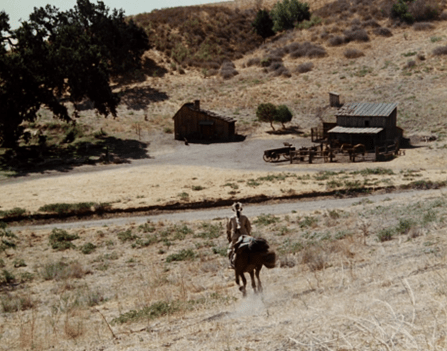
[UPDATE: Reader Ben suggests this might be a layered meta-joke by Landon, since he was Jewish and his birthday was on Halloween. Not sure myself, but I love it as a theory.]
STYLE WATCH: Even in a dream, Charles goes commando.

THE VERDICT: “No . . . it is Charles Ingalls!” It’s a pity about the stereotypes, because this one otherwise is a unique absurd comedy with a surprising wit. It’s a parody of boys’ adventure literature, classic TV Westerns, and, at times, Little House itself. Haskell B.’s cinematography is great, the chases are epic, and Gilbert and Landon give witty performances.
So, is “The Halloween Dream” undeserving of its Worst of All Time status? Clearly there’s no evil intent – it’s simply satirizing traditional (but racist) cowboys-and-Indians stories.
(Some fans argue that this story “can’t be racist” because it’s a dream and therefore the stereotypes it depicts aren’t “really happening.” But this doesn’t make sense. Is it also a dream that these stereotypes were broadcast on national television?)
Anyways, I don’t know that I’d go so far as to say it’s the WOAT. I can think of at least two stories I hate more; but ultimately, enjoying this one means playing a difficult game of Can You Overlook It? Today, casual racism hits like a punch in the face, and it’s even worse coming from a show that so consistently challenges racist attitudes.
As I said, a pity.


UP NEXT: The Return of Mr. Edwards (!!!)
 Walnut Groovy
Oh, boy! First and foremost, bless you for facing this one head-on and doing a great job tackling every part of what it is. I had never really watched this one before. It always ended up as background noise, and the lingering shots of Albert sleeping were all I remembered. Knowing it was next, I watched it last night. I won’t go into the obvious problems (though I do have to say the fat joke about the little girl was especially in poor taste, IMO).
For me, the episode highlights a few things that make Season 6 such an awkward mess at times. We opened this season with Laura declaring to anyone and everyone that she’s “a woman…a WOMAN!” but here we go with her partaking in a distinctly children’s activity, which will happen often through the rest of the season. Almanzo was introduced, but he doesn’t really factor into much and barely features outside of “Annabelle” and “Wilder and Wilder” until we get to the season finale. Nellie is mentioned several times here in “Halloween Dream,” but once “Back to School” ends, her role in the series is totally diminished, so the “let’s just blame it on Nellie” joke annoys me. I don’t know if Arngrim was actively looking for a lighter load so as to focus on other work (still haven’t read her book yet), so I acknowledge that possibility, but man, knowing some of the episodes that are coming up with soooo much focus on one-off characters (some with literally no connection to the Grove – cough The King is Dead cough), I just wish they’d given Nellie the spotlight a few times in the lead-up to Percival’s arrival. If anything, he could have been introduced earlier on so that their love story and Nellie’s softening could develop over a half-season instead of a two-parter. Laura and Nellie should have been firmly established as friends by the end of the season, too!
But now I’m just ranting. Quick, cue up “Hava Nagila” (seriously, what tf was that all about??).
LikeLiked by 2 people
Thank you, J. Toddward! I think it’s one almost everybody avoids. I’m not sure if I’ve ever seen it in its entirety before, and I’m quite sure I didn’t pay close attention to it if I did. I hear you about Season Six, though I think a lot of the individual stories are strong. As to your point about Almanzo not really having a presence till the end of the season, that’s the kind of thing I’m finding it interesting to notice watching these in sequence. Back in the old days, you never knew what you were going to get when it aired in syndication, and of course with video you can jump around as you please, and skip whichever ones you don’t like, so it’s easy simply to assume other episodes fill in the blanks. And as much as I like Percival, I agree that Nellie’s transformation from narcissistic teenager to more well-rounded adult could have been developed better. It’s hinted at in some of these stories, but it would have been an interesting thread to follow if it were featured more prominently. I say two episodes at least on this topic could have been added . . . any suggestions for what their plots would be?
LikeLike
You know Michael Landon’s birthday was Halloween, right? And he was Jewish? Does that explain Hava Nagila? Inside joke?
LikeLiked by 1 person
I forgot it was his birthday! I suppose that is a possible explanation, but if so it’s a layered meta-joke of a type not often encountered on this show! 😀
LikeLike
<chef’s kiss> nice job.
I’m always a bit disappointed when Jonathan Garvey is in an episode and Andy is so obviously overlooked/left out. Wouldn’t he also be going to the party? If they didnt want to mess with his actual presence, couldn’t they at least mention him? (“We need to meet up with Andy. He’s dressed as…” what? Jesse James? A giant chicken? Something?) I always felt bad for Patrick and wondered if there were bad feelings between him and Matthew.
I also would have loved to have witnessed Nellie’s costume party. Maybe she incorporated he curly black wig into her costume!
Also thank you for incorporating the Great Halloween Blizzard of ’91. No conversation about Halloween in MN is complete without a mention.
LikeLiked by 1 person
Thank you! I’ve often thought about the Andy factor too, and wondered about the Labyorteaux brothers’ personal dynamics. (I titled one earlier recap “In Season Four, I Was the Boy!”) But perhaps in this specific instance Andy was not invited on account of lingering awkwardness from the cheating scandal last season.
I actually did consider making a picture of Nellie’s party, but it would have been pretty complex, and I really didn’t want to spend more time with this story than I needed to!
I didn’t live here yet in 1991, so I didn’t experience The Iconic Blizzard No One Would Ever Forget myself. One does hear about it quite a bit to this day, though.
LikeLike
Howdy! Well, I wanted to ask your permission on a matter: recently I opened this guide about Highway To Heaven, a bit like yours. Of course, there are multiple references to Little House events or anecdotes, which couldn’t be otherwise considering the connections between these two shows. Basically, instead of pointing somewhere else, can I use your episode whenever I mention some events that you’ve already talked about here? It would be more specific, at least.
LikeLiked by 1 person
Oh, most certainly. And while I’m not big into H2H myself, I will check out your site! Good luck!
LikeLike
Thank you! It’s highwaytoheavencast.com if you’d like to. But is it a matter of preference of Little House over Highway, or you just don’t like it as a series?
LikeLiked by 1 person
Oh, I don’t know it well enough to judge it. I much preferred Little House when I was young, but I can’t say I’ve ever watched much Highway, then or now.
LikeLike
I took a look, and you make some very good observations! Keep it up! But be warned: If it’s anything like Walnut Groovy, it WILL take over your life! 😀
LikeLike
I agree so much with a previous poster regarding Laura. Last season aged Mary into adult, married, school teacher. But they kept Laura as a pretty irresponsible child. She’s always galavanting on different adventures and B plots. We rarely see her with any actual responsibility, and when she does have some, she does it poorly, like taking not Carrie to the bathroom on time. This season started with “I’m a woman”, left it at that and didn’t do more subtle character development, like perhaps changing her hairdo and seeing her act more responsibly. I think maybe stress her seamstress skills. Literary Laura did work in a dress shop, practically full time in between her teaching jobs. This particular episode is one I skip usually. I’m an “I Love Lucy” fan, and other episode I normally skip is also a dream episode of Lucy’s dream of a musical set in Scotland . Ricky sings, “I’m in love with the dragon’s dinner!” I never liked it, even as a kid.
LikeLiked by 1 person
Definitely agree . . . although the Scottish Lucy dream sounds kind of fun. . . . 😉
LikeLike
I think you could be right & “Running Bull” could be Jack Lilly‘s son. It would be nice if you ever get to confirm it. I was never a huge fan of this episode. As a kid growing up in the 1970s we played Cowboys &Indians a lot. I always wanted to be the Indian & never the cowboy.
🤷🏻♀️
LikeLiked by 2 people
When I first watched this episode, it was midway through and I didn’t realize the whole plot was a dream sequence, so I actually thought those were supposed to be 1:1 Native Americans, so you get why I wasn’t too thrilled about it. But even after realizing it was all a dream and that the episode made it clear from the beginning, I didn’t warm up to this premise. The show usually goes out of its way to make Native American characters as not only sympathetic, but harmless and noble, and I know there are limitations in that portrayal and that the Native-settler conflicts were complex and full of aggression, but what turned me off was that nothing seemed to be taken seriously. Now, having read this review I realize that’s supposed to be the point, that it was satirizing old clichés from Western productions. But that completely flew off my mind for years, so when I remembered this one, I saw a tasteless premise playing old cliches such as one-dimensional hostile Indians and a one-sided take on the conflict, with none of the seriousness I usually associated with this show. I can’t imagine an episode called “The Civil War Dream” with Albert dreaming of being back in time to the midst of the war and it all being taken as a wacky adventure, let alone the conflict between white settlers and Indians. In other words, there was something “un-Little House-y” about this episode.
Then again, “Cowboys & Indians” is a common kids’ game unlike civil war reenactements, so that explains why the whole Indian attack could be made a playful dream adventure, with a lot of events that’d never happen within the show’s “real life”, from an Indian attack in Walnut Grove out of nowhere, to Charles letting his kids go back to the tribe to work as spies to a 15-year-old Laura using a gun. It’s all meant to be nonsensical and cliched. But society being what it is, there’ll be much division about how well that holds up. The opinion that it’s tasteless and offensive is well-known, but there’s a sizable part who’d argue that it’s all meant to be “in good fun” and that it’s self-aware that it isn’t meant to represent actual Native-Americans. At the same time, though, it’s hard to say how well that explanation holds up. I remember when I saw Peter Jackson’s King Kong, where the natives on Skull Island were violent, deranged and resembled orcs more than human beings. There’s suplementar material and some blink-and-miss elements in the movie suggesting that those natives were once a prosperous civilization before the isle started to break apart, so their society fell apart and was reduced to those unyielded remnant in a brutal, deadly environment. But that explanation wears so thin that all most of the audience saw, myself included, was a tribe of hostile, dark-skinned “savages” playing the worst cliches of old productions straight, and making them little different than the dinosaurs and other beasts on the island. Granted, “Halloween Dream” isn’t nearly as bad, in that it’s a bit more clear that the over-the-top cliches are part of the dreams of a white kid who probably never saw and actual Native American in life. One thing I’m sure is that, not everyone will agree on whether or not that justifies the premise here, and how well it worked in hindsight.
LikeLiked by 1 person
It’s interesting you should bring up King Kong. I recently watched Zulu, the 1960s movie about the Anglo-Zulu War in South Africa. (Based on events that happened in 1879. I love watching movies and shows set in the Little House time period and imagining what’s happening back in Walnut Grove.) If you don’t know the movie, it’s an epic about a battle between a small company of British soldiers and a huge army of Zulu warriors. I know Peter Jackson loves the film, as he’s said he used it as a model for the Helm’s Deep battle scene in The Two Towers. But the Zulu people it depicts, while not really characterized individually, are a far cry from the monsterlike denizens of Skull Island in Jackson’s Kong. In that movie, Jackson is playing the same game as Landon in “The Halloween Dream” – presenting a vision of “hostile Natives” that’s a caricature of stereotypes from ancient movies like the Tarzan series, the original Kong, etc. etc. But it’s such a fine line to walk. Satire and parody only work as intended if the audience gets the reference. But how many viewers of Jackson’s King Kong did? Like you say, without that context, a lot of people are going to read the Skull Island Natives (or the Lightfoot and No-Shoot tribes) “straight,” and where somebody who recognizes the references will see the story as a comic exaggeration of old racist tropes, somebody who doesn’t will simply see it as aggressively racist. That’s why so many people see “Halloween Dream” as the latter, when it sees itself as the former. The danger is, when people aren’t likely to get a joke, is it worth making in the first place? (I realize this might be an irony coming from me!)
LikeLiked by 1 person
Ironically, I think the Natives from the 1933 version are a far cry from the ones created in Jackson’s version (not that this is a difficult task). Sure, they’re stereotypical and do sacrifice Ann Darrow to Kong, but they seem resignated to their rituals rather than malicious about it, and whereas your typical Natives would perform sacrifices for a religion neither the heroes nor the audience would believe to be real, the ones from the 1933 film sacrifice women to appease a very real threat, and their fears prove right when Kong breaks through the barrage separating him from tribe looking for Ann after she was rescued, massacring several tribes in what’s meant to be horrifying and tragic. Of course, the 1930’s natives weren’t meant to make a point or satire of anything, just playing a stock, but (then) innocuous archetype, but they still seemed more humanized and sympathetic than usual. It was already a step up that they were played by actual Black actors (keep in mind the Bela Lugosi vehicle, White Zombie, came out just a year earlier, with all the Hatitian characters played by white actors in blackface).
The dilemma about when something is meant to condone ideas we don’t like and when it’s tackling the subject about them is often tricky to see. I recall a discussion about the infamous last episode of Star Trek: TOS, where a woman from Kirk’s past, Janice Lester, lures him into a trap to swap bodies with him and take his place as captain, and at one point saying that “(Kirk’s) world of captaincy doesn’t allow women. It isn’t fair”, and acting erratic while in Kirk’s body while Kirk in hers tries to convince others who he is. At the end, when she’s returned to her original body and breaks down, Kirk and others look at her and he comments how “her world could be as good as any woman’s. If only”… when I first watched this one as a child, I kew the moment she talked about taking Kirk’s place that this would be a story about how “women should know their place”, given the limited roles given to women in the original show and the fact that she’s described as hating being a woman, parallelling how women who don’t accept feminine roles are perceived, and that the writing was condoning that perception. But to my surprise, there’s a lot of people who defend this episode, claiming that it didn’t mean to say that “women can’t be captains”. Since subsequent ST shows retconned the absence of women in positions of power to make it more plausible with social changes, presenting female captains long before the events of TOS, this episode became implausible, so people came to theorize that there was another explanation for Lester, that since she was criminally insane she was merely imagining a ban on women. That, or defending that even if the original idea was that Starfleet did bar women, Lester was meant to be a tragic, sympathetic character, so the show was trying to address gender roles as far as it could. I very much doubt that, given what things were in the 1960’s and the show’s portrayal of women, but people can’t seem to agree on what this episode meant to say.
Admittely, time can change what a work is perceived about when the context changes. I learned about this controversy on a 1940’s Christmas song called Baby It’s Cold Outside, in which a woman keeps giving reasons to leave her boyfriend’s house and go back home but he insists that she stay no matter what she says, and at one point she claims he spiked her drink!! But there’s context for that: back then, women weren’t supposed to give in to men’s requests, even for innocuous quality time, so the woman from the song keeps playing hard and making excuses, even claiming she saw him try to drug her when it’s clear he didn’t. But decades later, audience became alien to that context and in the modern post-MeToo scenario, it sounded like it was trivializing a date-rape situation. Those familiar with the story behind the song defend it, but others claim it sends the wrong idea and it was even removed from a few radio stations which used to play it on Christmas season, much to the ire of fans. In this case at least, the creators were visibly “innocent” and meant no harm, but at the same time, not everyone knows what’s behind it and those who listen to it out of context hardly imagine themselves back in the 1940’s when the song made more sense.
LikeLiked by 1 person
Yeah, I’m no expert on the original Kong, and it wouldn’t surprise me if it’s more nuanced than I implied. (I’m no expert on the Jackson Kong either, though I do remember raising an eyebrow at the natives in that one. Hard to believe it was twenty years ago.) I remember the 1976 version a little better (I have a taste for 1970s junk food), and I remember the “cannibals” in Pirates of the Caribbean: Dead Man’s Chest being presented in a similar exaggerated way. Again, these films served up the stereotypes with a twinkle in the eye, and they were released before our culture hit peak wokeness (though that certainly doesn’t mean nobody complained about them at the time!).
As for “Baby It’s Cold Outside,” I confess to shrugging at that controversy every year, though I accept that the lyric is a distasteful joke and no doubt would be upsetting if the listener had experienced something similar in real life. Does that mean it should never be played? I don’t know. Does it mean it should never be criticized? As much as I like distasteful jokes, there’s very little in this world that’s truly unworthy of criticism, and I would defend to the death the right of the individual to dislike a Christmas song for whatever reason. 😉
LikeLike
I can’t stand “Last Christmas” myself.
LikeLike
You’re right in that it’s not correct to call what Laura and Albert (and later on Willie and the other kids), blackface, because blackface specifically refers to non black people painting their skin to “look like” black people. In this instance, the proper term would be brownface. Instances where one paints themselves to look stereotypically Asian, the proper term is yellowface.
LikeLiked by 1 person
Oh yes, of course, and thank you for pointing that out. I actually did talk about brownface and yellowface in an earlier draft, but cut it for length. But what I meant was “blackface” used to be a term mostly reserved for talking about minstrel shows (which were often called “blackface shows”). Using it more broadly to describe Halloween costumes, opera tenors painting their skin to sing Otello, etc., is a more recent phenomenon (recent as in the last thirty years or so). All I meant was the term is used more generally today than it used to be.
LikeLike
Oh I see
LikeLike