
The Strongest Smaller Person in Walnut Grove; or
You Know, I’ve Never Been With a Black Man Before
(a recap by Will Kaiser)
EDITOR’S WARNING: This episode contains racist language and images of (barely) covered human penises. Thank you.
Title: The Fighter
Airdate: November 21, 1977
Written by Michael Landon
Story by Lawrence M. Konner
Directed by Michael Landon
SUMMARY IN A NUTSHELL: In one of those unpopular “not really focused on the Grovesters” episodes, a spiraling prizefighter gets rehabbed by Walnut Grove’s resident social worker.
RECAP: Hey, did anybody notice Pluto TV added a Little House channel this week? We did.

Double episode today!
First things first – inexplicably, we’ve returned to the terrible, horrible, no-good, very bad arrangement of the theme tune from Season Three.
DAGNY: I wouldn’t have noticed that.
ROMAN: Maybe this one takes place back in the Season Three timeline.

Next, we might as well address the elephant in the room (so to speak!).
In its opening moments, this episode gives us a closeup of a large penis, so if you get upset about such things, better scroll down a bit.
Contrariwise, if you love shocking closeups of genitals in children’s entertainments, well, today’s your lucky day.
Technically, we open on what appears to be a prostitute monkeying with two men behind a sheer curtain.
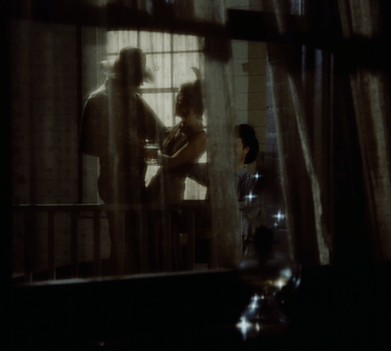
A title card tells us this is Carson City [Nevada] in 1865 – strange place and time for a Little House on the Prairie episode.
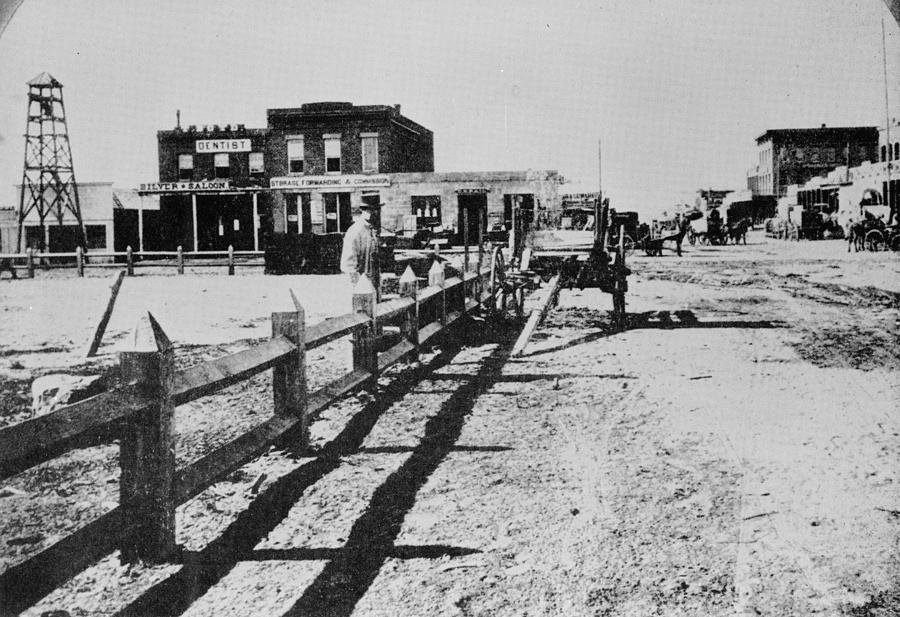
Ragtime piano plays on the soundtrack – anachronistic for the 1860s. (Despite its association with the Old West, ragtime wouldn’t become popular for another thirty years.)
Apparently these naughty people are outside on a balcony, and when the camera begins to move, we realize WE are in fact behind the curtain, and inside a bedroom.
On top of a dresser, there’s a canvas sack or satchel bearing the initials “J.K.”

And beside it, there hangs a robe with Joe Kagan stitched on it in large letters.
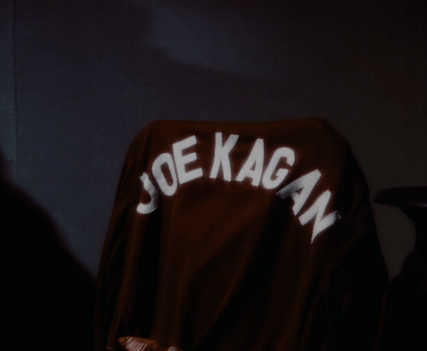
The voyeuristic camera creeps Hitchcockishly to the bed, where a large pair of feet, in boots, are resting.
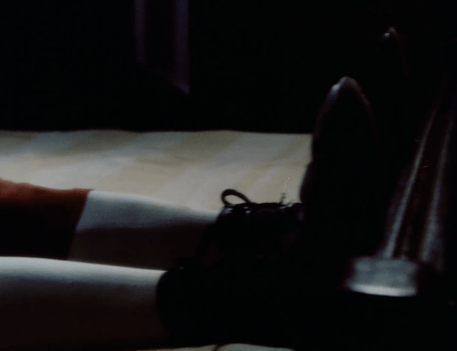
The feet are attached to legs. I suppose this is hardly surprising.

Anyways, they’re covered by white stockings and some sort of red tights.
And then we get it, reader: a closeup of a large and unmistakably real penis inside those same tights.
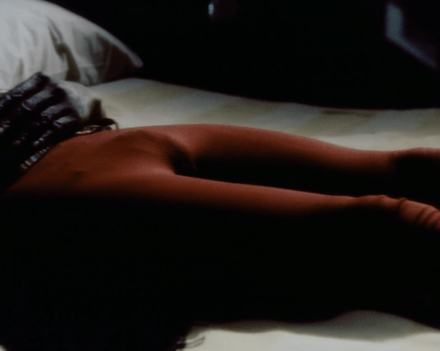
WILL: I don’t know how they got away with this.
ROMAN: Or why they would try.
DAGNY: Did Landon direct this one?
WILL: Yes.
DAGNY: Then I’m sure it was some hilarious dirty joke of his. He probably did it just to shock Karen Grassle.
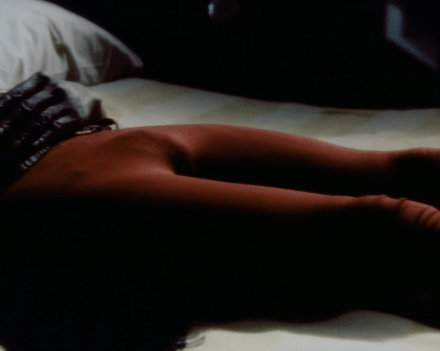
Not speeding up at all, the camera climbs the penis owner’s trunk.
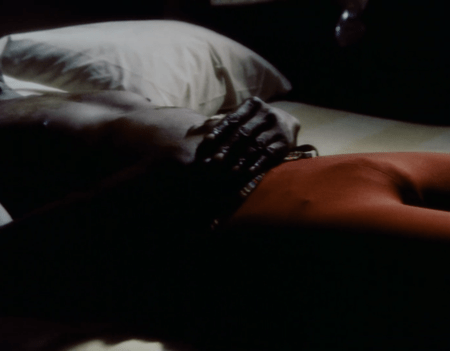
Said penis owner is revealed to be a shirtless, fit Black man of indeterminate age. He appears to be sleeping.
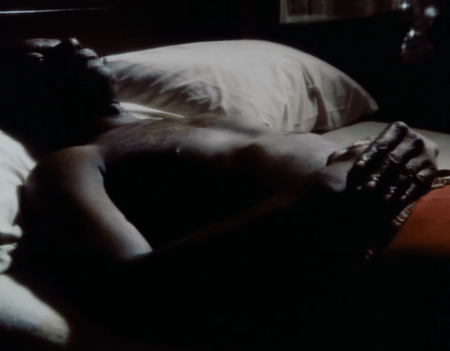
With the southwestern setting, early timeframe, African American focus character, and huge penis, you’d be forgiven if you assumed you’re watching the wrong show, reader, but you aren’t.
The man gets up and washes his face in a basin, then puts on his robe.
Apparently he’s in a suite, because he opens a door through which can be seen a (very beautiful) woman in a rocking chair as well as a boy, perhaps a little younger than Laura, in another bedroom.
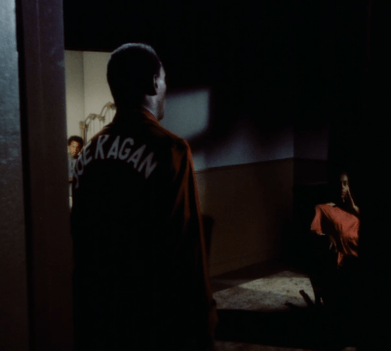
The man says to the woman, “Y’ain’t comin’, huh?”
The woman replies, “No.”
“This could be the one,” the man says. “It only takes one!”
The boy comes in and says, “Good luck tonight, Pa.”
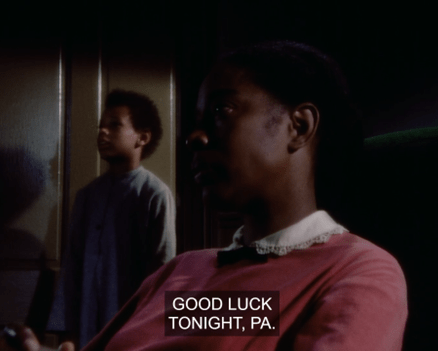
The man thanks him and says he’ll see him later, “if I ain’t too late.”
But the woman says, “Go back to your studies, Tim.” Her voice, with its impeccable diction, is very familiar, but we’ll get to that in a moment.

Then the man says, “You gonna wish me luck?”
After a moment, the woman says, rather coldly, “Good luck, Joe Kagan.”
DAGNY: It’s never good when your wife uses your full name.
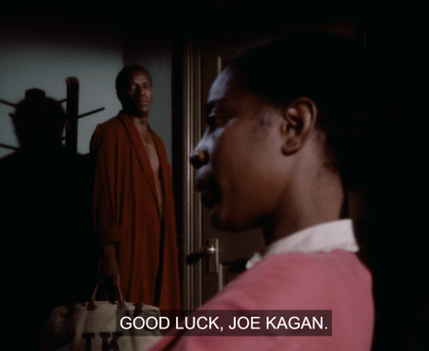
Kagan stands there a moment, but she won’t look at him, so he leaves.
Outside, Joe walks up a horse chute towards a barn. (Symbolism – treatment like an animal.)
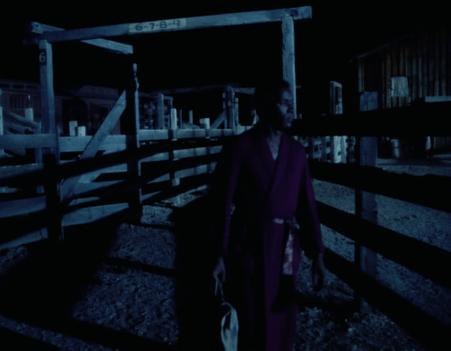
Inside, we see that two fighters are boxing as a crowd cheers.

We quickly cut back to the hotel room, where Mrs. Kagan still sits in the dark.

The piano is still playing, and with delight, we recognize the music as “The Fat John Rag” – the tune that put the chubby piano player out of work way back in “To See the World”!

The door opens suddenly, and Kagan staggers in.

His wife helps him to the bed, and in a terrible soft lisping voice, he says, “Ish – ish – Tim – Tim ashleep?”
“Yes!” Mrs. Kagan cries and gets the basin to wash his face.
That face, we see, has been brutalized. One eye is swollen shut, and his cheeks are raised and bruised on both sides.
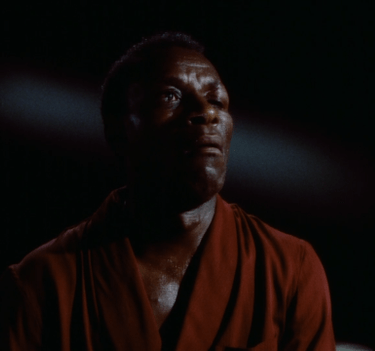
In the same awful childlike voice, Joe says, “I’m glad you didn’t see it tonight. I don’t know what happen’.”
He tries to shrug the loss off, but his wife hisses, “Oh, stop it! Stop it!”
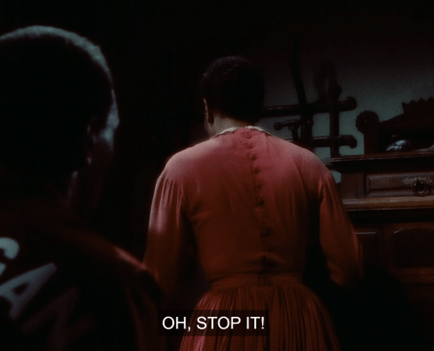
And, reader, if you don’t recognize her by now, you’re no kind of Little House fan, because Mrs. Kagan (“Janie,” according to the credits) is played by the extra-extraordinary Ketty Lester, known to us all as Hester-Sue Terhune.
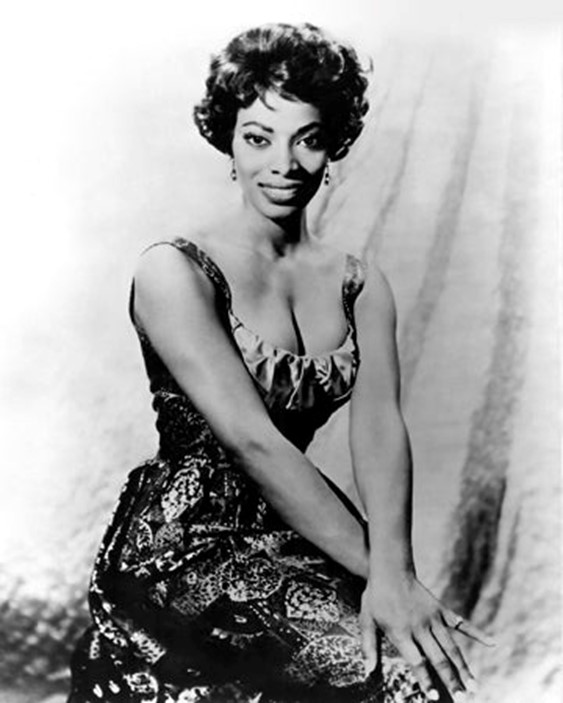
A brilliant singer as well as a stunning beauty, Lester performed with Cab Calloway in her youth, and scored a Grammy-nominated Billboard Top 5 hit in 1961 with “Love Letters.”
(You can take in her amazing performance of the song here:)
Sadly, her singing career never got the attention it deserved (though she did tour with the Everly Brothers).
Thank goodness for us, she turned to acting. In addition to Little House, she appeared on Green Acres, Sanford and Son, Marcus Welby, M.D, Days of Our Lives, The Waltons, Lou Grant, The White Shadow, Happy Days, In the Heat of the Night, Alien Nation (remember that?), Quantum Leap, and L.A. Law.
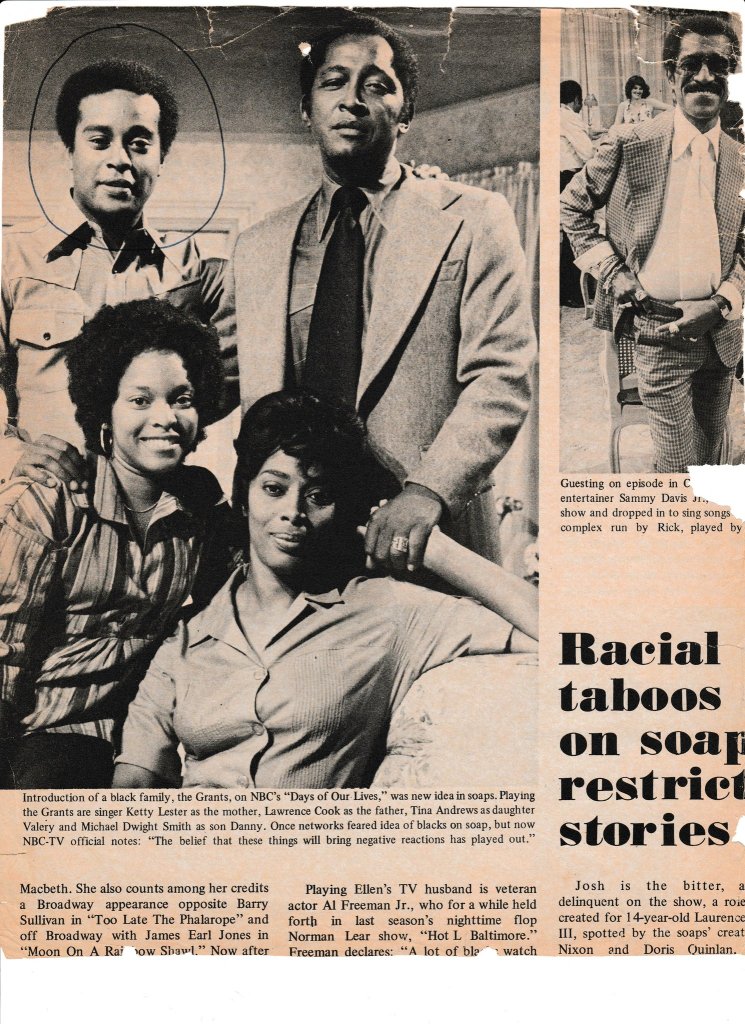
She was on Hill Street Blues, Benson, Webster, and St. Elsewhere – all four of which had superb theme songs, in my personal opinion.
She also did cartoon voices for G.I. Joe in the 1980s.
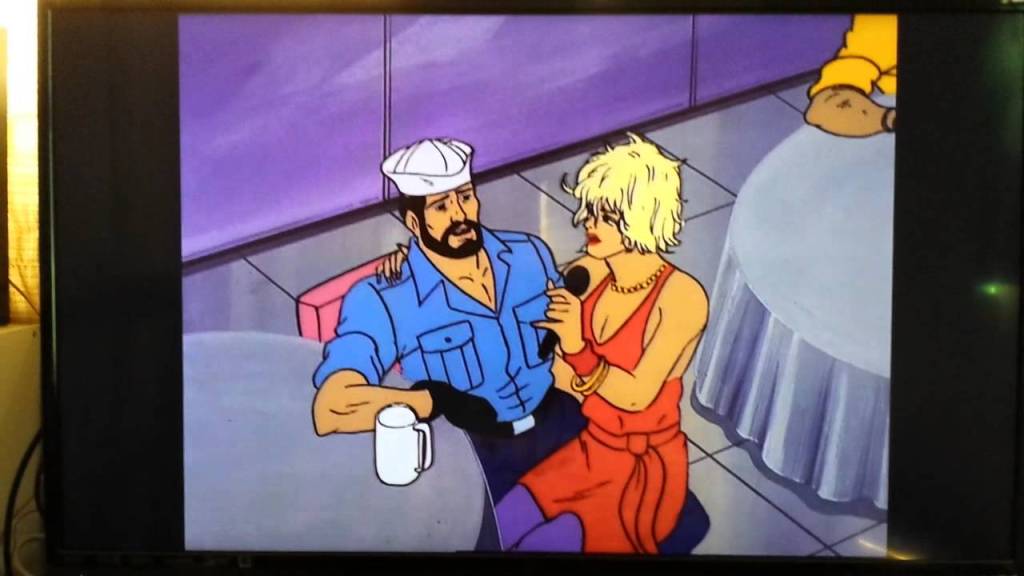
Her most recent TV role was just last year, on the Wonder Years revival.
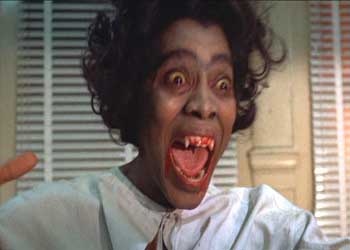
And of course she was in the blaxploitation masterpiece Blacula.
Oh, also, one critic called her “the first woman of Christian rap,” on the strength of “Let’s Talk About Jesus,” a little-known single from 1984:
She will return to Little House next season as Hester-Sue, but we’ll come to that when we come to it.
Anyways, Joe Kagan, who can barely speak, says, “Honey, I’m sorry – I know it look bad. What can I say? It just wan’t my night.”
“Listen, if you say that again I will scream!” says Janie, who’s close to screaming already.
Janie argues that getting beaten up so frequently is destroying his body and his brain.
Joe denies it, and Janie furiously throws a Bible at him. (Not literally, a la Eloise Taylor.)
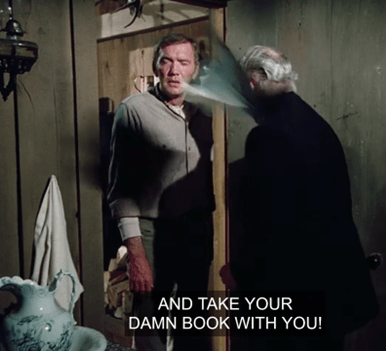
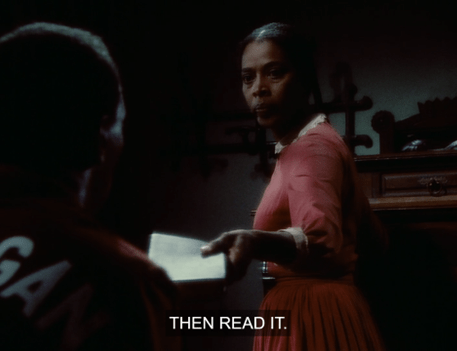
She demands he read aloud from it – apparently once a favorite pastime of his.
His voice barely a croak, Joe says, “I’m tired. . . .”
But Janie insists, and Joe reads, in a terrible high broken voice:
I love the Lord, because He hath heard my voice and my supplications; because He hath inclined His ear upon me, therefore will I call upon Him as long as I live. The sorrows of death compassed me. . . .
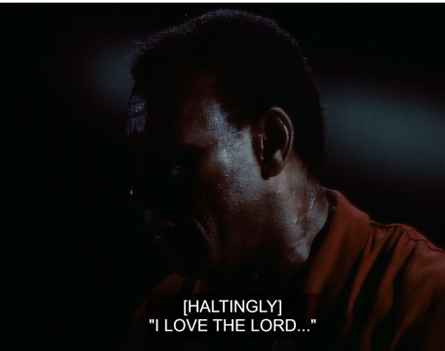
He begins weeping at this point.
. . . The pains of Hell gat hold upon me. I found sorrow and trouble. . . .
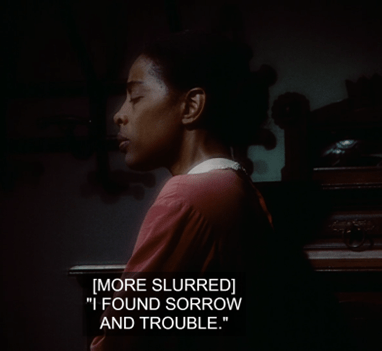
His voice becomes a wail:
. . . Then I called upon . . .
(The passage he reads is Psalms 116:1-4.)
Actually, I’d say he did fairly well; but he breaks down sobbing and says in horror, “I cain’t hardly understand me!”

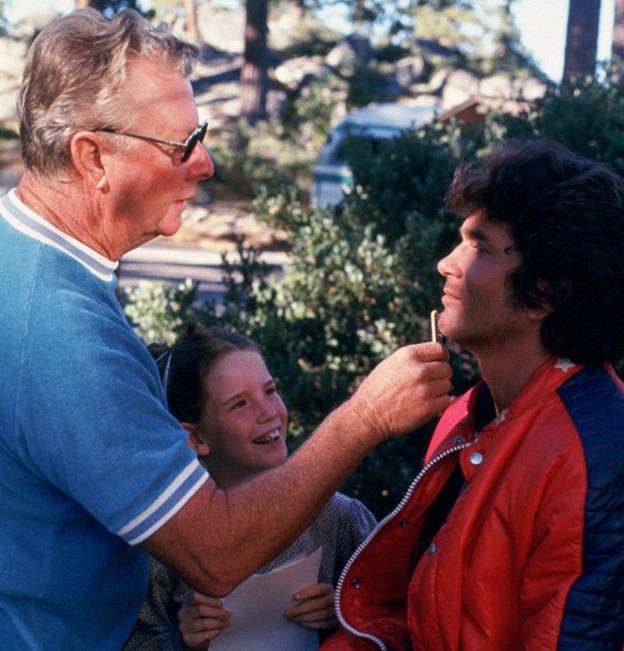
DAGNY: His makeup is fantastic.
WILL: Yeah. Hats off, Whitey Snyder.
I’ll say right now I find Moses Gunn’s performance in this story to be astonishing. Gunn was something of an icon of his era – a performer who triumphed on stage as well as the big and small screens.
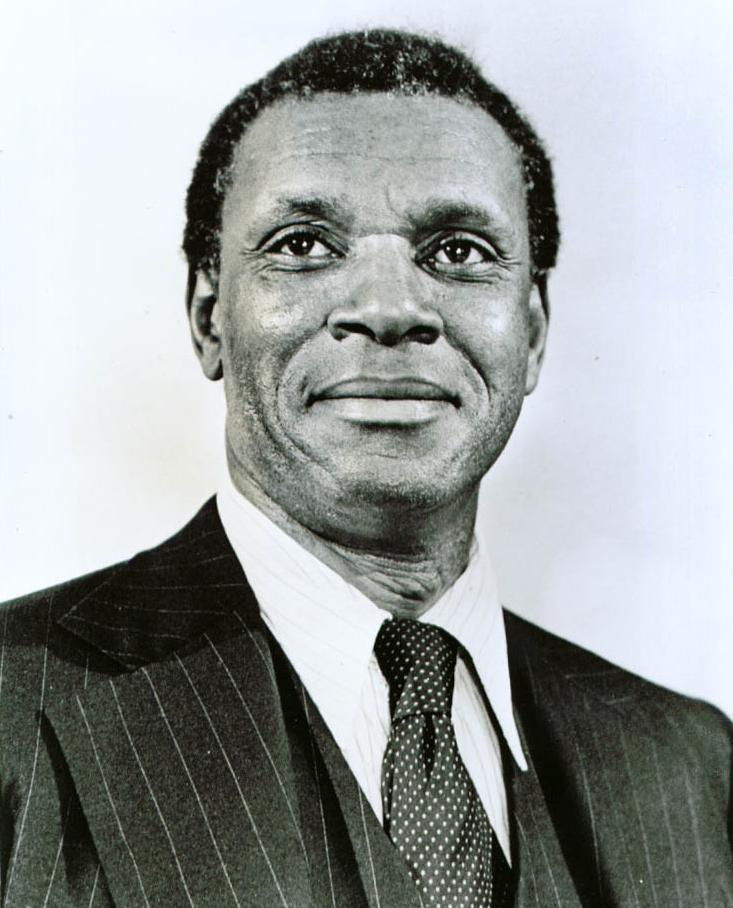
He acted four times in the legendary NYC Shakespeare in the Park productions, appearing with the likes of Martin Sheen, Olympia Dukakis, Andre Braugher, Raul Julia, Charles Durning, everyone’s favorite hot widow Mariette Hartley, and even Charlotte Rae (!).
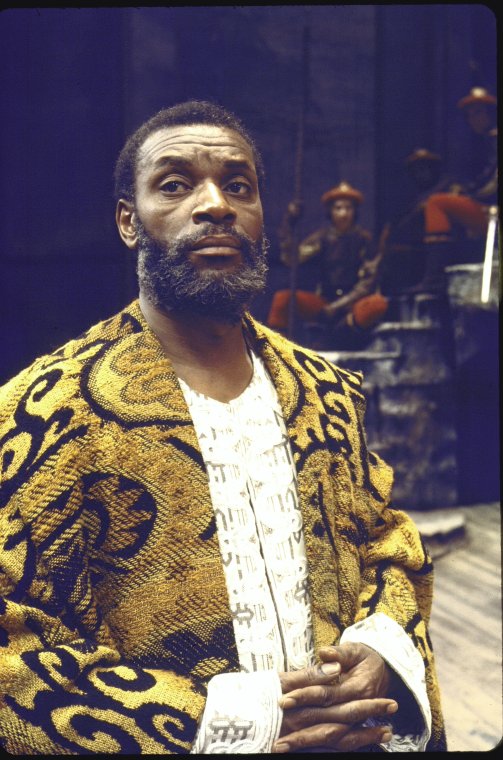
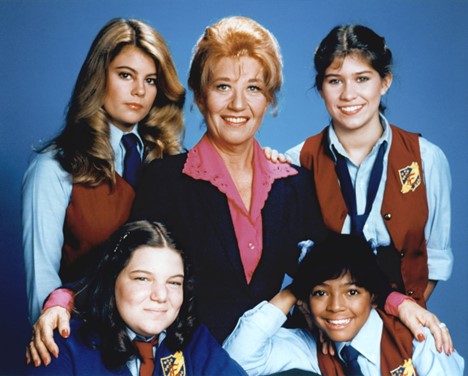
He starred in Roots on TV, and appeared on Good Times six times over.
He was in the first two Shaft films. (Sorry, Ketty Lester, but that eclipses even Blacula for blaxploitation coolness.)
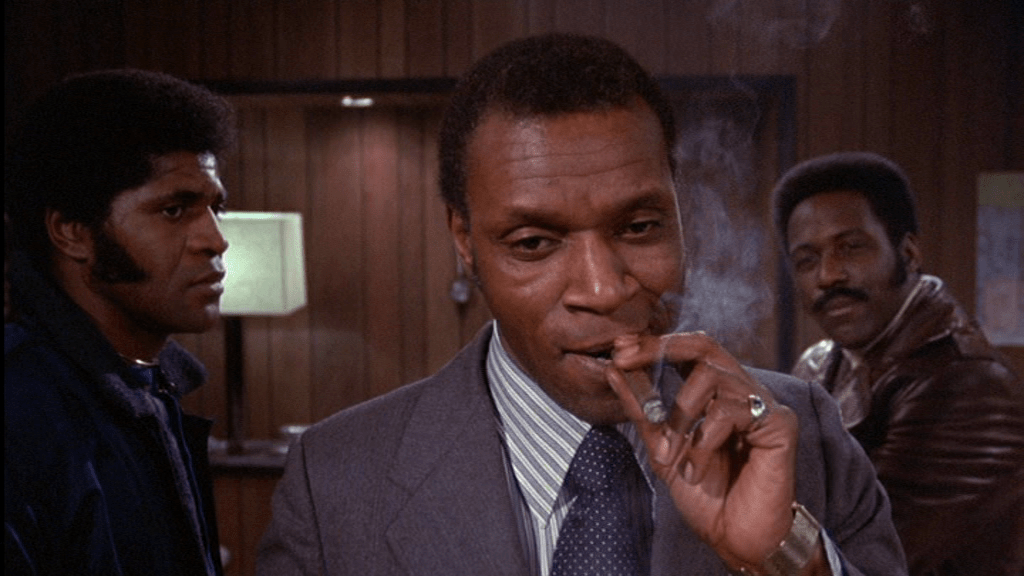
His many other appearances included Hawaii Five-O, The Jeffersons, Quincy, Maude, Hill Street Blues, The Women of Brewster Place, Amen, The Cosby Show, and Homicide.
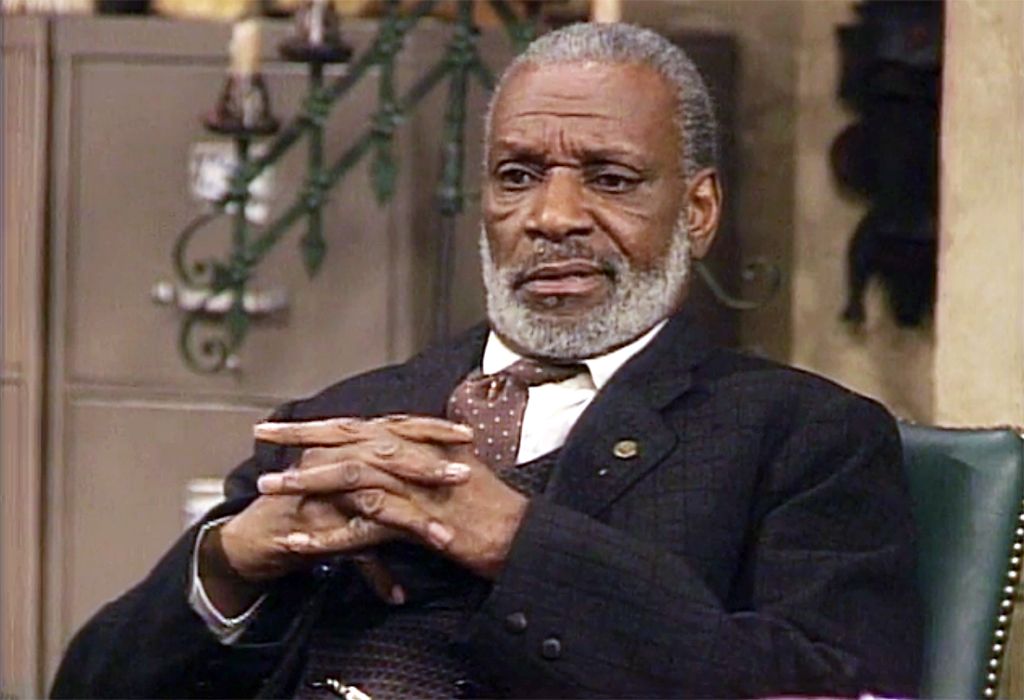
Surprise, surprise, he was also on Father Murphy, Kung Fu, and Highway to Heaven.
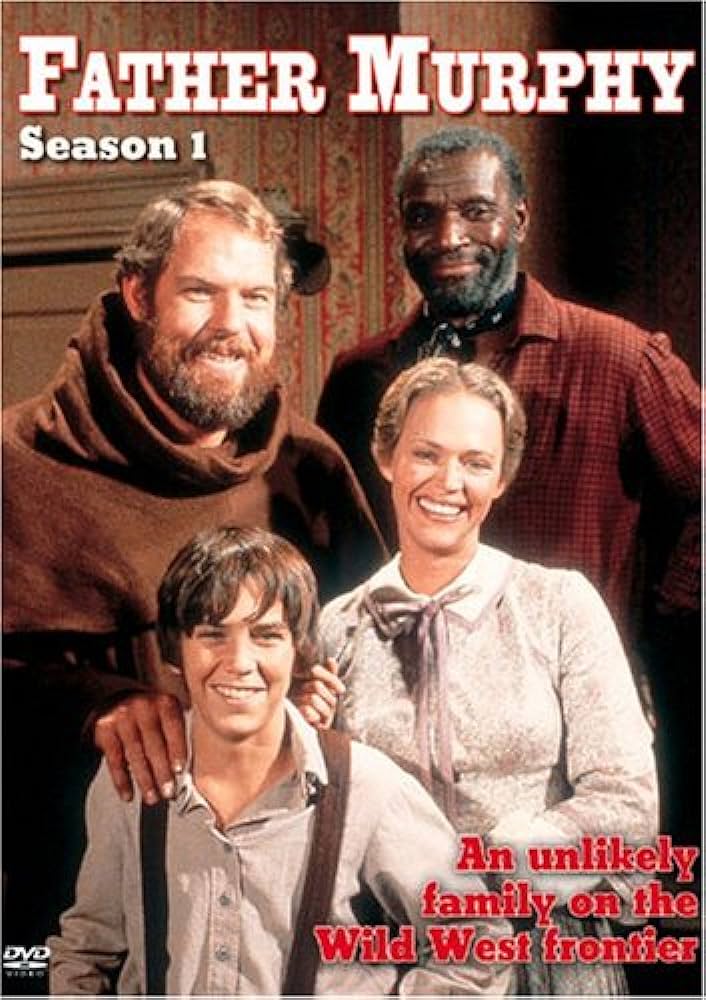
His other film appearances included Ragtime and Rollerball.
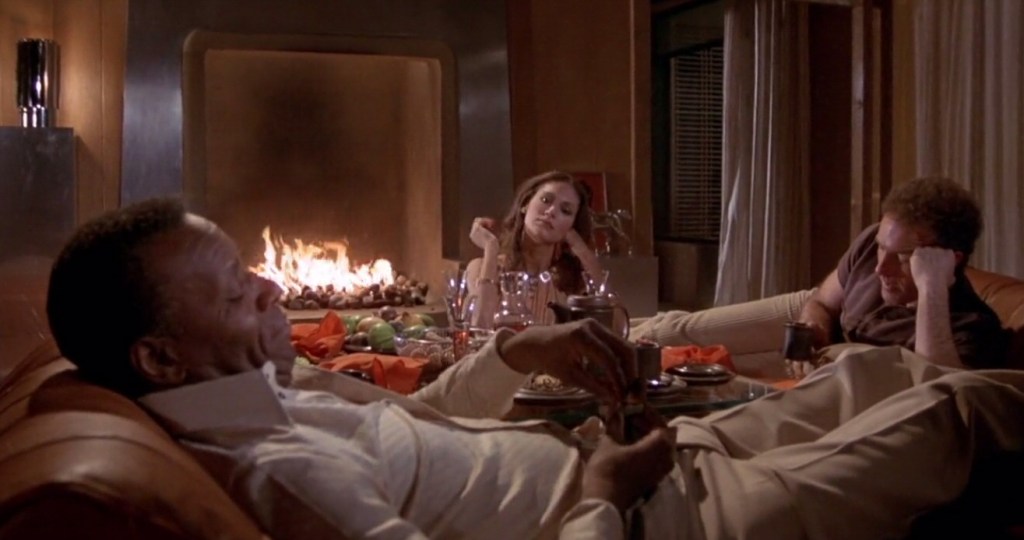
He did a few horror films and shows of interest, including Firestarter, Tales From the Crypt, and Amityville II: The Possession.

But, given my age, the things I know him best from, besides Little House, are two other children’s entertainments from my childhood.
First, he was in The House of Dies Drear, a TV movie about the ghosts of slaves they made us watch in school which scared the SHIT out of me as a fourth-grader.

WILL: He also was in an eighties fantasy film that’s a family favorite of ours.
ROMAN: The Dark Crystal?
WILL: Nope, but close.
ROMAN: The NeverEnding Story?
DAGNY: Oh my God! He’s that guy! The guy with the princess . . . what’s her name? Wind-Chimes?
That’s right, he played Cairon, the Prime Minister (or whatever) to the Childlike Empress in The NeverEnding Story.
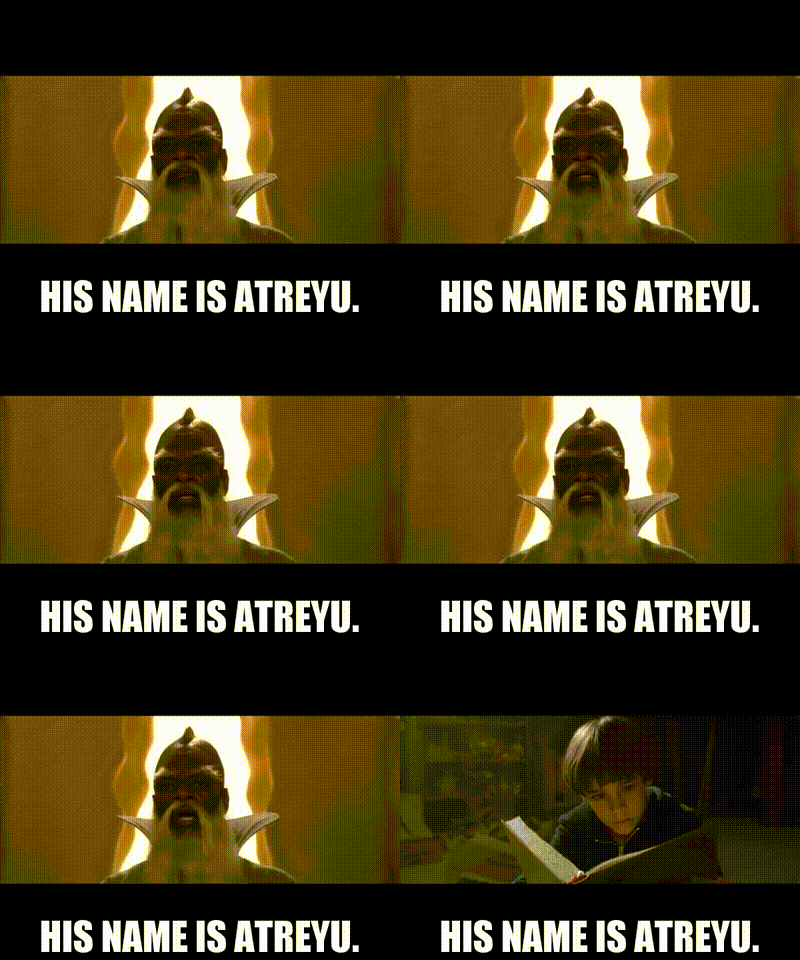
(And her name was actually “Moon Child.”)

Finally, Gunn’s name was used by Moses Gunn Collective, an Australian rock band; I’ve no idea why. Their music sounds terrible to me, but what do I know?
Suddenly filled with pity, Janie bends down and tells Joe it’s all right. Then tells him he shouldn’t fight anymore.
His voice still broken, and his face monstrous with his injuries, Joe cries back at her, “I have to! It’s what I do! It’s all I can do!”
DAGNY: He’s like you when I told you you were spending too much time on the blog.

Janie begs him to stop, telling him he can take a regular job doing “anything, anything!”
Well, if it’s 1865, that’s pretty doubtful, even if presumably the Civil War is now over (it ended in May of that year).
While Nevada was a Union state (granted statehood in 1864, possibly illegally, to boost Lincoln’s reelection odds), obviously a Black man’s employment opportunities would be limited just as severely there as anywhere else at this time.
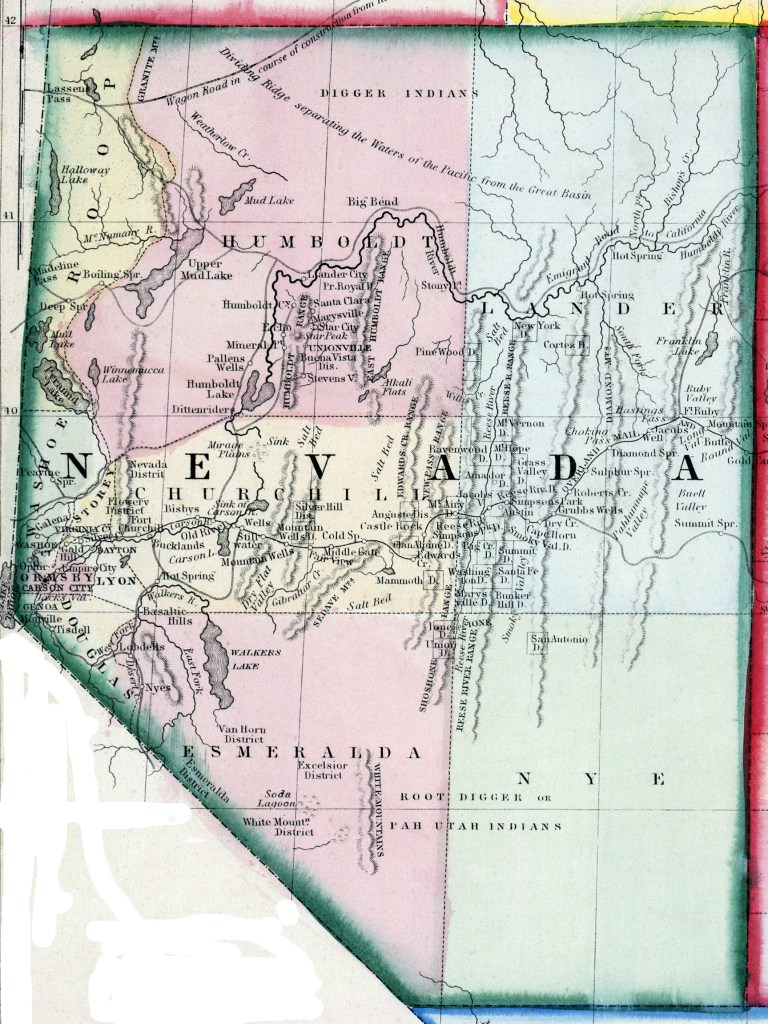
Fiercely (despite the small role, Lester shines in this story), Janie tells Joe if he doesn’t quit, she will leave him, and take Tim with her.
They stare at each other for a moment, and then Joe says in a hard voice, “I cain’t.”
Forced to live up to her threat, Janie says, “Then we’ll leave for Chicago in the morning.”
She adds “Good luck, Joe Kagan” once more, then goes to sleep with their son in the other bedroom.
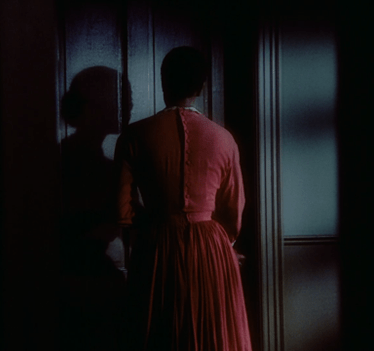
DAGNY: Now how does she do up all those buttons without a servant?
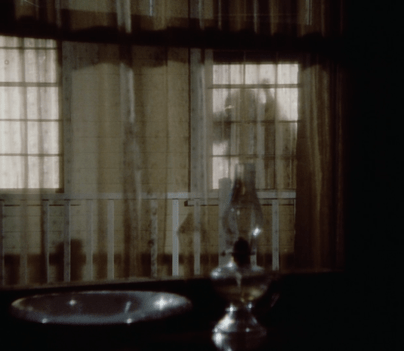
Joe sits alone after this, and the camera decides to point out the window, where a man and a woman in a neighboring room, possibly nude, are necking.
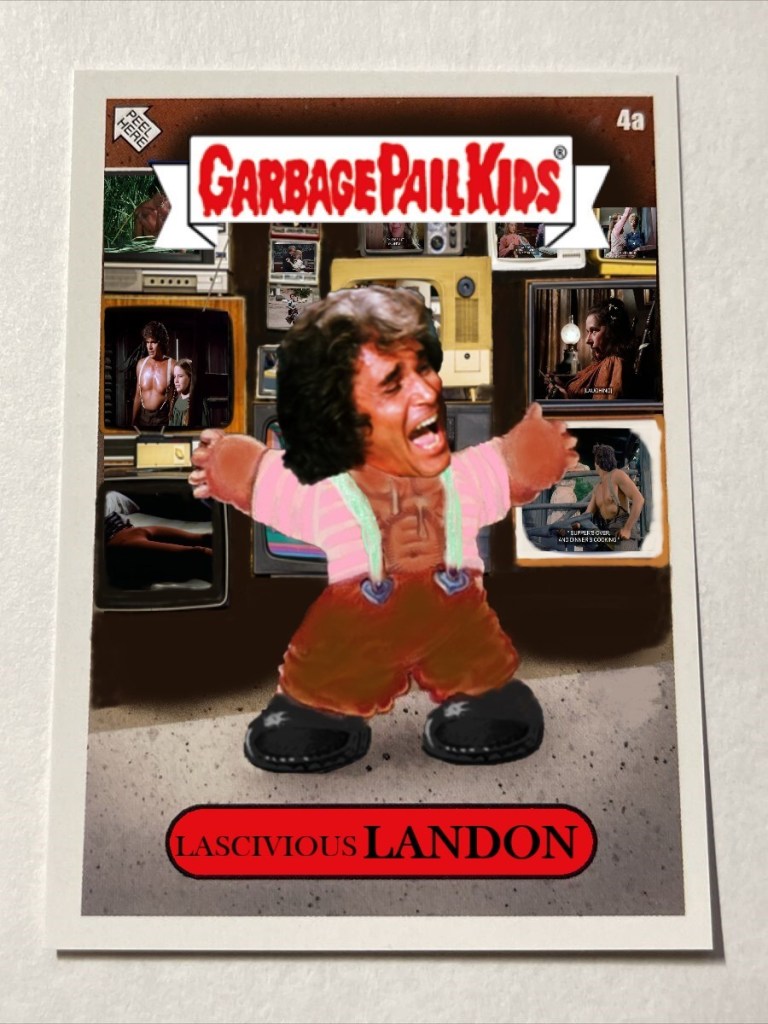
WILL: Lascivious Landon, a new Garbage Pail Kid.
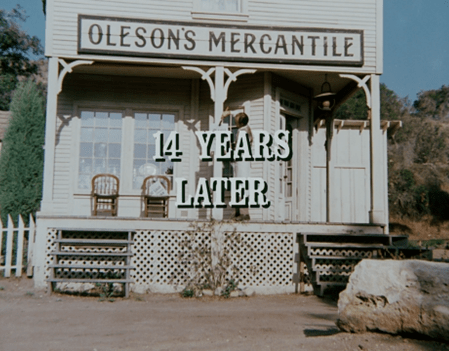
And THEN we cut to Nels hanging a sign at the Mercantile, as a title tells us it’s 14 YEARS LATER. (I.e., 1879-F, three years AFTER last week’s story.)
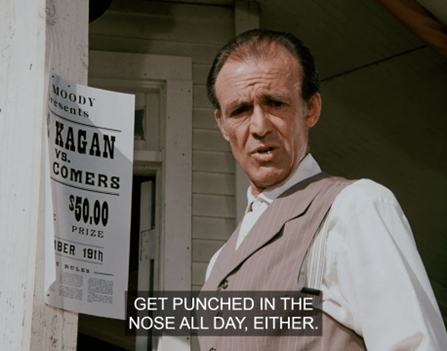
The sign, we see, advertises a boxing match in which Joe Kagan will fight any challenger who pays a $5 ($150 today) registration.
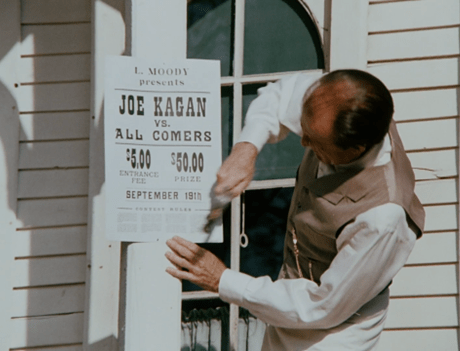
“Presented” by someone named “L. Moody,” the fight is to take place on September 19th (which was a Friday night in the real universe in 1879).
Across the thoroughfare, the schoolhouse vomits out a bunch of kids. Today they include Laura, Andrew Garvey, Nellie, Willie, an AEK, Not-Linda Hunt, the Smallest Nondescript Helen of Them All, Hangover Helen, Not-Carl Sanderson, and the new Gelfling Boy who just joined the cast a couple weeks ago.
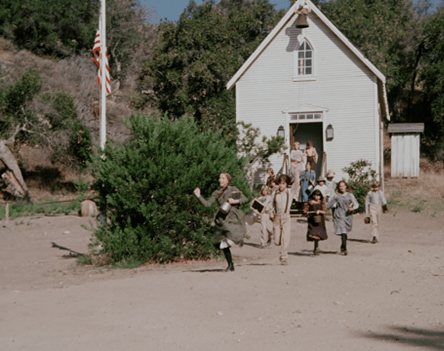
Laura and Andy stop to chitchat with Nels. The kids are thrilled by the idea of the prize, which is $50 ($1,500) to anyone who lasts three minutes with the champ.
“I bet President Rutherford B. Hayes doesn’t make that much money in three minutes!” says Laura. In fact, in 1879 President Hayes’s annual salary would have been a mere $50,000 – $150,000 in today’s money.
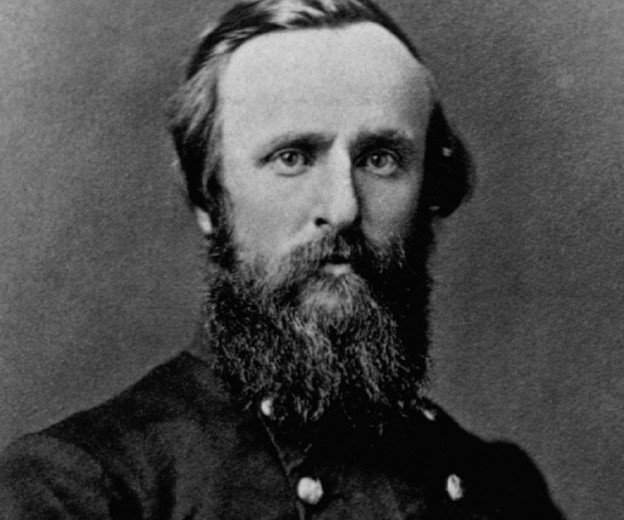
[UPDATE: Reader Denise caught me in my faulty math here – of course that should be $1.5 million, not $150,000. Handsome compensation indeed! Still, for three minutes’ work, that’s only 85 cents in 1879 money – about $27 today. THANK YOU, DENISE! You don’t want to know what I got on the math section of my GRE. – WK]
By comparison, since 2001, the U.S. President has drawn a salary of $400,000. That would equal about $7 every three minutes – or 23 cents (about $13,000 annually) in 1879 dollars.
“I suppose not,” says Nels. “But [Hayes] doesn’t have to get punched in the nose all day, either.”
WILL: Nels knows nothing about politics, ah ha ha ha.
Andy and Laura ask if Nels is going to sign up, but he says no. Then we hear Mrs. Oleson’s voice screeching inside, and he adds, “When you fight as much as I do, you need a day off.”
Nels takes off, but the kids linger behind. “Fifty dollars for three minutes!” Laura says.
ROMAN: She should do it.
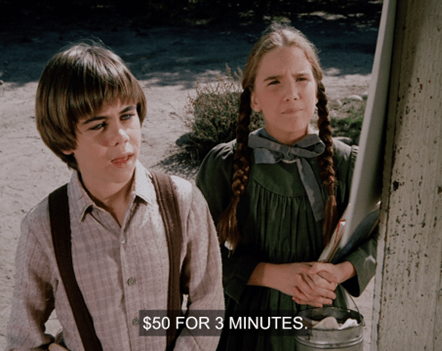
Then they bicker about whose father is stronger.
DAGNY: They should fight each other to decide whose pa will fight the boxer.
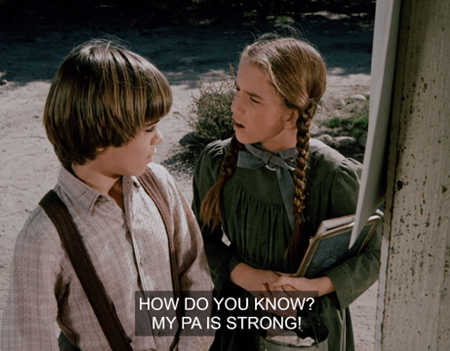
Hilariously, Laura then describes Charles as “the strongest smaller person in Walnut Grove.”
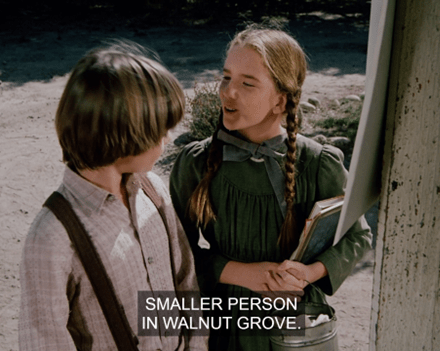
Nellie suddenly materializes out of the ether and says “Who cares!”

She’s wearing her fancy purple dress today.
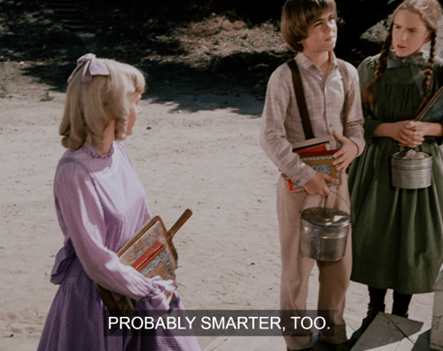
“A horse is stronger than both your pas; probably smarter, too,” she says.
“I wish they were offering fifty dollars to punch you,” says Laura.
(For an episode that isn’t well loved by fans, there’s a brilliant vein of wit running through this script.)

[UPDATE: Reader Vinícius reminds me they actually filmed an unused dream sequence for this episode in which Laura and Nellie do box each other. Alison Arngrim tells the story in Confessions of a Prairie Bitch:]
We were outfitted in 1800s boxing gear, including gloves. Thinking they were making it safer for us, the prop men padded the gloves so that our hands weren’t really in them all the way. Instead, they were balled up at the base. Anyone who knows anything about fighting knows this is a terrible idea. We couldn’t tell where the ends of the gloves were by feel. So, sure enough, Melissa swung, meaning to miss me, and punched me right in the nose.
I could feel my nose bend. I really thought it was broken for a second. But it was okay, and we opted to put our hands the rest of the way into the gloves to prevent further injury. We knew we would have been safer if they had just let us fight bare-knuckled.
Nellie says if Nels entered, he’d be sure to win.
DAGNY: What? She can’t really think that.
Nellie says her father was a boxing champion in college.
WILL: Nels went to college? What did he get, an MBA?

Nellie taunts Laura, saying even though the Ingallses are so poor, they’ll never win the prize money because Charles is too scared to enter.
Mary and Carrie pass by as the girls continue to snap at each other. (Mary has zero part in this one again.)
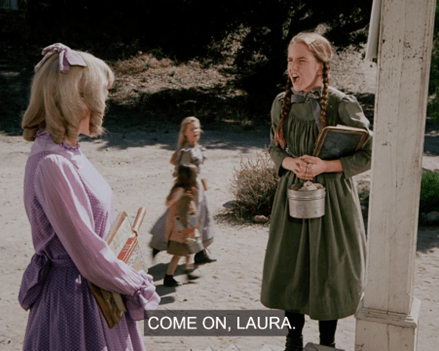
Laura follows them. Mary asks what they were fighting about, and Laura says, “About fighting.”

WILL: Did you notice, she crossed through the pagan stone circle?
ROMAN: Yeah. That’s probably how you open the door to Kezia.
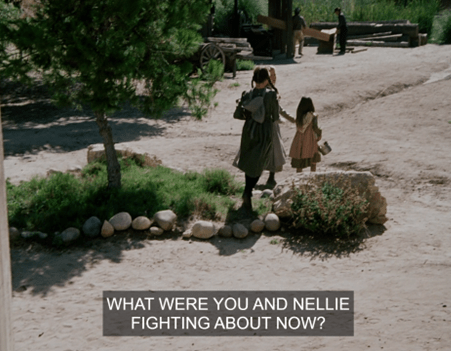

A weird chord on an electrified accordion or something takes us to the Little House at night.
Laura and Pa are having one of their Just Perfect Chats at the dinner table.
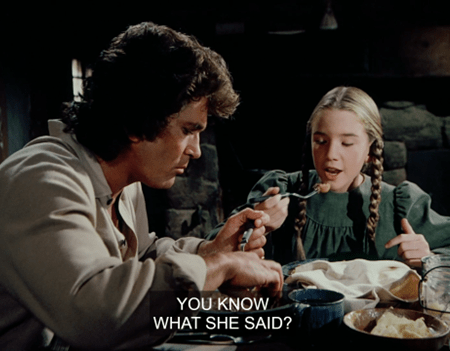
(I love when you can tell how fond of each other Gilbert and Landon were.)

Laura says Nellie accused Pa of being too chicken to fight, and he says, “Hey, whaddya know? Nellie’s right for once.”
Though we’ve seen him in physical combat many a time, Pa says he’s no fighter.
DAGNY: You know, he has a point. He’d have to think of something to get pissed about before he could fight anyone. He’d need motivation. He’s not a natural fighter, he’s a man of peace.
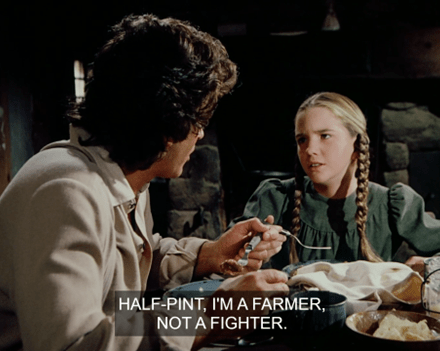
“But you’re not afraid of nothin’!” Laura says.
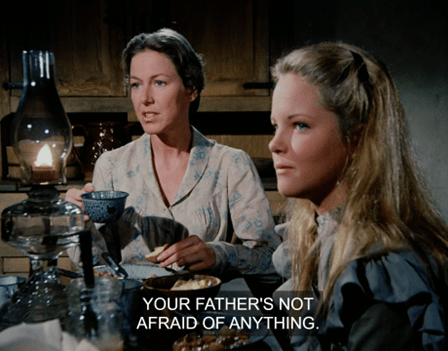
Ma pipes up and says, “Your father’s not afraid of anything.”
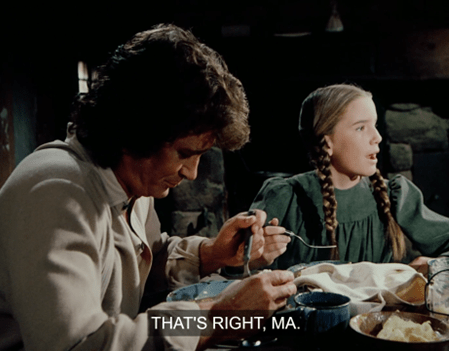
“That’s right, Ma,” says Laura, appreciating the support.
Meanwhile, a similar conversation is playing out at the Old Sanderson Place.
In my opinion, it’s a cozier scene than the Ingallses’, with Jonathan drinking coffee in a wingback chair whilst Alice does needlepoint by the fire.
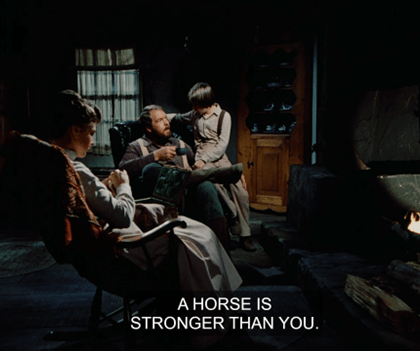
Andrew Garvey adds to Laura’s report by actually doing an impression of Nellie, then miming punching her.
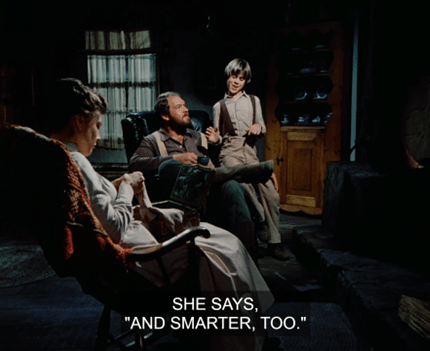

DAGNY: Ha!
Jonathan tells Andy he’s not interested in the match. Andy counters, “I heard you had a pretty good fight in Mankato once.” (Presumably referring to last week’s incident at the Shamrock Saloon – three years past now in Little House Universal Time.)

Just as Caroline did, Alice tut-tuts this topic.
DAGNY: The mas are shutting down the fight talk.
ROMAN: Yeah. Mas are LAME.
WILL: That’s exactly how you were that day at the State Fair!


Andrew goes to his room. Alice offers to get Jonathan more coffee, but he pleasantly says he’ll get it himself. Nice to see things back on track with these two.

Alice sits down to do the bills.
DAGNY: I think Alice has a more supportive undergarment than last week.
WILL: They probably got cards and letters.

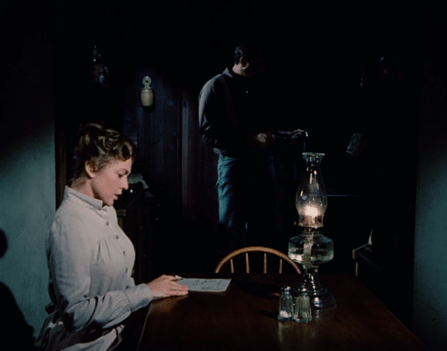
Alice says money’s tight because prices are going up. (They always are, ma’am.)
She mentions coffee now costs 12 cents a pound, or 36 cents in today’s money. And in fact, 12 cents a pound is exactly the price given by the Center for the Pacific Northwest’s 1870 price list.
(A quick survey of supermarket brands suggests coffee today is going for about $8 a pound, so 36 cents doesn’t sound so bad to me.)
“I’m gonna have to start drinking dandelion tea,” Jonathan jokes.

Then Jonathan shyly suggests he could make a go for the fight prize money.
Alice goes cold, saying, “You know how I feel about fightin’.”
Jonathan points out this is a sport, not the type of fighting she objects to. A fair point, I think.
But she remains unconvinced. Jonathan comments that a gender gap may exist concerning sensibilities about pro fighting.
I think that’s true, though for my part, I’ve never understood the appeal. Regular readers know I like all kinds of violent entertainments myself, but they’re purely fictional.

Then again, I don’t like most of the less brutal sports either.
I do enjoy watching bullriding and rodeo events, though, and I suppose those are plenty violent. (Holy shit, that stuff’s crazy.)
Then Alice says they can’t afford the entrance fee, and Jonathan produces five dollars from a secret stash – his “rainy-day” fund (a concept/expression from Renaissance plays).
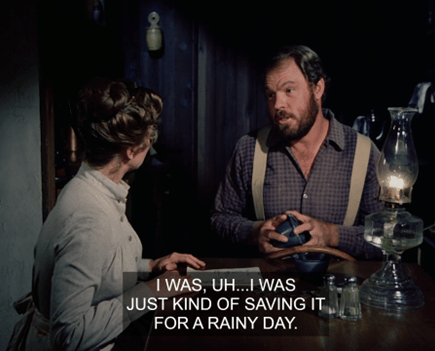
Andrew cheers from the doorway, then backs away when Alice yells at him.
DAGNY: Ha ha ha! Remember to give him the Funniest Face award at the Walnut Groovies this year.


Our suppertime survey of Hero Township now continues with a stop at Chez Oleson.
Mrs. Oleson, talking with her mouth full of course, is reminiscing about Nels’s days as a college boxer, though it’s unclear if she means she knew him back then.
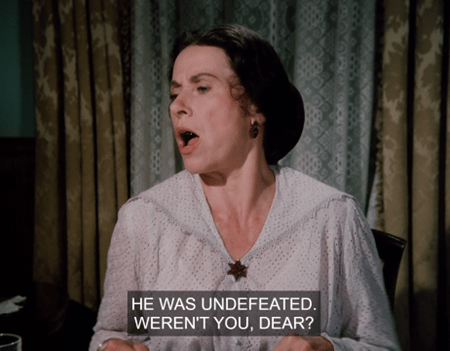
Nels claims he did box for three years in his youth, during which he was undefeated. Bantamweight, no doubt.

Willie, obviously thinking along the same lines, says, “Were ya bigger then?”
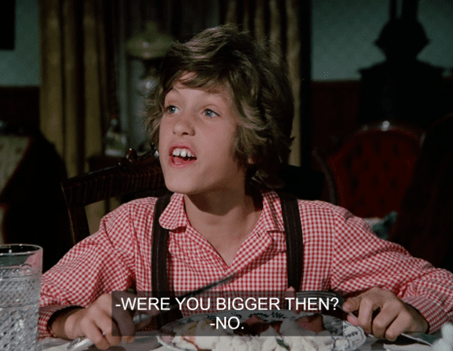
Offended, Nels gets up to demonstrate some of his old moves. I don’t know anything about boxing, so I’m not really going to try to judge anybody’s form or the like today.
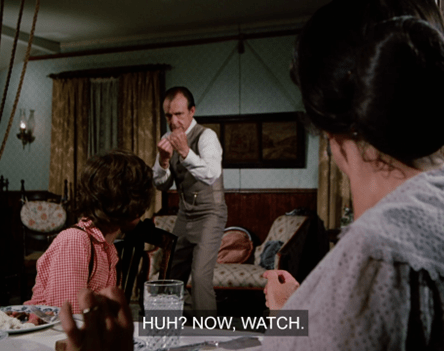
Harriet, somewhat surprisingly, seems delighted to see her husband frisking about. (I love them, don’t you?)

Then Nels’s wife and kids goad him into agreeing to challenge the fighter.
DAGNY: I don’t understand. Have they just met him?
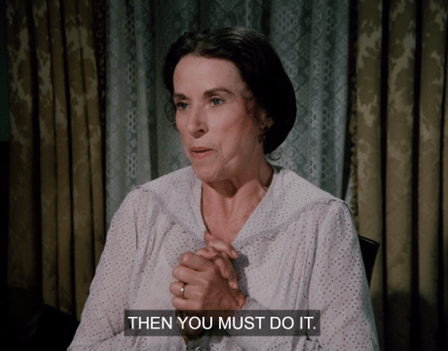
Then they actually drink a toast to Nels – “the hero of Walnut Grove!” – which cracked me up.
After a break, we cut to a stage arriving at the Post Office in the rain. On the porch, Jonathan Garvey, Nels, Andrew and Willie are waiting to see who gets out.
It’s one of those “rainy days” on this show where you can tell it was actually sunny when they filmed it.
In fact, as the first passenger disembarks, we can even see a rainbow in the corner of the frame!

I’ll mention that our own cinematographer Ted Voigtlander won an Emmy for this episode – the first Little House had won in any category at this point.
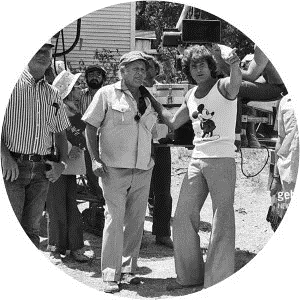
Voigtlander, who did the lighting and camerawork for about half the episodes so far, also worked on Bonanza, Highway to Heaven, Ben Casey, The Wild Wild West, and Columbo, and did the Melissa Gilbert version of The Miracle Worker as well as the notoriously goofy horror film Night of the Lepus (directed by William F. “Clax” Claxton).

Anyways, we can’t see the first passenger’s face, but he wears a heavy raincoat, has a debilitating limp (Granville-type) and walks with a cane.
WILL: He should do a somersault in the mud like Willie Wonka.
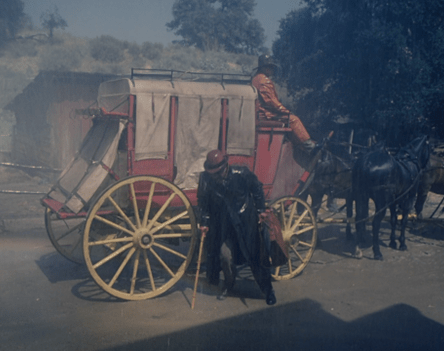
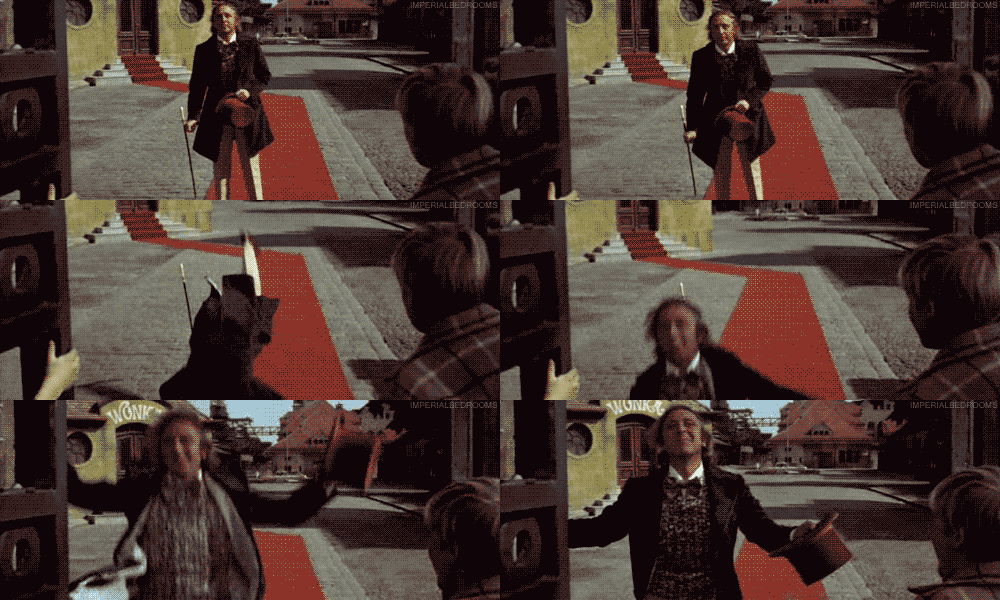
For a moment, Nels seems relieved, but his hopes are dashed when the real Joe Kagan emerges from the coach.
WILL: Garvey’s the only Grovester who would have a chance.
DAGNY: Yeah, another giant.

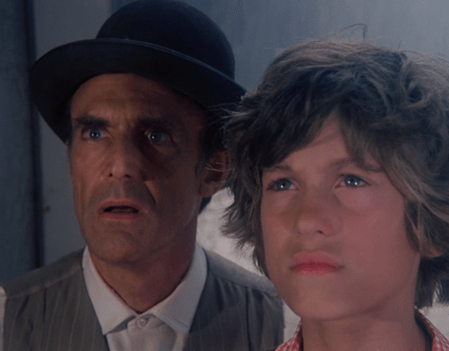
Kagan’s face is so battered and bruised it’s hard to tell if his eyes are even open, but he stops and seems to look at Nels and Willie for a moment.
Nels sinks his ass down on the bench.
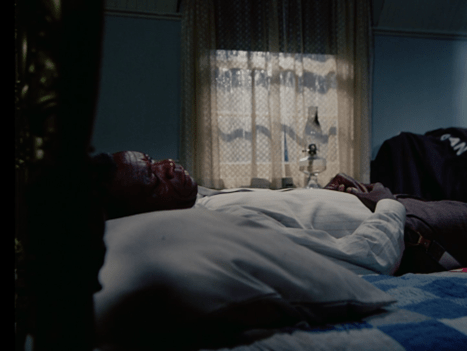
Then we see Kagan lying in bed. (He’s wearing proper trousers this time.)
DAGNY: Where is he staying?
WILL: In one of the rooms above the Post Office, I assume. But it’s funny, I think there would only be one room available. Because Doc and Miss Beadle also live up there.
DAGNY: Then where is the other guy staying?
ROMAN: Maybe Doc is spending the night at Hanson’s. . . .
WILL: Of course! Of course he is! And that explains why Miss Beadle is so close with them and covers for them! Because she’s Doc’s next-door neighbor at the boarding house. She’d see Hanson coming and going at all hours, so they’d have to come out to her!

Kagan rises and shambles across the room. He holds his head in pain.
He goes to the vanity and takes some aspirin out of a little box.
WILL: Hey, look, “made in Canada,” just like you.
DAGNY: Yeah. I wonder if Alison Arngrim’s mom donated it.

Moses Gunn’s “migraine” acting is good.

Kagan looks in the mirror, and we see his vision has become seriously impaired.

The man with the bad leg comes into the room. He’s also Black, which was hard to tell when he was out in the “storm.”

Apparently he’s been trying to buy booze at the Mercantile, only to find they don’t sell any. This may seem odd, but Minnesota historically has had some of the strictest liquor laws in the nation. Many counties were completely dry into the late 1950s.
As late as the 1990s, the laws were enough to shock this (formerly) hard-drinking Wisconsonian when he arrived here.

Since then, they have relaxed quite a bit. (You can actually buy wine on a Sunday now – as of 2017.)
Well, given Redwood County’s elected officials were resistant to expanding alcohol sales as recently as 2022, you’d think the depiction of Walnut Grove as dry in 1879 would be historically accurate. But according to the city’s website, there was at least one saloon in town in the 1870s.
Kagan then asks this person, presumably his manager, if he sent the money he earned to Janie and Tim.
The manager says he did, then notes Kagan’s “family” never writes to thank him for his ongoing support.
The man notes that Joe’s son Tim is now twenty years old, and should be providing for the family himself by now.
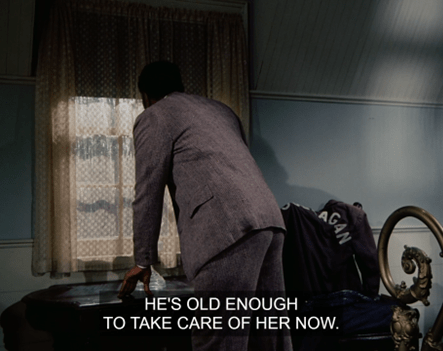
The man says, “You don’t owe her nothin’. She walked out on you, remember?”
Kagan, who still appears to have trouble speaking, says, “She did the right thing, I don’t blame her.”
He adds, “Wouldn’t want my boy to see me like this.”
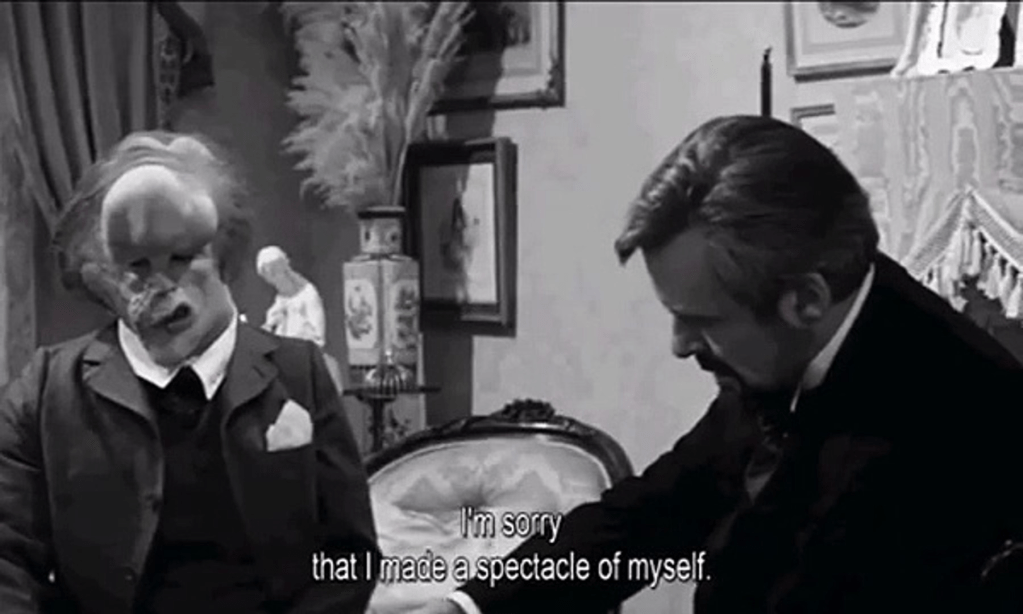
It’s a very moving story, I think. He sort of reminds me of the Elephant Man, with his fears that his appearance will distress anybody who comes into contact with him.
The manager then checks Kagan’s pain levels and vision, neither of which is good.
The manager says five Grovesters have signed up to fight. With Nels and Garvey, that leaves three slots unaccounted for.
WILL: Who else is going to fight him, do you suppose?
DAGNY/ROMAN: Mustache Man.

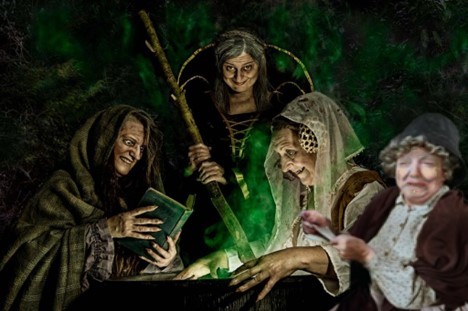
ROMAN: Maybe Kezia will fight him. [as KEZIA:] “Fair is foul and foul is fair!”
WILL: What does that mean?
ROMAN: It’s from the witches in Macbeth. It’s the closest I could come to thinking up a Kezia-type line.
The man says Big Jon Garvey is the only contestant to worry about, so he’ll be put in first.
But Kagan insists that the ring be made smaller – presumably to improve his chances of hitting a target he cannot see.
Annoyed, but with a smiling superficial pleasantness, the manager agrees, then says he’s going to head back out to drive up interest amongst the Grovesters.
“All you fight managers . . . you prey,” says Kagan, with a cold contempt for the art of publicity. (As a PR person myself, I hear you, Joe.)

The manager asks if he needs anything from town, but Kagan ignores him, and, obviously having had it with this Debbie Downer, the guy leaves Joe to his headache.
Back at the Little House, Pa has come upstairs to tuck the girls into bed, which I think is cute since they’re getting older.
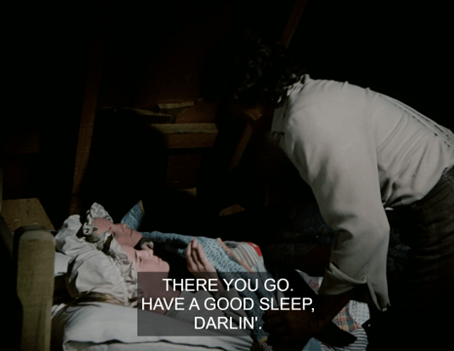
Laura asks Pa to reconsider and join the other brave town boxers like Nels. With irony, Pa tells Laura oh yes, Nels already spoke to me about how he’s looking forward to the fight.

Laura says Nellie’s been talking all over town about how he’s a “scary cat” – she says “scary cat” rather than “scaredy cat,” though whether this was a deliberate choice on Melissa Gilbert’s part is something I suppose we’ll never know.
(Looking into that idiom, it appears “fraidy cat” was in use by the 1890s, but “scaredy cat” probably didn’t come along until later.)
Pa starts to say “Sticks and stones,” but Laura says don’t gimme those platitudes. (Paraphrase.)
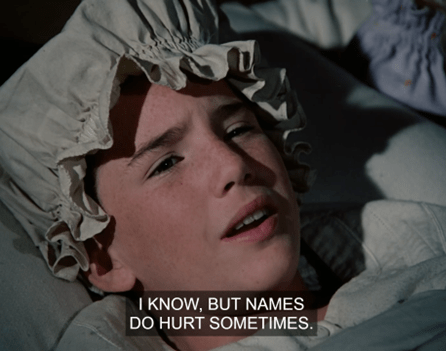
(“Sticks and stones” was already considered “an old expression” by the 1850s.)
Pa is unswayed, and he says goodnight.
DAGNY: They blow the lamp out rather than turn down the wick?
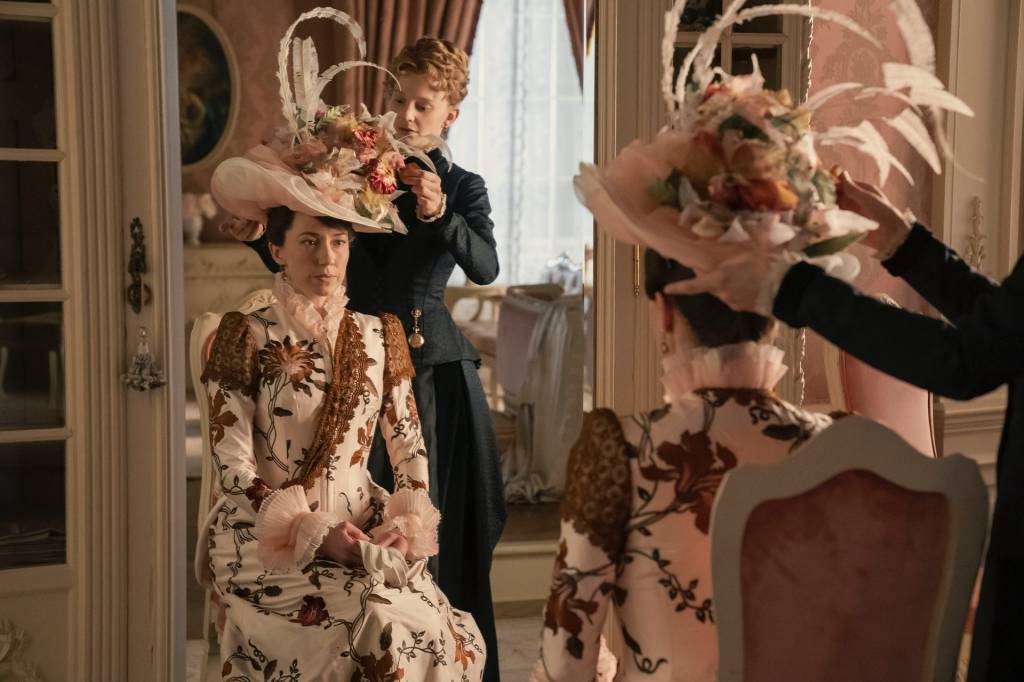
WILL: Well, they have very rude manners in the country. What do you think this is, The Gilded Age?
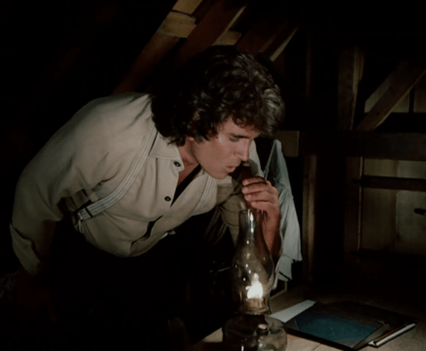
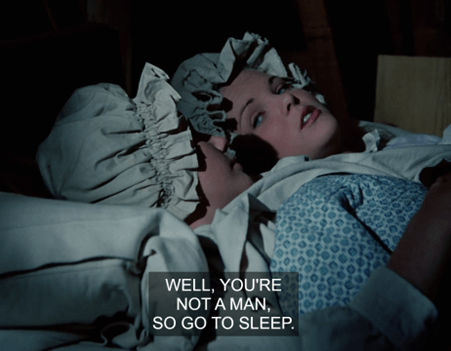
Laura and Mary have a mercifully short go-the-fuck-to-sleep conversation.
The next day, the thoroughfare is a-bustlin’ with wagons and kids.
DAGNY: Who is that guy sleeping there?
WILL: I think it’s Ben Slick.
DAGNY: It’s odd that he’s so prominently featured.
WILL: Well, they’ve been having some weird Grovester moments like that this season. Remember the crazy harmonica guy?
DAGNY: Oh my God, I forgot him already.


Charles and the Chonkies arrive at the Mill.
He checks in with Mr. Hanson (“Sharles”) and learns Garvey is in what Hanson dryly calls “the athletic club.”

Mr. Hanson seems peeved Garvey is training for the fight rather than delivering grain to somebody named “Simkins” or “Simpkins,” but of course he won’t go tell him that himself, the big sweetie-pie.
“The athletic club” turns out to be a storeroom full of bags of grain that Garvey is using as punching bags. (In reality I expect this would be a very dusty activity, but TV.)
Garvey struts and sweats and huffs and punches.
DAGNY: Oh, too bad Olive isn’t here.

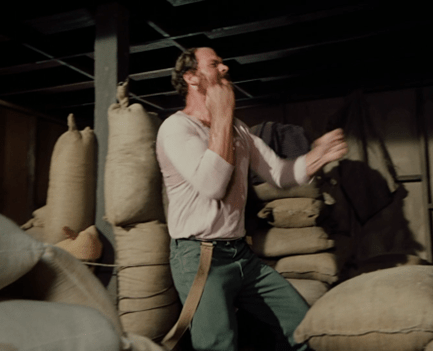
Charles tells Garvey he’s erecting the boxing ring in “the old Farlow barn” for “that Moody fellow.”
Charles asks if he can help with the Simkins/Simpkins project, and Garvey says sure.
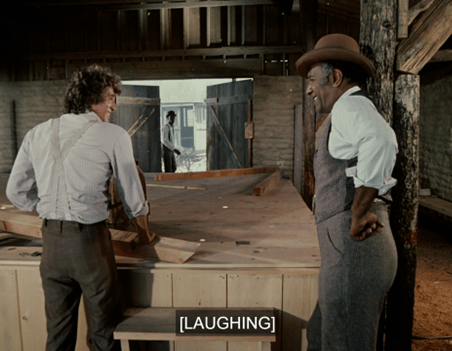
Then we see Charles building the boxing platform whilst Moody the manager oversees.
Charles comments the boxing ring is much smaller than he imagined. “They come in all different sizes,” Moody answers with a dry chuckle.

Moody then makes a little joke about how dull Walnut Grove is, which Charles loves.
Joe Kagan himself then appears, zombielike, in the doorway.
Moody introduces Charles, but all Kagan says is “Make it smaller.”
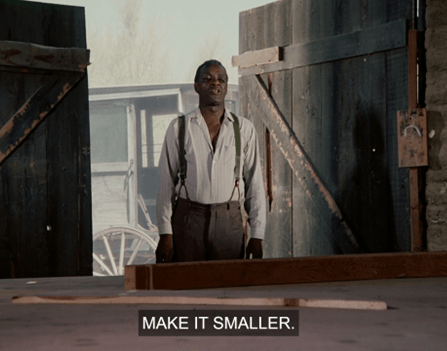
Embarrassed at the tricks of the trade being revealed, Moody says, “Oh, come on, now, Joe.”
But Kagan just says “Make sure there’s plenty of lanterns” and walks out.
Puzzled, Charles says, “How long has Mr. Kagan been fighting professional?”
“Too long,” says Moody.
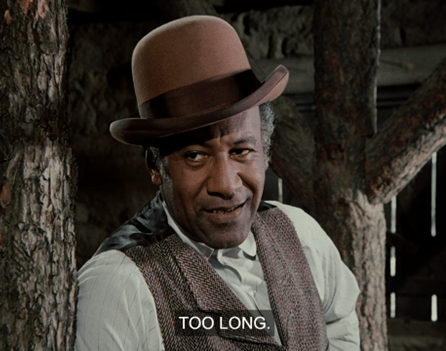
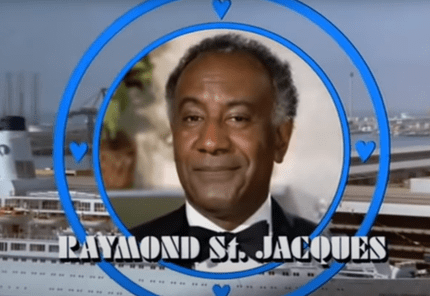
This actor, Raymond St. Jacques, was in Black Like Me, and he had a starring role in two influential Blaxploitation films, Cotton Comes to Harlem and Come Back, Charleston Blue.

He’s featured prominently (in green) on the spectacular poster for Cotton.

He was in The Green Berets with John Wayne and in John Carpenter’s They Live.
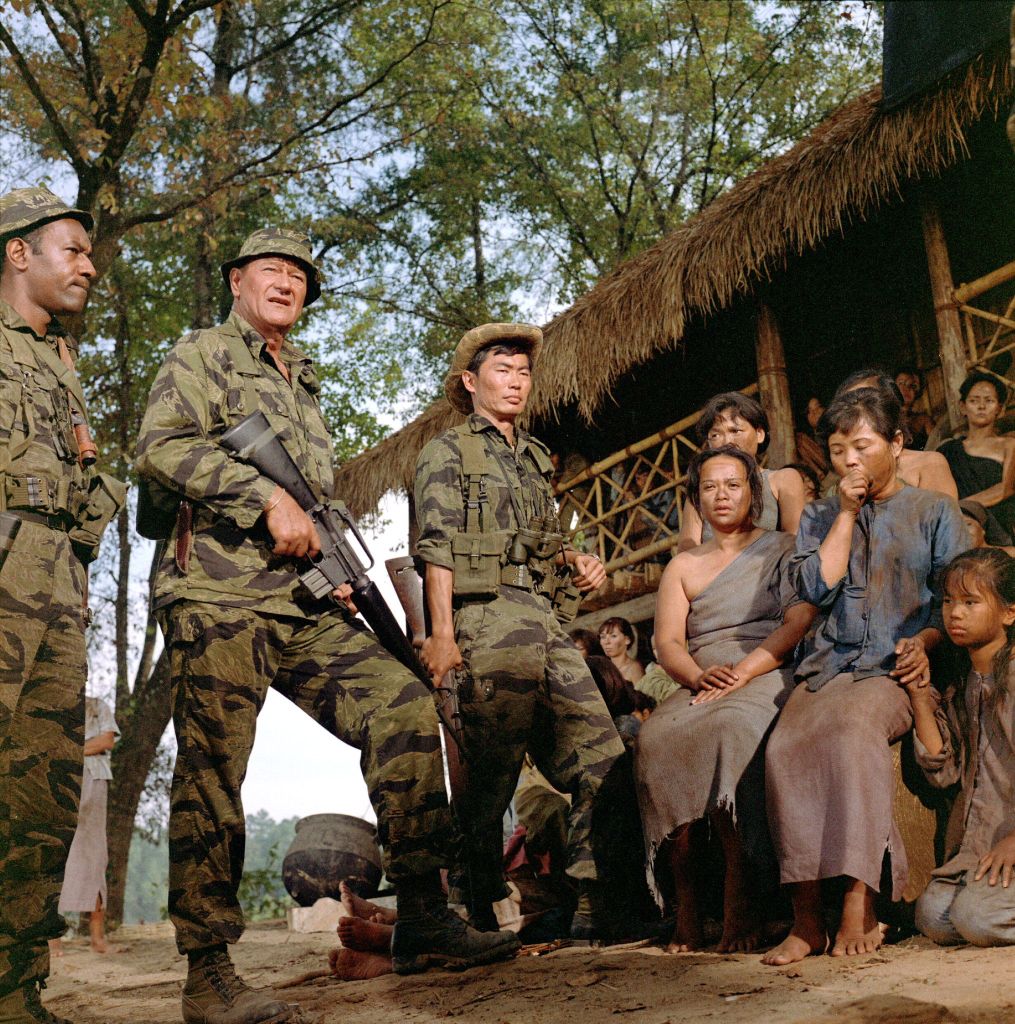
In life, he was a distinguished civil rights activist, and on screen he played Martin Luther King, Jr., in The Private Files of J. Edgar Hoover and Frederick Douglass in Glory.

On TV, he appeared in Roots, I Spy, Police Story, Police Woman, Fantasy Island, Voyagers!, Murder, She Wrote, 227, Amen, and A Different World.
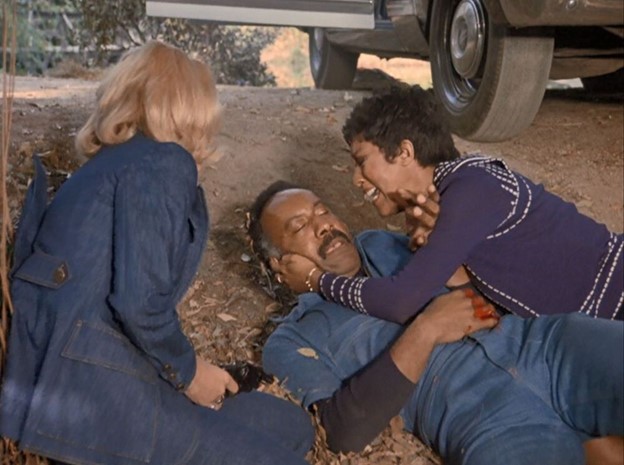
He had recurring roles on Rawhide and on Falcon Crest.

And he was on Love Boat.
Then we get another cute bit of business, as we see Mr. Hanson outside the Mill.
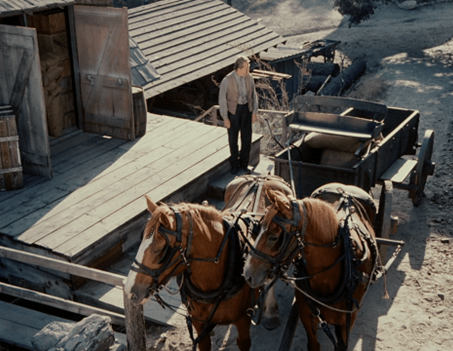
He’s looking at an empty wagon, presumably the one that should be filling up with grain for Mr. Simkins/Simpkins.
He makes a little florid gesture of exasperation and heads inside.

He stares for a moment at Garvey, who’s still punching away, unaware of his presence.

With another hilarious “oh, who gives a shit?” gesture, Hanson eventually just grabs a bag to start loading the wagon himself.
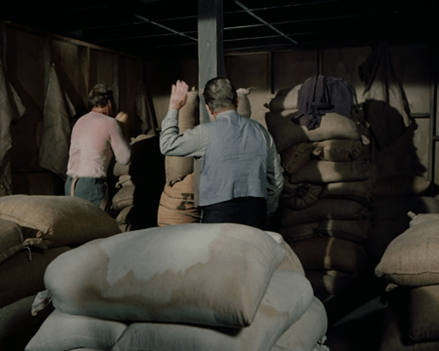
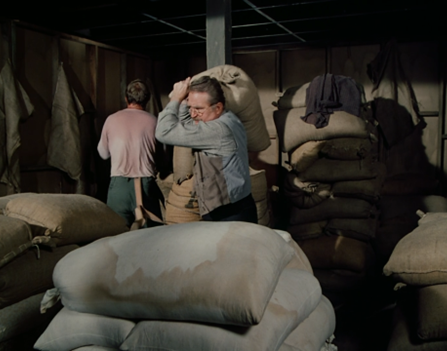
Unfortunately, that bag turns out to be an essential piece of gym equipment, because as soon as he’s gone, Garvey turns to punch it and gets a fistfull of support beam instead.
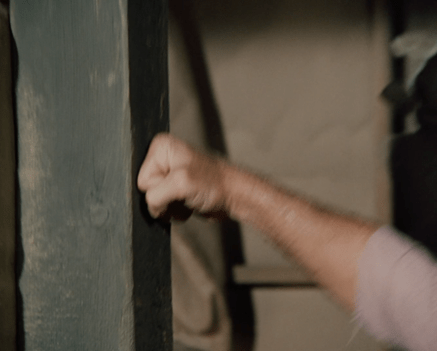
WILL: I hope there wasn’t a nail there. Ow.
Cut to Doc’s office, where the curtain opens with a flourish.
DAGNY: That was a nice touch.

Garvey’s hand has already been wrapped up.
GARVEY: How bad is it, Doc?
DOC: How bad does it feel?
GARVEY: Awful bad.
DOC: That’s how bad it is.
Hee hee! Like I said, this script is quite funny.
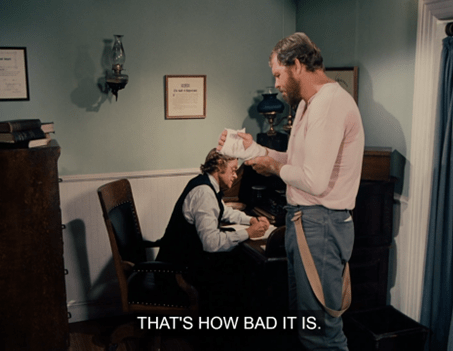
Charles comes in to check on him. Garvey is cursing himself and complaining about Moody’s no-refund policy for cancellations.
DAGNY: The real championship here should be who has the lowest-cut shirt.


Garvey then begins smooth-talking Charles, saying he should take his place in the ring.
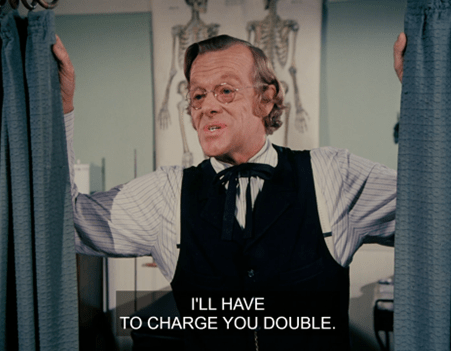
Doc rises and says, “I was planning on taking tomorrow off, Charles, but I think I better stay open. After all, what are friends for?”
Then he adds, “Of course, seeing as it’s Saturday, I’ll have to charge you double.”
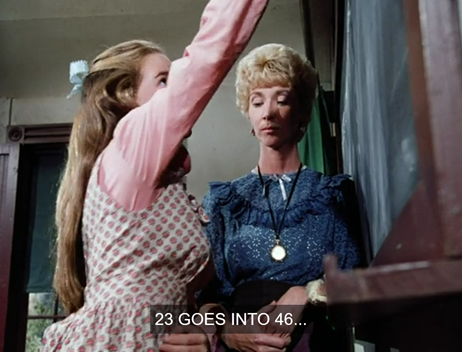
ROMAN: What, two apples instead of one?
DAGNY: Yeah, how’s Laura gonna stuff her bra? [as LAURA:] “Pa, I need those!”
Then suddenly we’re at the big fight!
Nels, pale with doom, sits on a bench with his family.
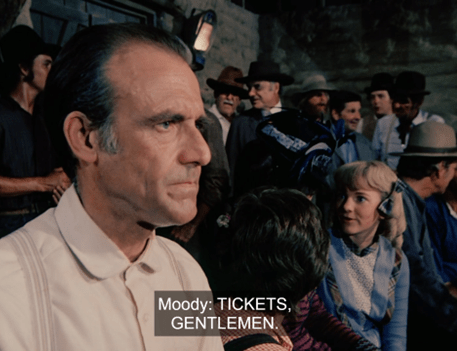
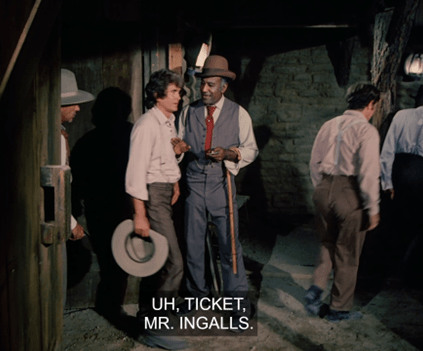
Charles arrives at the door, where Moody charges him 50 cents admittance, even though he’s a contestant himself.
The Old Farlow Barn is packed with people for this occasion – well, with men specifically. Apart from Mrs. Oleson and Nellie, I don’t see any women.
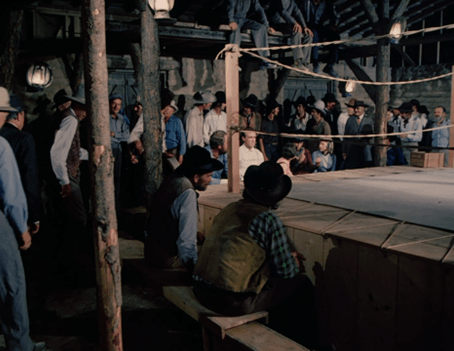
And actually, apart from the Olesons, Charles, Garvey, Carl the Flunky, Mustache Man, Mr. Nelson the Gray-Haired Dude, and the ZZ Top Guy, there don’t seem to be many Grovesters there.
DAGNY: Where did all these people come from? Sleepy Eye?
WILL: And Springfield, I bet.
ROMAN: All the bloodthirsty Minnesotans.
Come to think of it, why are they having this fight in Walnut Grove? Wouldn’t Mankato or Sleepy Eye make more sense? Presumably they’d have a better venue than an abandoned barn, too.
WILL: Don’t you think Doc would attend the fight? Not because he wanted to, but because he’d have to be on hand to stitch people up after?
ROMAN: Yeah. It’s what Doc on Deadwood would do.

Charles and Garvey sit together. When Garvey asks where Caroline and the kids are, Charles says “She took the girls down to the church to pray.”
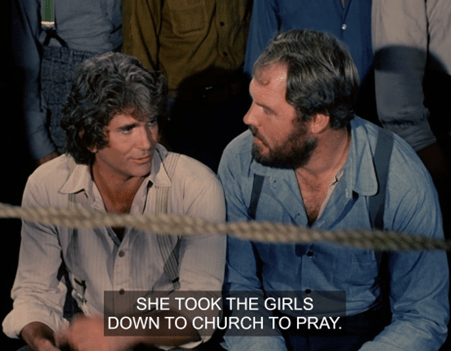
Garvey says it’s good they’re in the front row, because they can watch the first fight closely and “maybe analyze his weaknesses.”
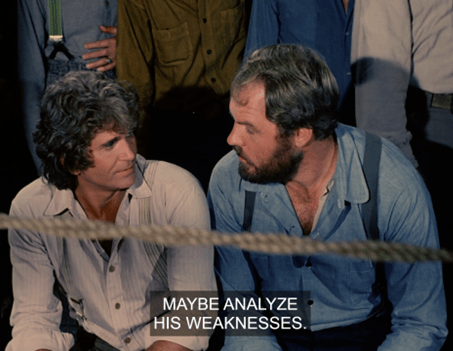
Charles greets Nels, who turns his head as if in a trance, but does not respond.
DAGNY: Poor guy. He looks like shit.

Joe Kagan is up in the ring warming up.
Moody gets up and introduces Nels. Everybody screams.
Nels dead-man-walks to the ring, where he’s handed gloves by a handsome man who looks a bit like Charles.
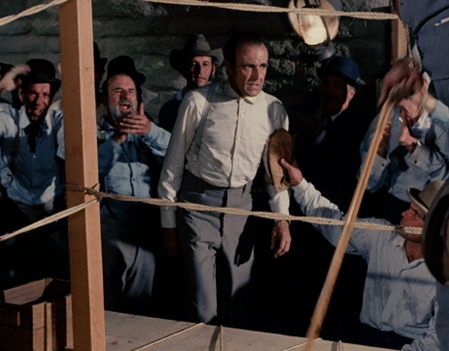
He looks a bit like Charles because he’s played by Hal Burton, who was Michael Landon’s stunt double.

His stuntman resume is very impressive. In addition to Marvel, The Fast and The Furious, Die Hard, Pirates of the Caribbean, Star Trek, and Halloween films, he was on Bonanza and The X-Files and in The Fugitive, Bram Stoker’s Dracula, and Django Unchained.
I expect it’ll be Burton himself we see fighting Kagan in a moment, but I also doubt we’ll be able to tell, since this show is very good at concealing its stunt performers.

Anyways, back to our story. Nels puts on his gloves. Others have commented that in the United States in the 1870s, gloves likely would not have been worn. In Britain, the famous “Marquess of Queensberry rules” for boxing, which did mandate gloves, had officially been adopted in the 1860s, but even there the new safety precautions weren’t widely adopted for decades.
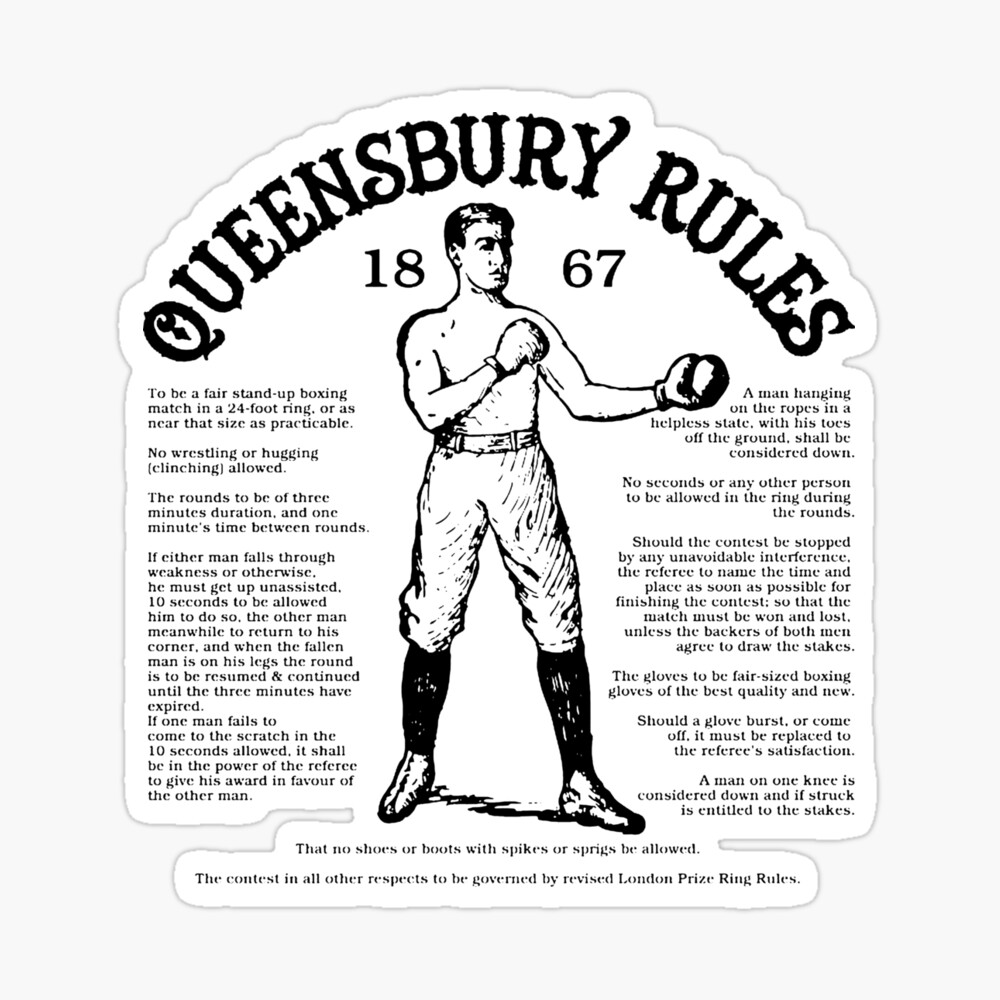
(The Marquess of Queensberry in question was an aristocrat named John Sholto Douglas who founded a sports association in 1866 that was one of the first to adopt the restrictions. A well known rat bastard with an ugly temper, Queensberry initiated the chain of events that led to Oscar Wilde’s imprisonment for homosexuality in 1895, but that’s another story.)

People have also questioned whether this match actually would have used formal three-minute rounds, though they did become standard eventually. I couldn’t speak to that.
Nels crawls into the ring, where the gigantic Joe Kagan stands like Frankenstein’s monster in his horror makeup.
DAGNY: Poor guy. He looks like shit too.
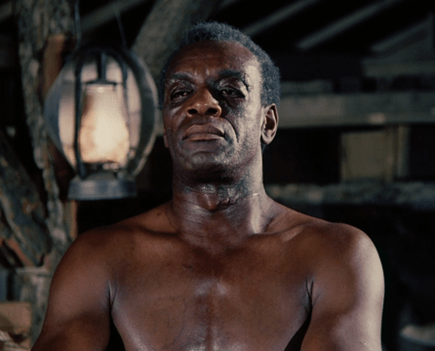
Mr. Moody invites Nels to “toe the line” – a boxing custom where contestants touch a mark in the center of the ring to orient themselves. (The saying was around by the 1870s, but it seems unlikely it originated with this sport.)
(I’ll acknowledge I thought this expression was actually “tow the line” – i.e., do your part to contribute to an effort’s success, like pulling on the rope in a tug of war.)
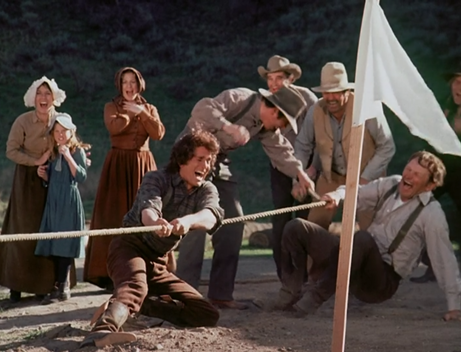
(But in reality, it seems “toe the line” actually means something more like “fully participate whether you like it or not.” While its origins aren’t totally clear, it seems they’re likely rooted in military or education systems, where soldiers and students are often expected to “line up” for activities.)
(I’m sure you knew that already, but I didn’t.)
Well, the bell rings, and Nels is instantly knocked cold by a single punch.
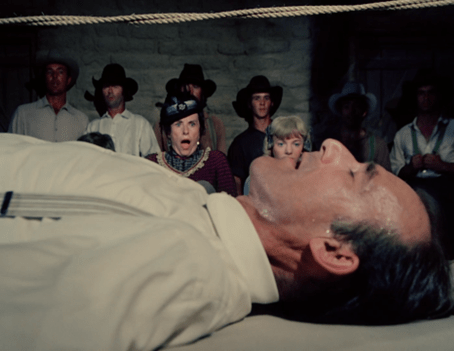
Mrs. O jumps forward and starts screaming for him to get up, but he doesn’t.
“Did you notice any of his weaknesses?” Charles says to Garvey in what might be the episode’s funniest line.

Surprisingly, or perhaps not, Harriet shows no interest in her husband’s wellbeing, simply leaving with the kids when it’s clear he’s not getting up.
Moody then calls Charles, who reluctantly steps up.
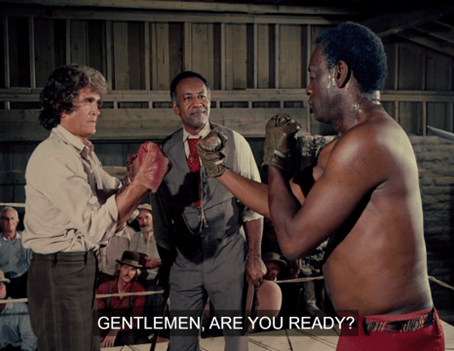
The round begins. I’m no color commentator, so forgive me if my summary isn’t all that entertaining.
Kagan gets the first punch in, which results in Charles trying to hide behind Moody for a while.
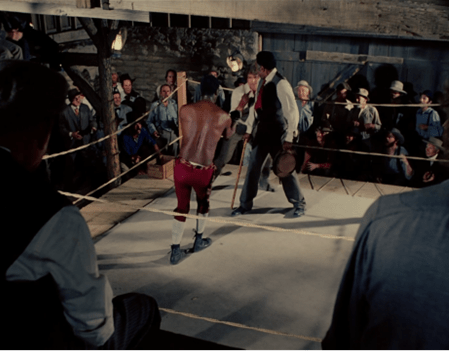
Carl and Mustache Man really seem to be enjoying themselves.
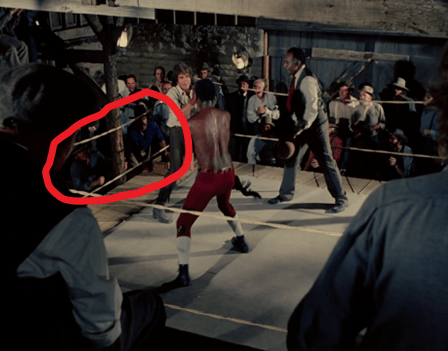
Also enjoying himself is Andrew Garvey, who’s watching the fight through a hole in the side of the barn. Laura suddenly joins him, having claimed she had to use the bathroom to escape Caroline’s clutches.
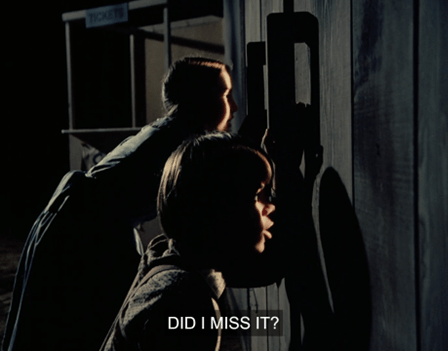
Kagan hits Charles again, knocking him to the ground.
But things are not going well for the champ. He puts his hands to his head, and we see his vision is very blurred.
WILL [DALEK voice]: “MY VISION IS IMPAIRED! I CANNOT SEE!”
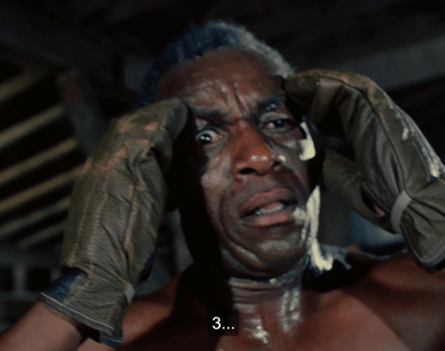
Kagan swings a couple more times at Charles and misses.
Outside, Laura and Andy are miming their own boxing moves . . .
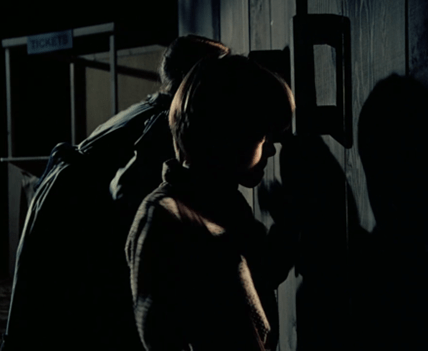
. . . when suddenly Ma appears, heavy in shadow.

Laura scrambles off, but Caroline can’t help taking a peek at the match herself.
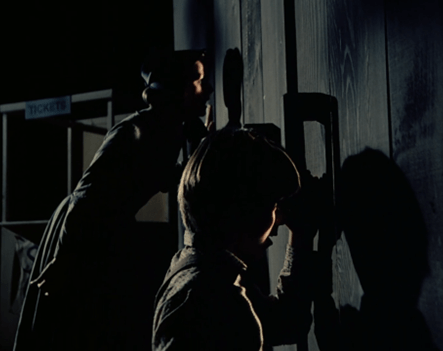
In the ring, Joe Kagan is struggling terribly. He misses another punch, allowing Charles to duck down and deliver several hard blows to his midsection.

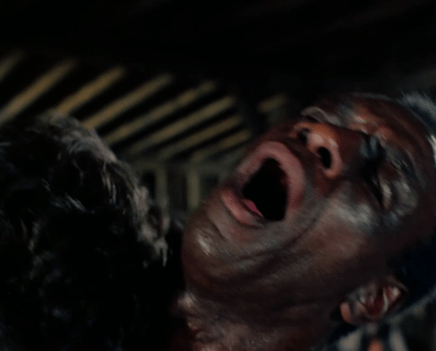
In obvious agony, Kagan reels back holding his head, and Charles is able to knock him down.
Outside, Caroline literally jumps up and down screaming “CHAAAAARLES, CHAAAAARLES!!!!!!”
She then pulls herself together, gives Andy a look of furious disapproval, and marches back to church.
Okay, maybe THIS is the funniest part of the whole episode.

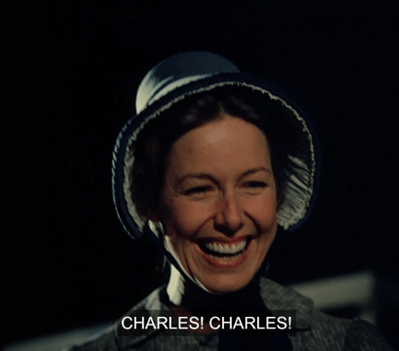

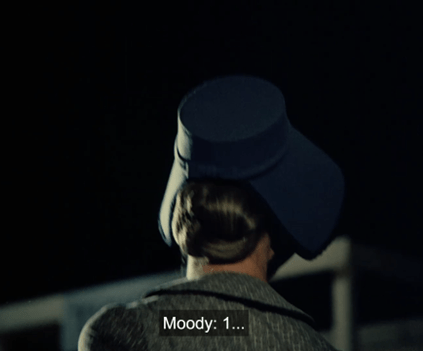
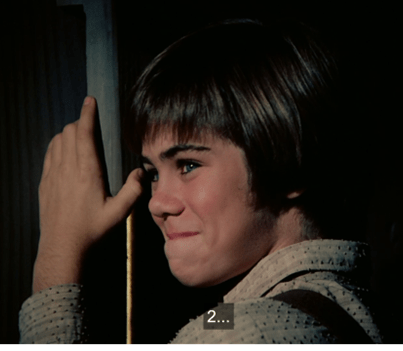
Andrew giggles as she goes.
DAGNY: Yeah, Andy gets the Grooviest Faces award this year.
Well, Charles wins the match. What about the other Grovesters who signed up after him? Tough shit for them, I guess.
Charles bends to help Joe Kagan up – but he’s in serious trouble.
Then we get the nice shot of a sunrise they use on this show from time to time.

Well, actually the last time we saw it it was sunset, not sunrise, and it was in the mountainous Morgan Creek region, not Walnut Grove.

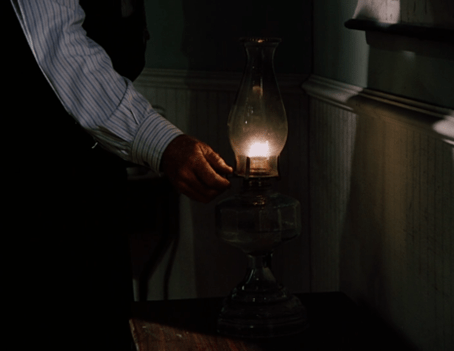
We see a hand turning a lamp off, and we’re revealed to be in Doc’s office again.
DAGNY: See? Doc didn’t blow it out.
ROMAN: He’s a man of science.
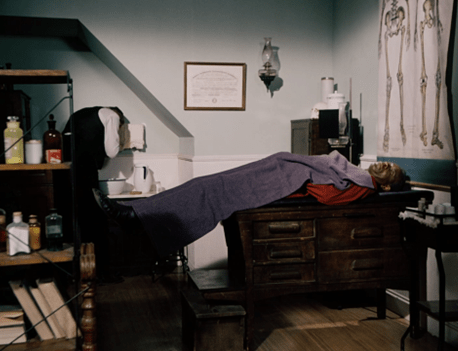
Joe Kagan is stretched out on the examining table.
DAGNY: Are his legs levitating?
Doc steps out to his waiting room, where Charles, Garvey and Mr. Moody are, um, waiting.
DAGNY [as DOC]: “Well, you killed him, Charles.”
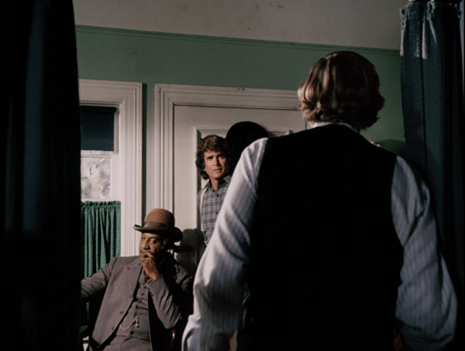
Doc says Kagan will be okay, but when Moody asks what’s wrong with him, Doc says, “I think you already know that, Mr. Moody.”
Then he says, “He’s been examined by other doctors recently, hasn’t he?” When Moody says nothing, Doc shouts, “Hasn’t he!”
DAGNY: What did the other doctor do, sign him?

Moody says other doctors had recommended he take a break from fighting, but to do so would have destroyed his career, since Kagan “ain’t exactly no John L. Sullivan.”
John L. Sullivan was the famed first heavyweight champion at the advent of the “gloved” period of boxing in the United States. But he didn’t start boxing until 1878, and wouldn’t have been well known nationally until the early 1880s.
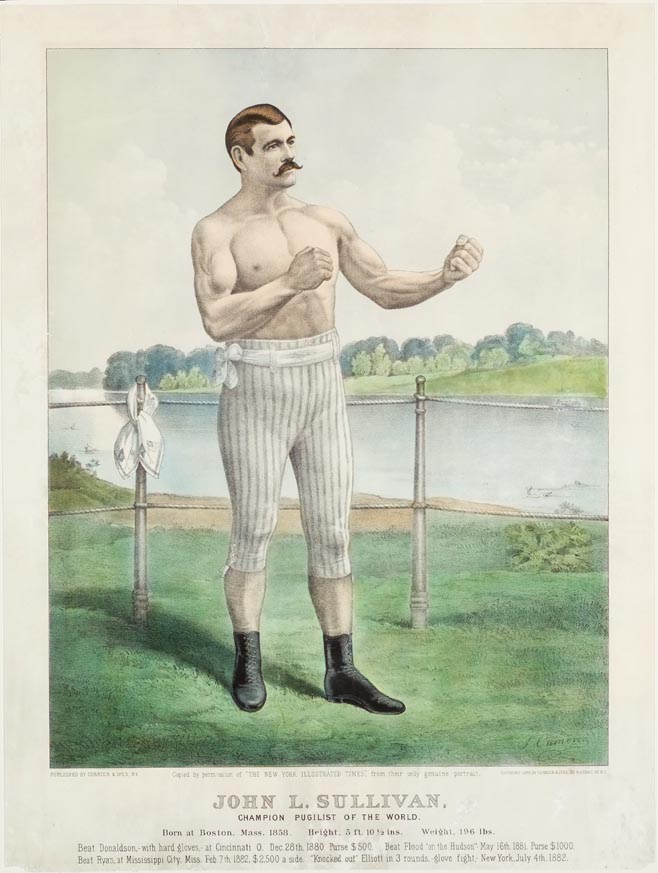
“We got to eat,” Moody shrugs.
“If he continues fighting, he won’t have to worry about eating,” says Doc. “He’ll be dead.” (Kevin Hagen turns in a classic Doc performance in this one.)

Charles and Garvey carry the champ back up to his bedroom.
DAGNY: That’s a nice quilt.
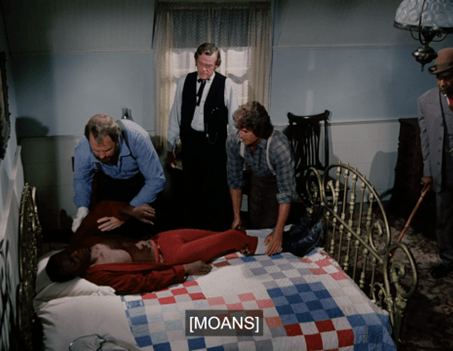
Doc gives Kagan, who’s regained consciousness, the bad news and shoots Moody a dirty look on his way out.
Moody turns to the wardrobe and starts packing up Kagan’s fancy robes and the like.
Kagan asks for some water, but Moody makes him get it himself.
Speaking in his little child’s voice again, Kagan says, “Mebbe I get better if I rest a while.” He sounds genuinely hopeful.
“Yeah, maybe,” Moody says. When Kagan asks what he’s doing, he tells him he has no choice but to fire him.
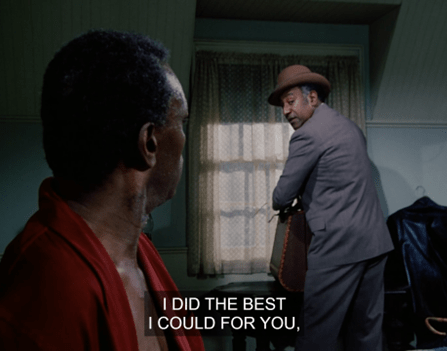
Kagan says that’s fine treatment after twelve years together, but Moody says, “I’m a manager, not a nurse,” and says Walnut Grove seems as good a place as any for Kagan to try to make a new life.
Looking after him with cool dignity, Kagan says, “I never did like you.”
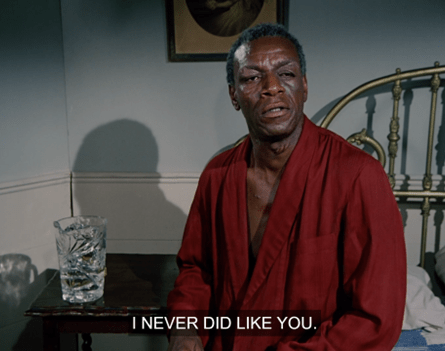
Moody finds this very funny, and limps out the door laughing.
DAGNY: The Bead should stick her head out and say, “Would you please keep it down? I’m grading papers!”

After a commercial, Pa returns home, where the Ing-Gals are all waiting for the medical report on Kagan. (Why would they care?)

Despite having taken a punch or two to the face last night, Pa has no bruising to speak of.
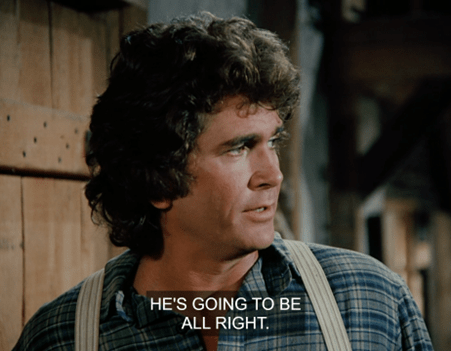
Pa tells Ma he has survivor’s guilt for nearly killing a man he didn’t know was ill.
WILL: Charles. What a sap.
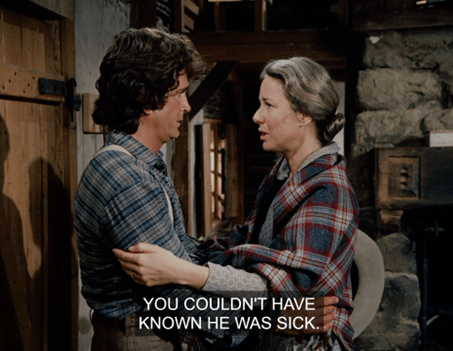
Ma says since Pa stayed up all night worrying about Kagan, he can skip church this morning, but Pa says he wants to go anyway.
DAGNY: That was a strategic move. He wants popcorn tonight.
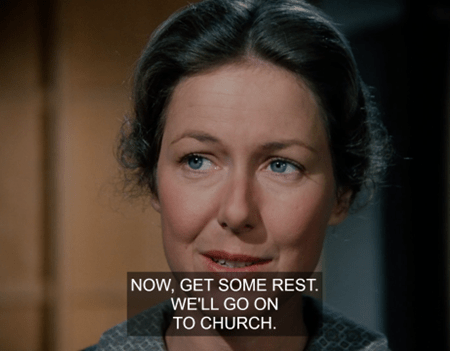
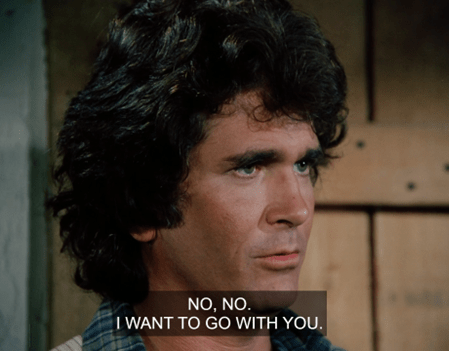

Incidentally, since it seems unlikely a whole day has passed, I think we have to conclude that in the Little House TV Universe, September the 19th of 1879 was actually a Saturday, not a Friday.

After church, Charles stops Doc. (Mrs. Foster can be seen in the background.)
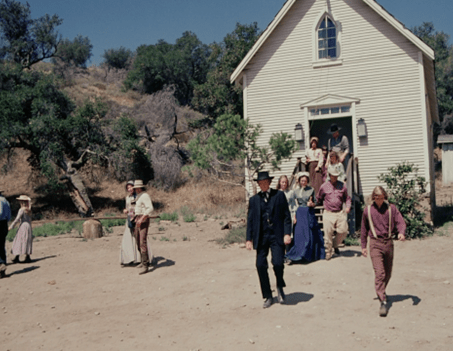
Charles says he wants to give the prize money back to Kagan, so Doc tells him to come along to see him.
WILL: Just pocket it, Doc! It’ll make up for all the chicken payments.

All the churchgoers depart, including Mustache Man and a buckboard-load of people we did not actually see come out of the church.

At Kagan’s door, no one answers – and suddenly Charles and Doc hear a crash from within.
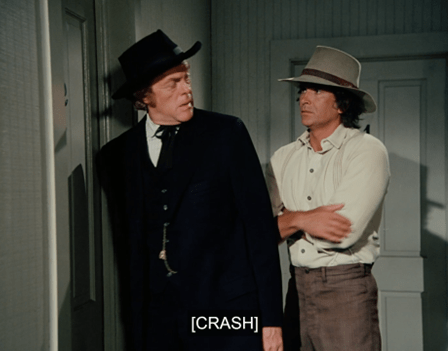
Charles breaks the door down, where they find Kagan lying on the floor – and a crude noose hanging from the ceiling.
DAGNY: That never would have held him. This is pretty strong stuff for Little House, by the way.
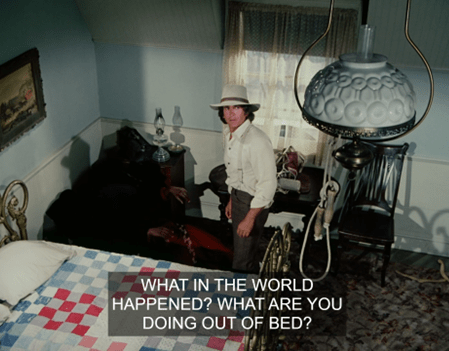
They get the boxer back in bed. Doc asks where Moody went, and Kagan says, “Gone – cain’t blame him – it’s all . . . all over for me now.”
He pushes Doc away, pretty gently, and asks to be left alone to die.
Charles, still feeling dire guilt, tells Doc he’ll stay with Kagan until he’s well.
WILL [as CHARLES, cheerfully]: “You know, I’ve never been with a Black man before.”
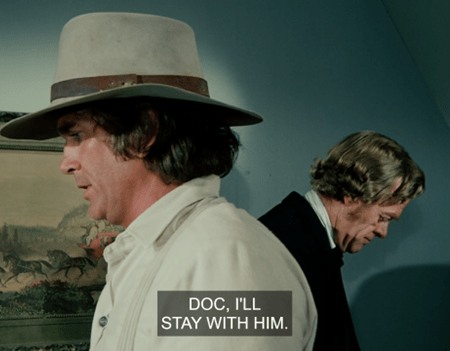
Doc pauses to tell Charles it could have been anybody who triggered this series of events.
ROMAN: Not Nels.
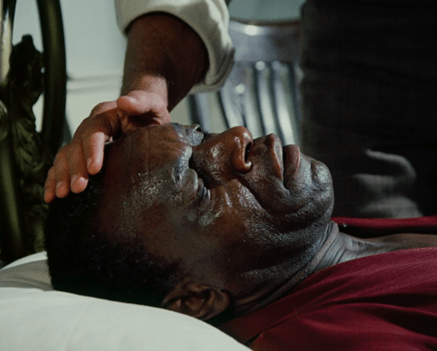
Later, we see Charles nursing Kagan back to health in his sickroom. Kagan tries to throw Charles out, but breaks down in a coughing fit.
DAGNY: His bad breathing sounds real. Did he have COPD?
WILL: Yeah, well, he did die of complications from asthma.
DAGNY: When? Moments after filming this scene?

WILL: You can see his real eyebrow peeping through the bruise makeup.
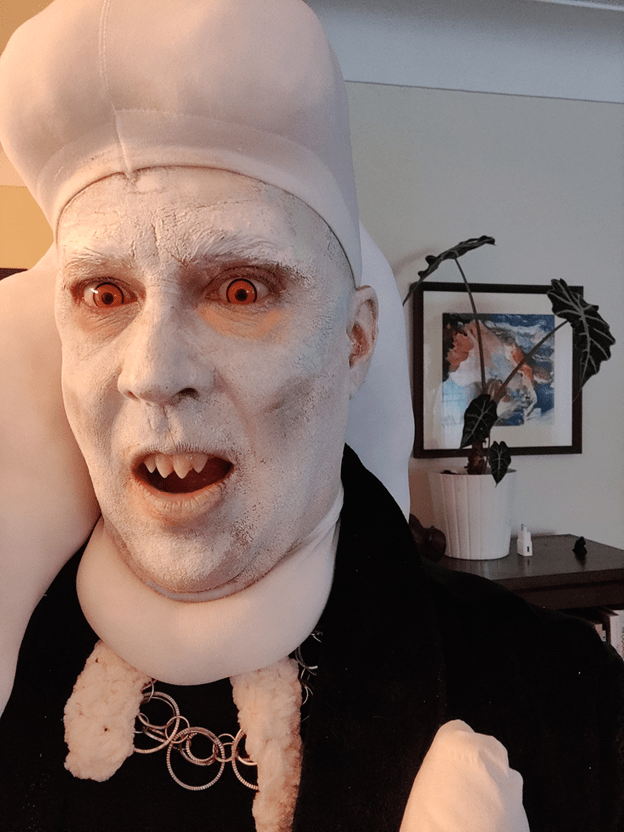
DAGNY: Eyebrows are hard. It’s like when we did your Bib Fortuna makeup.

Charles tells Kagan until he’s well, he’ll be following his orders. One thing that’s a little odd about this story is how little focused it is on race. Both Kagan and Moody are Black, a fact that none of the Grovesters seem to notice. No one comments on it, at least.
We get a little bit of commentary in the upcoming scenes with Tim, but for the most part race is ignored. Contrast this to previous episodes in which the arrival of non-white characters throws the community into a tizzy.
In “The Wisdom of Solomon,” for instance, Charles is quite sensitive with Solomon Henry, taking pains to show the kid he doesn’t think of him as a slave or servant.

He shows no such sensitivity to Kagan now, despite the high likelihood the man is also a former slave.
I know the situations are quite different, and I think it may even be reasonable to assume Charles takes this high-handed approach with Kagan on purpose, not because it’s a pose that’s comfortable for him, but rather because he suspects Kagan might respond to it.
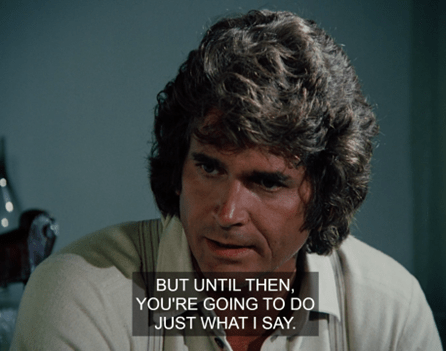
But if you want my educated guess, I bet Landon didn’t specifically write the script with a Black actor in mind at all, but tweaked it slightly after deciding to cast Gunn – hence the lack of race references.
Anyways, we then get a montage of Charles’s rehab regimen.
First we see Charles bringing Kagan to show him how things work at the Mill – presumably to prep him for a job.
DAGNY: That’s a cool bag.
WILL: It’s his severed-head bag. He’s used it before.
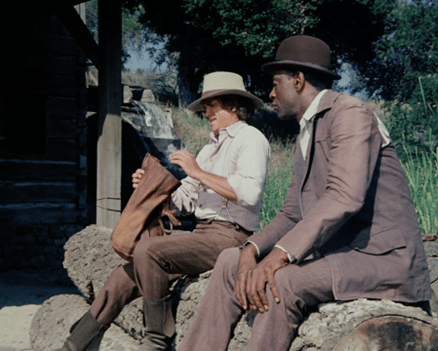


At lunch, Charles tries to give him an apple, but Kagan – obviously a man of good taste – refuses. (The apple is a Red Delicious.)

Charles makes him eat it anyway, though.
Then we see him forcing Kagan to eat his dinner.
DAGNY: This is just like Adam with Mary at the blind school. This show can’t get enough tough love.
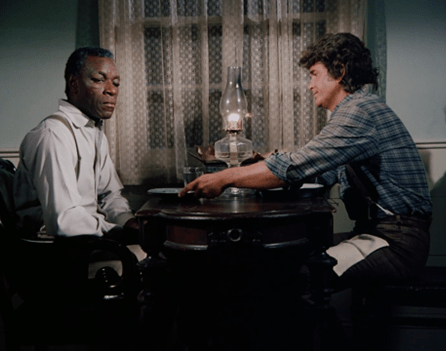
(I think both storylines are a little influenced by The Miracle Worker.)

Next thing we know, Kagan is indeed working at the Mill himself.
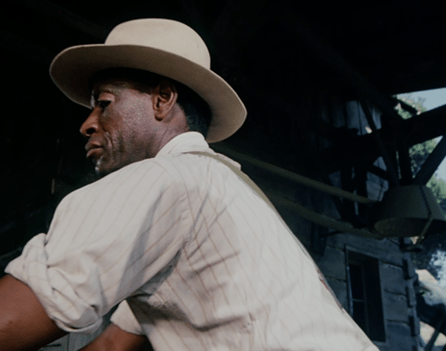
Time is clearly passing, and Kagan’s face is clearly healing, but the weather hardly seems like mid-fall.
DAGNY: David Rose is really shining here.
Up in Kagan’s room again, we get another dinner scene. This time, both men smile at the awareness that Kagan’s helping himself to seconds.
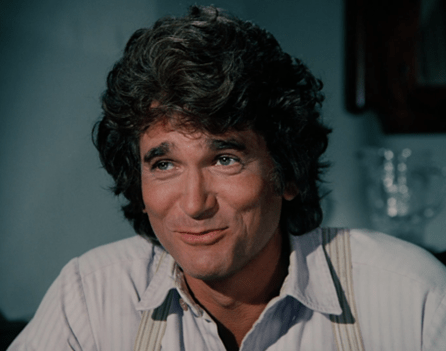
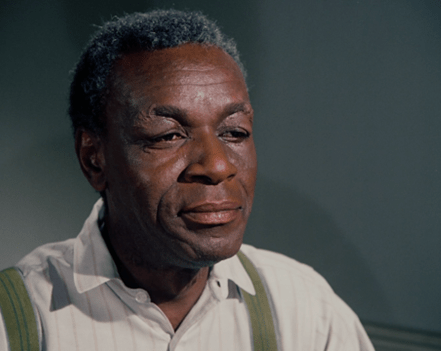
WILL: Now, all this would have made a good montage to a pop song of the time. “Undercover Angel,” or something.
Then one day, Charles takes a break from work at the Mill to discover Kagan has disappeared, leaving a half-eaten jelly sandwich.
ROMAN: A jelly sandwich? He must have been reading Walnut Groovy.


Charles freaks out like the parent of a stolen baby, but Kagan’s just in the privy.
WILL: He should have scared Willie out of there.

Finally, the montage ends, and we cut to a busy street scene in Chicago.
ROMAN: [laughs]
WILL: What?
ROMAN: Half those buildings are just paintings!
Huh? Surely not.
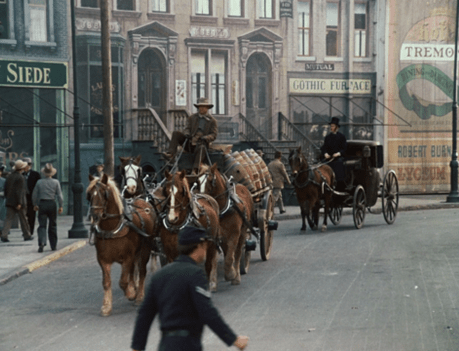
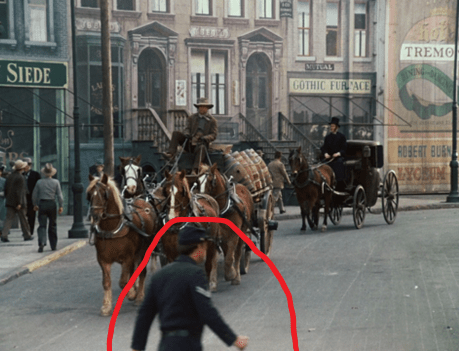
Prominent in the shot is an ad for the Tremont House – an actual Chicago institution that was rebuilt after the Great Fire in 1871.
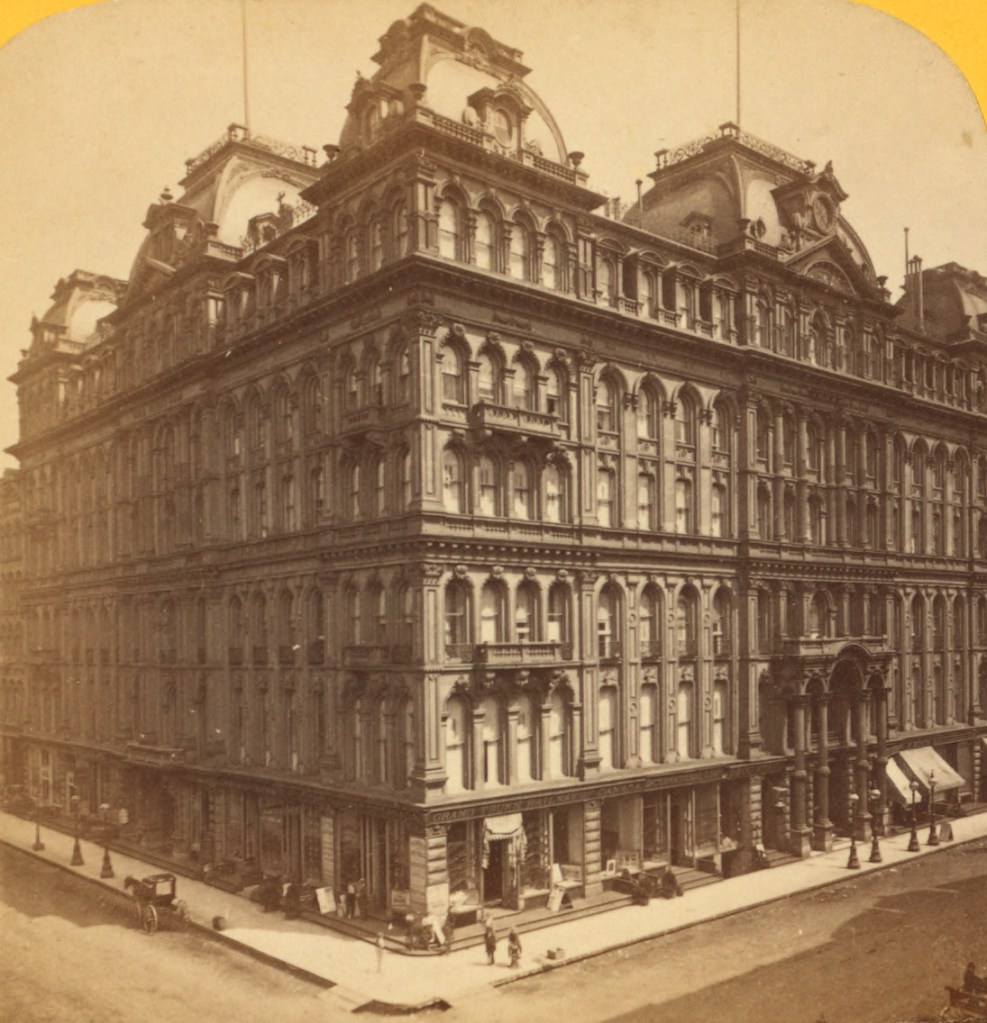
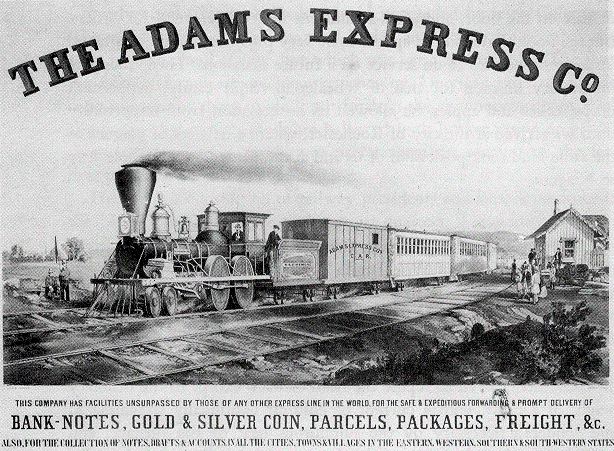
Other businesses represented are the Lyceum Theatre (also a real place that hosted vaudeville entertainments, though it’s unclear if it existed yet in the 1870s), Mutual Gothic Furnace (fictional), J.B. Boyd Ladies’ Fashions (fictional), Henry Siede Furs (actually a New York City store), and Adams Express Company (a real national freight company that still exists today).
There’s also a sign for a “Robert Burns Club.” Boy, somebody on this crew had a real hard-on for Burns.

Or is this a literary society John started up in Chicago?

There’s also a soldier of some sort crossing the street. Soldiers are actually a fairly rare thing on this show.
We cut to a workout room where several young men in states of undress are exercising.
DAGNY: Olive’s REALLY missing out.
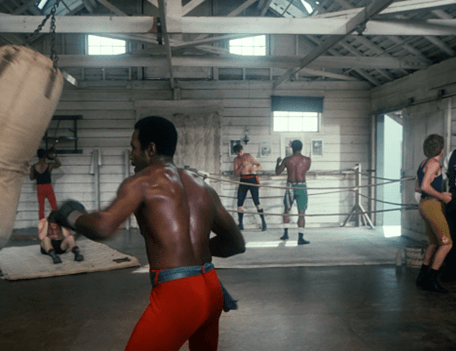
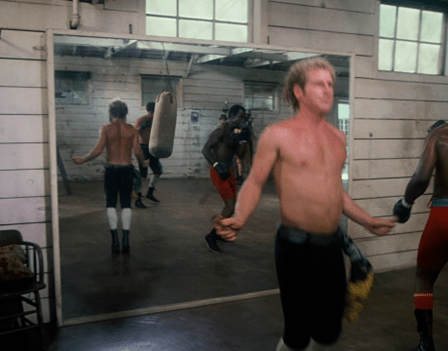
Like Kagan’s, some of the men’s endowments are also rather, um, evident.
DAGNY: Good LORD, Landon.


The camera pans to a back room, and who should we see but Mr. L. Moody, negotiating with someone he calls “Mr. Jake” to secure another fighter for his roster.
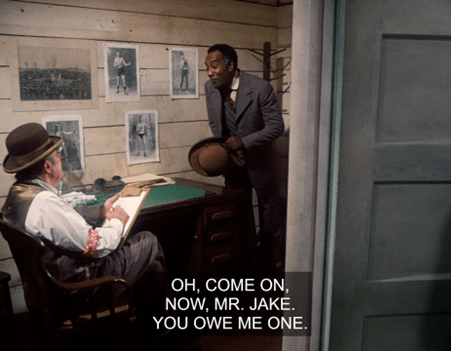
“Mr. Jake” (Jake Barky, according to the credits) is played by Paul Bryar, who was in nearly 400 movies and TV shows, including things like Vertigo, Rebel Without a Cause, Butch Cassidy and the Sundance Kid, and Night of the Hunter. He doesn’t have much of a part in this, though.
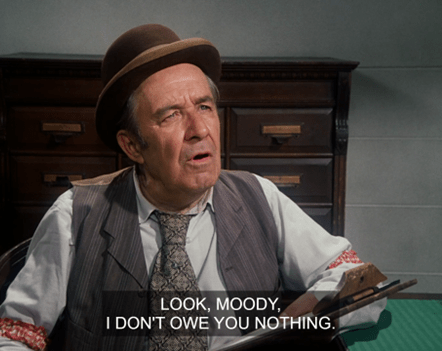
Mr. Jake clearly doesn’t care much for Moody, but he lets him have Tim Kagan – Joe’s son – because he knows Moody managed Joe and he is a lover of irony.

Mr. Jake tells Moody Tim has some strengths, but will never make a champ.
Mr. Jake points Tim out, and Moody goes over and introduces himself.
DAGNY: Tim got the penis genes from his father, too.
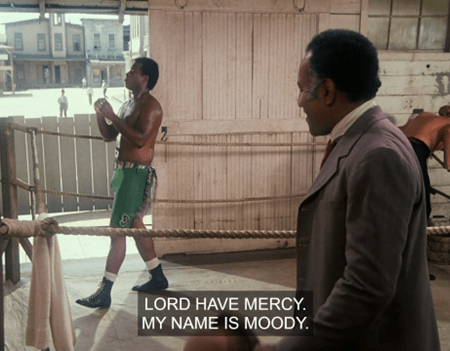
Tim bitterly scorns his father, saying not only did he abandon the family, he never sent any money like he promised. He says his mother died working in a laundry to support them.

Tim is played by Daryl Keith Roach, famous to us as Chuck, the friendly owner of the Bike-O-Rama in Pee-Wee’s Big Adventure.
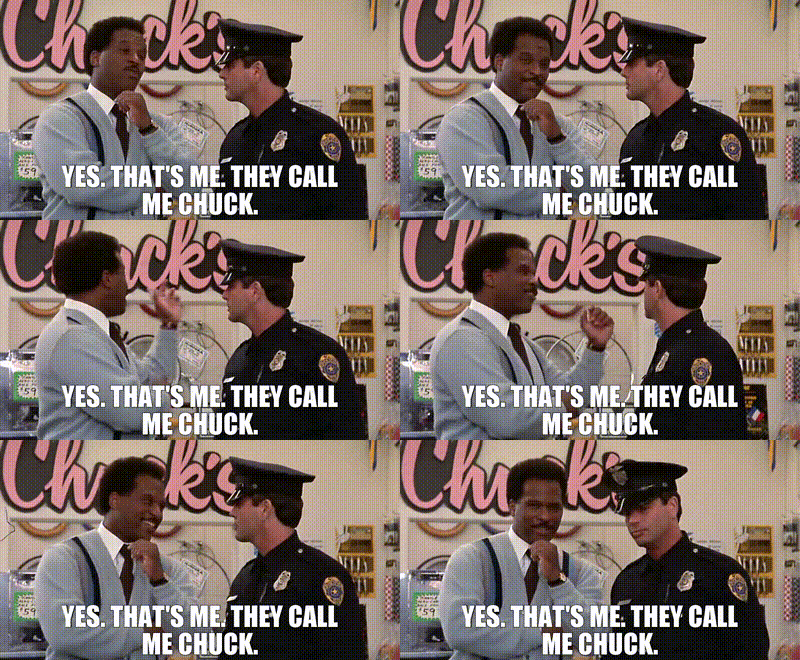
Roach was also in Shampoo and SpaceCamp, and appeared on Dallas, General Hospital, and Seinfeld.
Moody waves off Tim’s complaints about Joe and says he’ll give him a job.
Back in Walnut Grove, Kagan Senior and Charles are doing farmwork together. Kagan says the work is so hard, he feels “like I just went twenty rounds with Paddy O’Neill.” (If this is a real reference, I couldn’t track it down.)

Kagan, who looks and sounds much better, says it also makes him feel good to have done it.
WILL: Yet another character won over by the magic of Walnut Grove.
DAGNY: Yeah. They can’t help themselves.
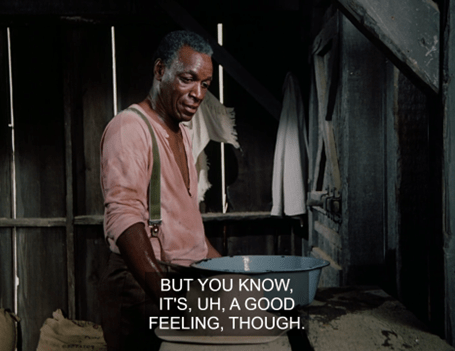
Apparently, they’ve been planting corn – which suggests we’ve shrugged off winter altogether and are now in the spring of 1880-F. (Doc suggested Kagan’s recovery would take “a few months.”)

Charles then says now that his health’s restored, Kagan can go and do as he pleases. Joe, however, doesn’t look super-pleased at this development.
DAGNY: Now that he’s well he should beat the shit out of Charles.

That night, Joe joins them for dinner at the Little House, saying he hasn’t felt so good in twenty years. He says he decided he’d like to stay in Walnut Grove permanently.
Pleased by this, Pa jumps up and gives him the $50 prize he won in the fight. Of course Kagan refuses it, but Pa insists.

Pa says he’s even been doing real-estate speculating on Kagan’s behalf, saying the $50 could make a nice down payment on “the Harper farm.” (Could this be the former property of Carl Harper and his wife, who both died in the typhus epidemic? Unlikely, seeing as it’s been about 25 years in LHUT.)
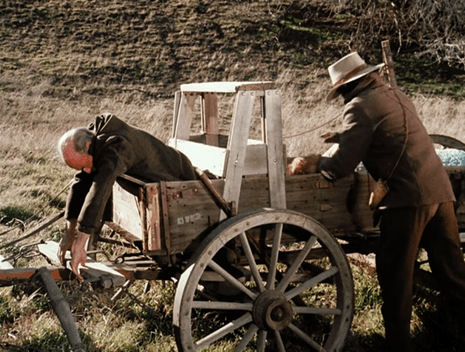
Pa says if he likes the property, they can drive to the bank in Springfield together to make their offer “next week.”
WILL: Yeah, in Springfield. Thanks, Ebenezer Sprague!

Everyone is delighted by this development.
Then we cut to Charles and Kagan on their drive to Springfield. They’re making leisurely conversation.
Kagan confirms he is in fact a former slave whose owner made him a boxer when he was fourteen.
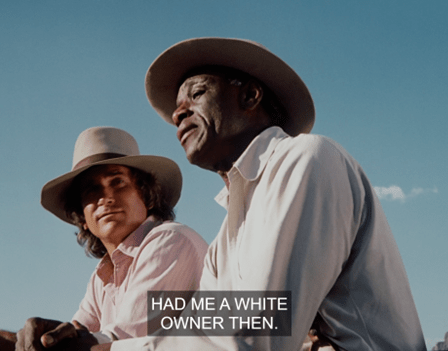
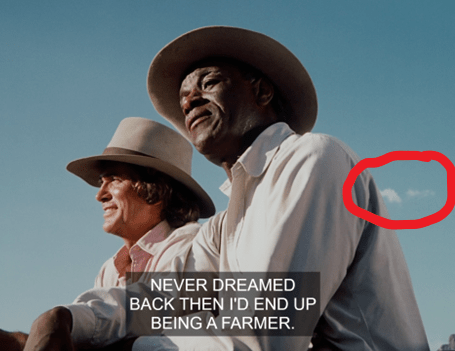
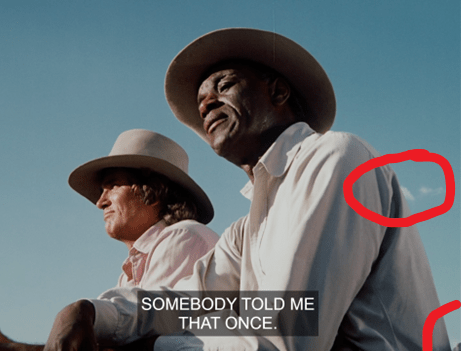
ROMAN: What is that thing in the corner?
WILL: I don’t know, but I don’t think they’re actually moving.

He says he made so much money from fighting, he was able to buy his freedom before the war. (If Moses Gunn’s real age is a guide, that means Kagan would have started fighting around 1845.)

Kagan notes wryly that boxing was the “onliest way I could hit a white man and not get hung,” which inspires a gas explosion of laughter from Charles.

DAGNY: Now I can’t stop looking at it.
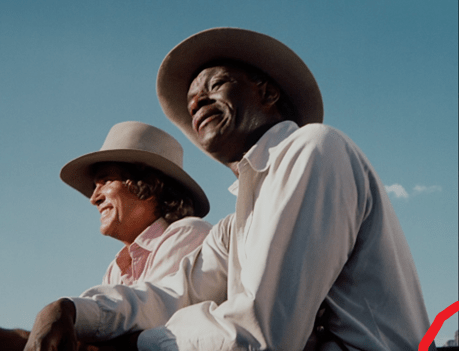
The cloud doesn’t move either.
The conversation winds up sending Kagan into melancholia, since Charles’s comments remind him of his wife’s.
In Springfield, which frankly looks larger than we’ve ever seen before (it is about three times the size of Walnut Grove today).
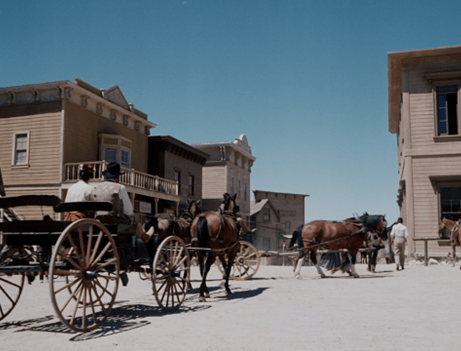
I wasn’t able to confirm this, but I think it’s likely Springfield and Deadwood, South Dakota, had the same city planner, because the layout of the towns is remarkably similar – right down to identical buildings.
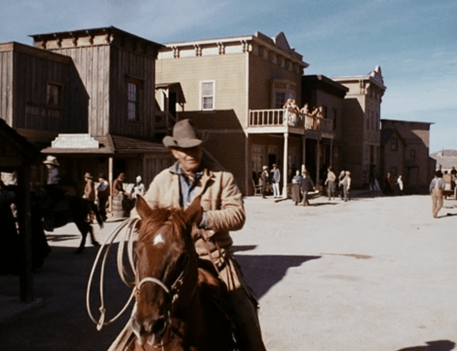
Charles drops Kagan off at the bank, even going so far as to point out the banker is named Carter.
(Could he be referring to long-running background Grovester Tom Carter? We haven’t seen him much around the Grove since Season Two, so perhaps he moved to Springfield and took a job as a bank teller.)
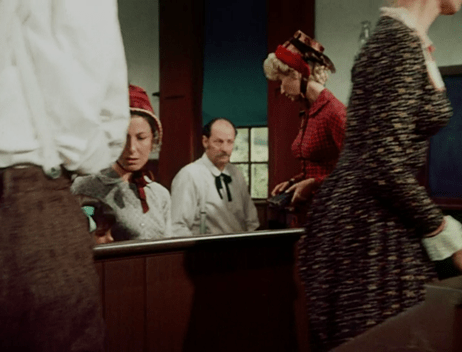
In a nice moment of vulnerability, Kagan tells Charles he’d like to wait for him to park the horses, since “I ain’t spent too much time in banks.”

Kagan crosses the street, and we see a joint called the Rollpoint Hotel in the background. (Not a painting.)

Kagan’s good mood turns to shock when he notices a, well, a notice.
It announces a boxing match featuring none other than TIM Kagan, and presented by none other than L. Moody.
WILL: What do you think the L stands for? Leonard?
ROMAN: Lester.
DAGNY: Leroy.
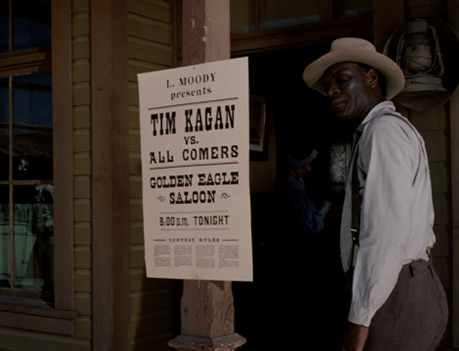
This fight is to take place at the Golden Eagle Saloon.
Clearly horrified his son has followed in his godforsaken footsteps, Kagan tears the notice down.
After a break, Kagan storms into the Golden Eagle, which looks like a hoppin’ saloon indeed, girls and all.
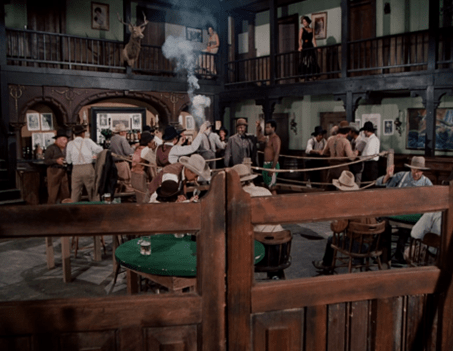
Interestingly, we see Carl the Flunky has traveled from Walnut Grove for the fight, or perhaps he just happens to be here on business. Whatever the reason, he’s betting on it.

Tim and Moody are standing in the ring, which has been erected in the middle of the room. Moody is blither-blathering and doesn’t see Joe.
Joe stands in front of the bar, behind which we see a vintage photo of a boxer – I wasn’t able to match it to a real person, though I can’t say I tried awfully hard.
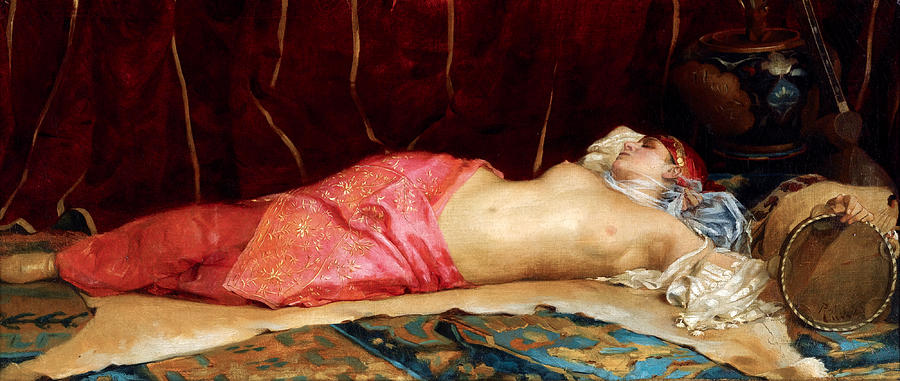
A detail of more interest to me, as a student of all things Victorian, is that there’s also a large and VERY raunchy painting of what is unmistakably an odalisque – a French term that was used in the Nineteenth Century to describe Turkish harem girls or concubines.
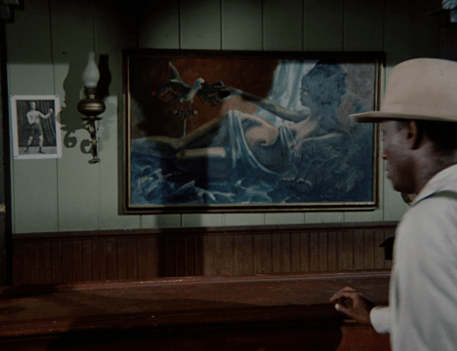
Reclining odalisques were an extremely popular subject for European artists. Not to put too fine a point on it, they essentially provided “exotic” (or, less charitably put, racist) soft-core pornography for men of the time.

More recently, the odalisque painting tradition has been harshly criticized as sexist and colonialist, but one can’t deny the individual artworks are often, um, striking.
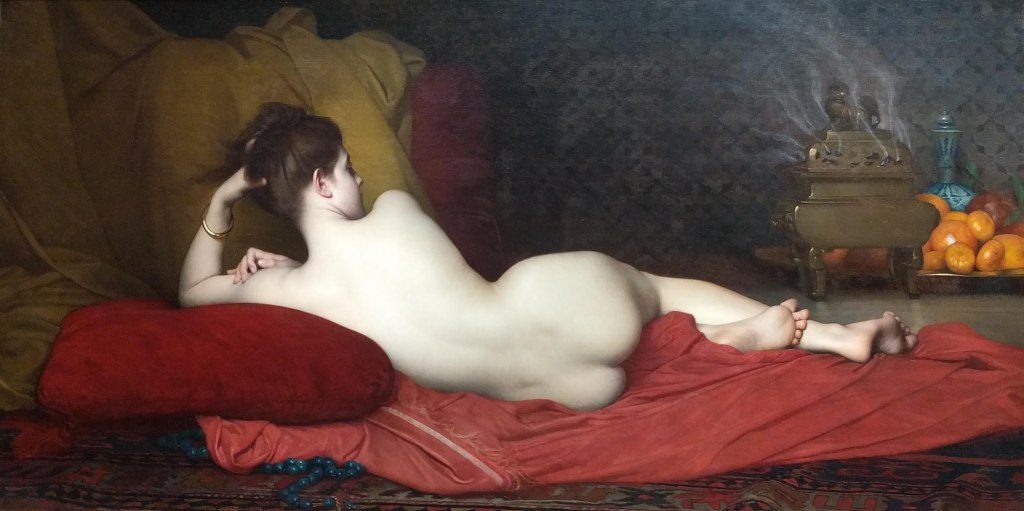
And anyways, the presence of an odalisque painting in this setting is very appropriate for the period, and shows once again the creative team on this show really did know quite a bit about history.

The painting here isn’t based on any real one as far as I’m aware, though.
In the ring, Tim Kagan is being photographed and interviewed, presumably for the Springfield Clarion.
A little reporter who looks like Jim Croce asks about Tim’s famous father Joe Kagan.
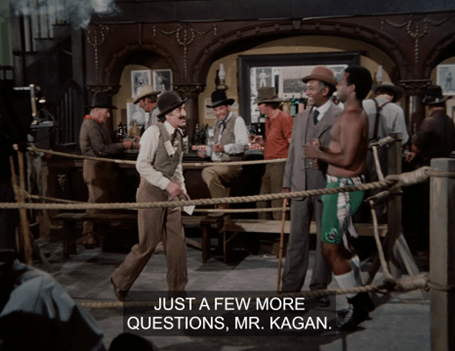

Joe listens intently as his son says, “I started fighting ’cause we had no money except what my mom made. . . . She died workin’ till she couldn’t work no more.”
Joe stares with silent horror and shame.
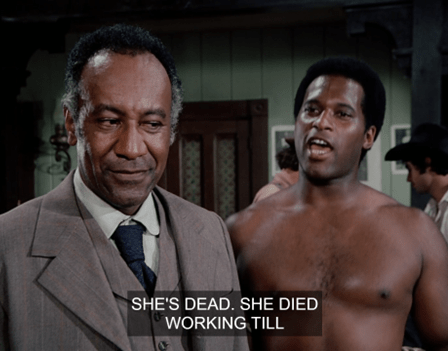

“I’m sorry,” says the reporter, and Tim sneers, “Why are you sorry? She was just another n─── doin’ white folks’ laundry.”
Embarrassed, Moody jumps in and says, “You don’t have to print that, sir.”
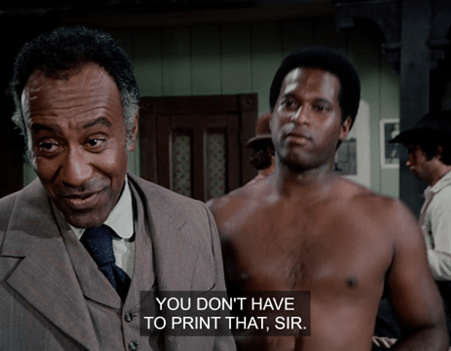
The little Jim Croce lookalike is played by Sandy Rosenthal, who appeared on Bonanza.

Tim adds he hasn’t heard from Joe Kagan since he was a child.
Moody cuts off the interview and tells Not-Jim Croce to be sure to promote the fight. (Though since the sign said the bout is “today,” I’m not sure how he’ll be able to do that unless he travels back in time to publish his story.)
Later, we see Moody exit the saloon, the windows of which say not Golden Eagle but Kellogg & Bro.

Interestingly, in “Gold Country,” we saw another saloon, the No. 3, that had similar signage, though that one was in Deadwood. Yes, I know it’s just the same set, but perhaps these Kelloggs were a hospitality company that franchised a number of watering holes in the region.
Moody limps happily down the boardwalk, which must run along a wormhole in time and space, because first he passes a store labeled “Levi Strauss, Tailor.” The famous co-inventor of blue jeans was based in San Francisco and to my knowledge had no stores in Minnesota in the 1870s.
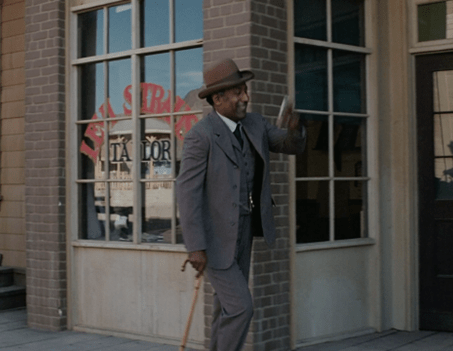
Then he passes a store called “San Francisco Hardware”!
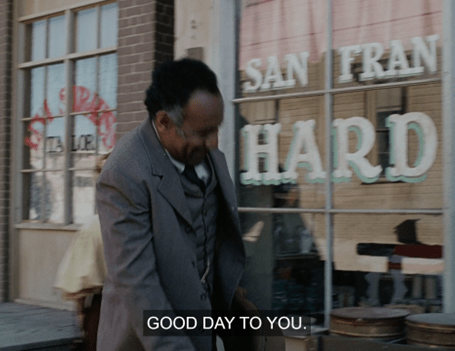
No doubt Mr. Moody would get a view of Alcatraz if he reached the end of the boardwalk, but unfortunately for him Joe Kagan leaps out of an alley and seizes him.
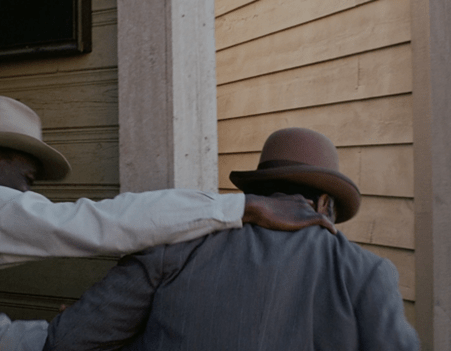
Kagan drags Moody to a hotel room – presumably Moody’s own? Joe slams him against a wall and accuses him of stealing the money he was supposed to send to Kagan’s family all those years.
Moody protests that there was no leftover money to send.
Kagan orders Moody to drop Tim as a fighter, but Moody says he’ll just sign up with somebody else.
Kagan says he’ll be the one to worry about that, then says, “You never go around my kid again after tonight. Dump him. If I ever hear about you goin’ round him again, I’ll kill you. You understand?”
He clearly means what he says, and Moody does understand.
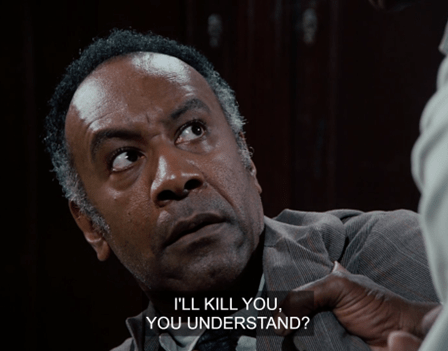
Kagan releases him, then says, “I’ll be the first one on the card tonight. The name is Hallornan. . . . My boy find out anything different, your mammy ain’t gonna know you.” The threat is very sinister.

Then he says it’s quite handsome of Moody to offer to pay his entry fee, and exits.
Okay, the clock is ticking now. Kagan goes back out to the street, where Charles has been looking for him. (Behind them we see the office of Berry & Clark Land Brokers.)
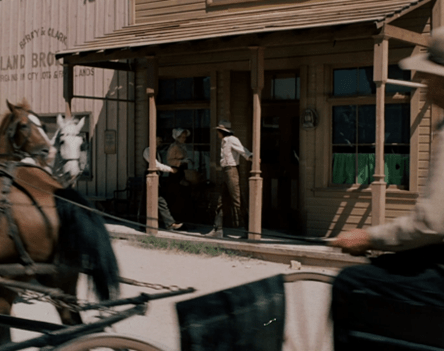
Rather mysteriously, Kagan says he decided to go sightseeing. He says Charles should just go home and he’ll stay the night and talk to the banker in the morning.
Charles is puzzled, but accepts this.
Kagan stops in a sporting goods shop to pick up some boxing stuff.
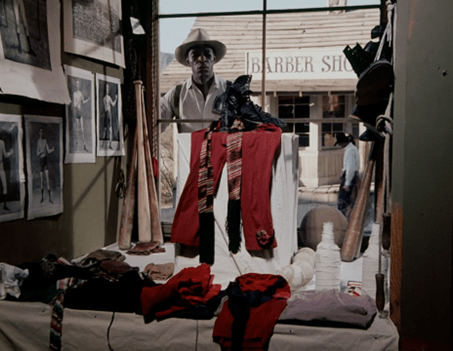
Back in the Golden Eagle that night, it’s a packed house.
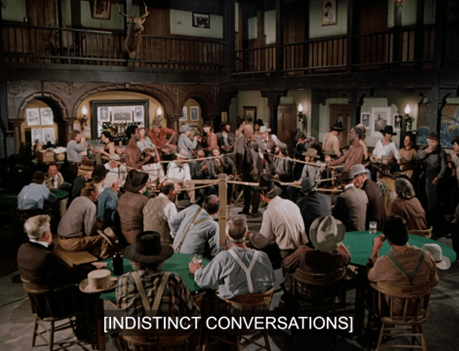
One of the prostitutes has a familiar look – in fact, I believe she’s Not-Lizzy Caplan, last seen soliciting Carl Sanderson out in Deadwood. (The Kellogg Brothers must have reassigned her to Springfield.)


Tim and Joe Kagan stand in the ring facing each other.
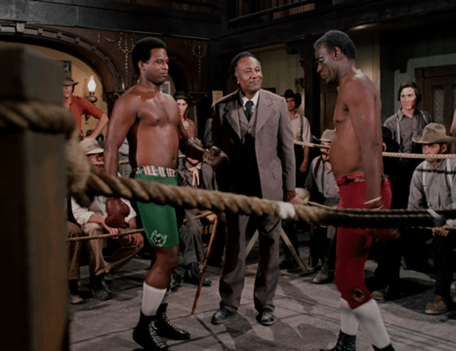
A discreetly placed rope conceals their husband bulges, both of which in a single shot no doubt would have incited riots throughout the land in 1977.
Not-Richard Libertini is there too.
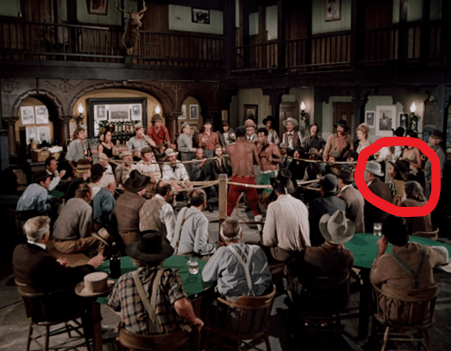
The fight itself seems unconvincing to this untrained eye, but long story short, Joe easily overpowers Tim and knocks him to the floor.
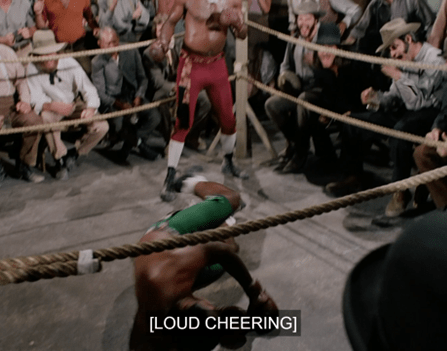
Joe and Moody stare at each other with contempt; then Moody bends down and tells Tim he’s fired.
Then we get an epilogue at the Springfield train station, a place we’ve visited several times without noticing the huge rock bluffs behind it.

It also seems to be both smaller and further away from town than it used to be.
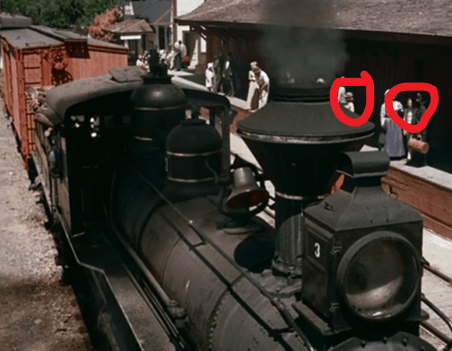
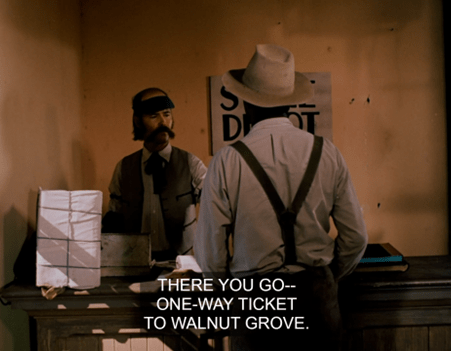
Joe Kagan is inside, buying a stagecoach ticket back to Walnut Grove from a clerk whose facial hair is probably the most “Nineteenth-Century” of anybody’s we’ve seen on the show so far.
Kagan goes back outside and sits down on a bench – right next to his son.
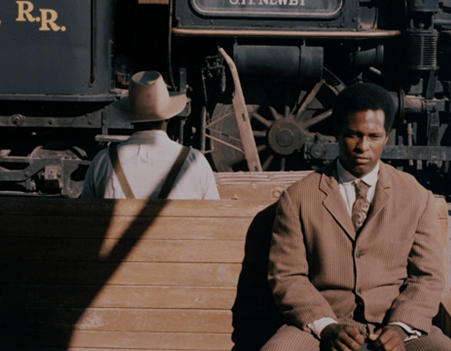
Joe turns and gently apologizes to Tim for beating him in the fight.
Tim tells him he’s done with fighting, and Joe suggests he try farming – a fulfilling life indeed. (Every farmer I’ve ever met does nothing but bitch about what a hard and thankless job it is, but never mind that.)

Tim says he’s going to travel to Denver, where his mom’s sister lives, in the hopes of finding a job.
WILL: Joe should be, like, “Oh yeah, Louisa? Oops!”
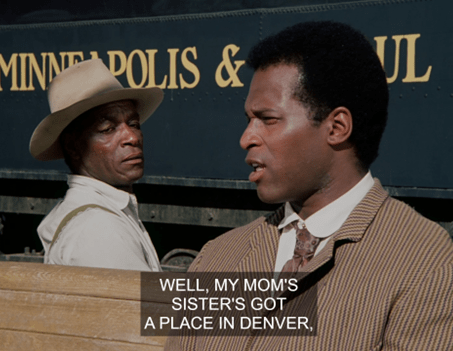
Tim says his mom wanted him to do that instead of fighting in the first place, saying, “Looks like she was right.”
“Womenfolk usually are,” says Joe.
Not unpleasantly, Tim bids Joe goodbye. Once he’s boarded his coach, Joe calls after him, saying, “Good luck, son.”
Puzzled but also touched, Tim says, “Same to you.”

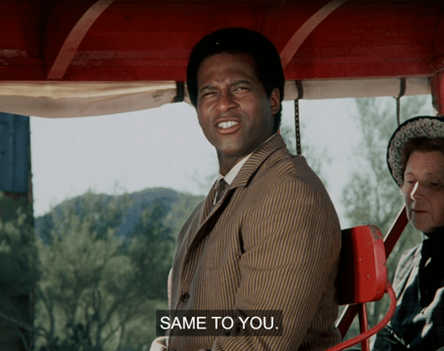
Joe watches his son go, and as the camera pulls back we see the train in the background isn’t our old pal the Number Three but rather a Number Eleven – I thought perhaps it was this famous Hollywood train, but as it turns out they don’t look much alike.


[UPDATE: It is in fact the same train – apparently the original “Reno” Number Eleven was badly damaged in a fire in 1995. It was rebuilt, but apparently nobody worried about making it identical to the original design. – WK]
STYLE WATCH: Those red tights.
Charles appears to go commando again too. And Tim Kagan wears a nice suit in the final scene.
THE VERDICT: Like a lot of stories mostly concerned with new characters, this one isn’t really beloved amongst fans . . . but also like a lot of those stories, it’s worth a second look. Powerful performances and epic themes make this a good Little House on the Prairie for grown-ups. Plus, for whatever reason, all the regular cast members are at their absolute funniest.
UP NEXT: Meet Me at the Fair
 Walnut Groovy
I have to admit it’s on one of those people where this is not one of my favorite episodes to watch. I can’t stand fighting! 😝🥊Joe Kagan was a good addition to the little house family. I forget what happened to his character later but I guess he had to leave the show so he could go on “father Murphy” with MO. Thanks for printing the Marquess of Queensberry rules. Every time I watch “the quiet man” I wondered what the hell they were.🍀🤔
LikeLiked by 1 person
I know – honestly, I never liked it either, but as I go through these one by one I sometimes find they’re better than I remembered. The Queensberry Rules are still famous, but I know him better from his persecution of Oscar Wilde – his son was Wilde’s lover, which he did not like one bit.
LikeLike
I watched this one last year and I didn’t remember that it had this much, er, risqué content. As a boxing fan, I was looking forward to the fighting sequences though truth be told, they’re not exactly exciting, with Joe Kagan on the edge of becoming a casualty, making the whole fighting part more tense and dramatic than exciting. If the story wasn’t made with Joe Kagan as a black man in mind, I think it added an extra layer of drama in his trajectory, in that his insistence in fighting isn’t just a matter of pride, but hanging onto the one thing he can do and earn well as a freed black man in a pre and post-civil war period, but it’s ironic that he was groomed to be a prizefighter by his master and yet this occupation is also what earned his freedom and a fairly good life as far as a black man could have.
Now, I seem to recall Alison Arngrim mentioning that she and Melissa Gilbert filmed a dream sequence where Nellie and Laura fight with giant boxing gloves, but the gloves made it hard to see when to pull their punches and MG ended up hitting Arngrim in the nose for real, and they thought it was broken for a moment (thankfully it wasn’t). Presumably they pulled off that scene afterward. I’m pretty sure this sequence was created for this episode and, if I could guess, I’d say it was to happen after Charles puts the girls to bed and they have a brief conversation which ends with Mary reminding Laura that she’s not a man, presumably explaining why she couldn’t fight Nellie the way boxers do, and boosting Laura’s imagination. I’d also bet this wouldn’t be the first time Laura imagined herself beating Nellie in a fight.
LikeLiked by 1 person
What is it that you like about boxing? No judgments, I just don’t find it entertaining myself and sort of share Landon’s views about its brutality and exploitative aspects. I agree with you 100 percent about Kagan’s race enriching the story, I’m just surprised if it was the original intent that it isn’t more prominent in the mix.
Dammit, I forgot that anecdote about the girls’ boxing scene! Thanks for the reminder – I’ll look up the story in ‘Confessions’ and maybe add it in. And sorry about all the dick jokes, you can’t make this stuff up sometimes.
LikeLike
Ah, no need to apologize for the risqué content. I find it hilarious how, for all that this show is associated with family-friendly programming and wholesome values (which is does contain), it’s still full of naughty material, not just when it’s tackling serious issues, but at times when it seems to test the lengths of how much it can get away with just for kicks. It shows that there are more layers in “Little House” than fluff and melodrama.
I like combat sports in general, though part of me is aware they often push the limits of healthy risks in sports. I keep telling myself they are fairly “controlled” displays of violence with precautions and all, even if boxing is particularly notorious for casualties and sequelae. But there was always something in it that fascinated me, and it’s probably because of the things I watched as a kid. Boxing gloves in booby traps and actual matches always popped up in cartoons I watched and for a long time boxing was the first thing that came to mind when the subject was fighting sports, so the whole imagery of the ring with ropes on all four sides and especially the signature rounded gloves colored either red or black stuck in my mind. So maybe my fondness for the sport has more to do with the TV show/cartoon take on it than the actual sport in real life.
It’s interesting to see that, even though the sport is fairly different here in the 1870’s with different gloves and rules, the issues it tackles, from the self-destructive side of the fighting career, to predatory managers to the declining champion who’s spent so much time invested in the sport he is unsure about his future after he’s forced to quit and is left behind are very much timeless. It’s a boxing episode that even non-boxing fans will like in that it’s more about showcasing the ugly side of the sport.
LikeLiked by 1 person
Love this answer – thanks!
LikeLiked by 1 person
Sorry for the late comment…we don’t like this one? This is one of the last episodes I ever saw, because it’s one of those 90 minute ones that never aired in syndication in markets where I lived until I was a teenager. Maybe I liked it because it was finally one that was new-to-me, but I think it was more that I liked seeing that Joe existed on the show before they just dropped him in in Blind Journey (with Mary saying she certainly remembers him!); I always liked when it seemed like characters actually remembered other episodes, and when characters recurred. It also is a pretty good episode, which probably helped!
LikeLiked by 1 person
Oops, I meant to add I’m pretty sure the sets you were wondering about were the sets at Old Tucson in Arizona. That’s where they shot Meet Me At the Fair too–the Fair episode has to be the one Karen Grassle talked about in her memoir, flying to shoot after giving up drinking and having dinner with Katherine MacGregor.
LikeLike
Well, maybe I’m wrong about this one not being fondly remembered – I admit my saying that is based more on intuition than science. And thanks for the reminder about Old Tucson – I will look into that for the “Meet Me at the Fair” recap, which is coming up next!
LikeLike
I agree this episode was super funny and it had more good moments from the Grovesters than I remembered.
Am I missing something though, or did the monetary conversion factor change partway through this? First it says,
” $5 ($150 today) registration” (a factor of 30) then later on it says,
“President Hayes’s salary would have been a mere $50,000 – $150,000 in today’s money” (a factor of 3).
LikeLiked by 1 person
Ha ha, you caught me in a VERY RARE ERROR! 😆 Thank you very much – I’ll update the post and correct this. I’ve been using $30 as a rough value for the Little House dollar, though when I started The Project it was closer to $20. . . .
LikeLike
I realized this is the only episode to feature both Joe Kagan and Lars Hanson, though I don’t think they ever appear on the same scene. And yet despite the lack of interaction between them, I think it’s possible Hanson played a part in saving Joe’s life. How? When he accidentally caused Jonathan’s hand injury, it forced Jon to beg Charles to fill in for him against Kagan, who barely made it out alive. If fighting Charles nearly proved fatal, imagine if he’d fought Jonathan, who happens to be much bigger and stronger… There’s no way Kagan would have made it out of the ring alive.
LikeLiked by 1 person
This is a possibility. Garvey is the gentlest of giants, but of course he and everybody else were expecting Joe to be some monster out of a superhero story. He would have been fighting hard. As for Mr. Hanson, I wonder where he would have landed regarding Joe’s membership in church. He was older and very traditional, and yet he usually caucused with the liberals on political issues. I’m trying to remember if he plays a role in ANY of the racism stories. . . . I know he was mysteriously absent when the Dakota warriors appeared in town.
LikeLike