
When Harry Met Allie; or
Girls Just Want to Have Phone
(a recap by Will Kaiser)
Title: Crossed Connections
Airdate: December 10, 1979
Written by Don Balluck
Directed by Michael Landon
SUMMARY IN A NUTSHELL: Scandal rocks Hero Township when switchboard operator Mrs. Oleson learns a Grovester’s dark secret. (I won’t tell you who it is, except to say she has six episodes to live.)
In other developments, Walnut Grove gets a wildly unethical new banker.
RECAP: Last week’s story aired during the 1979 holiday season, and the following week NBC preempted Little House for Berenstain Bears and Little Rascals (a cartoon?) Christmas specials.
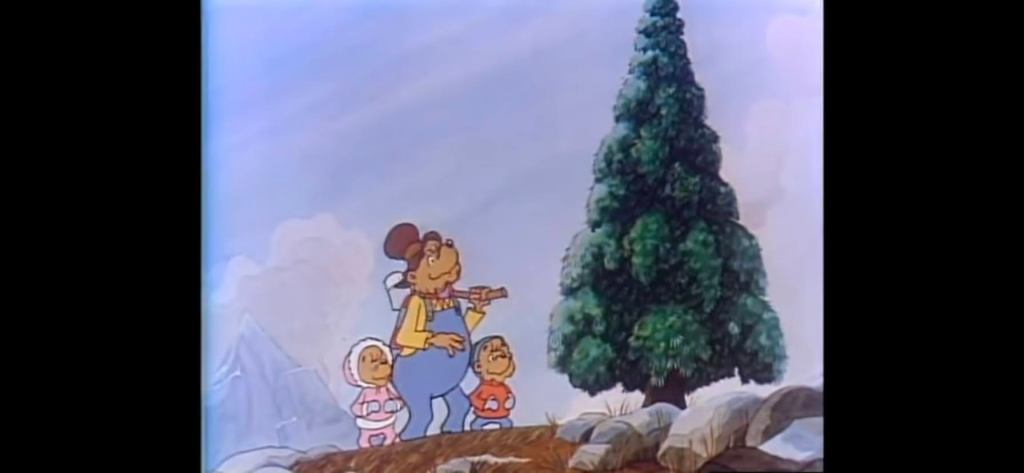

I don’t remember those myself, but I was four years old, so I probably did watch ’em.
Little House returned, then, with this interesting story, which takes elements from previous ones and fuses them into something perhaps more than the sum of its parts.
We’ll see, anyways. We open on a young man fooling around with wires at the top of a telephone pole – the proverbial lineman for the county.

The pole’s being installed at Nellie’s, but the camera zooms all the way back to the interior of the Mercantile – a nifty shot.
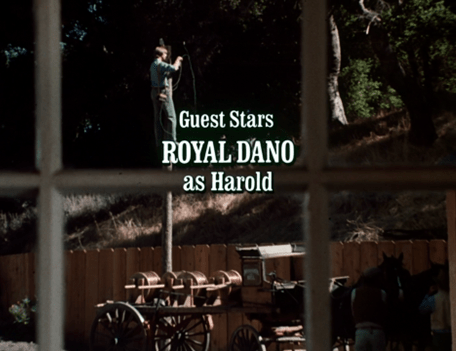


Inside, Caroline is thanking Alice Garvey for helping her choose a fabric pattern or some such.
Stepping outside, the ladies notice the erection, um, occurring, and make some wonders-never-cease-type comments.

Alice mentions that her mother “in Minneapolis” already has a phone. (In “The Sound of Children,” the Garveys go “back east,” and we theorized they were from Wisconsin originally.)
(That said, “S of C” took place at least nine years ago in Little House Universal Time (LHUT). Her mom may have moved to Minneapolis since then, I think it’s fine. )

Ma and Alice follow a sort of young John C. Reilly-type phone company worker inside. Curiously, they use a side door instead of the front one. The employees’ entrance?

In an office, Harriet Oleson sits at an elaborate switchboard.
DAGNY: Mm, this one.

Nellie is there too, with her heart-shaped apron on.

Young Not-John C says the Lineman for the County is going to test the line.
The phone rings, or rather buzzes, and Mrs. Oleson answers and screams “WALNUT GROVE!!!”

Now, when I say screams, I mean screams.

Screams may actually not be a strong enough word, in fact.
If ten normal people screamed “Walnut Grove!” together, it might approach the volume Katherine MacGregor coaxes from her vocal, um, apparatus at this moment.
She screams sloooooowly – fairly unusual for a scream on TV (or in real life for that matter). And it is eardrum-shatteringly loud.
In fact, I’m surprised the switchboard doesn’t splinter into smithereens, that’s how loud it is.
The sound is not without its effects, though. Outside, the Lineman for the County shrieks and falls to the ground. HA!

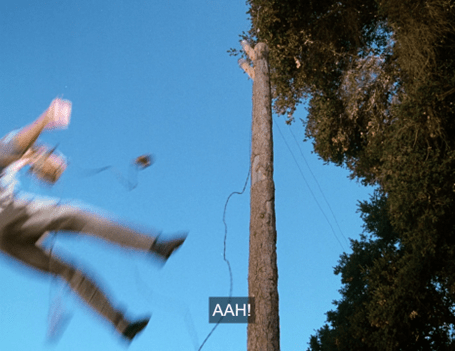
The Lineman, a dopey-looking flophaired young man, is okay, and he says “That’s a little loud, lady” into the mouthpiece.

He’s Tod Keller, who did stunts on a failed Knight Rider reboot and Riptide as well as in Friday the 13th: The New Blood and C.H.U.D. II: Bud the Chud (“Cannibalistic Humanoid Underground Dwellers” if that sounds up your alley).

Additionally, I was interested to learn, Keller acted, or perhaps appeared is a better word, in a couple soft-core porn videos from Penthouse in the eighties. (It cracks me up when the world of Little House overlaps with adult entertainment. How much more complex our universe is than people realize!)


DAGNY: That still of the guy’s ass is hilarious. You can tell they had to powder his jeans to make him look like he has a butt.

Well, Mrs. O tries answering the phone again, this time turning her greeting into a more of a singsong jingle.


So, details on the invention of the telephone are disputed, since a number of researchers were simultaneously working to achieve sound transmission along similar lines (literally).
But everyone agrees the first patented such device was Alexander Graham Bell’s. Indeed, the patenting was obliquely referenced in “Gold Country,” in which Mr. Edwards is reading a newspaper (don’t ask) that features a headline about Bell receiving it in 1876(-E).


In “Whisper Country,” set in 1877-G, Mary informs the backwoods Fisher family of the invention, only to have Caleb Fisher denounce it as a leftist hoax! (Paraphrase.)

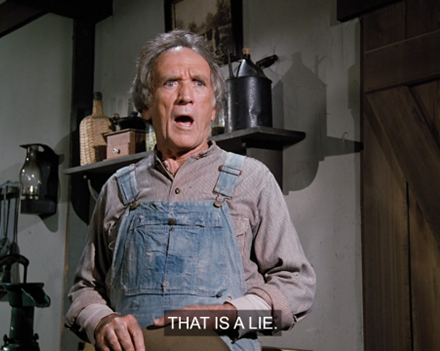
Adam’s prick of a father, Giles Kendall, Esq., has a speaker phone in his NYC office in “The Sound of Children” (1882-I).

But to date, our most notable adventure to feature the telephone, of course, is “The Godsister,” which features Charles and Jonathan Garvey installing phone lines between Springfield and Sleepy Eye.

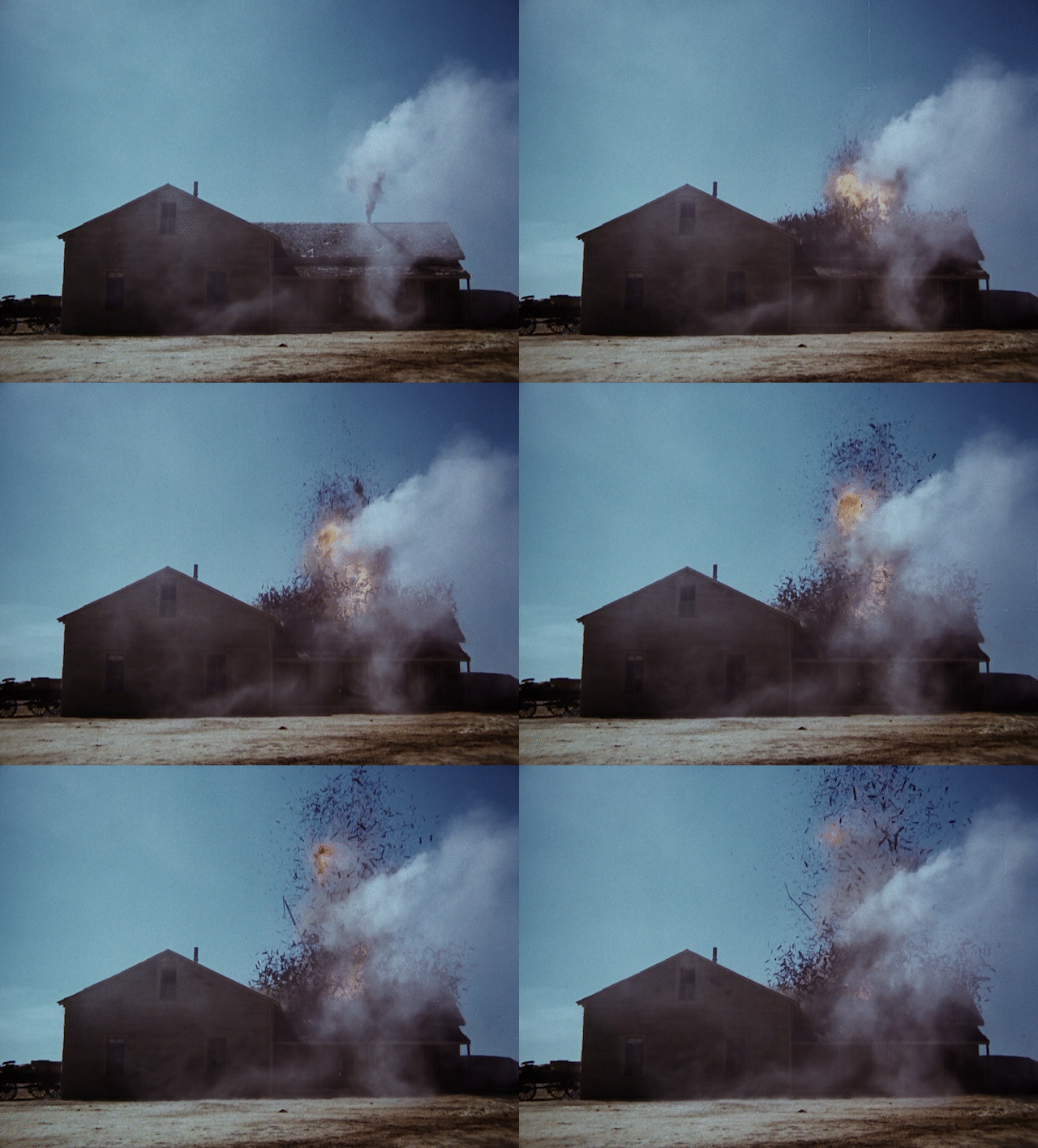
But as we will see, “Crossed Connections” as far surpasseth “The Godsister” as great’st does least – telephone-related-story-wise-speaking, anyways.

Apparently having explained the switchboard’s workings in a deleted scene, Not-John C. Reilly tells Mrs. O that she’ll be making a lot of money off the instrument, since people are buying telephones all over Minnesota.
(As a switchboard operator, is Harriet technically an employee of the phone company? Did operators get paid by the call? My own research was inconclusive, or at least I got bored reading about the subject pretty quickly.)

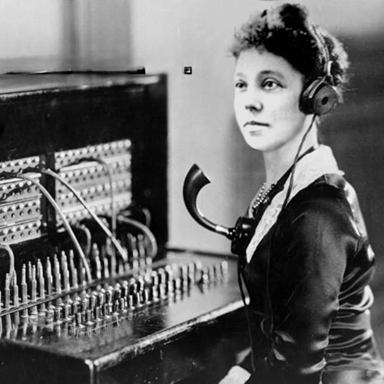
Others have quibbled about Walnut Grove having the telephone by this point, but I think it’s within the realm of possibility. By my figurin’, we’re now in 1885-L, nine years after the Bell patent and seven after the first female switchboard operator assumed the position. (This operator was a Massachusetts woman named Emma Nutt; women were almost immediately favored over men for operator jobs, since they were more patient and didn’t swear as much. Ha!)
Anyways, Not-John C is Dave Morick, who appeared in many things, such as Daniel Boone, The Brady Bunch, Hogan’s Heroes (seventeen times!), Kojak, The Six Million Dollar Man, The ABC Afterschool Special, Hunter, 227 and Amen, as well as the Landon projects Highway to Heaven and Sam’s Son.

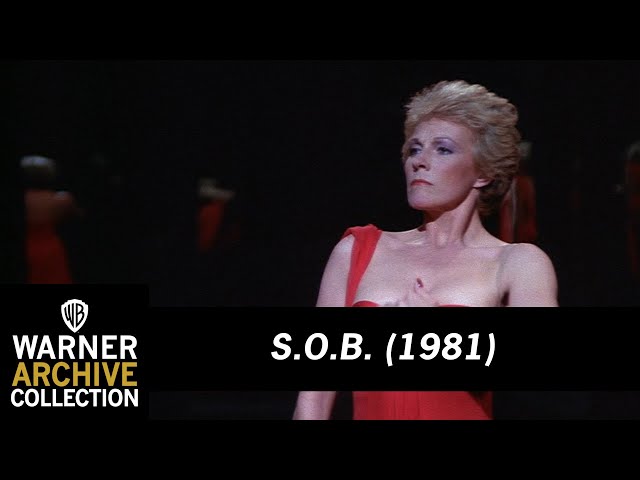
He was in the Jerry Hardin/Paula Crist/Tiger Williams vehicle Earthquake, and he was in S.O.B., a 1981 Blake Edwards comedy that in my day was still notorious as The Movie Where Julie Andrews Is Naked.
Well, Harriet eventually notices Caroline and Alice, and immediately takes credit for “bringing science to Walnut Grove.”
“We’re all in your debt,” Caroline says hilariously. (I take back what I said last week about Ma not being funny.)

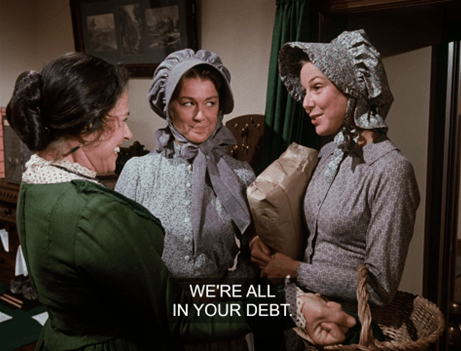
Harriet then asks Caroline if the Ingallses will be getting a phone of their own; but Ma says it’s too expensive.
Harriet is shocked Caroline would admit to being poor in mixed company, and she says so.

But Caroline simply shouts her down and she and Alice depart.
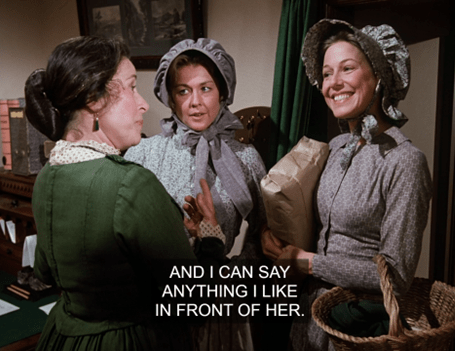
“I will never understand that woman as long as I live,” Harriet says to Nellie. “It’s one thing to be poor, but it’s another thing to admit it.”
“The poor are ignorant, Mother,” Nellie says; “that’s why they never amount to anything.” (Wildean wit is rare on this show, but MacG and Arngrim nail the delivery here.)


“How true, how true,” Harriet says, adding, “Thank heavens we’re rich.”
“Amen,” Nellie says.
HA! We’re off to a funny start in this one, yes? Don Balluck wrote it.


DAGNY: Nellie’s been getting nicer this season, but she keeps reverting to evil so her mother will be impressed.

Meanwhile, Not-Richard Libertini and an unknown Grovester woman pass by in a wagon. (Outside.)

We see another telephone pole has gone up next to the bank.
Inside, Laura and Albert are waiting to talk to a teller as a fussy-looking rabbity little man in the foreground dips his pen in an inkwell.

Albert asks the teller, a man who looks a bit like Jonathan Garvey might have in his younger days, “How much longer?” and the teller replies, “Be a while yet.”
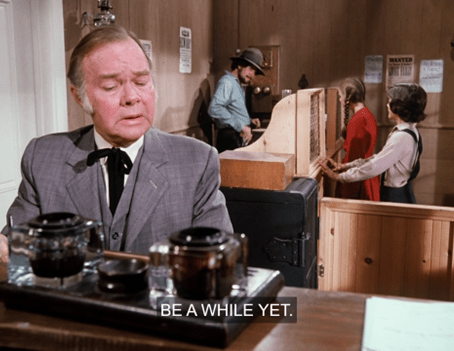
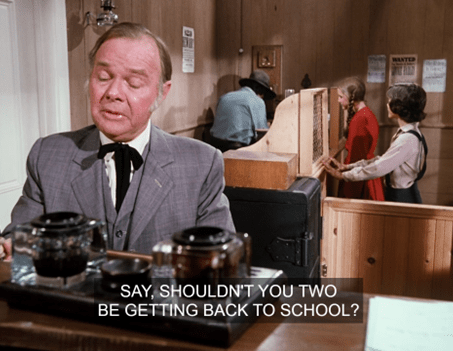
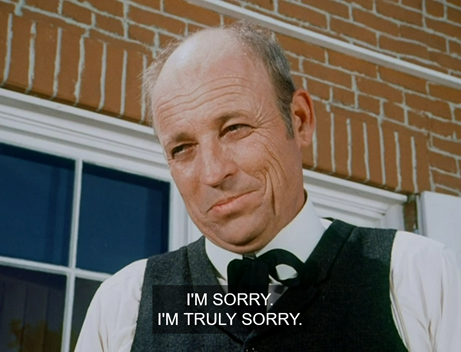
The rabbity man suggests the kids should go back to school. A brand-new character, this is Bill Anderson the banker. (Will he be as boring as his name? You’ll have to wait and see.)
Anderson is played by Sam Edwards, whom we’ve met once before, when he played the unnamed Postmaster-General of Winoka.

It’s possible Edwards is playing the same character here, and that, like so many others before him, the Postmaster-G migrated to Walnut Grove in search of different work and wackier adventures than those Dakota Territory could provide, at least once the Ingallses et al. had departed.
But just to keep you on your toes, this time we’ll assume he’s a new character. We’ll meet him again a few times, too.

Beginning his career as a stage performer in the 1910s (as a baby) and for many years a radio actor, the likeable Edwards boasts a list of credits that’s strong even by Little House bit-player standards, and that’s saying something.

The Adventures of Ozzie and Harriet, I Love Lucy, You Are There, Dragnet, Peter Gunn, Alfred Hitchcock Presents, Hazel, Wagon Train, Andy Griffith, Green Acres, The Invaders, Petticoat Junction, The Virginian, The Mod Squad, Mannix, Adam-12, Gunsmoke, Cannon, Barnaby Jones, Wonder Woman, The Dukes of Hazzard, Happy Days, and Days of Our Lives are just the start.
Moviewise, he did Hello, Dolly!, Escape to Witch Mountain, and The Postman Always Rings Twice, and he did voices for a number of animated films and shows too, including Bambi (he was Thumper), The Flintstones, and Jonny Quest.
I was pleased to learn he did voices for Disney Winnie-the-Pooh LPs, including Winnie the Pooh and The Blustery Day, which I loved when I was little.
Among other characters, he played Tigger, and I would go so far as to say he played him like an Edwards – Isaiah Edwards, that is, not Sam.


Sometimes when I look at the resumes of some of these actors, I just want to cry with admiration. My resume is so much shorter, and certainly much less fun, than any of theirs.
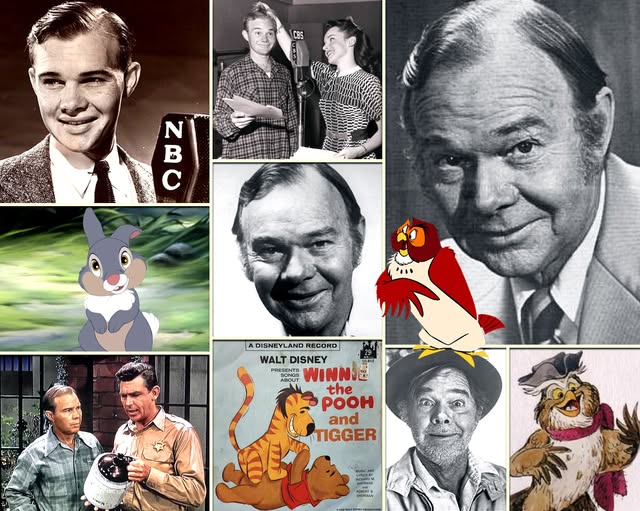
There’s a very nice tribute to Sam Edwards written by his son here.

Anyways, the bank’s founder (and Laura Old-Man Bestie) Ebenezer Sprague is not mentioned here. The last we heard of him, he was leaving Walnut Grove after two attempts to keep the bank in operation, and I think we can conclude his saga has, um, concluded.
There hasn’t been much talk about Walnut Grove’s financial wellbeing this season, but there have been signs (the restaurant opening, circuses and tent revivals coming to town, Charles Ingalls throwing $32 away on that bullshit Hol-book) that its economy is now humming along nicely.


Presumably this Anderson came to town to rehabilitate the bank during the current boom. Who knows, maybe he’s even a Sprague protégé, though that may be too much to wish for.

Presumably he’s also no relation to William Anderson, author of many books and articles about Laura Ingalls Wilder and other topics.


Well, Laura and Albert are apparently waiting around for the bank’s phone to ring, but Anderson nicely tells them to come back after school and he’ll let them talk on it.
The kids leave and Doc Baker appears.

The Teller Who Looks Like Jonathan Garvey Might Have In His Younger Days gives Doc a dirty look – not sure why.

On the back wall, there’s a wanted poster, this time for a “Lonnie Haney.” I can’t make out his specific offense.

There’s also a handwritten sign saying that The [Something] Is Coming! (Baby? Big Boy? I can’t see what.)
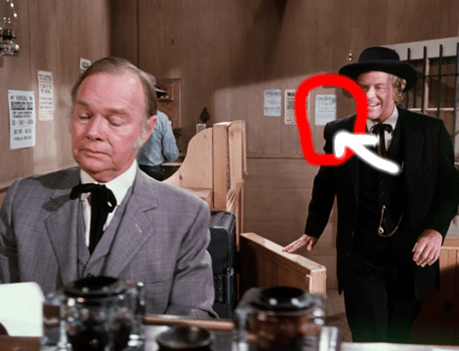
Greeting Anderson by his first name, Doc makes some smalltalk about the telephone. He says he’s sure it’ll disrupt whatever peace and quiet he has left to enjoy. (Oh, quit your bitchin’, Hiram. Mr. Hanson is dead and you won’t get a shot at another Kate Thorvald in a million years. What else have you got to do these days?)


Then we get a brief conversation about how Mr. Anderson played the stock market with some “pharmaceutical stock” he inherited and made a bundle.
Doc, who’s never shown the least interest in money (he gets paid in apples and chickens, for Christ’s sake), says he wants in on the investment.

Anderson says he has insider info that the stock’s value is about to fall big-time, so Doc shouldn’t bother. (This is the first insider trading Little House we’ve had, and unless I’m wrong, it’s the last, too.)

(I don’t play the stock market, so the whole business is a little unclear to me, but it seems Anderson is sincere here, not just scaring Doc away so he can keep the proceeds for himself.)
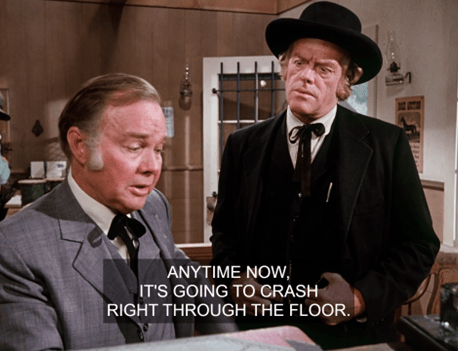
Doc suspiciously asks how Anderson knows this, and he says, “In my business, you learn to see the signs.”
Then he makes a sour face and Doc says if he’s so fucking great at reading signs, he should realize he has heartburn and take some bicarbonate of soda already. (Paraphrase.)

The Teller gives Doc another look as he heads out the door. It’s kind of a weird scene.

Then we see Alice and Caroline arriving at the Old Sanderson Place. It’s not exactly on the way home for Caroline, but it’s a lovely day, and maybe she’s getting her steps in.

We can see That Same Victorian House again up the hill. Do not mistake this for the Harriet Oleson Institute for the Advancement of Blind Children, which is closer to town.


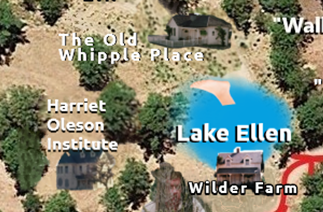
We already knew this house was there, and previously theorized it’s the one where Amos “the Maniac” Pike, the demented man who convinced himself his wife left when she in fact died, lived. (Good story, that one.)


It’s since been painted, of course.
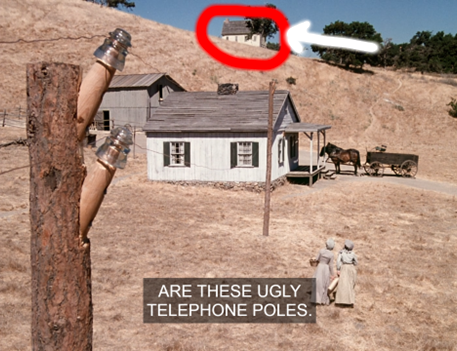
I don’t know who, if anyone, lives there now, but since that was 52 years ago in Little House Universal Time, it probably isn’t old Mr. Pike anymore.

Anyways, Alice is complaining how ugly the new telephone poles are, and I guess if you stop to think about it she’s not wrong.
The ladies notice a phone line has been installed at the OSP, and when they go inside, Jonathan Garvey surprises Alice by saying he decided to buy a phone! (I hate buying phones.)
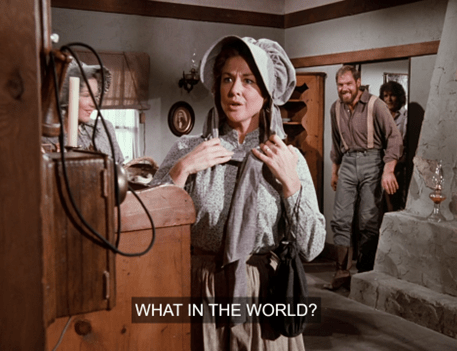
Charles is there too.
Caroline admits her whole “help me pick out a pattern” angle was a ruse to distract Alice.
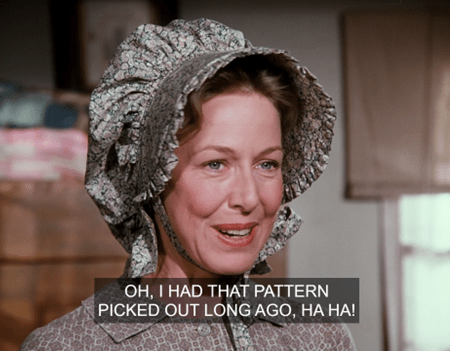
But Jonathan says don’t worry about it, he got so much money from Banker Anderson’s stock tip that they can easily afford it.
And when we remember how his face lit up when he got to try the telephone in “The Godsister,” we can tell this is also a present to himself.

Alice doesn’t call Jonathan a stupid fool like when he sold their horses to buy her a hat, but she does question the expense.


DAGNY: She looks funny with her bonnet untied like that.
ALEXANDER: Yeah, like she has dog ears.

However, with Jonathan’s reassurances, Alice boards the joywagon with the rest of them.
Back at the bank, Bill Anderson is on the phone with someone named Hal in Mankato.
WILL: This new banker has a really prominent role.
DAGNY: Yeah. Who does he think he is, Albert?


Mr. Anderson is asking Hal to put a bet on a horse for him. (The horse’s name is “Domino.”)
And at the switchboard, Mrs. Oleson is listening with her pinky extended and a rapacious look on her face.

Even Nellie is surprised.
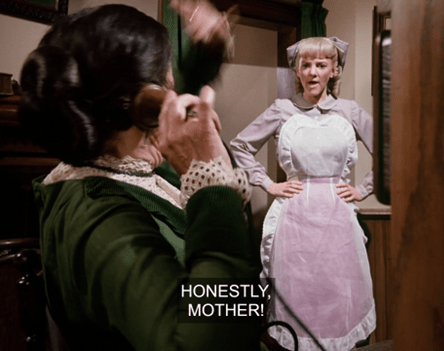
But Mrs. O just waves away her objections.

ALEXANDER: There really should be a security firewall between Harriet and people’s private information.

Anderson says his wife disapproves of him gambling, but now he can do it over the phone and she’ll never know! Maybe he’s more interesting than I thought.
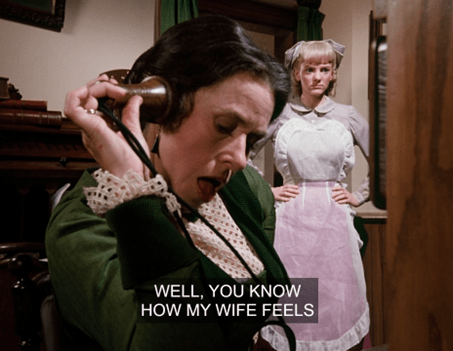
A call comes through from a Minneapolis operator. (She sounds suspiciously like Mrs. Foster.)

(While not exactly a paragon of discretion herself, Mrs. F would be far better suited to this job than Mrs. O, don’t you think?)

At the Old Sanderson Place, Alice answers the phone. It’s her mom!

Considering it’s Alice’s first time ever talking on a telephone, she lapses into ordinary conversational babble remarkably fast.

She runs down Andy’s grades, which are middlin’ (just like mine were).

Jonathan tells Charles he can come use the phone whenever he wants.
Chuck says, “Who am I gonna call?” and they all giggle. Ha!
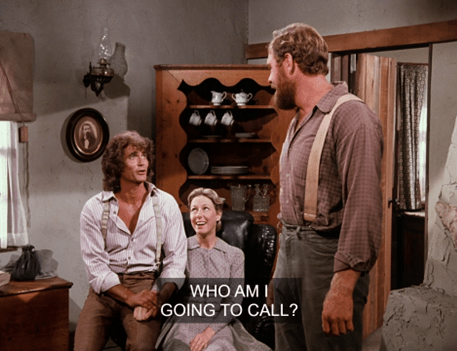

I wondered if phone communications were already known as “calls” at this point, but apparently they were. It was Alexander Graham Bell’s own preferred term, which he began using in 1876.

When Alice is talking, we can hear her mom’s voice (we never learn her name), but then she asks to say hi to Jonathan and suddenly we can’t, which seems odd to me.


Things take a bizarre turn when Jonathan hands the phone back to Alice.
Alice’s mom, whose voice we can now hear again, and who has a weirdly blank voice, sort of like an AI simulation, suddenly brings up a subject that stops Alice in her tracks.

“Harold stopped by,” she says.
After hesitating a moment, Alice says, “Yes, Mother, I will! I’ll call you back a little later.”
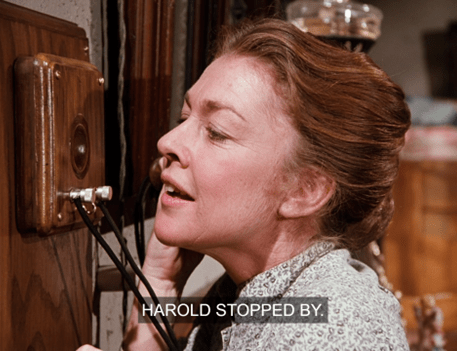

Her mom asks if she can’t freely talk right now, and Alice confirms she can’t.
WILL: There’s something about this conversation that bothers me. For one, I can’t believe Alice would be so comfortable and casual talking on the phone for the first time in her life.
DAGNY: Yeah. She just launches into smalltalk with her mom, like, “Oh hi, let me tell you about Andy’s report card.”
DAGNY: She seems like a sitcom housewife who’s on the phone all day long.
WILL: Right. Whereas she’s really a hayseed from the 1800s hearing a magic voice come from a horn. She’d be freaking out.
WILL: For the same reason, I don’t think she’d be able to ad lib so her mom knows she can’t talk. Like, “What’s that, Mother? Why, OF COURSE I can call you back!”
DAGNY: You’re right. That’s seasoned phone talker technique. At best, she might hang up and say they got disconnected.
Oh, well, who cares, right? Alice does hang up then, and Jonathan says “That was quick!”
WILL: How long did he think they would talk? He would have no frame of reference for what to expect.
DAGNY: Okay, now you’re overthinking it.

Alice lies that her mom had a baking emergency. Plausible enough, on this show.

Only Jonathan, who’s rough-edged but no fool, can tell something’s wrong.
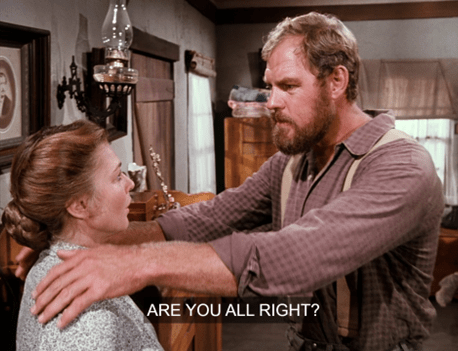
He’s so overwhelmingly happy about the phone, though, that he quickly drops the subject.

Jonathan says he and Charles will be making a delivery “down to Northfield.” (Northfield, Minnesota, which also figured in “The Aftermath,” is 130 miles northeast of Walnut Grove.)
Jonathan, Charles and Caroline then march out suddenly, leaving Alice alone with the “Terror of the Autons” chair.
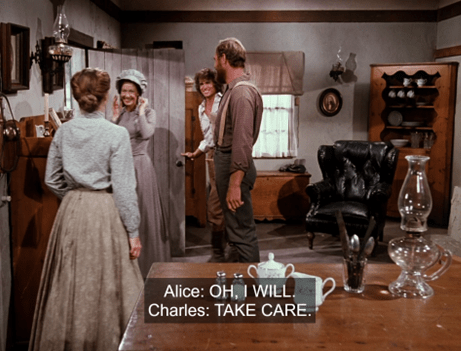


The minute the door closes, Alice runs to call her mom back – this time with Harriet Oleson listening in.

The first thing Alice does is ask her mom if Harold is coming after her.

Her mom says no, he wasn’t like that at all. However, she goes on to say “eighteen years in prison does take its toll” on a man’s appearance.
Mrs. Oleson’s eyes pop out of her head at this, and also when she learns the ex-con in question, Harold, is Alice’s ex-husband!

Alice’s mom mentions they were only married for three weeks, but Alice says that doesn’t matter now.
It doesn’t matter to Mrs. Oleson either. Hideously, she drops the phone and runs off to tell Nellie. She’s pretty repulsive in this one.

(Note: Rutherford B. Hayes and John Wilkes Booth appeared in that scene as well.)


We cut to the schoolhouse vomiting out kids, a thing we haven’t seen in a while.
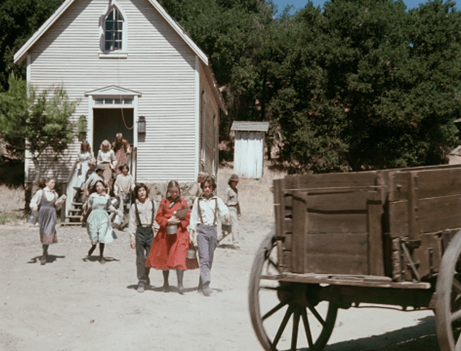
Amongst them today are Laura, Albert, Andrew Garvey, the Ambiguously Ethnic Kid, the Midsommar Kid, Not-Linda Hunt, the Non-Binary Kid, the Gelfling Boy, Not-Art Garfunkel, and Seth Johnson.
Andy is telling Laura and Alb about the phone, but he is immediately cut off by Nellie, who makes an appalling little speech from the restaurant porch.
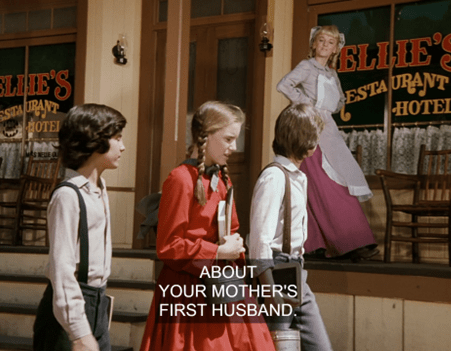
Nellie reveals in just a few words that Alice was married before to a man who just got out of prison.
Andy and Nellie start bickering.
WILL: Nellie, you’re a businesswoman. Picking on schoolkids is beneath you now.
DAGNY: I agree.


Andy finishes up by saying he’s going to tell his pa, and Nellie says, “Good idea! I bet he’ll be surprised!”

It’s nice to see Nellie’s got a little poison left in her still, but her malice on this specific topic is a bit funny, since of course she has an ex-husband of her own.
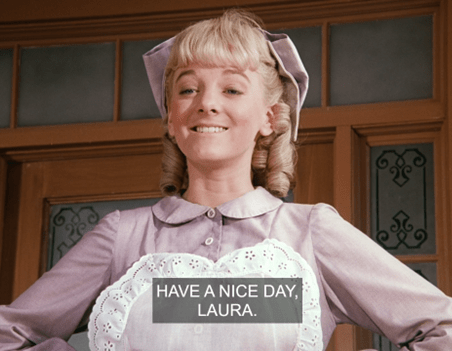
Andy runs off, and Nellie says, “Have a nice day, Laura.” (She ignores Albert altogether.)
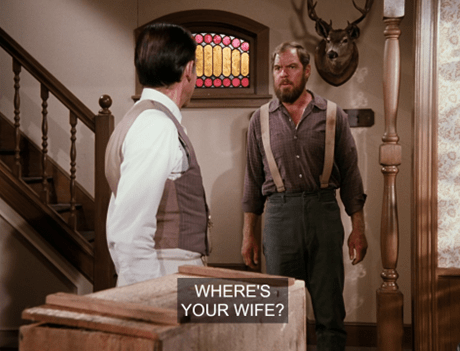
Later, Nels is prying open a crate in the dining room at Nellie’s.
Clearly riled, Big Jon appears and demands to see Big Harriet.
Mrs. Oleson is eating a gigantic bowl of popcorn in this scene – perhaps to lend a subtle yet unsavory erotic undertone to Alice’s history?

Garvey accuses Mrs. O of making up lies about his wife’s past, but she isn’t afraid of the big oaf.
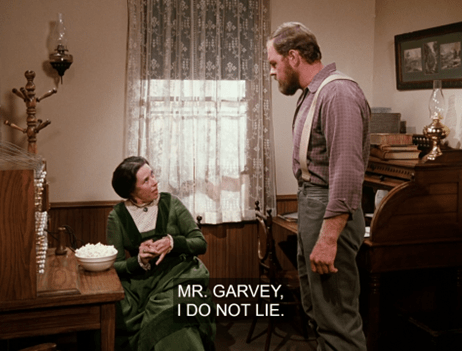
She proudly says she heard the story from Alice’s own lips over the phone.
She shoves a piece of popcorn into her mouth and looks at him. I don’t know how Merlin Oleson kept from bursting out laughing.


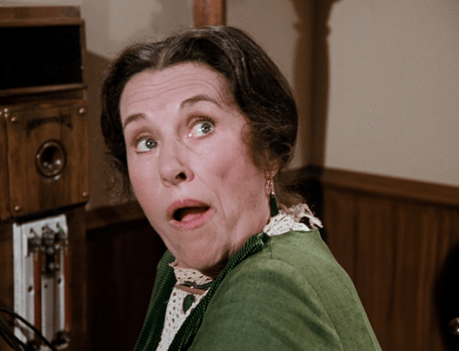
Mrs. Oleson says Garvey should go ask Alice.
WILL [as JONATHAN GARVEY]: “You have never liked me!”
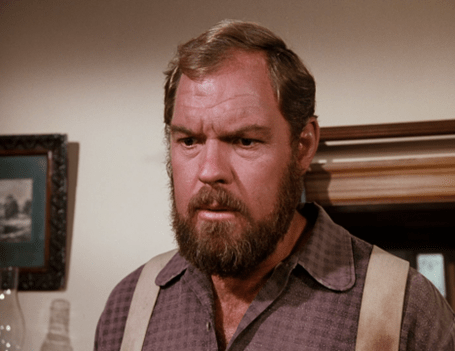
Garvey storms out, then Nels appears and scolds Harriet.

Harriet says she’s actually the decent person in this scenario, unfairly accused of lying.
“Don’t you ever let me catch you listening in on other people’s conversations again,” Nels says.
But Harriet just bullies him, then reprises her earlier theme of Alice Garvey being her moral inferior.
“I was never married before!” she says . . . setting up Nels to reply, “No, of course not! What other idiot would have ever married you?”
DAGNY: That’s pretty brutal for Nels.

Indeed, Harriet cries, though MacGregor plays it for laughs. Their relationship has a dark side, all right. (Olive, who dislikes the Olesons’ dynamics, would not love this part.)

(Anyways, she may have been crying wishing she’d married Dean Harmon, the only other idiot who did want to marry her.)

Then we get the obligatory Incompetent Fruit and Vegetable Peeling scene, as Alice Garvey literally saws carrots into chunks with a dull knife.
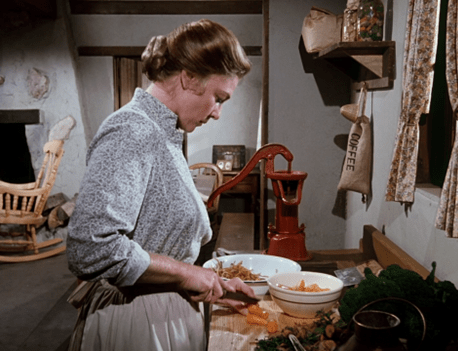
These she dumps over a roast of some sort that appears to have been cooking a while, telling Jonathan and Andy dinner’s going to be a little late.
We see the Garveys’ stove is also a Majestic.

I’m pleased to see there’s a bunch of crap on top of it, including a salt shaker, spice containers, a mixing bowl, and what appears to be a tin-man hat. People’s kitchens on TV always look neat as a pin. I hate that.

Ominously, Jonathan tells Andy to go to his room.
WILL: This one is moving fast. This is just the same day, right?

Of course, Alice assumes Andy “got in trouble at school again.” Totally in character for her to assume that.

Ignoring her comment, Jonathan says, “Do you know somebody named Harold?”
DAGNY: The jig is up, Alice.

When Alice doesn’t look at him, he says, “I’m waitin’ for an answer, woman.”
DAGNY [rolling her eyes]: “Woman.” . . .

Now, I’m sure most of you remember “The High Cost of Being Right” (also by Balluck), the Season Four story in which disagreement over what to do when the Barn of Garve burned down (for the first time, that is) brought the Garveys to the brink of divorce (for the first time, that is).

In that story, we saw both Jonathan and Alice at their worst, but things never got violent.
Which is a relief – because Olsen’s line reading here has an air of menace about it.

Alice still doesn’t turn to look at him, but she stands up straight and says bravely, “I did.”

Jonathan turns his back to her and says with deep disgust, “Oh, dear God.”

Alice starts to ask how he found out, but Jonathan interrupts her.

Alice says she didn’t lie about it, she just didn’t tell him so he would still marry her.
Big Jon spins around and roars, “Oh, it wasn’t a lie, it just slipped your mind, is that it?”
WILL [as ANNIE WILKES]: “Slipped your mind? SLIPPED YOUR MIND?!”


Alice starts spewing out information, saying she was “just a little girl” when she and Harold got married, and that she didn’t know “what he really was” until later.
As for why she didn’t tell Jonathan, she simply says, “I was afraid.”
DAGNY: I was petrified.

Jonathan starts getting, well, what I’d call hysterical, crying, “Oh my God!”

He loses control altogether then, crying, “There must be more. . . . What else is there that you haven’t told me? . . . Who else have you been with?”
Alice slaps him hard across the face.

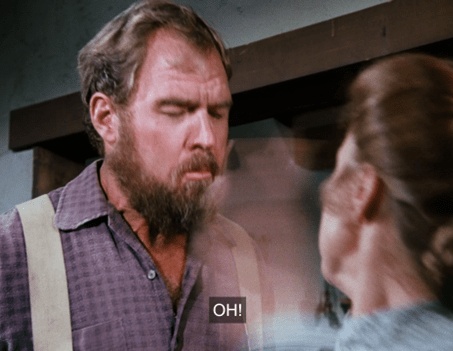
WILL: Pow! Right in the kisser.

And Jonathan storms out.
Phew. That’s a searing scene.
WILL: Do you think he’s justified in being upset?
DAGNY: Yes, but it’s an overreaction. It’s in character for him, though. He’s not stupid, but he’s very black-and-white. It’s how he understands the world.
Fair enough. It’s also how most people understood the issue of divorce in those days, if you believe Julian Lord Fellowes, anyways.
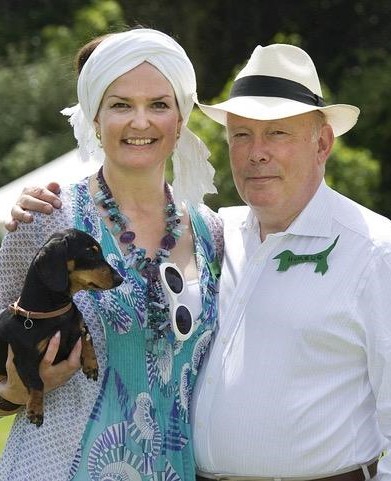
Both this season’s Gilded Age and the new Downton Abbey movie have plots involving the stigma (for women) of divorcing in the old days.


These stories of course are set amongst the wealthy elites, not the common, you know, rabble.
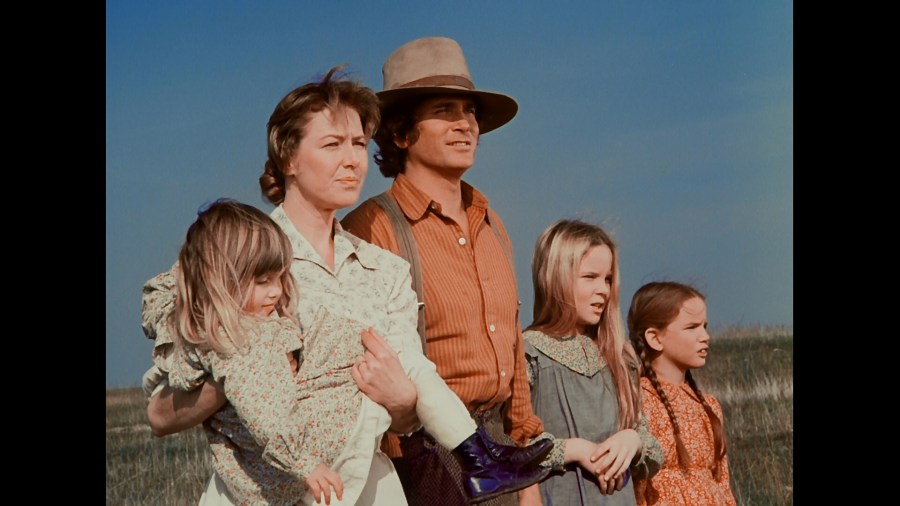
WILL: Also there’s the issue of him realizing she wasn’t a virgin on their wedding night, right? A pretty adult theme for Little House.
DAGNY: Oh yeah. That’s a big part of it. To him, it all adds up to her just not being who he thought she was. Men do that a lot. They don’t want to get to know the real you, they want you to live up to the dream version they have of you.
WILL: I don’t do that.
DAGNY: No, but you’re abnormal in a lot of ways.
WILL: Thank you, I think.
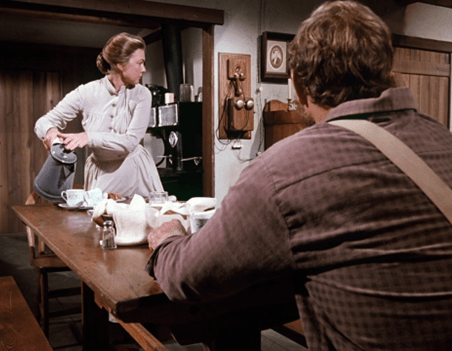
When we return from a break, the poor Garveys are having their breakfast together the next day.
Alice looks like she’s barely keeping it together, and one can’t blame her.

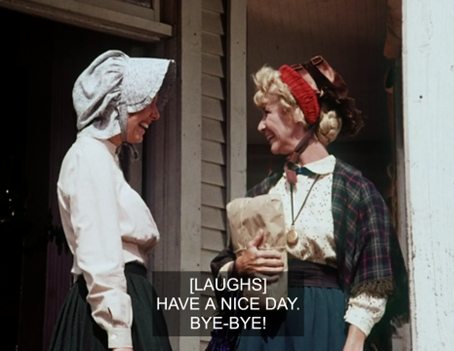
Andrew leaves for school, getting another “Have a nice day” from Jonathan. (Have-a-Nice-Days often have a rule of three on this show.)



Meanwhile, on the wall, the telephone and John Wilkes Booth look on with cruel satisfaction at the unhappy state of things.
Laura and Albert ambush Andy on the way to school, wanting to know the dirt.

To a crazy flourish from the Rose, Andy runs about five yards away, then slumps against a tree.


Laura and Alb approach gently, and Andy, crying, squeaks that Nellie’s story was true.
DAGNY: They’re standing awfully close. Like the Sting song.

(This story isn’t really focused on Andy, but that doesn’t stop Patrick L from being terrific in it.)

Andy runs off then, past a small body of water. Probably the coastline of Lake Ellen.


Clever Albert announces a scheme to get revenge on Mrs. Oleson, making a few deductive leaps in the process.

Meanwhile, in the bank, Bill Anderson is on the phone with Hal, who reports that Domino won the race.
ALEXANDER: So this banker has a gambling addiction? That’s probably not a great thing for the town.

Albert and Laura enter on the pretext of a finance-related question. (We can now see on the poster that Lonnie Haney is wanted for “murder and robbery.”)

Albert says he’s looking for a hot tip on a racehorse, and he heard Mr. A is the man to ask. (I’m not sure how he could know this, since he wasn’t privy to either conversation Anderson had about Domino.)

(Nellie was; but why would she tell them?)

Anderson flips out, and Albert tells him Mrs. Oleson is spreading his secrets around.
The phone rings then, and this time it’s a George, presumably an underwriter, calling about “the Townsend loan.”
Anderson hears a sneeze – only it wasn’t George.


When he’s finished with the call, Anderson says he’s going to go confront Mrs. Oleson, but Albert says he has a better plan.
“We’re gonna be late for school,” Laura says.
DAGNY: Poor Laura. That was her only line in this scene. Stupid Albert.

That night at the OSP, Jonathan reads the paper whilst Alice washes dishes.
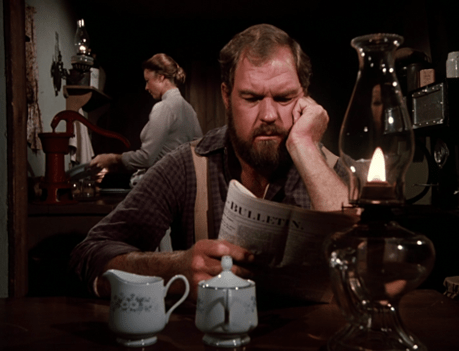
David Rose’s mood is pretty mellow, for the moment anyways.

The paper Jonathan’s reading is one we’ve never seen before: the Bulletin, or maybe the [Something]-Bulletin, since there appears to be a hyphen before Bulletin. (We can’t see what’s on the other side of the fold.)
Today one of the remaining daily newspapers in Minnesota is the Rochester Post-Bulletin. It did exist already in 1885, but it wasn’t called the Post-Bulletin yet. (Its name at that time was the Rochester Record and Union.)


There weren’t actually any Minnesota papers called the Bulletin at the time, so we’ll have to keep watching and see if it turns up again.
Anyways, Alice is trying to make pleasant smalltalk, asking Jonathan about the upcoming delivery to Northfield.

Jonathan is obviously still upset, answering in monosyllables.
Alice mentions that the Barn of Garve needs some repairs.
WILL [as JONATHAN GARVEY, angrily]: “What is that, some kinda remark?”

Jonathan mentions the trip to Northfield and back will take one day. (In reality, the trip would have taken about ten days round-trip by wagon.)
Alice, who can be impatient but also is direct in a way many Grovesters aren’t, puts down her dishrag and says she wants to be done with this shit. (Their quarrel, not the dishes.)

She snatches the paper away from him, and he snarls at her.
WILL: He should flip the table again, like he did in Mankato.
ALEXANDER: Yeah. Berserker rage.


DAGNY: Yeah. And the lamp sets the barn on fire again.
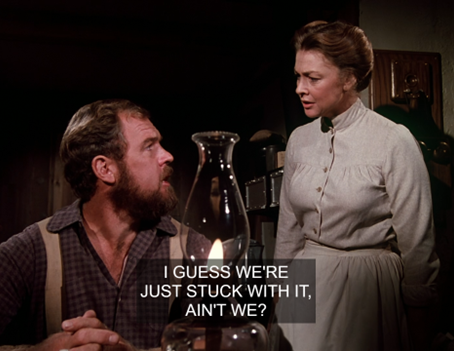


Poor Andy appears in the doorway of his bedroom and begs them to stop arguing.
Once he’s gone back, Alice says, “I think we need to be away from each other for a while.”
This would be the second time this has happened; last time Jonathan stayed in the Edwards/Galender/mountain fever/Enchanted Cottage shack. Will he again?


Meanwhile, back at the bank, Bill Anderson is making a call to another Mankato guy, “Walter,” and says he’s gotten a great tip about Smith Pharmaceuticals stock and wants him to buy five thousand dollar’s worth. ($167,000 today!)

(There is a Smith Drug Company based in the Carolinas, but it wasn’t started until 1925.)
Walter is quite alarmed at this decision, but Anderson assures him he knows what he’s talking about.

Then he turns to Albert and Laura with glee and says, “Done!”
As the orchestra plays a weird jaunty arrangement of Albert’s theme, Mr. Anderson looks out the window and sees Mrs. Oleson racing from Nellie’s to the Mercantile.
Then he places another call.
With Mrs. O indisposed, this time Nellie is the disinterested operator.
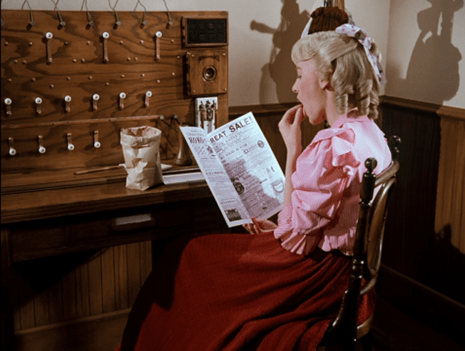
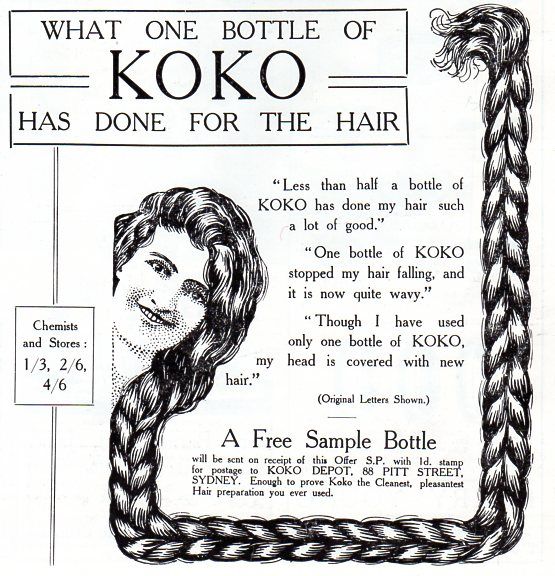
We catch her wearing Puffy Pinky and reading a British sales flyer. The two brand names I can make out are real ones: John Noble of Manchester, a women’s clothier (not founded till 1893, though) and “Koko For The Hair,” a hair tonic first produced in 1887 or 1888 by a company called the Koko Maricopas Co., Ltd.



Anderson calls Walter back, while Albert simultaneously appears in the switchboard office with a lunchbucket.

Albert says he has a present for Willie that he’s expecting, and hands Nellie a live mouse.

Nellie shrieks and flees straight into a wall. Ha!


She eventually exits successfully, and Albert turns to the mouse, makes the “okay” hand sign and says, “Good job, Herman.” (The hand gesture’s history is complicated, but it probably was used in this way by the 1880s.)


Back at the bank, Mr. Anderson tells Walter his last order is canceled, repeat, canceled.
ALEXANDER: This trick seems like a big risk to take. What if the phone didn’t work the second time?

Anyways, Walter, presumably a person of sense, is relieved.

Anderson turns to the kids and says, “I should feel guilty about this . . . but I don’t!”
WILL: Oh my God, who is this banker? He’s playing a prank on the richest woman in town? And making her lose a fortune?
DAGNY: Yeah. He’s not gonna last long.
ALEXANDER: She was just doing her job, bro.

Meanwhile, in the Olesons’ living quarters, Harriet and Nels are bickering.

Nels says he won’t countersign on any plan to play the stockmarket, so Harriet says she’ll just use the pile of cash she has hidden in a dresser, a place no burglar would ever look! (Paraphrase.)

[UPDATE: As I said,Mrs. O implies she doesn’t keep her money in banks because she doesn’t trust them. Reader Vinícius writes, quite correctly, that this contradicts the events of “The Race,” in which she pays for Sparks the horse with a check.]

[Vinícius goes on to say:]
This has always confused me, because, from what I know, most married women didn’t usually have access to bank accounts without their husband’s permission, and some couldn’t even get a credit card without a man as late as the 1970s, the same decade this episode aired. But apparently there were precedents for some wealthy women who had their separate account, which given that Harriet was wealthy before marrying Nels, it makes only sense she’d have her own money separate from his. And maybe her original account was drained after the crash of Walnut Grove in late Season 4.
[This seems an acceptable theory to me.]
Harriet starts counting out some Monopoly-looking ten-dollar bills with Abraham Lincoln on them. (These came out when Lincoln was the brand-new President, interestingly, and were last issued in 1863.)


Harriet also explains she keeps so much cash on hand because she “doesn’t trust banks.” It’s the first we’ve heard of that. She certainly didn’t object to them when she was cozying up to Ebenezer Sprague!
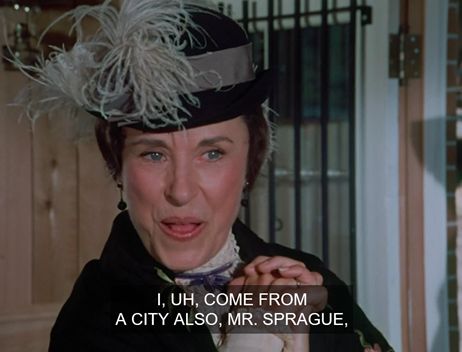
This fight goes a little further than usual in that Harriet says she’s going to leave Nels and he can buy out her half of the store.
Then she says she’s departing for Mankato immediately, adding that you can’t trust wire transfers made by phone because you never know who might be listening.

She hops into a buckboard and drives crazily off to the north, which is an acceptable route to Mankato.

Next we rejoin Jonathan Garvey and Charles on the road to Northfield.
ALEXANDER: Is that a coffin?
WILL: Yeah. They’re still driving Caroline’s dead mother around.
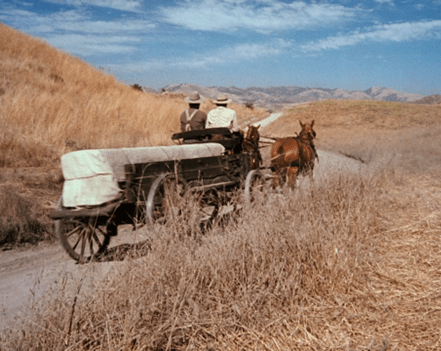

Garvey is pouring his heart out to Chuck.
DAGNY: This is good. He needs to talk to somebody who will tell him, “Get your head out of your ass, dude.”

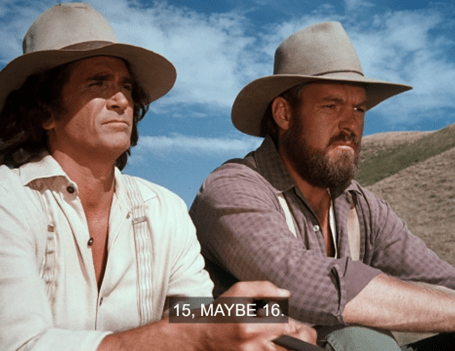
And so he does. Charles starts by asking how long the Garveys have been married, and Garvey says “fifteen, maybe sixteen” years.
Now, in “Harriet’s Happenings,” Garvey mentions that their fifteenth wedding anniversary is approaching. We dated that story to September of 1882-H, which would mean he and Alice married in 1867 or 1868.

Since we’re grounding this story in (the spring of?) 1885-L, that means the Garveys must be married at least seventeen years. (And probably no more than 29 if we judge from the sequence of events since Chuck cast Sterling Murdock out of the Grove.)

Of course, it’s also possible we’ve traveled back in time again, this time to 1882, 1883 or conceivably, 1884 (if they married in 1868 and it’s been sixteen years rather than fifteen). I’m going to keep that in my back pocket for the time being.
Charles’s take on the situation is nuanced. He doesn’t defend Alice for neglecting to mention her past, exactly, but he says it can’t be undone, so why not let it go?

He adds that everyone has had secrets in their lives.
“No,” Garvey says, “I haven’t.”
Charles then implies that if Garvey’s so perfect himself, there’s nothing to do but dump Alice after all.
Garvey is annoyed, but you can see he gets the point.


Then we apparently cut to the Springfield train station. Notably, we visited once before when Joe Kagan was playing head games with his estranged son in “The Fighter.”


But wait – Not-Axl Rose is riding a horse in the foreground, so maybe it’s Mankato?

But it’s neither. This time it’s actually Northfield, a place we’ve never visited before, but that we discussed in “The Aftermath.” It’s really only known for being the scene of a failed robbery that led to the destruction of Jesse and Frank James’s gang. (It’s got some good colleges too.)

Charles is finishing up his business with “Gregory,” a representative of the freight office. (Why would the freight office be in the train station?)

Apparently an old friend, Gregory asks Charles to convey his best wishes to Caroline, and Charles says oh, how nice, and the same to Charlotte.
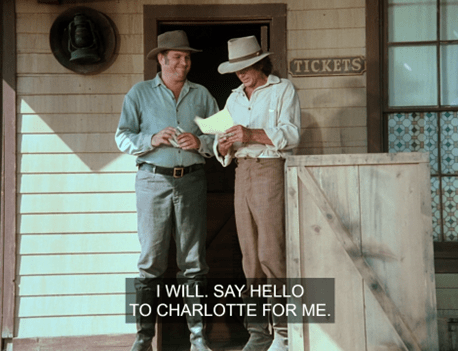
That’s pretty much it for Gregory, but he does get a credit: Sanford “Sandy” Gibbons, who acted on Father Murphy and Alfred Hitchcock Presents (in an episode directed by Robert Altman!) as well as in the nineties Western Tombstone.

But when Charles says they should look for a hotel, Garvey quietly asks if they can press on to Minneapolis, which he says is “awful close,” so he can talk to Alice’s mother about the situation.
Charles agrees at once.
DAGNY: They always have a lot of free time for travel. Who’s gonna run the farm?
ALEXANDER: Carrie.

(Minneapolis is actually over forty miles north of Northfield, about the same distance as Walnut Grove is from Sleepy Eye – that is, a day’s journey. To suggest that a drive from the Grove to the Twin Cities could be done in a single day is ridiculous – which we already know, since Mary had to take the train to get there in “The Pride of Walnut Grove.”)


Curiously, Alice’s mother lives in a huge fine house that’s identical to the one owned by John and Leslie Harper (in Columbia, Dakota Territory).


Also curiously, as I mentioned, Alice’s mother is never named in this story. (She appears in the credits as “Alice’s Mother.”)

Also also curiously, when we first meet her, Landon’s camera weirdly sneaks up behind her, like Vera Miles does with Mrs. Bates in Psycho.


Alice’s mom wobbles her head crazily even when she isn’t speaking, and I thought for a minute she would turn out to be somebody famous like Betty White; but when we see her, she isn’t.

Well, since Alice’s mom is so mysterious, and since it’s tiresome to have to write “Alice’s mom” over and over, we’ll call her “Madam X.”
We do finally get to see her face.

WILL: She actually looks like Alice.
DAGNY: Yeah, she does.

Well, while Marie Denn may not have been as famous as Betty White, she nevertheless was on a lot of great shows, or fun ones anyways, including Highway to Heaven, The Brady Bunch, CHiPs, Cagney & Lacey, St. Elsewhere, Tales From the Darkside (yeah!) and Family Ties.

She also was in the eighties horror film Night of the Demons. Not a favorite of mine, but it did spawn the Ginny Clark/Joshua Bond/Nurse Friendly vehicle Night of the Demons 2. (Also not a favorite of mine.)

Finally, she was in a sitcom called Going Bananas, about an orangutan named Roxana Banana who has super powers. It was only on for about a month, proving that, then as now, the American public has no taste whatsoever.

(The orangutan on the show was not Strawberry, who played the title character in “For the Love of Blanche,” but we’ll explore that matter another time.)

She, Jonathan, and Charles are having a chicken dinner with all the fixins; but Madam X quickly notices Jonathan is acting oddly.

Not wanting to lie, Jonathan says Alice got pretty worked up talking about Harold.
Madam X says she’s relieved Alice finally told him. “I can see that you’ve taken it well,” she adds. (It’s not clear if she really thinks that or is just trying to feel him out. There’s something sly about her, I think.)

Madam X then quickly and efficiently recaps Harold’s backstory.
A pleasant, handsome, wealthy and honorable boarder (Madam X used to let the rooms), Harold was apparently a father figure to Alice who then proposed, which is weird but I suppose was less so in those days.

(If Alice grew up in Minneapolis, as Madam X implies, perhaps it’s Jonathan whose family is “back east,” then?)
Madam X goes on that Harold adored Alice and treated her very well. But things turned sour when they discovered he was a competitive gambler.
ALEXANDER: He got an eighteen-year sentence for gambling?

[UPDATE: Vinícius also points out there’s a real-life precedent that possibly inspired or informed this story:]
Interestingly, there’s a case amid the extended Ingalls family which parallels Alice’s backstory: Charles’s own sister, Laura Ladocia, the Aunt Docia that shows up in the pilot, divorced her first husband August Waldvogel after he was jailed for murder. It seems he was working as paymaster for a logging crew when, one night, some visitors came. Believing it was robbers, August warned them to clear out and shot through the front door before even seeing who was out there, mortally wounding one of the visitors.
[EDITOR’S NOTE: That still happens today, unfortunately. – WK]
August was sentenced to 8 years and Docia was quick to get a divorce (presumably it’s easier when your husband is in jail for murder), despite all the stigma and carrying their second child at the time. August wasn’t an older man like Harold (they were the same age), but her second husband, Hiram Forbes, was 20 years older than Docia, though that marriage seems to have worked well as they were together for 32 years till his death.
Ironically, another Hiram in the family got in trouble with the law too: Charles’s brother Hiram, who served seven months in jail for slaughtering a stolen cow. He ran away for three years after the crime was exposed before being caught in the same town where, of all people, his sister Docia was living by then (found out about all that on pioneergirl.com).
[Thank you, Vinícius! As I’ve said many times, pioneergirl.com is an essential resource for diehard Bonnetheads, as well as casual fans like me. – WK]
Madam X tells Jonathan Harold is now a bartender at a place called the Good Times Saloon, “over in the Warehouse District. Terrible place, I’m told,” she says.
Now, the Warehouse District of Minneapolis is real, but we’ll get to that in a moment.
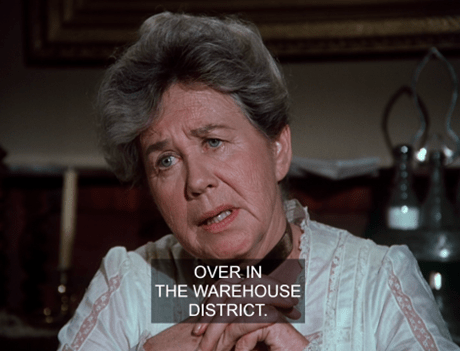
Before that, I’d point out that if you made me guess, I’d say this scene appears to be set on Nicollet Island, a real island in the Mississippi that during this period was home to Minneapolis’s Gilded Age types. It still is, in fact, with painstakingly preserved mansions that make it the ideal neighborhood for a certain type of old-fashioned rich person.
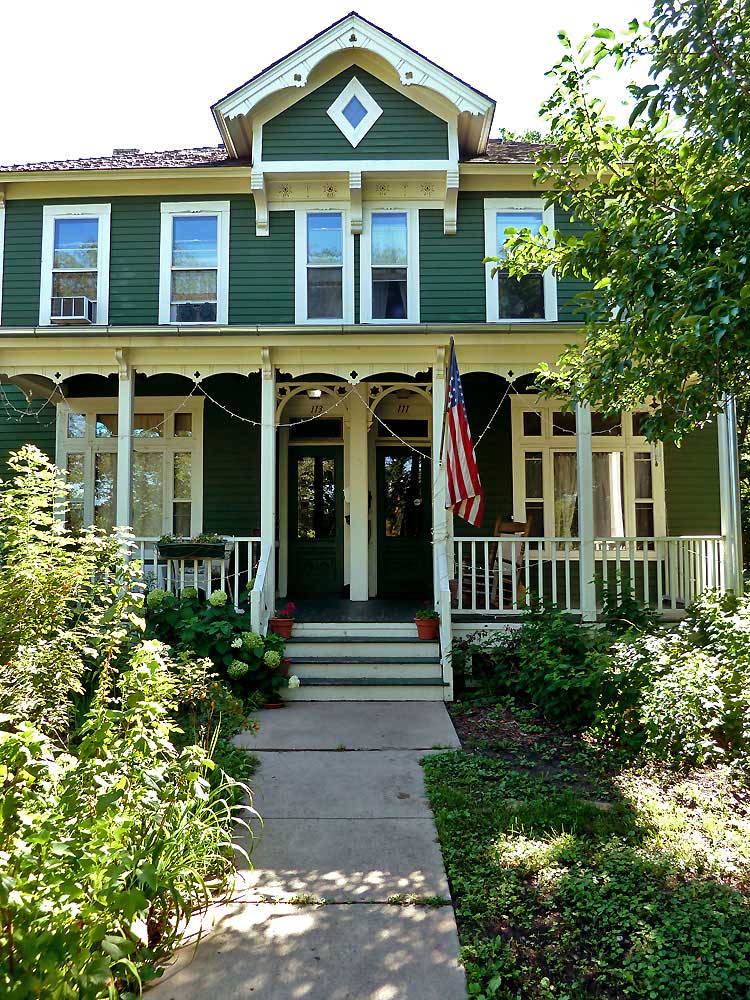


Well, at last Madam X says wow, this conversation is depressing (paraphrase), and turns the subject back to dinner. I like her.

Jonathan Garvey treats her very nicely, I’m glad to say, and after dinner he says he’s going to take a stroll through town.
Charles looks worried when Garvey says he wants to go alone, but he also can’t resist staying up drinking coffee and gossiping with Alice’s mom, which is cute.

Cut to Garvey standing outside the Good Times Saloon, where a homeless person lies in the doorway.
WILL: This is supposed to be the North Loop.
DAGNY: Oh my God.

Not to say that homeless people don’t live everywhere in the Twin Cities right now, sadly, but today the Warehouse District of Minneapolis isn’t a particularly “bad area.” (In my view, anyways. That is disputed by some.)


In fact, it’s become quite tony, full of theaters, wine bars, luxury apartments and the like. The Minnesota Twins stadium (quite deluxe) is there, and the celebrated Guthrie Theater (where Melissa Gilbert played Caroline in a musical) is just down the road.


There’s a farmer’s market nearby where you can buy expensive cave-aged cheeses, doodads created by Minneapolis’s art glitterati, and, probably, fruits and vegetables.
This upscaling was already happening when I moved here in the late 1990s. (I myself once attended a reading there by Russell Banks, who wrote The Sweet Hereafter. Happy times!)

The neighborhood was still known as “the Warehouse District” back then, but about twenty years ago there was a successful campaign to rebrand it as “the North Loop.” I think you’d be unlikely to hear many people referring to it as the Warehouse District these days.

But that is what it was originally called, and the show’s depiction of the area in the 1880s is probably not far from the truth. At the time, the area was known for “drug problems, deaths and thefts” – and, especially, for prostitution. (In 1889, one Minneapolis newspaper reported that “for some time past, the police have had an eye out for the ladies of uneasy virtue who have made life an endless round of reckless dissipation” in the neighborhood.)
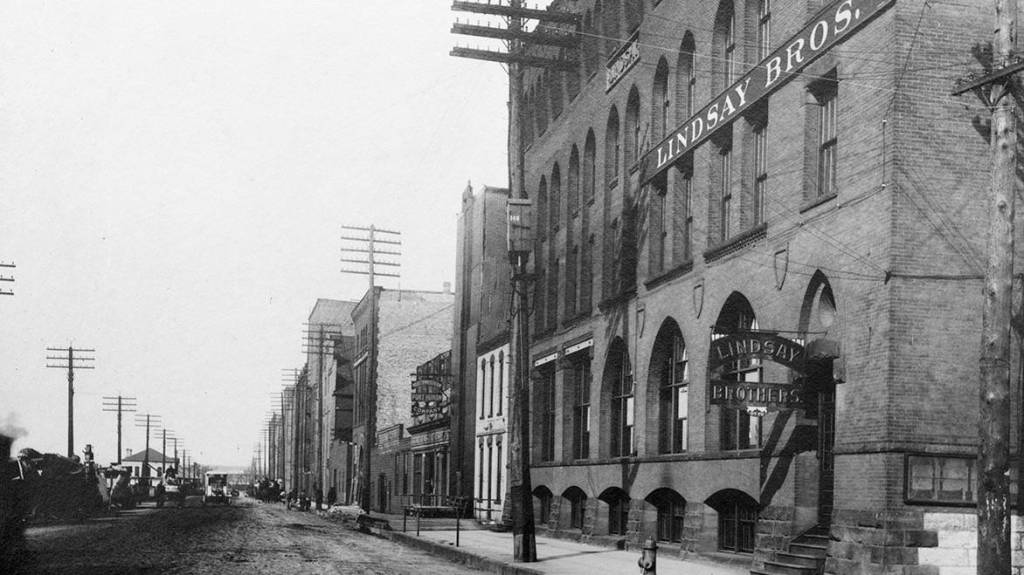

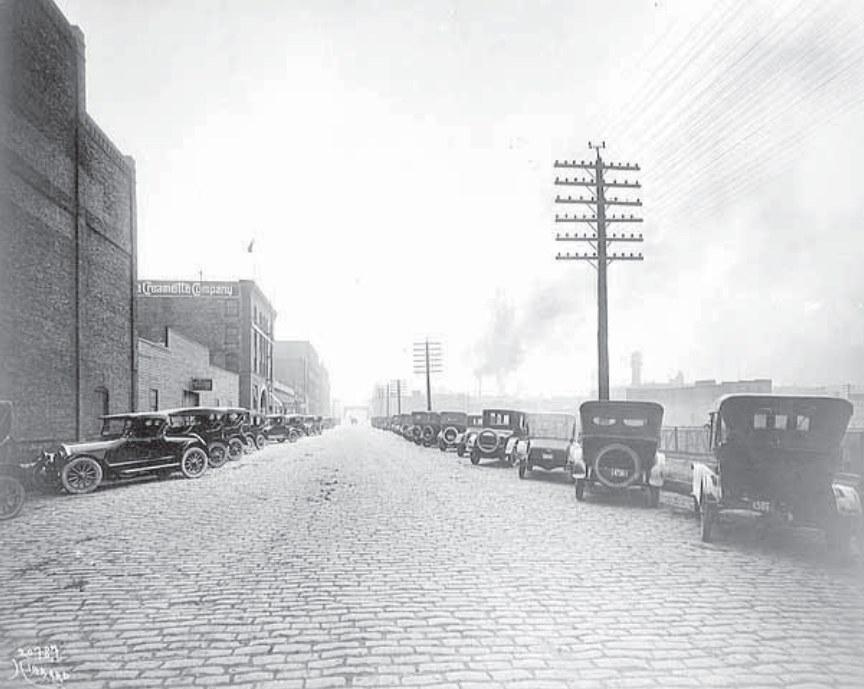
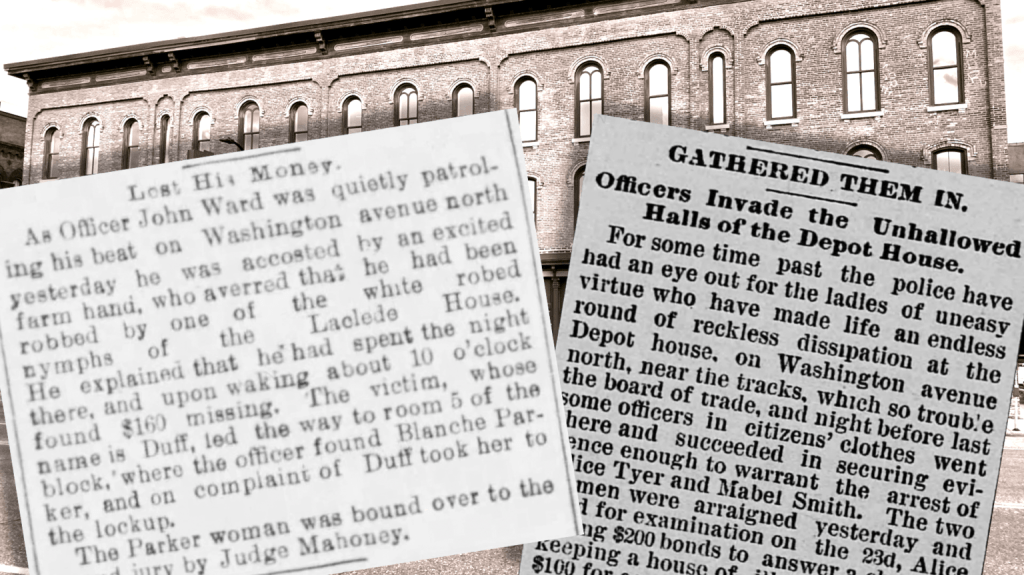
Oh, and it really is within walking distance of Nicollet Island . . . though at the time there was no bridge connecting the island to the rest of Minneapolis. (Perhaps a kindly ferryman took Garvey over, though?)

In an exquisitely composed shot (thanks, Landon), Garvey enters, followed by the camera.
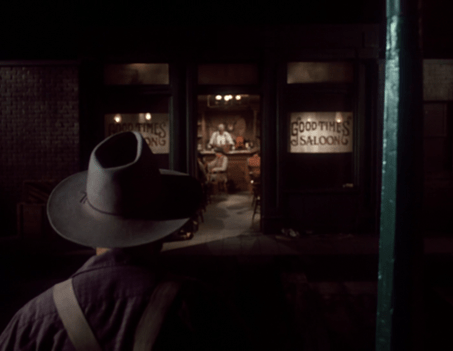
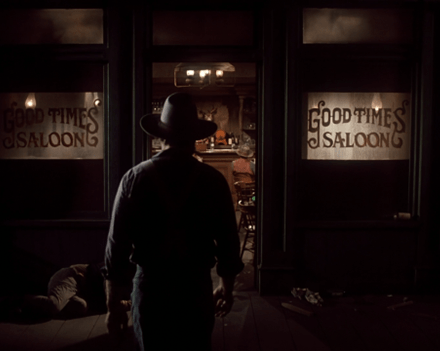

We see no women of “uneasy virtue,” though, or any other kind for that matter.

There don’t appear to be any good times either. Mostly the place is occupied by men drinking alone in silence.
One of them is a weirdly decorated old bird who looks like he might be a defrocked country doctor, or something.

Garvey sits down at a gaming table.
Working at the bar is a frowning, gray-haired man.

Little House fans will instantly recognize him as Sylvia’s creepy father in “Sylvia”; however, his role here is quite different, so let’s assess it on its own.
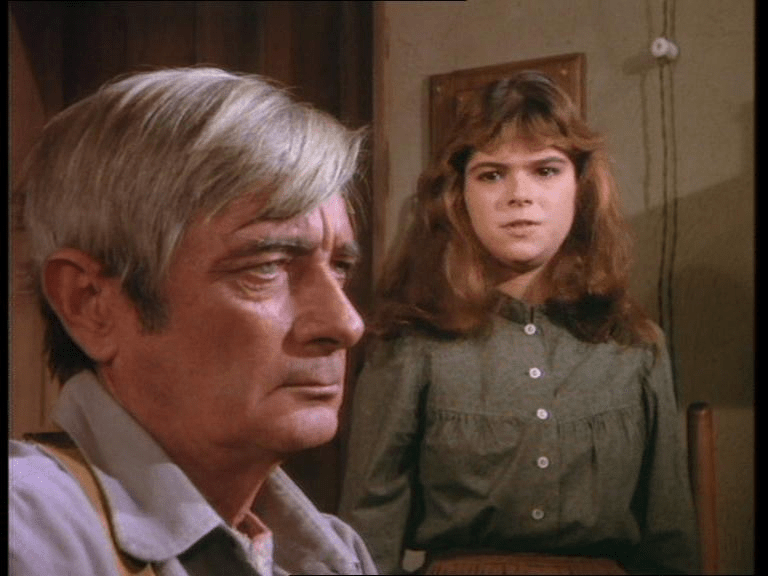
The man comes up to Garvey and asks, without enthusiasm, “What’ll it be?”

Garvey orders a beer. It drives me crazy when characters in shows and movies just order “a beer” rather than a specific brand, real or fictional.

I suppose they don’t want to discourage legitimate sponsors from advertising with them.

Of course in this old-timey context, it’s fine.

Another customer places an order, confirming the barkeep is indeed the famous Harold.
Garvey watches him closely, trying to take the measure of the man.

Eventually everybody except Garvey leaves the saloon, the Weirdly Decorated Old Bird being the last to stagger out.

Harold tells Garvey it’s closing time. (There wasn’t a standard closing time in Minneapolis in those days, so I’m not sure how late it is, but Minnesota has never been as alcohol-friendly as a lot of other states, so I bet it’s not too late. Madam X probably has a curfew, anyways.)

Harold isn’t terribly friendly, but he agrees to let Garvey stay a little longer when he says he’ll buy him a drink. He pours Garvey another beer, and a double shot of whiskey for himself.
“I been achin’ for this all night,” he says, and gripes about how the owner makes them pay for every drink.
“A man’s gotta quench his thirst,” Garvey says, and Harold says sadly, “That he does.”
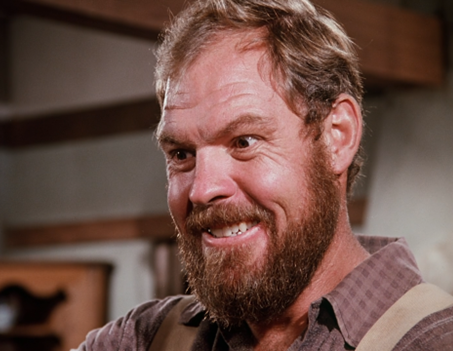
So Harold is played by Royal Dano – a curious name, but of course we’ll also meet Almanzo and Eliza Jane’s brother Royal down the road a bit.

Royal Dano was in tons of things, mostly but not exclusively Westerns.
His TV credits include The Rifleman, Wagon Train, Rawhide, Lost in Space, The Virginian, Bonanza, Daniel Boone, The Big Valley, Death Valley Days, Gunsmoke, Radames Pera’s Kung Fu, Police Story, How the West Was Won, Quincy, Fantasy Island, Twin Peaks, and many, many more. (Forgive me for not linking some of Dano’s titles. We’re leaving on a trip and I wanted to get this recap posted before we went. I’ll fill the links in later (probably).)
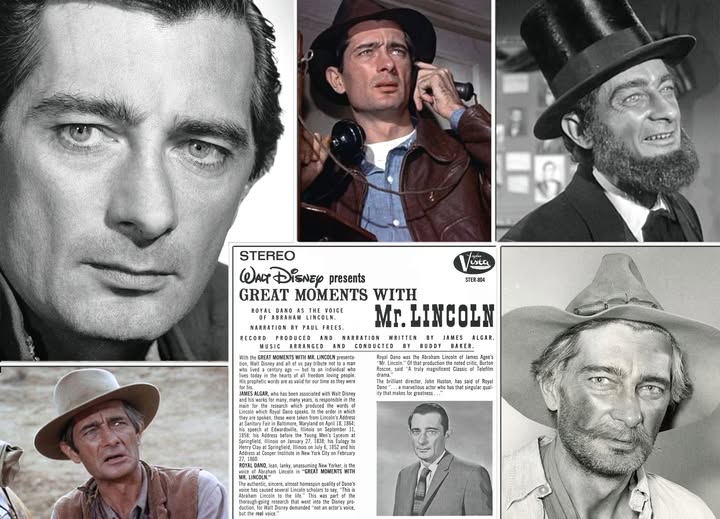
He did Mr. Magoo’s Christmas Carol, which an old girlfriend of mine was obsessed with. (If I never heard the phrase “Ringle, ringle, coins where they jingle” again, it would be all right with me, but it lives in my nightmares.)
Moviewise, Dano did Alfred Hitchcock’s The Trouble With Harry, Moby Dick (the Richard Basehart vehicle), Cimarron, The Great Northfield Minnesota Raid (hey!), Big Bad Mama (with Angie Dickinson), The Outlaw Josey Wales, The Right Stuff, Ghoulies II, and Killer Klowns From Outer Space.
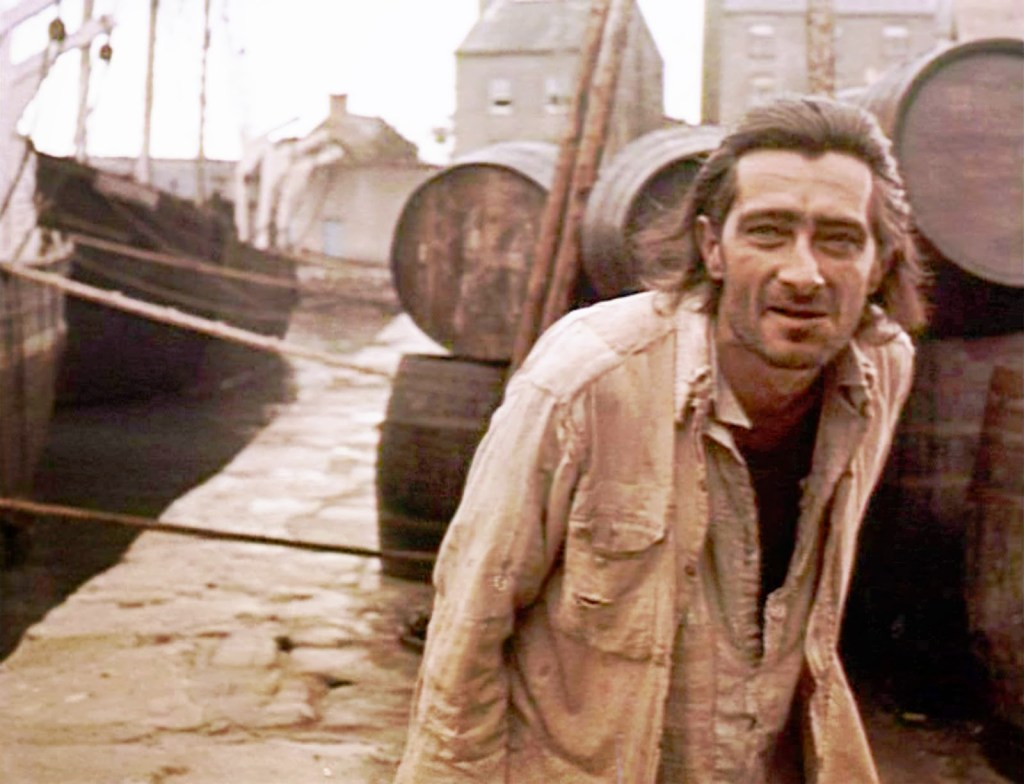

He also was in The 7 Faces of Dr. Lao, a bizarre fantasy film from 1964 starring Tony Randall in yellowface as an ancient Chinese magician, or something. It’s racist, but nevertheless blew me away with its weirdness when I was a child.


Finally, Dano is the reason most Americans still imagine Abraham Lincoln speaking with a deep, slightly gruff, folksy voice.
Lincoln has been portrayed many times in movies and TV shows, but Royal Dano did the voice for the animatronic Lincoln at Disneyland.
Walt Disney himself had seen Dano play Lincoln on TV, and said that’s the guy for our new robot show.
Robot Lincoln still performs at Disney, though not as much as he used to, and they still use Dano’s voice track . . . even though Abraham Lincoln actually talked in a very high, peculiar voice that everybody of his time commented on.

No matter. I think Royal Dano is really good in this story, so let’s get back to him in action.

Garvey introduces himself as “John Gifford.” (I would have said I was Big John Gifford, but Garvey isn’t feel self-aggrandizing.)


“People just call me Harold,” Harold says, softly and sadly. He’s becoming friendlier as the whiskey does its work.

“You’re not from this part of the city,” Harold observes with a chuckle. “Your clothes are too clean!”
WILL: Clean clothes after an all-day wagon ride?

Garvey develops his John Gifford alter ego a bit, saying he’s a traveling salesman specializing in farm equipment.
They start talking about the loneliness of life, and Garvey buys Harold another drink.
Garvey dares to ask Harold if he was ever married, but when he returns the question, Garvey says, “Guess I ain’t never met the right woman.”

Getting more talkative, Harold starts telling Garvey about Alice, and how much he regrets having thrown her away. “There hasn’t been a day since that I haven’t thought of her,” he says.
WILL [as HAROLD]: “My GOD was she hot.”

He says in his younger days, he was a dandy and a gambler – “good at it too,” he adds.
ALEXANDER [as HAROLD]: “I knew when to hold ’em.”

He admits he never revealed to Alice his money came from gambling, instead saying he was a prosperous landlord. (In her reminiscences, Madam X acknowledged the improbability of a wealthy man living in a boarding house.)

Almost immediately after getting married, he says, he lost all the money he had . . . and then the loan sharks came to collect.
He says he should have gone legit, but instead fell in with some bank robbers, and wound up in prison for eighteen years.
Harold says he wishes he’d told Alice about his past from the start, but he was terrified of losing her – a statement that clearly resonates with Jonathan.
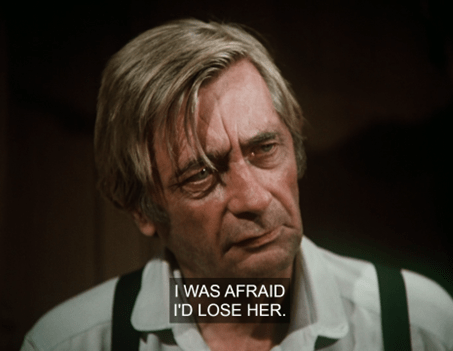
He said he’s since learned that Alice got married.
DAGNY [as HAROLD]: “ . . . to some great big ape. . . .”

“I can’t help but wonder,” he says, “if that man knows how lucky he is.”
ALEXANDER: Is Jonathan going to try to get them back together?

Having heard enough, Garvey abruptly says he’s got to leave, telling Harold to keep the change and pour himself another round. (He does, too – his third double in five minutes.)

Outside, the homeless guy has not moved.
ALEXANDER: Does he kick that guy to death in frustration?

He doesn’t, but he also doesn’t check to see if he’s, you know, still alive or anything.

Back at Chez X, Charles has waited up.
(We see Alice’s mom is another member of the Rutherford B. Hayes Loyalist Society.)

Garvey tells Charles he sought out Harold, and summarizes their conversation.
DAGNY [as JONATHAN GARVEY]: “I’m way hotter than him, in case you’re wondering.”

He tells him Harold said he hoped Alice’s husband knows how lucky he is, and (with the tiniest suggestion of a smirk) Chuck says, “Does he?”

Garvey nods, and Charles smiles, knowing everything will be all right.
Back in Walnut Grove, Nels is reading the newspaper in the parlor. (Gaylord is quitting again.)

Hilariously, Nellie is playing “Top Hand” (!) on the piano, arranged as a mazurka, or something. (Who taught her? Toby Noe?)
ALEXANDER: She’s playing the Little House theme? That’s breaking the Fifth Wall.

Nels, who’s unusually nasty in this story, yells at Nellie to knock it off.
She says if Harriet wasn’t out of town he wouldn’t be so mean to her, and he says if wishes were horses we’d all ride in style. (Paraphrase.)
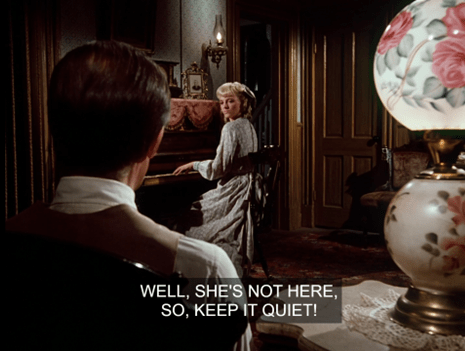
Nellie bangs on the piano like Don Music and runs up to her room. (So she does still live there? You’d think she’d have her own swanky suite at the hotel.)


Enter Harriet, who’s covered in dirt and crying. She lost all her money due to Bill Anderson’s trick. (He better pray to God she never finds out.)
ALEXANDER: She gets caught in a lot of get-rich-quick schemes.

Rather than being upset that they’ve lost a fortune, Nels lectures her on the immorality of eavesdropping.
She wails on and on.
WILL: What happened to her? Did she roll around in sawdust?
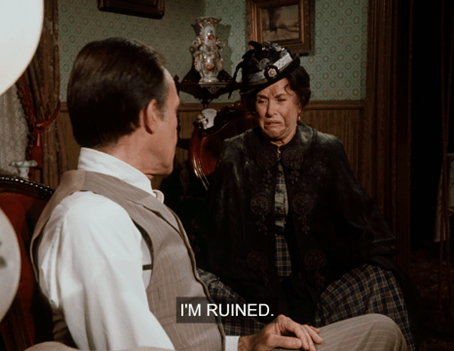
As for the money, Nels says he’s taking over management of their business affairs. (I’m sorry to say I’m not sure that’s an improvement, with all his handouts and freebies.)




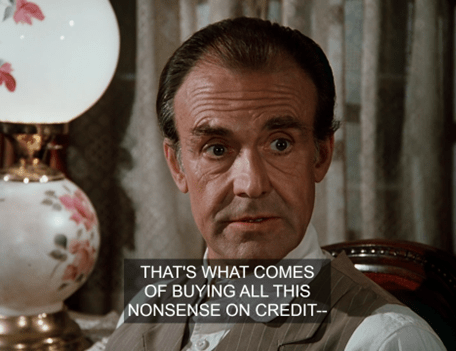
Nels is smug, saying she’ll have to get a job to pay off her credit card debt.
DAGNY: God, those eyebrows.
And next we see Harriet working as a common laborer at the store whilst Nels sits drinking sarsaparilla and preparing to go fishing.

Back at the Old Sanderson place Alice hears the Garveywagon approaching and looks up apprehensively.
DAGNY: He didn’t call her to tell her everything’s fine? He really made her wait for him to get home, in anguish the whole time?
WILL: Maybe he can’t remember their phone number.

Jonathan climbs out of the wagon and removes his hat.
ALEXANDER: He should throw Harold’s head at her feet.

Jonathan immediately apologizes both to Alice and to Andy and begs their forgiveness.

Group hug . . . and then, Garvey goes over and knocks the telephone pole down with his bare hands!
DAGNY: Oh my God! Why the hell did he do that? He forgave her! There was no need to destroy the phone.
ALEXANDER: Yeah. Also, he could have just pulled it off the wall.

STYLE WATCH: Alice Garvey’s mother’s look elicited some comments.
DAGNY: She’s spicy. She’s wearing a choker and you can see through her dress. Maybe that’s why Alice grew up so easy!

Garvey’s pants received some comments too.
ALEXANDER: Why does he have belt loops AND suspenders?

Others have commented on this as well, and in fact, before the 1920s most men’s trousers did not have belt loops.
ALEXANDER: Don’t you have to take your hat off in a bar?
WILL: Unless you’re a cad, yes.

Charles appears to go commando again.
THE VERDICT: While not exactly plot-driven, this is an elegant, more satisfying take on the themes of “The High Cost of Being Right” (not least because it has an ending that isn’t apeshit). (There’s a hint of “Harriet’s Happenings” and “‘Someone Please Love Me‘” too.)
It’s got a reflective, almost philosophical quality to it, with Royal Dano’s sad, gentle Harold the key to its ultimate success. (He’s a bit like the Joe Kagan we meet in “The Fighter” – a noble character in ruins.)
It’s also a showcase for Olsen, Parady, and MacGregor, with some nice bits for Arngrim too. All of them are quite wonderful. (Laura doesn’t get shit to do, though.)
And of course, it’s a nice final exploration of Alice’s character before Landon fries her up.
UP NEXT: The Angry Heart
 Walnut Groovy
So, Mrs. Oleson suddenly doesn’ trust banks, but didn’t she have a bank account of her own in “The Race”, where she withdrew money from to purchase a race horse? This has always confused me, because, from what I know, most married women didn’t usually have access to bank accounts without their husband’s permission, and some couldn’t even get a credit card without a man as late as the 1970’s, the same decade this episode aired. But apparently there were precedents for some wealthy women who had their separate account, which given that Harriet was wealthy before marrying Nels, it makes only sense she’d have her own money separate from his. And maybe her original account was drained after the crash of Walnut Grove in late Season 4.
Nellie’s attitude makes me wonder if this episode was written before they came up with her moments in earlier episodes, or maybe this is indicative that her old habits are still there, even after she started adult life. Myabe she still wants to live the times when things were simpler and she didn’t have to worry about her own business.
Interestingly, there’s a case amid the extended Ingalls family which parallels Alice’s backstory: Charles’s own sister, Laura Ladocia, the Aunt Docia that shows up in the pilot, divorced her first husband August Waldvogel after he was jailed for murder. It seems he was working as paymaster for a logging crew when, one night, some visitors came and, believing it was robbers, he warned them to clear out and shot through the front door before even seeing who was out there, mortally wounding one of the visitors. He was sentenced to 8 years and Docia was quick to get a divorce (presumably it’s be easier when your was in jail for murder), despite all the sitgma and carrying their second child at the time. August wasn’t an older man like Harold (they were the same age), but her second husband, Hiram Forbes, was 20 years older than Docia, though that marriage seems to have worked well as they were together for 32 years ’til his death. Ironically, another Hiram in the family got in trouble with the law too; Charles’s brother Hiram, who served seven months in jail for slaughtering a stolen cow. He ran away for three years after the crime was exposed before being caught in the same town where, of all people, his sister Docia was living by then (found out about all that on pioneergirl.com).
LikeLiked by 2 people
Thank you, Vinícius! I have updated the post (in a couple places).
LikeLiked by 1 person
I’m one of the people who’s always been bugged that there were ever phones on a show that’s supposed to take place in a small town in the 1800s. There’s another autobiographical children’s book series set in Minnesota–in Maud Hart Lovelace’s Betsy-Tacy books, she describes the advent of phones in her town in the fourth book, which would have taken place around 1904. And the town she calls Deep Valley was Mankato in real life. So if phones didn’t come to Mankato until 1904, I don’t buy them in Walnut Grove in 188whatever year they’re saying it is.
I don’t hate this episode though!
LikeLiked by 2 people
I’m sure you’re right
LikeLike
I agree the actress who played Alice’s mother looks just like the actress who played Alice. (there’s going to be another actress on Little House on a one time episode that reminds me of Patrick Labyorteaux. But apparently there’s no relation). Love the background info that the other commenter gave about the Ingalls family. Another great recap.👒
LikeLiked by 2 people
In my attempts at making a timeline for the show, I concluded that S6 is set between 1882 and 1883 (ignoring that the events in one LH Season should cover at least half a decade), because the main families lived in Winoka from late 1880 (going for the Winoka Warriors game) to July next year, then went through at least one winter and S5 ended during Spring or Summer. Also, Laura will turn 16 near the end of the Season, which in real life was in ’83. But a couple following episodes will imply it’s still ’81 during this season, even though that’d be shortly after they left Winoka. I guess 1881 is, to this phase, what 1876 was during the pre-Winoka phase… a year the timeline kept getting back to: first it was 15 after Civil War started at Amy Hearn’s fake funeral in Season 1, then the telephone had only just been invented in the S3 finale, then the Jesse James had only just been wiped out in S4: it seemed the writers had a thing for the year 1876.
Anyway, that’d mean Alice’s brief marriage happened 18 years prior to ’82 in 1864, during the war, so either Harold was spared the draft or, most likely, he was a draft dodger. And going for Jonathan’s comment about his and Alice’s 15th anniversary in “Harriet’s Happenings”, the Garveys got married in 1866, just a couple years after Alice’s failed marriage to Harold. Also, in a fascinating coincidence, that’d mean Alice was born circa 1848 (as she was 16 in ’64), which is the same birthyear as Docia, the Ingalls aunt I mentioned who may have inspired her backstory.
LikeLiked by 1 person
*first it was 15 years after Civil War started at Amy Hearn’s fake funeral in Season 1, then… the Jesse James gang had only just been wiped out in Season 4.
LikeLiked by 1 person
Creating timelines for this show is an exasperating puzzle, but it’s one I adore. I shall keep your theory in mind as we press on!
LikeLike
Upon revisiting it now, I was a bit confused about what perception the writing wanted us to have of Harold and his courtship of a teenage Alice, to whom he was a father-figure first. Clearly he’s meant to be a shady figure, having served time in jail and as a part of a dark chapter that Alice wanted to forget, but when he does appear, his portrayal is fairly sympathetic for what’s essentially a groomer, and it’s even possibly implied that his relationship with her could have worked out if not for the fact that he was a gambler and his desperate part in the bank robbery and all. Maybe the writing expected this backstory to be taken in a more neutral perspective as something that happened in the past century, but new viewers would tend to see a character like Harold in a far more negative light than 4 decades ago. There are times I can’t tell whether a condemnable attitude in an older production not being vilified is a result of the work wanting the audience to take their own conclusions or being from a time people were more tolerating of such an attitude, if only by not immediately condemning it. Then again, this is a period piece and so there’ll be attitudes that they expect would be see as more normal at the time period even if the contemporary audience wouldn’t.
On a lighter note, you mentioned how Sam Edwards did Tigger in a Mr. Edwards-y way — we have a connection of our own between these two characters here in Brazil. Tigger’s most prominent voice in Brazilian dub was done by Isaac Bardavid, who also voiced Mr. Edwards in the first two seasons of the show, along with other characters, including Jonathan Garvey in a handful of episodes (he was best known as the Brazilian voice of Wolverine in the 1991 cartoon and the live-action films; he and Hugh Jackman even met when Jackman visited Brazil in 2017: https://www.facebook.com/revistaportfolio/videos/o-ator-hugh-jackman-fez-uma-homenagem-ao-grande-ator-e-dublador-isaac-bardavid-q/630094178266865/).
I actually think Bardavid resembled what Victor French’s Mr. Edwards would be like in old age, especially when he wore a full beard: https://ogimg.infoglobo.com.br/cultura/filmes/25376496-f60-624/FT1086A/13484710_JB-NI18-03-2014Rio-de-Janeiro-RJ-Isaac-Bardavid-ator-e-dublador.-Foto-Gustavo-Stephan.jpg
LikeLiked by 1 person
Ha! I love the comparison of Bardavid with French – they do indeed have a wonderfully similar vibe.
As for Harold No-Name (to borrow a phrase from Mrs. Oleson), you raise some great questions, ones I don’t think the show was really interested in exploring. If we assume the age difference between Royal Dano and Hersha Parady corresponds with that of Harold and Alice, that means Harold would have been at least thirty-nine when he began courting sixteen-year-old Alice. Today that inevitably puts us in Jeffrey Epstein territory; in the 1970s, it would have invited criticism but not necessarily have been seen as pedophilic; and in the 1860s or ’70s it would have been much more common, though not without raising eyebrows. (Most married couples of the time were actually quite close in age, and May-September unions were not universally popular. Somewhere or other I talked about the 1862 painting “The Unequal Marriage,” a sharp satirical work by Vasili Vladimirovich Pukirev, which offers a cold, depressing view of such a marriage, even including a self-portrait of the artist in the background, frowning at the “happy couple”! https://www.rhiannonpiper.com/articles/behind-the-painting-the-unequal-marriage.) On the show, however, there’s nothing to indicate Harold’s interest in Alice was improper, either by the standards of the time or in the script’s judgments of his personality. As you say, Harold surprises Garvey by being gentle and kind – obviously a decent man in ruin. And Garvey didn’t really object to the age difference in the first place – he’s more concerned with Harold’s criminal background (and Alice’s lie of omission), and oddly it’s Harold’s CHARACTER that defuses Garvey’s resentment and jealousy.
LikeLiked by 1 person
“Gesundheit”? Is this a common reply to a sneezer overseas?
LikeLiked by 1 person
Oh yes – it’s a bit old-fashioned, and “bless you” is much more common these days, but you still hear it from time to time
LikeLiked by 1 person