
The Big Chill, Walnut Grove-Style; or
The Name’s Charles Ingalls, Motherfucker
(a recap by Will Kaiser)
Title: “Whatever Happened to the Class of ’56” [sic]
Airdate: January 14, 1980
Written by John T. Dugan
Directed by Michael Landon
SUMMARY IN A NUTSHELL: Where do I begin? The Midwest regional Grange meeting in Milwaukee has overlapped with Ma and Pa’s twenty-fifth high-school reunion, even though they didn’t have high-school reunions back then and Ma and Pa didn’t go to high school in Milwaukee.
All their old friends are magically rich, but they’re also all depressed degenerates looking for a fix or a hookup.
In a side plot, Charles organizes a farmers’ union.
RECAP: First things first – I take back everything bad I’ve said about Elon Musk. (That covers some ground.)
Why? Well, I’ve learned that as of right now, our recap of the Pilot is included as a citation for an entry about the Little House TV series at Grokipedia! (I wonder if I can sue for royalties?)

I guess Groovy is one of the low-quality sources you hear people complaining about in articles about that site-clopedia.
Nevertheless, I’m honored to have been chosen by Grok itself. And, may I add as long as we’re talking about it: In your FACE, Wikipedia editors who didn’t find my Two Fat Ladies blog an acceptable source in 2014!

[UPDATE: Dagny just read that bit and said I should note that she said, “Readers, if you think he’s joking about this decade-long rage, he isn’t.” – WK]
Second of all, happy holidays! I hope those of you in the U.S. had nice Thanksgivings. We’d intended to visit my family in Wisconsin, but a series of snowstorms made us decide not to. (Despite my efforts to imply otherwise, Minnesota isn’t always a frozen hellhole. Our last couple of winters have been mild, in fact; but this year we’re getting an early start. It’s snowing again now, in fact.)


Since there wasn’t time to defrost a bird, we made do with what we had in the house, fashioning a sort of “turkey” out of a lamb shoulder and a jumbo octopus we had in the freezer. It was delicious!

Anyways, we open to the pleasant image of the tumbling millwheel and the pleasant sound of the iconic 3/4 setting of the theme.

The Unknown and Dark-Bonneted Grovesters cross the bridge into a(n equally iconic) shot of the thoroughfare.


At Groveland Elementary-Middle, the U.S. flag flips in the breeze like a cat’s tail.
It appears to be the 36-star version from the 1860s – wrong for this period, though quite attractive of course.


Inside, Charles Ingalls is addressing a gathering of men. Most of them wear hats, which seems improper since the venue is also a church.

Charles is chairing a meeting of “the Hero Township Grange.”
We discussed the National Grange at length in the recap for “Times of Change,” in which Charles was a delegate to the annual convention in Chicago.


Disgusted by that meeting, which was an orgy of corruption as well as an orgy of sex, and by the horndog conduct of his former future son-in-law John Sanderson, Jr., Charles returned to Walnut Grove disillusioned.


The Grange also figured in the Mary Goes Blind and Winoka story cycles when its war with the rail barons made the Grove a ghost town.


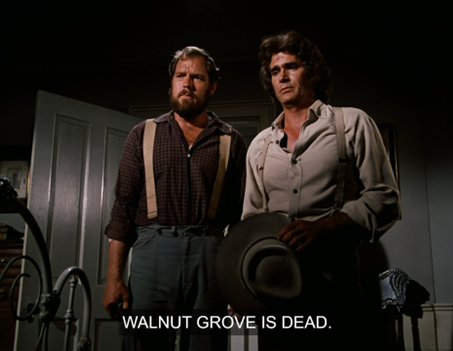
Charles says the National Grange wants to streamline the way farmers buy materials.
A cynical farmer says they just want a cut of the transactions for themselves. (He’s Conrad Bachmann, who was on Highway to Heaven and in Bedknobs and Broomsticks and Tremors.)

But Charles says actually, the proposal would prevent middlemen from taking such cuts. (I don’t know why he’s so trusting, given his history with the Grange.)

Jonathan Garvey is also skeptical, but Charles doubles down and says a pilot program in Kansas is proving the benefits to the farmers.
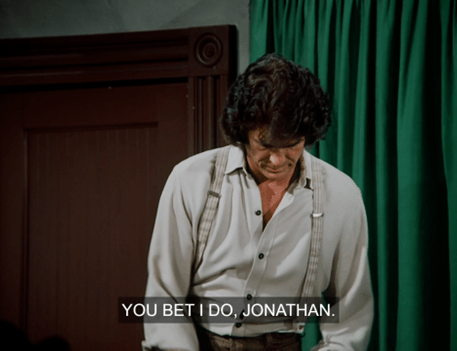
“You got some fer-instances?” Garvey says, and Charles replies, “You bet I do, Jonathan.” (It’s possible Garvey was planted in the audience to ask this. Charles can be a web-spinner that way.)

Charles says the going rate for a “reaper” is $275 (about $9,000 today – a little high for the period according to my research, but not out of the ballpark).
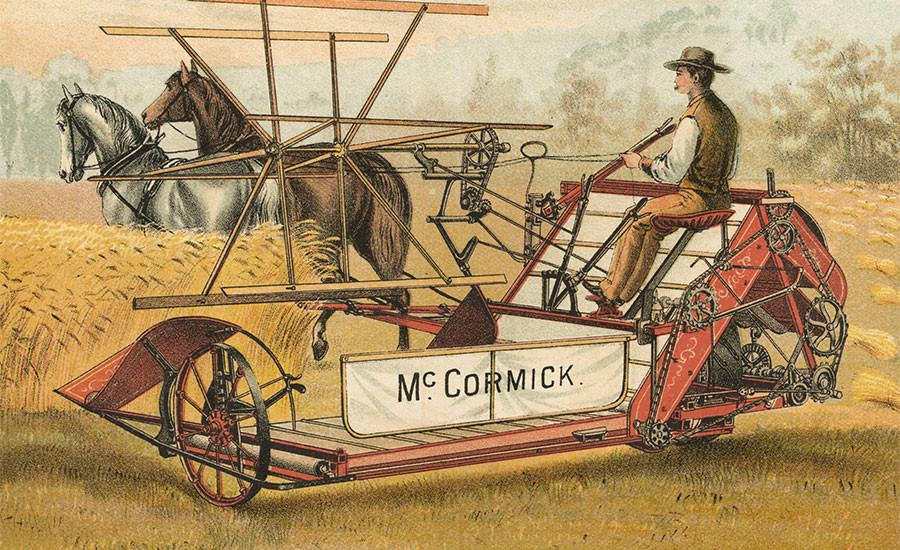
(A modern harvester today, of course, can run hundreds of thousands of dollars.)

But Charles says in Kansas, the new system is shaving off a third of that cost for purchasers.
DAGNY: Nice chest veins, Chuck.

The Grangesters, who include Mr. Penguin Man, Not-Richard Libertini, Mustache Man, and Not-Peter Schickele, are impressed.
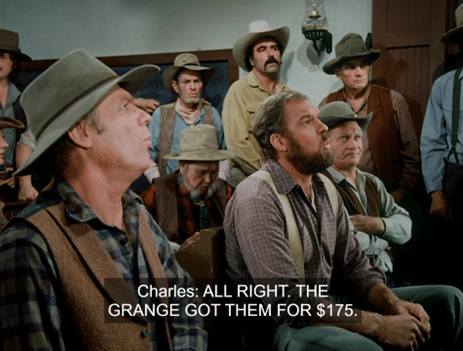
Charles gives a few more examples, and Garvey exclaims, “Hey, I wanna save that kind of money! I think we all do!” (Like I said, an obvious plant.)

Charles calls for a vote.
WILL: Does Mrs. Oleson come in and vote against it?

No; and the resolution easily passes.
“Now, the last thing we have to decide,” Charles says, “is who we’re gonna send to the regional convention in Milwaukee to represent our Grange.”
Guess who they pick.

Milwaukee has never been mentioned before on this show, but Bonnetheads and other wise persons will know it’s about forty miles from Concord, Wisconsin, the town where Charles and Caroline met as children on the banks of the great gray-green greasy Oconomowoc River. (This is covered in “‘I Remember, I Remember’” in Season Four, remember?)


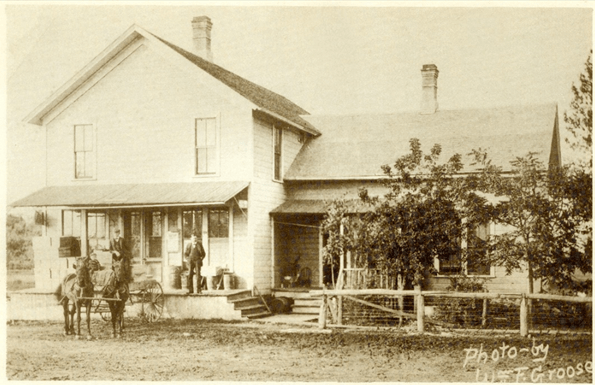
Back at the Little House, Laura and Albert are doing homework. (Actually, Albert is playing with Baby Grace. It’s one of a few moments where we’ve seen how fond he is of her.)

Pa comes in and tells Ma they’re going on an all-expenses-paid vacation to Milwaukee. Ma rewards him with an “Oh, CHARLES!”

Pa says Albert and Laura (in that order) are old enough to run the farm.
DAGNY: Oh, of course, ALBERT and Half-Pint can do it.

As for Grace, Alice Garvey has volunteered to take care of her, and she is as we all know the consummate caregiver for small children.

Changing the subject, Pa hands Ma a letter “from Dillon Hyde.”
“Dillon Hyde!” Ma cries. “I haven’t seen him since the day he went to college.”
AMELIA: Caroline is beautiful.
WILL [smiling]: You always say that.
AMELIA: Well, she always is.

Ma explains her old classmate Dillon is now “Grand Master of the National Grange.” (The Grange originally used esoteric titles and rituals in imitation of the Freemasons. Still has a few, in fact.)

Dillon Hyde “was the richest boy in Concord,” Ma adds. “Handsome too.”
Pa looks up dubiously.

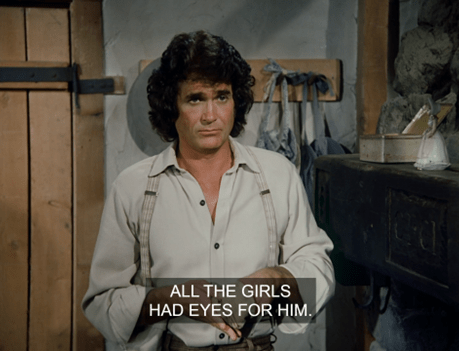
Laura asks if Ma also crushed on this Dillon, but she says she “only had eyes” for Pa. (A Seventeenth- or Eighteenth-Century expression.)
Ma says the note is an invitation “to the twenty-fifth reunion party of the class of 1856 – in Milwaukee, the last night of the Grange convention!”
(The title of this story was apparently inspired by What Really Happened to the Class of ’65?, a bestselling nonfiction book that featured alumni at a reunion reflecting on societal change since they graduated.)

However, there are a number of questions raised by this invitation.
First and foremost, if they went to school in Concord, why the hell is the reunion in Milwaukee, a city a full day’s drive away? (It’s about as far as Sleepy Eye is from Walnut Grove.)
Second, if you’re like me, you wondered if high-school reunions were a thing in the 1880s. The answer is no, they weren’t, though college reunions were emerging across the United States around that time. High-school reunions didn’t come around till decades later.
Third, would Charles and Caroline even have graduated together? In real life, Charles was three years older, and remember, in “‘I Remember, I Remember,’” Caroline appeared to be about three years older than him.

I suppose it’s possible; but since in 1856 the real-life Charles was already twenty, it seems funny he’d still be in school.
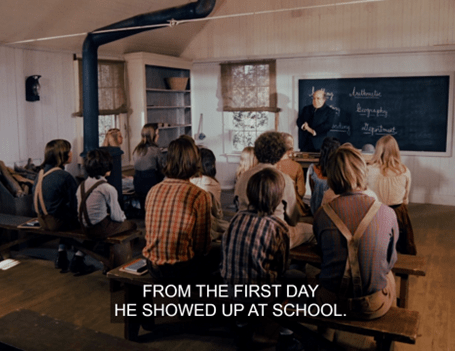
Fourth, were there even enough kids in this “graduating class” to justify a formal reunion? There weren’t more than fifteen students in the Concord classroom, and half of those were Charles’s and Caroline’s own siblings.
Finally, and this admittedly is less a question than an observation, but if this is in fact the twenty-fifth reunion of the Class of 1856, that puts us in 1881, which means we’ve traveled in time again and begun a new timeline again (“M”).
More on these items later, perhaps.
Anyways, we cut to the Mercantile, where Harriet Oleson is finishing a transaction with Mrs. Foster.

Mrs. O is in a good mood. She even says “You have a real nice day!” as if she’s Dolly Parton.

Caroline approaches the counter, and things get weird as Harriet takes her shopping list and starts complimenting her wonderful handwriting.
DAGNY: Oh my God, Harriet. . . .

Harriet says Mrs. Foster told her Dillon Hyde also has a “fine hand.” Mrs. F, she says, mentioned that Hyde “wrote to somebody here in Walnut Grove.”
WILL: Mrs. Foster’s professional ethics are as bad as Doc Baker’s.

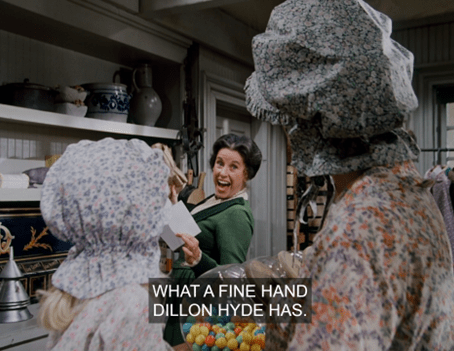
Caroline dryly reports she was the letter’s recipient, and Harriet expresses comical shock.

WILL: This seems bizarre – is the Grand Master of the National Grange a celebrity or something?
DAGNY: They’re rich, so she’s probably familiar with the family.

Caroline says she and Charles are Mr. Hyde’s old classmates, and are going to their twenty-fifth reunion.
Mrs. Oleson encourages Caroline to buy a new dress for the occasion, saying “We can work something out!” when she frets about the cost.
“After all,” Harriet chuckles, “your credit’s good here.”
DAGNY: She’s like the clerk in Pretty Woman.


Really in an exceptionally good mood today (did Nels succumb to her advances last night?), Harriet says not only will she let Caroline buy on credit, she can have it half-price!

AMELIA: How much would those dresses be?
WILL: I don’t know – maybe five dollars?
AMELIA: How much is that?
WILL: Like, one fifty range?
AMELIA: Probably not that much. Those are clearly homemade.
WILL: No, I think she ordered them. Mrs. Whipple is dead, remember.
Then Harriet adds that “I can guarantee you, I will be dressed to the nines” – origin obscure, but probably around by 1881 – “when I have my twenty-fifth reunion!”
Caroline bursts out laughing at the idea it hasn’t yet been 25 years since Mrs. O was in school. The laughing is fine; her mistake is explaining what she’s laughing about.

Well, she asked for it.
At that moment, Baby Grace breaks a crystal pitcher. Looks expensive, but Ma just laughs. (You wouldn’t think she’d take this so lightly. They can’t afford anything but tin cups for their own home!)

Mrs. Oleson pettily says with that added expense, the Ingallses’ credit is no longer good enough to finance the dress.
Caroline, who didn’t want the fucking dress in the first place, keeps laughing, and Mrs. O says, “I suppose you think it’s funny! You know, you have no more credit!”
“Of course it does!” Caroline says – an answer which doesn’t make any sense. (We will need to watch her for signs of laudanum relapse. She really has been terribly giggly in this scene.)


In a strange insult, Harriet screams “You’re senile!” as Ma staggers out of the shop.

Next we see the ol’ Number Three train steamin’ up.

A conductor who looks like Carl Gottlieb, who wrote the Jaws screenplay, shouts “All aboard!”


(He’s J. Edward McKinley, a veteran of Perry Mason, Bonanza, The Munsters, Batman, Gunsmoke, H2H, and Airport 1975.)

Anyways, Jonathan Garvey has taken Charles and Caroline to the train station in Springfield, but he doesn’t say or do anything of consequence. A number of readers have complained about the lack of significant action for the Garveys this season, and as usual when a number of our readers come to a consensus, they’re right.

Speaking of lack of substance, Ma and Pa then have a romantic but content-free conversation on the train, the only significant part of which is Ma saying she considers Pa more handsome now than he was as a teenager.
WILL: It’s true. I’ve seen I Was a Teenage Werewolf.


Oh, and Charles also describes Dillon Hyde as “a pain in the butt.”
We then see what must be the site of the Grange convention, since it has a (semi-nude) statue of the Three Graces, the symbolic icons of the organization, in a fountain near the street.
AMELIA: Whoa, that statue.
DAGNY: Yeah. Big city, big titty.


AMELIA: How many nipples do we see on this show?
WILL: Counting Charles’s?
AMELIA: No, just women’s.
WILL: Well, there was that top the Bead used to wear. . . .

(If you want to find out what Charlotte Stewart said when asked about that, you can check out our interview with her here. It was the first question we asked.)

Anyways, this must be Milwaukee, although the statue of the Graces is identical to the one in front of the Grange headquarters in Chicago.


Standard issue for all regional offices, no doubt; only everything else in the shot is identical to that Chicago street too.


Milwaukee also appears to be vivid in color, whilst Chicago looks dim and dingy. But you know, all the soot from the Great Fire.


Complicating the matter is that on the corner of the city block, there’s a sign which says Fleischmann’s Bakery – which was indeed a famous real bakery in the 1880s, but in New York City. (Of Fleischmann’s Yeast fame.)


I see there’s an art museum I didn’t notice when we did the Chicago story.

Also, there’s a wall painted the same color as the sky, which creates a sort of optical illusion if you look at it right.
DAGNY: Yeah, I see that. They should have painted it with a Laverne & Shirley mural instead.
WILL: Yeah. That would stop errant balloonists from flying into it also.

[UPDATE: Reader Beth amazed me by writing that there’s also a Laverne & Shirley episode with this exact same title! No doubt also inspired by the Class of ’65 book I mentioned above. The L&S episode didn’t air till 1983, though, so once again, Little House was a trendsetter. Thanks, Beth! – WK]
A snooty-looking hotel clerk is checking in Grangesters at the front desk.

He calls for a bellhop, saying, “Show Mr. Hawkins to Room 312.”
The bellhop leads Mr. Hawkins, who resembles a Happy Days–era Ron Howard, through the busy lobby and to . . . (wait for it:)
. . . an elevator!


I don’t know why this surprised me, but it did. (The elevator, I mean – not that 1880s Milwaukee should have a Ron Howard lookalike. He’s surely some ancestor of Richie Cunningham’s.)


The elevator did exist by 1881, and there’s no reason to think a cosmopolitan city like Milwaukee wouldn’t have one.

In a nifty shot, the elevator rises to reveal Ma and Pa gawping at it.



At the front desk, they talk to the clerk.
WILL: They should be careful. In “Strawberry Shortcake in Big Apple City,” the desk clerk turns out to be the Purple Pieman in disguise. And he sort of talks like this guy.
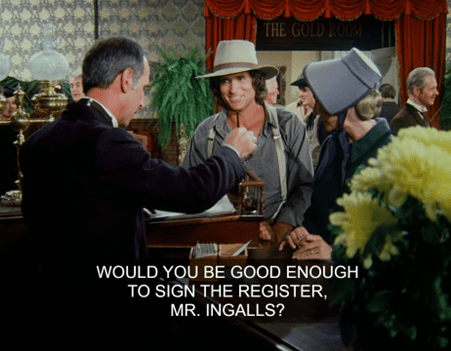


Among the Grangesters in the lobby is the Alamo Tourist from Pee-Wee’s Big Adventure. I don’t know why he’s there, since Charles is representing the Hero Township grange.

Then again, we’ve seen the Alamo Tourist in a number of other places, including Mankato, Sleepy Eye, Rochester, and both Winoka and Columbia, Dakota Territory.




He has Springfield connections too. He was amongst the team who installed the phone lines between there and Sleepy Eye.

And he was implied to be a fan of the Springfield Green Stockings. That in itself doesn’t prove anything, of course, but I think he may move around a bit.

And, of course, he was at the national convention in Chicago in 1877-E. So that checks out, I guess.


The next bit is rather disturbing. As Charles is checking them in, a man’s voice screams “CAROLINE QUINER!”
The next thing we see is a large, wavy-haired man with a wide-open mouth rushing toward the camera. He looks like Tucker Carlson crossed with the Great Goblin from The Hobbit.


The man brays “CAROLINE!” again. Ma looks amused, Pa looks confused, and the Purple Pieman looks, as I was . . . disturbed.


Ma then recognizes him as “Arnie Cupps,” a name I find vaguely coarse for some reason.

This Cupps man, who’s also a Grange delegate and who speaks in such an exaggerated American accent that I thought the actor must be British, hugs Caroline and they laugh together. (Would etiquette of the time allow a man to touch a woman other than his wife like that in public?)

“I’D KNOW YOU ANYWHERE, CAROLINE!” the man brays. (Bruh, if you know her so well, you know she pronounces her name Caro-len, not Caro-line.)

WILL: So can I just put “bruh” in where people used to say “dude”?
AMELIA: Yeah.
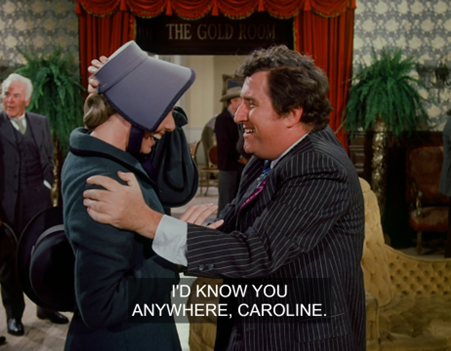
Caroline brings this Cupps over to see Charles, whom he also remembers from childhood.
All of Cupps’s dialogue is brayed or screamed, but I’m not going to continue styling it all-caps, for the sake of readability. Take the tone as a given.

Anyways, Cupps brays that his wife, Hattie, will be so pleased to see her.
Then he (outrageously!) kisses Caroline on the cheek and says goodbye, walking backwards and braying that he’s selling a large piece of property and he CAN’T WAIT FOR THAT REUNION! (Sorry, I couldn’t resist the all-caps for very long. Bruh.)


I’m not sure if he’s supposed to be drunk or just “colorful,” but he staggers a bit and actually smashes into some people as he’s leaving.

This alarming person is played by James Gallery, whose resume is filled with all these TV shows that defined my youth: Salem’s Lot, M*A*S*H, Benson, Bosom Buddies, Diff’rent Strokes, St. Elsewhere, Perfect Strangers, ALF, Mr. Belvedere, and more.

Caroline says Arnie must have married Hattie Simpson, another classmate of theirs.
“Well, he hasn’t changed,” Charles remarks with amusement.
The Purple Pieman tells the Ingallses their room is ready, adding “Have a nice day!”


As they follow the bellhop, Caroline says, “Arnie Cupps was voted most likely to succeed!” I’m not going to waste a lot of time on this, but I’m pretty sure that just like they didn’t have high-school reunions in the Nineteenth Century, they also didn’t have contests for “most likely to succeed,” “biggest flirt,” “most likely to drop their phone in the toilet,” etc., like they do today.
Then Pa says he’s afraid to take the elevator. The bellhop assures him it’s perfectly safe, and Ma says she’s so excited to try it.

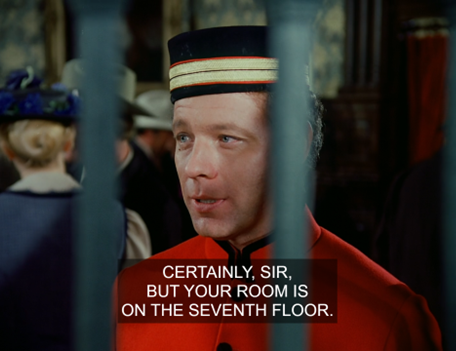

AMELIA: Is that the guy from The Haunting?
DAGNY: I thought it was the guy from West Side Story.
WILL: Both those guys are Russ Tamblyn! And no, but it does look like him.


No, actually it’s Lynn Philip Seibel, who went to prison here in Minnesota years after the series was over. (Unpleasant story, sorry to bring everybody down.)
Anyways, Pa says he’ll never trust a contraption like that, and Ma sadly tells the bellhop they’ll climb the seven flights of stairs instead.
AMELIA: No, come on, Ma!
DAGNY: I hate when she does that. I hated it when I was a kid and I hate it now. “Oh, you want to walk? Then I’ll walk.”
WILL: But Charles is at fault here, really. It’s fine he didn’t want to take the elevator, but he should have said, “No, no, you SHOULD do it!”

Ma and Pa’s hotel room is very grand. In fact, you’d think they’d be a little more wowed than they are.
WILL: Kind of a garish color scheme. Even I can see that.

There are a dozen roses in a vase on the table, as well as a bottle of real French champagne – compliments of Dillon Hyde for Caroline.
Chuck raises an eyebrow at this.

Another bellhop appears at the doorway (this actor was called “Woody Tracy” and never went to prison for anything, as far as I can tell) with a message.
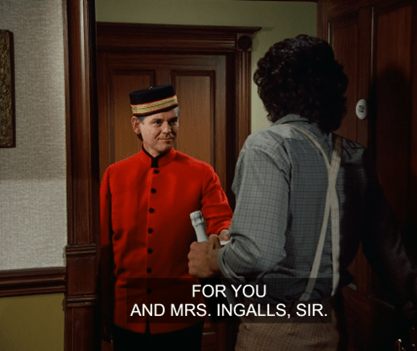
And saying, “Compliments of Mr. Dillon Hyde,” Charles hands the wine to him!
AMELIA: He gave it away? It was a present for HER!
DAGNY: Yeah. He didn’t even ask her.

We know Pa is a teetotaler, though he will take strong spirits if medically necessary, and once appeared to be on the verge of having a glass of hard cider with Baker Makay.


And I suppose we’ve never seen Ma drink alcohol. There was that time Adam’s ass of a father brought some wine to the Little House, but we didn’t actually see anyone drinking it.

(Again, I assumed that was because they have no glassware, though.)

Well, Charles reads the message, which is an invitation to a “soy-ree” hosted by “Mr. and Mrs. Thaddeus Sawyer.”
WILL: I don’t buy him not knowing how that was pronounced. He reads Emerson, for God’s sakes.

The party is to be in the “Gold Room” of the hotel. (Just like in The Shining!)

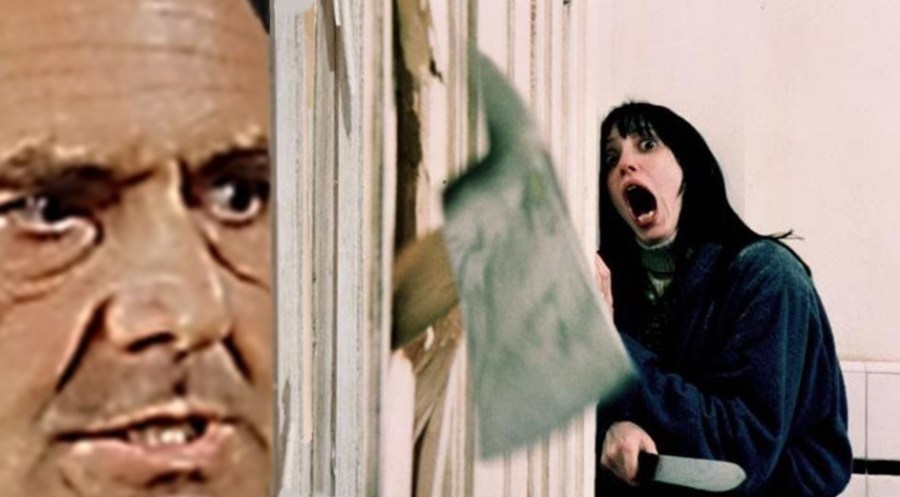
Caroline doesn’t recognize their hosts’ names, but there’s a note at the bottom saying Mrs. Sawyer is their former classmate, Amy Phillips.

Ma notes Amy had a huge crush on Charles, but Chuck quickly says Amy had a scrawny, ugly body and was nicknamed “String-Bean Amy.” (A little too quickly, I might suggest.)


Caroline says she needs to pick out her dress, and Chuck says, “I don’t think you have to wear anything. . . . It says right down there at the bottom, ‘dress optional.’”

DAGNY: This is just like that Everybody Loves Raymond where Ray doctors Robert’s wedding invitation.

Pa heads to the steam room and Ma starts getting her rust-colored number ready to wear.
AMELIA: I want to see this handsome Dillon Hyde.
DAGNY: Me too.
WILL: Don’t get your hopes up.

After a break, a shot of the street establishes the hotel is near a used-furniture shop.

Cut then to the soy-ree already in progress.

There’s a string quartet and a cadre of red-jacketed waiters (the jackets looking suspiciously similar to Nels’s ringmaster outfit in “Annabelle”).
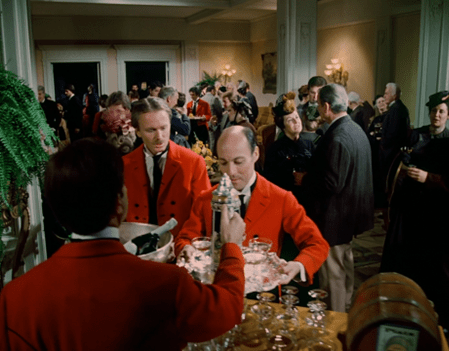

And the whole thing is well attended by people dressed in finery.

The camerawork in this scene is well done. You really feel like you’re walking amongst these partygoers. (Haskell B. this time.)
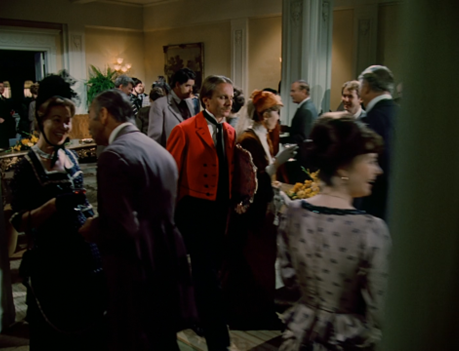
One of the waiters picks up a tray of champagne glasses and a large ornate beer stein. (We see a keg of beer labeled Platz, and we can make out the words GOTT and WEHR on the stein. Could it say Gott zur Ehr, dem Nächsten zur Wehr?, a little German rhyme celebrating the bravery of firefighters? I found a few steins online that bear the slogan.)


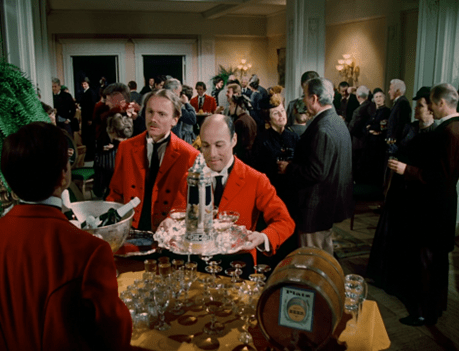
The waiter, an efficient-looking little bald man, conveys us to a group of partiers that includes the braying Arnie Cupps.

The other members of the group are three women, one of whom says she drinks nothing but champagne, and a man in a rather loud check jacket.

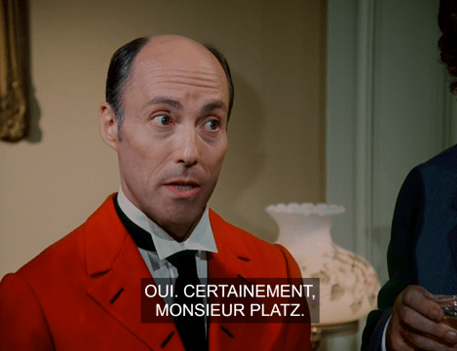
After distributing the champagne (in French), the waiter offers the stein to the man in the loud jacket, saying, “And the beer you ordered, Monsieur Platz.”

The man, who’s large and ruddy-faced and speaks with a German accent, says, “You are sure this is Platz beer?”

“Oui, certainement, Monsieur Platz,” the waiter says.
(The actor playing the Efficient Little French Waiter manages to inject a lot of personality into a tiny role, I think. He’s Damian London, an American who had a recurring role on Babylon 5 and who also appeared on Get Smart, Highway to Heaven, and Seinfeld.)

The woman who said she only drinks champagne, apparently Mrs. Platz, says in an affected “upper-class” drawl that “Jacob won’t drink anything except his own product.”

Herr Platz is proud of his beer, quoting his own slogan, “When you drink Platz beer,/You’re always full of good cheer.” Everyone laughs.

Herr Platz takes a long pull from his stein, which is very large. (I’m pretty sure it is the firefighter slogan. Perhaps Herr P is a volunteer fire chief in his free time, and received the stein in thanks for his service during the Great Fire?)
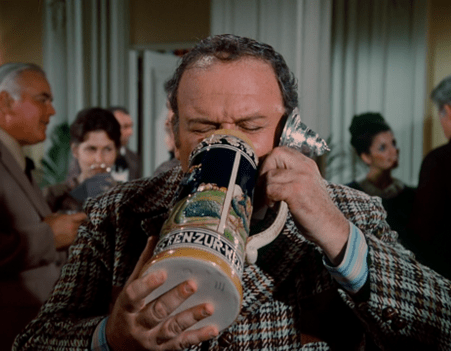
Mrs. Platz makes a disapproving face at her husband’s drinking as the others watch him in amusement.

Jacob Platz is probably a satirical combination of several German-born Milwaukee beer barons of the time, including Valentin Blatz (maker of Blatz), Joseph Schlitz (maker of Schlitz, “the beer that made Milwaukee famous”), and Jacob Best (the founder of Pabst Brewing Company).
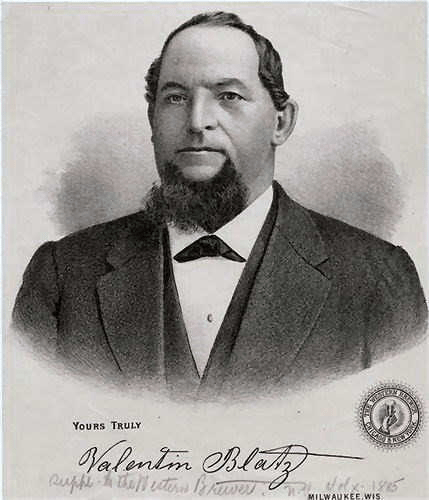
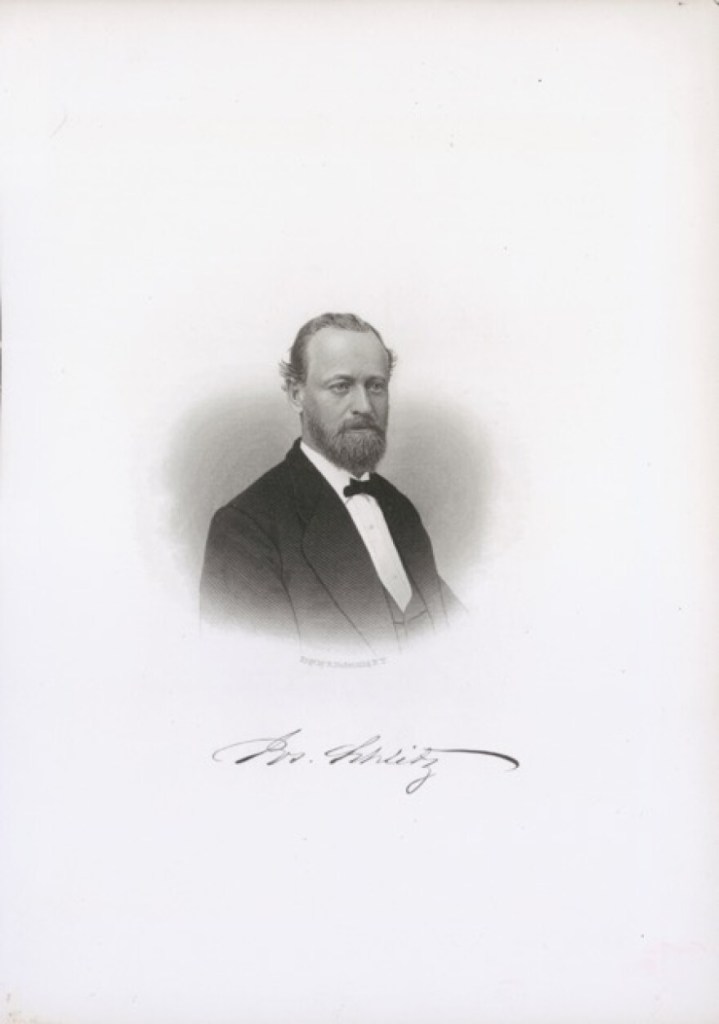

(I was never much of a beer drinker, but I always thought Schlitz wasn’t bad for how cheap it was.)

Herr Platz is played by John Lawrence (who’s not German, as you might have already guessed). He was on Ben Casey, My Three Sons, Family Affair, The Doris Day Show, and Fantasy Island.

He was also in some interesting movies, including John Carpenter’s They Live, the Michael Mullins/Lisa Reeves vehicle The Pom Pom Girls and the John Furlong vehicle Supervixens.

He was also in a horror movie oddity from 1972 called The Asphyx. I liked that one – about a Victorian scientist who tries to discover the secret of immortality and winds up killing his whole family, more or less. Not scary, but plenty weird.
Well, in come Ma and Pa, and one of the women from the Platzgruppe rushes over exclaiming “Charles Ingalls!”
She’s blond, very attractive, and richly dressed: Amy Phillips Sawyer.
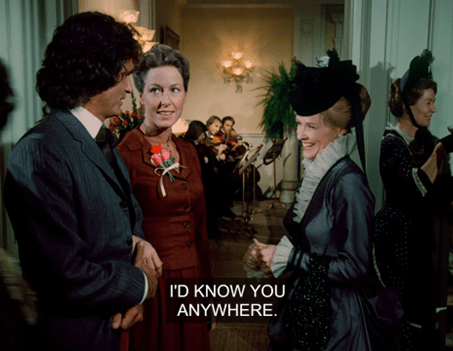
She’s very friendly, and seems like a nice enough person to me.
She looks like she’s about the same age as Charles and Caroline, too. There’s a lot of bickering on the internet, it seems, about the age gulf between the actors who play all the classmates. Suspension of disbelief, fandom, I beg you!

Besides, if you’ve reached a certain age and look at pictures of your old chums, you’ll find the spectrum runs from Baby Finster to Mumm-Ra and everything in between. I have reached that age.


Back in the Platz collective, Arnie Cupps is relating an hilarious anecdote. We don’t get to hear the story, but the punchline is “I just stuck a foot in each wheelbarrow!”

Platz laughs his head off. I think these two are okay.
WILL: He’s kind of like if somebody gave Mr. Hanson a muscle relaxant.

Amy P-S brings Ma and Pa over to meet her husband “Thad,” a tall, rather grim-looking man who nevertheless greets them quite pleasantly.

There’s another man there too, a “Winthrop Morgan.”
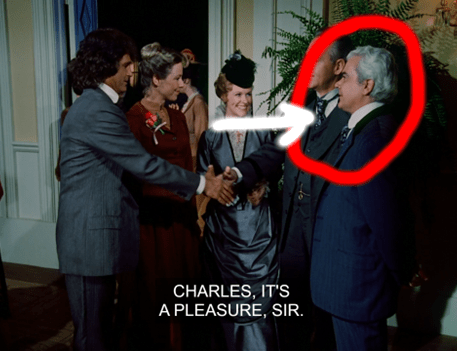
Amy steers the Ingallses over to meet the Platz faction. Misery acquaints a man with strange bedfellows.

Caroline hugs Arnie Cupps’s wife Hattie, who also looks and seems like a pleasant enough person. (Hattie barely has a part, but the actor playing her, Jean Howell, was on You Are There, Dragnet, Schlitz Playhouse (hey, Schlitz!), Gunsmoke, Dennis the Menace, Perry Mason, Days of Our Lives, The Waltons, and Eight is Enough.)

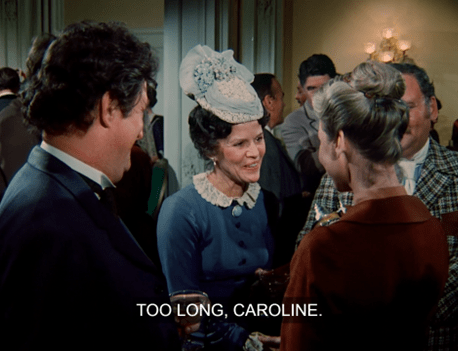
Amy also introduces the champagne-loving lady as “Florence Garner,” a not-so-pleasant alumna who as I guessed is now married to Herr Platz.
“Florence, it’s so good to see you!” Caroline says, to which Mrs. Platz gives Caroline the up-down and hilariously responds, “Thank you.”
(Lynn Cartwright plays Mrs. Platz like a Disney villainess. She’s quite aware she’s the real star of this show.)


(Cartwright had a very interesting life history, which an unusually thorough bio at the IMDb will tell you all about.)

(She’s probably best-known, to people my age anyways, as “Old Geena Davis” in A League of Their Own.)
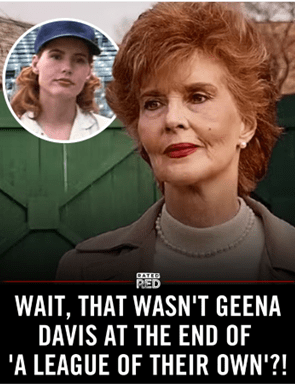
(I once met somebody who was in that movie. At the time, she was doing a play where she portrayed a British person, and she wouldn’t drop her fake accent when she talked to you. No, it wasn’t Madonna.)

(I actually won’t say who it was, to protect her privacy. Some really crazy people read this blog, you know! You should see some of the notes I get.)
Moving on, Cartwright was on Alfred Hitchcock Presents, Schlitz Playhouse, and Adam-12, and in the movies The Wasp Woman and The Garbage Pail Kids Movie.

But the most wonderful thing I learned about her is that she was married to Leo Gordon – Milo Stavroupolis in “The King is Dead”!
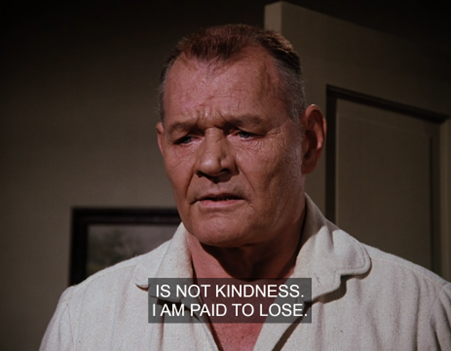
(He also wrote the Wasp Woman screenplay, incidentally.)

The two made a good-looking couple. Charles-and-Caroline-level good-looking, practically.



Suddenly a “silver fox” appears in the room.

He runs straight to Caroline and kisses her.
WILL: This is the handsome Dillon Hyde.
AMELIA: Oh, I see. Well, he’s about as attractive as Dick Van Dyke.
WILL: Yeah. Or Alan Alda crossed with a weasel.

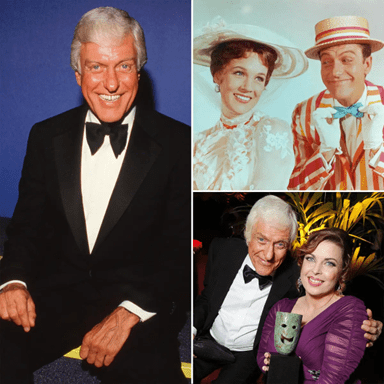


Hyde is played by Liam Sullivan, who was on The Twilight Zone (twice – both good ones), Bonanza, Gunsmoke, Lost in Space, Star Trek, Daniel Boone, Falcon Crest, Dynasty, The A-Team, St. Elsewhere, Highway to Heaven, The Young and The Restless, The ABC Afterschool Special, and Dallas.

Then he shakes Charles’s hand, saying, “Nice to see you, Charlie-Boy.”
AMELIA: Nobody calls him “Charlie.”
WILL: There was that one prostitute. . . .


Mr. Hanson, of course, also called him Charlie when they first met, but soon settled on “Sharles” as a better nickname.

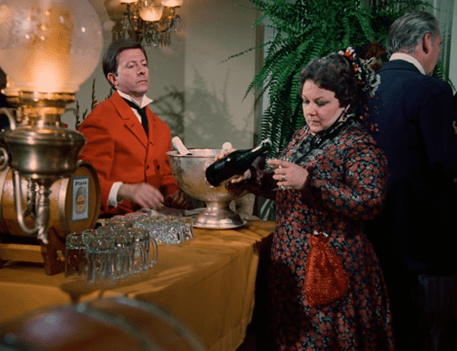
Meanwhile, over at the booze table stands a woman in a gorgeous gown covered with roses.
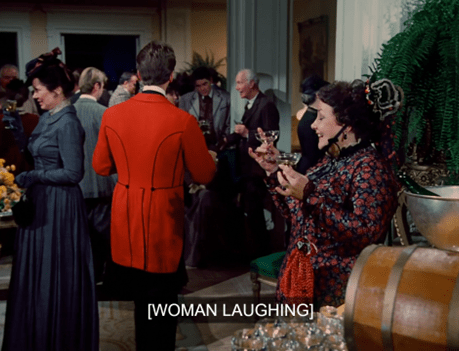
She’s actually dressed a bit like Carmen from the opera, with black lace and the whole bit.

She’d look, as Captain Corcoran said of Little Buttercup, like “a plump and pleasing person,” were it not for the fact she’s clearly drunk. And no wonder, since she’s literally double-fisting it.

She’s also talking to herself, saying “Edith Ross married a midget.” (That’s the second story in a row where this offensive term has been used in the script.)
Well, this is Mrs. Hyde. “Clementina!” Mr. Hyde says. “This is Caroline Quiner!”
AMELIA: He’s weird and he needs a haircut.

(Some people have questioned whether these people would have known Ma as Caroline Quiner or Caroline Holbrook, since (remember) as we saw in “‘I Remember, I Remember‘” and “‘Author! Author!’”, she seriously identified with the Holbrook family.)



(But I don’t know. Probably she experimented with different names in her teenage years, like Amelia did going back and forth between her full name and “Mimi.”)
Clementina Hyde puts down her drinks and embraces Caroline with a vigor which surprises her.

Clementina slurs, “Help me do my homework, Caroline, please?” and laughs sloppily.

She turns her attention back to drinking, muttering that she never understood algebra. You’re not the only one, Clementina.

Finding the champagne bottle empty, Clementina crosses the room and seizes another from a waiter.
Dillon Hyde then asks Caroline to check out the terrace with him.
Clementina, meanwhile, refills her glass and starts muttering about Edith Ross again. The camera stays with her a long while, though.
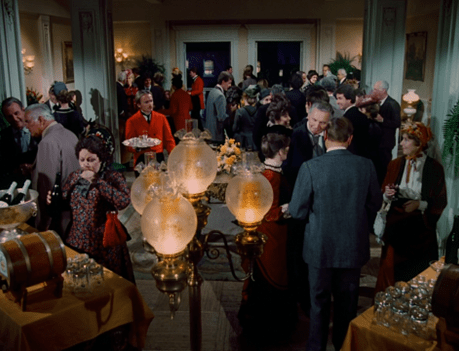
A waiter carrying a very 1970s-looking platter of fruit and vegetables aids in the transition to a different corner of the soy-ree.

Does anyone else remember the eighties infomercial that was selling knives, narrated by a man who got progressively more excited as he watched what they could create out of foodstuffs, culminating in him screaming “THE COLORFUL JOLLY HEN!” when that creature was introduced as a sort of grand finale. I’ve looked for it online for years; no use.
On a couch, Thaddeus M. Sawyer is boring Mrs. Platz by talking about his successful farm machine manufacturing company.

(There actually was a major farm equipment company at the time named L.D. Sawyer and Company; but in the real world they were based in Canada.)

They briefly discuss the Grange co-op proposal, which Arnie Cupps says is of interest to him because he owns fifteen thousand acres of farmland.
Then, in one of those moments I dread in work meetings, Cupps asks Charles to compare his accomplishments to his own. Actually, I dread being asked any question in a work meeting, comparative or not.
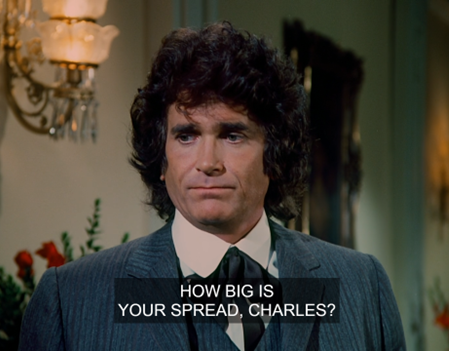
Charles must admit he only has 160 acres – not far off from the size of the real-life Ingalls property in Walnut Grove.
Florence Garner Platz judges this icily.

Charles is embarrassed, but shrugs her opinion off.

[UPDATE: Reader Leslie writes:]
Why doesn’t Charles mention that in addition to his modest farm, he is the owner of the most successful mill and freight business in Walnut Grove? Plus all of his many side hustle carpentering jobs? When you go to your high school reunion, you have to play all of your good cards. And was there any mention of their daughter and her husband running a school for the blind? (Everyone knows you need to keep your wealthy friends apprised of potential philanthropic opportunities. I’m sure Harriet wouldn’t mind.)
[Couldn’t have put it better myself. – WK]
Speaking of acreage, out on the balcony Dillon Hyde is bragging to Caroline about his 2,000-acre estate, which he calls “The Willows.” (It’s not impossible, but it’s rare even for grand properties in this part of the country to have names.)
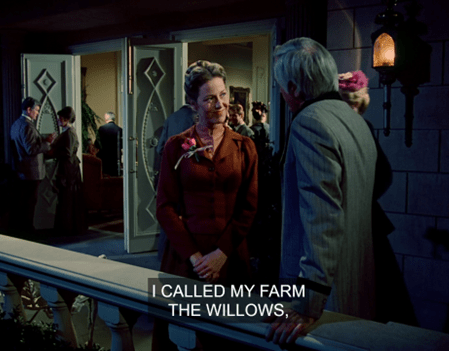
Arnie Cupps appears then, and in a side conversation asks if he can borrow $100 (about $3,200 today). He claims he was pickpocketed and assures Hyde he’ll pay him back when “the bank opens.”

He doesn’t say what he needs it for. Since the weekend is all-expenses paid, I’m not sure what it could be. I doubt he needs $3,200 to tip the waiters.
Inside, Morgan Winthrop (or is it Winthrop Morgan?) is trying to convince Charles to oppose the co-op proposal. He notes that a change would compromise the existing harmonious relationship between the manufacturers and the hardware cocksuckers who sell the equipment.

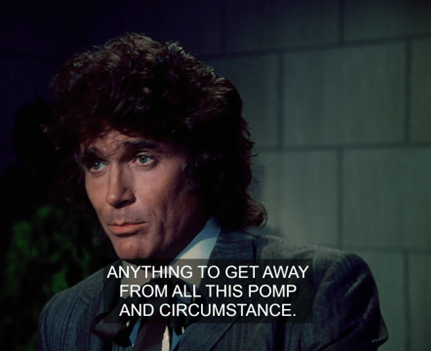
Charles is annoyed, and, finding Caroline alone, he asks if they can leave.
WILL: I always get excited to go to formal events like that, but it’s true, they are very rarely fun.

(I got to go to our regional Emmy Awards once. Our project won, which was great! But it really wasn’t fun at all, unless you like seeing local TV meteorologists and the like getting super-drunk. Which does have its points.)
A little surprised, Ma says she hasn’t even talked to Hattie yet; but Pa, who isn’t always likable in this story, says she can do that over the next couple days.

Charles says he can’t stand “all the pomp and circumstance.” (This expression is from Shakespeare – Othello – but it’s unclear if it was already being used to mean “fussy formality over nothing” until the Twentieth Century.)
We then see Mr. and Mrs. Sawyer talking to someone Sawyer addresses as “Senator.”

Apparently a U.S. Senator, since he mentions “the new Farm Bill,” this is likely Angus Cameron, since he looks just like him.
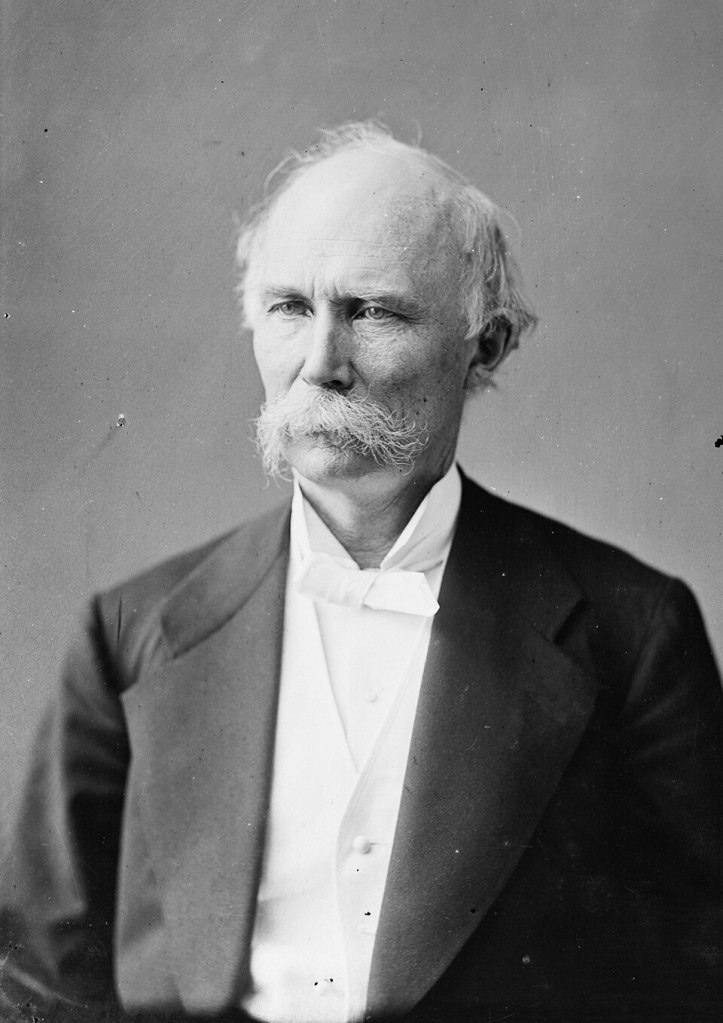

A Republican, which meant something quite different in the 1880s than it does today (and how), Cameron had intended to retire from the Senate in 1881, but opted to continue in that body when the senior Senator from Wisconsin, Matthew H. Carpenter, died in office.

Technically, there was no Farm Bill until the Great Depression, though.
Clearly a wily old fox, Sen. Cameron jokes about flirting with Sawyer’s wife whilst letting Sawyer pay for his campaign. (Cameron was married in real life, but obviously he isn’t here. As W.S. Gilbert observed, married men never flirt.)

Then Cameron spots “the Governor” (at that time, William E. Smith, another Republican) and excuses himself.

(In a nice touch, a guy turns to his wife and points out the Senator as he passes.)
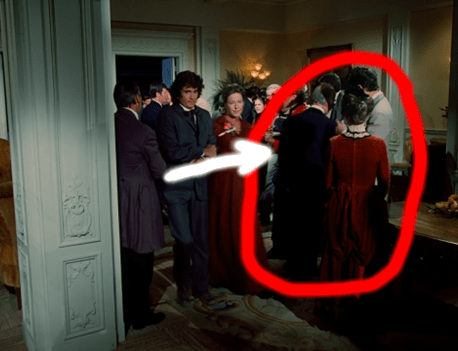

Ma and Pa approach the Sawyers, and Pa says what with travel, they’re tired and are going to withdraw.
Dillon Hyde appears out of nowhere and says “Charlie-Boy” can go, but Caroline should stay!

Ma seems to consider this, but ultimately declines.
Not to be put off, Hyde invites them to “The Willows” for an afternoon of country pursuits the following day.
DAGNY: “The Soiree Party”? Isn’t that redundant?
WILL: It says “The Sawyer Party.”
DAGNY: Oh.

“And bring your riding clothes!” Hyde calls after them as they depart.
Strangely, the camera does not follow any of this characters at this point, but rather returns to Clementina Hyde, who’s still drinking alone.
AMELIA: Huh? Does she wind up being really significant to the story or something?
WILL: You’ll have to wait and see.

Up in their room, Caroline is making some unfortunate comments about how fat Clementina has gotten.

Then she gently asks Charles why he’s so moody.
AMELIA: Yeah, Pa’s been a complete dick since the moment they got here.

Charles annoys me a bit in this episode, too; but now he’s true to character and starts talking to her about his feelings.
AMELIA: Aw.
WILL: You like that, huh?
AMELIA: Yeah. I’m back on Team Charles.

He admits to feeling jealous of their old friends, noting that Arnie Cupps said he owns 15,000 acres of land.
Caroline says, quite sincerely, that she wouldn’t change anything about their lives.

Charles calls Hyde a “pain in the butt” again, and they laugh.
AMELIA [as CHARLES]: “Hello, room service? Send a big bucket of popcorn up to Room 702.”

In fact, they do appear to be getting amorous.
DAGNY: That’s pretty good foreplay, just shaking and rolling around.

The next morning, Charles receives a message that the Minnesota Grangesters are having a confab before the start of today’s session to meet with Winthrop Morgan (Morgan Winthrop?), the man who tried to get Charles’s attention last night.
Ma says she and Hattie are going to see the town today.
(I haven’t been to Milwaukee in years, but it has a special place in my heart. There’s a wonderful zoo and lots of arts offerings, and I adore their IrishFest.)

(I saw Tommy Makem perform in Milwaukee once, and Doc Severinsen, and the Pipes and Drums of the Black Watch, and Mannheim Steamroller.) (Not all together, of course.)



Then we see Morgan Winthrop (Winthrop Morgan?) finishing up a presentation to a large full room of farmers. I wouldn’t think there would be that many Minnesotans there, but I guess if each of Minnesota’s 1,700+ townships has its own “subordinate Grange,” this is only a small slice of their representation.

While Winthrop/Morgan is speaking, we see Thaddeus Sawyer slink into the back of the room.
Charles demands to know who Morgan/Winthrop represents.
AMELIA: Those are some eyebrows.

Indeed they are. Winthrop/Morgan looks a bit like Ian Holm playing Ernest Borgnine.


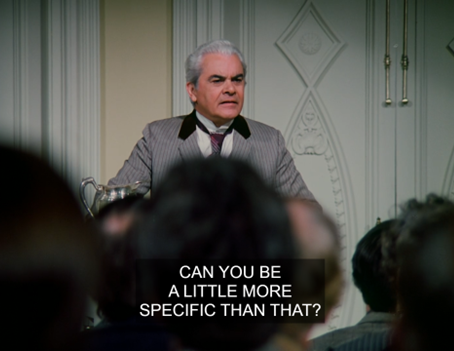
He’s Phillip Pine, who was on every TV show in the Twentieth Century at least once, including Superman, Gunsmoke, Schlitz Playhouse, Peter Gunn, Wagon Train, The Untouchables, The Twilight Zone, Bonanza, The Fugitive, Lassie, Star Trek, Hawaii Five-O, Ironside, Mannix, Police Woman and Story, Barnaby Jones, Quincy, and Santa Barbara.

There’s a wonderful quote of his at the IMDb:
My career has given me the chance to live out many facets of my own character. Two years ago I had the role of a judge on a crime series. While on a break, my mind wandered and I realized I had played, at one time or another, every character represented in the room – the young hood, the defense attorney, the D.A., the accused, etc. And I had found satisfaction in playing each one.
How wonderful! It may seem boring to list out all these old shows and movies for these character actors, but I really love their accomplishments, and this quote is one reason why.
Anyways, Morgan/Winthrop admits he works for the Loyal Order of Hardware Cocksuckers, and Arnie Cupps screams “WE’VE BEEN FLIM-FLAMMED!”, which made us all laugh. (So Arnie’s part of the Minnesota delegation? Where does he live?)


Winthrop/Morgan says if the farmers vote against the proposal, the retailers will give them a 10-percent discount on all goods.
Arnie Cupps points out this offer is meaningless, since they can set the prices at whatever they want.
Morgan/Winthrop warns them that if they fail to comply, the retailers will start yet another trade war. (I don’t know much about the Nineteenth-Century agriculture industry, but it wouldn’t surprise me if the politics actually could be cutthroat like this.)

Sawyer, who we notice has one drooping eyelid, watches the back-and-forth with a sinister look.
AMELIA: Is that John Lithgow?


No, it’s Ken Norris, who was involved in making some strange horror films, including Bizarre and Too Scared to Scream. (I don’t know them, but Bizarre looks interesting.)
There’s also a Ken Norris who was on Doctor Who in 1965 (“The Space Museum”). The IMDb is confused on this point, but I think that’s a different person.

Again according to the IMDb, our Ken Norris was also an “aeronautical engineer who, with his brother Lew, designed Donald Campbell‘s record-breaking Bluebird CN7 car and hydroplane Bluebird K7.” I’m pretty sure this is a different Ken Norris too. (Just as well, since Campbell was killed racing the K7.)

Quite idiotically, Winthrop/Morgan explains his association’s strategy to control the stupid, dumb farmers.

But as self-appointed leader of the SDFs, Charles leaps up and says fuck you, man! (Paraphrase.)

All the farmers then rise in a body, roaring “Together! Together! Together!”
WILL: Do they tear that guy limb from limb?

Thaddeus Sawyer, obviously Morgan/Winthrop’s client, gives him a look of displeasure.

Next we see Ma and Pa arriving at “The Willows.”

We don’t get a good look at the house, but I think it’s the same one they used for the Burton School for the Blind in “‘I’ll Be Waving as You Drive Away.’”


All this is accompanied by a sweepingly noble melody from David Rose. I think we’ve heard this one before, but I’m not sure where. Sounds a bit like the theme to an eighties primetime soap. Falcon Crest, perhaps.

They’re having a sort of Room With a View–style garden party behind the house.


It’s unclear what time of year it is – the trees appear to be in full foliage, but later we’ll see bare branches and Ma and Pa all bundled up.

Dillon Hyde and Amy Phillips Sawyer appear on horseback, the actors apparently doing their own riding (though Liam Sullivan seems to struggle with his horse a bit).
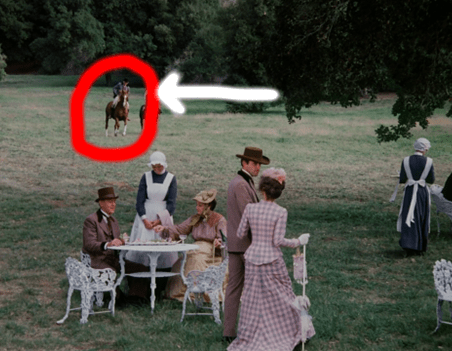
Hyde greets the Ingallses, and Charles at last tells him he prefers Charles to “Charlie.”
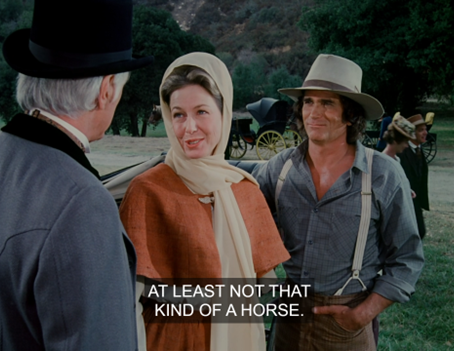
Hyde is surprised Caroline isn’t dressed for riding, but she says she doesn’t, “at least, not that kind of a horse.”
AMELIA: “That kind of horse”? Saucy!
WILL: Oh my God, child.

Actually, we’ve never seen Ma ride a horse on this show, though presumably she would be able to.
Hyde calls Charles “Charlie” again, and Charles corrects him again. (I’m of the opinion people don’t need – or get – to approve their own nicknames, but I understand that’s an unpopular view these days.)
Charles pokes at Hyde for being surprised at his informal attire.
AMELIA: He’s very Grandpa Kaiser in this one.
WILL: Yes.
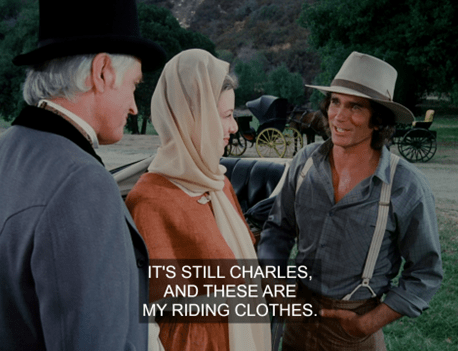
Amy Phillips Sawyer calls for Charles to join her and take Dillon’s horse. (Chonky-model.)

Charles climbs aboard and off they go.
And, to goofy music, Dillon Hyde says he’ll show Caroline around the property in a surrey.
DAGNY: What’s with this silly, sloppy music, David? It doesn’t match the circumstances in the least.

The leapfrogging melody abruptly morphs into weird horror chords on the organ. It’s possible David Rose was altered when he scored this scene.


We see Clementina and Thaddeus Sawyer, then, sitting together and drinking. They see the couples heading off and give each other inscrutable looks.


Meanwhile, Charles and Amy Sawyer race across the countryside.

It does look fun, but I don’t know. I once went on a riding tour of a rain forest in Central America, only my horse split off from the group and took me on a long and terrifying solo ride through muddy, slippery, mountainous jungle in the pouring rain. It was very Romancing the Stone.

It turned out the horse knew what he was doing, and I survived. It was the best and worst experience of my life!
Anyways, they stop briefly at a duck pond.
WILL: A lot of ducks this season.


Sitting on the grass, Amy and Charles make smalltalk, with Amy saying she always wondered what became of him.

In a sudden turn, she then starts talking about how unhappy her marriage is.
WILL: She looks like Lynda Day George.


Actually, she’s Lynn Benesch (sometimes spelled Benish), who was on Gunsmoke and had substantial parts on One Life to Live and The Young and The Restless.

It’s a bit odd there are so many Lynns in this episode. Isn’t it?

Amy says she envies Caroline’s life, then takes Charles’s hand and begins stroking it.
AMELIA: Whoa. Women are always throwing themselves at him, aren’t they?

Amy says his hand is “so strong,” then presses it to her face.
WILL: This music’s weird too – it seems like sincerely romantic stuff. Are we supposed to be hoping he’ll dump Ma?

Charles looks at her dispassionately, and says the strength of his hands comes from muckin’ the auld byre. (Paraphrase.)
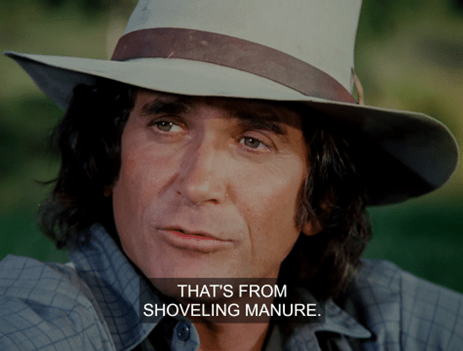
Actually, despite its neutral tone, his delivery is pretty devastating. Amy gets the message and releases his hand. “I think the horses have had enough rest,” he says, again dryly.

A flood of emotions is spewing from Amy’s face. Well, perhaps that’s not the best way to put it. Anyways, Landon lingers here too; my point is he seems unusually interested in the emotions of female characters in this one.
Whatever the reason, Lynn Benesch knocks it out of the park with her subtly changing expression.


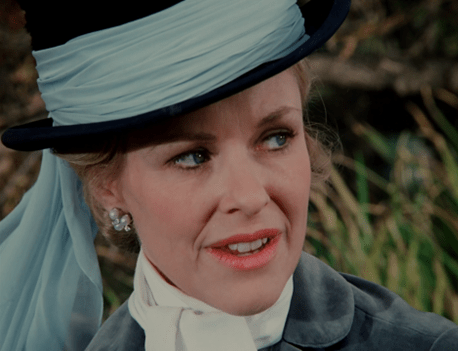
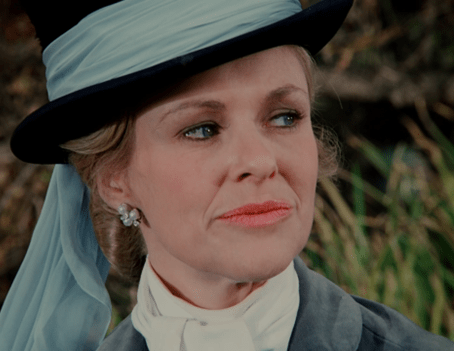

Meanwhile, Dillon Hyde stops the carriage in a remote spot as Caroline smiles rapturously.

He asks Caroline how often they get “up to Milwaukee.” (Since the city is southeast of Minnesota, I’m not sure how that’s “up.”)

Caroline says, “I haven’t been here since my folks went through on their way to the Big Woods.” (This is even more confusing. In real life, Caroline was born in Brookfield, a Milwaukee suburb, and her family moved to Concord when she was six.)

(In the Little House TV Universe, it’s suggested that the Holbrook-Quiners relocated to the Big Woods at some point, but in actuality they stayed put, and it was only Charles’s family that moved. Either way, Milwaukee is forty miles in the wrong direction if one is traveling from Concord to the BWs.)


Dillon then scootches over closer to Caroline and makes an extremely clumsy pass at her.
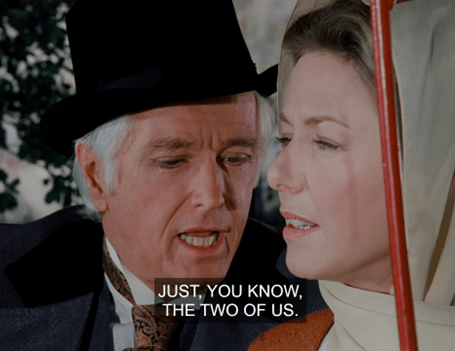
With a subtle change of expression (we’re overflowing with subtle Cs of E this week), Ma quotes Charles, calling Hyde “a pain in the butt” yet again.
DAGNY [as MA, hysterically]: “Charles Ingalls is the most amazing man who ever lived! I don’t need any money! I will live in poverty with him the rest of my days!”

Looking embarrassed, Hyde gets the horses going again. Obviously, this scene could have taken a much nastier turn, and I’m pretty surprised there’s no element of fear in Grassle’s performance. Ma must not get that vibe from him, though.

Anyways, both these failed seductions happen awfully quickly, but I do give this one points for how much ground it covers in a timespan of a single episode. (I would not have wanted to see it as a two-parter.)
Back in their hotel room that night, Charles makes some standard “working-class Joe” complaints about rich-people food. Come on, Chuck, you haven’t lived till you’ve had mock tur-kraken instead of boring old Thanksgiving turkey!
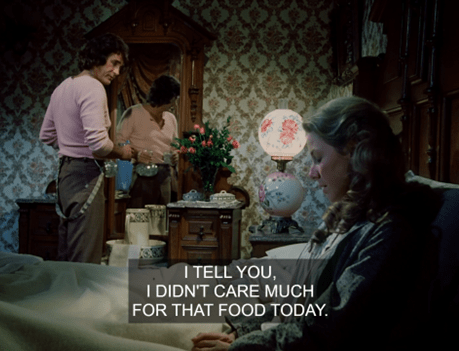
Needless to say, it’s clear neither of them told each other what happened at The Willows.
Charles notices Caroline is far away in her mind, and when he asks what’s the matter, she bursts into tears.
AMELIA: She’s that upset that somebody made a pass at her?
DAGNY: Well, he wasn’t hot like that handyman.


Still without saying what happened, the two have a little conversation about how all their old friends have been changed for the worse by their wealth and success.
DAGNY: This is a common theme on this show – success and riches not equalling happiness. Michael Landon must have struggled with that.

Charles says the reason their marriage is more successful than the others’ is because it’s founded purely on love, not earthly accomplishment.
“Without you, I’m nothin’,” he adds. “I’m a farmer and I love it, and I’m a father and I love it.”
DAGNY: If you’re happy and you love it, clap your hands.

Very sincerely (and wonderfully), Pa tells Ma how much he loves her, and asks her to marry him again. “I thought you’d never ask,” she says, laughing.
The proposal may seem to come out of nowhere, but as a literary device I think it’s an excellent way to express that these two, had they the option, would choose their own life over any other. Indeed, that is a rare thing in this world.

Pa turns off the light, and yes, I think we can presume this is one of the rare times a “Popcorn Twofer” is implied.
DAGNY: This show.

Now, you’d think this might be the end, but of course there’s still the formal reunion to get to. As with “The Angry Heart,” Landon the showman can’t leave well enough alone, and needs to tack on a crazy chaotic over-the-top coda to remind us we’re watching Little House.
That coda begins with a shot, finally, of the exterior of the hotel, which is named Sherman House.

There was a famous Sherman House hotel in Chicago, but apparently in the Little House TV Universe it was built in Milwaukee instead.

The final session of the Grange convention lets out with all the farmers cheering. “You won’t be celebrating for long!” snarks Winthrop/Morgan.

Civilly enough, Thaddeus Sawyer says to Charles, “So, you voted for the co-ops, despite the odds?”
WILL: Now he looks like a Boris Karloff character.
DAGNY: Yeah, or somebody from a David Lynch movie.


Restating the theme of last week’s endorsement of socialism or mob justice, depending on your taste and interpretation, Charles says with the farmers united as one, the odds are on their side.

“Come on, Charles!” Arnie Cupps brays. “That reunion party tonight should be a WING-DING!”

Morgan/Winthrop scuttles after Sawyer as he heads for the elevator, protesting that he can still change the farmers’ minds.
Sawyer boards the elevator, gives Winthrop/Morgan a cold look with his good eye, and says, “Good day, Morgan.” (Some PR clients are never satisfied.)

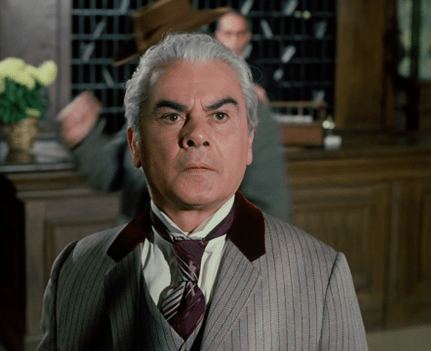
The elevator floats up, with Sawyer staring down the entire time.
DAGNY: Landon director?
WILL: Yes. You still got it.
DAGNY: Actually, I think this whole episode would be better if David Lynch directed it. Think of it – the elevator, the desk clerk, the parties. . . .



Now comes the reunion.
AMELIA: This is so bougie.
WILL: Yeah. Is that JD Vance?


Everybody is there: Clementina dances by herself as Arnie Cupps gives her a worried look, the Sawyers chitchat with each other, and Herr Platz slurps from his stein.
DAGNY: That cutlery sound in the background is too much.

Now, before you get your hopes up, no, Sorrell Booke does not return as Mr. Watson of deportment!-deportment!-deportment! fame.


Perhaps now is the right time to tell you, though, I think I’ve matched up all our dramatis personae with their childhood counterparts.

Dillon Hyde is there too, sitting alone, and drinking. No champagne for him tonight – hard liquor only.

Charles and Caroline are dancing happily. She’s wearing Boobilicious 2, which she’s augmented with a peach-colored bow.

DAGNY: I hate how they infantilize Caroline by giving her such a huge bow.
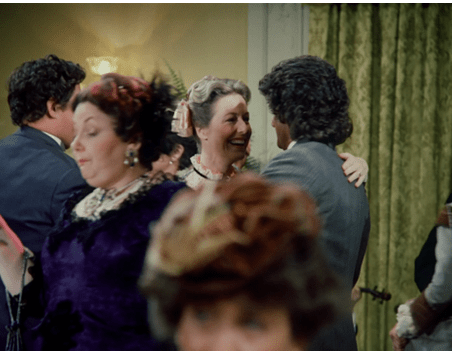
Florence Garner Platz remarks that they provided all the beer for the party for free. “I like to be generous!” Platz himself says cheerfully. He really seems not a bad sort.

But Dillon Hyde looks up nastily and says, “Free advertising.” He’s clearly quite drunk.
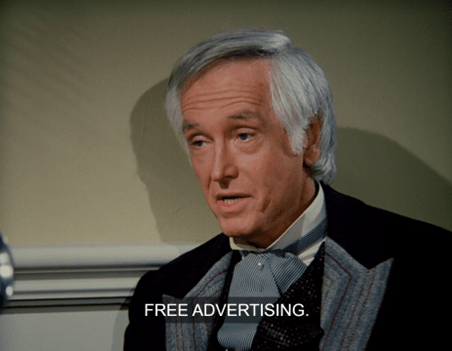
Then Hyde leans in and says to Platz that his beer is awful.
Poor Platz looks around in dismay.


Walking carefully, Hyde crosses the room, ignoring his own wife, who’s standing next to an enormous eagle carved out of ice, watching him.

Hyde walks straight up to the dancing Ingallses and says, “Mind if I cut in, Charlie-Boy?”

Charles gives him a small smile and says, “As a matter of fact, Dillon, I do.”
Hyde starts to lecture Charles about the etiquette of a formal dance, but Charles simply says, “I never said I had etiquette,” then adds, “Why don’t you dance with your own wife.”


AMELIA: Yes, Charles! Ma’s so into him.

Hyde watches them unsteadily as they dance away.
DAGNY: Now he looks like Mr. Humphries.


Clementina watches this scene with interest, then smirks, then starts laughing.


Hyde looks at her with disgust. He heads over to her and, saying, “You are making a fool of yourself,” drags her off the dance floor.
Arnie Cupps reports that the insulted Platzes have gone.
Hyde shoves Clementina onto a chair, saying, “Sit down and stay down!”
“Hey, take it easy, Dillon!” Arnie says.


Hyde rounds on Arnie, saying he hasn’t repaid him the hundred dollars, and announces to whoever will listen that Arnie is a “four-flusher” (that one was new to me) who claims to own thousands of acres when in fact his farm is even tinier than Charles’s.

Very alarmed, Arnie says he’ll pay him back, but Hyde sneers at him, then shoves him into the little efficient-looking waiter.
DAGNY: Oh!
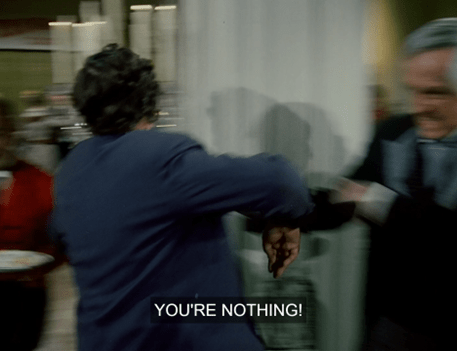

Broken dishes go flying as Arnie falls to the floor.

The musicians, who have added a few players since the soy-ree, stop suddenly. (Unprofessional, guys. You’re being paid to keep things groovin’.)

Dillon Hyde stares furiously at Arnie, and, saying “You son of a -” (this is very strong for Little House), staggers forward as if to attack him again.

But he’s stopped by Charles, who tells him to cool off.
In response, Hyde grabs him by the arm and says, “Who do you think you’re talkin’ to, Charlie?”
In a quiet voice, Charles says, “Watch what you’re takin’ hold of, Dillon. I been workin’ hard for twenty-five years.”
AMELIA: Ooh hoo hoo! Boom, Charles!


Hyde considers the size of Charles’s bicep and releases him.

Charles helps the humiliated Arnie Cupps to his feet.
Clementina Hyde, who’s wearing another gorgeous gown, gets to her feet and approaches her husband.
DAGNY: They shouldn’t have put her in that necklace. It’s too small for her neck and I’m sure it hurt her terribly.
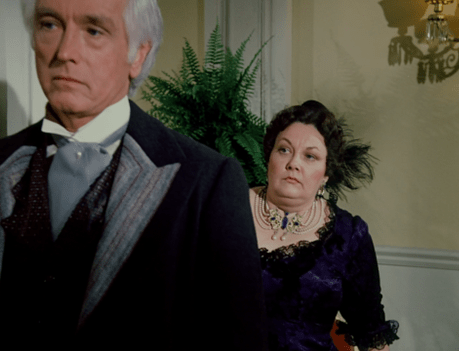
In a voice dripping with contempt, Clementina observes that “the great Dillon Hyde is scared of a poor dirt farmer.” (The actor is Mary Elizabeth Corrigan, who also appeared on an episode of Maude.)

Dillon spins around, hissing, “Shut up!” Clearly this is not how he pictured this party going.
But Clementina stands her ground.

“You’re nothin’,” she says quietly, then makes a short, devastating speech about how despite his wealth, he’s a failure as a human being.
“We’ve got nothin’,” she continues, voice breaking. “We’re nothin’!”
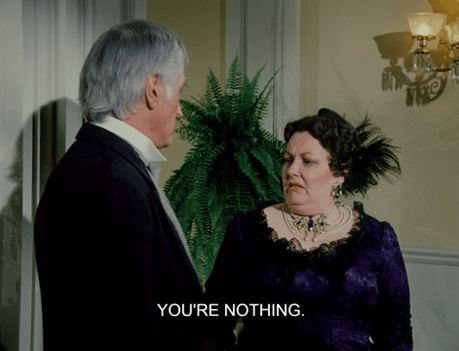

And Dillon slaps her across the face with the back of his hand.
DAGNY: OH!

Instantly, Charles steps forward and punches Hyde in the gut as hard as he can.
DAGNY: Oh my God!

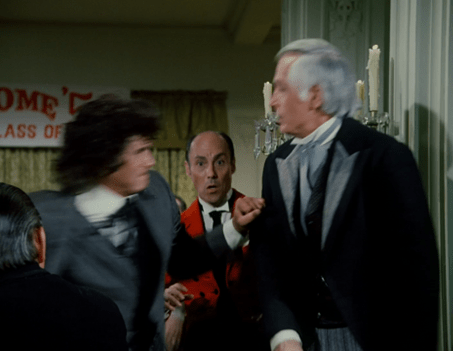

Or maybe not quite as hard as he can. I notice that Charles, famously a lefty, hits Dillon with his right fist.

Hyde crumples and stares, shocked by pain of a sort he’s surely rarely experienced.

“The name’s Charles, Dillon,” Charles says.
AMELIA: Yeah. [as CHARLES] “Charles INGALLS, motherfucker!”

Then he takes Ma by the arm and they leave.
AMELIA: He should have made sure the drunk lady got out of there safely.

The musicians, who didn’t stop this time, continue playing, and the party goes on.
AMELIA: Everybody just resumes talking and laughing?
DAGNY: Yeah. “Oh, whatever, it’s Wisconsin.”

It’s true that the people of my home state have a high tolerance for alcohol and alcohol-related behaviors.

Then we see a stagecoach driving through what’s presumably the Minnesota countryside. (The Little House theme is playing again, you see.)

Charles calls out to the driver, a mustached man but not the Mustache Man, telling him to drop them off at the “next farm on the right.” That seems strange. I doubt stages made personal dropoffs at people’s homes.

But what do I know? And either way, it means the body of water the stagecoach just passed must be Lake Ellen.


Charles wakes Caroline, who’s been sleeping.
DAGNY: My God, how could anyone sleep in that bumpy carriage?

The coach drops them off, and they stand at the head of the driveway looking at the Little House.
WILL: What time of year is it? It looks cold, suddenly.

It does – the wind is blowing hard and everything’s brown. Moreover, Ma and Pa are wearing their winter coats. . . . Oh, well, let’s call it late fall of 1881-M.
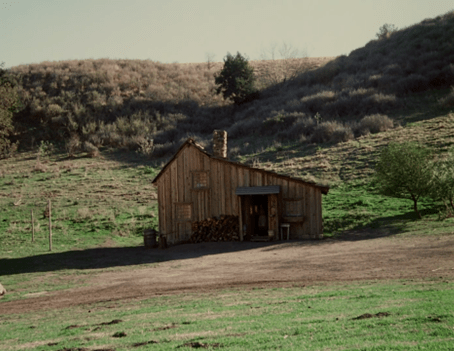
The kids come running out and everybody hugs. Bum-Bum-Ba-Dum!
AMELIA: Yay! And who gives a shit about Mary?
DAGNY: Yeah, it’s as if she isn’t on the show anymore.

STYLE WATCH: The Bead’s old hotsy-totsy red dress is on the rack in the Mercantile.
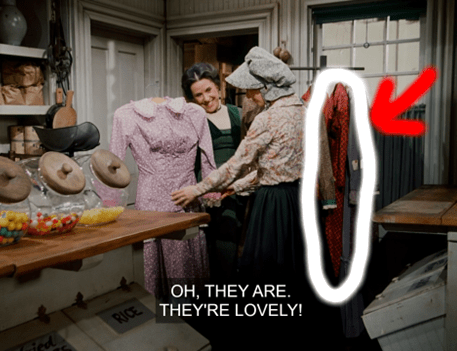
So is Boobilicious 2!

I like the cat figurine on the shelf in the store.

I’m not sure if it’s perfect for the period, but I love the elevator design.

Dagny and I had a thorough discussion of whether Caroline’s dress is rust-colored or deep red. Evidence inconclusive.
Dags also commented on the hotel’s “vagina wallpaper.”

A lot of stiff detachable collars in this one.


Correct me if I’m wrong, but Clementina Hyde’s headpiece seems to have John Bevins’s carved rose beads in it.


Ma’s elegant headscarf got high praise from our panel.
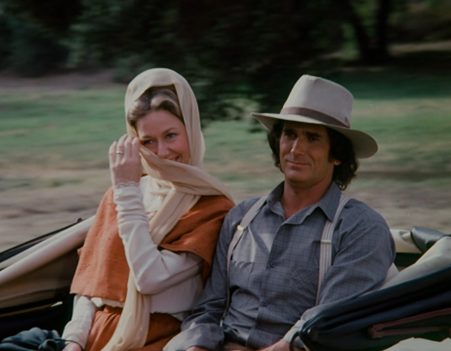
Dags liked Dillon Hyde’s black jacket.

Charles appears to go commando again.
THE VERDICT:
AMELIA: I have to admit, I really liked that one.
DAGNY: Yeah. The fight scene was pretty good. I bellowed three times at it, which is a good indicator of quality. It brought it up to about a B for me. Plus I liked Mrs. Oleson.
I have a hard time getting past the absurd premise myself, but as with many of the stories I’ve “always disliked,” I found it actually full of things I do like. (Here’s a tip: If there’s a Little House story you hate, watch it six times in a row. I guarantee you’ll like it better by the end of the process! You’d think it would be the opposite, I know.)
It packs quite a lot of plot into a single episode, the “proposal” scene is lovely, and Landon and Grassle are both perfect in it. Mary Elizabeth Corrigan’s Clementina is complex and surprisingly sympathetic, and Lynn Benesch is terrific as the unhappy Amy.
That said, it’s pretty twisted for a kids’ show, what with all the implied swinging.
Thanks for reading, and see you next time. And again, happy holidays!
UP NEXT: Darkness is My Friend
 Walnut Groovy
I wonder what became of Harold Watson, that boy who bullied Charles and competed for Caroline in “I Remember, I Remember”. Dillon Hyde comes across as a replacement to him, though I can’t tell if that’s intentional or they just plain forgot about the flashbacks in “IR,IR”. Then again, Caroline’s narration there informed that Harold’s father Mr. Watson didn’t last much longer as a teacher there after Lansford intimidated him for his unfair punishments of Charles, so maybe the Watsons moved from there before Harold graduated school.
This one was never a favorite of mine; I can’t even remember having ever watched it when I accompanied the show on TCM. The whole story revolved around the theme of how their rich ex-colleagues didn’t reach happiness through their wealth compared to Charles and Caroline’s wholesome marriage and family. Now, an obvious message doesn’t necessarily matter as long as the execution keeps the story entertaining. And what the episode does isn’t really all that exciting to sustain an interesting episode, at least to me. It’s not a bad episode exactly, just not on my top 5 from Season 6. I actually liked Arnie though, he was over-the-top, but a breath of fresh air amid all those uptight miserable snobs the colleagues had become (seriously, are we supposed to believe most of those kids from a small town who studied in a one-room school struck it rich in adult life? At least Arnie is a bit ore believable as upper middle class at best).
Anyway, I think this is the first time we see the timeline go back to 1881, as the Ingallses and co got back to Walnut Grove that same year and it’s been at least a year since that, and there’ll be a shot of Albert’s adoption papers with the year of 1881, indicating that was when he was officially adopted, presumably shortly after convincing his birth father to let him stay with the Ingalls in “The Family Tree”. So early Season 6 is supposed to be in ’81, I guess?
LikeLiked by 1 person
Well, given the resemblance between Harold and Junior Standish, it’s possible the former grew up and moved to Winoka, where he dallied with Miles Standish’s wife – Junior being the result.
(I had no idea when I started this Project that wild-oat sowing would explain so many mysteries. This specific instance isn’t really that surprising, though, and it serves Mr. Standish right.)
As far as the timeline goes [deep breath], you’re right, there’s no question that this story is set in 1881, even if the date is never spoken.
Before this, the last precisely dated story was “The Godsister,” which is stated to take place “five years” after the invention of the telephone, viz., 1881.
But there have been twenty-four stories since then, including at least three different versions of how the characters spent their summer vacation. (Were they riding the rails to California and back, or vanquishing the Lake Kezia Monster, or traveling to spend a few weeks with the Edwardses? When did they defeat the evil faith healer and welcome London’s circus to town?)
In addition, we have to fit in Mary’s miscarriage, successful pregnancy, and “going unblind”; the writing and publication of Gramps Holbrook’s volume of short stories; Albert’s progression from apprentice to master carpenter; Jud Lar[r]abee’s trial, and the anthrax epidemic; Charles’s erotic residency at the Harper ranch; the long saga of Jordan Harrison’s fake blindness; Rev. Alden’s courtship and marriage; and now the joint Grange Meeting/Soiree/Class Reunion/Oktoberfest/Playboy Mansion Party in Milwaukee.
Plus, at a random point in the middle of it, there’s a Halloween special! So no, I’m sorry to say I don’t think they can all be in 1881. 😀
LikeLike
sigh… typed my comment and it was all lost in the void. Boo.
Yes. The premise is so ridiculous (a 19th century high school reunion for a small rural, one-room school house where everyone turns out rich? Gotcha.)
But why doesn’t Charles mention that in addition to his modest farm, he is the owner of the most successful mill and freight business in Walnut Grove? Plus all of his many side hussle carpentering jobs? When you go to your high school reunion, you have to play all of your good cards. And was there any mention of their daughter and her husband running a school for the blind? (Everyone knows you need to keep your wealthy friends apprised of potential philanthropic opportunities. I’m sure Harriet wouldn’t mind.)
I lived in Brookfield for a while, but I never could remember how long Caroline’s family lived there and when they moved to the Big Woods. Watching the show does not help. Lol.
LikeLiked by 1 person
That is an excellent point! I wish I’d thought of that, in fact. I’ll update the post! (I’ll also check and see if I can find your other comment. Approved commenters’ thoughts sometimes get swept away to spam for reasons incomprehensible to me. . . .)
LikeLike
I once started a discussion on the Little House subreddit, wondering if the show would influence the new Netflix adaptation, since so much of our imagination of the characters is based on the first show. It didn’t engage the redditors much, but a couple commenters expressed their fears that the new show would be “too modern”, with one saying it might be like “Anne with an E”, by their own words, “where a lot of unbelievable modern storylines get shoehorned into a show that’s supposed to be set in the late 1800’s”. Now, “Anne With” is a show I very much like, though I concur there are moments the introduction of more contemporary elements and attitudes can push beyond the suspension of disbelief (not a big problem to me, but I can see why it’d be for fans of period pieces). That said, I find it interesting that somebody would point that out in a community dedicated to the original Landon version, where school reunions of one-room classes happened in the 1880’s, the general store has catalogues that shouldn’t be there for the next 20 years or so, the townspeople open a fully integrated school for the Blind and only the more egregiously racist person seems to object to that, and schoolmarms are allowed to keep teaching even when they have children — there was such a thing as a Marriage Bar, which lasted all the way to the mid-20th century and forbade married women to take certain jobs deemed unfit for their wedded routine and life, including teaching; it was more lax in rural areas where options for teachers were more scarce, so Eva Sims and Alice Garvey (who wouldn’t be allowed to work as postmistress under the MB either) as married teachers is possible, though it’s never mentioned that being married could threaten their position, making me wonder if the Marriage Bar even exists at all in the LH TOS universe.
Of course, some of these artistic licenses were made when not everyone could tell the difference from what it was like in real life (maybe some knew there’d be no school reunion, but fewer would know when the telephone arrive at WG, only that it was already a thing and so was possible), so the show remained a fairly credible portrayal of the Old West, even when the viewers spotted the anachronistic parts. Also, the changes in “Anne with an E” tended to be more explicit and have the characters openly challenge the norms of the period and place, in a way many would think it messes with our immersion that these are supposed to be 19th century characters.
Since you mentioned Charles asking Caroline to marry him again, there’ll be another episode with Arnie Cupps, where Laura finds she’s pregnant and Caroline thinks she’s too, and, anyway, not to spoil everything, after a series of events, they’re invited by Arnie to attend his son’s wedding at their old neighborhood, and there they decide to renew their votes again. I wonder if the writers had this dialogue about remarrying here in mind when they decided to bring Arnie back from this story.
LikeLiked by 2 people
Dammit, now I wrote a long answer that disappeared before I could post it! Grrr.
Olive and I watched Anne With an E. I liked it, though I prefer the Megan Follows version. (Do you like that one? It’s unfortunately hard to find these days.) But you’re right, Anne With an E is Green Gables done Michael-Landon’s-Little-House-on-the-Prairie-style. And I really didn’t mind that – what I mainly missed was the old cast.
And I love the quote from that redditor, of which I’ve heard many variations. (“The new Little House is going to be so woke – why can’t they just be true to history like the old show was???” :D)
I think we’ve talked before about how some fans give Little House grace because they watched it as kids, having no idea hick one-room schools didn’t have big-city reunions in the 1800s and so forth. But the internet is the bigger factor in our hypercritical age. Not only has it attached ideological significance to every piece of entertainment (a crime I’m guilty of, I know), it makes any idiot in his rumpus room an instant “expert” who can sneer at anachronisms etc. that nobody would care about otherwise. Well, as Walnut Groovy proves! 😀
I haven’t been following the news about the Netflix Little House closely. But I wish they were using the show as a jumping-off point rather than the books. Actually, I wish they did an episode-by-episode reimagining! Now THAT would be something.
LikeLiked by 1 person
I haven’t been able to watch the 1985 adaptation of Green Gables, I’m afraid. The only option available seems to be the DVD box to be purchased, which is too expensive with the shipping costs, and it never aired anywhere on TV that I remember when I was younger. I was only vaguely aware that there was this story about a redhead girl called Anne set in the late 19th century, but aside from bumping on a few Internet bits about the previous versions, I think the Netflix show was the first time I ever got to watch any version of the story. The Megan Follows version sure looks and sounds like a lovely period piece not unlike Landon’s Little House, that I’d really like to watch (that and its spin-off Road to Avonlea).
I think it’s true that we give the original versions more leeway for being the ones we watched as kids; though another factor is that the original Little House show, even with all the anachronistic changes and occasional storylines about racism and social issues, was more of a slice-of-life show which didn’t usually challenge its own social norms, as it accompanied characters who were immersed and content with that reality they were born and lived in. There were times they’d denounce bigotry and act closer to post-Civil Rights people, of course, but for the most part, the storylines and portrayals of characters let you get immersed in the reality of the old West post Civil War. Some of the attitudes typical of the time period are treated in a more neutral, even benign light than if this weren’t a period piece set 100 years before the show was made.
In that, I think Landon’s LH takes after the books; I never got to read them, but what I learned about them indicates they’re mostly slice-of-life adventures set in a time and place long gone (even for the time they were written) with little to no judgement by the narrative, helping us get immersed in characters living that reality. A lot of Little House and Green Gables readers look to that immersive, non-judgemental approach for comfort and associate it to what made them fans of those stories, so they think a new version that brings elements that weren’t there and challenge the reality the characters lived at will tarnish the essence of the source material.
To be honest, nothing about the upcoming show indicates it’ll do that and it may be a fairly credible take on the period — the most notable change so far is that there’ll be Native characters who will be part of the recurring cast, and from what I see, adopted White customs and live near the White neighborhood. There are precedents of these, but some who hoped for a more faithful adaptation are put off by those early news indicating they won’t be following the books too closely, and that the new show might be checking boxes to update a story they wished got a closer adaptation.
There are things that have become recurring in making period characters more pallatable for contemporary audiences; like making female characters who refuse to get married at all when everyone takes it for granted, have them wear pants, take masculine positions and be more physical, none of which we associate with the original Little House show, even at its “wokest”. Some may not mind, even like that in other stories, but should that be done in the Netflix show, they’ll think those changes will get in the way of capturing the essence of the source material and just make the story more clichéd, especially since that reminds them of a “checking boxes” kind of update.
Aw man, I swear this wasn’t supposed to get this long! Summing things up isn’t my strength, I try to write an opinion, it turns into an essay (I had to scrap an whole segment involving the book and film versions of Enola Holmes and comparing Little House to Dr. Quinn). TL:DR, the original shows were more neutral to the time period they were set in, and fans of both those versions and the books that inspired them (especially the latter) fear that the new versions are sacrificing the immersion to update things and missing what made them such timeless stories in the first place.
LikeLiked by 1 person
Don’t apologize for “long-windedness” – I always enjoy hearing your thoughts, and remember, you’re talking to somebody whose recaps take longer to read than it would to watch the actual episodes!
It is a pity you haven’t experienced the original TV Anne. The approach is actually pretty different from Landon’s – my understanding is it’s a pretty faithful adaption of the books (which I haven’t read, so don’t quote me on that).
Faithful or not, it’s both a good drama and a believable Nineteenth-Century village “slice of life.” It’s also quite funny, and the cast is perfect, with Colleen Dewhurst especially good as Marilla. (There’s also a Mrs. Oleson-type character any Little House fan would enjoy.)
I watched it for the first time at age ten, so you might think nostalgia is coloring my views, but Dagny and I revisited it just a few weeks ago, and it’s still terrific. Damn that CBC! My understanding is they’re hoarding the video rights so only Canadians can watch it. Nationalism takes many forms!
LikeLiked by 1 person
I have always liked this one. I love how you made the connection about two little house characters being on different episodes that were actually married in real life! Merry Christmas & a happy new year to you & your family.🥳🎄
LikeLiked by 1 person
Well, I just think Milo and Florence are the cutest couple. 😀 Thank you and merry Christmas! And I’m glad you said you liked this one – I came to it prepared to do a hatchet job, but I kept an open mind and was surprised to find I enjoyed it too. Thanks as always for reading. 🙂
LikeLike
There, I knew this would be much more entertaining to read than watching the episode, and I was right. (It did take me three days to read, but this is a busy time!)
I guess notifications continue to go to spam, so I’m sorry to miss commenting on Werewolf in a timely way; I enjoy that one a lot more even though it’s as ridiculous as this one. I think Werewolf is the first time we see Lucy Lee do Eliza Jane with vulnerability, which she knocks out of the park as much as the comedy (I find Lucy Lee Flippin so funny…you’re coming up on one of my all-time favorite Little House line readings, “Lunch is over, children!”).
When Albert said that they couldn’t take on the bully alone, did Laura in that moment actually recall the events of The Bully Boys? It helps me forgive Werewolf for having the same ending.
LikeLiked by 2 people
I’m sorry about the spam thing. I actually looked into it, but I really don’t think it’s on my end of things. (Check every two or three weeks, that’s about the pace we’re taking these days.)
I agree with you 1000 percent about Eliza Jane. What an addition she was to our dramatis personae! And what a performance – Lucy Lee Flippin is probably the scene stealer of the year.
LikeLike
Caroline in this episode was insufferable. I am Team Harriet all the way here as Caroline Ingalls made fun of this poor shopkeeper who was trying to extend some Christian charity. And when Baby Grace breaks the expensive pitcher and Caroline just laughs and laughs like a drunkard, that drew me even closer to Harriet, blind benefactor. Shame on you Caroline – I hope nothing bad happens to you. Like, three episodes from now.
LikeLiked by 1 person
I agree. I don’t really understand that scene – Mrs. O is uncharacteristically nice, to the point where I fear she may have been drugged, but Ma’s reaction to her offer is rude and strange.
LikeLiked by 2 people
She “may have been drugged” – HAHAHAHAHA! I hope Nels didn’t drug his poor wife before high tailin’ it out of town with an Irish hussy!
LikeLiked by 2 people
Ha! Don’t get me started on that one. (Yet.)
I like when Nice Harriet shows up from time to time. It’s not often, just enough to help us understand why the rest of them put up with so much shit from her. My favorite is probably in “My Ellen,” where her observations of Mrs. Tyler’s strange behavior help Charles & Co. figure out what really happened.
LikeLiked by 1 person
“Winthrop/Morgan looks a bit like Ian Holm playing Ernest Borgnine.” This made me laugh out loud for real X) thank you, so true!
LikeLiked by 1 person
Thank you – I appreciate that! 🙂
LikeLike
Laverne and Shirley also had an episode called “Whatever Happened to the Class of ’56” about their high school reunion in Milwaukee… parallel universes 100 years apart.
LikeLiked by 1 person
Oh my God, you’re kidding! I love that! I’ll update the post . . . thank you!
LikeLike
“There’s a lot of bickering on the internet, it seems, about the age gulf between the actors who play all the classmates. Suspension of disbelief, fandom, I beg you!”
I used to be one of those who gets really sore about the age gap between actors not matching, particularly when ones a decade or less apart play parent and child. Now I mostly accept that depending on the case, and in all fairness, most of the actors here are convincing as being in their early 40s– Lynn Cartwright in particular looks stunning at 52. Dillon Hyde does stretch credibility a bit with his head full of gray hair and played by a 56 year old Liam Sullivan, though given his miserable personality and unhappy marriage, it’s possible his hair started turning gray earlier in life.
Speaking of ages, Landon was 43, matching Charles as having graduating 25 year earlier but Karen Grassle was 37. She got frustrated when an episode was made in Season 7 about Caroline thinking she’s pregnant at the same time as Laura, only to find she’s entering menopause, because Grassle was only 39, even though Caroline would be in her mid-40s by then. A lot of the actors started off matching ages ended up a bit younger than their characters due to the show covering about a decade and a half in 9 years (Willie should be pushing 20 by the final season, but Jonathan Gilbert was still 16).
LikeLiked by 1 person