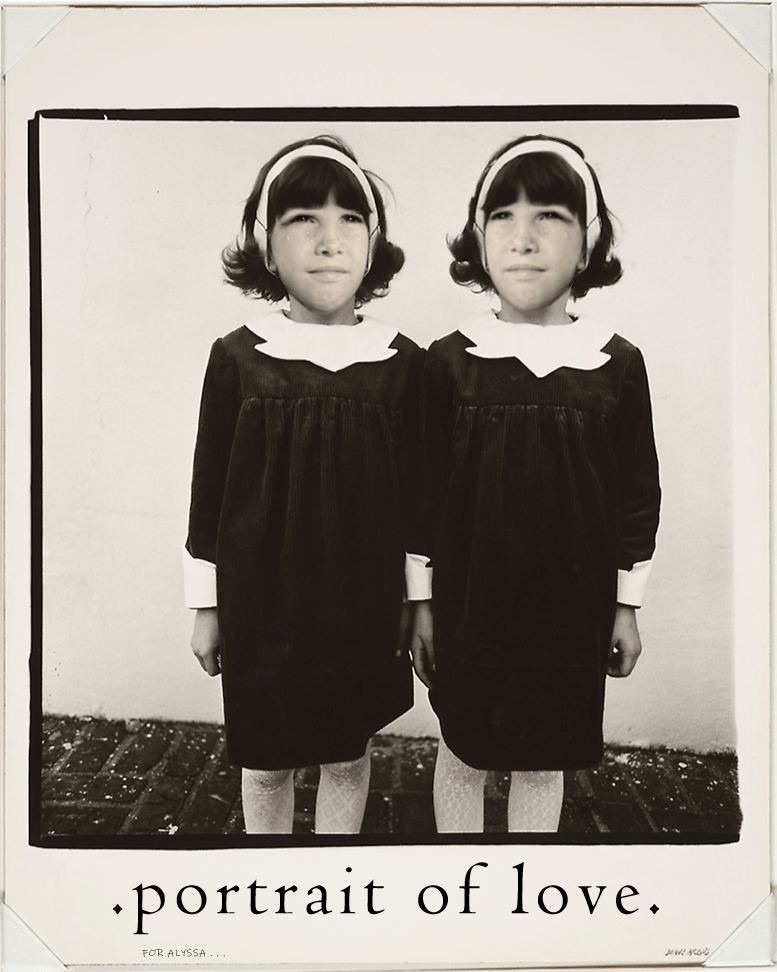
Blunk; or
Will Blinders Never Cease
(a recap by Will Kaiser)
Title: Portrait of Love
Airdate: October 27, 1980
Written by Michael Landon
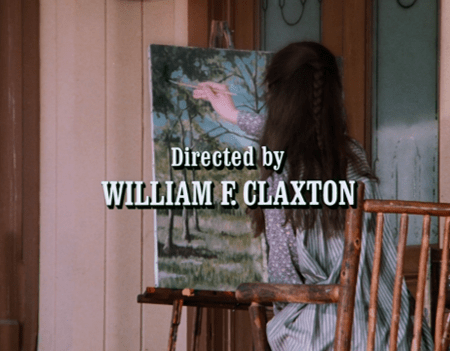
Directed by William F. Claxton
SUMMARY IN A NUTSHELL: The Blind Obsession Tour continues when a completely new blind person addresses some family matters. Featuring Madeleine Stowe.
RECAP: A couple housekeeping items to start. First, this past week I watched Clint Eastwood’s High Plains Drifter for the first time. I can’t recommend it unconditionally – it’s the kind of movie where sass-mouthed saloon girls “get what’s comin’ to ’em,” if you take my meaning – but it’s notable for being a clear inspiration for Season Three’s “The Bully Boys,” right down to Geoffrey Lewis playing the leader of a trio of brutal outlaws who inflict their savagery on the residents of an Old West town. More than that, it features our own Richard Bull, Carl C. Pitti, and John Hillerman (Sterling Murdock), and as such is a sort of Little House feast for those who can stomach its less savory elements.
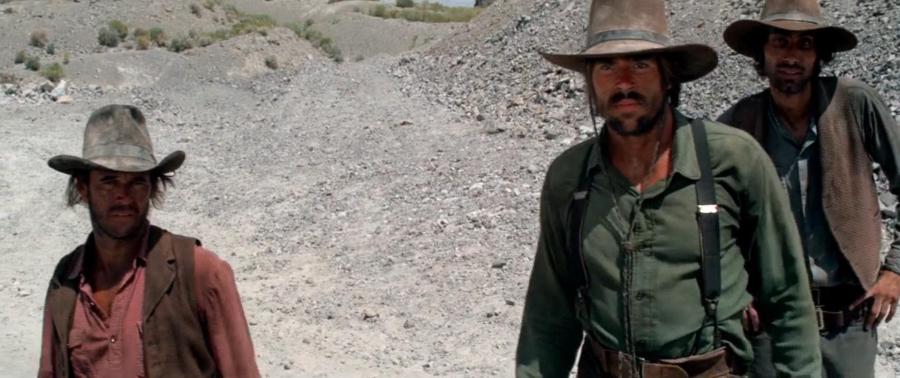
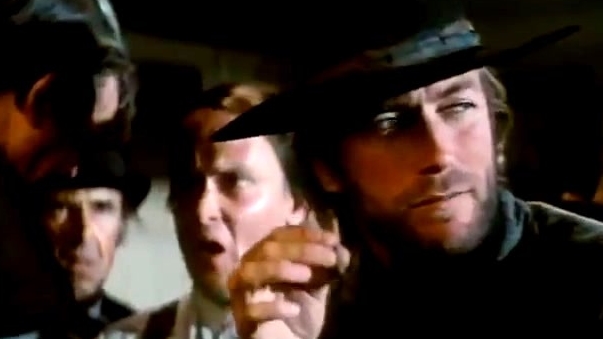
Second, my friend Bernice told me she learned that somebody she knows dated Dean Butler back in the eighties! I have nothing juicy to share about their, uh, coupling (and wouldn’t share it if I did), but I thought you all might be interested.
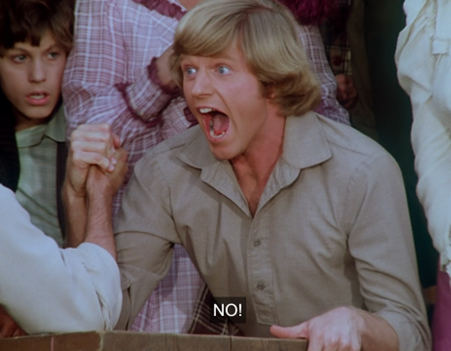
WILL: Now pay attention, Dags. Today’s plot is similar to a story you’re VERY familiar with.
DAGNY: Ready to go.
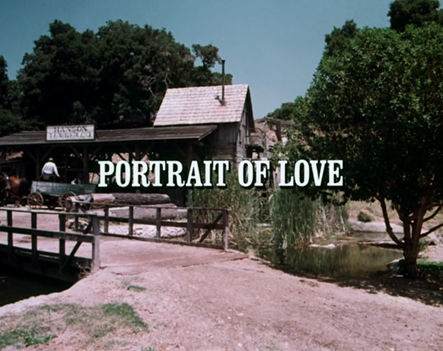
We open on a simple shot of the Mill, with today’s title, no quotes.
A buckboard crosses the bridge. We can’t see the driver’s face, but he and his passenger seem a loving couple.
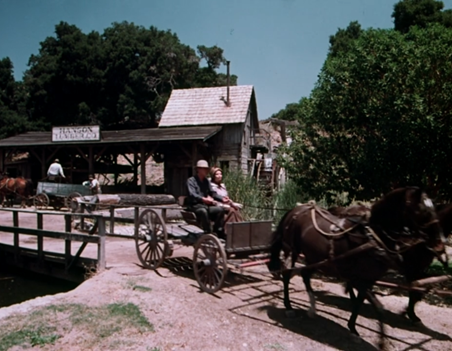
Based on this limited evidence, I’m confident we can conclude it’s Harve and Mabel Miller.
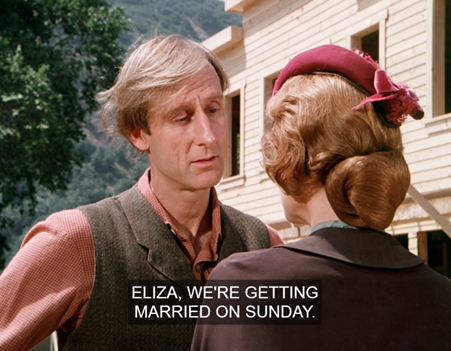
As for why they’re here, no doubt Harve flopped in Missouri (shocker) and came crawling back. Plus it’s safe now, with You Know Who gone.
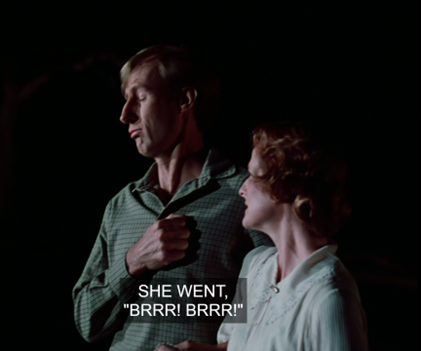
On the porch of Nellie’s/Caroline’s, a young woman is painting a picture.
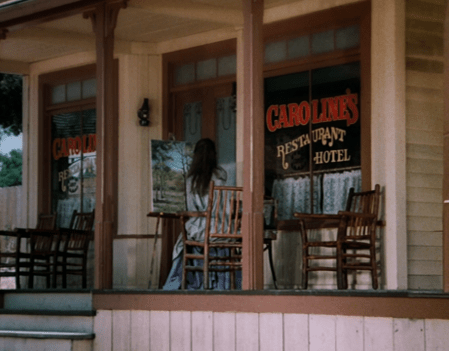
DAGNY: Oh, is the similarity that this person’s a painter like Quaint Irene on Mapp & Lucia?
WILL: No. The similarity will be clear by the end.
Landon wrote this one, and Clax is back as director.
We get a closeup of the artist now. She’s a dark-haired beauty of about twenty. Slender and actually fairly Nineteenth-Century-looking, I think, like the drowned Ophelia in a painting, or something.
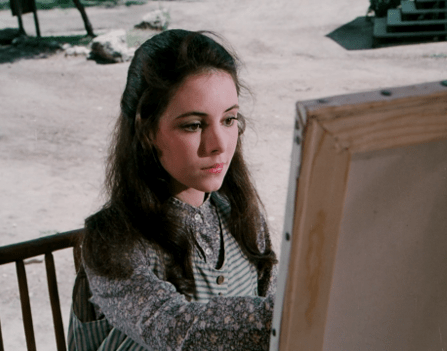

It’s obvious to anyone even passingly familiar with this show that this young woman is blind. While the actor would go on to be famous (we’ll get to who she is in a minute), her blind-acting is effective, but not particularly unique.
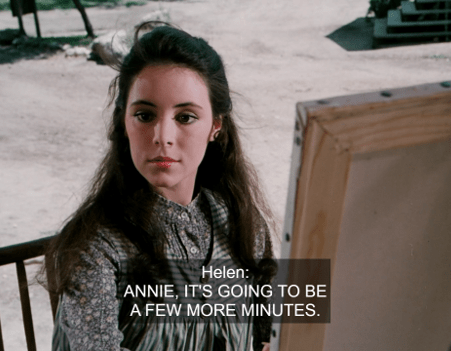
What it is is a perfect realization of the classic Little House “blind” mode, in fact: stiff posture, unmoving eyes and head, no blinking, etc.
You may ask, But if she’s blind, how is she a-paintin’?
Read on.
A lady pops out of Nellie’s/Caroline’s and says she’s still chitchatting inside. The young woman, addressing her as “Mother,” says she’s enjoying her work. “My hand wants to paint,” she says.

The lady goes back in and sits with her husband. Her hat has a kind of pith-helmet look, and he has bushy sideburns.
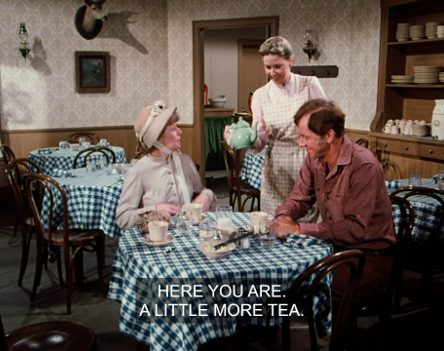
The man, whom we’ve never seen before but who addresses Ma as “Caroline,” invites her to join them for tea since their daughter, “Annie,” isn’t coming in.
Ma peeks out the window and marvels at the picture that’s coming to life. (Ma is easily impressed by artistic efforts, though. She nearly swooned reading John Junior’s masterpiece Prairie Songs.)
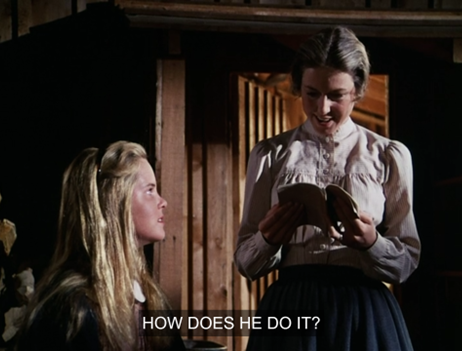
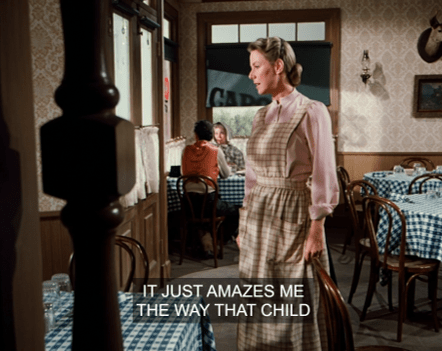
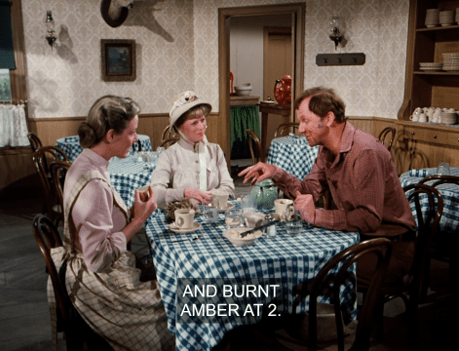
The dad gives us a clue that Annie’s blind, then, saying the paints are organized on the pallet by color, “with azure blue at twelve o’clock, and burnt amber at two.”
WILL [as CAROLINE]: “Burnt amber? Why, that’s the color of my husband’s skin!”

Telling Ma “your daughter” (Laura? Mary?) is responsible for Annie exploring her talent, Annie’s parents confirm she’s “almost totally blind,” meaning her artistic gifts are extra-extraordinary.
The mom says Annie perceives her paintings as “the only thing she can see.” Annie’s mom attributes this to a miracle of God.
The dad rather Reb Tevye-ishly says he wishes God had blessed her with a more practical talent.
DAGNY: That’s a father.
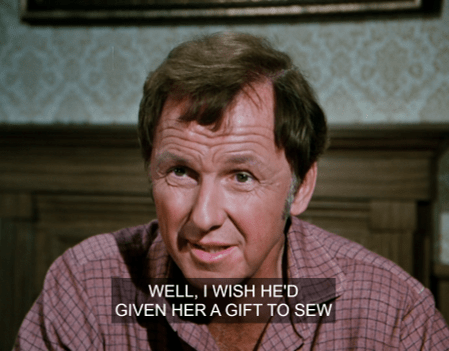
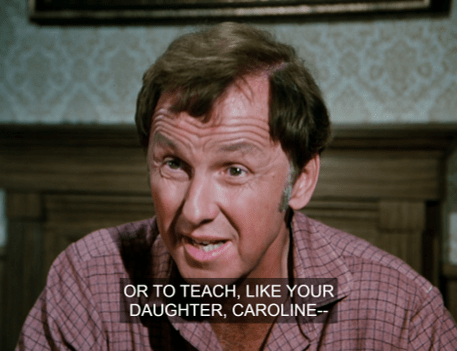
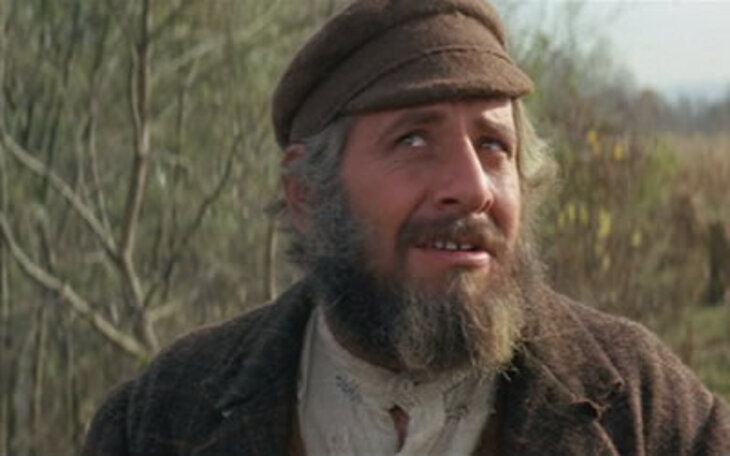
“Oh, now, Sorrell, don’t start that,” the mom says mildly.
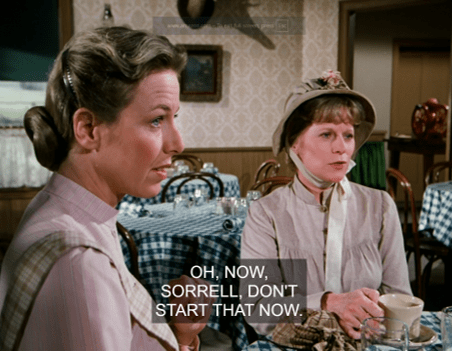
As Two Fat Ladies fans and other culinaristos may recall, sorrel is a lemony herb used in European cooking before citrus was widely available. (Some people still use it.)


(Greatest cooking show of all time.)
Addressing his wife as “Helen,” Sorrell says Caroline is such a close friend of theirs (despite our never seeing them before) that he knows he can speak frankly and not be judged.
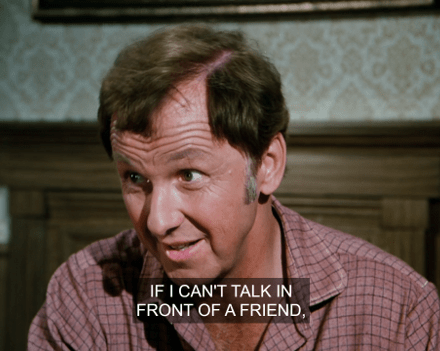
Apropos of nothing, Sorrell says, “My wife doesn’t like to think about our dyin’, but it’s a fact of life.”
WILL: They’re like my parents advance-care planning.
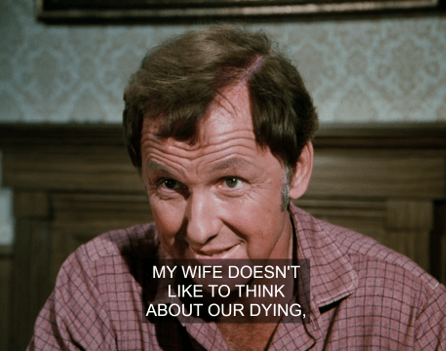
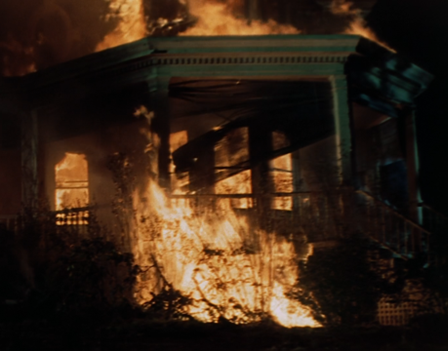
Sorrell says he’s worried how Annie will support herself should they die in a fire, stagecoach crash, anthrax epidemic, or some combination. (Paraphrase.)

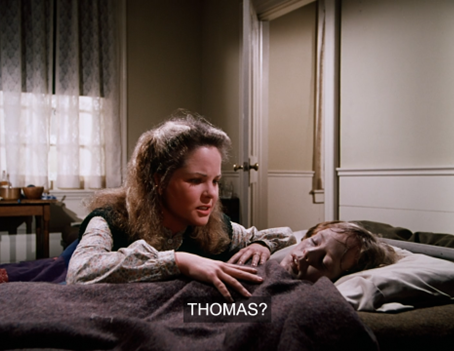
Suddenly, Ma says, “Well, that isn’t gonna be for quite a while yet!” in a Southern accent to rival Penelope Parker’s.
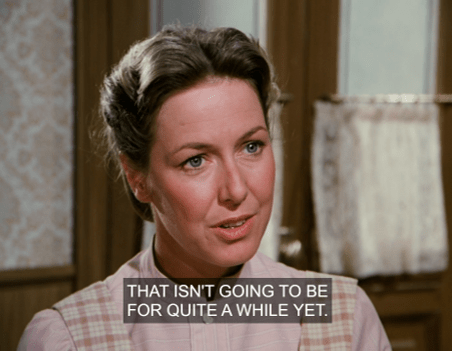
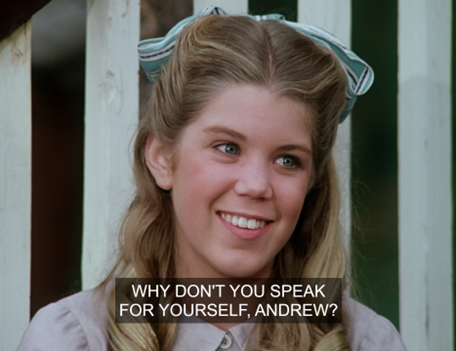
AMELIA: What just happened there?
DAGNY: Yeah, she sounded like Julia Sugarbaker for a minute.
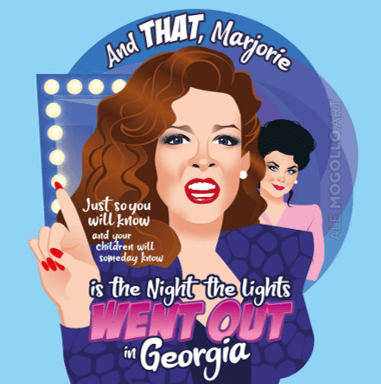
WILL: Yeah. She sounded like she was from South CAROLINE-A! Get it?
AMELIA: Yes, I get it, Pops.
Sorrell mentions they adopted Annie “as a baby.”
DAGNY [wearily]: Another adoption?
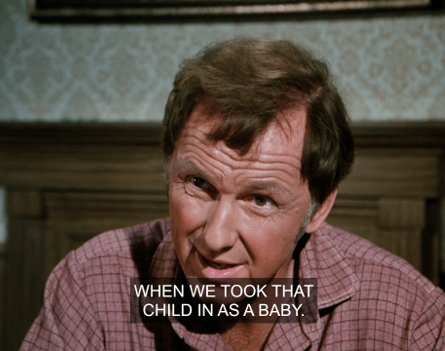
(Apparently these people prove Mr. Case the Orphanage-Master of Sleepy Eye wrong about parents being unwilling to care for disabled children.)
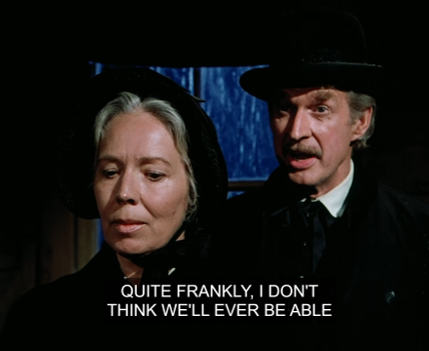
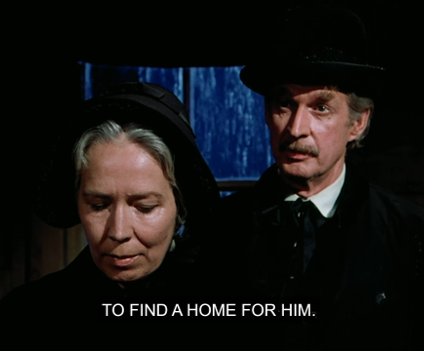
DAGNY: The dad has an interesting browline. It’s the opposite of the Muppet eyebrows most men on this show have.
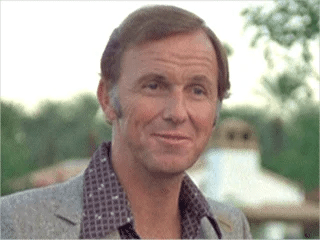
Sorrell (the family surname is Crane according to the credits) is played by Paul Napier, who had a recurring role on Knots Landing and who also acted on Dynasty, Days, Coach, and Saved By The Bell.
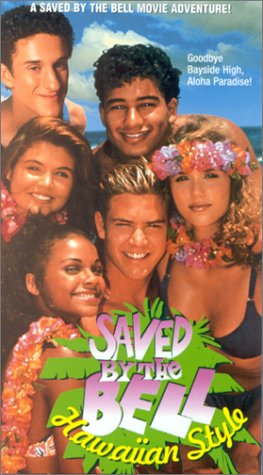
Last week Friend of Groovy Maryann said she thought Married…With Children was “the start of the downfall of TV.” (I mentioned this to Little Orphan Joshie, which made him cry.)
I’m not saying she’s wrong . . . but it’s Saved By The Bell that would get my vote.
One last thing: Paul Napier was apparently Mr. Goodwrench in the General Motors commercials of the Twentieth Century.
Well, Helen Crane says she’s got picklin’ to do, so Caroline escorts them out.
“Oh, it’s beautiful!” Ma screams when she looks at Annie’s painting. (See what I mean about her enthusiasm?)
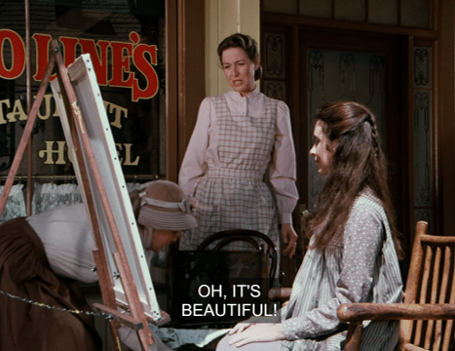
Annie offers to give it to Ma as a present, but Ma says she couldn’t possibly.
WILL [as CAROLINE]: “Oh, no, we’re only allowed to keep one piece of art at the house. It’s a Little Bo Peep figurine. I love Little Bo Peep.”
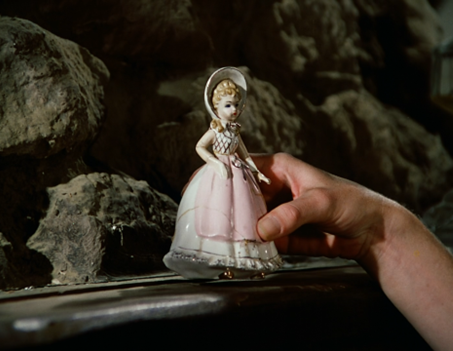
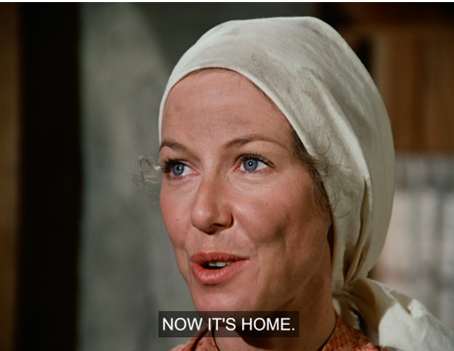
DAGNY [as CAROLINE]: “Sometimes Charles likes to pretend his carvings are art, but they aren’t.”
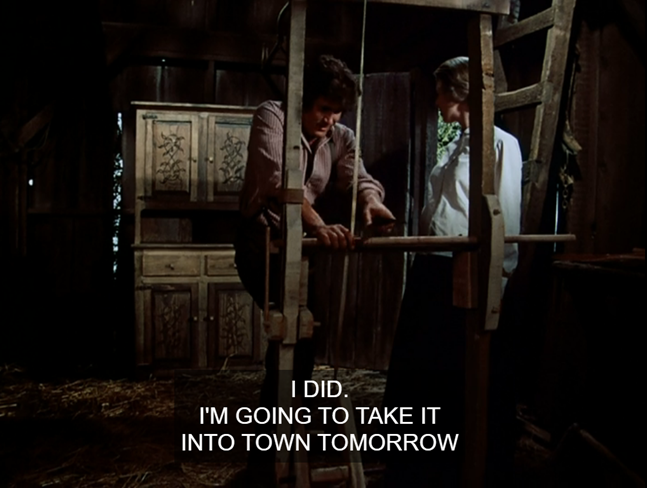
Actually, Ma does accept the gift, but I don’t think we ever see it again.
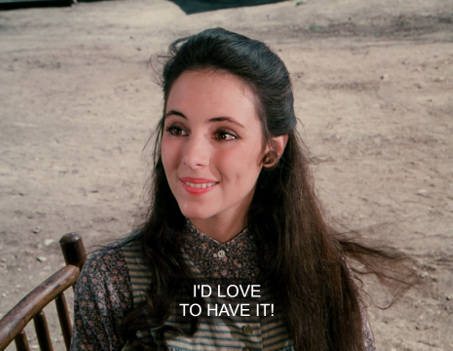
DAGNY: Who are these people? There’s a blind person in town that’s best friends with the Ingalls, but we’ve never met her?
It is strange. Certainly none of the Blind School students we’ve met resemble Annie.
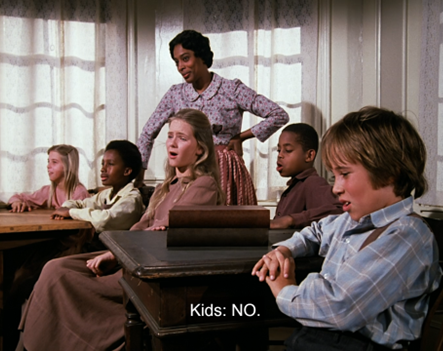
Annie’s painting is of a woodland scene, and Ma puts it on the mantelpiece in Nellie’s dining room.
AMELIA: Looks like a Bob Ross.
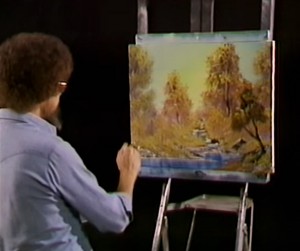
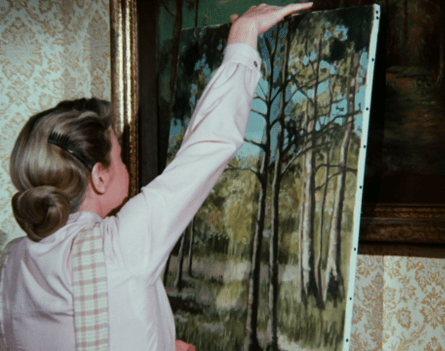
Next, rollicking “Western” music of the sort normally reserved for travel/work montages accompanies Mustache Man’s coach as it arrives at Nellie’s.
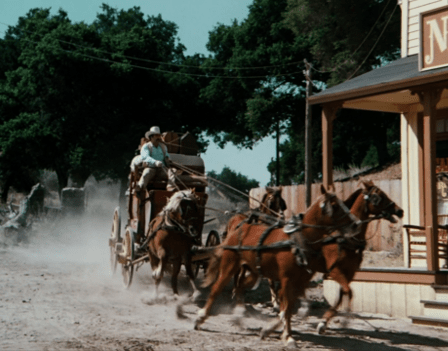
AMELIA: Whoa, what’s wrong with that horse? Are they gonna shoot it, like in True Grit?
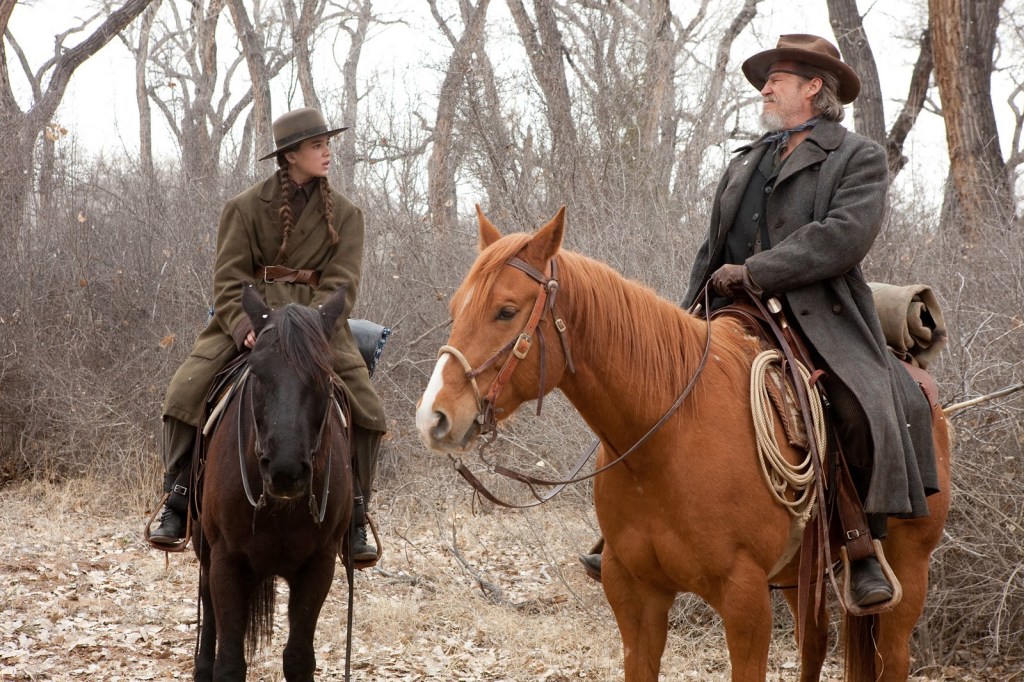
They don’t shoot it, but one of the horses does appear to be in some distress.
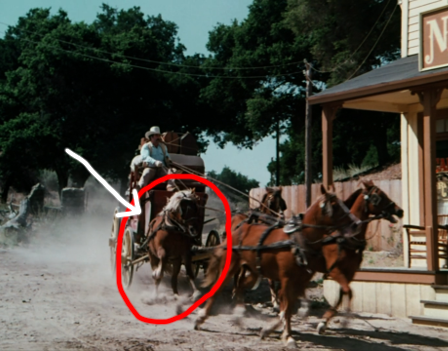
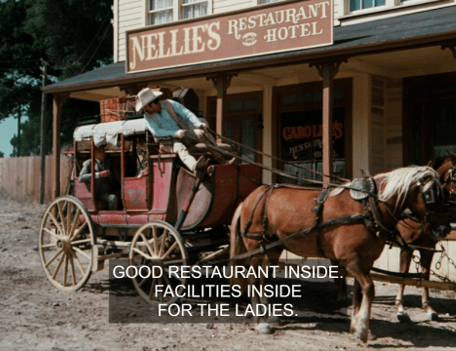
Mustache Man gives Caroline’s a nice little plug as the passengers get out.
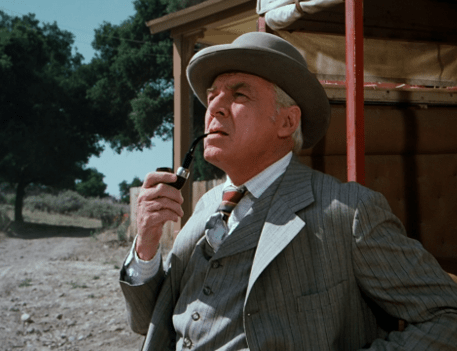
A professorish late-middle-aged man smoking a pipe disembarks. He puts a hand on his hip confidently.
DAGNY: Who’s this, now?
WILL: It’s Professor Van Helsing. There were reports of a vampire in the area.
J.C. Fusspot’s pretty sister, who was also in the stage, and a man who’s not very pretty but who has nothing really objectionable about his appearance either enter Caroline’s.
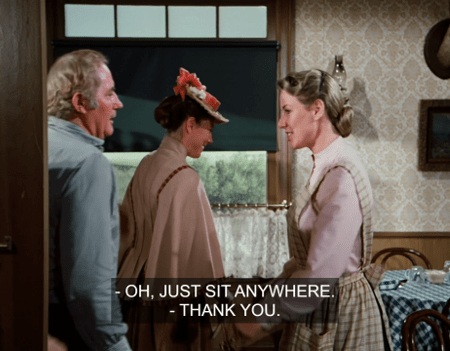
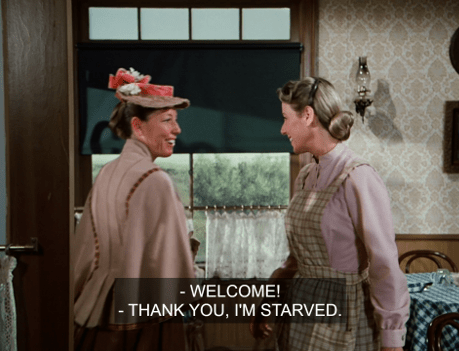
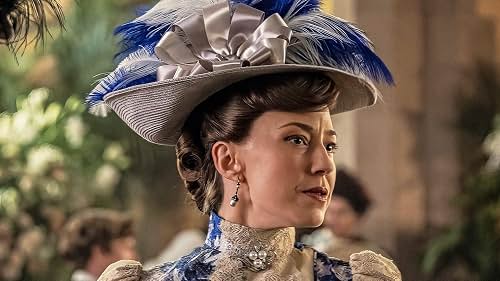
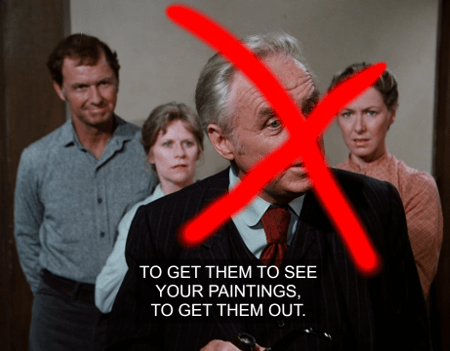
Ma welcomes them in, and the Fusspot Sister gives her a bright smile and says, “Thank you, I’m starved!” She looks a bit like (the gorgeous) Carrie Coon of The Gilded Age.
The professorish pipe-smoker makes a beeline for Annie’s painting.
Like a museum docent, Ma rushes over and says don’t touch it.
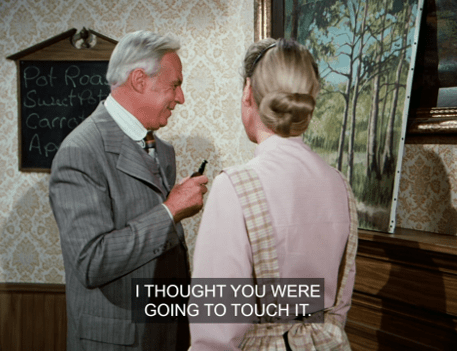
The man describes the painting as “extraordinary.” (It doesn’t seem to me to be an extraordinary example of anything. But what do I know?)
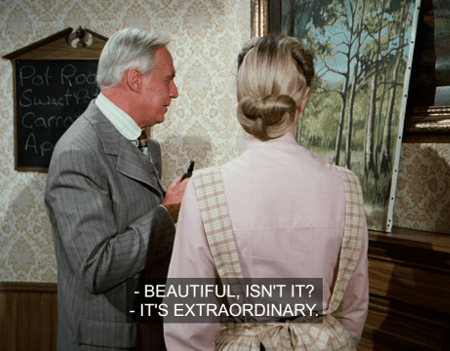
The Professor is amazed when Caroline tells him that Annie’s blind.
Introducing himself as “Jeremy Unger,” the man produces a visiting card and instructs Caroline to give it to Annie. (He’s a bit high-handed with her, I think.)
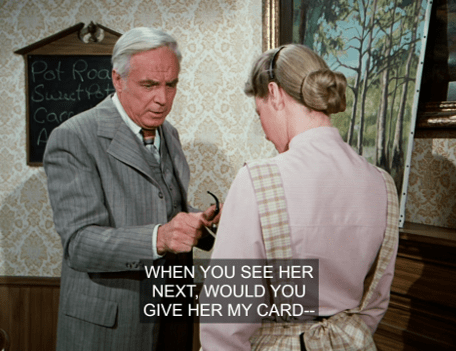
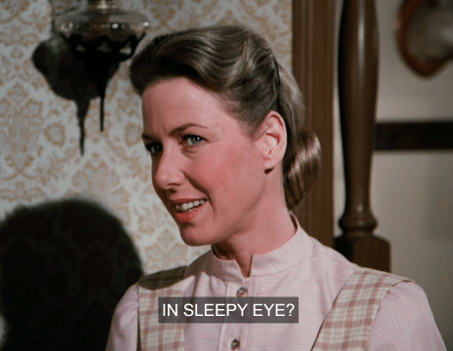
This Unger is apparently a gallery owner. Ma says, “In Sleepy Eye?” – for once voicing the audience’s dubiousness.
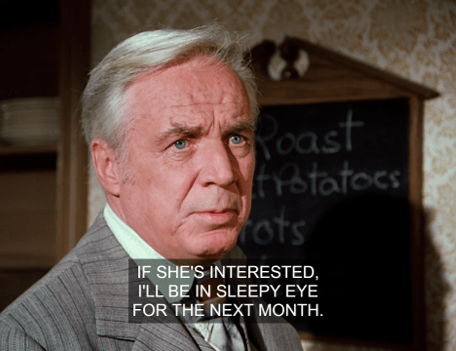
Professor Unger says his main dealership is in Minneapolis – then as now the arts hub of the state.

Unger says he’s most keen to talk to Miss Crane.
WILL [as UNGER]: “You see, I run a small circus . . .”
Still a bit pompous, Unger then orders a liverwurst sandwich.
AMELIA [as UNGER]: “I’m very Ungry, ha ha!”
WILL [as UNGER]: “That’s an old Unger family joke.”
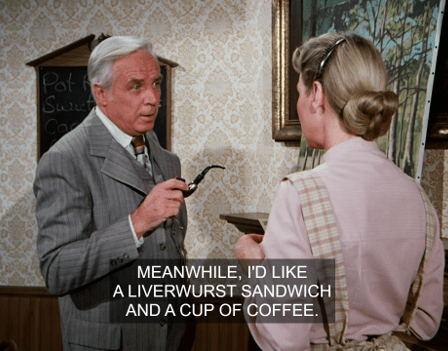
Next we see Ma delivering the news to the Cranes, presumably at their home. Annie, who’s painting a new picture, is astonished to learn of Unger’s interest.
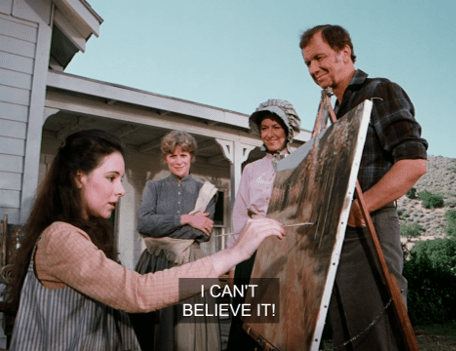
WILL: Can you still use the term idiot savant?
AMELIA: No. I learned that on The Pitt.
DAGNY: I can’t believe you’d need to ask that.
Ma offers the use of the Chonkywagon to take Annie’s many, many artworks to Unger’s gallery in Sleepy Eye. (Why would they need to bring them? Couldn’t he just come to the house and look at them? He’s already in Walnut Grove, and I’m sure he’d pay the shipping if he wanted to buy them.)
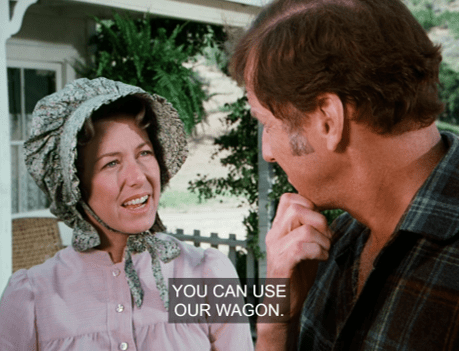
Caroline even volunteers to drive the family herself. Are they serious? The series hasn’t really explained how Caroline has time to run a full-time restaurant, keep her own Little Household, and run around delivering messages to blind artists . . . much less delivering the paintings themselves to galleries a full day’s drive away!
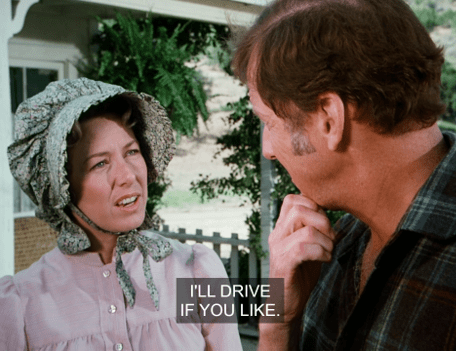
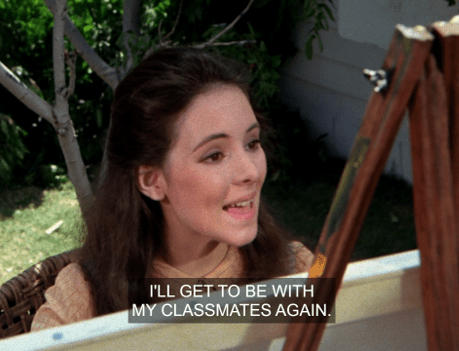
These mysteries go unanswered, but never mind. Ma says they’ll have free lodgings at Garvey Kendall. “I’ll get to be with my classmates again!” Annie exclaims. (Again, we’ve never seen any student remotely resembling Annie at the school.)

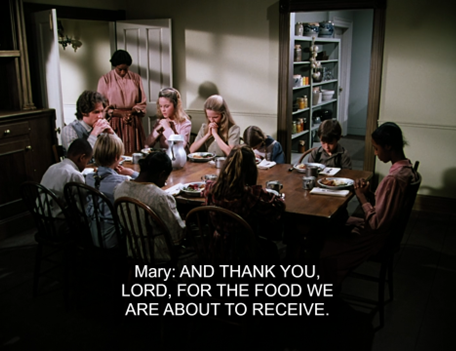
Then Annie cries, “I want to paint happiness!” (On second thought, maybe she did go to the Blind School. That’s sure the kind of idiotic thing Sue Goodspeed would say. They were probably roommates.)

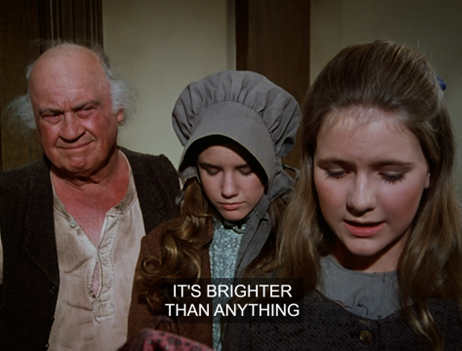
(This raises a question: If Sue G and all the other blind kids moved to the new school in Sleepy Eye, why didn’t Annie go with them?)
Well, the next thing you know Ma is driving the wagon cross-country with the top up.
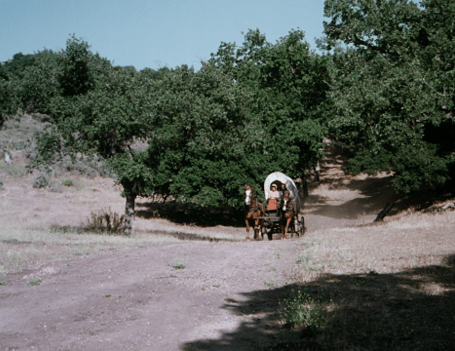
DAGNY: Hey, harpsichord!
AMELIA: Yes . . . but HOW MANY harpsichords?
(A little inside joke. We had attended a concert of Bach’s concertos for three and four harpsichords earlier that weekend at the Twin Cities Early Music Festival. It was jangly.)
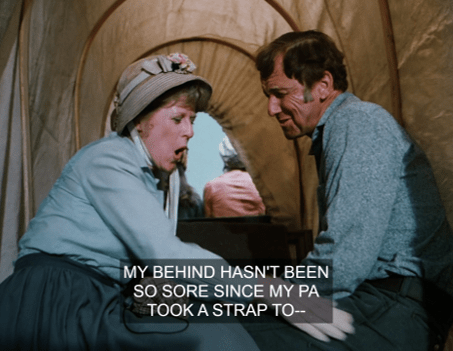
In the back, Sorrell Crane complains that the bumpy road is a pain the ass, literally.
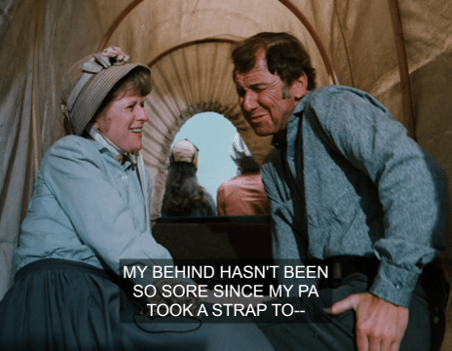
Helen Crane laughs and slaps him on the haunch, the saucy wench! They seem like good people.
Up front, Annie and Boobilicious Ma shoot the shit, Annie humming “Camptown Races” at one point.
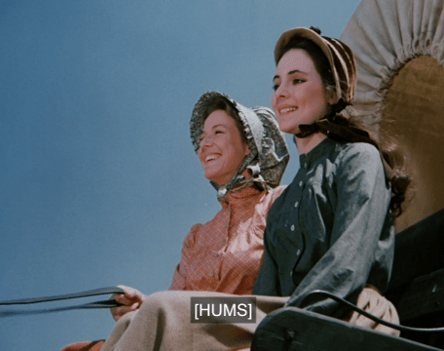
DAGNY: Who is she? I recognize her. Did she play a blind person in something else?
WILL: She did! It’s Madeleine Stowe. She was in Blink. Is that what it was called? Or Blunk?
DAGNY: It wasn’t Blunk.
WILL: Squint? Or Close Your Eyes?
DAGNY: Hide Your Eyes?
It was Blink.

Blink, you may recall, was a thriller from 1993, in which a young blind woman gets an eye transplant, then witnesses a blurry murder, I think. (The nineties was a great time for trashy mainstream psychodramas like this: The Hand That Rocks The Cradle, Sleeping With The Enemy, Single White Female, etc., etc.)

Madeleine Stowe was a big movie star, or nearly, in the nineties, appearing in the Stakeout series, The Last of the Mohicans, Terry Gilliam’s engrossing if annoying post-apocalyptic time-travel thing 12 Monkeys, and Robert Altman’s Short Cuts, one of my very favorite movies from that period.
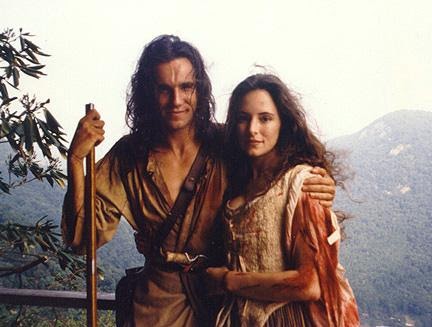
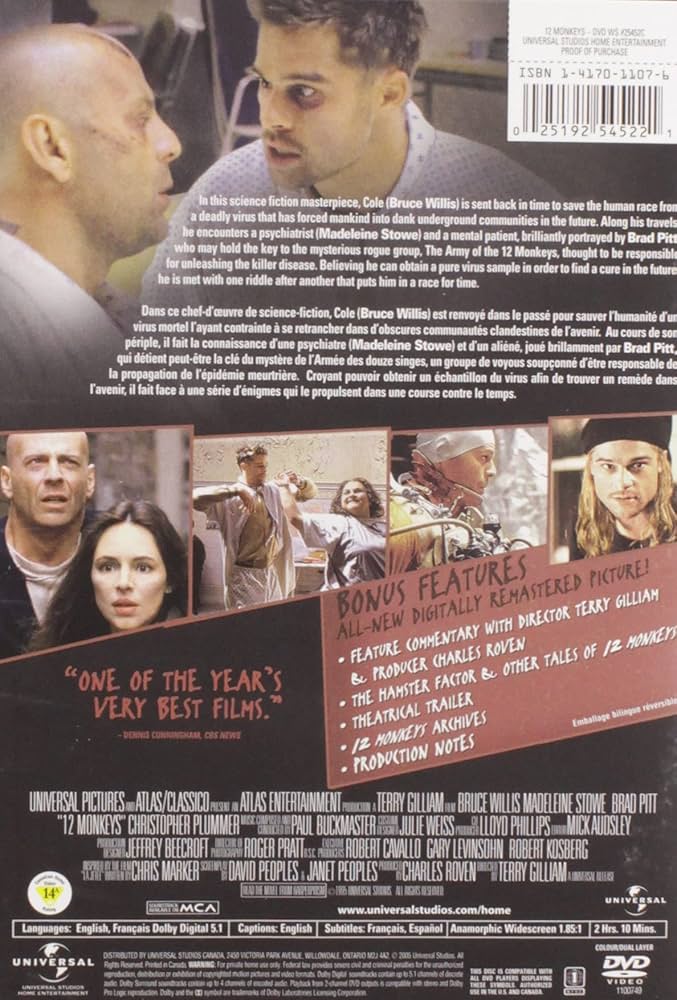
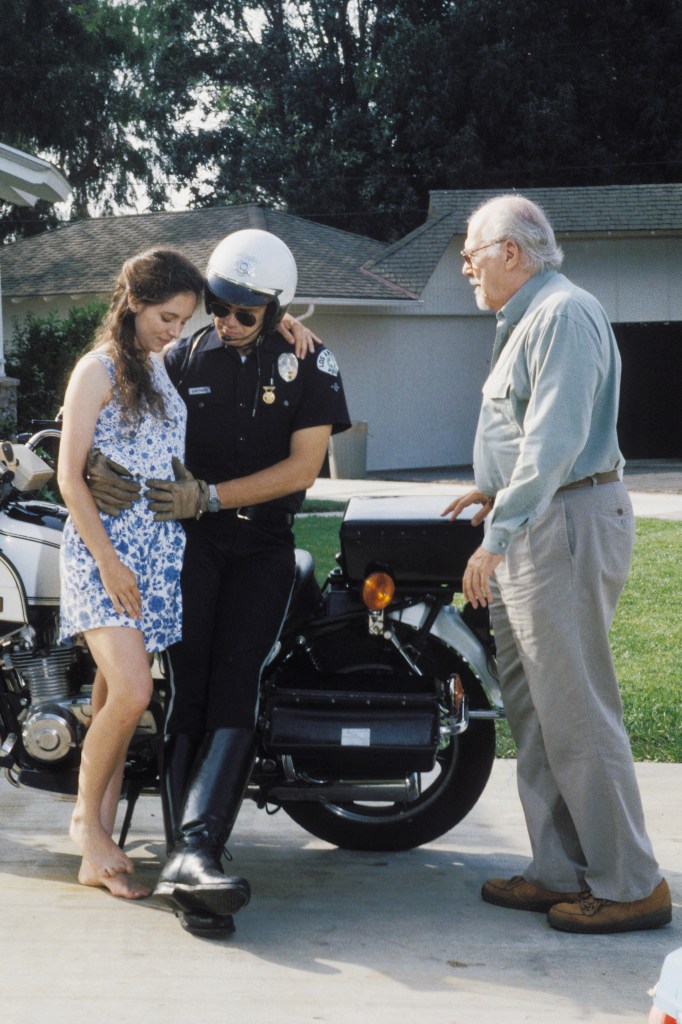
But she semi-retired before that decade was through and has acted only intermittently since.
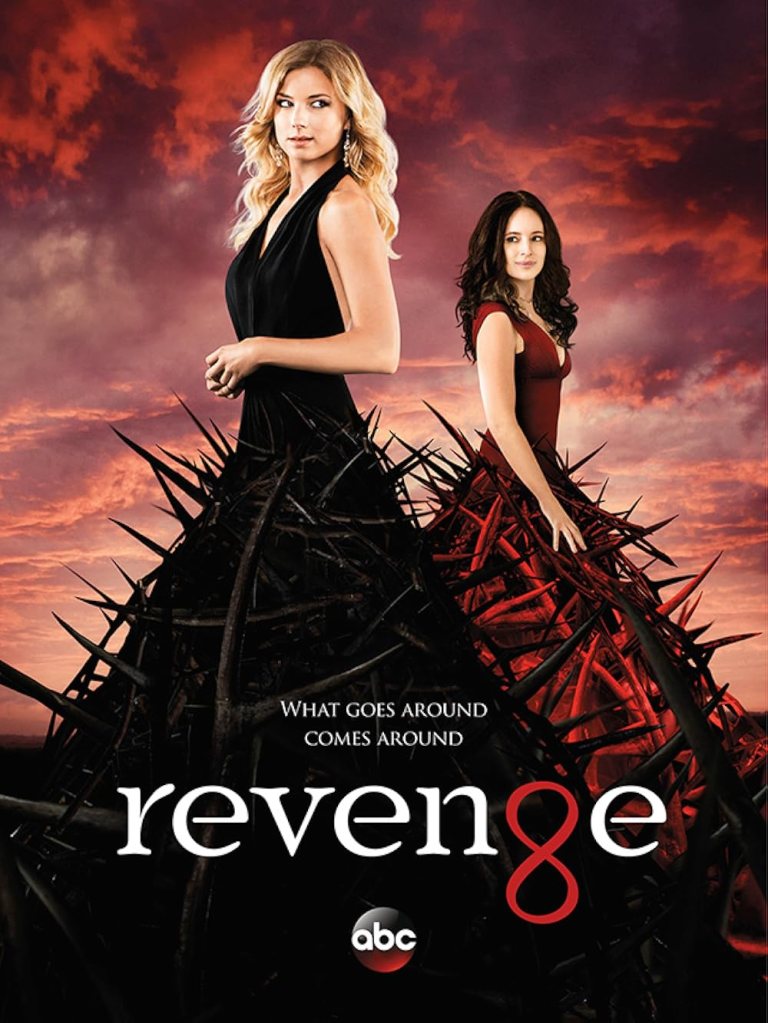
She was a regular on a TV show called Revenge in the 2010s (I don’t know it) and did a cameo on the 12 Monkeys TV series, which was inspired by the movie.
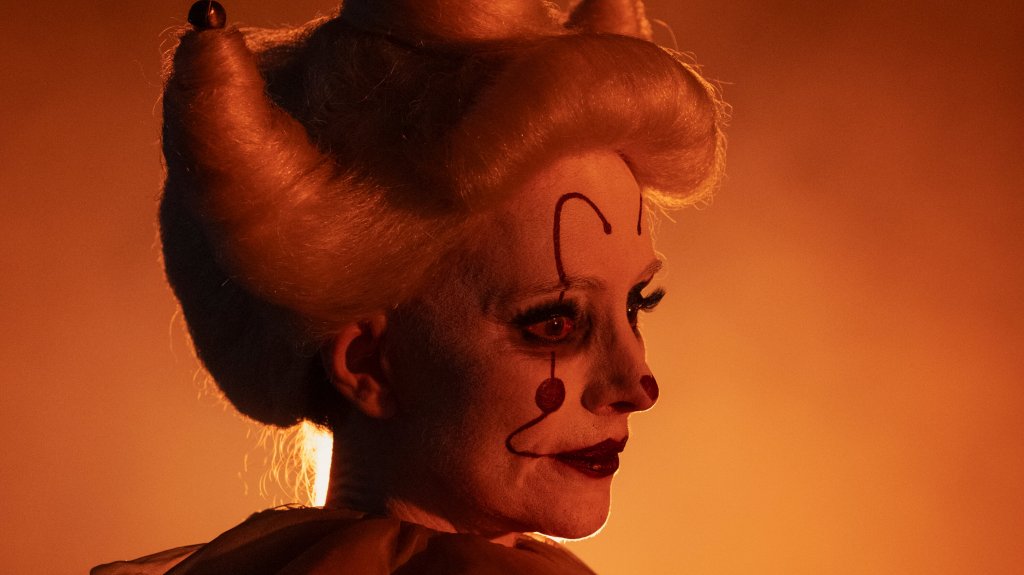
More recently, she played Mrs. Kersh, a scary throwaway character in Stephen King’s IT who is given an elaborate backstory in Welcome to Derry.
Annie explains why the screenplay author (Landon) took pains to have Professor Unger recognize the quality of her art before learning she was blind. Annie has (probably correctly) thought her sightlessness raised her work in her family and friends’ estimation; unable to judge her own work, she wants validation as a true artist, not just a performing oddity.
Then we cut to Professor Unger chewing his pipe as he scrutinizes Annie’s paintings. Indeed, they are Bob Ross-y across the board.
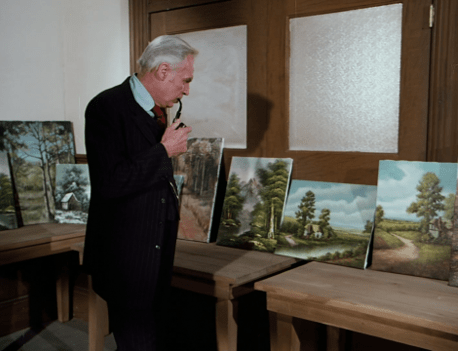
I’m sure there were a shitload of drippy landscapes painted in late Nineteenth-Century America, but I think it would have been more fun to give her the fun and cartoony “folk art” style of a lot of self-taught creators of the time. (Plus her pictures would be much less boring.)

Unger is revealed to be at Garvey Kendall, with Mary and Adam themselves in attendance.
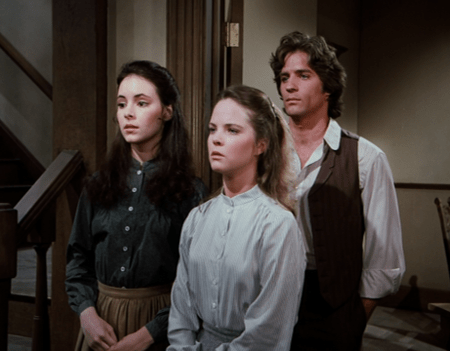
AMELIA: Why do they have to have other blind people with her?
WILL: To prove she’s really blind. Adam had to run her through the tests.
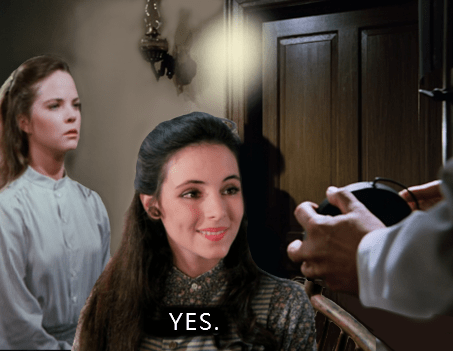
Annie says she doesn’t want the gallery customers to know she’s blind, but Unger says it’s a great marketing hook and not a criticism of their quality.
DAGNY: She should also pretend to be a man, so people will actually buy her paintings.
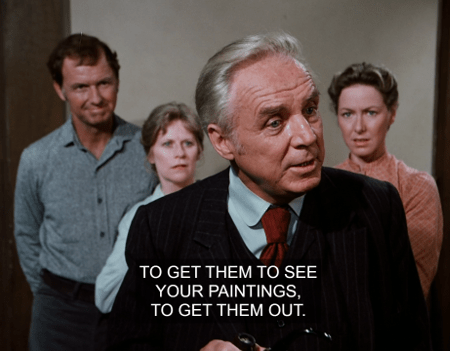
Unger is quite cynical about how all artists are poseurs of one sort of another. He even disses Vincent van Gogh’s famous ear-endectomy as a publicity stunt.
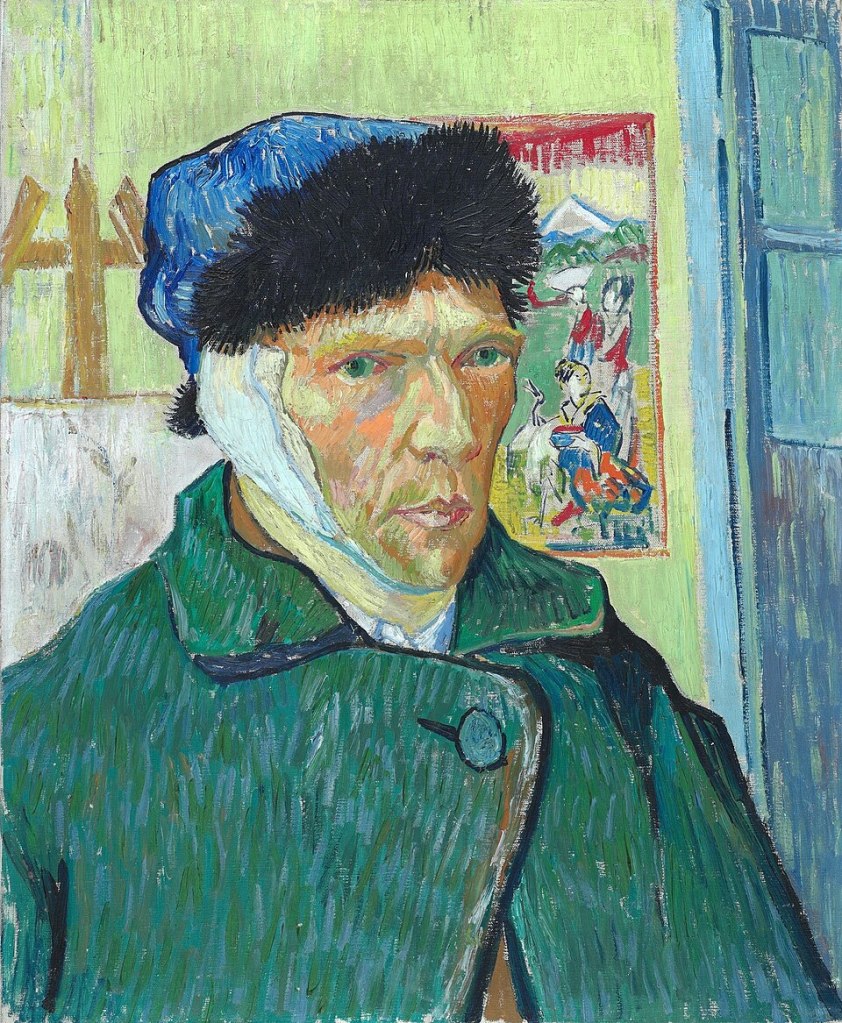
(The circumstances under which Van Gogh cut off his ear are a little unclear, but it wasn’t a publicity stunt. Also, I date this story to 1885, three years before Van Gogh severed the ear.)
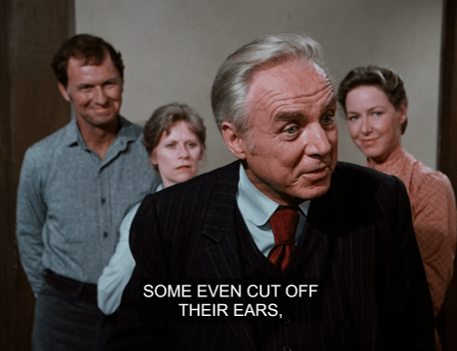
Unger is Ward Costello, a former journalist and World War II vet who had a recurring role on General Hospital and who also acted on Alfred Hitchcock Presents and Barnaby Jones.
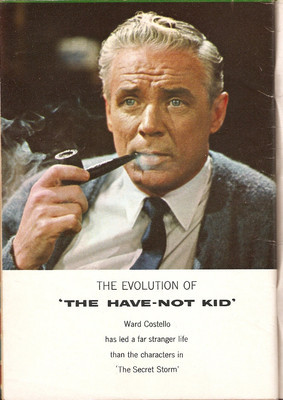
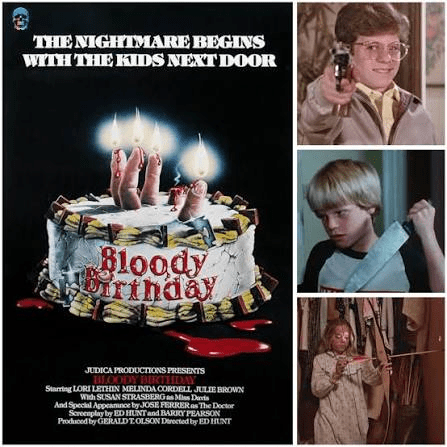
He appeared in the movies Return to Witch Mountain, Bloody Birthday (excellent – about killer ten-year-olds), and Roe vs. Wade.
He was in Code Name: Diamond Head, which was memorably featured on Walnut Groovy’s ancestor Mystery Science Theater 3000.
Costello wrote a pretty folk song that was used as the theme of a World War II film called The Gallant Hours.
And he guest-starred in a notoriously horrific Star Trek: The Next Generation story arc, playing a Starfleet admiral who falls under the control of an alien parasite.
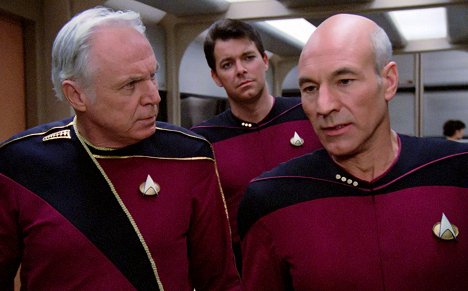
He survives and recovers . . . but not everyone is so lucky:
(I saw that episode the first time it aired and couldn’t believe they put it on TV. Gag, barf.)
Well, Mary grins through this whole scene, but says nothing.
Next we see a goofy-looking young man who looks like a scarecrow in somebody’s garden, selling newspapers.
AMELIA: Is that Alexander?
(He’s not un-similar.)
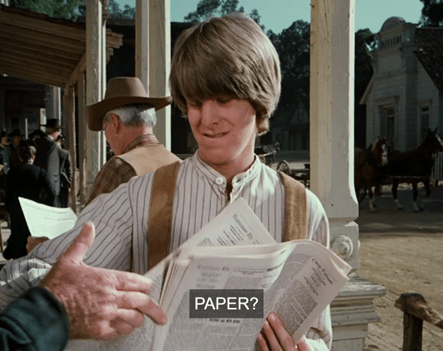
Not-Alexander’s customer is the Alamo Tourist from Pee-Wee’s Big Adventure, and the paper he’s selling is called The Bradleyville Register, a publication which promises, in a truly bizarre font, the “Complete News of the Community and the County.” (“Bradleyville” is not a real Minnesota town.)
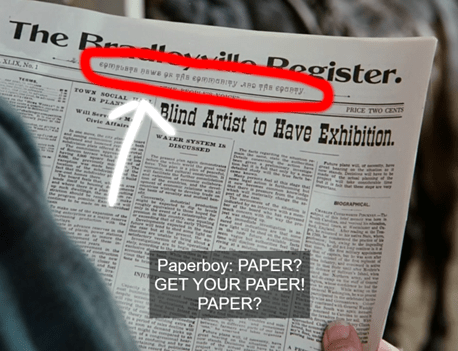
The headline at the top reads “Blind Artist To Have Exhibition,” but the article underneath it, quite hilariously, is about nothing.
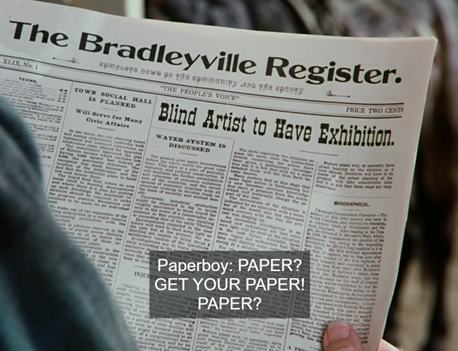
(Excerpt: “An immediate investigation is assured and indications are that some new light will be shed on the situation in the near future. Available facts seem vague but authorities feel time will disclose some means of arriving at a solution.” Available facts seem vague indeed!)
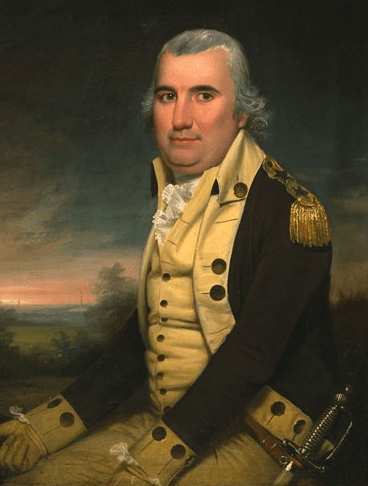
For unknown reasons, the front page also includes a profile of lesser-known Founding Father Charles Cotesworth Pinckney. (Pinckney was a crony of Alexander Hamilton’s who ran for President multiple times.)
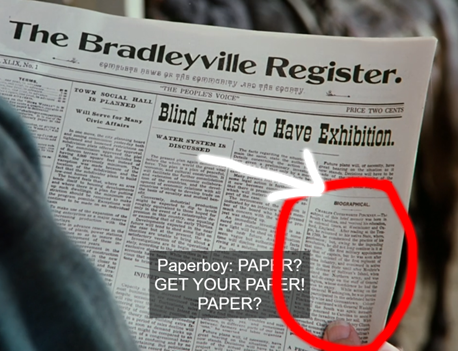
The back page of the paper, meanwhile, shows that another crop has failed, and that old Ely is at it yet again.
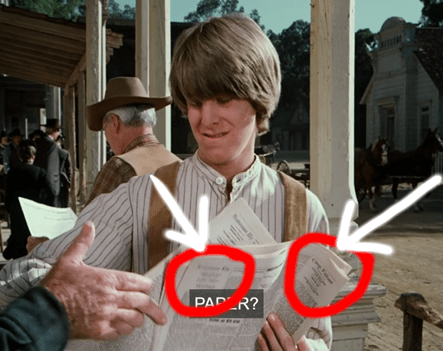
Then we cut to a man reading the news to a woman who appears to be bedridden (or just tired).
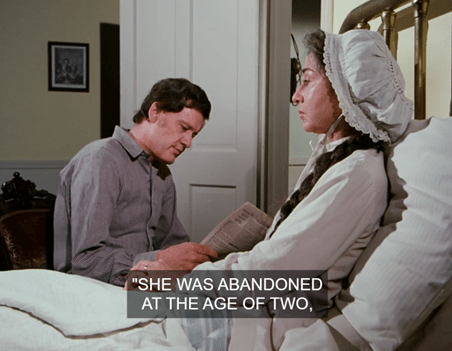
The article gives some details about Annie’s progression into blindness.
AMELIA: So is she really blind, or isn’t she?
DAGNY: Blindness is a spectrum, she can probably see colors, etc.
WILL: Oh, so she’s faking it?
DAGNY: That is not what I said at all.
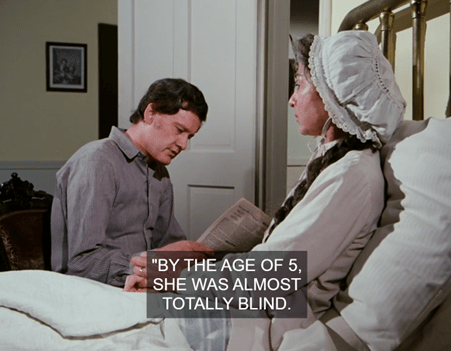
The man also reads that Annie was a student at Garvey Kendall/the Oleson Institute dating all the way back to Winoka.
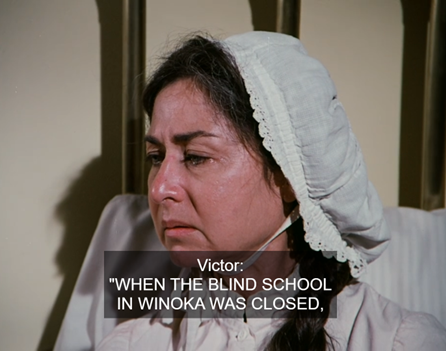
Frowning – she seems quite restless and uneasy, in fact – the woman in the bed says, “It’s her – my little Sandra.”
WILL: This is like The Marriage of Figaro. Do they identify her with a birthmark?
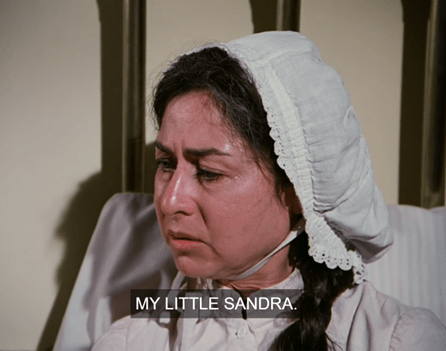
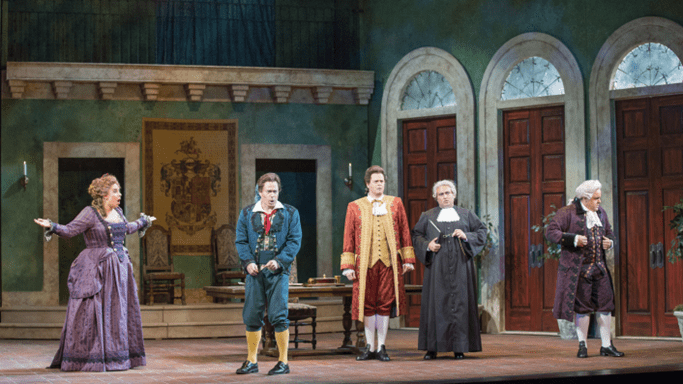
The man reads that the Garvey Kendall School will be hosting the exhibition of Annie’s work. (Why there, and not Unger’s gallery? Just to reinforce the blind gimmick?)
DAGNY: He looks like a schlubbier Colin Firth. You know, remember when he firtht thtarted to get old?
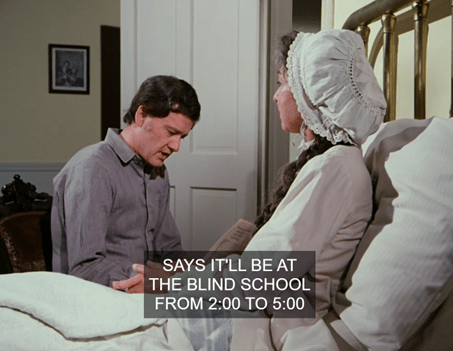

The man notes that the exhibition will be held “on September eighth, ninth and tenth.” Hmm. “‘Fight Team Fight!’” took us into the 1885 football season, and the timeframe for “A Silent Cry” was somewhat ambiguous, so I’d guess we’re now in 1886 of the M timeline.
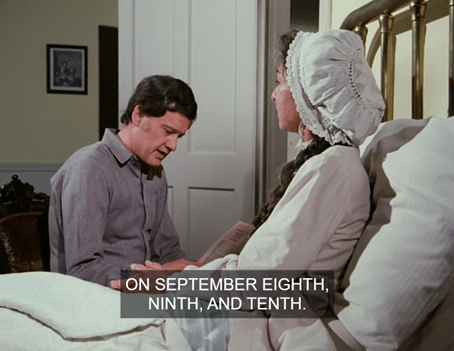
Anyways, Schlubbier Colin Firth appears in the credits as “Victor Crosby,” and he’s played by Jim Antonio, an actor with a lot of interesting credits who, as of this writing, is still alive and kicking at 95.
On TV, Antonio did Lassie, Get Smart, The Waltons, Mannix, Quincy, and JAG, and he was in the movies Splendor in the Grass, the Ward Costello vehicle Roe vs. Wade, the crazy Gregory Hines robot action-thriller Eve of Destruction, Outbreak, Pleasantville, and Catch Me If You Can. (I hated that last one. I’m not sure if I’ve seen a Leonardo di Caprio movie since.)
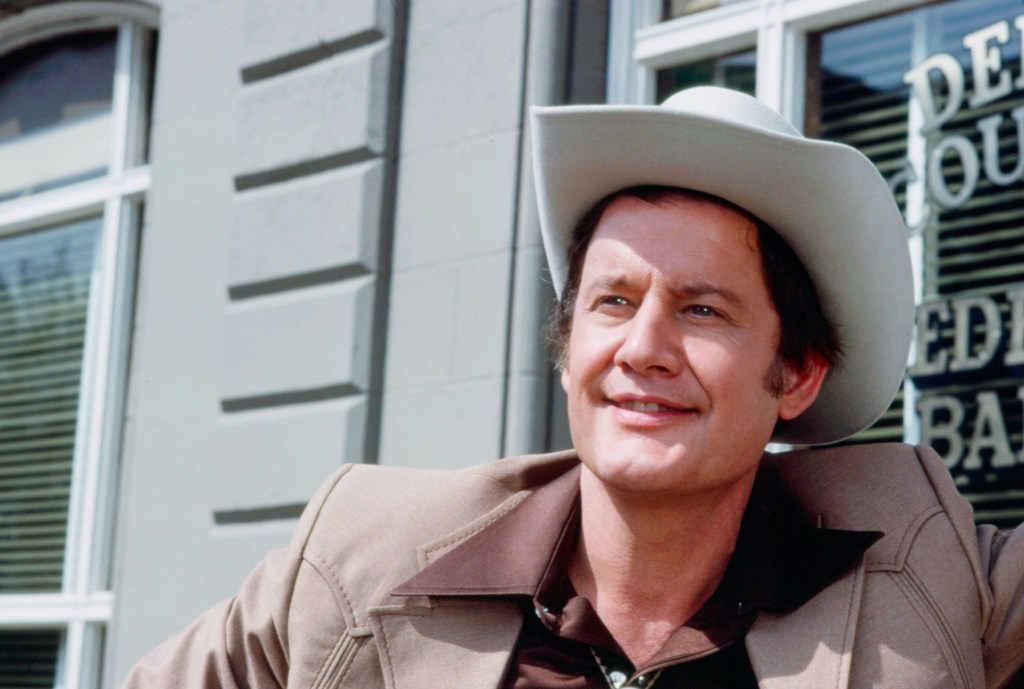
Quite curiously, at the start of his career, he appeared starkers in a couple soft-core “nudism” films from sexploitation legend Doris Wishman, Blaze Starr Goes Nudist and Gentlemen Prefer Nature Girls.
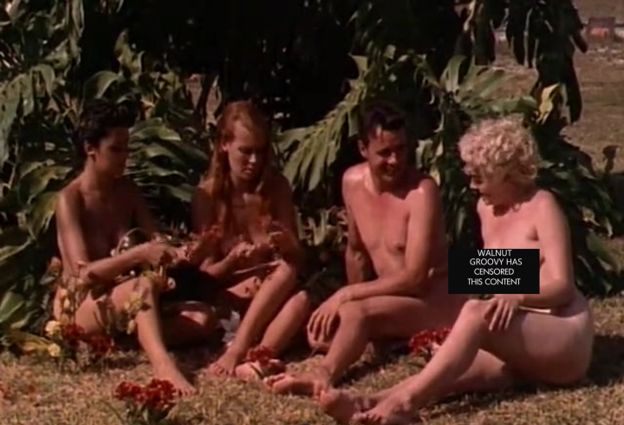

No nudity for him or anybody else on today’s Little House, though.
Well, Annie/Sandra’s bio mother embarks on a dark reverie about abandoning her child fourteen years earlier.
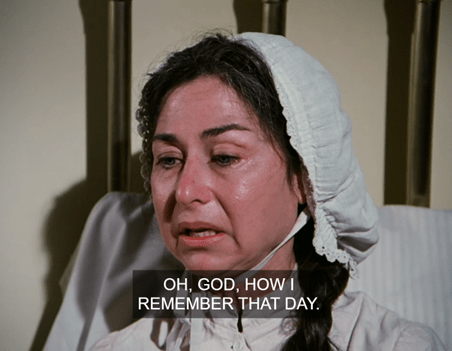
In obvious emotional torment, the woman says, “I can still see her, sitting on the steps of the Winoka school. . . . ‘I’ll be back soon,’ I said. . . .”
(I don’t know what school she means. There was no blind school in Winoka until Adam, Mary and Mr. Ames arrived there in 1882-G.)
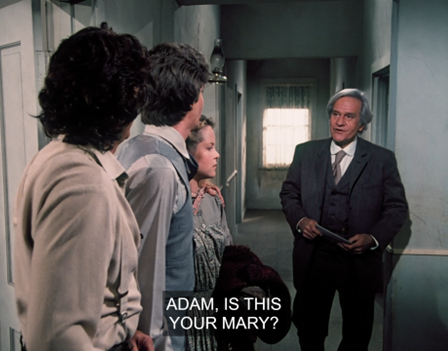
Addressing the woman as “Marge,” Victor tells her not to torture herself.
Victor says Marge could never have raised Annie herself given the circumstances. (He doesn’t say what those circumstances were, but the implications are that he isn’t Annie’s father.)
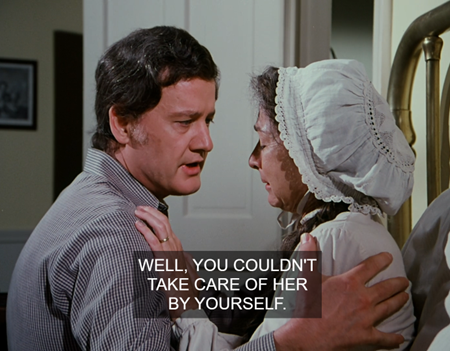
Shuddering with regret, Marge says the pain of letting her daughter go was unbearable, and still is. She insists Victor go to Annie’s exhibition in Sleepy Eye and tell her she was always loved.
Victor clearly thinks this idea is not the goodest – but, calling him “my love,” Marge insists.
Finally, Victor agrees, saying, “I’ll get Mrs. Hawkins to look after you.” He gently insists she eat some soup so she’ll get her strength back.
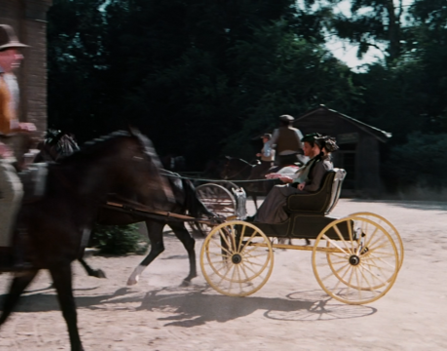
After a break, we find ourselves in Sleepy Eye, where J.C. Fusspot’s Visiting Sister is driving through town in a yellow-wheeled buckboard. (I guess now we know where she was visiting from.)
And in front of Garvey Kendall is a poster advertising Annie’s exhibition. (It doesn’t seem to mention her blindness.)
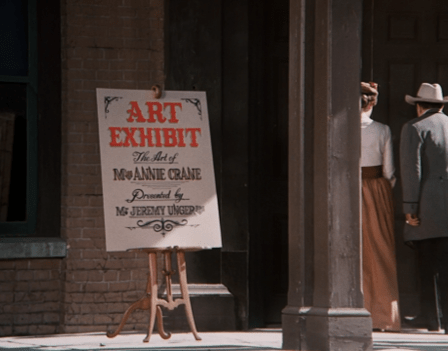
There’s quite a crowd inside.
AMELIA: Are Pa, Laura and Albert even in this one?
WILL: I don’t think so.
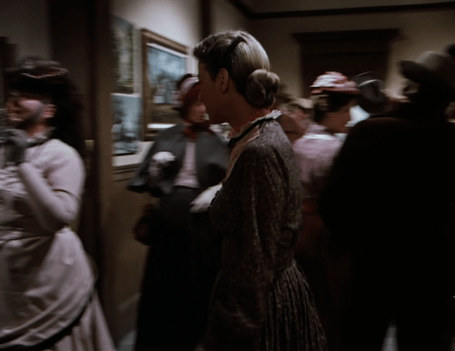
Ma is wearing Boobilicious Two, which she’s accented with some sort of lacy orange collar.
AMELIA: She’s dressed like that one harpsichord today. Orange and black.
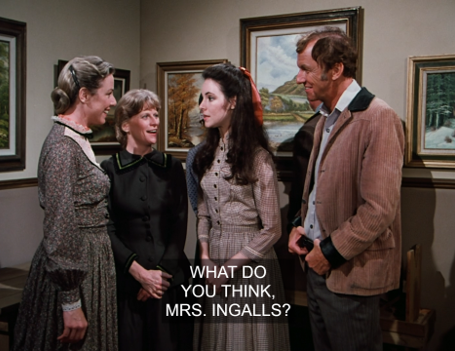

Most of the attendees seem to be normal Sleepy Eyesters, but there are a few artist-types or “highly artistic persons,” as Thomas Ligotti called them, there as well, including a snobbish-looking lady with a lorgnette.
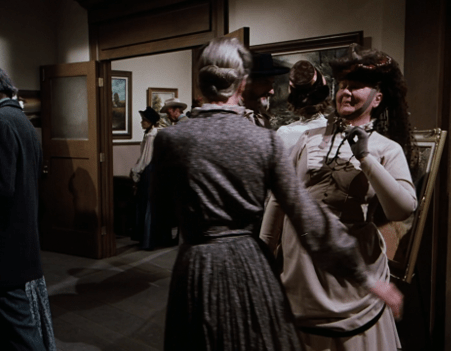
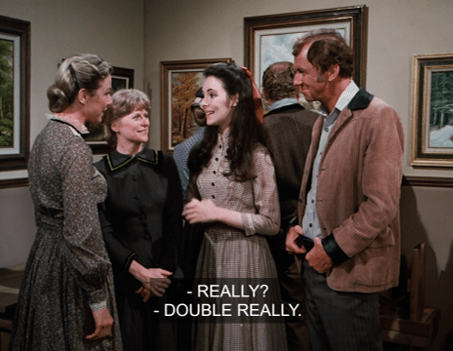
Ma tells Annie her paintings are a hit. “Really?” Annie says. “Double really!” Ma laughs, sounding more like a Valley Girl than a Nineteenth-Century Midwestern farmwife.
Unger introduces Annie to a fussy Englishman from “London Arts, Limited.” He speaks in a heightened RP “hard cheese, old man” accent and is clearly some sort of forerunner to Mr. Montague, whom we’ll meet down the road a bit.
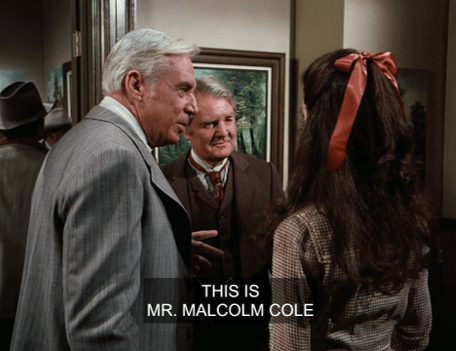
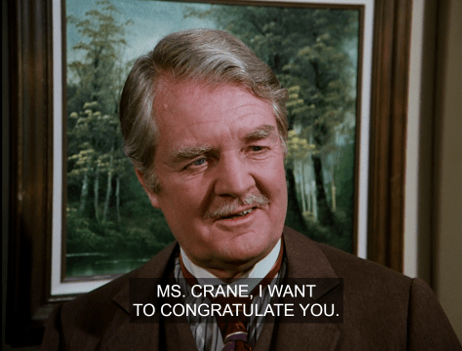
Called “Malcolm Cole,” this Highly Artistic Person is played by Richard Neilson, an actor best known for stage work and, apparently, for being a world-class ping-pong player as a teenager.
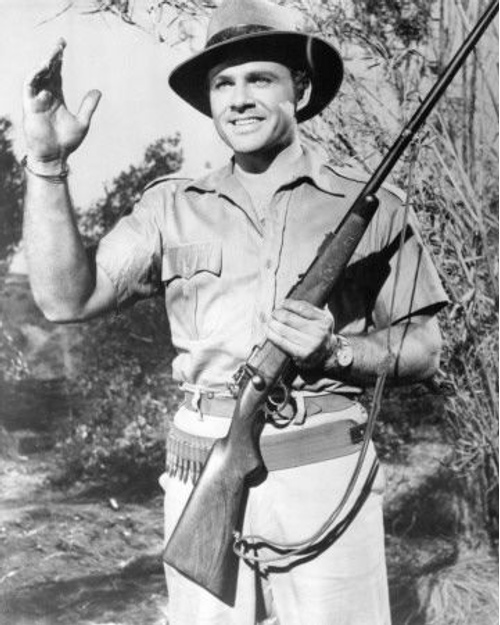
Mr. Cole, of course, simply must have some Cranes for his own gallery in London.
“London, England?” Annie asks excitedly, and Cole replies, “My dear, to an Englishman, there is no other London.” (I’m not sure what other London there would be to a blind girl from Walnut Grove, Minnesota, either.)
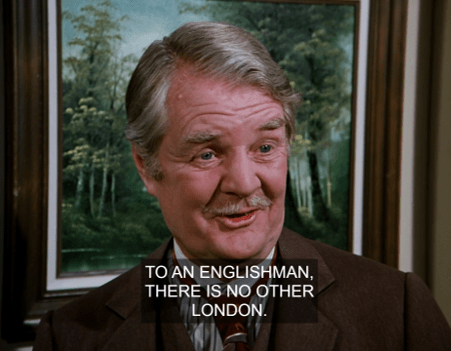
(Actually, though the online evidence is pretty diaphanous, there are, or were, apparently two separate towns in Minnesota called London.)
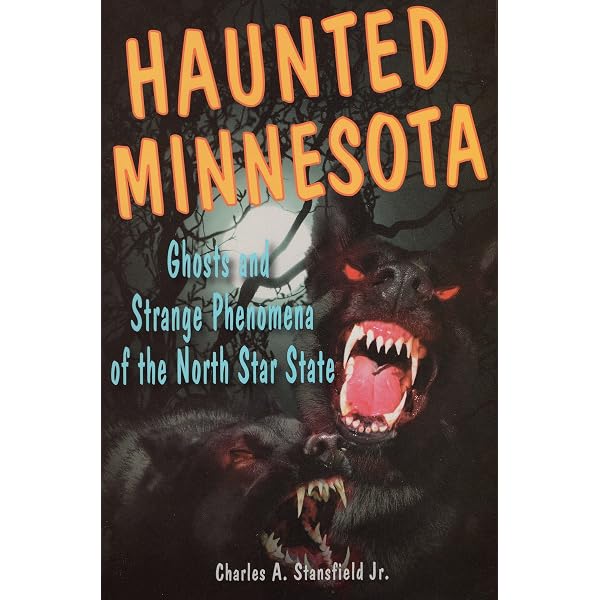
(One, described by Wikipedia as “an abandoned ghost town” and apparently written up in Haunted Minnesota: Ghosts and Strange Phenomena of the North Star State, is near the North Shore of Lake Superior, far from Walnut Grove.)


(We used to have a copy of Haunted Minnesota lying around somewhere, but I can’t find it.)
(The other is closer to Walnut Grove in the far south. It’s possible Annie would have this one in mind, I suppose – it did exist in the 1880s.)

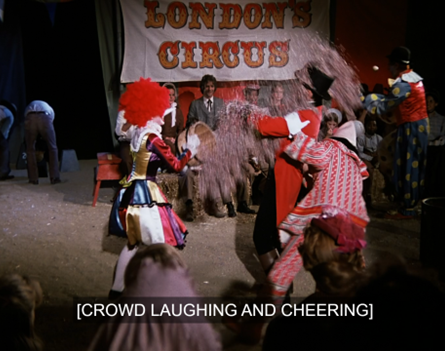
(And of course, she might have thought of London the Clown from “Annabelle,” though I don’t recall seeing her at the circus performance. Still – possible.)
Mr. and Mrs. Crane embrace their daughter.
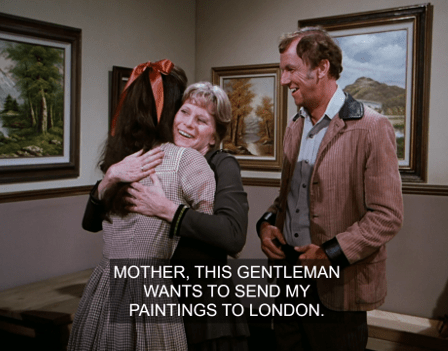
AMELIA: Who is the mom? I recognize her.
WILL: She kind of looks like Donna Pescow from Out of This World.
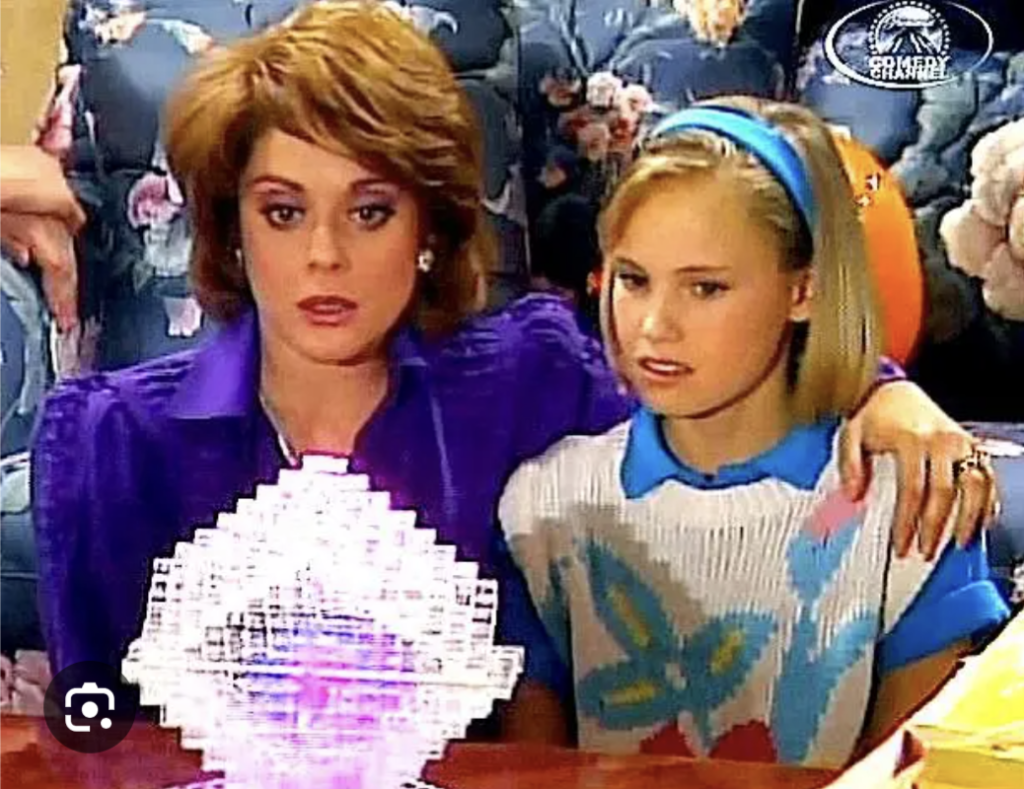
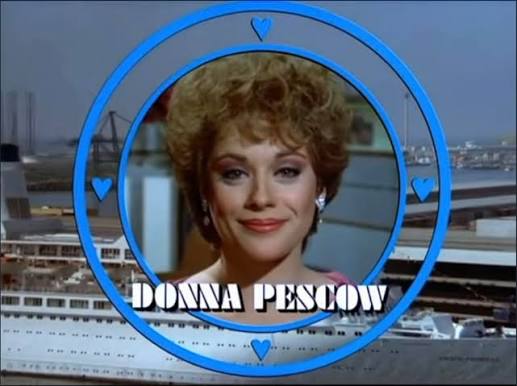
Donna Pescow also appeared on a notable Love Boat, playing a one-legged maid whose fortunes change when she meets an arthritic Van Cliburn-type former concert pianist.
But actually, it turns out Helen Crane is not Donna Pescow at all, but rather Mariclare Costello. (No relation to Ward Costello, so far as I can tell.)
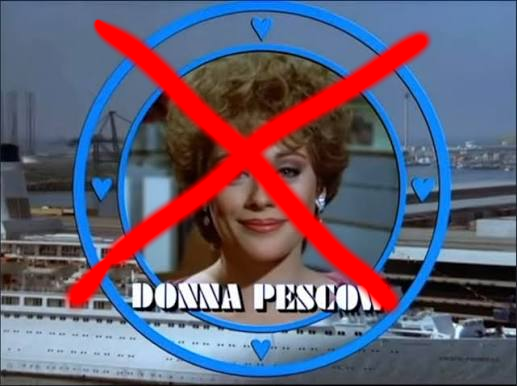
Mariclare Costello had a recurring role on The Waltons and was also on Lou Grant and Santa Barbara.
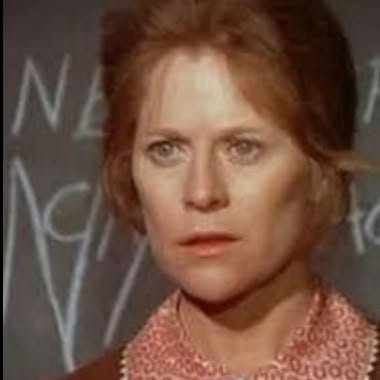
She was in the movies Ordinary People, Buckaroo Banzai, and Indecent Proposal, also from 1993, a film that caused a minor scandal by depicting Demi Moore as an ordinary yet superhot woman who agrees to sleep with a stranger for a fortune. (Why this plot should have raised eyebrows in era of Girls Gone Wild is beyond me, but the nineties was a weirdly conflicted era.)

The last two items on Mariclare Costello’s resume are to me the most interesting. First, she was in Let’s Scare Jessica to Death, a low-budget 1971 psychodrama in which she has a leading role.
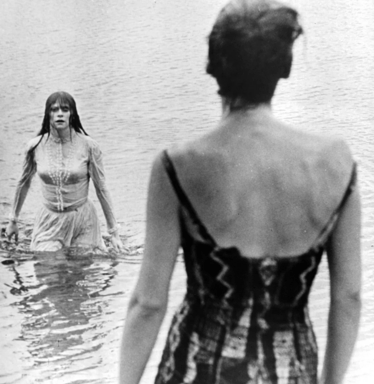
Costello plays a strange young woman who might be a vampire, or who might just seem like a vampire to the movie’s mentally ill heroine. It’s got quite a cult following, and is a mysterious, dreamlike piece of cinema, worth seeing.

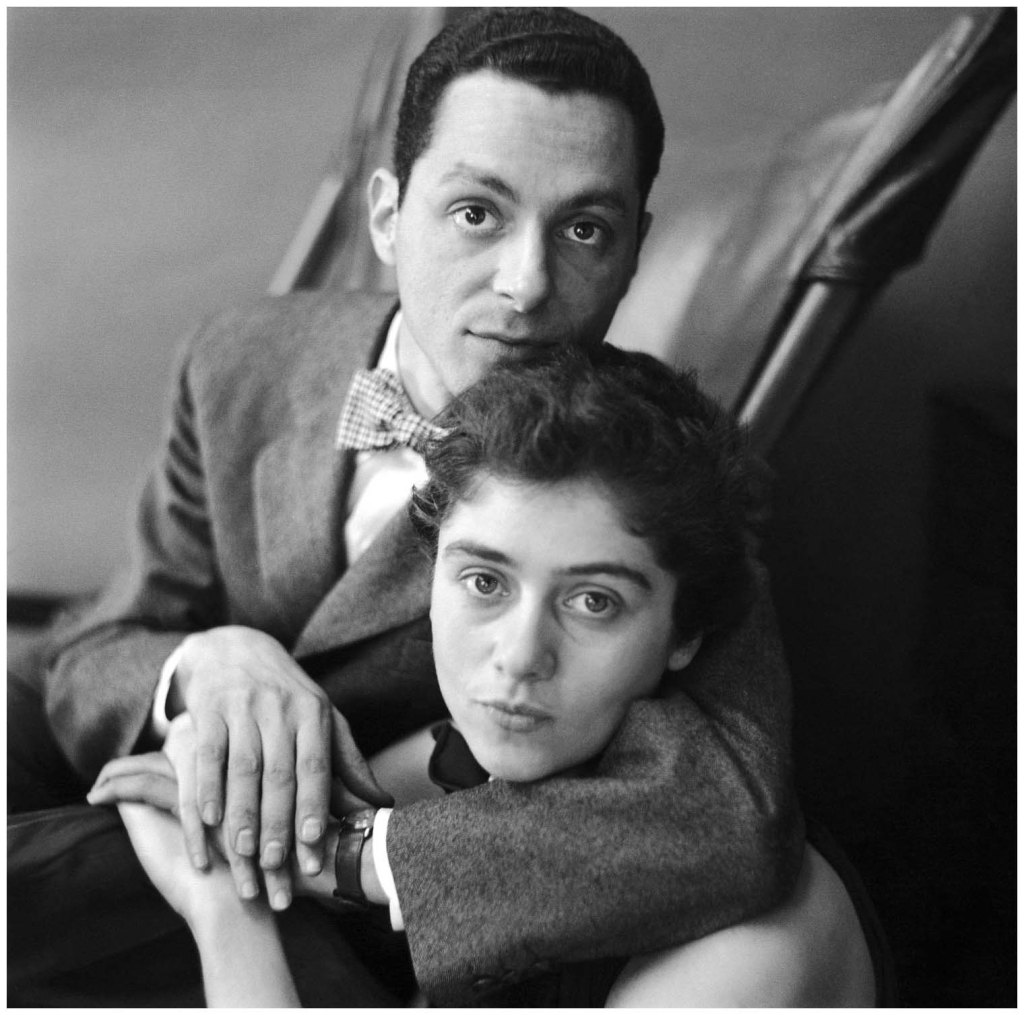
Finally, in real life Mariclare Costello was married to Allan Arbus, whom those of a certain age may remember as the Mustache Man of M*A*S*H.
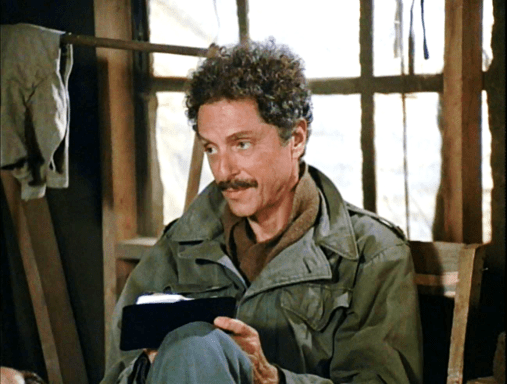
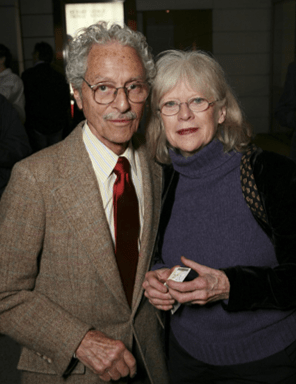
Allan Arbus’s first wife was Diane Arbus, known I’m sure to many of you as the creator of bizarre black and white art photos that ride the line between compassion and exploitation. (The Arbuses split amicably many years before he married Costello, though.)
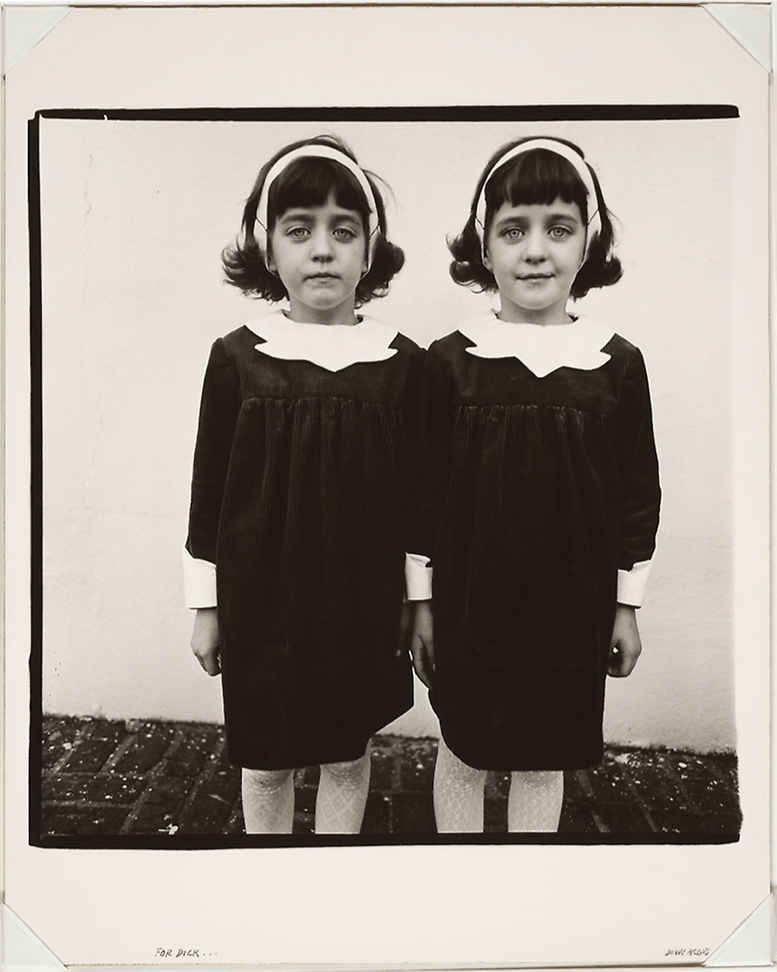
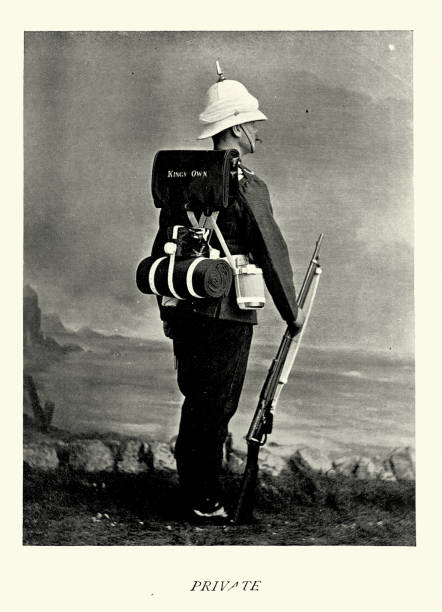
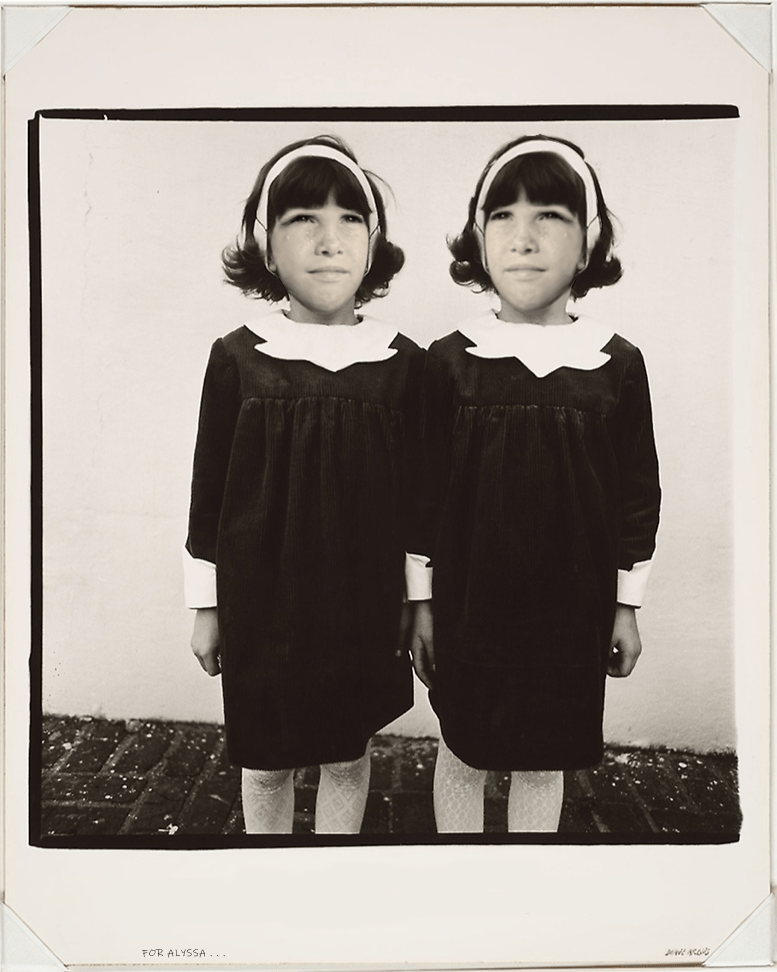
Sadly, Diane Arbus died before ever having the chance to photograph the Greenbush twins.
Meanwhile, Caroline shoots the shit with the art dealers – surprisingly comfortably, in fact.
WILL [as UNGER]: “I’m sorry . . . you’re that woman from that restaurant? . . .”
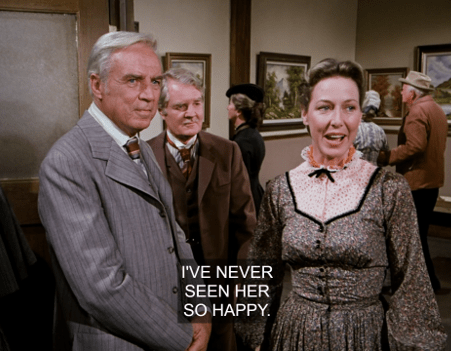
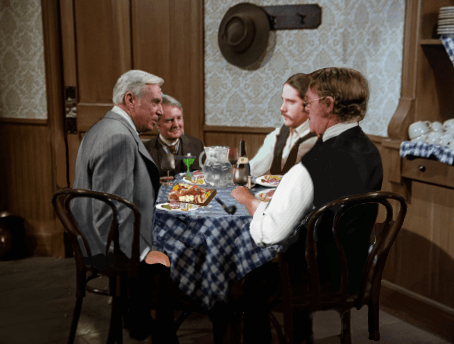
But no, to their credit, these sophisticated gents seem to feel no snobbery towards our humble service worker/bumpkin/female protagonist. (Professor Unger and Mr. Cole are rare Little House characters whose sexualities might be up for debate.)
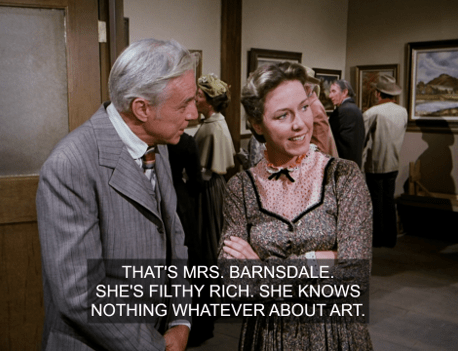
In fact, Unger takes Ma into his confidence, whispering some insults about “Mrs. Barnsdale” – the Highly Artistic Person with the lorgnette seen earlier.
(This kind of easygoing mockery is a fun way to make friends. But it can be dangerous. Once, noticing that a coworker had a photo of himself in drag on display at his desk, my first wife laughed and asked why. It was his mother, he told her.)
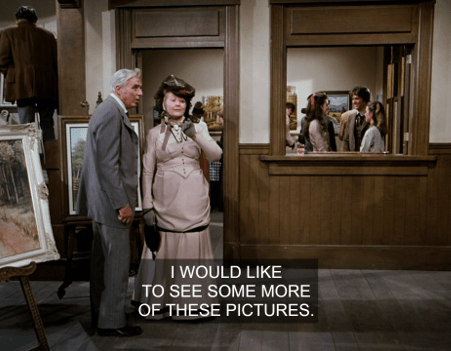
(Mrs. B, by the way, is Jeanne Determann, who was on Bonanza and Highway to Heaven.)
Meanwhile, Annie has joined Adam and Mary in the background, and giggles hysterically at some filthy anecdote Adam is telling.
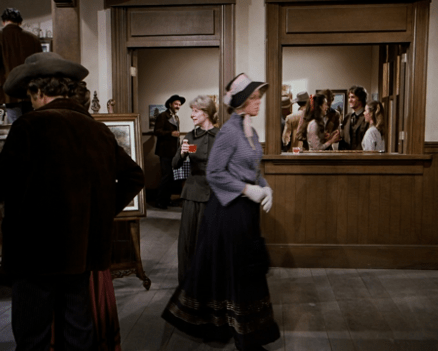
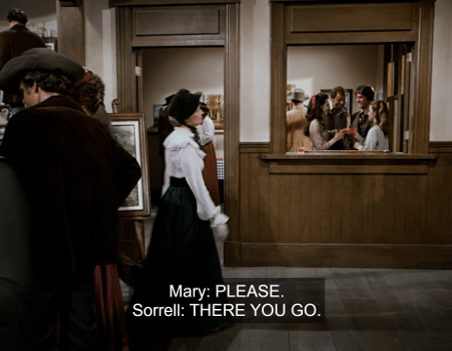
Sorrell Crane approaches the little group and asks if Mary would like some punch. “Please!” she says enthusiastically.
WILL: Another great Mary episode.
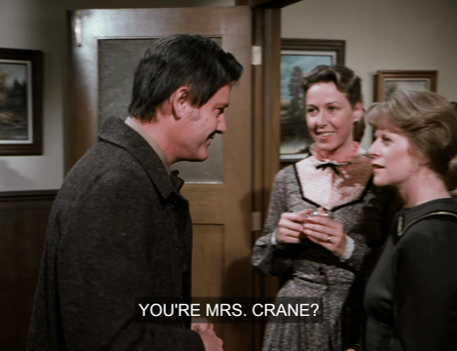
Then Victor Crosby appears. He approaches Annie’s mother and says, “Excuse me – you’re Mrs. Crane?”
“Yes, I am,” she replies.
AMELIA [as MRS. CRANE]: “You’re Mithter Firth?”
Mr. Crosby says he has a pressing personal matter to discuss with Annie.
DAGNY [as MRS. CRANE]: “She’s not for sale.”
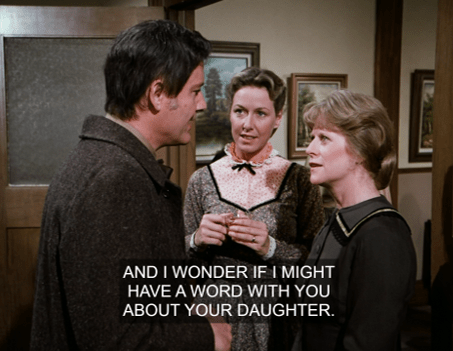
They chat briefly . . . then Helen instantly takes Caroline aside and reports that Annie’s bio mom wants to reestablish contact. (Mariclare Costello is good in the part, I think.)
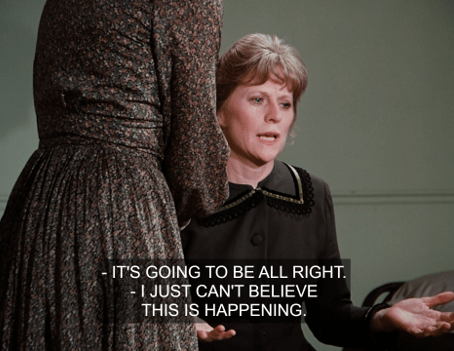
“The first thing you’d better do is calm down,” Ma says.
WILL: That was a bit snippy.
AMELIA: Yeah. Why is she even telling Caroline this?
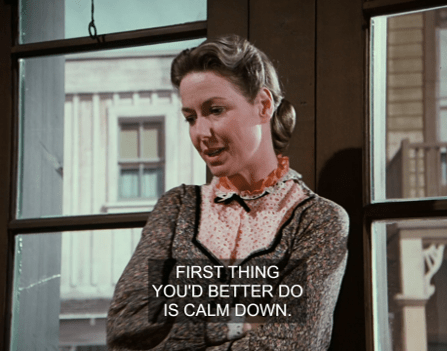
Helen says although Annie was just two when brought to the orphanage, she claims to remember the betrayal.
AMELIA: I HATE this dress.
WILL: What? That’s Boobilicious Two!
DAGNY: The fit does seem a little off this week. Grassle maybe lost some weight.
After the exhibition, Professor Unger says he wants to take them all out for dinner at “the best French restaurant in the state.”
WILL: Oh my God, it must be Chez François!!!
DAGNY [laughing]: I guess it’s gotta be.
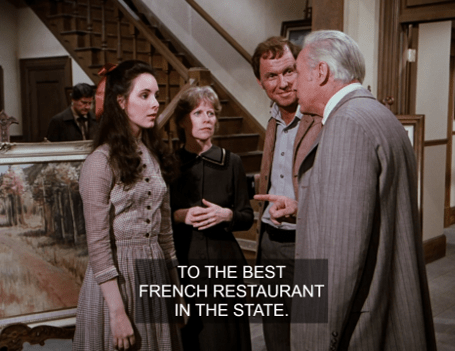
(Chez François, of course, was the elegant Sleepy Eye restaurant where Jonathan Garvey and Charles dined and ditched in Season Four’s “Apple Boobs.”)
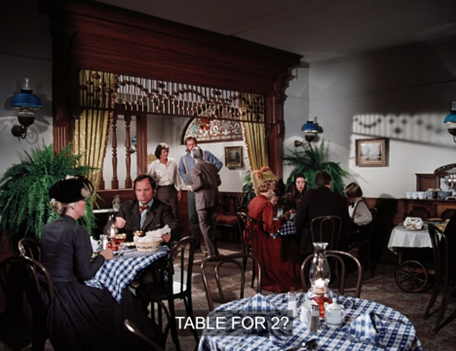
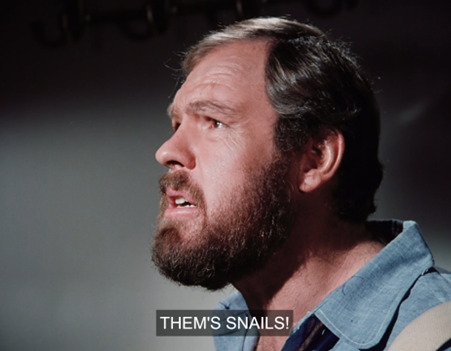
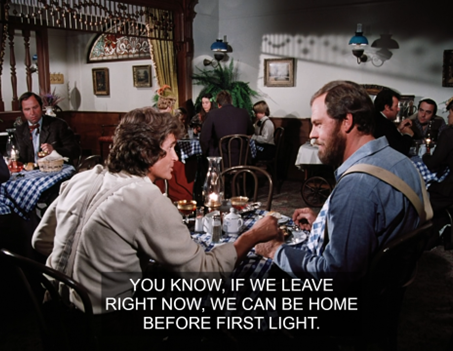
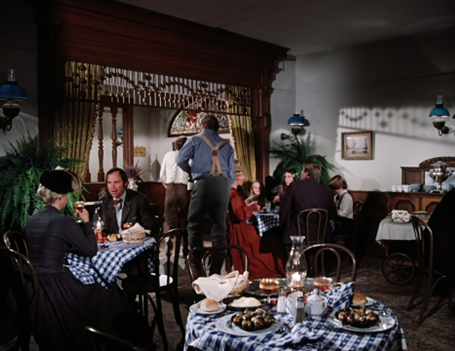
(It’s a good thing Chuck isn’t here. Surely he’s blacklisted.)
(And speaking of Sheriff Garvey, where the hell is he for this story?)
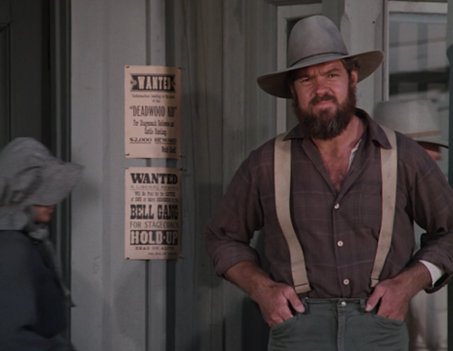
Annie expresses excitement at the idea, again semi-hysterically.
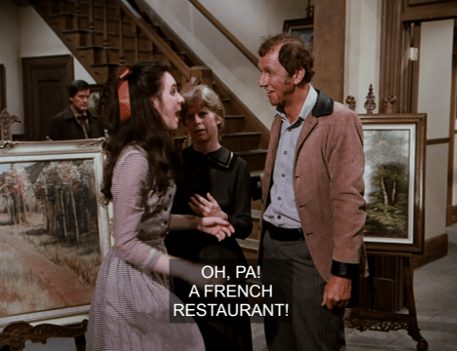
But before dinner, Mrs. Crane takes her aside to introduce her to Mr. Crosby.
Mrs. C takes them into a room labeled “Court Records,” which, very oddly, still seems to have a lot of court records in it. (Garvey Kendall is in a former courthouse, but wouldn’t they have needed those?)
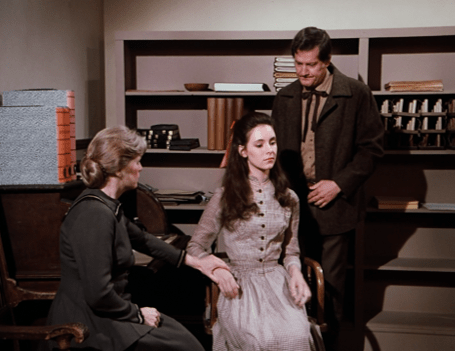
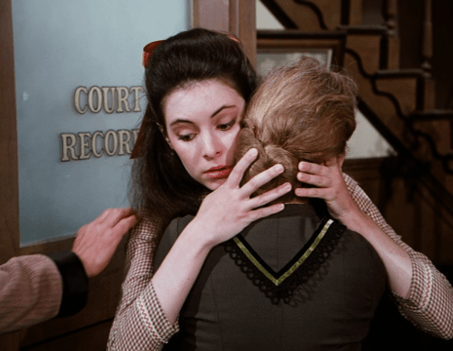
Crosby quickly drops his bombshell, and Annie reacts with anger and bitterness.
DAGNY: Wow, she’s crying for real. That’s rare on this show.
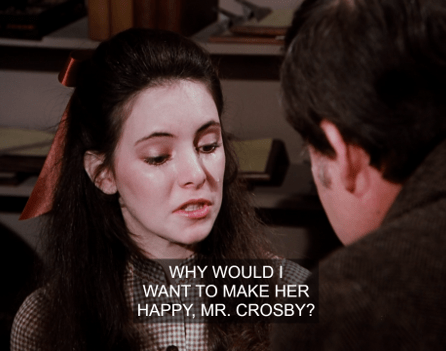
Surprising everyone, she rises and screams that Crosby should return and deliver her mother a message of hate.
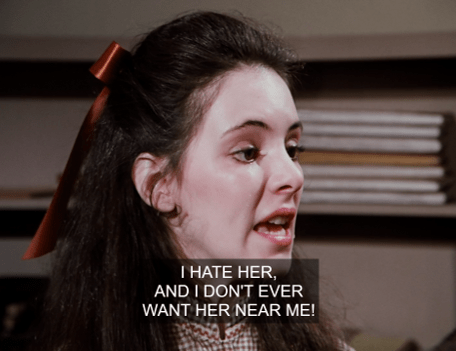
Saddened, but not without dignity, Crosby exits, and Annie hugs Mrs. Crane.
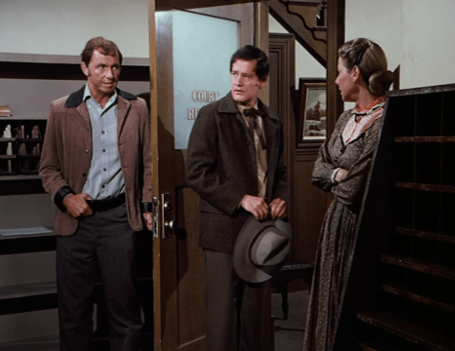
AMELIA: In-tense. This is some good acting.
WILL: Well, it’s Madeleine Stowe.
Distraught, Ma follows the family out.
AMELIA: It’s that orange thing on her neck. It makes her look like a Skeksis.
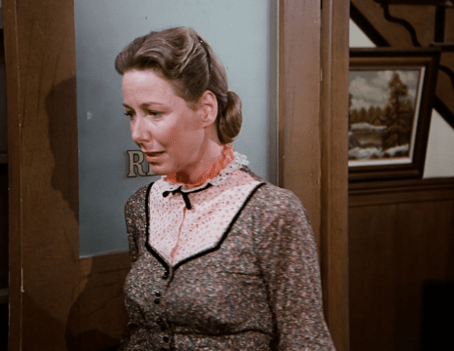
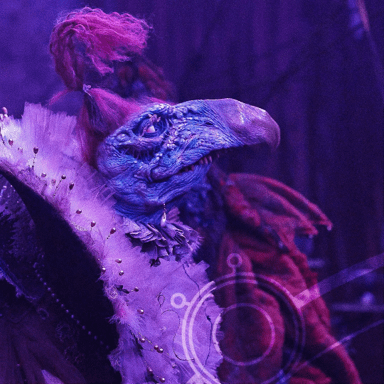
An exaggeration, surely.
DAGNY: I think sometimes they made bold color choices so they’d pop on old TVs.
WILL: Yeah, they’re coming out of the seventies, when people loved, like, orange, puce, catshit yellow, et cetera.

That night, Butt-In Ma, still in her Skeksis gear, pays a visit to Annie’s bedroom at the school, and comforts her.
AMELIA: Does Caroline adopt her?
DAGNY: No. Only Charles is allowed to adopt kids.
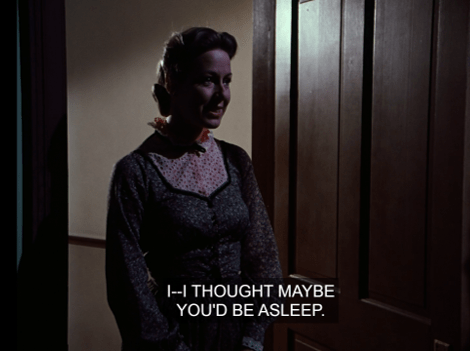
“Try and get some rest,” Ma says.
AMELIA: I love Ma’s nose.
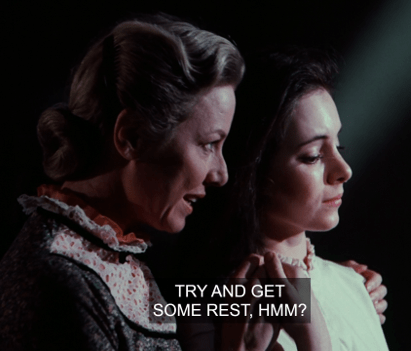
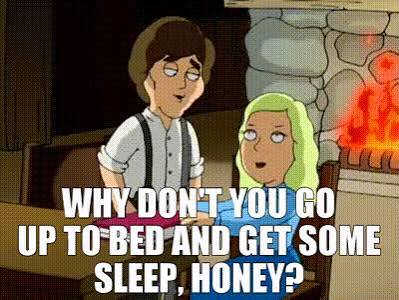
(I remember reading once that, leaving out variations on “hello” and “goodbye,” “Try and get some rest/sleep” is the most commonly spoken line in English-language movies and TV programs.)
Back in Walnut Grove, Helen Crane comes up behind Annie, who’s just finished a new picture.
AMELIA: Is it her evil mother, laughing maniacally and casting her away?
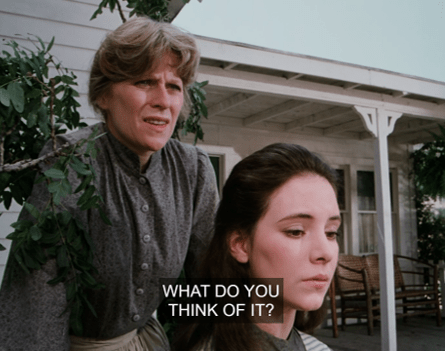
Actually, it is.
“It’s Marge,” Annie says icily. “Mother Marge.”
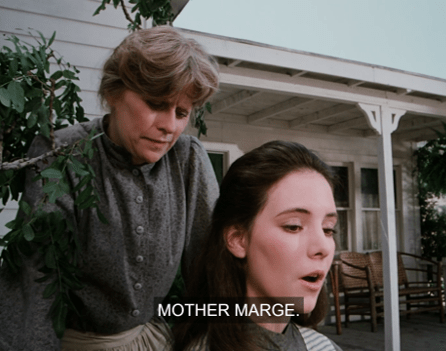
Apparently some time has passed, because Mrs. Crane tells Annie she must let go of the dark hatred that’s poisoning her.
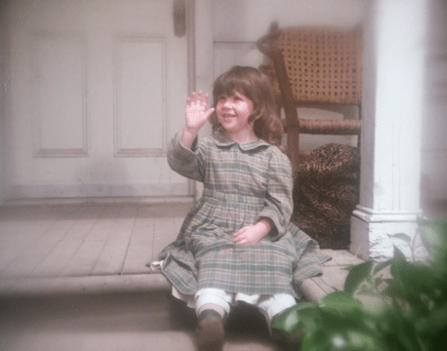
We get a flashback, then, to Mother Marge leaving Little Orphan Annie on the doorstep.
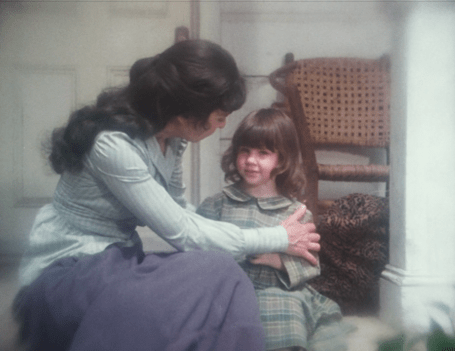
The mom waves “buh-bye” to the little girl, who waves back. (So apparently Annie wasn’t blind at all yet?)
When we return to the present, we see she’s painted “Mother Marge” as a grotesque witch-like figure. (It doesn’t look much like the real Marge, but truth be told it’s also more fun than all her Bob Ross shit.)
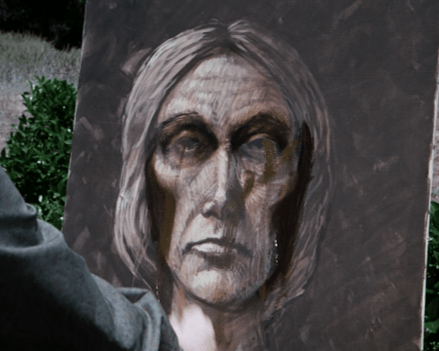
Annie slashes at the painting with her brush. She doesn’t quite gouge the eyes out, but almost.
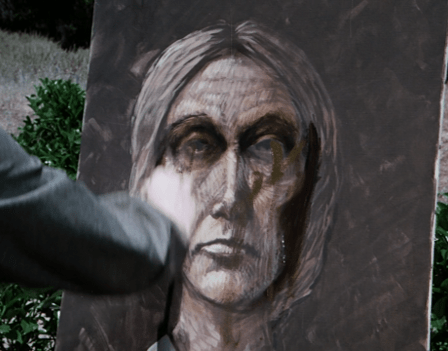
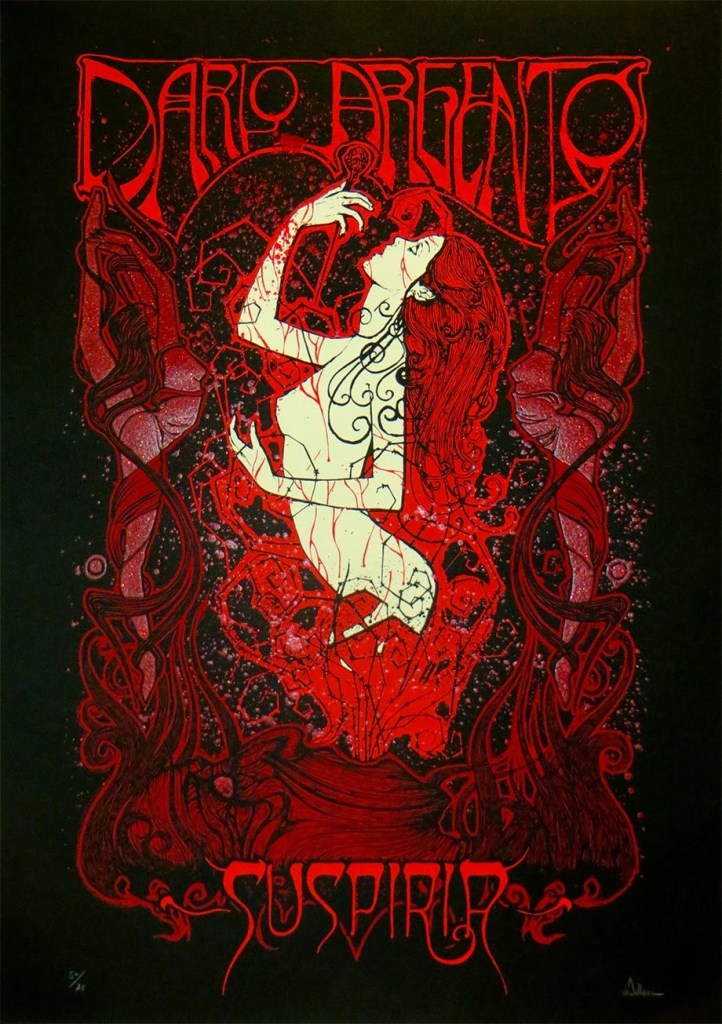
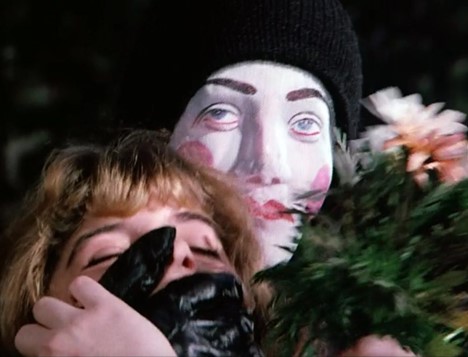
This is another hint of a weird undercurrent of horror this season, which is seemingly influenced by the films of Dario Argento. (Little House will never run out of surprises.)
Meanwhile, at Nellie’s (once again, “Caroline’s” has disappeared from the signage), Ma and Preggo Nellie are chitchatting in the kitchen.
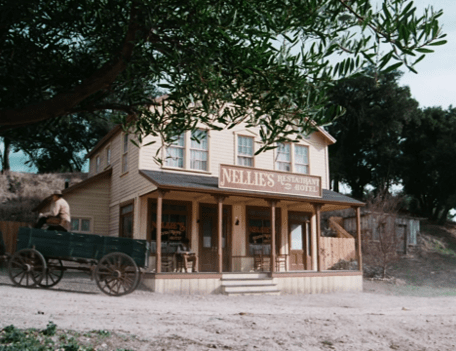
WILL: Nellie has been pregnant at least two and a half years.
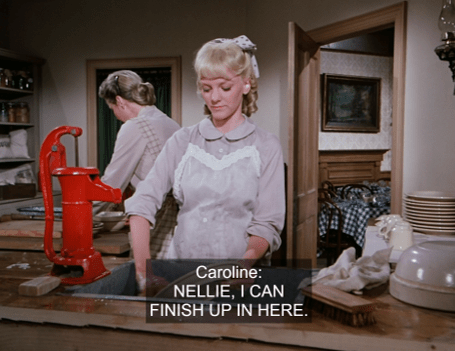
(In “‘Laura Ingalls Wilder,’” we established that Nellie became pregnant in February of 1884, roughly, and as I mentioned earlier we’re now in September of 1886.)
Nellie says Harriet’s been driving her nutso with her fussing.
Nellie claims that her mother calls on the phone ten times a day. (From across the street? I guess it’s possible. My mom and sister live about a mile from each other, and yet . . .)
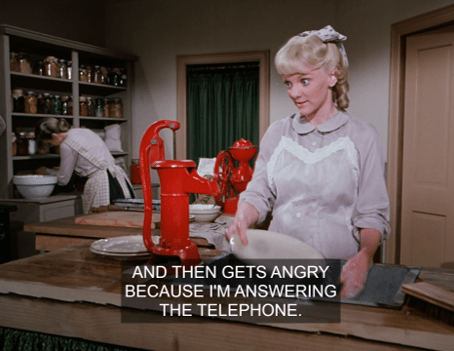
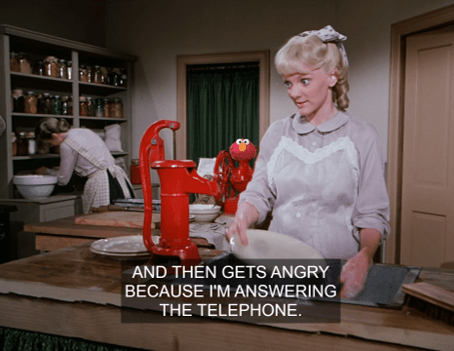
DAGNY: Is that Elmo behind her?
Their conversation is quite friendly – until Ma fat-shames her, that is. (#51.)
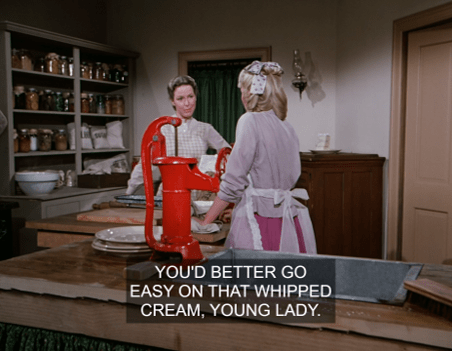
Suddenly Percival marches in.
AMELIA: Hey, Percival!

He’s all a-lather. (Not literally.)
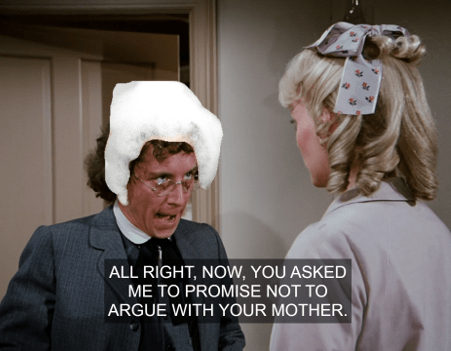
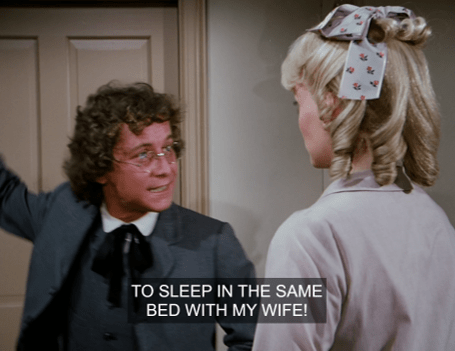
Apparently he’s taking Harriet’s prenatal interference even harder than Nellie is. He’s outraged because Mrs. O told him she doesn’t think he should be sleeping in the same bed with Pregnant Nellie. (It’s interesting, isn’t it, how motivated Percival and Nellie are by sex. For all this show’s reputation for family-friendly wholesomeness, it’s quite sex-positive.)
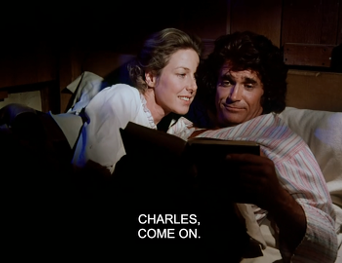
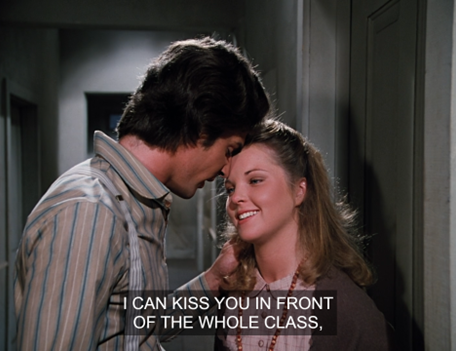
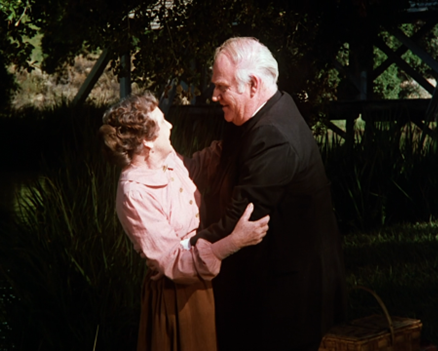
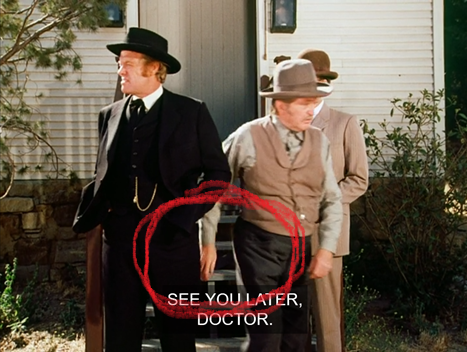
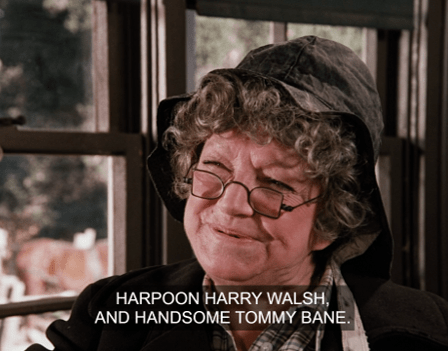
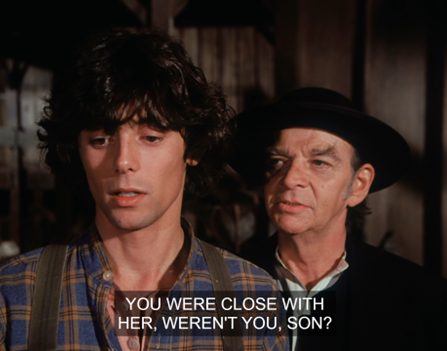
One could even argue that the series is pornography-ambivalent!
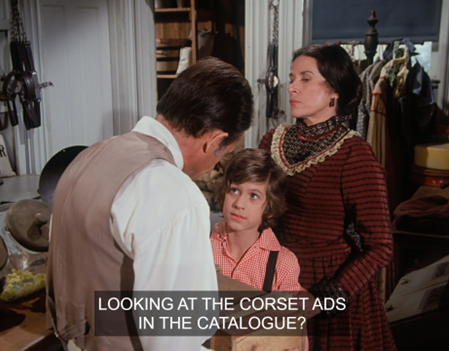
In fact, so far in the series, only John and the Brothers Galender have had their sexual desires presented negatively, for obvious reasons.

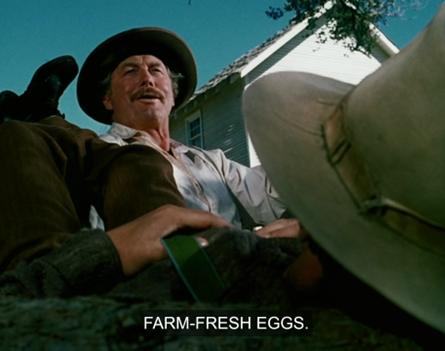
The show also, of course, has nothing good to say about characters who are possibly pedophiles, like the teachers Hannibal Applewood and Mr. Watson.
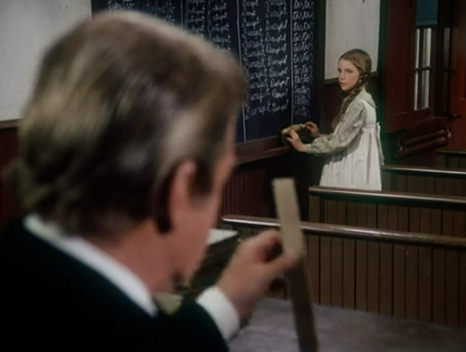
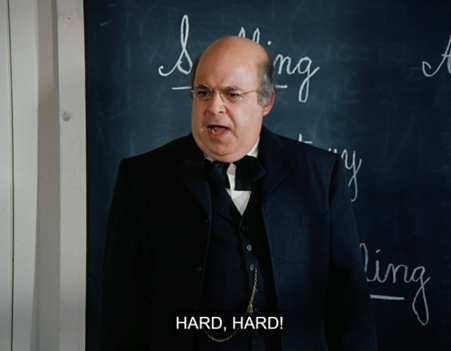
Then again, other such characters are presented more ambiguously.
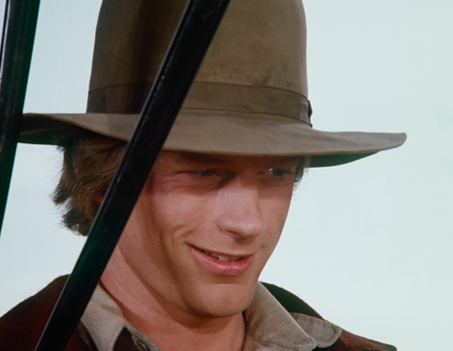
Of course, a few pairings on the show aren’t exactly what you’d call white-hot sexually.

Anyways, Percival notices Caroline and looks a little embarrassed at having shared info about their boudoir.
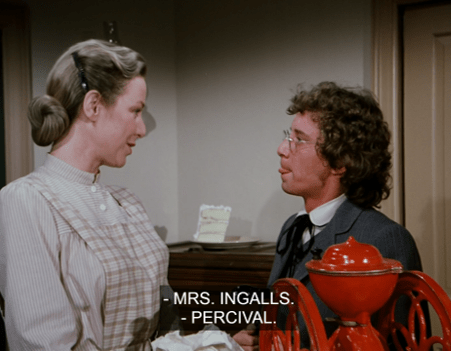
Nellie endorses the idea of Percival letting Harriet have it with both barrels.
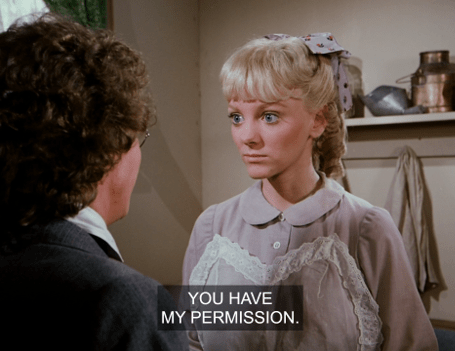
Harriet suddenly calls for Percival. “Here, Mother,” he says hilariously.
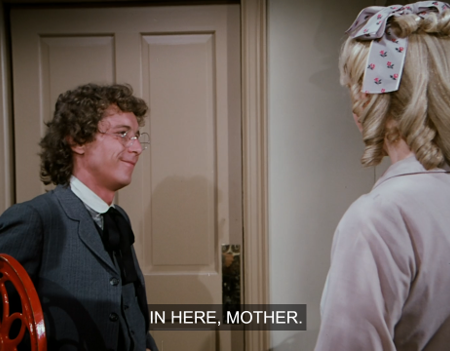
Like the bold bantam cock he is, Percival steps between Nellie and his mother-in-law and screams at the latter.
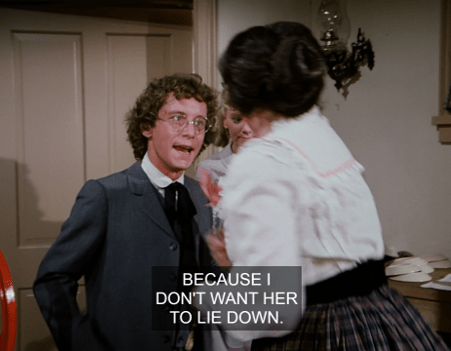
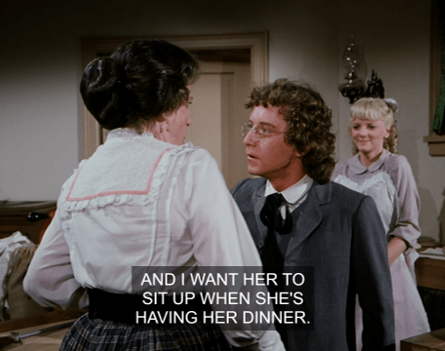
Then, just to shock Harriet, Percival and Nellie start making out right in front of her. Ha!
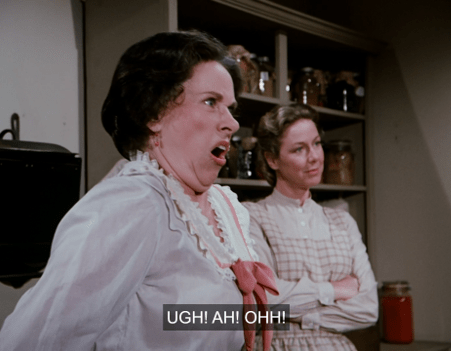
Mrs. O recoils and slithers out.
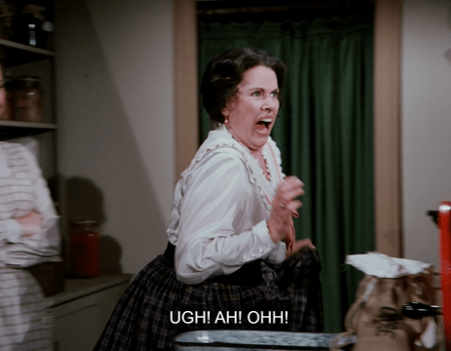
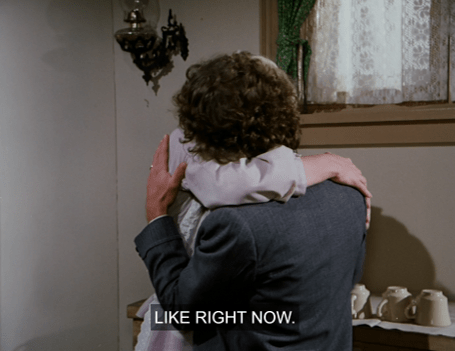
Once she’s gone, Percival and Nellie cuddle with real affection.
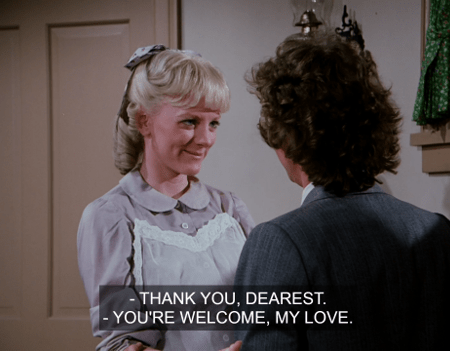
He goes out as well, and Ma says, “He’s pretty amazing!” (Also with what sounds like real affection.)
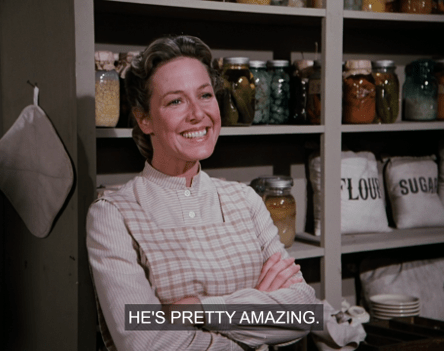
Anyways, Ma goes out to the dining room, and Helen Crane comes in. She says Annie’s become very depressed.
DAGNY: She needs some Ingalls social working.
AMELIA: Well, if Charles was here this would all be cleared up already.
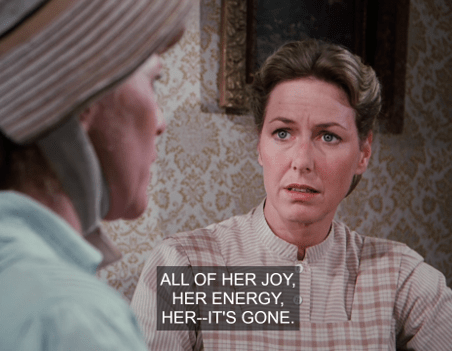
Mrs. Crane says she believes Annie should exorcize her demons by meeting her mother. (I’m not sure that always works, but I’m not sure it doesn’t. I’m not adopted myself, but the people I know who are have an enormous range of feelings about their bio parents, including several who have met and become friendly with them.)
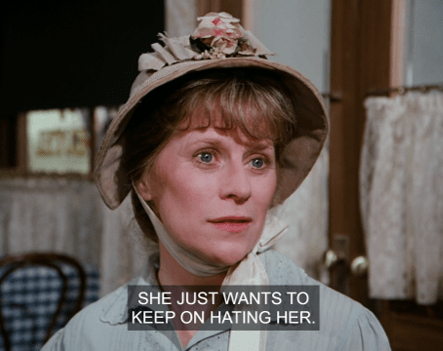
Ma has a great idea: Why not call Mother Marge on the phone and invite her to Walnut Grove?
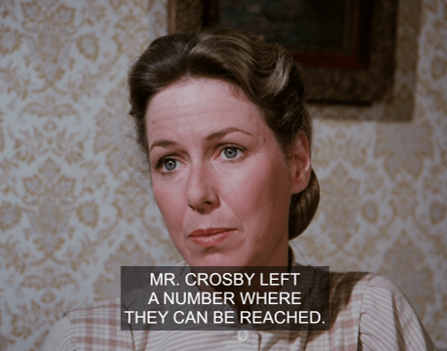
I agree – not with Ma, but with you, dear reader, in thinking this is a terrible idea, for innumerable reasons.
Helen Crane recognizes that too, and expresses some polite reservations.
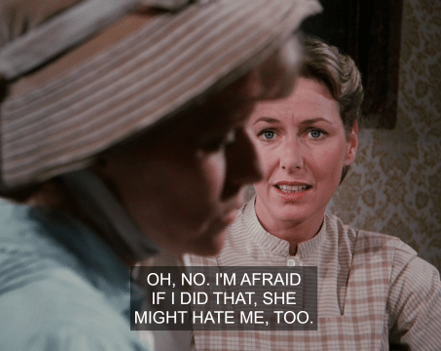
Not to worry, Ma says, if you don’t invite her, I will!
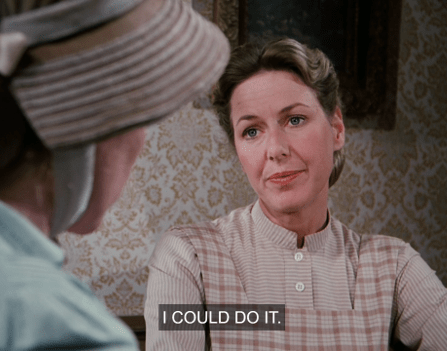
Remember that Sleepy Eye is forty miles away, a full day’s drive. Even if that weren’t the case, what kind of meddler would do this? And who would respond to it?
Not to mention, Ma is usually the sane and sensible member of the family, at least compared to dreamy Don Quixotes like Pa and Laura, hysterics like Mary, little dummies like Carrie and Grace, and murderous junkies like Albert!
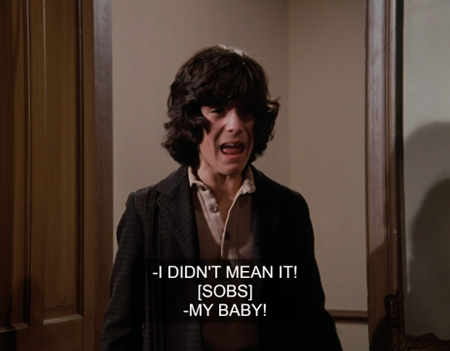
There have been maybe one or two stories where Ma had some out-there ideas. (She schemed to get Mr. Edwards and Grace Snider together in “Mr. Edward’s [sic] Homecoming.”)
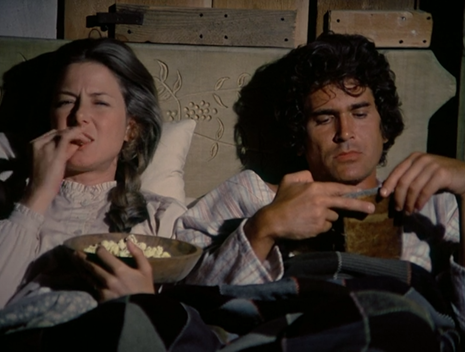
But usually, she’s the proverbial turd in the punch bowl when the others suggest their crazy ideas.
We cut then to a weird sight: Mr. Crosby giving a massage to Mother Marge, in bed.
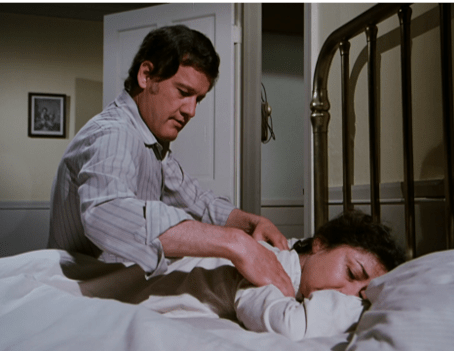
Unlike most of the massagees we’ve seen on the show, Marge’s body is covered head to toe.
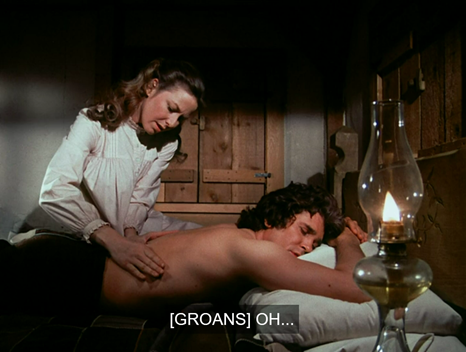
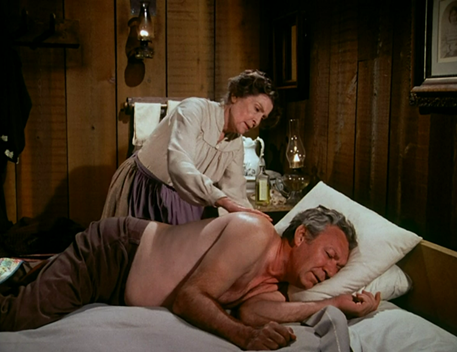

Mr. C says “when you get better” they should take a vacation to someplace with beautiful sunny weather. (Like Mankato?)

The phone rings, and Victor answers. After a brief conversation, Victor fills MM in on the invitation, but agonized Marge says she’s too ill to travel.
After a commercial break, we find ourselves at the Little House! It’s night, so just Ma and Pa are there.
Looking through some papers, Pa says, “I’ve checked all Albert’s spelling and history homework. You’re gonna have to check his algebra.” (Kids in rural Nineteenth-Century America had it so lucky. Back in the olden days of 1980s, we had to do our homework ourselves.)
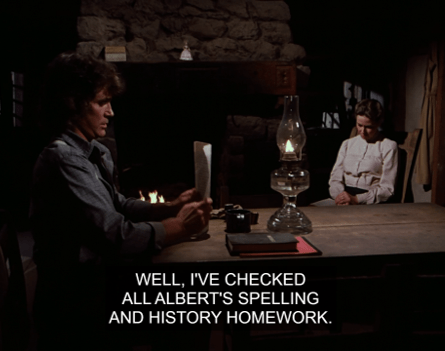
AMELIA: Is he filling his pipe?
DAGNY: Yeah. He must be missing Baby Adam.
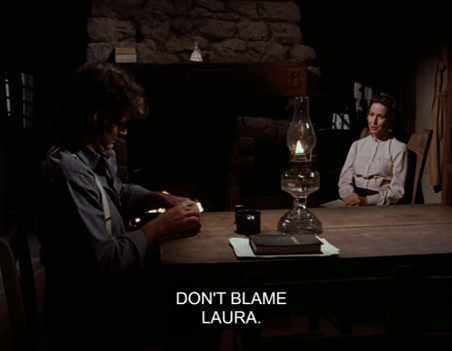
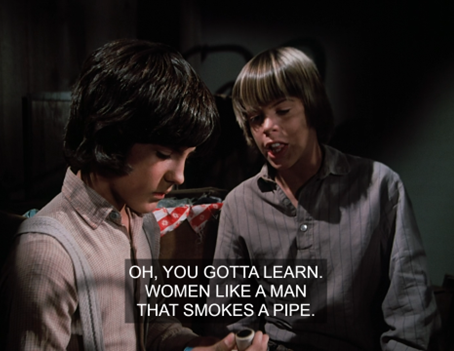
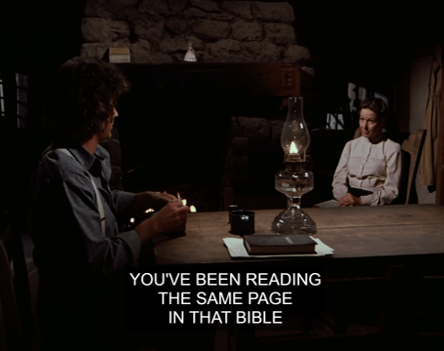
Ma comments on the Greek origins of algebra, and Pa, seemingly embarrassed at his lack of math skillz, zings her for pretending to read the Bible when she’s really just spacing out.
Ma deduces, quite correctly, that Mother Marge is not too ill to travel, since her husband put Ma’s call on hold to go ask her.
AMELIA: Smart.
WILL: Yeah, she’s Poirot-ing it.
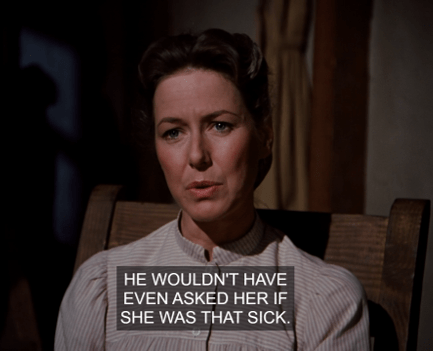
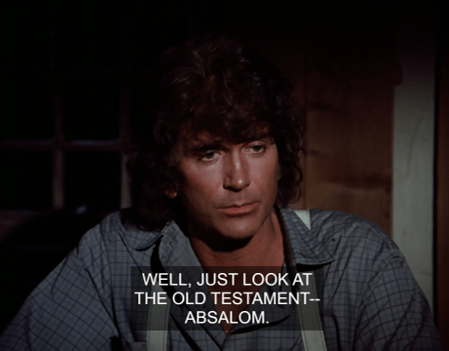
Pa says the mother likely still loves Annie despite the rejection. He brings up the Old Testament story of Absalom, saying, “Here he was trying to kill his own father, King David asked God to take him [David] instead.”
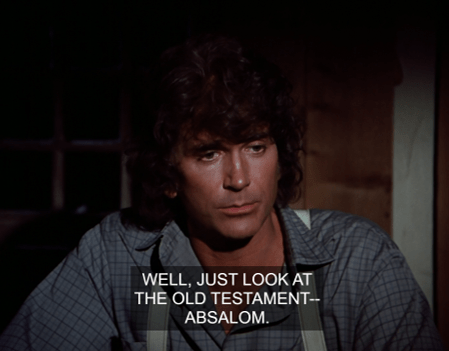
I remember the story of Absalom from my childhood. Pa’s spin on the story is an interesting one. Absalom was one of King David’s many, many children. (David, if he existed, was a libertine and philanderer, and possibly bisexual.)

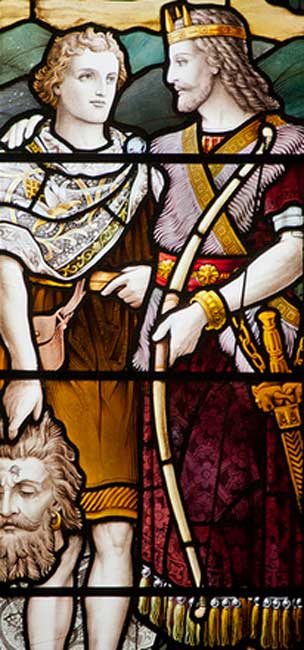
One day, another of the king’s sons, Amnon, raped their sister Tamar, but King David waved the incident away since Amnon was next in line to the throne.

Disgusted and outraged, Absalom killed his rapist brother and tried to raise a rebellion against King David.
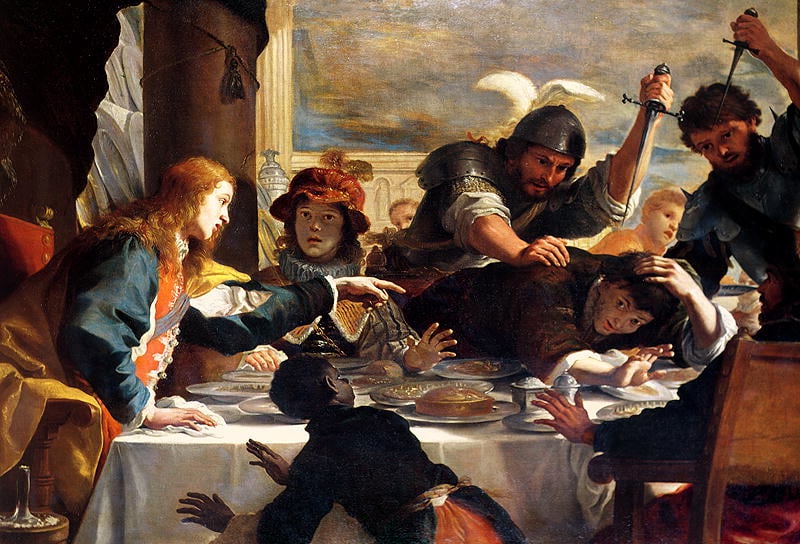
Absalom wasn’t such a great guy himself; in revenge, he had sex with ten of his father’s sex slaves on a roof where the whole city could see. (This whole story is weird and disturbing and can be unpacked a number of different ways.)

But he was a very popular prince, and his army battled with David’s for a while.
The most famous part of the story, as I remember, was that Absalom, depicted by tradition as a vain dandy with long beautiful hair, was pulled off his horse when his hair got caught in a tree. Even though King David had said Absalom should be captured alive, his soldiers found him and killed him, which, indeed, made David quite sad.

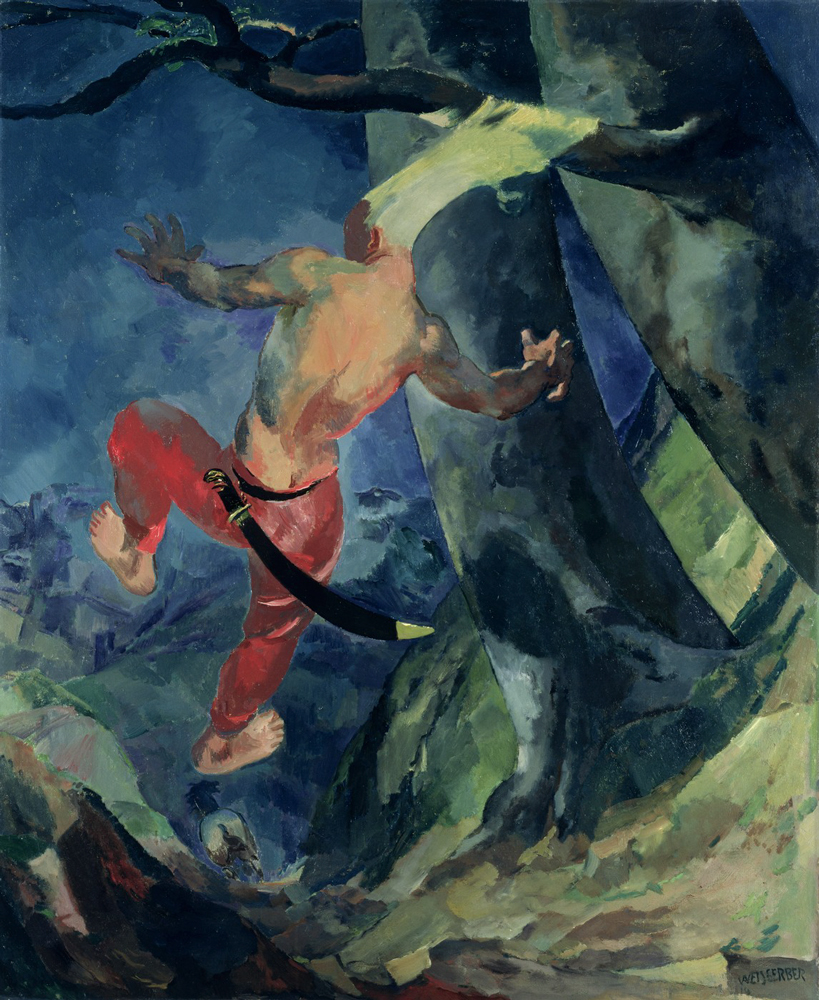
Nevertheless, I’m not sure “King David loved his son who rejected him” is an obvious or perfect moral for the story.
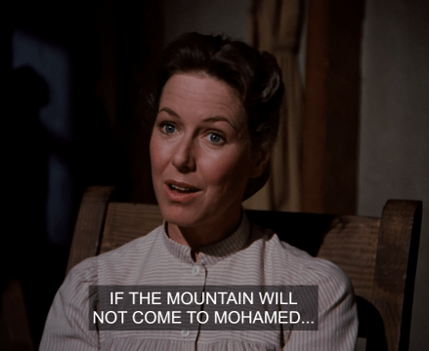
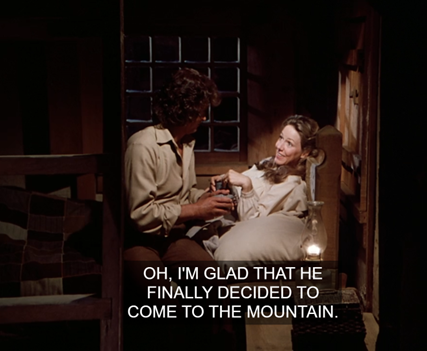
Ma says she’s going to take the wagon (well, actually she asks Pa’s permission to do so), surprise Mother Marge in Bradleyville, kidnap her and bring her back for a forced reunion with Annie, again using the “Muhammad must go to the mountain” saying to justify this insane plan.
WILL: She just said that, like, two episodes ago.
DAGNY: You repeat your jokes a lot too.
WILL: . . . Never.
Well, she heads straight to Bradleyville, where she finds Victor Crosby, a fellow hospitality worker, serving drinks in a saloon.
AMELIA: This saloon isn’t very wild.
DAGNY: No, looks like an old-person bar.
WILL: Well, Bradleyville.
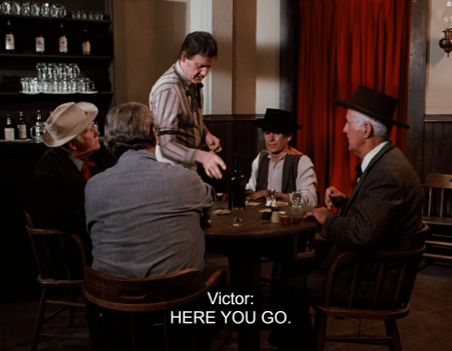
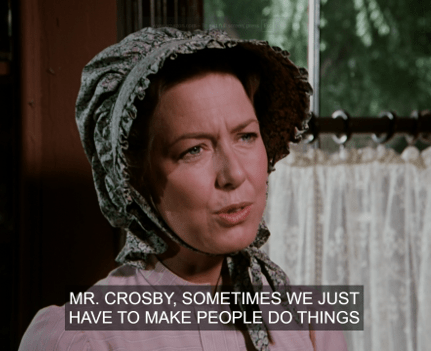
Ma says to him that “sometimes we just have to make people do things whether they like it or not.” That sounds like Prince Amnon logic to me, but whatever.
DAGNY: God, Karen Grassle’s so pretty. She’s barely wearing any makeup and she looks gorgeous.
Addressing some offscreen person named “Charlie,” Victor says he’s going to continue this conversation outside.
But then we jump ahead in time, with Victor tricking Mother Marge into driving with him to Walnut Grove.
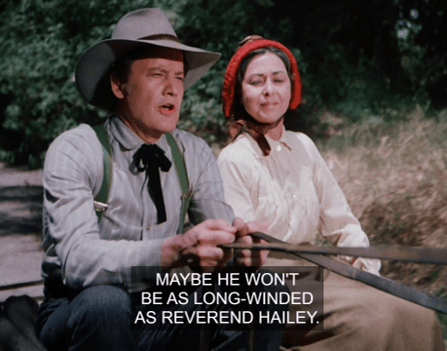
He doesn’t say where they’re going, but says why don’t they pull over at the nearest church to take in a service – for fun. He says the minister might not “be as long-winded as Reverend Hailey.”
AMELIA: Reverend Hailey? A woman?
WILL: A man’s last name, I expect.
Well, at Walnut Grove, the Reverend Alden is leading the congregation in singing, you guessed it, “Bringing in the Sheaves.” (With this, “Sheaves” pulls ahead of “Onward Christian Soldiers” in the race to become this show’s King of Hymns.)
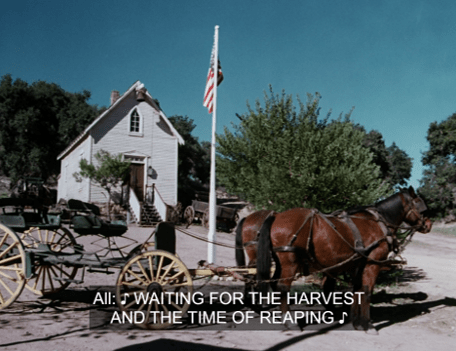

Not too many people in church today: the Ingallses (and Absalom-o – I mean Almanzo), the Olesons (and Percival), the Cranes, the Crosbys, Bret Harper’s Former Underling Rod, the Dark-Bonneted Woman, Not-Carl Sanderson, and a man who resembles Congressman Tom Emmer, the Pride of Minnesota.
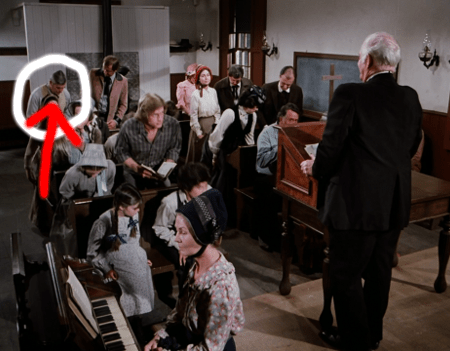

Bizarrely, we again have somebody sitting at the organ, though no organ accompaniment is heard.
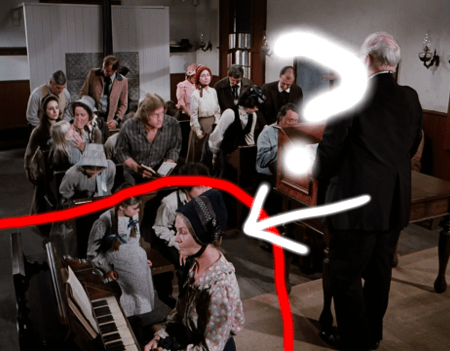
AMELIA: Does Manly have a black eye?
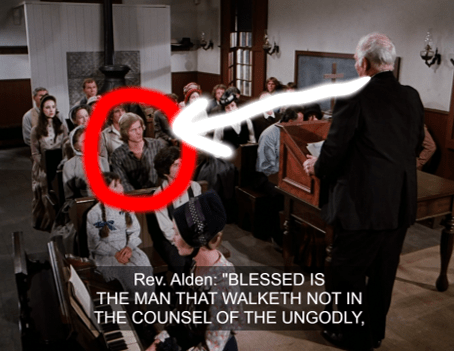
The reading today is Psalms 1:1-3, adjuring God’s followers to walk a righteous path, but not to “stand in the way of sinners” or “sit in the seat of the scornful.” In other words, it’s a call to mind your own business, and is probably why to this day, religious people let the non-religious live their own lives, without interfering, complaining, shaming or threatening damnation.
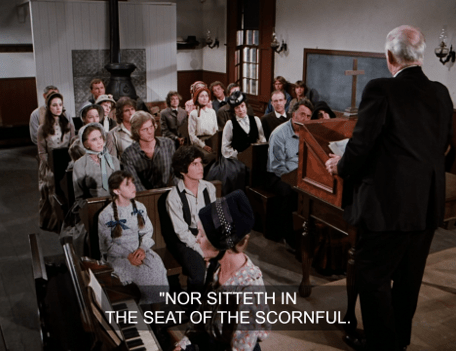
Aldi gives Annie a shoutout for her great art show.
In the congregation, Mother Marge realizes she’s been bamboozled.
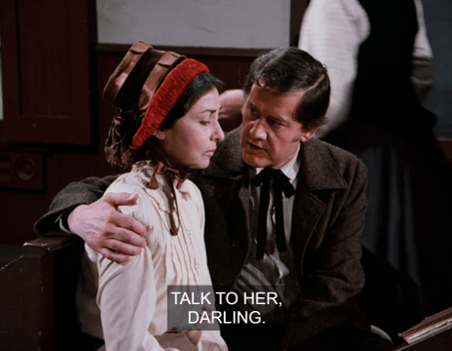
By contrivance, she and Annie are left alone in the church after the service.
With difficulty, Marge approaches Annie and introduces herself.
DAGNY: I think this episode would be better if that was Rachel Dratch.
WILL: I’m sure you’re right.
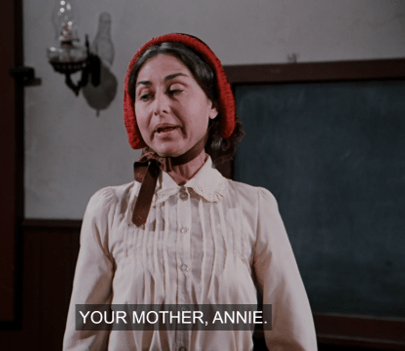
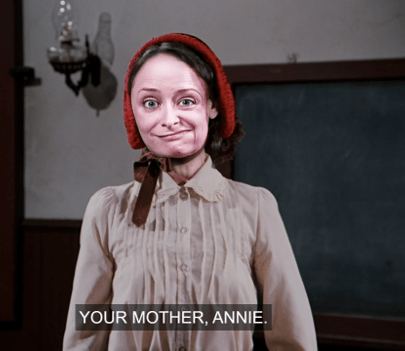
But she isn’t Rachel Dratch; the actor is Constance Pfeifer. (I’m not sure if she pronounced the P or not.)
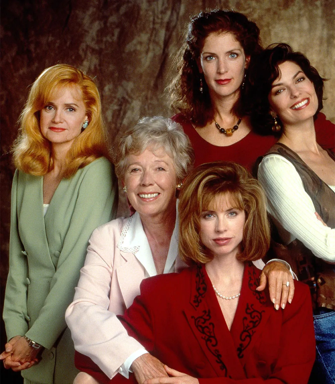
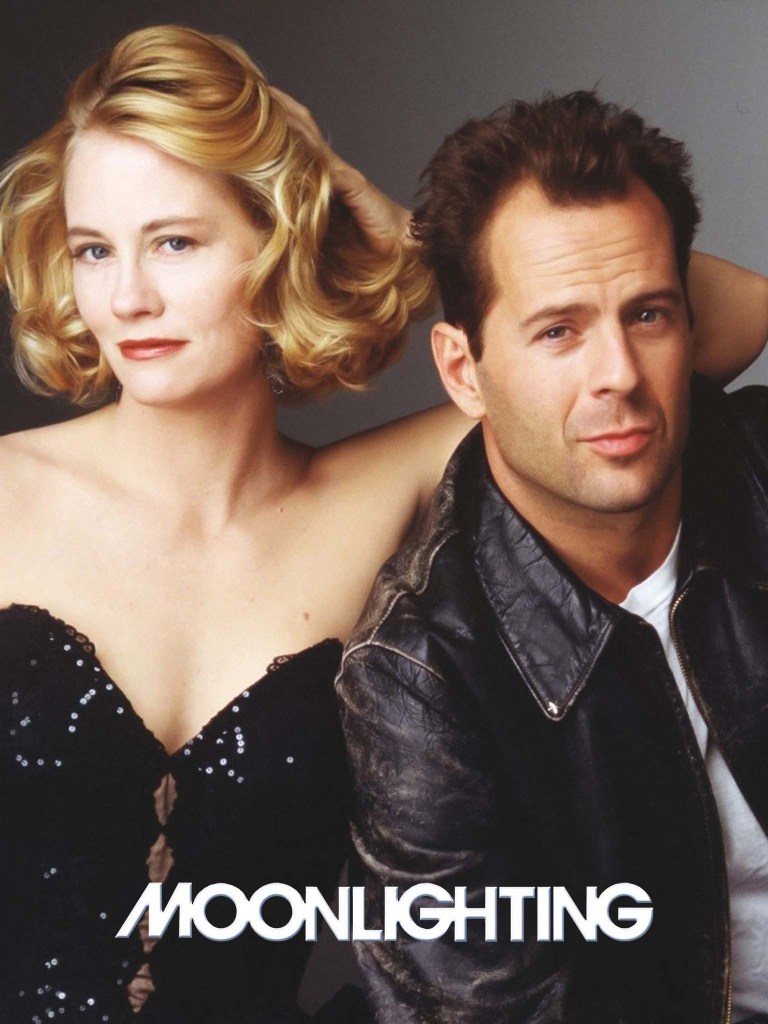
Pfeifer acted on Police Story, WKRP, Moonlighting (yes!), St. Elsewhere, Tales From the Crypt, and the Elizabeth Hoffman vehicle Sisters.
(My friend Gianni once was an extra in a crowd when Bruce Willis, then at the height of his fame, was filming a movie in Chicago. At one point, when the cameras were off, Willis walked by his group, and Gianni screamed “BRUCE, I LOVED YOU ON MOONLIGHTING!!!” Willis burst out laughing and gave him a thumbs-up.)
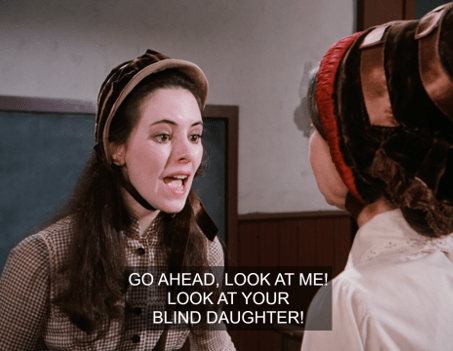
Annie rips into Mother Marge, saying what a horrible person she was to abandon her just because she’s blind.
She stands up and screams, “Look at me! Look at your blind daughter!”
Standing her ground, Marge puts her hands on Annie’s shoulders (or around her throat?) and says, “What color is your hair?”
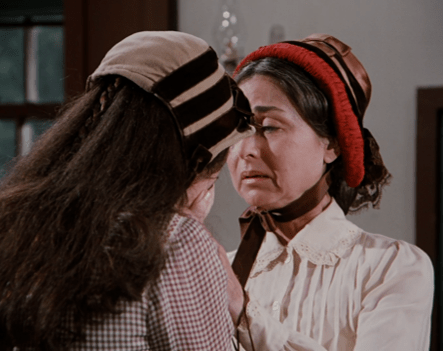
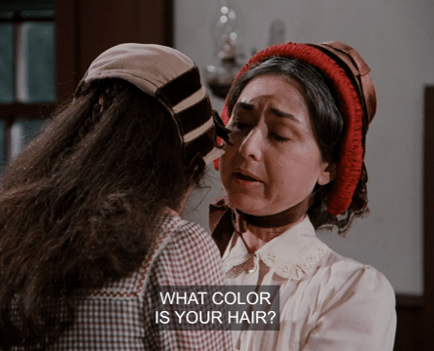
Yes, reader, as you’ve probably guessed by now, she’s blind too. The show’s used this gag before, of course.
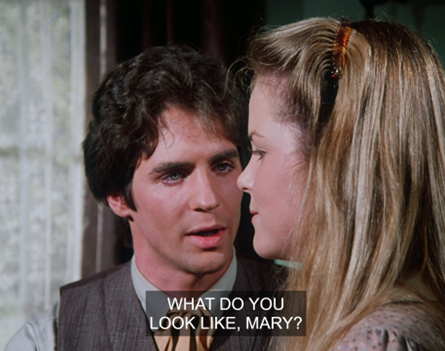
Realizing her mother can’t see, Annie collapses into tears.
AMELIA: Oh, she just snotted into her hand so hard!
WILL: Well, Madeleine Stowe’s the real deal. You know who else does that? MICHAEL LANDON.
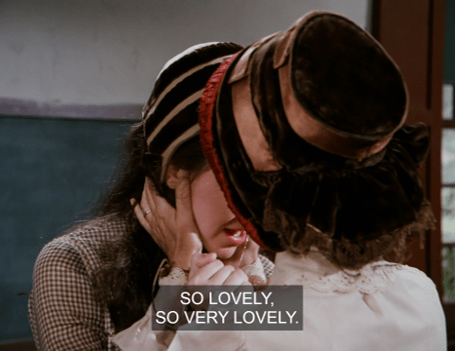
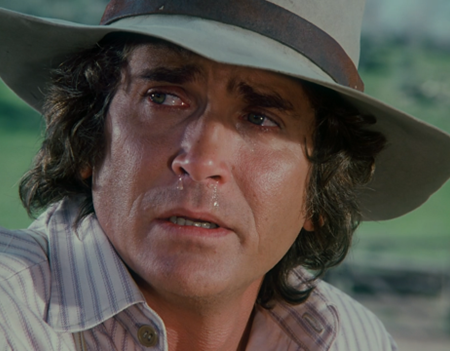
By way of explanation for Annie’s blindness, “I had scarlet fever when I was carrying you,” Marge says. (Scarlet fever!)
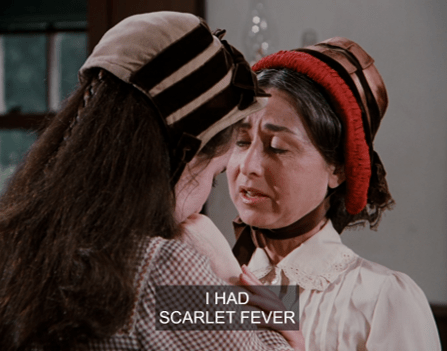

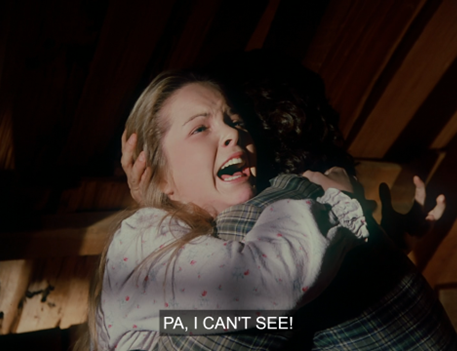
Marge says as a blind single mother, it was impossible to take care of a child.
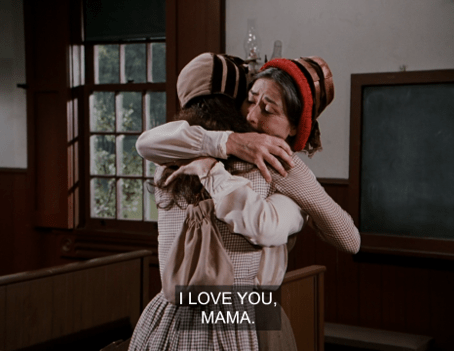
Annie hugs her then, crying, “Oh, Mama, why didn’t you tell me?”
Echoing Annie’s own comments about hiding her blindness from the art patrons, Marge says, “I didn’t want you to come to me out of pity.”
Hugs and exchanges of love.
Then we see (and Voiceover Laura tells us, though why she should give a shit is beyond me) that Annie had another exhibition, this one attended by all her parents and featuring a new portrait of she and her mother smiling at each other.
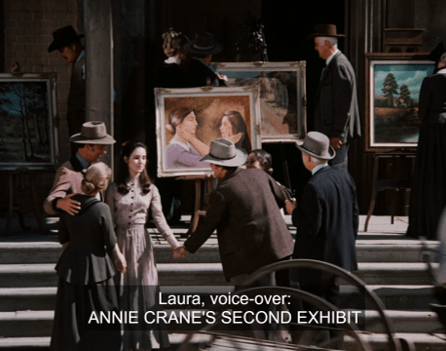
(The picture is actually a rather good resemblance of both of them, which some readers have pointed out is weird, and it is. Because while Annie, who wasn’t always blind, might remember her young mother’s looks, she would have no idea what she herself looks like.)
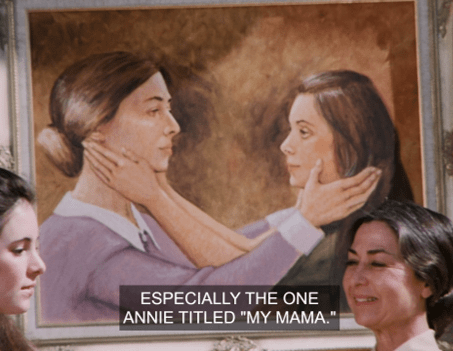
(Maybe Helen Crane was right, and it is a miracle.)
(Alternatively, probably Carrie or somebody molded Annie’s face out of clay, and Annie felt it to get the jist.)
WILL: So did you figure it out? She resents her mom, but doesn’t realize how much she sacrificed for her. . . .
DAGNY: . . . OH MY GOD THE EYE TRANSPLANT!
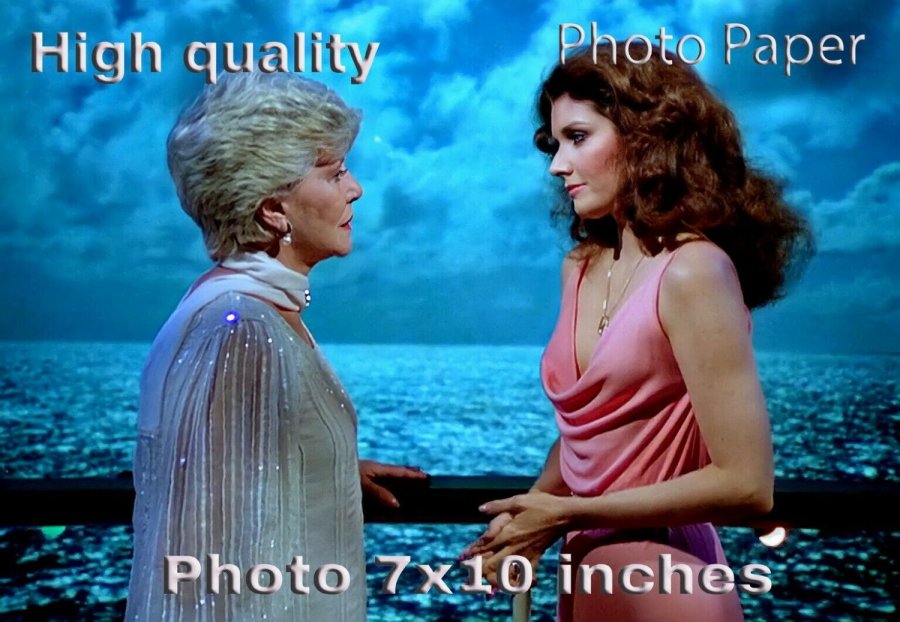
Yes, reader, the trajectory of this story is remarkably similar to that of the Love Boat episode “The Misunderstanding.” I am loath to do it, but since the AI summary of the plot is perfectly adequate, and since this recap has taken me forever to finish, here it is in a nutshell:
Episode Details
- Air Date: December 10, 1983
- Segment Title: “The Misunderstanding”
- Morgan Brittany’s Role: Karen Stevens
- Key Guest Stars: Arlene Dahl (as Ellen Kirkwood, Karen’s washed-up movie star mother), Claire Trevor, and Vic Tayback.
Plot Overview
Karen Stevens (Morgan Brittany) harbors deep resentment toward her famous mother (Arlene Dahl).
She believes her mother abandoned her during her childhood when she underwent a traumatic eye transplant procedure. But a reconciliation and revelation unfold on the cruise when Karen learns the truth about the donor and the circumstances surrounding her past medical crisis.
AI clearly doesn’t want to ruin the twist for you, but I will: Karen learns her mom was herself the eye donor, and that she destroyed her own Hollywood career, which had been founded upon her dazzling eyes, in the process . . . all out of love for her daughter.
Quite similar, eh? Landon should have sued for royalties.
STYLE WATCH: Dagny liked Professor Unger’s necktie.
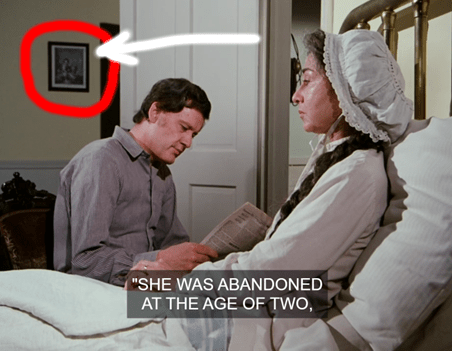
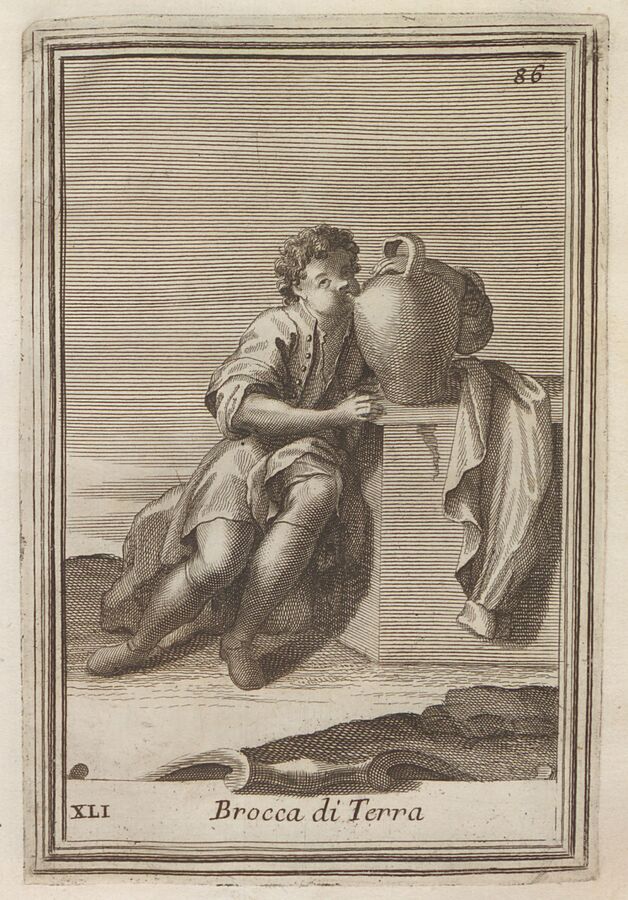
The Crosbys have some artwork that looks reminiscent of the Eighteenth-Century Gabinetto Armonico.
DAGNY: Annie’s eyebrows are shaped the same as mine would be if I overplucked them.
AMELIA: I love Nellie’s hair in the back.
DAGNY: Yeah, since she got nice she has a more whimsical sense of style.
AMELIA: Is that a new apron on Ma?
WILL: I think it is.
Actually it isn’t, but it is nice.
Unless I’m wrong, this episode was the first to feature both Boobilicious One and Boobilicious Two.
THE VERDICT:
AMELIA: That one did not score very high in my book.
With a clever, rather writerly script (it’s about how interpreting compassion as “pity” can hurt relationships), this features strong performances, but nevertheless is a somewhat tedious melodrama, focused on new characters we don’t really care about. The big twist is also pretty predictable (especially if you’ve seen Love Boat: “The Misunderstanding”).
While it’s always nice for Grassle to carry an episode, Ma’s involvement in this story isn’t really believable.
UP NEXT: Divorce, Walnut Grove-Style


Hi, was wondering if you have a personal email address I could write to, just to ask a Little House-related question. Thanks.
LikeLike
Sure – realwalnutgroovy@gmail.com
LikeLike
I can’t remember where I read this but after Landon & Grassle’s season two negotiation tiff, apparently Grassle was given at least one episode each season that was a Ma~focused episode. (So obviously this was season seven Ma centric episode). I agree it seemed kind of far fetched that she would be this much of a Butinski,. I don’t mind this episode but again like you said it’s very hard when they introduce characters that are supposed to be bosom buddies of the Ingals family & yet we never see them again! Also, thanks for the shout out.☺️👒
LikeLiked by 1 person
That explains why Caroline is essentially taking Pa’s typical role of residential busybody here, even though Charles was available right there. She’ll get a better solo story next season, one where her role and need to fend off by herself is more plausible (going to help a pregnant friend facing an outbreak and an abusive husband in a mining camp, and Caroline and Doc Baker are the only ones who can help her with the disease and her upcoming baby).
LikeLiked by 1 person
When I saw the picture with the twins turned into the Greenbushes, I thought it was one of those photos used in the “Ms Peregrine’s Home For Peculiar Children” book series (the author used a series of real-life B&W old pictures to illustrate the title children and other characters, some of them are creepy but fascinating).
I’ve been accompanying Pamela Bob’s Little House 50th podcast, and in their review of “Richest Man in WG”, Alison Arngrim mentions that her father always said he hated sentimentality in fiction, but not just any kind– he hated fake sentimentality in fiction, the one that feels half-hearted and forced, like some people think Little House is with its melodramatic storylines. But for the most part, the show avoids this “fake sentimentality” by being completely genuine and earning its sentimental themes, and it helps that it balances with a dose of realism and a down-to-earth touch.
This episode isn’t “insincere”, but there are just so many contrived elements in the plot that just don’t add up: Caroline’s intervention would usually be welcome to give her a solo story, but as you say, her level of meddling with the Crane family just feels uncharacteristic and hard to buy given her incredibly filled routine working the household and at the restaurant; but aside from that, there’s the fact that Anne can still remember her mother when she abandoned her as a toddler, and how she grew up in the same blind school where Adam and Mary taught before being adopted by a couple who happen to be friends with Caroline, whose daughter teaches in the same school? Unless the Cranes met the Ingallses more recently after the blind school was realocated to Sleepy Eye, and their friendship was precisely started by their daughters’ respective connections to the blind (Annie as a former student, Mary as a tutor). Still, all these contrived elements don’t help the story avoid the “fake sentimentality” that Alison’s father is said to have denounced.
I like Annie Crane though, and how beneath her gentle demeanor, she hides resentment and pain until she learns more about why her mother really left her. I do wonder why they couldn’t have used Mary in this story. I know sources have said that as of this point they just didn’t know what to do with her, but story involving blind people and resentment over that really feels like it could use her somehow.
LikeLiked by 1 person
No shit! Very well put.
LikeLike
I thought Mariclare Costello looked familiar too, when I saw this episode a while ago on Pluto’s Little House channel. She kinda resembles the actor who played the chef lady in “Treme” and the brothel madam in “Deadwood,” Kim Dickens. https://upload.wikimedia.org/wikipedia/commons/thumb/5/5b/Kim_Dickens_by_Gage_Skidmore.jpg/1280px-Kim_Dickens_by_Gage_Skidmore.jpg
“Revenge” is a fantastically crazy show! Like a mashup of those trashy ’90s movies you listed and an ’80s nighttime soap. Premise is a woman (Sharon Carter actor Emily VanCamp) returns to the rich town where her dad was wrongly convicted, in order to play a very long con and get revenge on them all -especially Madeline Stowe’s character, who’s the HBIC.
Speaking of trashy and soaplike, can’t wait for your take on Laura’s Dynasty-inspired catfight (the second one of the show, after her v. Nellie in the mud) and improbable ink stains in the next episode!
LikeLiked by 1 person
[as CY TOLLIVER] Joanie Stubbs, the one and only. (I loved her on that.)
DAGNY and I will give Revenge a try.
And yes, the next story is a REAL DOOZY. I’m excited about it.
LikeLike
First season of Revenge is fantastic, but be warned it’s diminishing returns afterward. (Like latter Little House.) Season 2 is overall good though uneven. S3 and S4 aren’t as good, especially if you have a lower tolerance of “shocks” and silliness and sudden unearned changes in the status quo. Still glad I watched it all, but 22 episodes each season were spread out once a week, so I didn’t mind “wasting” an hour occasionally at that slow pace. There are wikis with detailed recaps if you eventually get bored yet want to know how it all turns out.
LikeLiked by 1 person
So far has this episode provided the least return for what you put in it? I appreciated your Absalom expounding and your description of Madeleine Stowe’s weird “excited” acting, at least!
LikeLiked by 1 person
Well, I did struggle with boredom when I was recapping it (which is pretty unusual). I’d hoped you couldn’t tell!
LikeLike
I just finished reading my first post … I loved you 6 before – just more now! This is a great blog, Will, Dagny, et. al. Looking forward to more 🙂
LikeLiked by 1 person
Thanks, Janet! So glad you liked it. 🙂
LikeLike
i read “Sorrell says he’s worried how Annie will support herself should they die in a fire, stagecoach crash, anthrax epidemic, or some combination. (Paraphrase.)” and got a bizzar mental image of a stage coach full of anthrax passengers on fire crashing and busted out laughing
great recap!
LikeLiked by 1 person
☺️❤️
LikeLike