
Look How Mad His Butt Is; or
Hit Him With the Moose Head!
(a recap by Will Kaiser)
Title: Barn Burner
Airdate: February 19, 1979
Written by Don Balluck
Directed by Michael Landon
SUMMARY IN A NUTSHELL: After the Barn of Garve burns down (again), the rule of law finally comes to Walnut Grove.
Dark and shocking.
RECAP:
DAGNY: I had a dream last night.
WILL: Oh yeah?
DAGNY: Yeah. I was making popcorn.
WILL: . . .
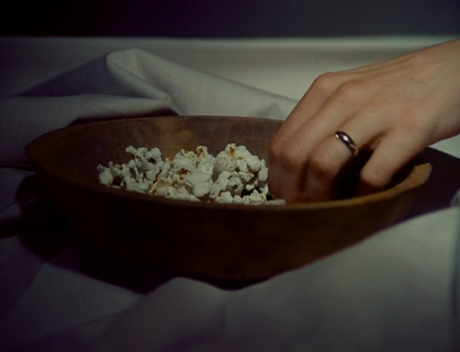
Hi everybody. I know some of you haven’t been looking forward to this episode, which features physical, verbal and emotional brutality, really from beginning to end.
(It’s a racism one, so readers who hate when we discuss what these stories are about and their resonance for today might wish to take the week off.)
Our first indication this story is dark comes from David Rose and His Sinister Trombones playing a funeral-march rhythm in a minor key.
WILL: I need my glasses upgraded. It looks like “Bra Burner” to me.


DAGNY: I was thinking more like a butt burner.
WILL: What’s that?
(There’s some butt talk in this recap, so those who don’t like that are also encouraged to skip this one.)
(In fact, probably nobody should bother reading this one! I often wonder why anyone does.)

Anyways, an epic melody rises in the horns. I once studied composition, but I never learned how TV music was produced in those days. Did David pre-write music of various moods and colors to add when editing began? Did he get the storylines far in advance? Or did he compose in a frenzy once the episodes were finished?

A woman passes in front of the school.
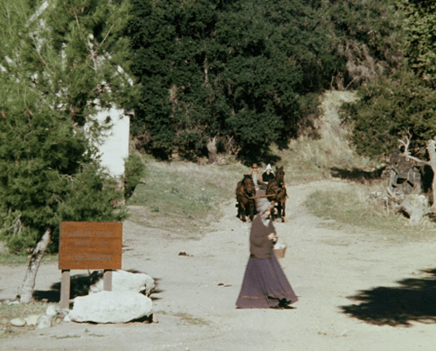
She looks a bit like the Bead, but don’t get too excited. It isn’t her.

She might be Mrs. Lavish, the striking if rather heavily made up Grovestress we’ve met a few times now.

A couple drive a wagon into town from the north. I’m pretty sure the man is “Unknown Grovester.” (My tracking system is not always that helpful.)

He’s accompanied by a Medieval Peasant Woman, which makes sense, since we identified them as a couple in “Harriet’s Happenings.”

We see that both Jud Larrabee (two Rs this time) and Joe Kagan are in this one.

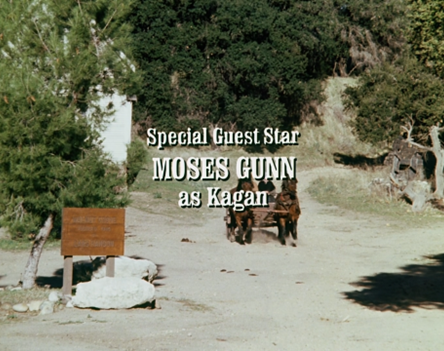
Kagan plus Larrabee is a volatile cocktail, two Rs or not, and is our second indicator it’s not a light frothy Kezia-type story we’re in for.

At the Mill, we see a huge crowd of men, well, milling about, you might say!

I know, this is perhaps my weakest wordplay since describing Queenie Smith as being “miraculous in her performance as the Whip.” (I’ve been doing this for 111 stories, folks. The candle of my wit is a puddle of wax on the floor at this point.)

We notice the tight thin trousers of Charles Ingalls are at the center of things once again.
DAGNY: Michael Landon’s butt literally reflects sunbeams.

Jonathan Garvey is addressing the assembly. It’s a meeting of the local farmers’ guild, who last gathered together in “Money Crop” – an astonishing 44 years ago in Little House Universal Time (LHUT).


The guild is not to be confused with the Grange, a national organization we encountered last season.

Garvey says they must agree on a high price to charge for the wheat. Anyone selling at a lower price would ruin the others’ chances to make money on theirs. (Undercutting like this is known as “predatory pricing.”)

Jud Larrabee pipes up and says, “Suppose they go elsewheres and get it cheaper.”
Joe Kagan says nobody will do that, since it’d cost more to ship the wheat from another location. (Because Walnut Grove is so conveniently located? Not sure I buy that. There isn’t even a train station.)

A smooth-faced man who sounds drunk says, “ I dunno, maybe we should back off a little bit.”

He looks a little like Ciarán Hinds, but that’s not the only reason you may recognize him, or think you recognize him, or think you may recognize him.
It’s because he’s Larry Golden, an actor we’ve met twice already on this show.
First he was the guy who chickened out of the blastin’-oil mission in “The Long Road Home.” (Not that I blame him!)

Then he played the wormy-looking but nice minister who befriended the Ingallses in Dakota Territory.
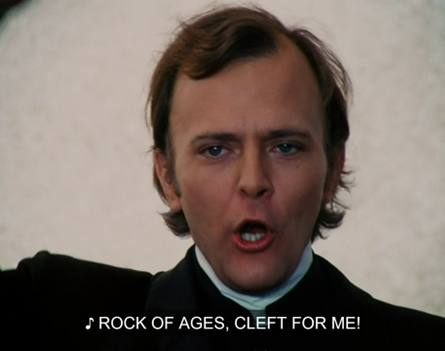
Garvey interrupts to explain the economics of the thing again, and drunk or not, the guy backs down.
Carl the Flunky is on Team Garvey. He says last time this happened, they weren’t prepared and lost a shitload of money.

He even tosses his toothpick to the ground in disgust!


With feeling, Jonathan Garvey says, “I’d just as soon burn my whole crop as sell as cheap as I did last time!” (You wouldn’t think he’d tempt fate; but let’s not get ahead.)


Larrabee isn’t satisfied, saying as the area’s largest wheat producer, he doesn’t like the risk.
WILL: He was a SHEEP farmer in “The Wolves,” remember? Why did he change to wheat?
DAGNY: Probably because of that incident.

It soon becomes clear Larrabee has another reason for objecting to the plan: “Why should I stick my neck out so some ex-slave make the same money as I do?”

Larrabee is clearly still stinging after his smackdown by Harriet Oleson of all people in “Blind Journey.”

Charles closes his eyes as if in pain. If I asked which character this season was most likely to induce migraines, I think Jud Lar[r]abee would be up there in the rankings.

A man with a broom-brush mustache also leans forward and frowns at Larrabee’s comment.

Most of the men seem to disapprove of Larrabee’s attitude, in fact.

Joe Kagan himself stays cool as Garvey argues with the odious little man.
“You think Joe Kagan is the only one gets hurt if we don’t stick together on this thing?” Garvey asks.
DAGNY [as JONATHAN GARVEY]: “If he was, that would be fine!”

Larrabee ultimately agrees.
DAGNY: That guy on the right looks like a little baby.

Garvey adjourns the meeting.
WILL: Is that Wolfman Jack?


Besides the regulars already mentioned, I only recognize Not-Richard Libertini in this group.

Afterward, Larrabee sidles up to taunt Joe.
“Free or not,” he sneers, “looks like the white folks still have to take care of you, don’t it, boy?”
Kagan just laughs his Yoda laugh in Larrabee’s face.
WILL: You see, that’s the effect I was going for when I scoffed at the line-cutters at the State Fair.
DAGNY: You did not get there.


Then we cut to the Old Sanderson Place, where a dude is laughing in Garvey’s face.

Garvey says his wheat quote is no joke.

The dude, a Mr. Bates, apparently represents a flour company. Minnesota was in fact called the “flour-milling capital of the world” by many in the late Nineteenth and early Twentieth centuries.

Minneapolis is still known by the nickname “Mill City,” and you can see the old mills and silos around town.

DAGNY: That’s a great hat. It’s green!
WILL: Yeah, the Fourth Doctor wore a green hat kind of like that.


Mr. Bates smugly says he’ll just buy from Garvey’s neighbors instead.
DAGNY: That’s a lotta lip to give a guy who could pull the wheels off your wagon, bro.

But when Bates gets to Joe Kagan’s pig farm, he finds the wheat’s no cheaper there.
Bates drily says that Joe is acting “uppity.”

Everybody these days seems to acknowledge there are racist connotations when a white person calls a Black man “boy,” as Jud Larrabee did a moment ago.
But some people are less familiar with uppity. In a nice (?) coincidence, the word was coined by Joel Chandler Harris in his first Uncle Remus book, which we discussed just last week.


First appearing in “The Fate of Mr. Jack Sparrow” (no relation to the pirate, uh huh haw), uppity is used to describe a bird in that story.

In the Remus stories, all the animal characters are comic caricatures of Black people who speak in a dialect created/captured by Harris.
Over time, of course, this word came to be applied not just to fictional birds who talk like Black people, but to actual Black people themselves. The usual construction used was “uppity n—.”
“Uppity n—” was especially used in the Southern U.S. in the Jim Crow days, and was applied to Civil Rights leaders by many opponents in the 1960s.
The use of “uppity” to denigrate Black people isn’t just ancient history, though. There have been public uses of it this century too. It was notably applied by Rush Limbaugh to First Lady Michelle Obama, in response to her work to encourage healthier eating by children. (Limbaugh is somehow now a recipient of the Presidential Medal of Freedom, but on the other hand, he’s no longer alive.)

The Remus book with “uppity” in it was published in 1881, so it’s possible the term was in use in Minnesota by 1883.
Hell, maybe Carrie spread it around town herself. She is fond of offensive expressions.

Anyways, Joe Kagan remains calm as Mr. Bates describes what Joe’s doing as “blackmail.” (Another deliberate word choice? Don Balluck wrote this week’s script.)

Cut to a very close-up shot of the yellow wheels of the Yellow-Wheeled Buckboard.
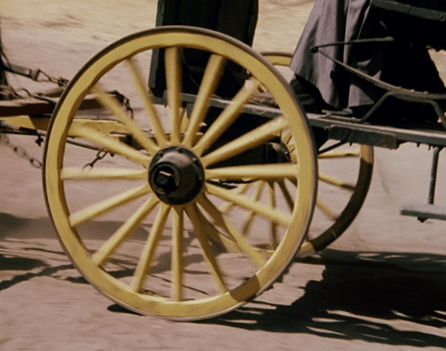
Today it’s conveying the Unknown Grovester, the Medieval Peasant Woman, Not-Ellen Taylor and the Gelfing Boy through town.
At first I thought this was very good attention to continuity, since we deduced in “Harriet’s Happenings” that Not-Ellen and the Gelfling are sibbies, and since we saw the Unknown G-ster and the MPW together at the top of this story.

But actually, it appears they’re just reusing the same footage from “H’s Hs.”
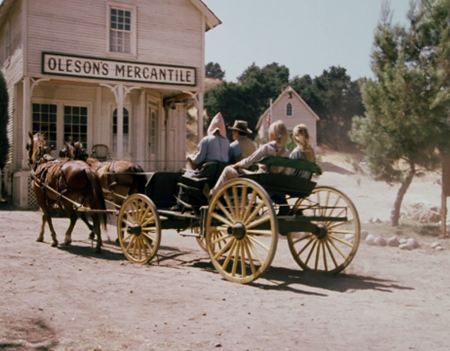
Inside, Harriet Oleson is loading up groceries for Joe Kagan. She’s pretty friendly, for her anyways.
Jud Larrabee comes in. (He’s always running into his enemies in this store, isn’t he?)


Larrabee interrupts Kagan mid-sentence to ask Mrs. Oleson for service.

Larrabee wants to buy ammunition and what our transcriptionist interprets as “beagle oil.” (That’s what it sounded like to me too.)
In fact, Larrabee is buying Bigeloil, a cooling liniment mostly used for horses.
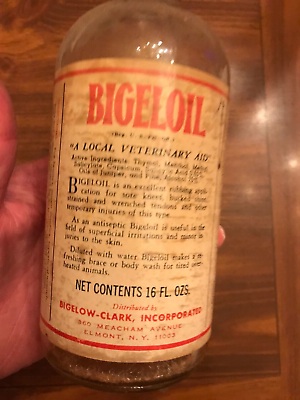
I couldn’t find when the Bigeloil brand launched, but it was well known enough by 1892 to be acquired by another company, so I think it’s fine timeline-wise-speaking. Still exists today.

Well, despite the courage she showed attacking Larrabee’s racism in “Blind Journey,” Mrs. O seems uncertain how to handle this development.

But when she turns to accommodate Larrabee’s request, Joe Kagan stops her – physically – and says, “Finish my order first.”

Clearly uncomfortable, Mrs. Oleson nevertheless politely helps Kagan complete his purchase, which includes two large jars of orange marmalade, before helping Larrabee.
DAGNY: Did he just buy out their marmalade? He’s one person, how much does he need?

They are quite large jars. Some would say they’re enormous jars!
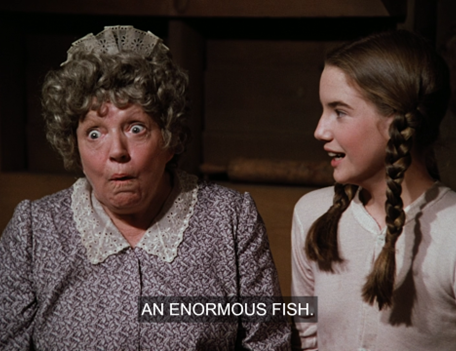
Then Jud Larrabee says, “You gonna get yourself in a lot of trouble, boy, talkin’ to a white lady like that. Now I reckon you owe Mrs. Oleson an apology.”

Now, I know we do have some younger people who read this blog who may not realize just how big a deal it would be for a Black man to put his hand on a white woman in the Jim Crow days.
“Jim Crow” was a system of formal laws and policies as well as of unwritten expectations about social conduct. According to the Jim Crow Museum in Big Rapids, Michigan:
A black male could not offer his hand (to shake hands) with a white male because it implied being socially equal. Obviously, a black male could not offer his hand or any other part of his body to a white woman, because he risked being accused of rape. . . . Black people who violated Jim Crow norms . . . risked their homes, their jobs, even their lives. White people could physically beat black people with impunity. Black people had little legal recourse against these assaults because the Jim Crow criminal justice system was all-white: police, prosecutors, judges, juries, and prison officials. Violence was instrumental for Jim Crow. It was a method of social control. The most extreme forms of Jim Crow violence were lynchings.
Lynchings were public, often sadistic, murders carried out by mobs. Between 1882, when the first reliable data were collected, and 1968, when lynchings had become rare, there were 4,730 known lynchings, including 3,440 black men and women. Most of the victims of Lynch Law were hanged or shot, but some were burned at the stake, castrated, beaten with clubs, or dismembered. . . . Lynching was used as an intimidation tool to keep black people, in this case the newly freed people, “in their places.”
. . . Many white people claimed that although lynchings were distasteful, they were necessary supplements to the criminal justice system because black people were prone to violent crimes, especially the rapes of white women. Arthur Raper investigated nearly a century of lynchings and concluded [in his 1933 book The Tragedy of Lynching] that approximately one-third of all the victims were falsely accused.
. . . Lynch law was often supported on the popular belief that lynchings were necessary to protect white women from black rapists. [Gunnar] Myrdal [in his 1944 book An American Dilemma: The Negro Problem and Modern Democracy] refutes this belief in this way: “There is much reason to believe that this figure has been inflated by the fact that a mob which makes the accusation of rape is secure from any further investigation; by the broad Southern definition of rape to include all sexual relations between Negro men and white women; and by the psychopathic fears of white women in their contacts with Negro men.”
A long quote, and a bummer, but necessary for understanding the tensions of this scene, I think.
And remember, the Civil Rights Act of 1964 was passed just 15 years before this episode aired. Jim Crow was well within the memory of the Baby Boomers who would have been watching Little House with their kids in 1979.
Now, Minnesota was a northern state and never had Jim Crow laws, but there were formal racist policies here. Dagny recently worked on a project in our neighborhood to identify racial “covenants” (language on property deeds forbidding their sale to non-white people) that were still on the books. There actually was one on our house (built in 1948!), which we’ve now had expunged.

Long story short, I think the scenario depicted here is quite plausible. It wasn’t just a Southern problem.
Well, Mrs. O still seems uncomfortable, but not from Joe touching her.
Kagan immediately replies he owes Mrs. Oleson money for the groceries, but nothing more.

Jonathan Garvey sticks his head in the door and tells Joe to hurry up. Joe completes his transaction, and Mrs. O gives him a brief but seemingly genuine smile.

After they’ve gone, Mrs. Oleson’s expression changes to one of suspicious contempt as she stares Larrabee down.

But Larrabee is only worried about his own image of masculine strength, saying, “If I’d started anything, Garvey would have helped’m out! I cain’t handle both of ’em.”

Mrs. O flatly asks if Larrabee still wants to purchase anything, but he stomps out.
Harriet gives him another look and shakes her head as he goes. She’s not her usual decisive self here; but it’s far from her worst hour.

Next, we go to the Larrabee property, where Larrabee is walking around with Mr. Bates. He gives Bates the same price the others did, but then adds, “Of course, I could give you a bargain on apples.”
Mr. Bates, a flour man, is confused.

He’s James O’Connell, who acted on The Waltons and Highway to Heaven and in The Postman Always Rings Twice, Death Hunt, Who Framed Roger Rabbit? and The Cable Guy.

He was also in Bound for Glory, which costarred Tony Becker (whom we’ll meet again in a moment as Zeke Larrabee), as well as fellow Little House alums Ted Gehring, James Jeter, and the Sierra Number 34 train.

Bates says since it’s apple season, all the farms have apples – so many, he stammers, that “why, even, even the pigs’ll be turning their backs on ’em for feed!”
DAGNY: He kind of Jimmy Stewart-ed it there.


“Well,” Larrabee says, “the onliest reason I brought up the apples is, if you could see your way to buy ’em at a modest price, I just might be persuaded to give a little on the wheat.”
The two men laugh evilly.
DAGNY: Oh my God, he’s fucking them! He’s so yucky.


He is yucky, but Don “Red” Barry deserves credit for making him so.

(This will be the last time we meet Barry, a troubled man who died by suicide in 1980.)
Next we see a bearded man in a hat racing up the drive of the Larrabee place.
DAGNY: Is that Mr. Edwards?

It isn’t. Once again, it seems to be Mustache Man pretending to be Jonathan Garvey. They really should have invested in a bigger stunt driver, considering how often they depict Drivin’ Garvey.

Garvey bangs on the door, roaring his foe’s name.
DAGNY: Look how mad his butt is!

A woman comes to the door – Mrs. Larrabee! (Previously, we assumed Larrabee was a widower, but I guess that’s wrong.)

From inside, Larrabee says, “Let him in.”
Larrabee is fooling around with a stereoscope whilst Lem and Zeke, his sons last encountered in “The Craftsman,” do their homework at the table. (Tony Becker and Christian Berrigan are both back.)

Surprisingly, Larrabee’s house is full of books and expensive-looking art. (Books? Jud Larrabee?)

Garvey warns Larrabee his comments will be too ugly for the family to hear, but Larrabee just sasses him.

Larrabee fudges his account of what happened slightly, saying Bates proactively offered to buy his apples.
Then he adds, “Besides, there ain’t no n— gonna make the same profit as me.”
Garvey is outraged at this motivation. Larrabee tries to throw him out, but the big guy stays and lectures him about how the Grovesters have struggled to rebuild the economy since the Great Crash of 1881-G.


He again says they all might as well burn their wheat now, for all the good it’ll do them.
DAGNY: Let me guess the plot. Larrabee’s barn burns down, and Laura solves the mystery of which Grovester did it.
WILL: You’ll have to wait and see, but you should apply for a job writing for the new series, I think.

Larrabee screams at Garvey to get out, and Mrs. L, Lem and Zeke make faces of concern.


Then we get a neat shot of a Chonky passing the camera, which is in front of Garvey’s horses and wagon, which are in front of the Little House at night.


Inside, Jonathan and Alice are visiting.
DAGNY: Merlin Olsen is a butt actor. You can tell he’s calm now, because his butt is calm.

Garvey regrets being so aggressive in front of Larrabee’s family. “I ain’t never talked to a man like that in my life,” he says.
While it’s true Jonathan Garvey rarely gets angry, it’s not like he never does. He was pretty nasty to Alice when the barn burned down previously.

He flipped over the gaming table in the Shamrock Saloon because other players were cheating.

He squeezed Harlan the Bouncer’s guts out like the last of the toothpaste in Winoka, as revenge for beating Charles.

He punched Harlan’s sidekick Glover in the dick as part of the same incident.

On the phone company worksite, he threatened to eat Shaughnessy the cook after a dispute about potatoes.

And of course, let’s not forget “WHERE’S MY MOOSE HEAD!”

Alice, who has a more fiery temperament than her husband, says as far as she’s concerned Larrabee can, well, go fuck himself in the face. (To borrow a high government official’s elegant phrase.)

Everyone shrugs and says what can you do, then Caroline nicely invites them to stay for supper.
DAGNY: I always liked when they asked people to stay for supper.

But Alice and Jonathan say Andrew’s waiting at home.
Back at the Larrabees’, Jud paces around the parlor in a rage. He guzzles down a large whiskey.

Nervously, Mrs. Larrabee says, “Well, you can’t hardly blame [Garvey] for being upset. . . .”
Larrabee yells at her and she cowers away.


Larrabee grabs his shotgun and storms out, shoving his wife when she tries to stop him.
At the Old Sanderson Place, Andy is doing his homework. Though naturally dumb, he does try. A good kid.

Suddenly Larrabee bursts in with the gun.
DAGNY: Oh my God!

He demands to see Garvey, then starts searching the house!
DAGNY: Oh, no! Oh, shit!
WILL: Hit him with the moose head!
(Actually the moose head is nowhere to be seen.)

Andy screams at him, but Larrabee screams back and hurls the kid to the floor, where he remains motionless.
DAGNY: Oh, no . . .
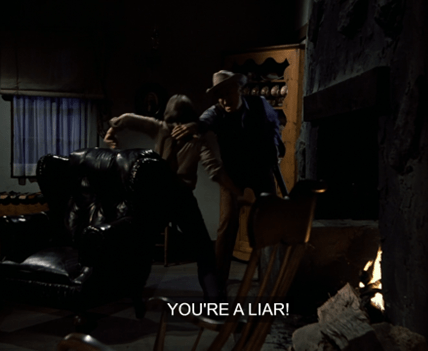


Alarmed, Larrabee turns the body over. Andy struck a cedar chest on the way down and is covered in blood.
DAGNY: Oh, shit!
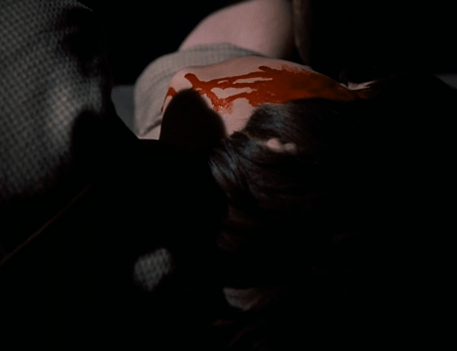
Larrabee flees the scene.
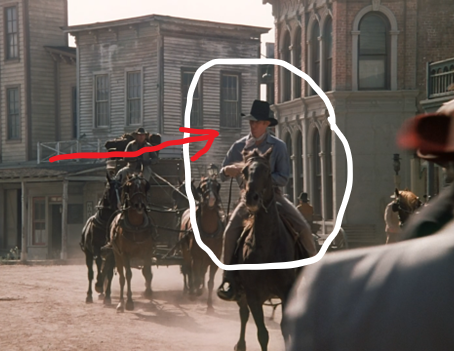
(As he rides away, you can see it’s a much younger stuntman. Looks like Herbert Diamond, in fact.)

But Andy is still alive. He crawls from behind the “Terror of the Autons” chair and gets to his feet.

Andy grabs a lantern, then rushes out to the Barn of Garve. He saddles a horse and rides off for help.

(This rider, we can see, is also a stuntman, or stunt-kid. In fact, I think it’s one of our Ambiguously Ethnic Kids!)


Andy meets his parents on the road, and tearfully but bravely updates them on the sitch.

Jonathan wants to take Andy’s horse and pursue Larrabee. Alice cries that Larrabee’s got a gun; but Jonathan doesn’t care.
DAGNY: He’s probably impervious to bullets.
WILL: Yeah. He’s like a grizzly, you’d need seventeen shots to bring him down.

Ultimately, Alice convinces him to come home with them.
But the Old Sanderson Place is a scene of horror: the Barn of Garve is in flames! (Again!)
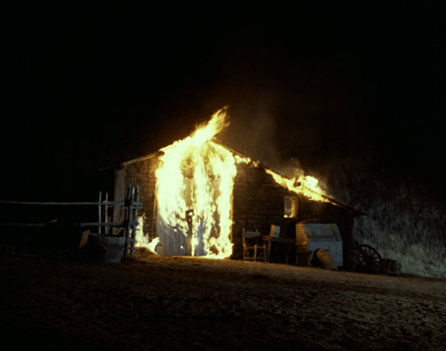
We get a wonderful shot of the shadow of the fire on the house as they drive up. Technically, because it produces light, fire can’t actually cast a shadow, but the soot and particles in the smoke do.

“Lord God!” Jonathan exclaims.
Andy, still dripping with gore, says, “Mr. Larrabee! He must have come back!”
DAGNY: That is a bad head injury. I think part of his brain is coming out.

Jonathan turns to ride out, and when Alice tries to stop him again, he says, “Don’t worry, I’m just goin’ to town.”
WILL [as JONATHAN GARVEY]: “I’ve got me a hankerin’ for marmalade!”

Whew! Pretty intense, huh?
Well, things don’t let up! Next we hear Harriet Oleson screaming (literally screaming this time) at Nels, who’s getting his hat on and grabbing his gun.

For the Grovesters are forming a posse, which Harriet is begging Nels to not join, for his own safety.
DAGNY: The way these wives are behaving is very believable, actually.
WILL: Yeah, I can see my mom being this way. I’m sure you’d cheer me on if I joined a posse, though.

Well, Nels doesn’t listen to her, and the posse, which consists of seven or eight Grovesters, arrives at Larrabee’s house.
WILL: It’s a Cormac McCarthy novel again.

They bang on the door, and inside we see Larrabee, surrounded by his mantel clocks and bibelots and loading his gun. (So was it not loaded when he took it to Garvey’s house? That would be an interesting wrinkle in the story, but let’s not get ahead.)

Jud’s horrified family watches as he screams through the door.
He warns that anyone trying to get in will have their heads blown off . . . when a calm voice speaks from across the room.
DAGNY: Yeah, Nels!

Yes, our beloved Nels is pointing a gun through the window right at Jud Larrabee’s head.
WILL: Nels could never shoot anyone.
DAGNY: I think he could, under the right circumstances.
WILL: I don’t know. He wouldn’t even let them shoot that monster.
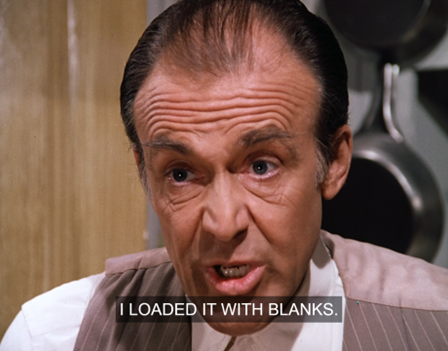
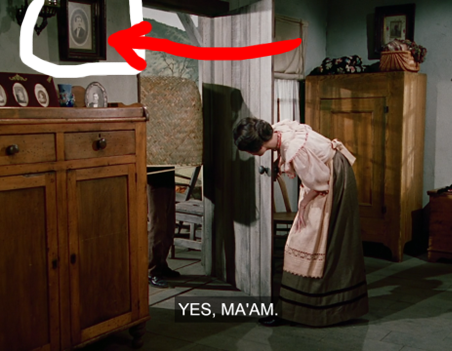
It’s worth noting that Jud Larrabee has that picture of John Wilkes Booth on his wall as well.

It’s the first time the picture makes sense, in fact.



Larrabee drops the gun, and Jonathan Garvey charges in to strangle him.

Joe Kagan and Charles stop him. Joe insists the case must be handled by law, not vigilante justice.

DAGNY: Nels comes through the window? That’s awesome.

Nels says, “We’ll lock him in the ice house until the judge gets here Thursday.” How does he know that’s when the judge is coming? They couldn’t have notified anyone yet; the attack only happened tonight, after dark. What, did they send Carrie in her balloon to wake the judge in Sleepy Eye?


The men seize Larrabee and haul him outside, Nels apologizing to Mrs. Larrabee as they go. (A nice touch.)

After a commercial, David gives us an unusual harpsichord-and-drum duet as we see Andrew heading off to school, head a-bandaged.
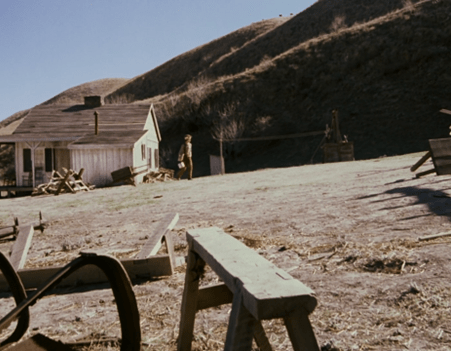
There’s something at the top of the hill that doesn’t look organic; but I can’t tell what it is.

He passes the ruin of the Barn of Garve, which looks a lot smaller than you’d think.

(For comparison, here’s what my family’s barn looked like after a tornado blew it down in 1983:)

Andy pauses when he notices something: the remains of the lantern he left behind the night before. Memories flash before his eyes.

DAGNY: I like these little flashback touches. It’s a device we haven’t seen before. Is it Landy this week?
WILL: Yeah.


Always experimenting, that Landy.
Jonathan Garvey appears and tells Andy he should stay home from school and rest. But apparently Doc has been out to the house and blessed Andy to go. We must be a day or two out from the attack.
Jonathan shakes his head and says, “Hard to believe this happened.” Wouldn’t he say, “Hard to believe this happened again?” It’s strange to me there’s no reference at all to the previous fire on the Garvey property. True, it was 21 years ago in LHUT, but one’s barn being destroyed is, I can tell you, a memorable thing.

Anyways, Jonathan says Larrabee will go to jail for this. (There’s an airplane trail in the sky behind him.)

Looking thoughtful and a little guilty, Andy heads to school.
The class today includes him, Laura, Albert, Carrie, Nellie, Willie, the Larrabees, the Kid With Very Red Hair (Mean One), Not-Ellen, Miniature Art Garfunkel, the Misbehaving Girl, Not-Gelfling Boy, and a little blond kid we’ve never seen before who looks a bit like a Weeble.

Awkwardly – and surely it would be awkward having both Andrew and Larrabee’s kids as pupils – Mrs. Garvey tells the children there won’t be any school the next day, because they’ll be using the room for “town business.”
Mrs. G dismisses the students, and out on the playground, Andy sees Zeke Larrabee being bullied.

The bully is a tall kid we’ve seen before: it’s Rob MacGregor, the kid Mary kicked in the nuts for making racist comments and trying to strangle Laura in “Freedom Flight.”

(It’s odd that he and Mary were the same age in that story, but now she’s a middle-aged married schoolmarm and he’s still a playground bully.)
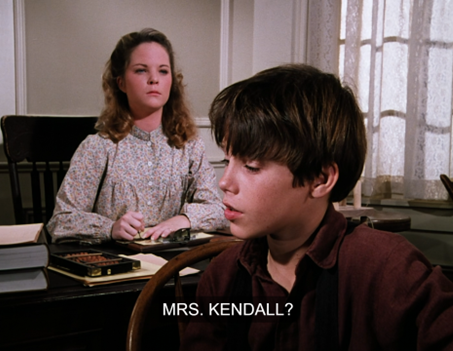
(Rob M played by Brett Ericson, who appeared on Eight is Enough and Lou Grant.)
Addressing the bully sharply as “Todd” (we’ll just ignore that), Andy says leave Zeke alone.
Rob MacGregor challenges him, but quickly backs down.
He skulks off accompanied by fellow bullies Very Red Hair and Not-Gelfing Boy, Not-Gelfling Boy adopting a look of cool disdain as they go.
DAGNY: It’s nice the school finally has a gay kid.
WILL: Who runs with the bullies! He’s like those tough gay guys on Seinfeld.

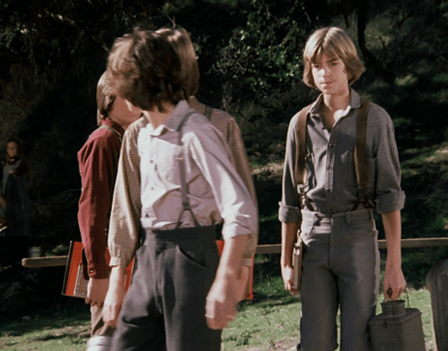


Zeke Larrabee, an antisemite and rotten puke of a bully himself, tells Andy he doesn’t need his help or sympathy.

Andy says it’s not his fault what Zeke’s dad did to him. Zeke snarls that even if his dad’s guilty, it’s Andy’s dad’s fault for making him do it.
That night at the Garveys’ table, Jonathan gives a nice blessing where he thanks God for understanding his grumpiness given recent developments.

WILL: Are those Tater-Tots? Were they even invented then?
DAGNY: I think they’re carrots.

Jonathan says Larrabee vehemently denies setting the fire.
Andrew is going to testify against Larrabee is court. You can tell he finds it a heavy responsibility.

Now it’s trial time! This one’s flying by; it’s packed with action and drama.
A lot of people arrive at school to watch the proceedings. They include Muriel, Harriet Oleson’s archery rival (arch-rival?) who looked like Cynthia Nixon.


She arrives chauffeured by Carl the F, on the way passing Kezia’s Topsy-Turvy Adventureland (which we haven’t seen in a while).

Larry Golden is also there, muttering to somebody who looks like a poor man’s Robert Mitchum.


Larry says despite being friends, he feels Jud should hang for betraying the farmers.
Joe Kagan overhears this.

Next we see Jud Larrabee shivering in the ice house. Is that really where they’d keep him? Seems like cruel and unusual punishment. Why not a room over the Post Office?

Nels appears at the stairs to summon the prisoner to court. He’s armed, but I hope he has backup.
The classroom is pretty full. In addition to those already mentioned, Mrs. Oleson, Nels, Doc, Hester-Sue, Mrs. Foster, Mustache Man, Herbert Diamond, Not-Richard Libertini, the Medieval Peasant Woman, Mr. Penguin Man, the Unknown Grovester, and the Larrabee family are all there as well.

At the desk sits the judge, a spectacled man with a mighty nose/mustache combo.
WILL [as THE JUDGE, sniffing]: “Do I detect a whiff of lemon verbena about this desk?”


DAGNY: He looks like Mark Maron.


The history of court trials in frontier America is complex, but the scenario presented here seems basically accurate. The judge is described as a circuit judge, meaning a Federal judge with oversight over large regions of the country.
Today Minnesota is in the Eighth Circuit, which also includes North Dakota, South Dakota, Iowa, Nebraska, Missouri, and Arkansas.
The Eighth Circuit wasn’t established until the 1890s, but circuit judges existed before then. They traveled long distances to preside over local trials (they were in fact nicknamed “circuit riders” since they were constantly on the move).

The judge is attended by Reverend Alden.
DAGNY: Is this the first time a judge has ever been summoned to Walnut Grove?
WILL: Well, there was Judge Picker, who came to officiate the Garveys’ divorce. But for a criminal case, yes.

That got me to thinking: Have there been worse crimes committed here? What’s the worst thing that ever happened in Walnut Grove?
DAGNY: Well, there were those brothers who sexually assaulted Ma.
WILL: And beat people up, and bought houses and stuff without paying.
DAGNY: Yeah. They just went away, right?
WILL: Well, yeah, after Reverend Alden roughed them up in church.
DAGNY: This show.


WILL: What about Busby? They were just going to lynch him for killing Ellen. I don’t think they were gonna call in the authorities.

DAGNY: Yeah. And what about Ellen’s kidnapper mom? She got off scot-free.

The other incident that comes to mind is the Jesse and Frank James hostage crisis. (Another Don Balluck story.)

In that one, not only did the Grovesters not call in the law, they actually frustrated the efforts of a group working to capture the kidnappers (and killers).

Nels, Carl and Johnny Cash Fusspot bring in the prisoner, who admits to assaulting Andrew but pleads not guilty to the barn-burning. (This script appears to be suggested by William Faulkner’s short story “Barn Burning.” The narratives are quite different, but both include revenge, petty, resentful, racist fathers, boys who agonize over what to reveal in court testimony, and barn burning, of course.)

The judge invites Rev. Alden to be jury foreman, but Alden replies that this is inappropriate, presumably because as the Grovesters’ spiritual leader, he would not wish to influence their decisions about legal matters. (This notion, archaic among American clergy today, is known as “separation of church and state.”)

Then Aldi says, “I think Charles Ingalls would do an entirely responsible job.”
WILL/DAGNY: Oh my Gawd/surprise, surprise, etc.

The judge instructs Charles to just choose jurors from the audience. The trial audience, I mean, not the TV audience at home.

(This appears not to have been how juries were selected, even back then; but a simplification to keep the pace brisk is acceptable, I think.)
WILL: Where are Adam and Mary? They don’t care about any of this?
DAGNY: The Blind School is still open. It’s Thursday.

For a start, Chuck picks Nels, Doc, “Fred Simmons” and “Steve Mason” (no idea who these two are).
But Larrabee suddenly screams, “Judge! Those men is all prejudiced agin me!”
The judge shoots down this objection. (One thing that seems wrong about this trial is there are no lawyers present. There certainly would have been at the time; in fact, attorneys often traveled the “circuit ride” with the judges themselves.)

Larrabee continues, saying, “Well, why don’t he get Matt there on the jury!” and points out his friend Larry Golden.
Charles calmly says Matt (last name Gillis) was his next choice. (I knew a guy named Matt Gillis once. An ass!)

Then Charles calls Joe Kagan, and Larrabee goes berserk.
“Judge!” he screams again. “It’s agin the law to have a colored on a jury!”
Annoyed, the judge says, “I must inform you and the court that it has recently been declared unconstitutional to bar a member of the Negro race from sitting in judgment of a white defendant.”
He’s likely referring to Ex Parte Virginia, an 1880 Supreme Court ruling that people (well, men) couldn’t be excluded from jury selection because of their race. (This upheld two Constitutional Amendments and the Civil Rights Act of 1875.)


The judge overrules the objection, then Charles calls “Jeff Harmon,” “Harry Ross,” “Tom O’Farrell,” and “Mike Dubbins.” (We see Mr. Penguin Man get up when Tom O’Farrell is called.)

We go to commercial.
When we return, the Yellow-Wheeled Buckboard sits quietly outside, as if pondering legal conundrums itself.
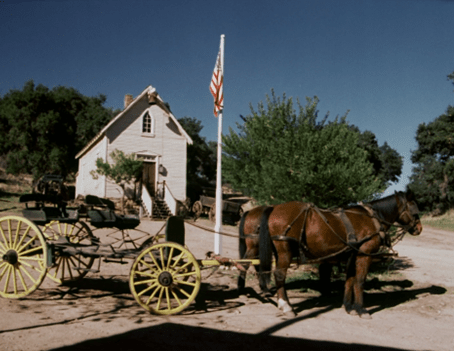
Inside, Jonathan Garvey takes the stand, and tells how he went to Larrabee’s house and yelled at him.
He says, “I was the first. I think there’da been others, but word got around I’d already spoke m’piece.”

(Word got around? Impossible. Larrabee’s house is near the Old Rustic Bridge in the southeast corner of Groveland, which we know since Albert would sneak across Larrabee’s property to get home from work at Isaac Singerman’s nearby woodwright’s shop.)


(After leaving Larrabee’s, at which time it was still light out, Garvey must have picked up Alice walking home from school. (The schoolday was already concluded, since Lem and Zeke were doing their homework already, but presumably Mrs. G stayed to erase chalkboards and lock up.))
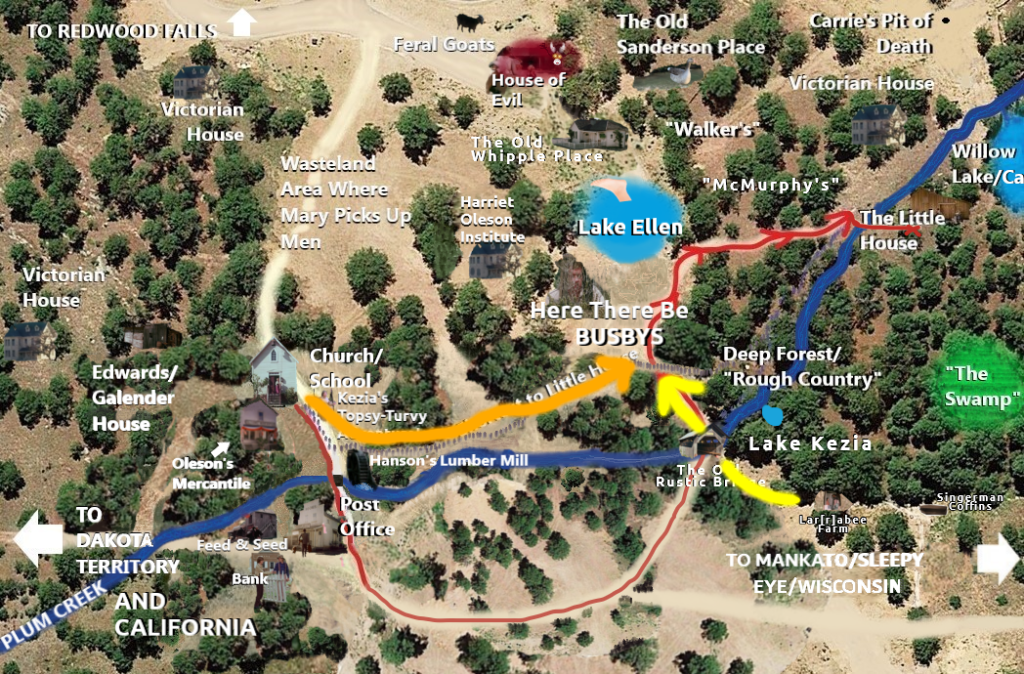
(The Garveys then went directly to Charles and Caroline’s to report what happened. It was dark by this point, but not yet suppertime.)

(After that, they met Bloody Andy in the road as they headed home. By now the barn was burning, but literally nobody knew about it yet.)
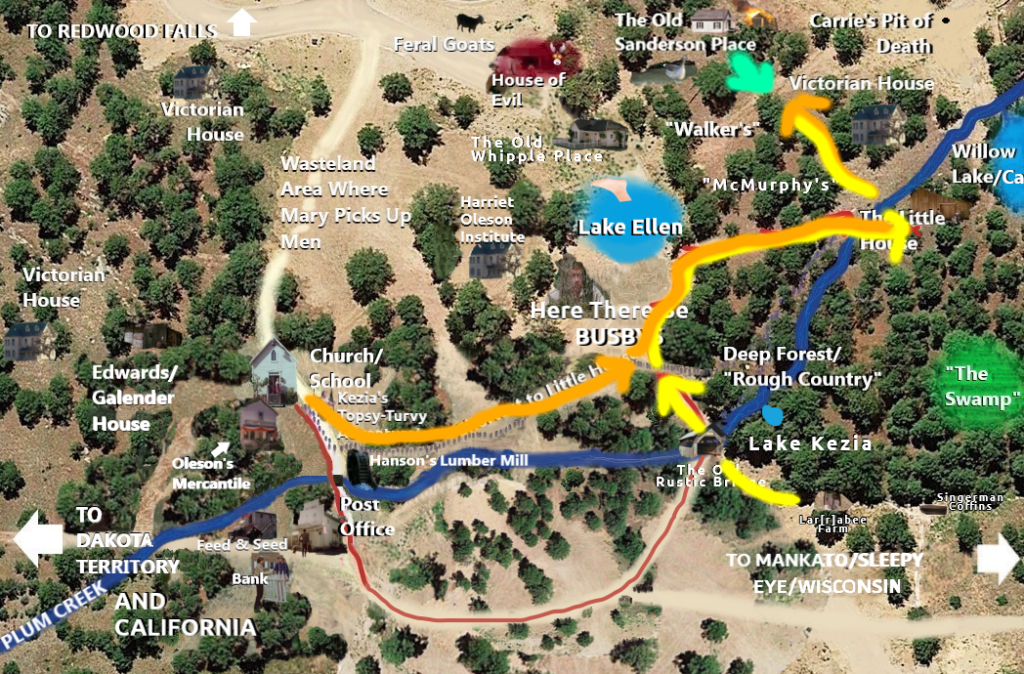
(After the briefest of stops at the burning barn, Garvey went straight to town to gather a posse.)
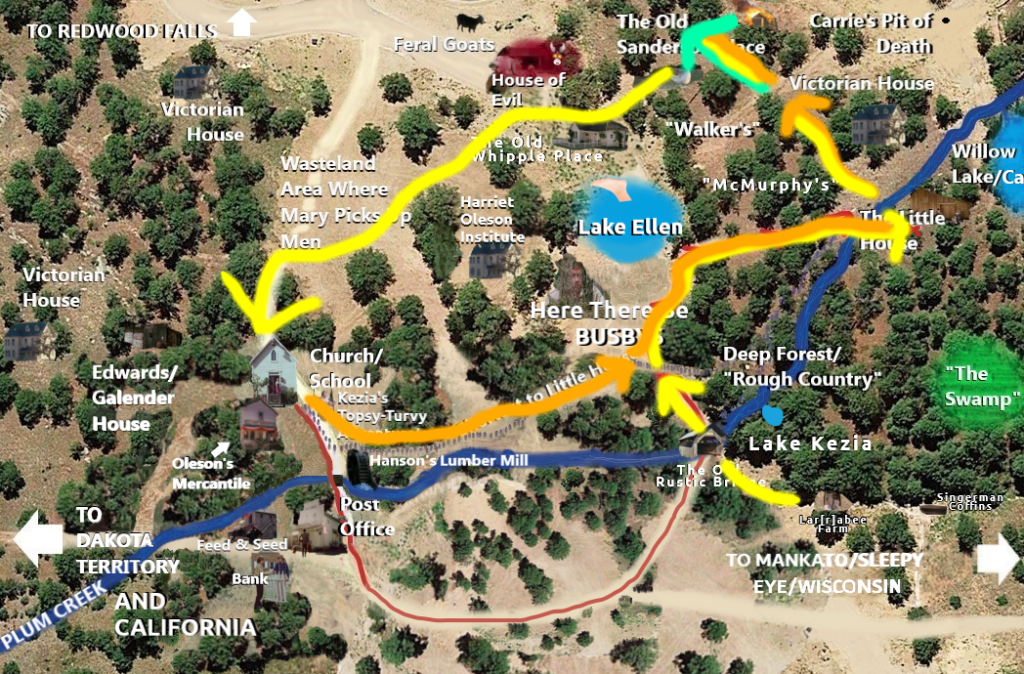
(Or maybe he picked up Charles first.)

(As for Jud Larrabee, after assaulting Andy, he surely went straight home. He wouldn’t go into town and tell anybody what happened, considering what he’d done.)

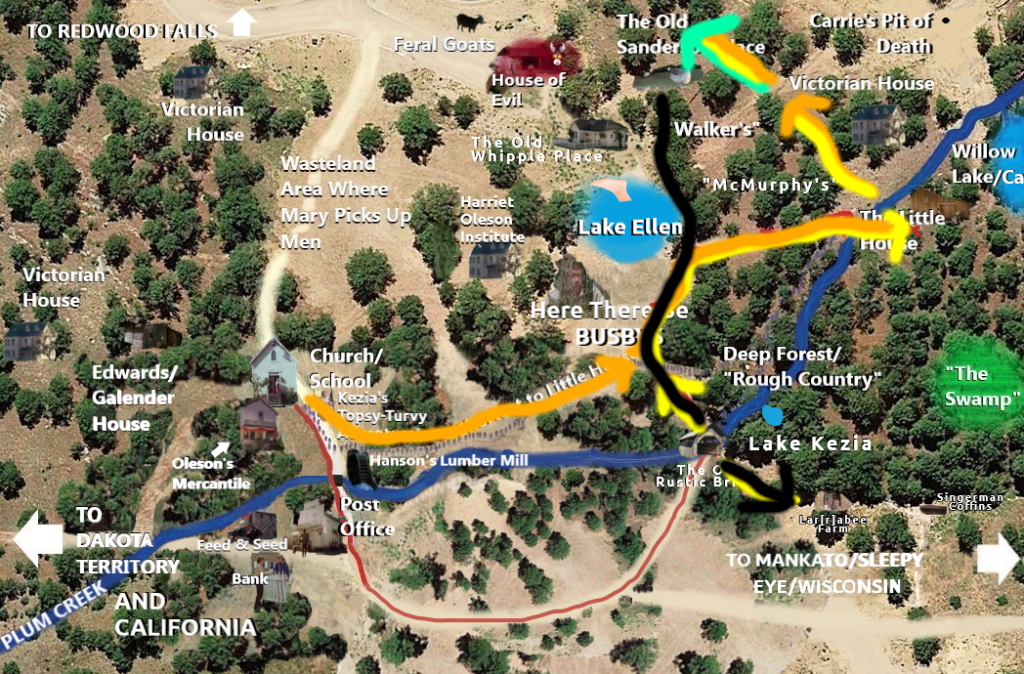
(You’ll notice that in his haste, Jud Larrabee followed the eastern shore of Lake Ellen to get to Garvey’s and back. This explains why he never met Alice and Jonathan on the road between the Old Sanderson Place and the Little House.)
(This all works fine . . . except how then did “word get around” Garvey had “spoke his piece”? No one could have brought the news to town before Garvey himself got there to raise the posse.)
(Unless maybe it was Carrie traveling in her hot-air balloon, of course.)
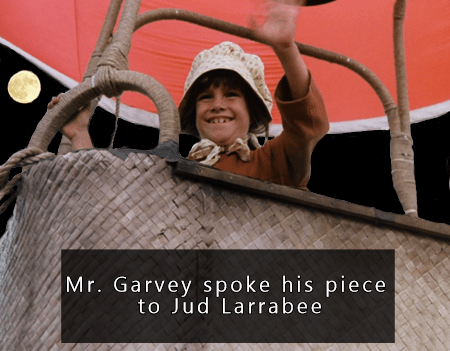
Garvey tells the court he and Larrabee are more en- than fren-emies.

Larrabee starts screaming how he deserved vengeance after Garvey browbeat him in front of his family. The judge is like, okay, well, I guess there’s your motive.
DAGNY: Larrabee’s a great lawyer for himself.


Andy is the next witness, and as the judge questions him, we see Rev. Alden himself is the twelfth juror.

Mustache Man is amongst them too.

Andy says there’s no way Larrabee throwing him to the floor was an accident. I question whether he’d really remember this incident after being knocked unconscious; I was in a car wreck many years ago (I wasn’t the driver) and was knocked out. When I came to in the hospital, not only couldn’t I remember the crash, I couldn’t remember anything from half an hour before it.

Well, Larrabee starts screaming again, but the judge shuts him up.
Andy says he didn’t see Larrabee when he woke up.
Allowed to cross-examine, Larrabee says sweetly, “I didn’t mean ya no harm! Cain’t you see it was an accident?”

“No, I can’t,” Andy says coldly.

“Judge, can’t you make him see it was an accident!” Larrabee screams, but the judge ignores his idiocy.

Then Larrabee himself takes the stand, where he admits he did break his promise to the guild.
The judge says he can’t see why Larrabee lowered his wheat price, given he’d have made more at the high price. He asks if Larrabee’s annoyance that Joe Kagan was included in the guild influenced his thinking (a notion Garvey mentioned in his testimony).
“That’s right,” Larrabee snarls with satisfaction. “And he got himself wiped out, too!”
The judge quietly asks if Larrabee has anything else to say for himself.
Larrabee urgently says he shoved Andrew but didn’t mean to hurt him, then says he believes Garvey burned his own barn to frame him. He says Garvey made cavalier references to burning his own wheat, which is true.

The audience mutters. I won’t linger on it, but there are some weird-looking new Grovesters in the courtroom today.

These include an old man who appears to have drawn on a mustache with a Sharpie . . .

. . . a younger man with a baby curl glued to his forehead . . .

. . . and a man who looks like a bald Will Ferrell.
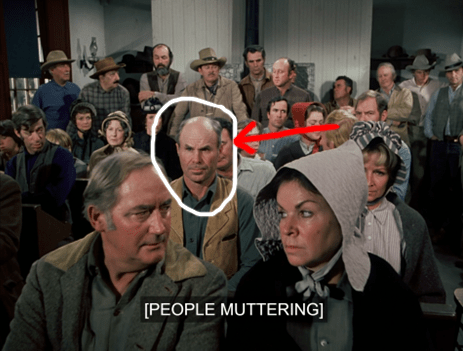

The judge says he’ll give the jury an hour to deliberate, though he doubts it’ll take that long.
There’s a fun in-joke for True Grit fans (I’m one myself) in this episode, because the judge is identified in the credits as “Judge Parker” and is played by an actor named Jeff Corey.
In the famous John Wayne film version of True Grit, Corey plays the villain Tom Chaney, whom girl hero Mattie Ross doggedly pursues after he kills her father. (It’s a great story. I prefer the Coen Brothers’ version, but the original is good too. And the book is a masterpiece.)
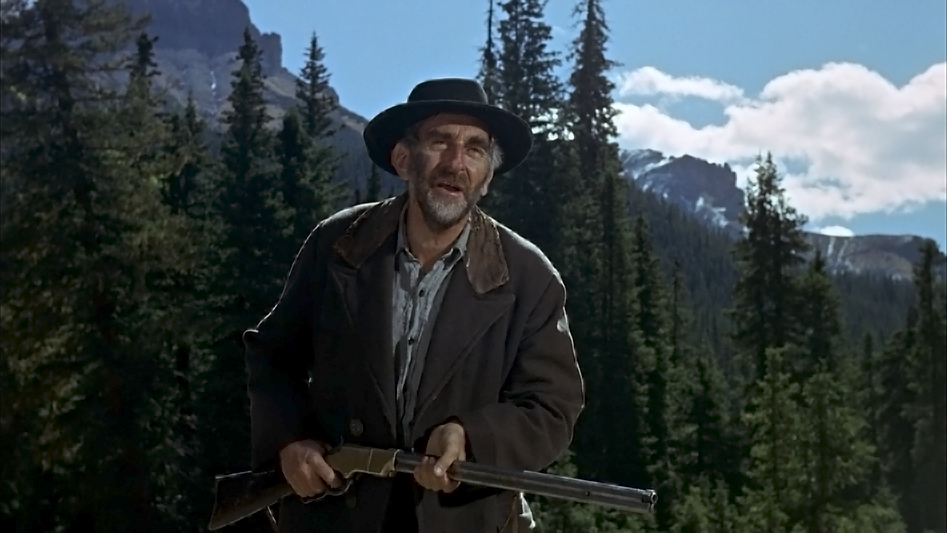
Anyways, Mattie hopes to bring Chaney back to Arkansas to be tried before a bloodthirsty judge named Parker. (“Hanging judge” Isaac C. Parker was a real person, but it can’t really be him in “Barn Burner,” since he only presided in Arkansas.)

Jeff Corey appeared in several movies in the first half of the Twentieth Century (including the classics Miracle on 34th Street and The Killers).


But during the communist witch hunts of the 1950s (a period for which many today seem shamefully nostalgic), Corey refused to testify before the House Un-American Activities Committee, resulting in his blacklisting in Hollywood for a decade.
Corey made lemonade out of the situation, becoming a beloved acting teacher. Alumni of his studio included James Dean, Kirk Douglas, Rita Moreno, Anthony Perkins, Leonard Nimoy, Jack Nicholson, Jane Fonda, Barbra Streisand, Rob Reiner, Penny Marshall, Richard Chamberlain, Cher, and Robin Williams.

In the 1960s, Corey was allowed to return to acting, and in addition to True Grit, he appeared in In Cold Blood, Butch Cassidy and the Sundance Kid, Little Big Man, Oh, God!, and many others.

On TV, he acted on The Untouchables, Perry Mason, Rawhide, Gunsmoke, Star Trek, Bob Newhart, Fantasy Island, Matthew Labyorteaux’s Whiz Kids (!), Faerie Tale Theatre (!!), Manimal (!!!), Night Court, The A-Team, Roseanne, Beauty and the Beast, Babylon 5, Murphy Brown, Charmed, and other shows too numerous to count.

The courthouse vomits everyone out.
DAGNY: Is everybody gonna run to the bathroom?

Andrew Garvey overhears Mrs. Foster chatting with somebody about how Larrabee deserves hanging for his crimes. (She’s one to keep an eye on.)

Andy asks if Larrabee will be hanged, and Jonathan Garvey says he doesn’t know, but would consider that too harsh a punishment himself.
It seems at this time murder and rape were the most common capital offenses; however, throughout the early history of the United States the death penalty was at times imposed for arson, as well as for “those found guilty of aiding runaway slaves . . . attempted murder and rape, bestiality, burglary, horse stealing, kidnapping, piracy, sodomy and witchcraft.”
Alice says she’s going to take Andy home.
Meanwhile, in the ice house, Jud Larrabee receives an unexpected visit from his wife.
DAGNY: I love when they film down here. It’s scary. It’s like The Soap Factory.

Larrabee tells his wife with his pal Larry Golden on the jury, there won’t be a conviction.
Mrs. Larrabee says, “After what you did?”
“What do you mean after what I did?” Larrabee says. “You seem to forget none of this woulda happened if they hadn’t taken that n— in as one of our own.”
Like Zeke’s claim that Garvey was to blame if his pa burned down the barn, this is not sensible. You might as well say if you voted for cruel, horrible, stupid people instead of smart annoying ones, it’s the smart people’s fault you did so. It isn’t. It’s your fault.

Adele Larrabee says sadly, “Hate . . . that’s all you know.”
Larrabee looks up at her coldly (well, he is in the ice house) and says, “Who you talkin’ to.”
Mrs. Larrabee says she’s talking to a man she doesn’t understand, who’s filling Lem and Zeke with “the same poison.”
Taking a deep breath, she says, “Well, no more. No matter what happens in the trial, you’ll not see your sons or me again.”
“And who’s gonna stop me?” Larrabee asks.
“I am,” Adele replies. “Any way I have to.”
DAGNY: Wow!

It is a devastating little performance. Mrs. Larrabee is played by Joan Tompkins. No acting slouch herself, she appeared on Father Knows Best, Hazel, The Danny Thomas Show, Dr. Kildare, The Fugitive, Bonanza, The Brady Bunch, I Dream of Jeannie, My Three Sons, Lassie, Barnaby Jones , General Hospital, and Eight is Enough.

Two other items of note from her bio. First, we’ve met her before on this show. By a funny coincidence, she played the wife of Don “Red” Barry’s character in “Fred”!
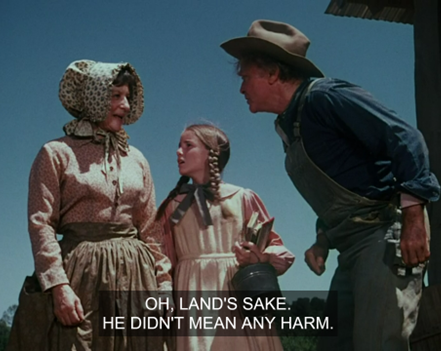
Barry was a lot nicer in that one, but it still didn’t seem like the happiest of marriages.

Second, in real life, she was married not to Red Barry, but to our own Mr. Hanson, Karl Swenson!

Well, Alice and Andrew Garvey arrive back at the OSP.
DAGNY: Andy gets to drive a lot in this one.

Alice goes inside . . . but Andy suddenly shouts “Hyah!” at the horses and races back to the road.
DAGNY: Is he going back to Winoka to make his fortune?

After a break, the court reconvenes. Foreman Chuck tells the judge the jury has found Larrabee guilty of assaulting Andy (no shock, since he pled guilty). But they couldn’t agree on the barn-burning charge.
There’s a slight hubbub. Revoltingly, Jud Larrabee turns and winks at his pal Larry Golden, who just stares daggers at him.


Getting grouchy, Judge Parker snaps at the crowd.
Charles says only one man voted not guilty, and the judge asks that person to identify himself.
It’s Joe Kagan.

Before you go thinking Judge Parker is so great, he asks if this is a power play because Joe – who, in case he’s forgotten, is a lowly Black person – is so thrilled to finally be called for jury duty.
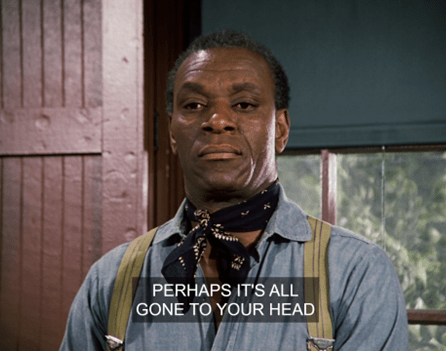
Joe Kagan says, “No, sir. I take no pleasure in going against the opinion of these good people.”
The judge huffs that he should explain himself.
Joe says he believes it likely Larrabee committed the crime, but the evidence is purely circumstantial.
DAGNY [as JOE KAGAN]: “If only forensic science was already invented!”
WILL: Yeah, they have done a lot of arson cases on Forensic Files over the years.

Very annoyed, Judge Parker says Kagan can step down from the jury, and he’ll simply appoint somebody else who will vote to convict.
DAGNY: Is this how they’d really handle it?
WILL: I certainly doubt it! It’s a kangaroo court!

“All right,” Joe says, “but not before I have my say.”
Astonished, Judge Parker says, “You’ve had your say; you’ve had more than your say!” and threatens to throw Kagan out of the room.
“Then that’s what you’ll have to do, because I’m gonna speak my piece!” Joe says. (A lot of piece-speaking in this one. Probably not anachronistic.)
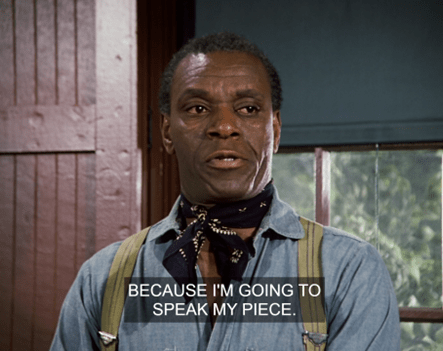
Rev. Alden rises at once and says, “Your Honor! It can’t hurt anything, can it?”
WILL: Aldi, saving the day once again.

Parker gives him a “you’re killing me Smalls” look.

Exasperated by these fucking people (judges rarely have good experiences with Grovesters, do they?), he says fine, go ahead.


“But,” he adds, “I don’t want you wasting any more time unnecessarily.”
WILL [singing]: “Supper’s waitin’ at home, and I gotta get TO it.”
Parker really shouldn’t complain, since the maneuver he’s trying to pull is completely unethical and an abuse of power.
Joe Kagan says:
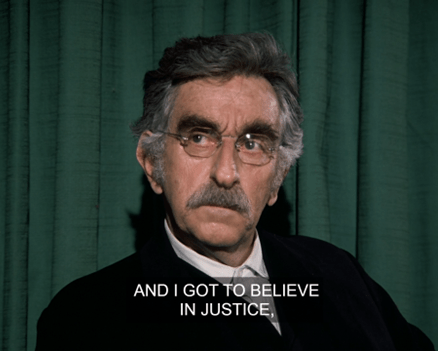
Thank you, Your Honor. Uh, Mr. Larrabee over there – I ain’t got no use for him or his kind. We all know what he did to this town, to the Garvey boy. Wouldn’t matter to me if him and others like him fell off the face of the earth tomorrow. World would be a better place, that’s for sure. But that ain’t up to me. I got to live my life the best way I can, knowin’ that the Larrabees of this world are lookin’ at me and my kind with hatred in their hearts. I cain’t change that. But I gotta believe in the law, and I gotta believe in justice, and I gotta believe that it applies to each and every one of us includin’ Mr. Larrabee.
And maybe . . . maybe I think about things different from most folks. Because, I guess, maybe I am different. For less reason than you’d convict a man for burnin’ a barn that nobody saw him burn, I’ve seen my people with ropes around their necks hangin’ dead. And that’s what makes me different. Because I can’t erase those pictures from my brain.
In the audience, Hester-Sue begins to weep quietly.


Joe goes on:
I know what can happen when justice disappears. And I will bring harm to no man when his guilt ain’t been proved in my eyes.
Everyone sits pondering this.
WILL: Put that in your pipe and smoke it, Megyn Kelly.

Judge Parker dismisses Joe, who walks back to put his hand on Hester-Sue’s shoulder. (Moses Gunn knocks it out of the park once again, and Ketty Lester nearly steals the show, despite not having any dialogue.)

With the case still to wrap up, Parker instructs Charles to choose another juror.
Charles calls Ray Bickel, and Herbert Diamond gets up in response.
Now, somebody on the internet ID-ed Ray/Herbert in this episode as an actor named Joe Zboran. (The character is uncredited.)
I’m not so sure – I can’t find any pictures of Zboran online, and his IMDb bio gives his birth year as 1917 . . . which would make him 61 at the time this was filmed. That can’t be right, can it?

Judge Parker orders Herbert to state his verdict, when Andrew Garvey’s voice pipes up from the back of the room.
WILL [as ANDREW GARVEY, singing]: “Two! Four! Six! Oh! Oooooooone!”


Surprised again, Judge Parker asks him if he lied in his testimony.
Andy says he did not, but he didn’t mention that he left the lantern on the fencepost before leaving home that night.
DAGNY: He’s good in this one.
WILL: He sure is.

“The wind was blowin’ somethin’ fearful, too,” Andy says. (This isn’t true – despite Landon’s love of giant wind machines, there was no detectable breeze in the scene in question.)

“Judge, that’s the way it must have happened!” Larrabee screams again.
“I wanted to be sure he was punished for what he did to me and my folks, and the whole town,” Andy says. “But I can’t.”
WILL: Albert would have no problem lying.
DAGNY: No. He’s cutthroat.
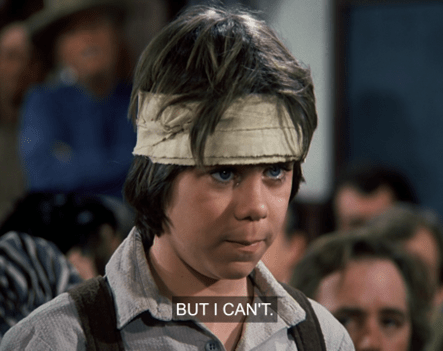

The judge tells Larrabee to rise, and says he’s guilty of assault but is getting off on the barn burning.
“Thank you,” Larrabee says in relief.
As for the sentence, Parker says he’d love to send him to jail, but instead will make him pay Jonathan Garvey the value of his destroyed wheat – at the high price.
“Judge, that ain’t fair!” Larrabee screams.
Well, this judge has finally had enough. Doing that supervillain thing where he screams then whispers, he says, “I would advise you not to use the word ‘fair’! My sentence might change rapidly.”


Then he drily asks if Larrabee would like to contribute any more helpful words to his cause.
Having finally shut Larrabee up, Parker adjourns the court.
Adele and the boys sit silently as everyone else files out.
DAGNY: This one is a BUMMER. Everybody in town is now poor, and Mrs. Larrabee won’t get a divorce settlement because her husband is ruined too.
WILL: The Garveys made out okay.

Eventually Lem and Zeke move out too, but Adele Larrabee stays behind to look at her husband.

He looks back at her; and then suddenly screams, “I didn’t need no n— defendin’ me!” His voice cracks as if on the verge of tears.
Adele takes one last look at the pitiful man and walks out.
“I didn’t need nobody!” Larrabee goes on screaming. “You understand me, I didn’t need nobody!”

WILL: Bum. Bum. Ba-Dum.
DAGNY: Oh my God, that’s it? What a note to end on!
WILL: Yeah, it is a shocking ending, isn’t it. Little House is so often about Middle-Aged Man Redemption. Not this time.
STYLE WATCH:
Alice wears a new bonnet. Corduroy?
DAGNY: It’s nice.

Joe’s neckwear is great, as always.

Jud Larrabee’s house has a huge, rather ugly carpet.

A lady in the courtroom wears a kind of eighties-looking striped bonnet. It’s a little Max-Headroom-y.


THE VERDICT:
DAGNY: That was out of tone with the rest of the show, but it was terrific.
I agree. While neither light nor fun, it’s got more power than a runaway caboose, with a thrilling plot, crazy-good performances, and something to say about our world that’s still worth thinking about today.
Gunn, Barry, Olsen, Lester, Jeff Corey, Joan Tompkins, and especially Patrick Labyorteaux give perfect performances.
And with three great stories this season, Don Balluck has redeemed himself for his relativist wiffle-waffling in “The Aftermath,” as far as I’m concerned.
See you next time!
UP NEXT: The Enchanted Cottage
 Walnut Groovy
Hi, I am a nurse who lives in Murray, KY and I watched LHOTP as a child growing up and absolutely loved it. And then my sister and I would play “olden days” and it was all based on what we’d seen and learned on LHOTP. My mom found us old dresses, put our hair in Laura braids, we had lunch pails, strapped dad’s belt around our books, and tied ropes that we imagined were reins onto the handlebars of our bikes and pretended it was our horse and we had a blast!!! Then as an adult I found the streaming reruns and have loved watching them again. And I was googling something about something from the show and came across something that said “walnut groovy” and I thought that sounded so funny and had to check it out. And when I started reading your things, I would die laughing. So much of your thoughts and feelings about the show were similar to mine. Our sense of humor is the same. And it was soooooo fun to watch an episode and then read what you had to say about it. Many times I’d see an episode and think oh wow this one was so silly or far fetched or exaggerated I can’t wait to see what he says!! The first blog of yours I HAD to look up was the one about the episode where ma gets sick and almost cuts her leg off. That episode scared me to death when I was younger. It freaked me out so much I NEVER forgot it. Cause as a child it was so weird, I didn’t understand what the hell was wrong with her. I thought she was just going crazy.
Anyway, I just wanted to say thank you so very much for your website. It is so funny and clever and unique. What a smart idea you had. To find an old, beloved tv show and post your humorous criticism and observations. It is so enjoyable to rewatch and read your funny commentary. Thank you for your hard work, I appreciate it so much. You have made me laugh so much and that is an amazing gift.
LikeLiked by 6 people
Thank you so much! Welcome to Walnut Groovy! 🙂
LikeLiked by 1 person
Excellent recap! Hard episode to watch.
LikeLiked by 1 person
Thanks, Toby!
LikeLike
I was being so productive at work today and then I saw this update!
I’ve always loved this episode.
I’m glad you talked about Jeff Corey; at first I thought you were ignoring his career. He’s also in The Devil and Daniel Webster (or All That Money Can Buy if you must), one of my favorites.
LikeLiked by 1 person
Thanks, Ben. I hadn’t seen this one in a long time, and I was really impressed with how it stands up. Sure to be up for some Walnut Groovy Awards at the end of the season! 😀
LikeLike
You did a great job with this considering there’s not much comic relief in this episode! (Those who don’t learn from history are doomed to repeat it). Also, I like the Weeble‘s reference. (About as close as we can get to anything that looks like an egg these days)!
LikeLiked by 2 people
😀 That’s for sure – I was just in New York over the weekend, where the eggs were something like $15 a dozen. Yeek!
LikeLiked by 1 person
Of all things to be covered during this one, the last I’d think is the characters’ behinds and what they say about their owner’s mood.
This is easily one of my top 3 favorites from S5. I lost count of how many times I rewatched it on Prime, not just because of all the aforementioned qualities in its themes, acting and how well it’s handled, but also for the terrific soundtrack here, which casts a somber, but epic tone throughout the episode.
One thing I always noticed about the Joe Kagan and Hester Sue appearances is that the Walnut Grove townsfolk seem remarkably accepting of Black people compared to what would be the norm for the time period, even opening a fully integrated Blind School and most of the members at the farmers’ guild don’t seem to be on Larrabee’s side even before he backstabs them. But there are subtle elements here that help highlight just how the bigotry associated with the period is still there, like how while they don’t endorse Larrabee’s remarks against Joe, they don’t fully condemn them either and it seems to be treated as just a different opinion. Also anytime Joe gets more bold towards someone or speaks his piece, he relies on some white friend backing him up, from Jonathan being around when he and Larrabee butt heads at the Mercantile to when he challenges the judge’s refusal to let him speak and threats to remove him before Rev. Alden defends him, and even when he comments on the town’s strategic position for Jonathan’s plan, Charles feels the need to say “Joe’s right”. And I think the judge’s attitude really sums up those relations, in that while he seems to accept a black juror because the law says so, he’s quick to question Joe’s judgement and ability to participate in a white man’s trial at the first opportunity. Yet unlike Larrabee and Mrs. Oleson and her worst, Judge Parker is not a blatant jerk who goes out of their way to antagonize nonwhites, he’s a regular judge who isn’t used to them in a situation where “lowly” minorities are meant to be equals. And in spite of that,
Joe’s role avoids the “white saviorism” it could fall into because rather make him too dependent on the white characters, it hoghlights the racial inequalities in the time period without undermining Joe’s agency and ability to make plot-relevant decisions.
Speaking of plot-relevancy, I’m surprised by how tangencial Charles is here. He gets a prominent role in the paper, participating in the farmers’ decision, the posse that takes Larrabee and is even made jury foreman, but aside from appointing Joe to the juror, little he does is relevant to the plot, as only Joe, Larrabee and the Garvey men make largely impacting decisions throughout the episode. For that matter, the Ingallses are pretty secondary here (Laura and Albert don’t even say anything or interact with Andy).
LikeLiked by 1 person
This is beautifully observed, Vinícius. And yes, this is definitely my favorite Season Five story of them all.
LikeLiked by 1 person
Oh, and I’m curious, what are your other two favorites?
LikeLike
Oh, I was saying in a hypothetical Top 3, that if I were to make one, “Barn Burner” would definitely be there. Now, if I were to rank the top 3 best of Season 5, the strongest candidates would be “There’s No Place Like Home Part 2” (all the recurring characters joining forces to bring Walnut Grove back to life is done really well), “The Craftsman” (it became much better upon rewatching), “Mortal Mission” (arguably as dark and powerful as ‘Barn Burner’, with a sense of tension and tragedy culminating in a bittersweet conclusion) and the Season finale “The Odyssey” (Laura and Albert help a terminally ill boy fulfill his dream of seeing the sea, it’s as sad and wholesome as it sounds). Those would definitely be in my top 5.
LikeLiked by 1 person
Two of those would also make my top five, but you’ll have to wait for this season’s Groovy Awards to find out which. . . .
LikeLike
I liked to see the contrast between how three characters consider jumping to action against their wives’ judgment, for different reasons: Larrabee decides to take a gun to Garvey’s place for being humiliated, Jonathan briefly tries to go after him when he sees what Larrabee did to Andy, and Nels joins the posse to capture Larrabee. Jonathan is talked out of it by his wife, Larrabee and Nels are not. But there’s a contrast of context and motives: Larrabee only wanted to act out of pride and only had his hurt ego to avenge, and never listened to his wife. Jonathan had a better motive to go after him and risk himself, but then he’s reminded that looking after his family is more important, and only resumes action when the burned barn turns up and he has legal leverage to form a posse against his foe. And Nelse ignores his wife’s pleads not to go too, but unlike Larrabee, he’s not going off to solve a personal conflict; he’s doing his part as a townsman in an effort to take a suspect to justice, following the law as far as possible, even cornering Larrabee in a way he assures law is enforced in a completely bloodless way. I do wonder how much of that contrast between these three was intentional in the script.
LikeLiked by 1 person
Who knows, maybe it was? It certainly has an elegance about it. And even if it wasn’t intentional, it’s good enough for me!
LikeLiked by 1 person
Great episode. At times the crowded, confined trial scenes give it the feel of a stage play. The ending is fantastic, the way the dramatic music suddenly stops before Larrabee yells that he ain’t giving up his racist ways even though Joe Kagan went to bat for him. “I don’t need nobody!” Well he’s going to get to prove that now.
BTW, Larry Golden was in a “very special” 2-part Bonanza episode from the final season. He’s an evil psychopath who kills Joe’s pregnant wife Bonnie Bedelia (IIRC it’s because her brother owes Larry money and he wants Bonnie to pay the debt) and then burns their house down with her in it to get rid of the evidence- though they do find her charred body (sounds familiar!). Joe rides all over tracking Larry down. When he finds him he tries to kill him with his bare hands but then changes his mind, I think?
Anyway, it’s a very sad episode. You might already know this, but it was supposed to be Hoss who married Bonnie- but Dan Blocker died before filming started so Joe married her instead. Very sweet scene when she tells him she’s pregnant, he used it again when Ma told him she was pregnant with Baby Charles. Lot of crying from ML and Lorne Greene, they were definitely crying over losing Dan. Hell of an episode.
LikeLiked by 1 person
Yes, somebody did share that story with me before. I don’t know much about Bonanza, actually – I think the only one I’ve seen is the one that inspired “A Matter of Faith,” where Little Joe nearly cuts off his arm. But I do know about Landon and Blocker’s legendary friendship. I smile and think of it every time I watch “School Mom” or see Dirk Blocker in something else. 🙂
And I agree 100% about “Barn Burner.” It’s one of those Little House stories that’s even better than the show as a whole.
LikeLike