SUMMARY IN A NUTSHELL: Therapy Charles has to cure a guy who’s addicted to beating up his own grandparents.
EDITOR’S NOTE: Please let me know if a huge chunk of this story is missing. I had some problems with the formatting this time around. I think I fixed it, but do let me know, please. – WK
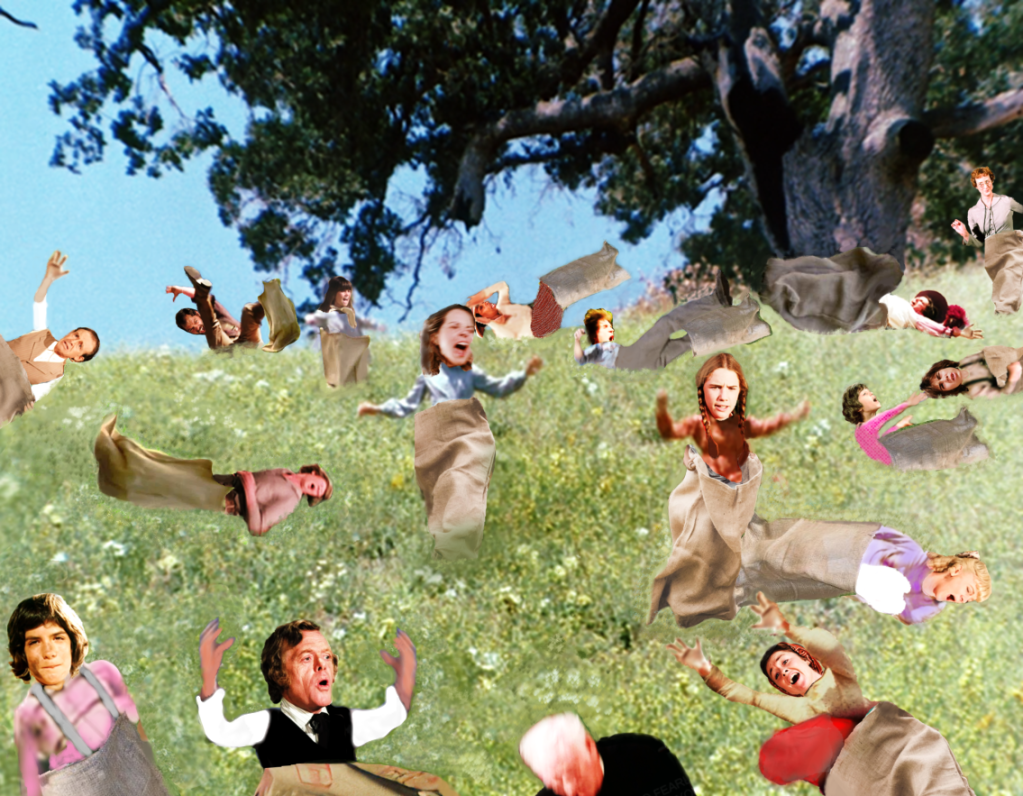
RECAP: Happy November! Hope you all had a good Halloween. In my researches for this recap, I happened upon this amusing Groovy-style graphic:
Art by Violent Movie Underground
With all the kids out of the house, it was a quiet Halloween here (plus the weather sucked). I didn’t do a scary costume this year, instead dressing as Shakespeare.
Actually, as others have noted, the footage here is simply borrowed from “Quarantine” in Season Three.
Previously on Little House
Little House fans know the show sometimes repurposes footage like this, most commonly to indicate sunrises and sunsets.
Sunrise
Sunset
For the most part, recycled clips on this show fall into one of two categories: forgivable, or unforgivable.
The majority of repurposed footage is used forgivably. Attentive viewers might notice the duplication, yes, but objectively there is nothing about the clip itself that links it to the events of the earlier story in which it appeared. A sunrise is a sunrise is a sunrise, for example.
Another textbook example is the shot of Jack drinking from Plum Creek that opens both “Country Girls” and “Founder’s Day” in Season One. (Accompanied in both instances by David Rose’s wonderful tune, “Drinkin’ Jack.”)
Since drinking from the Creek is something Jack presumably did every day, this duplication is forgivable.
Forgivable
The other, less common practice I would deem unforgivable use. In “unforgivable” cases, the reused footage contains elements that uniquely connect it to the story in which it was originally used.
Examples are rare, but they tend to be more noticeable, as we saw in “‘Author! Author!’”, which reused shots of an old Old Cat game on the playground/graveyard from “The Sound of Children.”
This use would have been forgivable, but when our analysts examined the footage, we noticed you could see Nellie Oleson enjoying recess . . . despite Nellie having graduated and started her own business nine stories earlier. See what I mean?
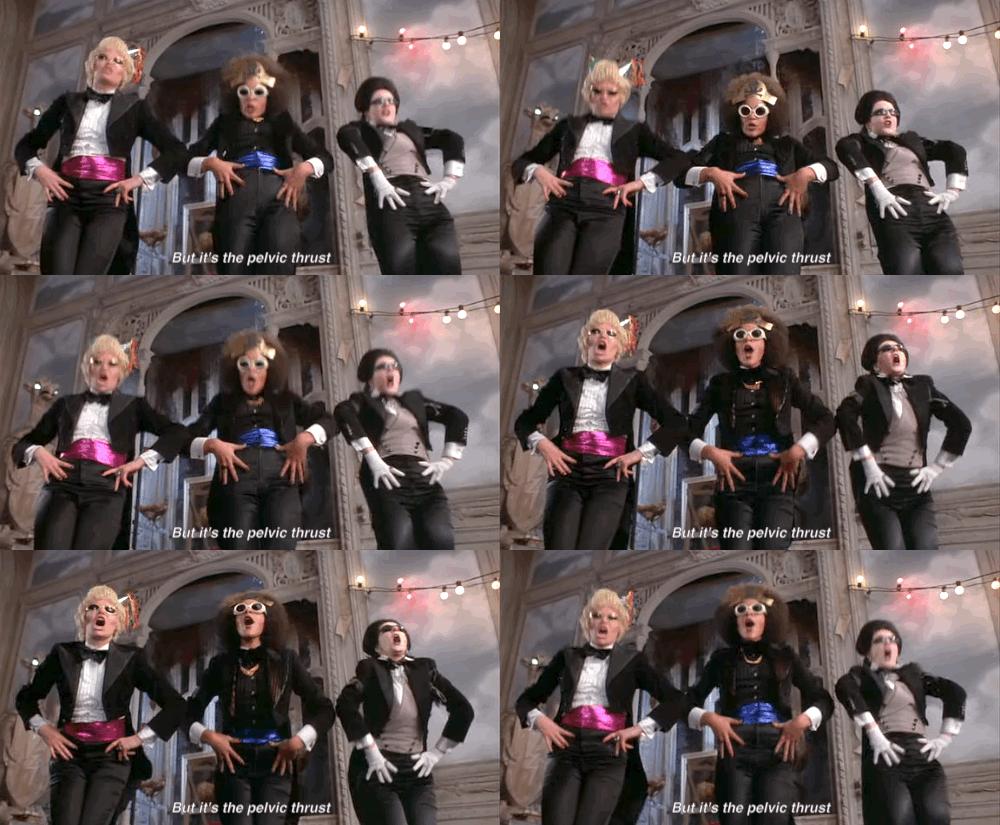
Some instances of repurposing footage aren’t so easily categorized. Readers will recall Mustache Man performing the Time Warp (an apt selection for this show) at the Springfield train station – in three different episodes!
Previously on Little House
Whether this is an “unforgivable” error, or whether Mustache Man the character is simply doing the dance on three separate occasions is impossible to ascertain. I’m inclined to forgive it, myself.
Who couldn’t forgive this?
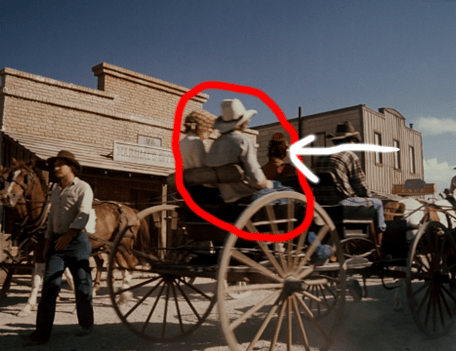
For that matter, if the apparition of Jack following the wagon is in fact meanttobehisghostorangel, the example belongs in the Forgivable column.
From the Walnut Groovy archive
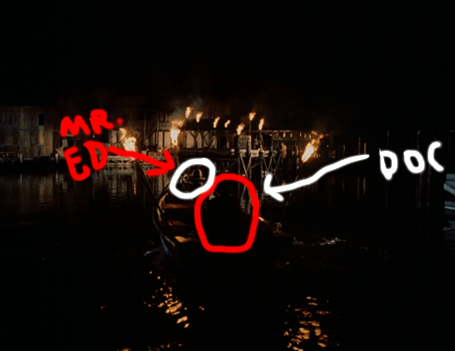
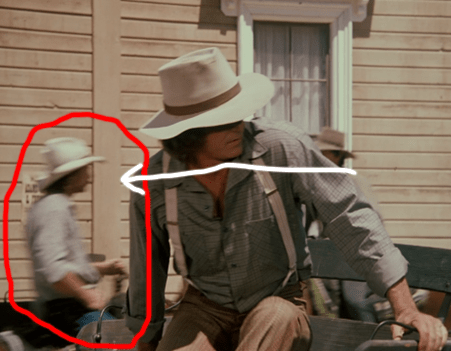
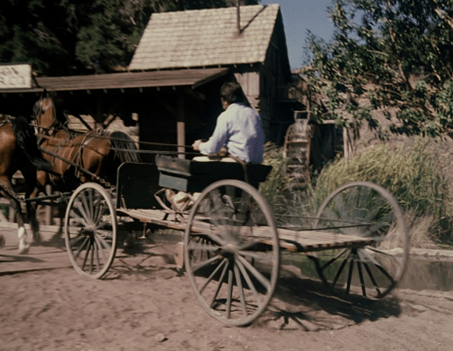
Anyways, I’m sorry to report this “Quarantine” footage definitely falls into the unforgivable category . . . since we can clearly make out Mr. Edwards, who does not appear in this episode, ferrying DocBaker, who also doesn’t appear in it, to the dock in the clip!
Unforgivable.
An inauspicious start, but on we stumble. David Rose’s music on this occasion is, I would say, more ethereal than sinister.
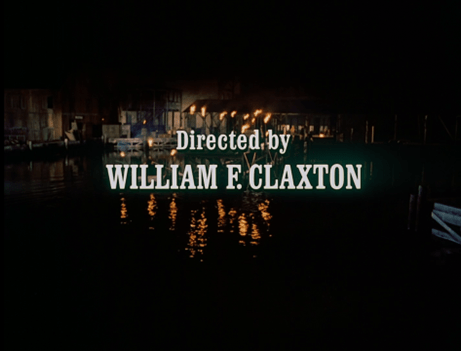
Del Reisman of “Annabelle” fame is back as writer, and William F. Claxton (also of “Annabelle” fame) is back as director.
Welcome back, Clax
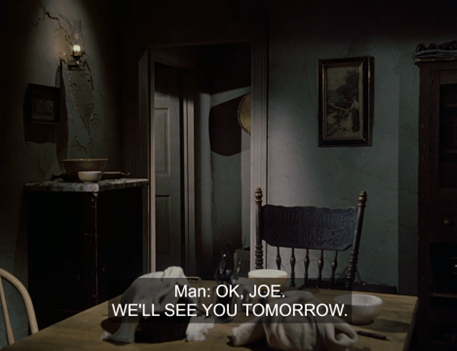
We cut to the interior of some humble domicile – more apartmentish than farmhouse- or soddy-ish, perhaps.
A woman enters from another chamber, and offscreen we hear a man’s voice saying, “Okay, Joe, we’ll see ya tomorrow.” (Sounds suspiciously like Carl C. Pitti.)
The woman wears a fishwife-type head-kerchief.
Scottish fishwives circa 1906
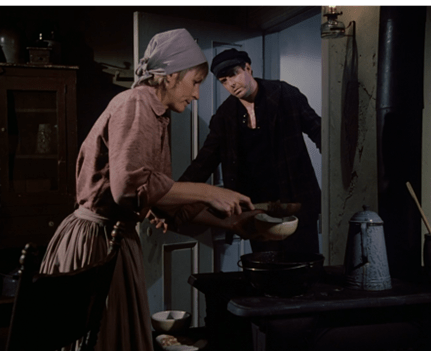
She hurries to the stove and ladles some dark foodstuff as a large man in a fisherman’s cap appears through another door.
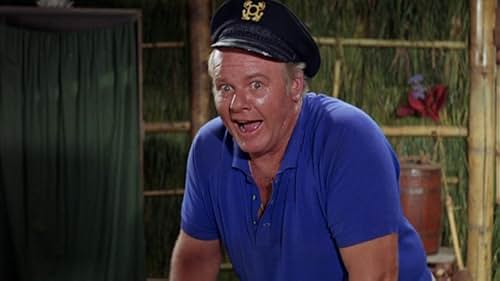
This Skipper stares at the woman, his stance and nasty chuckling manner suggesting drunkenness.
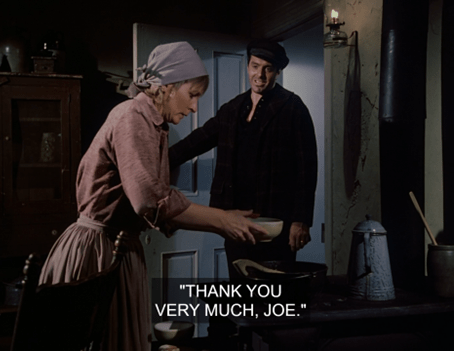
“‘Welcome home, Joe,’” he slurs ironically.
(It’s rude, but I appreciate the technique. In our house, we’re so accustomed to Olive sneezing constantly that we often don’t notice it happening, and on such occasions she’ll say “Oh, BLESS you, Olive!” in much the same tone.)
(Olive is doing a semester abroad, which is why she hasn’t been with us recently. Back by Christmas.)
Anyways, Joe doesn’t stop at that. “‘Thank you very much, Joe!’” he goes on with what I think it’s fair to call mirthless laughter. I don’t think I’ve ever heard laughter with less mirth, in fact.
100-percent mirth-free
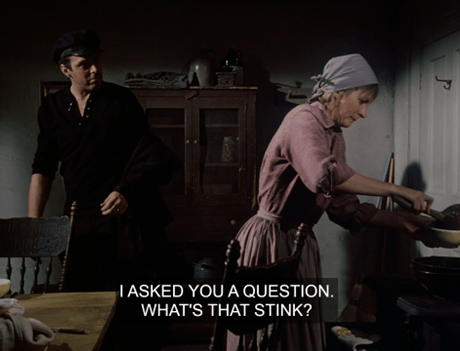
As if this weren’t charming enough, he looks around and says, “What’s that stink?”
“Sit down, Joe,” the woman says in a light, very quiet voice. (Nervous, not soothing.)
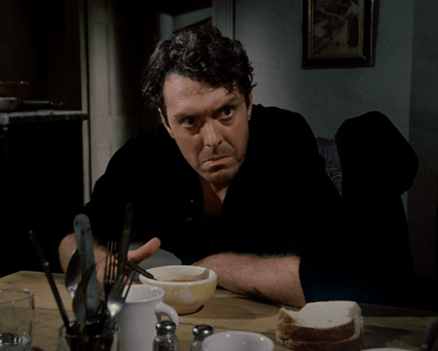
He sits down and takes a bite of the soup, then spits it back into the bowl.
“It’s like glue, we could use it on the docks,” he says. (What a boor, insulting a person who’s made him dinner! Talk about unforgivable.)
Joe’s wife says it’s the best she can do without money for ingredients, stupid. (Paraphrase.)
Nah, she isn’t so bold as to put it this way; but Joe gives her a hideous look nevertheless.
Mrs. Joe dares ask if Mr. Joe went looking for a job today.
Joe blows this question off, then yells for his son, who’s apparently already eaten his serving of dock glue.
A skinny dark-haired little boy enters, and Joe orders him to sit down whilst he eats.
They don’t get very far into the meal before Joe is haranguing the kid, whose name is Tod, about ripping his good blue shirt. Tod says he tore it playing baseball.
Joe snarls at him, rips the shirt further, and slaps him across the face, noting this is in fact the same treatment he got from his own father as a child.
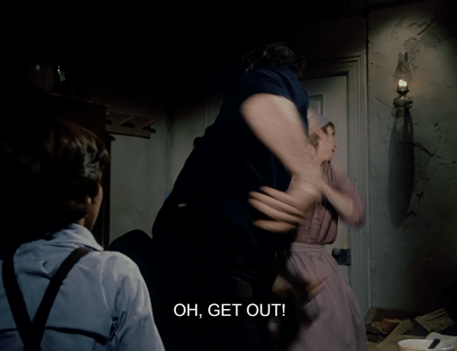
Joe starts shaking the poor kid, quite horribly, and shoves his wife back against the door when she tries to intervene.
Then he expresses disgust at his crying family and departs.
Donat was a regular on a Stephen King-based series called Haven(don’t know it), and he did voices for the Star Wars animated series Ewoks(which I think I liked as a kid, but don’t quote me on that).
Richard Donat’s character on Ewoks
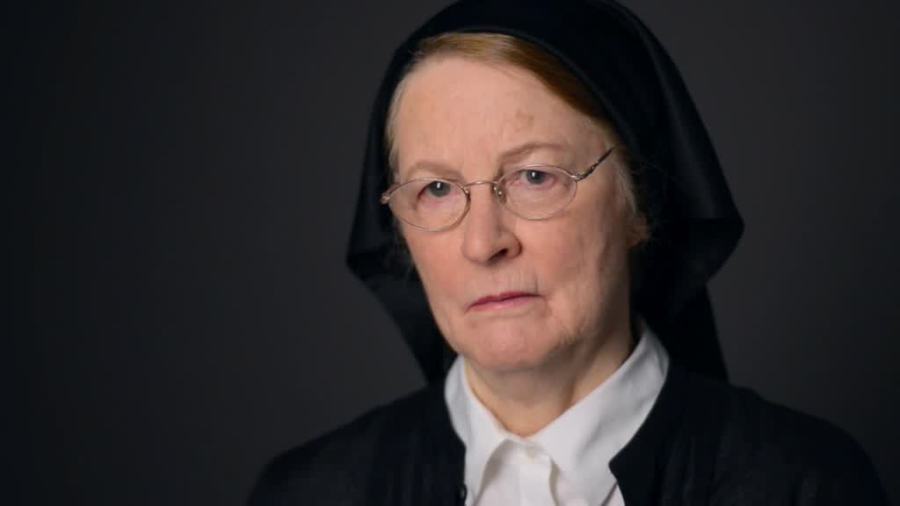
Joe’s wife is Mary Hamill – no relation to Mark, or to any Ewoks either, as far as I know. She was on an episode of Quincy, though.
Mary Hamill as a stern nun
And little Tod is Richard “Ricky” Segall, a performer we’ve met once before. (He was the pipsqueak AEK who delivers the telegram announcing Mary’s math awesomeness in “The Pride of Walnut Grove.”)
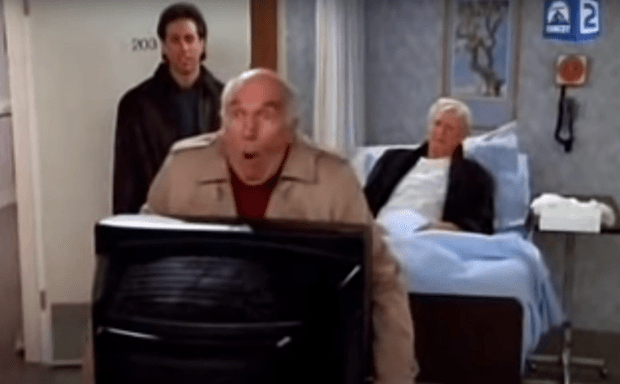
Gene Dynarski (in foreground), with Jerry Seinfeld and Lloyd Bridges
Joe accuses Jedediah of letting the people he hires “stuff a few bucks in yer lumberjack.” I don’t pretend to recognize or really even understand the expression, but it’s clear he’s accusing the fake Irishman of taking bribes.
And then the punches flew, and chairs were smashed in two; there was blood and a single gunshot, but just who shot who?
We hear police whistles a-shrillin’, and then we return to Joe’s place. (The family name, we learn later, is Dortmunder.)
In the middle of the night, Mrs. Dortmunder answers the door.
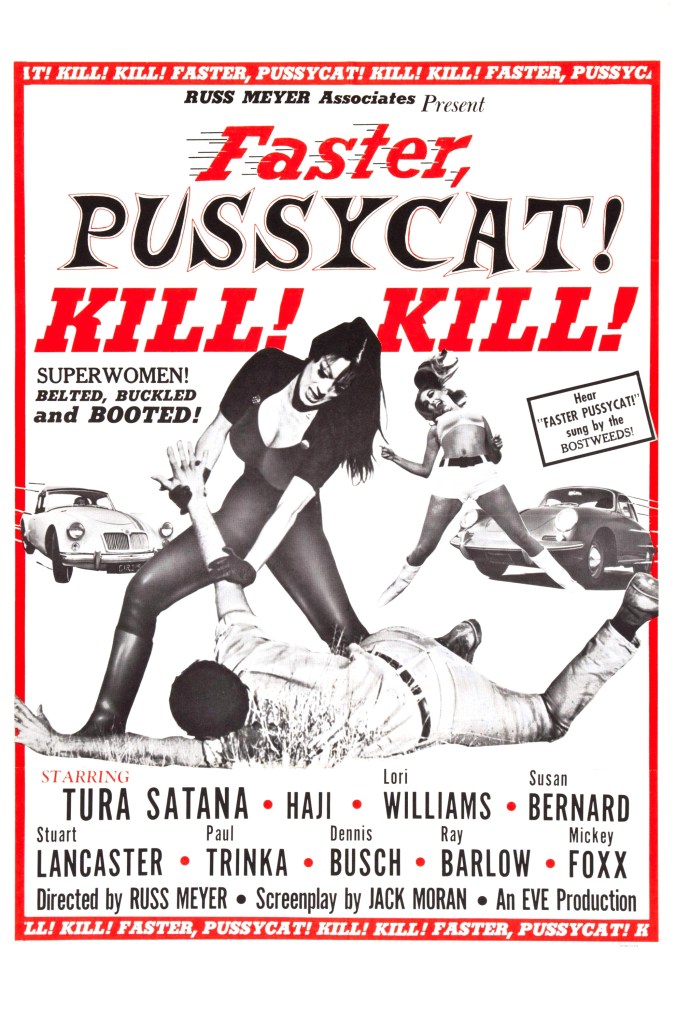
It’s a stereotypical Irish policeman named Doyle, played by John Furlong.
I’ve made myself a pledge not to get carried away listing the actors’ credits anymore, but he was in the famous Russ Meyer sexploitation movies Vixen!, Supervixensand Faster, Pussycat, Kill! Kill!
Mrs. D asks what Joe’s done this time, and the copper says, “He’s been killed.”
The new widow is upset, but young Tod appears to be fighting laughter as David Rose freaks out in the pit.
AMELIA: Well, weird and dark so far.
Yes. Now we transport seamlessly to Walnut Grove, where Mustache Man is driving through town and the Little House theme is playing nobly on a trumpet. (The musical transition is seamless too, of course. Well, you know David.)
From across the bridge, we can see Charles and Carl the Flunky hard at work.
A smiling elderly gent who looks might be Tim Blake Nelson’s grandfather shuffles up to Charles, who addresses him as “Brewster.”
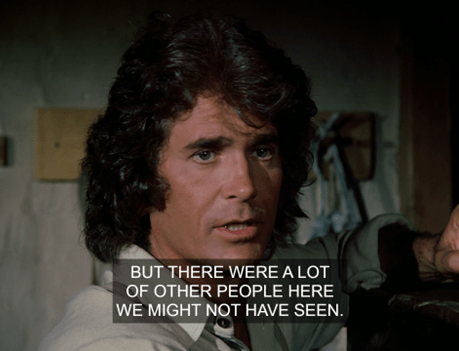
Brewster’s just opened a letter, and tells Charles his daughter is sending his teenage grandson to the Grove for a while.
He mentions his daughter’s name is Edna, and the family lives in Chicago.
They have a little side conversation about how dirty cities are, people then as now being full of helpful concerns about problems in places they don’t live and rarely visit.
Brewster says he’s dreaming about how much farmwork he’ll get done with a younger person around to help him.
Charles doesn’t seem to judge this attitude, like he did with the labor-seeking paterfamilias(es?) in “‘Remember Me’” and, more recently, “The Family Tree.”
Previously on Little House
Brewster then pushes off to tell “Virginia,” presumably his wife, the news.
Chuck turns to Carl and says idiotically, “Well, there’s a happy grandfather, isn’t he!”
Carl doesn’t reply, but he does grin like it’s the funniest fuckin’ thing he’s ever heard. (I wouldn’t score it awfully high myself.)
(Perhaps Groveland residents have begun amusing themselves by switching houses for brief periods, like in Mapp & Lucia.)
Au reservoir, Prunella Scales
Inside, a lady, also quite elderly, sits and spins. (Many’s the time in school when I would tell somebody to sit and spin. The salad days!)
When Brewster comes in, she greets him as “Brew,” which I think is cute.
Brewster plays a little trick on her, saying the letter from Edna didn’t say “much of anything,” then letting it drop that their grandson is coming for a visit.
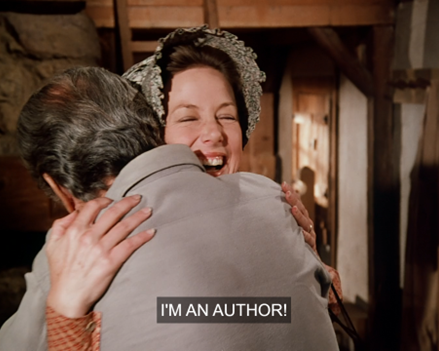
Grinning and laughing, the two Grovester oldsters hug each other, then turn to burble over a photo of the kid – who of course is Tod from the opening sequence.
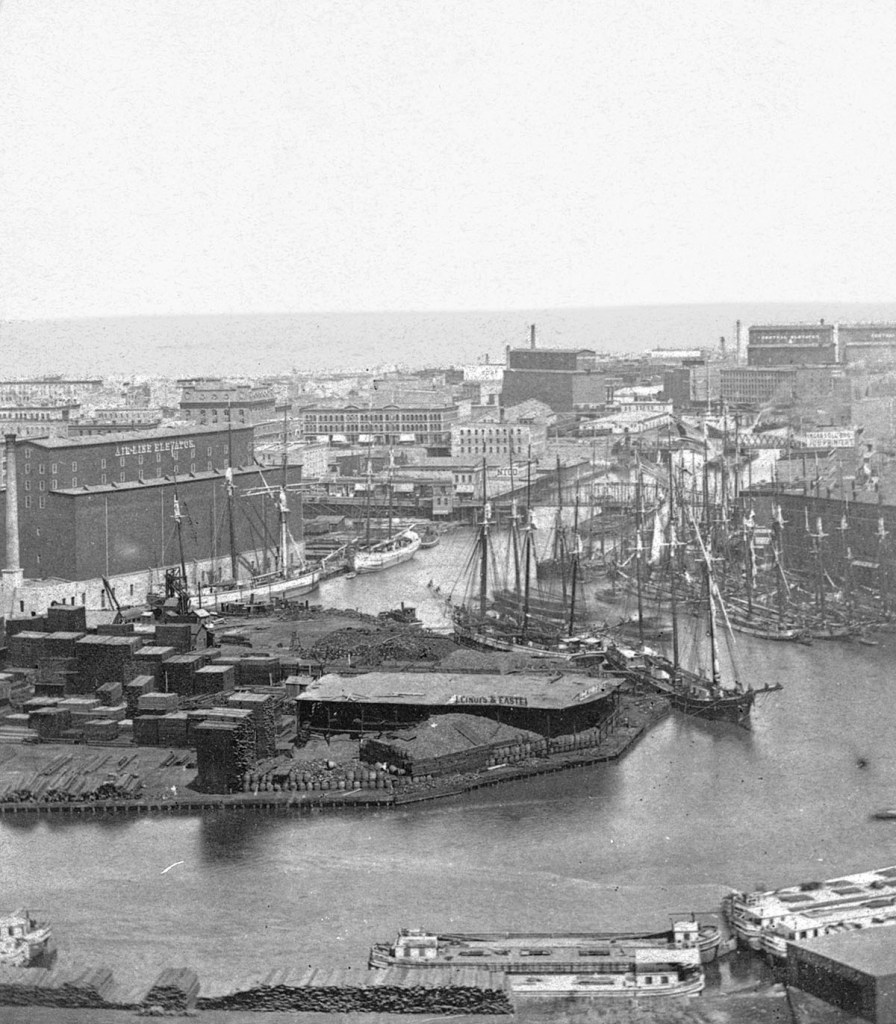
So the town on the wharf was meant to be Chicago, and I suppose you could do worse than using Elmsville as a stand-in for it.
Wolf Point in Chicago, 1885
Next, David Rose continues misdirecting us with more frolicking music as we see a wagon cruising into town.
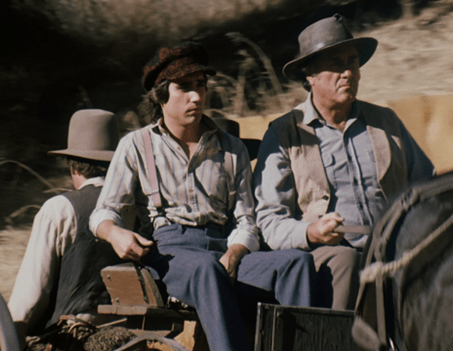
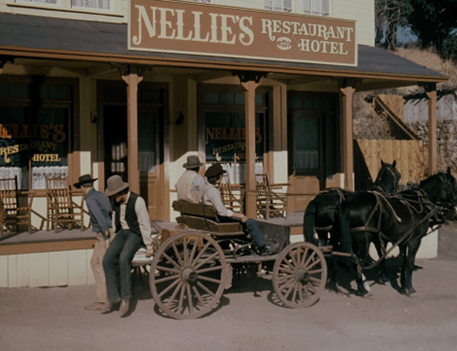
The wagon stops in front of Nellie’s. Its other passengers, two nondescript men with an embarrassed air about them, hop off the back.
Nellie steps onto the porch and begins grousing that the guests are arriving before they’re rooms are ready. (I like that she takes this job seriously.)
Tod – for yes, the young man is he – interrupts Nellie to ask where his grandparents are, but she ignores him.
“I asked you a question,” Tod says with some menace.
I don’t care for his tone at all; but Nellie just looks at him with cool authority, like he’s some bug to squash. “What was your question?” she says.
“You heard me,” Tod growls, and Nellie, who of course did hear him, says Mr. and Mrs. Davenport aren’t there, adding, “They’re such courteous people. . . . Surely they don’t know you.” Ha!
(This is a dynamic I wish the show would use more often – Nellie or Mrs. Oleson spitting poison at somebody who really deserves it for once.)
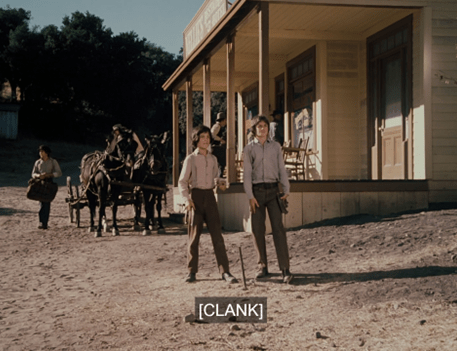
Tod hops down from the wagon and turns his attention to Albert and the Non-Binary Kid, who are playing horseshoes in the street. (I think this is the first game of horseshoes we’ve seen on the show.)
Tod rudely sidelines Albert to ask where he can find the Old Davenport Place.
Just like I did when I was young, Albert answers in a contorted way designed to show off his cleverness.
And just as happened to me on such occasions, Albert is taken for a mental defective, bullies not generally known to appreciate airy persiflage of that type.
Unlike me, however, Albert is a genuinely nice person, so he offers to show Tod the way himself.
Tod follows him, but shoots down Alb’s attempts at friendly smalltalk.
(He should be careful. If I were a newcomer to town, Nellie Oleson and Albert Ingalls would not be the first people I’d want to piss off.)
Alb and Tod arrive out at the Old Davenport Place, where Old Brewster sees them coming.
The subtitle transcriptionist translates Old Brew’s exclamation as “Hey!”, which I suppose is what I’d officially put down as well. (Though to me it sounds more like “Hiya oh whee!”)
The two sweet Grovester Oldsters rush – well, as much as they’re able – to greet their grandson.
But Tod makes weird faces when they hug him, and in fact he shoves Grandma Virginia away. (Tod’s conduct towards his elders and everybody else in town sickens and outrages me. But I’m getting ahead of our tale.)
Old Brewster mentions this is the first time they’ve seen Tod since his father died. (Tod’s father, that is, not Old Brewster’s.)
Timothy Wead, who plays Tod, didn’t have a long acting career (he went on to become a minister), but he was on episodes of Fameand Quincyaround this same time.
Timothy Wead on Quincy
Timothy Wead today (with his niece)
Timothy Wead was 23 when he filmed this episode, but Brewster mentions Tod is seventeen. Little Ricky Segall was ten, so if we assume we’re still in 1885(-L), that means Brewster and Virginia haven’t seen him since at least 1878.
The overjoyed grandparents blather about how delighted they are that he’s come to live with them. And my God do these two actors lay it on thick throughout.
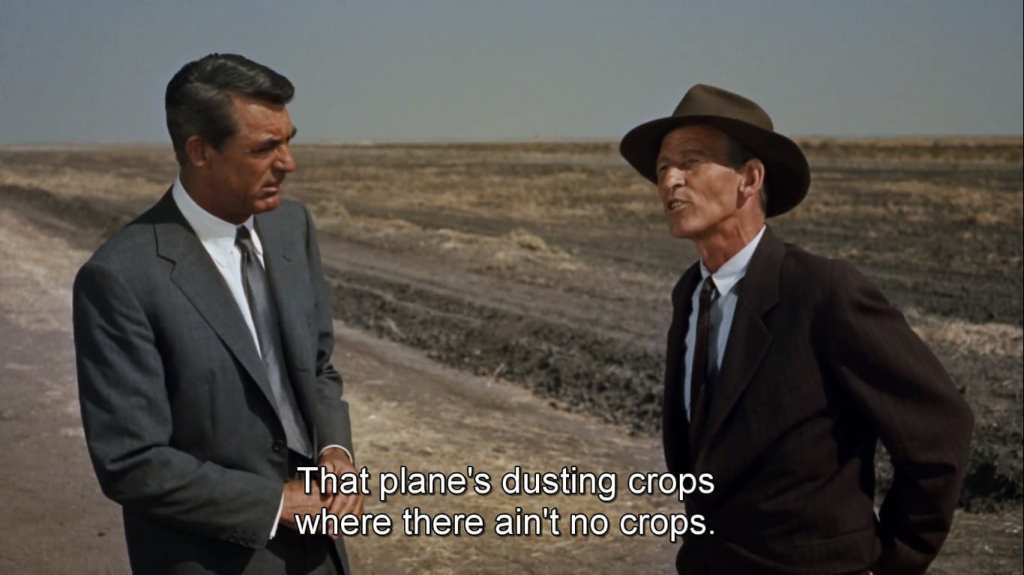
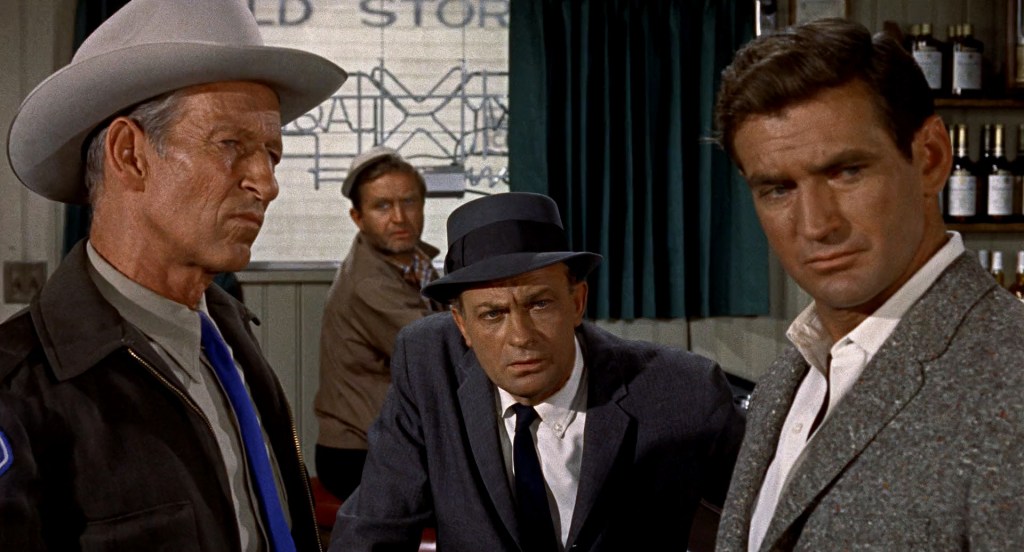
Old Brewster is Malcolm Atterbury, who has a freaking amazing resume, which includes memorable roles in two of my favorite Alfred Hitchcock movies.
In North By Northwest, he’s the laconic stranger at the plain-state bus stop who notices a plane “dustin’ crops where there ain’t no crops.”
And in The Birds, he’s the incurious Bodega Bay deputy who suggests Jessica Tandy’s house was attacked by thousands of birds because she had the light on in the living room.
Malcolm Atterbury (at far left) in The Birds
Malcolm Atterbury in The Birds (with Karl Swenson at the back!)
Notably, he was also in I Was a Teenage Werewolf(more on that one next week),which was where he made the acquaintance of the young Michael Landon. (Atterbury himself was never young, though.)
Malcolm Atterbury with Michael Landon in I Was a Teenage Werewolf
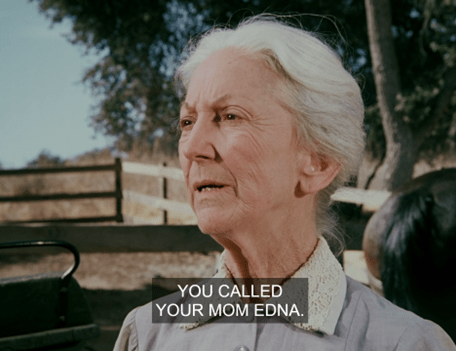
With hostility, Tod says the only reason he’s here is that “Edna just wanted to get rid of me.” (The use of his mother’s Christian name shocks Grandma Virginia.)
Then Tod flatly says, “I could use some groceries.”
Virginia is taken aback by his manners, but says “Yah!” like the good Minnesota grandmother she is and heads back into the house. (We really do all say “yah” here. Minnesotans who tell you otherwise are delusional.)
Tod mutters a small apology then, saying, “I had a long trip.”
Old Brewster simply cackles and says Tod’s gonna love the fishing in these parts.
That night at the Little House, we join a much happier family at dinner.
Albert is offering his objective analysis of Tod; viz., that he’s an asshole.
Pa says give him a chance, he’s new in a strange place. But Albert says the guy’s assholery exceeds mere fish-out-of-water-ness.
Laura says they should invite Tod and Co. to dinner and give him a steamin’ pile of country hospitality.
AMELIA: Holy makeup. She looks like a saloon girl.
Indeed, Laura is wearing more makeup here than we’ve ever seen her wear before. Possibly more than all the other times combined, in fact.
(Others have commented how, rather than believably plan and script a coming-of-age arc, the production team simply caked more makeup on Melissa Gilbert throughout this season.)
Previously on Little House
Ma starts saying, “Well” – only Albert, who’s buttering up a roll, immediately interrupts her. (Yet again, Caroline’s part is shit in this one.)
Eventually Ma says they should probably let the young creep get settled before throwing him a fucking party! (Paraphrase.)
Albert doubts Tod will ever be integrated into Groveland society, but Pa says, again idiotically, “If anybody can perform a miracle, it’s the Davenports!” (Why? Because they’re nice? Everybody’s nice in this town, Chuck.)
Meanwhile, Baby Grace plays with her food, in this case yogurt with peaches or something equally unlikely.
Everyone cracks up at Grace’s sloppiness; Pa especially, of course.
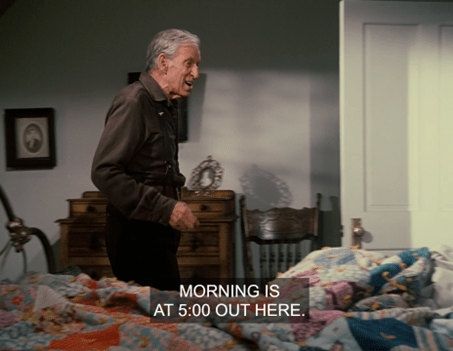
The next morning, Stupid Old Brewster horrifies Tod by waking him for chores at five. (John Wilkes Booth stares at the two from the wall, giving the moment a subtle sinister feel.)
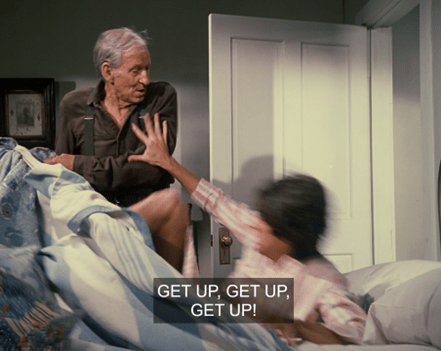
As obnoxiously as can be imagined (and I mean that literally), Brewster harangues the kid with rhyming doggerel, then yanks the covers off the bed.
(origin of this rhyme unknown)
My dad had a better method for getting my sister and me out of bed in the mornings – popping ice cubes into the necks of our pajamas. (He could have kicked Tod Dortmunder’s ass, though. And would have!)
Anyways, I do feel that the Davenports, especially if we can trust Nellie that they’re so “courteous,” might have warned Tod to expect an early wake-up call like this.
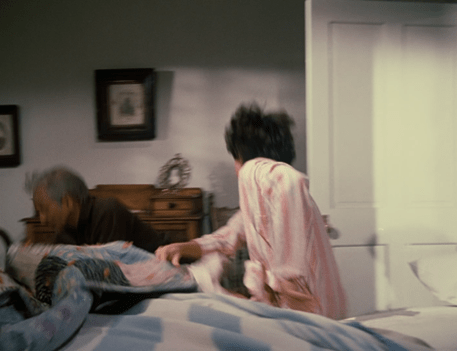
This is not to excuse what happens next, which is that Tod knocks the old man to the floor.
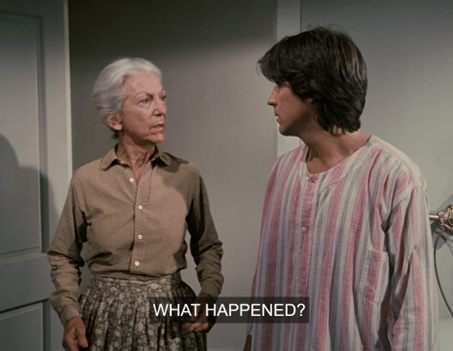
Grandma Virginia rushes in, but as one might expect, Old B downplays the incident.
With something approaching fear, he ushers his wife out of the bedroom.
Whilst I might not excuse Tod’s actions, that’s exactly what Old Brewster does when Virginia asks for the real story.
“It’s not natural to push an old man,” Virginia says with feeling. Brewster fakes offense at being called an old man, which makes her laugh. Atterbury and French are a bit much at times in this one, but they do have believable chemistry.
Like Charles, Brewster is interested in the psychology of the individual to a nutty degree, for a farmer, and he wonders aloud what Tod’s thoughtless brutality is really about.
AMELIA: He looks like Grandpa Kaiser. His eyes are the same color.
As for Virginia, she obviously believes the boy needs a hard kick up the ass, and I can’t say I blame her. But she defers to Old Brew for the moment.
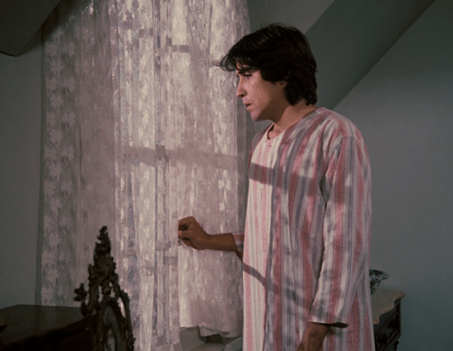
Upstairs, Tod looks out the window and sighs, then sits down and puts his face in his hands. Whether it’s regret, self-loathing, simply the existential horror anyone up at dawn experiences, or some mix is a matter for conjecture.
David’s muted brasses, hissing and snarling like demons, don’t make things any clearer.
After a brief commercial interval, we see the buckboard of Almanzo and Eliza Jane Wilder crossing the bridge! (The downtown bridge (DTB), that is, not the old covered one (OCB).)
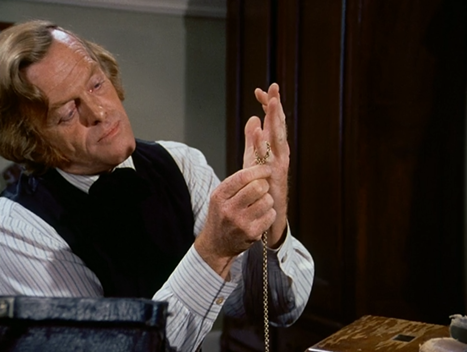
Next, we abandon the Wilders’ company for that of Charles, who’s looking at a watch in the Mercantile.
Now, this is not a watch Charles wants to buy, but rather, although never before mentioned, one left to him by Lansford when he died. (Or maybe just when he wandered off to die. )
Previously on Little House
Charles apparently brought the watch in for service in an untelevised adventure.
Many details about this Project are admittedly blurring for me by this phase of things (it’s a lot to remember!), but I don’t think we’ve had too many watch-driven plots.
The other one that comes to mind is “The Collection,” where Mary catches Johnny Cash stealing Reverend Alden’s watch.
Previously on Little House
But we forget about the watch when the Davenports appear in the store. Old Brewster lies about how great things are going with Tod.
Charles invites the Davenports (dammit, I keep wanting to call them the Brewsters) to a picnic at their place after church this week.
In re Tod, Charles says, “There’ll be a lot of people there his own age, he’s sure welcome to come.” (What people? Almanzo? Adam? Christie Norton? Others have noted that whilst the Grove is up to its gills in youngsters, oldsters and middle-aged people of all types, young adults and twentysomethings are rare.)
Adam
Almanzo and Christie Norton
Herbert Diamond (?)
This guy?
Absurd remark.
(And besides, Christie Norton moved to Mankato.)
Previously on Little House
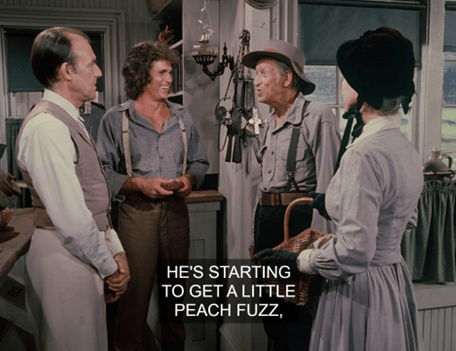
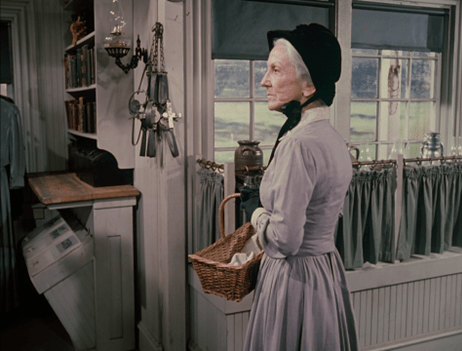
Old Brew is so irresistibly adorable, I can’t help but hate him. With sickening sweetness, he says he wants to get dear little Toddy a shaving kit, as “he’s startin’ to get a lil peach fuzz!” (Peach fuzz in this sense first appeared in print in 1871.)
Well, Ol’ B sweeps all the unpleasantness under the rug, despite Virginia’s disapproving looks. (I like her better.)
Back at the Old Davenport Place, Tod is nicely thanking his grandfather for the shaving stuff. You know, as we get deeper into this one, Tim Wead’s acting will become more flamboyant, but I like how in these early scenes he communicates the subtle struggles within this kid. (Tod is trying; he’s failing, but he is trying.)
The good feels immediately dissipate when Old Brewster starts talking about how fun it is to shave at night, since the a.m. is for workin’ and churchgoin’!
Tod then shocks his grandparents again by telling them he doesn’t “do” church.
Grandma Virginia, who’s clearly had enough of Tod’s shit, nevertheless tries to lure him with the promise of the picnic.
Tod speaks quite sharply then, saying he’s now a man and will spend his Sundays as he pleases.
This is fair enough, but he makes it worse by cracking that “God didn’t make it around to my neighborhood, so I never made his acquaintance.”
“God is everywhere,” Brewster says – without anger, but seriously.
But Tod just scoffs. Even so, when he’s halfway out the door, he stops and asks if he can meet them at the picnic anyways. (See? Inner struggle.)
The oldsters approve of this, even giving each other little encouraging looks.
We jump to the picnic, then. Turnout looks okay, though once again all Blind School personnel are mysteriously absent. [UPDATE: Reader Leslie points out the Garveys are too.]
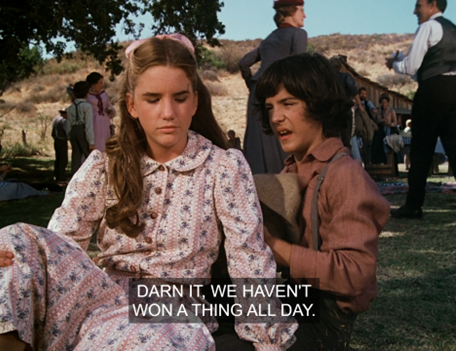
Three main teams are competing this year: Laura and Albert, Not-Linda Hunt and Not-Art Garfunkel, and Almanzo and some little blonde chiquita we’ve never seen before.
Almanzo and the chiquita are victorious. Laura and Alb don’t even finish, having fallen down before reaching the finish line.
Actually there were a couple more teams (Non-Binary/Not-Linda’s Little Sister and Carrie/Midsommar Kid), but they all fell on their faces at the starter’s pistol.
Carrie and the Midsommar Kid crash and burn
Eliza Jane rushes over to her brother, saying, “Congratulations, Manny!”
Then she adds to the Chiquita as an afterthought, “And you.” Ha!
Speaking of afterthoughts, Almanzo says “Nice try, Beth” as he heads over to the lemonade table. (Oddly, Laura’s nickname stumps the transcriptionist, who – also oddly – uses “Manny” rather than Almanzo in the titles. A new hire?)
Laura and Alb complain about losing the race, whilst Nels and Eliza Jane have a nice little conversation behind them. I can’t make out what they’re saying.
Laura grabs an apple from a washtub. Granny Smiths and Red Deliciouses are coexisting civilly, this episode taking place in less divided times than our own.
Having lost the race, Laura decides to go annoy Tod, who’s sulking alone by one of those weird logs.
AMELIA: Why would he even come if he didn’t want to meet anyone?
Actually, he’s asleep, but Laura wakes him and jibber-jabbers embarrassingly . . .
. . . until he rudely gets up and abandons her.
AMELIA: Well, she bungled that whole exchange.
Before Tod leaves, we do learn that he was a dockworker in Chicago. (Do you suppose he knows Kezia???)
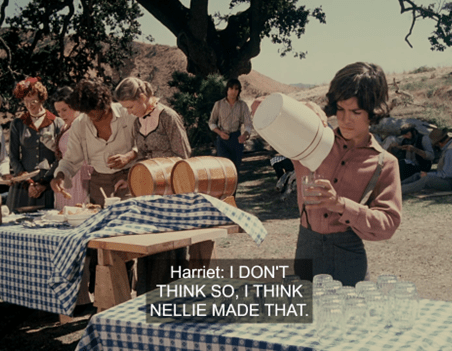
Over at the food table, we join Charles and Harriet Oleson mid-side-conversation. The Altman-esque overlapping dialogue is hard to make out . . . but I think they’re sharing a laugh about Nellie’s bad cooking!
MRS. OLESON: . . . I don’t think so, I think Nellie made that.
CHARLES: Let’s hope not.
[BOTH LAUGH]
CHARLES [taking a bite]: Mm! It’s good!
Tod approaches for some lemonade, but Ma says there’s some in the house and he can help himself. (Meanwhile, Mrs. O turns to Eliza Jane and says, “Minnesota is a lovely place to . . .” But I can’t make out anything more! Grr!)
Inside, Tod takes a little lemonade; outside we hear Nels says it’s time for the “mountaintop sack race.” (Mountaintop sack race? That doesn’t sound like a great idea, Nels. You’ve seen the opening credits, right?)
David gives us some nervous, edgy music, and you can probably guess what happens: Tod steals Pa’s watch from the mantel.
!
He also puts his glass on the mantel without a coaster.
!!!
Speaking of which, since when do the Ingallses have glassware? I suppose the Olesons might have brought it. . . .
Previously on Little House: Tin cups galore
In this scene, Tod sips the lemonade, getting lemon pith on his mouth; but I’m not sure what this signifies, except perhaps that his moral education so far has been pith-poor.
(I couldn’t resist that one.)
WILL: This is pretty dumb. What’s he going to do with that watch? It’ll be missed immediately, and he can’t wear it or sell it to anyone in this town.
AMELIA: Yah.
That night, Charles is falling asleep reading The Home Mechanic.
Ma notices and says, “I’m sleepy too!”
AMELIA: Ma’s got some fantastic dialogue in this one.
Wondering what time it is, Caroline looks for Pa’s watch and notices it’s missing.
Checking the watch is presented as if it’s a commonplace occurrence, but in fact we’ve never seen them rely on any timepiece in the Little House. (In “The Monster of Walnut Grove,” Pa tells time by the moon.)
Previously on Little House
The two conduct a brief search. Neither Laura nor Albert have the watch.
WILL: Albert probably traded it for drugs.
AMELIA: Huh?
(Remember, this is Amelia’s very first time through the series!)
Coming soon on Little House
Ma suggests that Carrie, who’s asleep already, might have taken it.
WILL: Hold old is Carrie now? She isn’t a toddler who would play with it like a toy.
AMELIA: I don’t know. She is pretty . . . childlike.
AMELIA: Plus Laura still pulled shit like that at that age.
But Ma immediately says her real theory is Tod stole it.
WILL: There’s a reversal in this one of a sexist expectation you might have, that men are the hardasses and women are gonna make excuses for kids.
AMELIA: Yeah. I like that.
The next morning, or later that week, or sometime, Tod is getting ready to board Old Brewster’s wagon, alone.
He tells Brewster he’s going “take a ride over to Mankato.” Would he even know where that is? I suppose he maybe went through it on the train from Chicago.
Another question, would he know how to drive a wagon? He’s a dockworker from the inner city.
I suppose maybe he would . . . but that’s a lotta damn maybes if you ask me.
Old Brewster says he can’t, because he needs the wagon himself today.
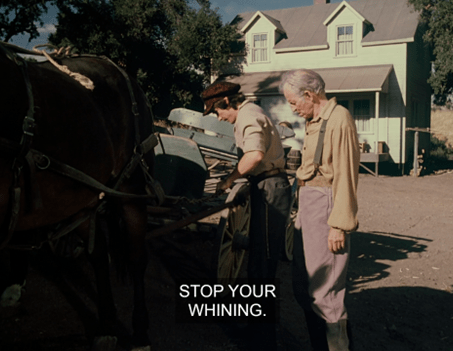
But Tod says, “Stop yer whinin’” – a catchphrase, you’ll recall, of his father’s.
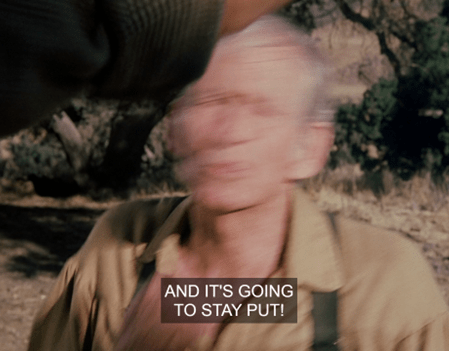
Old Brew notices the watch chain then, but when he tries to stop him, Tod slaps him across the face, pretty hard.
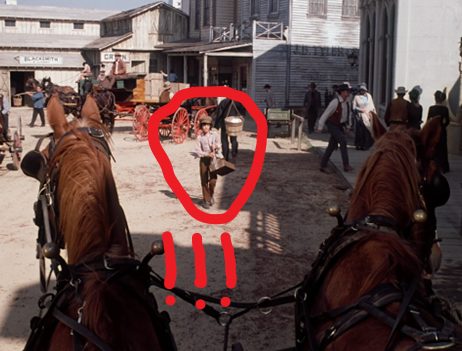
Tod drives to the main road, where he is almost immediately transformed into Jonathan Garvey.
In fact, the vehicle also changes, and the horses as well.
What the fuck?
A strange error, but never mind. Inside, Grandma Virginia tends to Brewster’s injury.
AMELIA: Now this makeup is good. He really looks like he has a welt on his mouth.
Virginia wonders, fairly enough, why their daughter didn’t tell them what to expect with Tod.
Brewster makes no reply, because then he hears a wagon on the drive and cries, “He’s back! He’s going to apologize!”
But Virginia looks out the window and announces Charles Ingalls instead.
AMELIA: They should have played the theme again.
Immediately dropping his “everything is perfectly normal” act, Brew scuttles off to the stairs so Charles won’t see what happened. (I thought this next bit might turn out like the second act of The Marriage of Figaro, but spoilers, it doesn’t.)
The Marriage of Figaro
At the door, Charles says he came to talk to Brewster, but when Virginia says he’s out he asks if he can talk to her about the matter instead.
AMELIA: I like that Charles doesn’t insist on talking to the man. I love him.
Charles quite gently and respectfully brings up the missing watch.
It’s a flattering portrait if so, but it might be. Cleveland had become President for the first time earlier that year. (More proof, as if any were needed, that my dating system works perfectly.)
Old Brewster reveals his presence then, and the two oldsters explain the dilemma to Charles.
Charles quickly heads out to try to catch Tod on the road to Mankato.
Virginia and Brewster hold each other sadly.
AMELIA: I like these two. Do they continue on the show?
WILL: No. Tod kills them, of course.
AMELIA: I can’t tell if you’re serious.
And the next thing we know Charles is arriving in Mankato. (Once again, in reality, and formerly on this show, Mankato is a three-day wagon drive from Walnut Grove.)
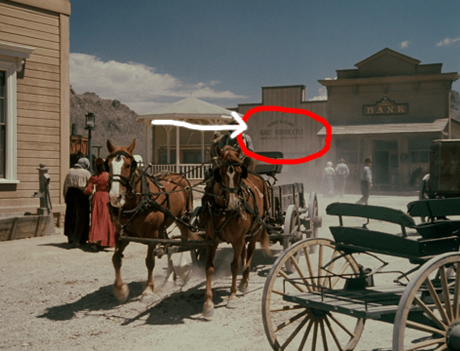
We can see the Mankato offices of Berry & Clark Land Brokers, with the L in Land mysterious missing. (I doubt it’s a neon light that burned out.)
Berry & Clark And Brokers
AMELIA: Is that cactus?
Yes, it is. You know, just a few weeks ago, Dags and I traveled to Tucson, Arizona, to visit our friends Kael and Keith, two Original Groovesters. (Kael and I used to watch Little House together in college, and Keith is such a fan he dressed as Laura for a Halloween party I gave in the Year 2000. Happy times.)
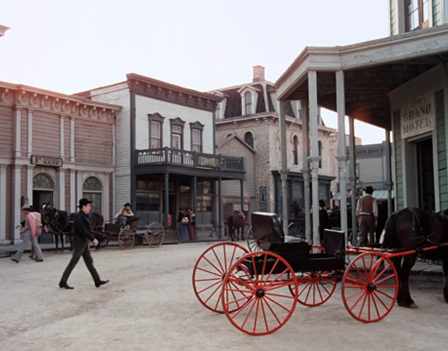
I know you will question my commitment to this Project, reader, when I tell you we decided not to go to Old Tucson Studios, the famous fake town which was the shooting location for many Westerns, and which on this show has stood in for Mankato, Winoka, Deadwood and other rootin’-tootin’-ish locales.
Deadwood
Springfield
Redwood Falls
Sleepy Eye
Boswell
Winoka
Mankato
Built in 1939, the “town” set was mostly destroyed in a fire in 1995. It was rebuilt, but my understanding is the construction was newly designed rather than a recreation of the old buildings.
Old Tucson today
Tragically, a priceless collection of costumes from Little House was also destroyed.
Anyways, if you’ve been to Old Tucson since 1995 and feel it’s an essential stop for the Little House fan, please let me know! I’m sure we’ll go back another time.
Charles climbs down from the Chonkywagon as Not-Axl Rose and William Tell Hat (by now Mankato institutions) pass by.
Inside a saloon, some men are playing the roulette wheel.
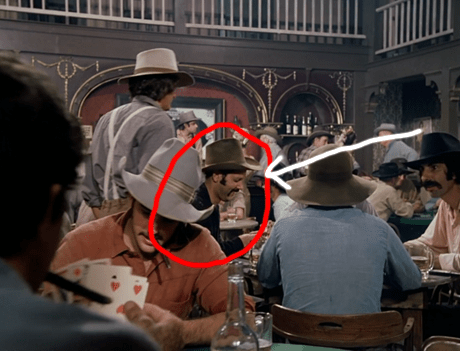
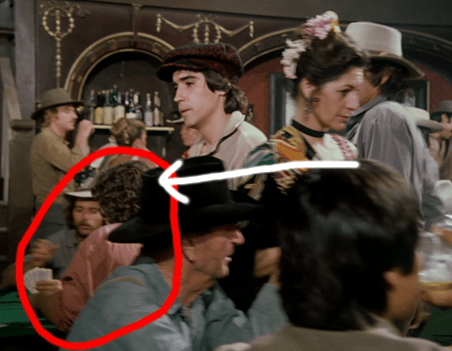
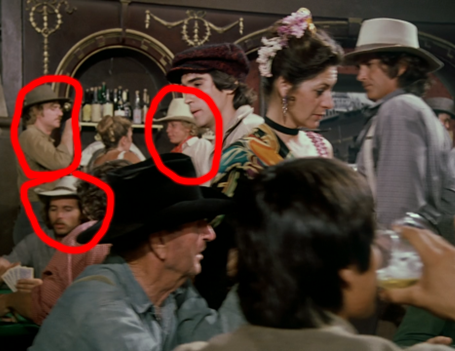
At first we don’t see too many familiar faces, but as Charles passes through the room we spot Not-Clint Howard and our old friend the Giddy Idiot.
William Tell is also there, but that’s okay, this must have been where he was headed a moment ago.
And of course, we also find Tod, at cards.
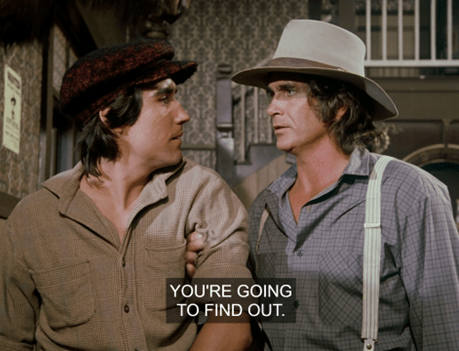
Charles approaches him, makes a fierce face, and speaks quite sternly.
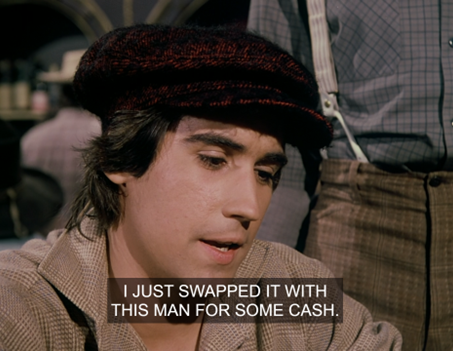
Tod waves him off, but he keeps pushing. Soon it comes out that Tod sold Pa’s watch to the dealer.
No matter, Pa orders Tod and the dealer to “swap back.”
WILL: Where’s the bouncer in this place? Miles Standish would have thrown Chuck out on his ass the minute he started this.
Previously on Little House
Pa is still stern as a stern nun played by Mary Hamill, and they do swap back.
AMELIA: I like Scary Charles.
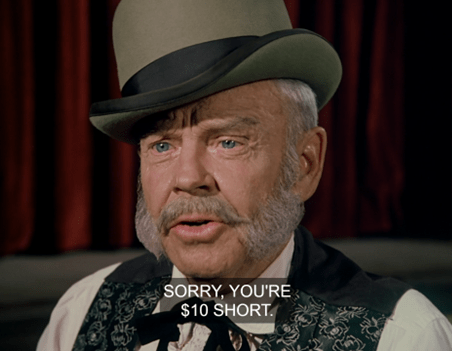
The dealer – at least, he looks like a dealer – is Clyde Harper, who was primarily a transportation coordinator who worked on many Landon projects, including the final movies.
He’s muttonchopped, has eyes of Mary-Ingalls blue, and is wearing a vest decorated with crazy spiders or something.
Previously on Little House
Unfortunately for Tod (but not for the plot), he doesn’t have cash for the full value of the watch, but fortunately Charles happens to have ten dollars (about $335 today) in his pocket. (Maybe he got a cut of Gramps Holbrook’s publishing royalties.)
Previously on Little House
Embarrassed and annoyed, Tod heads for the door. (Not-Axl Rose, Not-Pedro Pascal, and the Buster Scruggs wannabe with the William Katt hair are there too.)
The real-life modern-day adult Jonathan Gilbert apparently is a time traveler, since he is in the bar as well.
!
Anyways, Charles catches Tod before he escapes, saying he still owes him ten bucks.
Charles gives the kid a choice, saying either he can come back to Hero Township and work off the debt, or he’ll have the local sheriff or marshal arrest him.
Tod laughs at this threat, so Charles drags him to the jailhouse. (Unfortunately, we don’t get to see him pulling the young asswipe through the streets.)
The Marshal, who seems on familiar terms with Chuck, locks Tod up. (We can see a wanted poster for a Jeff somebody – Clayton? Cletus? – on the wall.)
Charles starts to walk out, passing as he does so another time traveler, this one from the late 1970s, judging by his clothes.
(We can see William Tell again in the same shot.)
Tod yells, “Thought you were supposed to be my grandparents’ friend!” and Charles shoots back – not literally – “A lot better friend to them than you are, boy.”
Again strangely, the Buster Scruggs wannabe with the William Katt hair, despite having been comfortably enjoying a conversation in the Silver Slipper as Tod and Charles left, is now right next to Tod in his cell.
Forty-three seconds ago on Little House
I suppose maybe Time-Traveling Jonathan Gilbert and/or Time-Traveling Seventies Guy arrested him and brought him to jail in their TARDIS earlier in the day.
Back in Walnut Grove that night (ha ha! ha ha ha!), Charles brings Old Brew and Grandma Virginia up to speed.
Charles says he’ll return to Mankato the next day and repeat the offer to Tod, agreeing to drop the charges if he’ll come work for him.
Actually, Charles says he’ll drop the charges no matter what, on account of his friendship with the Davenports. But Virginia says she’s frightened of him and doesn’t want him back in the house.
AMELIA: She really looks like a Virginia.
In our house, Roman, Alexander and I once were watching the horror movie The Taking of Deborah Logan(worth seeing) and tried to trick Dagny into joining us by saying we were watching a thoughtful drama called Weekend in Virginia. She quickly figured it out. (It didn’t help that Roman was calling it Weekend in Virginia whilst Alexander was calling it Weekend at Virginia’s.)
aka Weekend in Virginia or possibly Weekend at Virginia’s
Anyways, Chuck goes back to Mankato. Buster Scruggs must have been bailed out, since he’s sitting in a wagon that drives past the marshal station.
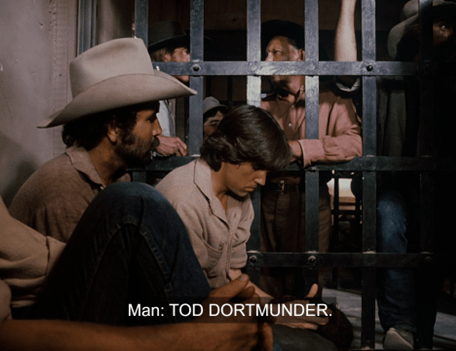
Inside, the Marshal calls Tod Dortmunder. (Finally, the family name. Tod is “death” in German, but I’m not sure what Dortmunder could signify. It appears the word literally means “there-mouth,” but if there are any German readers out there who know better, please correct me.)
Oddly, there’s a Richard Kennedy billed as “Sheriff” in the end credits, but looking at photos of the actor Richard Kennedy, I’m quite sure he’s not the same person as our Marshal.
First off, the IMDb describes him as “chubby,” and the Marshal of Mankato doesn’t look very chubby to me.
Another view
Second, I was able to find a photo of Kennedy from the infamous exploitation flick Ilsa: She-Wolf of the SS. I always knew sooner or later somebody who was in that would turn up on this show, but it’s pretty clear from the photo that this isn’t him.
Richard Kennedy in Ilsa: She-Wolf of the SS
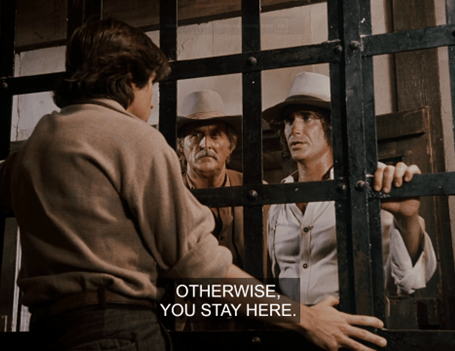
Charles says he’s free to go if he chooses to work, or he can rot in jail.
AMELIA: Is this really how it worked in those days? Wouldn’t Charles have to stay for the trial? They couldn’t just keep him in jail forever for stealing ten dollars.
<
AMELIA: And why is the Sheriff taking orders from Charles, anyway?
We never find out, because Tod agrees to go with him.
[UPDATE: Reader frauschiller89 writes from Germany:]
Dortmund is a pretty big city in Germany and “Dortmunder” would mean “someone from Dortmund.” But yes, you identified the words “dort” [there] and “Mund” [mouth] right. There are T-shirts existing that play with it. They contain those words and an arrow pointing down . . .
[Hahahahaha, filthy! We love it. Thanks, frauschiller.]
Charles brings Tod back to Groveland by Chonkywagon. (They’re just gonna leave Brewster’s rig in Mankato???)
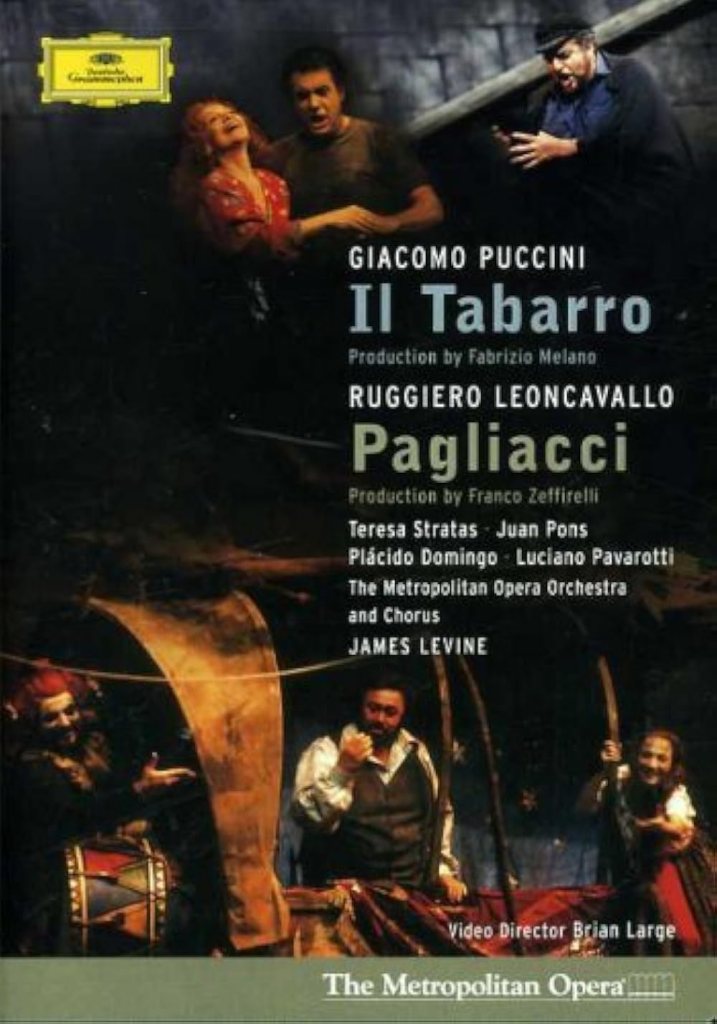
Charles and Tod are discussing his working arrangements. “Don’t worry, hard work’s not gonna kill you.” (If Tod is a stevedore, I doubt he’s afraid of hard work, at least if the opera Il Tabarrois any indication. )
Tod asks how long this assignment will take, and Charles says, “Till you pay back the money owed on the watch.”
AMELIA: Yeah, till you pay back the money owed on the watch, bitch!
Tod says Chuck is quite the martinet (paraphrase), then for no reason at all, adds, “You sound like my pa. He made all the rules . . . till that night. . . .”
Charles says he knows Tod’s father is dead, but that’s not his problem.
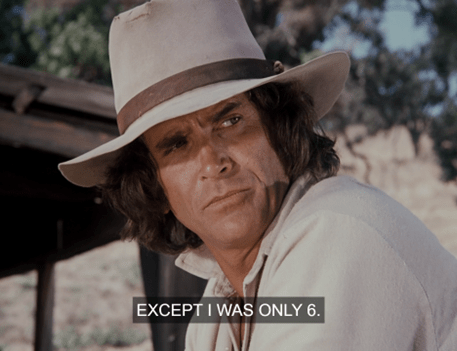
“I ain’t askin’ you for sympathy!” Tod hisses. “If my pa hadn’t died when he did, I’d have killed him myself, except I was only six.” (So Tod hadn’t seen his grandparents since at least 1874, not 1878.)
He goes on, “My pa hit me with his fists, not once or twice, but a lot of times! I wished him dead over and over and over! Finally some fella on the docks up and shot him.”
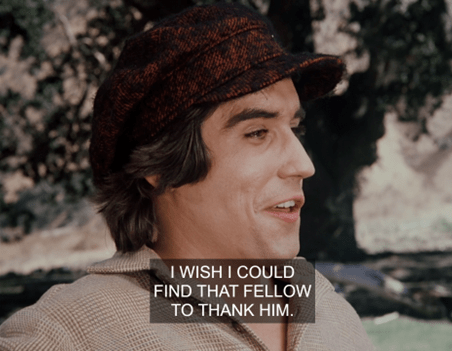
Then he laughs, “I wish I could find that fella and thank him!”
Appalled by this speech – and it is an appalling sentiment – Pa stares at him a long time, then finally says, “I’ll show you where you sleep.”
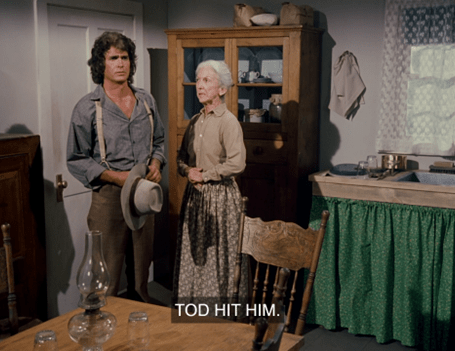
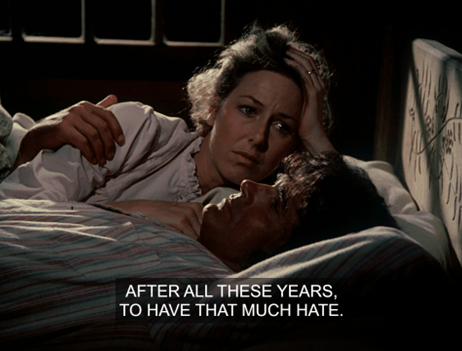
That night, Pa and Ma sit up dissecting Tod’s case.
AMELIA: Her hair is messy. Must have been Popcorn Night.
Post-popcorn?
They agree the young man’s problems are beyond their experience. They’re beyond mine too. This episode makes me grateful for my own family. It’s easy to blame the behavior problems of kids on their parents – and this episode nods in that direction – but there’s also an element of chance at work. Many good families have had struggles raising kids that we never experienced, and I don’t take it lightly. I don’t know how we would handle a Tod ourselves.
Anyways, Ma advances the genetic theory, so I guess there is more to this script than just blaming the parents.
“Do you really think workin’ off the debt will accomplish anything?” Ma says.
“He was right about most things,” Ma says. (Tell that to Bunny, why don’t you!)
Previously on Little House
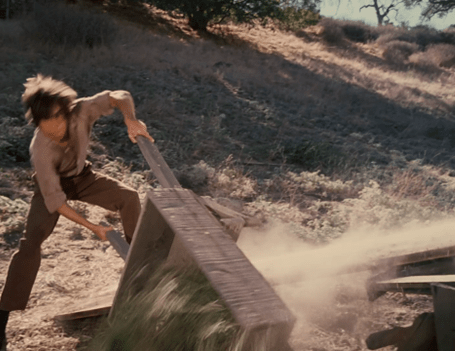
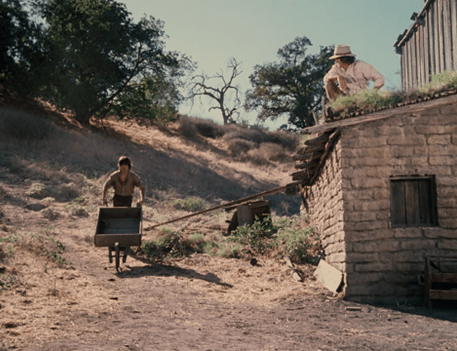
Then we get a musical montage of Tod working.
First, he drives spikes into a dead log for some reason.
Then he tips over a wheelbarrow of sod intended for the little “soddy annex” attached to the barn.
Charles laughs at him. Todd angrily throws an armful of sod, then realizes he just looks foolish.
Then he digs a hole for some kind of post. (Since Charles’s pockets are literally overflowing with cash suddenly, maybe he decided to get a telephone after all.)
Previously on Little House
[UPDATE: Speaking of telephones, reader Leslie notes that a few phone calls could have cleared up a lot of things in this narrative.]
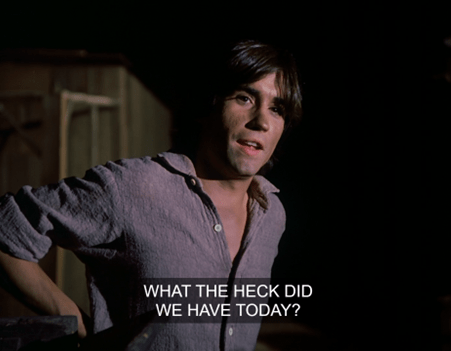
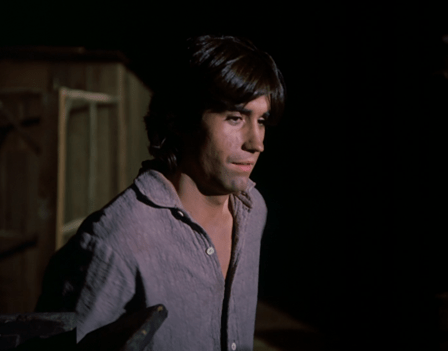
They finish up after dark. Tod says he’s too tired for dinner, and Charles mentions they’ve got a big day ahead of them tomorrow.
“What the heck did we have today?” Tod asks, but when Pa looks up he realizes it was a little joke and smiles.
AMELIA: See, he’s softening up.
WILL: Yeah. Who could spend a whole day with a sanctimonious boob like Charles and not enjoy it?
We see Tod is bunking in the soddy. That’s a better bet than the hayloft. At a French and Indian War reenactment I once was made to attend, I slept a night in hay, an occurrence responsible, I believe, for my lifelong asthma-type issues.
Soddy Toddy
He selects an apple (Red Delicious, gag barf) and, still chewing, turns in for the night.
AMELIA: He only took one shoe off.
The next day, we see the KOW 1900 and Cowlet hanging out in their pen as Old Brewster drives out to the Casa.
Again, how he recovered his rig from Mankato is never explained.
Old Brew looks around worriedly and, no doubt sure the boy will spring at him any moment, says, “Where’s Tod?” But Charles reassures him Tod’s in town.
Tod has apparently been working for Charles for two weeks now, and Chuck gives him a good report.
“Hasn’t flared up at you or nothin’?” Brewster asks.
AMELIA [as CHARLES]: “No, I’m a real man.”
Brew says he’s glad to hear Tod’s a good worker, since nobody who works hard can be all bad.
AMELIA: I like Brewster.
WILL: I’m sorry to say I don’t.
AMELIA: Why? Too nice?
WILL: Too nice, a little too “gee whiz, up with the rooster, ain’t it a glorious day for farmwork, heh heh heh! An’ did ya see my grandson’s gettin’ a little PEACH FUZZ!”
AMELIA: I like him. We need more gee-whiz old men.
She’s probably right about that. As for Tod, he’s out splitting wood against a backdrop of Minnesota mountainscape.
Charles appears and tells him his indenture is over.
WILL: Oh, it’s just like The Tempest! “If thou more murmur’st, I will rend an oak/And peg thee in his knotty entrails!”
AMELIA: Whatever, Pops.
Tod says he’ll be off then to a hobo’s life, heading toward California.
WILL: It’s too bad Dagny isn’t here, she loves hobo storylines.
(Dags actually hatesthis episode and decided to skip it.)
Instead, he points out Tod will hurt his grandparents’ feelings.
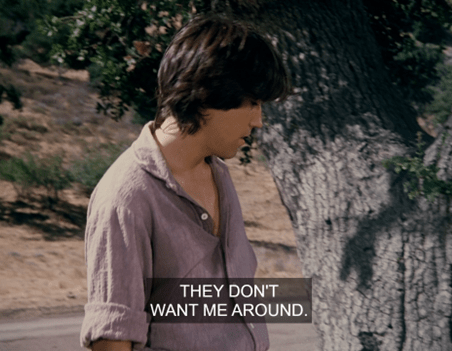
“They wouldn’t want me around,” Tod says, and Pa says quick as a flash, “Who would, the way you were actin’?”
AMELIA: Oh God, here comes Therapy Charles.
Tod admits The Ginny & Brew Show was starting to grow on him (paraphrase), but says he’s better off on his own.
Pa offers his insights into the human condition then, saying “It’s not so bad bein’ around folks who care about you.”
I’ll give you this next bit verbatim. It isn’t very long.
TOD: Nobody cares, not really.
CHARLES: Your grandparents do.
[beat]
CHARLES: So do I.
You’ll agree this is classic Charles performing classic Charles-type behavior.
Landon is standing perfectly still, his expression unchanging. His hands are folded primly at the top of the ax handle, and there’s a sheen of perspiration on his burnt-orange neck.
He looks a little smug, but benevolent and wise at the same time.
Ladies and gentlemen, Michael Landon as Charles Ingalls.
Tod starts stacking the firewood he just cut.
AMELIA: He should throw a log at him.
WILL: Charles should, or Tod should?
AMELIA: Either would be good.
Then, for no reason except to fill time, we get a “comedy” sequence in which Bandit crawls into Carrie’s bed and scares her.
She really is scared of things covered by bedclothes, isn’t she?
Previously on Little House
David Rose gives us some crazy swirling music, then settles down when Ma puts Bandit out.
Meanwhile, Pa is wrapping a present – a brand-new shirt from the Mercantile for Tod. (See, more foolish spending.)
No, actually, she takes the wrapping project away from him and says despite his always having to be fatherly to everyone in his sight, Charles might not have broken through to the boy.
AMELIA: I like Ma’s hair. It always looks good down.
“What he says and what he feels are two different things,” Charles opines. There is a lot of pop psychology in this one.
He goes on to say Tod’s got to “give God a chance to heal him.”
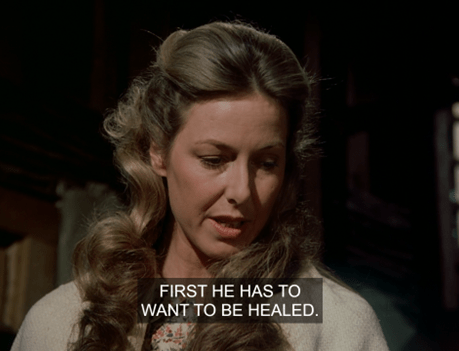
Caroline puts her hand on his arm and says, “First he has to want to be healed.”
AMELIA: [retching sounds]
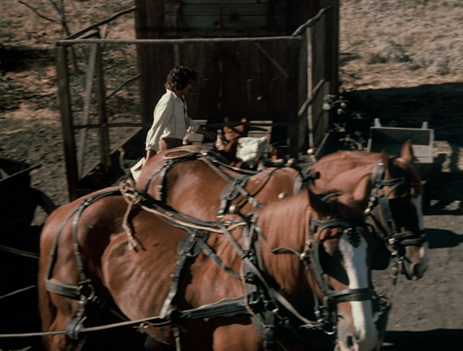
The next morning, Pa heads out to the soddy, passing the scrawny Chonkies on his way. (There are a lot of comments on the internet about how the horses look underfed throughout the series, but I don’t know enough about the topic to give an opinion.)
(I mean, I don’t usually let that stop me, but feel free to weigh in if you’re an expert. I’m not.)
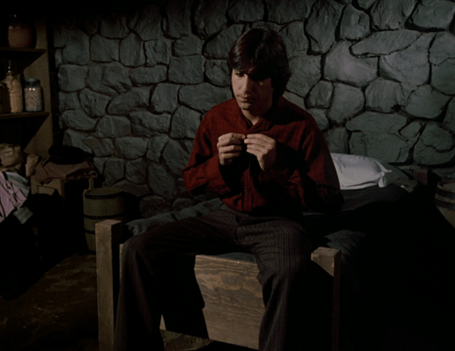
Out in the soddy, Tod is already wearing a new shirt, or at least it’s new to us.
WILL: Oh, does he give him the same shirt he already has? That would be awkward.
Pa invites Tod to church, but he declines.
Pa starts to push it, but Tod is still stubborn. I’m not sure why Chuck likes this guy so much.
Then Pa tosses him the thank-you present.
WILL: Here’s where things really start going off the rails.
AMELIA: What? Isn’t this the end?
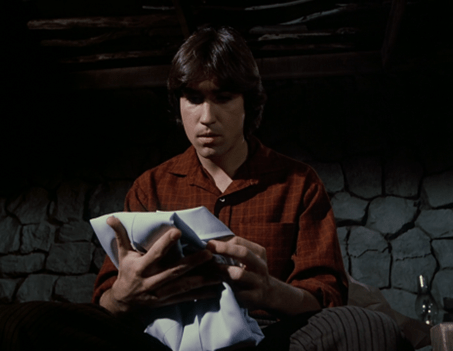
No, it isn’t the end. For when Charles leaves and Tod opens the package . . .
AMELIA: Oh God. . . . THE SHIRT! . . .
!!!
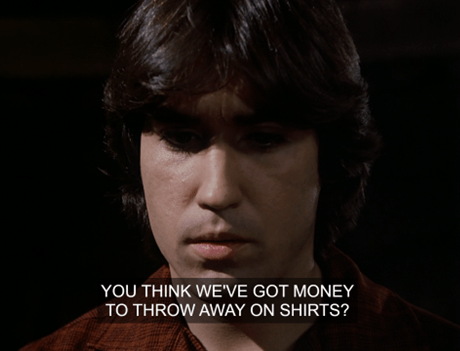
Yes, the shirt. Tod suddenly flashes back to the day his father died . . . and in a crazy rage, he tears the shirt to pieces!
Sort of.
WILL: I think he’s having trouble tearing it.
AMELIA: Yeah. You can tell he’s a second away from biting it.
The shirts aren’t especially similar, so does he react this way to all shirts? What is it, the buttons? You know, that’s a missed opportunity – they should have had him only wear undershirts until the end. It would make his shirtaphobia more believable, I feel.
After a break, to somber music, we see all the Ingallses come out of the Little House and get into the wagon for church.
All the Ingallses but BABY GRACE, that is!
WILL: Where’s Grace?
AMELIA: Sleepin’ in the back.
No, she isn’t sleepin’ in the back. It’s obvious the wagon is empty as the five others approach from the house.
Well, that’s a mystery. Pa finds the torn shirt, then sends the family into town whilst he rushes to see if Tod’s murdered Brewster and Virginia.
Producing a Bunny-model saddle horse from who knows where, Pa races to the Davenport farm.
WILL: Is the whole house gonna be a bloodbath?
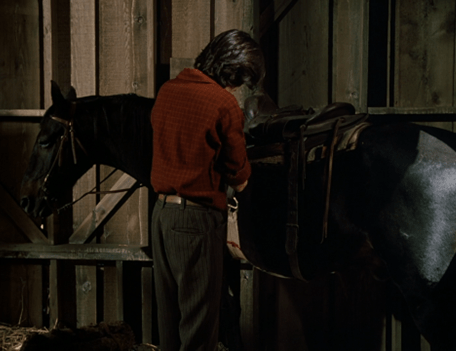
But Pa is distracted by a neighing horse and runs into the barn first.
AMELIA: Tod isn’t killing their horses, is he?
WILL: That would be dark. . . .
AMELIA: Hey, it’s Little House.
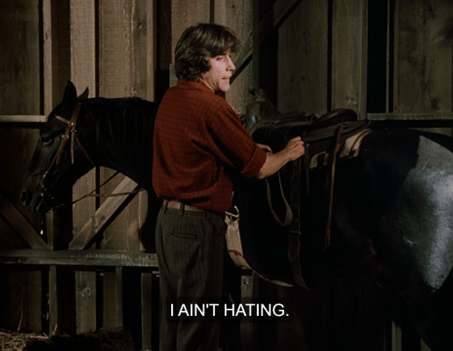
But no, he isn’t killing the horses, just stealing one.
Charles says from the threshold, “Why you wanna leave hatin’?”
WILL: That was the kind of line my friend John Pima loved.
Tod rolls his eyes at yet another onslaught from this busybody.
Chuck says shirt-tearin’ equals hatin’ in his book.
AMELIA [as TOD]: “Well, you see, the day my dad died . . . oh, it’s a long story.”
Charles says he was afraid Tod was going to kill his grandparents.
Tod is annoyed; and it is kind of a bleak assumption.
Pa goes on and on and on.
AMELIA: Charles doesn’t know when to quit.
WILL: No, he does not.
Tod becomes one of the few Little House characters to point out how Pa gets off on being everybody’s dad.
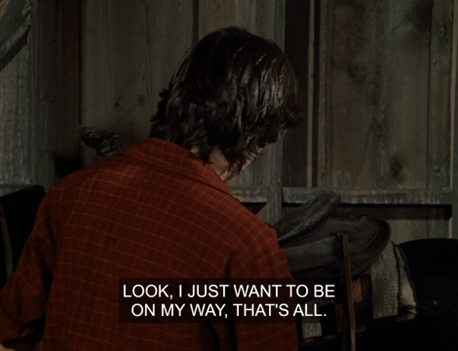
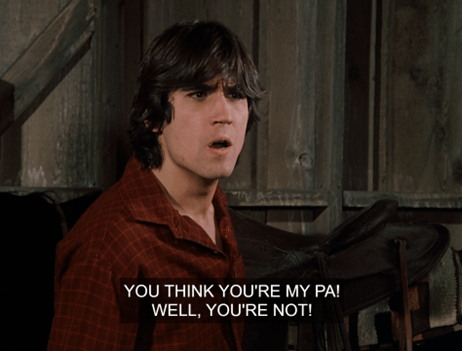
Tod yells that Charles isn’t his father, he’s “just a dumb farmer.”
You’re all alike! You’re just like my pa! That’s why he’s dead, because I hated him! And I hate you! I hate you, I hate you!
(I call that hatin’, myself.)
He lunges at Charles, screaming, “Come on! Hit me! . . . What’s wrong with you! Hit me!”
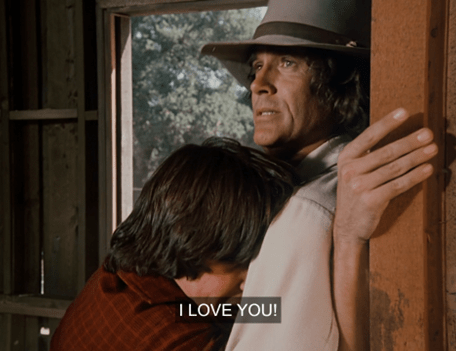
Then, midfight, he collapses sobbing into Charles’s arms, screaming, “Stop! Papa! Papa! I love you! I love you! Why’d you have to die! Didn’t want you to die! I love you! I love you!”
AMELIA: This is too much. My grade just went way down.
Indeed, this is too much. It’s like a Little House parody, or one of those 1980s PSAs where kids yell at their parents for modeling drugs to them.
AMELIA: Now CHARLES is crying?
I told you. A bit much.
Pa strokes Tod’s hair and snuzzles him. Also a bit much, but it is Charles.
WILL: Laura should show up and get jealous.
As Tod loses steam, Charles looks up and gives a thank-you smile to the Almighty.
AMELIA: So I assume Tod moves in with them permanently?
One could probably write another 2,500 words on the subtext of this scene, but this recap is already too long. At church, Rev. Alden is greeting parishioners.
WILL: Oh, Aldi! I’m glad he’s in this one.
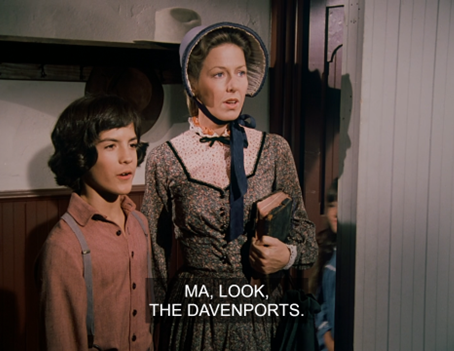
The Ingallses come in, and Albert says, “Ma, look, the Davenports!” I’m not sure why he sounds so surprised, since the script implies they’re regular churchgoers – even if we’ve never seen them before. (Is Albert perhaps realizing he’s a TV character?)
As they take their seats, Carrie looks into the camera and smiles. (Man, there are a lot of bloopers in this one.)
WILL: So tell me, is Grace STILL in the wagon?
AMELIA: Yeah. Sleeping in the sun.
Dis-Graceful?
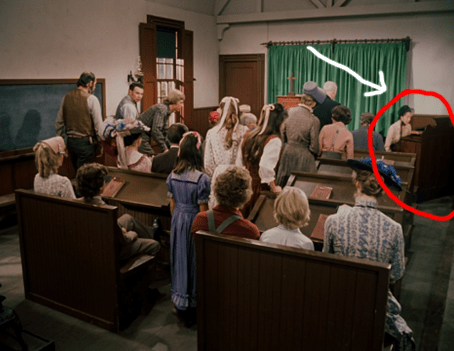
Bizarrely, the Groveland Congregational church organ, which disappeared nineteen stories ago, has been restored to its former place. This time, J.C. Fusspot’s Visiting Sister is sitting at it. (Who suspected she played?)
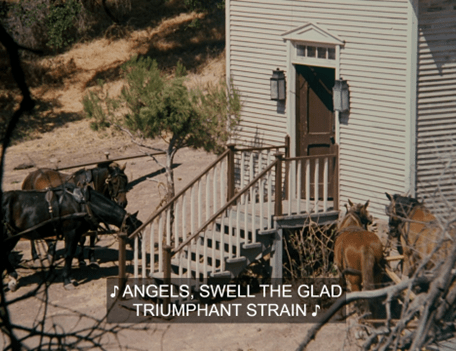
Rev. Alden announces the opening number, “Ring the Bells of Heaven.” (Last heard in “The Voice of Tinker Jones” in Season One!)
Aldi gestures to the organist . . . who, rather than playing the organ, blows into a pitch pipe!
Then they sing it a capella! What the fuck?
Charles joins his family . . . and then, in an echo of “Mr. Edward’s [sic] Homecoming,” Tod does, too. (I mean, he joins his own family, not the Ingallses.)
Hilariously, Stupid Zaldamo can’t find the right page and spends the whole song flipping through the hymnal.
Ha!
Old Brew and Grandma Ginny are delighted.
AMELIA: Where’s Hester-Sue? She’d rock the shit out of this song.
Previously on Little House
WILL: Speaking of which, where are all the blind people?
AMELIA: They’re probably camping this week.
WILL: I suppose. Probably they took Baby Grace with them.
Constable Doyle wears a metal wreath pinned to his helmet – an authentic touch, though apparently the wreath should be framing a number.
A Chicago police officer in 1909
Unusually, Mustache Man wears no hat whilst driving through town.
Laura wears a nice summery new dress with pink stripes and blue flowers.
AMELIA: Tod’s hat is interesting. I can’t tell what it’s made of.
WILL: At first I thought suede, but now it looks sort of like tweed covered with velour.
WILL: It’s a little too big for him, I think. It makes him look like Little Orphan Albert.
His aversion to shirts notwithstanding, he does wear one of those interesting-patterned/textured shirts that turn up on this show from time to time. I wonder if it got burned in the Old Tucson fire too?
Charles appears to go commando again.
THE VERDICT: A well-told story that dissolves into self-parody in the final act. It has its strengths (Wead, Atterbury, French and Landon are all great), but Amelia’s right, the “I love you” scene does take it down a notch.
I live in Minnesota. My name's not really Will Kaiser, but he and I have essentially the same personality.
View more posts
18 thoughts on “The Angry Heart”
I hated the ending and the fact that Charles buys him a shirt which must’ve been quite high in price and never bought Solomon a thing not even a tablet. And why did that young man have to love a father who despised him?? Gag
Rather than make a second trip to Mankato, why doesn’t Chalres just make a phone call from the hotel? That would save a lot of time if Tod were to prefer jail.
And what of the Garvys? They must go back and forth to various relatives. No wonder Andy’s education is lacking. Poor guy. It would be nice to see them more regularly…
As for the episode itself… I’m never a big fan of Charles as social worker.
That is a great point. For that matter, why wouldn’t Edna Dortmunder call her parents to tell them Tod’s coming rather than send a telegram? I assume she’d have easy enough phone access in Chicago. Why don’t the Davenports call her to talk about Tod’s problems, rather than just speculating? Actually, I think a number of post-“Crossed Connections” stories might be simplified (or prevented!) by a simple phone call.
As for the Garveys, well, one could argue that Jonathan does have that cameo on the road to Mankato. . . .
I guess they really wanted to have a redemptive quality ending to most of the episodes. Because you don’t have to love someone who wasn’t good to you. There’s too many other good people in our lives that love us.☺️
Oh, we just watched that Twilight Zone in the picture above, with WG’s Brewster Davenport as the mysterious peddler. He was familiar enough that I looked him up and quickly placed him in the Hitchcock movies but missed that he was in this, so that’s cool!
Honestly, this is one I’ve never liked either. In fact, we recently watched it with some Little House friends at a party a while back, more or less at random. Just for fun, no serious analysis.
I came away really hating it – Tod’s character especially, but also Old Brew, who’s such a dad-gum sweetie-pie I wanted to drown him.
The funny thing is, as I dug in to write it up (I usually watch each episode about four times), goddamn if didn’t find myself warming to the thing. This happens a lot! Maybe it’s just that the recaps are so fun to work on (sometimes the worst stories are more fun, in fact). But I also think there’s just a core of quality to this show that makes it something special, even when not at its best.
There are almost no other TV shows I can imagine standing up to Groovian microanalysis, not by me, anyways. (Well, there are a few, but their fandoms have pretty much done them to death already. And I already did Two Fat Ladies!)
But when I started The Project, I remember asking myself if I could really enjoy doing every last Little House, no matter how terrible. (You probably are aware that I didn’t approach the series with the impression it was always perfect.)
And so far, the gamble’s paid off: there hasn’t been a single episode I haven’t enjoyed “doing.” (“Circus Man” comes close, and of course we have yet to come to Season Nine, but so far so great.)
Anyways, I do hope you’re in it for the long haul. I enjoy your comments a lot. 🙂
Not to pile on the compliments, but I enjoy all the write-ups! Even of episodes like this one that I don’t care for. And sometimes they help me appreciate an episode more…like I’m sure the main reason I’ve disliked The Preacher Takes a Wife most of my life is because it’s about a boring old man, but I could appreciate it more reading about it through your family’s perspective (and as a fairly newly minted boring old man).
So let’s see what you make of Whatever Happened to the Class of 56 when it rolls around, one of my all-time least favorites. A typical 1980s-class reunion themed episode…we’re supposed to believe a reunion of a farming community one-room schoolhouse.
Oh my God, the class reunion one is THE WORST. I just rewatched it last week prepping for the recap, and I nearly had a seizure. We must soldier on, however.
The ending always made me more confused than disappointed. It’s just not clear what it was supposed to mean. Is it that Tod had to admit that he still loved and missed his abusive father even after everything he suffered in his hands? Is it because he had conflicted feelings for his father and had to spit it out as rhe catalyzing moment to overcome his trauma? Is it that he had to forgive his father in order to move on? I’m not sure what that’s about. The show has the pattern of never portraying death in a positive light, especially killings, so while Joe’s death meant the end of beatings and yelling for Tod, it didn’t heal his psychological wounds, and it seems he never processed his sudden death, which could manifest in conflicted feelings of relief and guilt. But how that was the turning point for Tod to heal isn’t made clear. In stories like “Child of Pain” where Yulin’s character had to admit that he blamed his son for his wife’s death in order to overcome his alcoholism made sense, even in the rushed portrayal of therapy, and to have that as the catalyst element fueling his alcoholism and violence made sense; and when Charles had Peter the lonely rich boy work for him and stay with them at the Ingalls place, it made sense that he was giving him the attention and guidance he needed from a father, before guiding the kid’s actual dad to do the same. Here, Tod’s admiting his love for his abusive father isn’t clear enough in how it’s the turning point. Usually the show’s sense of optimism and believing the best in people makes these stories credible, but they still tend to make sense within their own logic, which isn’t quite the case here.
On an unrelated note, I’ve been watching Buffy the Vampire Slayer and recognized Dean Butler in one episode today as the protagonist’s father. It was odd to see him in modern (1990’s) clothes, though he still sounded like Almanzo, implying that that’s his natural accent.
Yeah, this is good analysis. I would add that it’s another example of the show suggesting that once a person realizes the origin of their personality problems, they’re instantly cured. I’m also surprised that Grandma Virginia, who was (justifiably) afraid enough of Tod to ban him from the house, would wax ecstatic when he came into church at the end. He would have a lot of work to do with his grandparents to earn back their trust – showing up at a service I accept as a positive development for him (in the Little House universe, though not always in the real one), but still. At the same time, hard work plus therapy plus joining a community may not instantly cure anybody, but it is a start.
This one is pretty terrible and largely unbelievable. I just don’t believe a hug and a cry would cure this dangerously unbalanced kid of what has been troubling him half (or more) of his life. You’re right about parody. Reminds me of the scene in Good Will Hunting when Matt Damon is supposed to be “cured” after one big cry with Robin Williams. That’s not how therapy works, Hollywood!
I wish it was how therapy worked! I’m always looking for the ONE BIG THING that would turn me into a normal well-adjusted person if only I realized it. No luck so far! 😀
I haven’t seen Good Will Hunting since it came out. I despised it at the time, because it was full of scenes like the one you described. I like to think I’m fairly evolved about feelings and the like, but sensitive-bro movies are NOT for me. Maybe it’s because Little House already did it perfectly, and there’s nowhere left to go? 😉
I do love that you made your first reference to President Grover Cleveland here! Every time you bring up President Rutherford B. Hayes – and the references have been numerous – it brings a smile to my face. And despite his infamy as a presidential assassin, the mentions of John Wilkes Booth are incisive and wondrous. If only he hadn’t shot President Lincoln, what could he have accomplished in life?
Ha ha ha! You know, I suppose it is possible that in the TV Little House Universe John Wilkes Booth was a good guy. That means Lincoln must have died some other way, though. Probably a stagecoach rollover, knowing this show.
Dortmund is a pretty big city in Germany and “Dortmunder” would mean “someone from Dortmund”. But yes, you identified the words “dort” and “Mund” right. There are T-shirts existing that play with it. They contain those words and an arrow pointing down…




























































































































I hated the ending and the fact that Charles buys him a shirt which must’ve been quite high in price and never bought Solomon a thing not even a tablet. And why did that young man have to love a father who despised him?? Gag
LikeLiked by 1 person
Excellent points
LikeLike
Rather than make a second trip to Mankato, why doesn’t Chalres just make a phone call from the hotel? That would save a lot of time if Tod were to prefer jail.
And what of the Garvys? They must go back and forth to various relatives. No wonder Andy’s education is lacking. Poor guy. It would be nice to see them more regularly…
As for the episode itself… I’m never a big fan of Charles as social worker.
LikeLiked by 1 person
That is a great point. For that matter, why wouldn’t Edna Dortmunder call her parents to tell them Tod’s coming rather than send a telegram? I assume she’d have easy enough phone access in Chicago. Why don’t the Davenports call her to talk about Tod’s problems, rather than just speculating? Actually, I think a number of post-“Crossed Connections” stories might be simplified (or prevented!) by a simple phone call.
As for the Garveys, well, one could argue that Jonathan does have that cameo on the road to Mankato. . . .
LikeLike
I guess they really wanted to have a redemptive quality ending to most of the episodes. Because you don’t have to love someone who wasn’t good to you. There’s too many other good people in our lives that love us.☺️
LikeLiked by 1 person
As for the Garveys, well, one could argue that Jonathan does have that cameo on the road to Mankato. .
😆😆😆😆
LikeLiked by 1 person
Oh, we just watched that Twilight Zone in the picture above, with WG’s Brewster Davenport as the mysterious peddler. He was familiar enough that I looked him up and quickly placed him in the Hitchcock movies but missed that he was in this, so that’s cool!
I never liked this one either, Dagny.
LikeLiked by 1 person
Honestly, this is one I’ve never liked either. In fact, we recently watched it with some Little House friends at a party a while back, more or less at random. Just for fun, no serious analysis.
I came away really hating it – Tod’s character especially, but also Old Brew, who’s such a dad-gum sweetie-pie I wanted to drown him.
The funny thing is, as I dug in to write it up (I usually watch each episode about four times), goddamn if didn’t find myself warming to the thing. This happens a lot! Maybe it’s just that the recaps are so fun to work on (sometimes the worst stories are more fun, in fact). But I also think there’s just a core of quality to this show that makes it something special, even when not at its best.
There are almost no other TV shows I can imagine standing up to Groovian microanalysis, not by me, anyways. (Well, there are a few, but their fandoms have pretty much done them to death already. And I already did Two Fat Ladies!)
But when I started The Project, I remember asking myself if I could really enjoy doing every last Little House, no matter how terrible. (You probably are aware that I didn’t approach the series with the impression it was always perfect.)
And so far, the gamble’s paid off: there hasn’t been a single episode I haven’t enjoyed “doing.” (“Circus Man” comes close, and of course we have yet to come to Season Nine, but so far so great.)
Anyways, I do hope you’re in it for the long haul. I enjoy your comments a lot. 🙂
LikeLike
Not to pile on the compliments, but I enjoy all the write-ups! Even of episodes like this one that I don’t care for. And sometimes they help me appreciate an episode more…like I’m sure the main reason I’ve disliked The Preacher Takes a Wife most of my life is because it’s about a boring old man, but I could appreciate it more reading about it through your family’s perspective (and as a fairly newly minted boring old man).
So let’s see what you make of Whatever Happened to the Class of 56 when it rolls around, one of my all-time least favorites. A typical 1980s-class reunion themed episode…we’re supposed to believe a reunion of a farming community one-room schoolhouse.
LikeLiked by 2 people
Oh my God, the class reunion one is THE WORST. I just rewatched it last week prepping for the recap, and I nearly had a seizure. We must soldier on, however.
LikeLike
The ending always made me more confused than disappointed. It’s just not clear what it was supposed to mean. Is it that Tod had to admit that he still loved and missed his abusive father even after everything he suffered in his hands? Is it because he had conflicted feelings for his father and had to spit it out as rhe catalyzing moment to overcome his trauma? Is it that he had to forgive his father in order to move on? I’m not sure what that’s about. The show has the pattern of never portraying death in a positive light, especially killings, so while Joe’s death meant the end of beatings and yelling for Tod, it didn’t heal his psychological wounds, and it seems he never processed his sudden death, which could manifest in conflicted feelings of relief and guilt. But how that was the turning point for Tod to heal isn’t made clear. In stories like “Child of Pain” where Yulin’s character had to admit that he blamed his son for his wife’s death in order to overcome his alcoholism made sense, even in the rushed portrayal of therapy, and to have that as the catalyst element fueling his alcoholism and violence made sense; and when Charles had Peter the lonely rich boy work for him and stay with them at the Ingalls place, it made sense that he was giving him the attention and guidance he needed from a father, before guiding the kid’s actual dad to do the same. Here, Tod’s admiting his love for his abusive father isn’t clear enough in how it’s the turning point. Usually the show’s sense of optimism and believing the best in people makes these stories credible, but they still tend to make sense within their own logic, which isn’t quite the case here.
On an unrelated note, I’ve been watching Buffy the Vampire Slayer and recognized Dean Butler in one episode today as the protagonist’s father. It was odd to see him in modern (1990’s) clothes, though he still sounded like Almanzo, implying that that’s his natural accent.
LikeLiked by 1 person
Yeah, this is good analysis. I would add that it’s another example of the show suggesting that once a person realizes the origin of their personality problems, they’re instantly cured. I’m also surprised that Grandma Virginia, who was (justifiably) afraid enough of Tod to ban him from the house, would wax ecstatic when he came into church at the end. He would have a lot of work to do with his grandparents to earn back their trust – showing up at a service I accept as a positive development for him (in the Little House universe, though not always in the real one), but still. At the same time, hard work plus therapy plus joining a community may not instantly cure anybody, but it is a start.
LikeLike
This one is pretty terrible and largely unbelievable. I just don’t believe a hug and a cry would cure this dangerously unbalanced kid of what has been troubling him half (or more) of his life. You’re right about parody. Reminds me of the scene in Good Will Hunting when Matt Damon is supposed to be “cured” after one big cry with Robin Williams. That’s not how therapy works, Hollywood!
LikeLiked by 1 person
I wish it was how therapy worked! I’m always looking for the ONE BIG THING that would turn me into a normal well-adjusted person if only I realized it. No luck so far! 😀
I haven’t seen Good Will Hunting since it came out. I despised it at the time, because it was full of scenes like the one you described. I like to think I’m fairly evolved about feelings and the like, but sensitive-bro movies are NOT for me. Maybe it’s because Little House already did it perfectly, and there’s nowhere left to go? 😉
LikeLike
I do love that you made your first reference to President Grover Cleveland here! Every time you bring up President Rutherford B. Hayes – and the references have been numerous – it brings a smile to my face. And despite his infamy as a presidential assassin, the mentions of John Wilkes Booth are incisive and wondrous. If only he hadn’t shot President Lincoln, what could he have accomplished in life?
LikeLiked by 1 person
Ha ha ha! You know, I suppose it is possible that in the TV Little House Universe John Wilkes Booth was a good guy. That means Lincoln must have died some other way, though. Probably a stagecoach rollover, knowing this show.
LikeLike
Dortmund is a pretty big city in Germany and “Dortmunder” would mean “someone from Dortmund”. But yes, you identified the words “dort” and “Mund” right. There are T-shirts existing that play with it. They contain those words and an arrow pointing down…
LikeLiked by 1 person
Hahahahahahaha! Oh, that’s a scream – I’ve gotta update the post with that info
LikeLiked by 1 person